
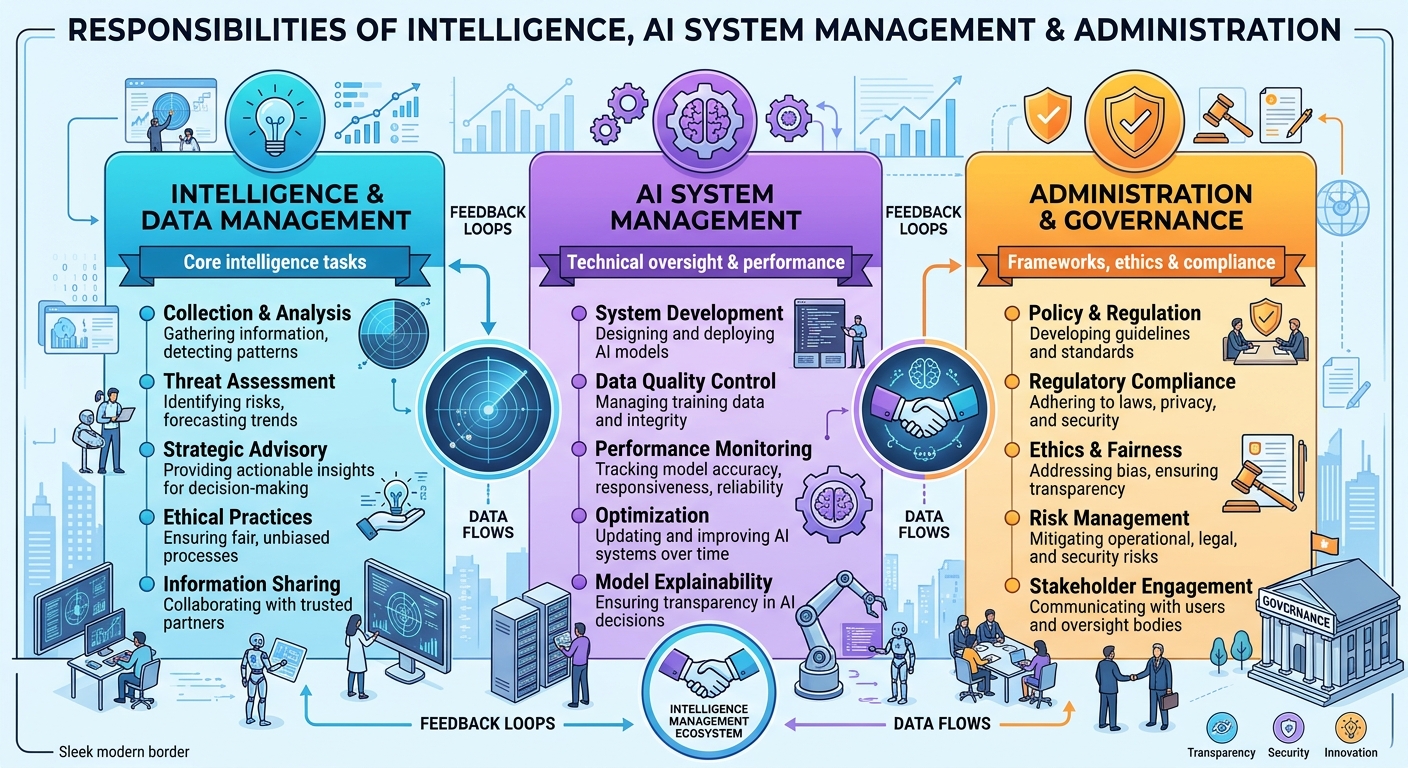
A comprehensive educational thesis on artificial intelligence, intelligent systems, management, administration, governance, operational responsibilities and modern organisational development.
1. Introduction
Artificial intelligence (AI) is becoming an important component of modern economic development, scientific research, industrial production, banking, agriculture, education, healthcare, cybersecurity and public administration. However, an AI system does not become reliable merely because it has an advanced model or powerful computers. It also requires effective management, administration, technical supervision, security, financial control and responsible human decision-making.
AI system management and administration is the organised process of planning, developing, deploying, monitoring, maintaining, securing and improving AI systems so that they achieve their intended objectives safely, accurately, efficiently and economically.
The central question is not simply how to build an intelligent machine. It is also how to manage the entire environment in which that machine operates.
For example, an AI system used by a ginger farmer might analyse soil conditions, weather forecasts, irrigation requirements, crop diseases and expected yields. To make that system useful, administrators must ensure that the data is reliable, the software is working, the predictions are monitored, the costs are controlled and the farmer remains able to make informed decisions.
The same management principles apply to an AI system in a bank, factory, hospital, school, government department or technology company.
The central thesis
Successful AI administration combines five essential capabilities:
- Intelligence: the ability of an AI system to analyse information, identify patterns and generate predictions or recommendations.
- Management: the coordination of people, resources, objectives and performance.
- Administration: the execution of policies, procedures, records, permissions and operational processes.
- Governance: the establishment of accountability, rules, oversight and acceptable uses.
- Engineering and operations: the technical work required to build, deploy, secure, monitor and maintain the system.
These capabilities work together. Intelligence produces potential value; management and administration turn that potential into an organised, controlled and measurable service.
2. Understanding the architecture of AI system management
Organisational objectives
Business needs, public needs, research goals and measurable outcomes
AI governance and administration
Policies · responsibilities · budgets · risk controls · compliance
Data management
Collection, quality, access, privacy and storage
AI model management
Training, testing, evaluation and versioning
Infrastructure
Cloud, servers, chips, networks and software
Security and safety
Threat prevention, testing and incident response
Deployment and continuous monitoring
Measure results, detect failures, improve performance and report outcomes
Human oversight, auditability and feedback should operate across every layer, rather than being added only at the end.
The architecture illustrates that AI management is a complete organisational system. A failure in one layer can undermine the others. A highly capable model, for instance, may produce poor results if its training data is outdated, its infrastructure is unreliable or its users misunderstand its limitations.
3. The meaning of intelligence in an AI system
Intelligence refers to the capacity to process information, learn patterns, solve problems, reason within defined limits and produce useful outputs.
In artificial intelligence, these capabilities are implemented through computational methods rather than necessarily through human-like consciousness or understanding.
An intelligent system may perform one or more of the following tasks:
- Recognise patterns in large datasets.
- Predict future events using historical information.
- Classify images, documents, transactions or other data.
- Understand and generate human language.
- Recommend actions based on objectives and constraints.
- Detect anomalies that might indicate errors, fraud or equipment failure.
- Support planning, optimisation and decision-making.
- Execute approved actions automatically within defined boundaries.
3.1 Intelligence is not the same as administration
| Function | Primary responsibility | Example |
|---|---|---|
| AI intelligence | Analyse and generate outputs | Predict crop disease risk |
| AI management | Coordinate the system and its people | Decide priorities and allocate resources |
| AI administration | Apply procedures and maintain records | Manage access permissions and approvals |
| AI engineering | Build and maintain technical components | Deploy a model and connect it to databases |
| AI governance | Define acceptable behaviour and accountability | Establish rules for sensitive decisions |
| AI auditing | Examine compliance and performance | Verify whether outputs meet required standards |
These functions may be performed by separate teams in a large organisation or combined into a few roles in a small business.
A fundamental principle: an AI system can recommend a decision, but the organisation must establish who is authorised to approve it, who is responsible for the outcome and how mistakes will be corrected.
4. The principal tasks of AI system management and administration
4.1 Strategic planning and objective setting
AI administration begins before software is purchased or developed.
Administrators must identify the problem, determine whether AI is appropriate, estimate costs and benefits, establish priorities and define what success means.
Key responsibilities include:
- Identifying organisational problems that AI could help solve.
- Determining whether ordinary software, statistical analysis or AI is the most suitable solution.
- Defining project scope, objectives and expected outcomes.
- Establishing budgets, schedules and staffing requirements.
- Evaluating technical feasibility and organisational readiness.
- Setting measurable performance targets.
- Determining who owns the project and who approves major changes.
Example: A bank may want to detect suspicious transactions. Management must define the types of fraud to detect, acceptable false-alarm rates, privacy requirements, operating costs and the procedure for investigating flagged transactions.
Without clear objectives, an organisation may invest in impressive technology without producing meaningful results.
4.2 Data management and administration
Data is one of the most important resources in AI. The quality, relevance, legality and representativeness of the data can directly affect system performance.
The administrator must ensure that data is collected, processed, stored and used appropriately.
Main responsibilities include:
- Establishing authorised sources of data.
- Checking accuracy, completeness and consistency.
- Identifying missing, duplicated or outdated information.
- Documenting data origins and permitted uses.
- Managing data access and retention.
- Protecting confidential and personal information.
- Maintaining backups and recovery procedures.
- Monitoring changes in data quality over time.
For example, an agricultural AI system may receive soil measurements from different fields. If the sensors use inconsistent units or have not been calibrated, the system may produce unreliable fertiliser recommendations.
Data administrators must therefore coordinate with domain experts, engineers and AI specialists to make sure that the information entering the system is fit for its purpose.
4.3 AI model management
An AI model is the computational component that has learned patterns from data or has been designed to perform a particular intelligent task.
Managing a model requires much more than installing it once.
The responsibilities include:
- Recording the model’s name, version and intended purpose.
- Documenting the training and evaluation data.
- Testing accuracy and other relevant performance measures.
- Checking for bias, unreliable outputs and known limitations.
- Approving models before production deployment.
- Tracking changes in model versions.
- Monitoring performance after deployment.
- Reverting to a previous version or disabling a model when necessary.
- Retiring models that are no longer appropriate or supportable.
This process is often associated with machine learning operations (MLOps), which applies engineering and operational practices to the development and maintenance of machine-learning systems.
Generative AI introduces additional responsibilities, including evaluating factual reliability, testing prompt-injection risks, monitoring inappropriate outputs and verifying the sources used in important decisions.
4.4 Infrastructure and technical administration
AI systems depend on hardware, software, networks and computing resources.
An administrator may need to coordinate:
- Cloud computing services or on-premises servers.
- CPUs, GPUs and other AI accelerators.
- Storage systems and databases.
- Operating systems and software dependencies.
- Network connectivity and application programming interfaces (APIs).
- Identity and access management.
- System availability and performance monitoring.
- Capacity planning and cost optimisation.
- Software updates and vulnerability remediation.
For large AI deployments, infrastructure management may include monitoring electricity consumption, cooling, compute utilisation and the availability of specialised chips.
The objective is to provide enough computing capacity to meet service requirements without unnecessary cost or unacceptable operational risk.
4.5 Cybersecurity and access administration
AI systems introduce familiar cybersecurity risks as well as risks specific to AI.
Administrators must protect the data, models, software, credentials and interfaces that support the system.
Essential duties include:
- Assigning permissions according to job responsibilities.
- Using strong authentication and, where appropriate, multifactor authentication.
- Protecting API keys, passwords and other secrets.
- Encrypting sensitive information where appropriate.
- Applying security patches and managing vulnerabilities.
- Logging important activities and investigating suspicious events.
- Testing backup and recovery procedures.
- Preventing unauthorised changes to models and datasets.
- Establishing procedures for security incidents.
AI-specific risks may include malicious instructions hidden in documents, attempts to extract confidential information, manipulated training data and unauthorised use of connected tools.
A secure AI system needs controls around both the model and the surrounding applications. Security cannot be achieved by relying on the model alone.
4.6 User and account administration
AI administrators must ensure that the correct people can use the correct functions.
Typical tasks include:
- Creating and disabling user accounts.
- Assigning user roles and permissions.
- Managing subscriptions, licences and usage limits.
- Training staff to use the system correctly.
- Maintaining acceptable-use policies.
- Monitoring resource consumption.
- Responding to user support requests.
- Removing access when a person’s responsibilities change.
For example, an employee who is authorised to analyse sales information should not automatically receive permission to access confidential payroll records.
The principle of least privilege means granting only the access needed for a person’s authorised work.
4.7 Workflow and automation management
Many AI systems do more than generate answers. They can be integrated into workflows involving databases, business applications, approval processes and external services.
Administrators must define:
- Which tasks the AI can perform automatically.
- Which tasks require human approval.
- What information the AI may access.
- What happens when the system is uncertain.
- How failed operations are detected and recovered.
- How duplicate or unintended actions are prevented.
- How every consequential action is recorded.
For example, an AI assistant might prepare a purchase order automatically but require an authorised manager to approve the order before money is committed.
This separation between recommendation and authorisation reduces the risk of uncontrolled automation.
5. The responsibilities of AI management personnel
AI administration is a multidisciplinary activity. The following roles represent common responsibilities rather than mandatory separate job titles.
1. AI programme manager
Sets objectives, coordinates departments, manages schedules and budgets, resolves organisational obstacles and reports progress to leadership.
Accountable for programme delivery and alignment with organisational goals.
2. AI systems administrator
Manages system configuration, accounts, permissions, software environments, operational availability, updates and technical support.
Accountable for assigned operational and administrative controls.
3. AI and machine-learning engineer
Develops, evaluates and deploys models, integrates them with applications, diagnoses technical problems and improves model performance.
4. Data engineer or data steward
Maintains data pipelines, data quality, metadata, access rules, lineage and appropriate data handling.
5. AI security and risk specialist
Assesses threats, reviews security controls, evaluates AI-specific vulnerabilities and coordinates risk mitigation and incident response.
6. AI governance and compliance officer
Coordinates policies, risk classification, regulatory reviews, documentation, accountability and independent oversight where required.
7. AI quality and performance analyst
Measures reliability, errors, user satisfaction, business outcomes, operating costs and changes in system performance.
In a small organisation, one qualified person may fulfil several of these functions. In a bank, hospital or large technology company, some duties should be separated to prevent conflicts of interest and to provide independent checks.
6. Governance: who is responsible when AI makes a mistake?
AI governance is the framework of rules, decision rights, oversight and accountability that determines how AI may be developed and used.
The organisation remains responsible for its decisions and obligations even when it relies on an AI system.
A governance framework should answer five questions:
- Purpose: Why is the AI system being used?
- Authority: Who can approve, modify or disable it?
- Safety: What risks must be controlled before deployment?
- Accountability: Who investigates failures and authorises corrective action?
- Transparency: What must be documented and communicated to affected people?
Example of a responsibility matrix
| Activity | Responsible role | Final accountability |
|---|---|---|
| Approve AI project | Project team and AI manager | Designated executive or project sponsor |
| Validate model | AI specialists and domain experts | Assigned model owner |
| Grant system access | System administrator | Designated system owner |
| Approve sensitive use | Relevant risk, legal and business teams | Authorised decision-maker |
| Respond to security incident | Security and IT teams | Designated incident leader |
| Review performance | AI operations and quality team | Business or service owner |
| Retire a system | Technical and business teams | Authorised system owner |
Responsible means carrying out the work. Accountable means ultimately answerable for the outcome. Both should be assigned explicitly.
7. The complete AI system lifecycle
AI administration must continue throughout the system’s life, from the initial idea to eventual retirement.
- Stage 1 — Identify the problemDocument the need, intended users, expected benefits, alternatives and potential harms.
- Stage 2 — Assess feasibility and riskEvaluate data availability, cost, technical capability, privacy, security and whether AI is suitable.
- Stage 3 — Design the systemSpecify the architecture, data flows, model requirements, access controls, human review and recovery mechanisms.
- Stage 4 — Develop and prepare dataBuild or configure the model, prepare datasets and document their sources and limitations.
- Stage 5 — Test and validateEvaluate accuracy, reliability, robustness, security, fairness where relevant and performance under realistic conditions.
- Stage 6 — Authorise deploymentConfirm that acceptance criteria have been met, risks are addressed and the appropriate people have approved release.
- Stage 7 — Operate and monitorTrack availability, cost, errors, user feedback, security events and changes in data or model behaviour.
- Stage 8 — Improve or retrainMake controlled changes, retest them and maintain records of versions, approvals and results.
- Stage 9 — Retire responsiblyDisable obsolete services, revoke access, retain or delete data according to applicable requirements and preserve necessary audit records.
This lifecycle is iterative. Monitoring may reveal that a model needs to be improved, restricted or replaced. Any significant change should return to appropriate testing and approval before it affects users.
8. Daily, weekly, monthly and annual administrative duties
AI administration requires a structured operational routine. The exact schedule depends on the system’s risk, complexity and service requirements.
Daily responsibilities
- Check service availability and system alerts.
- Review critical failures and unresolved incidents.
- Monitor unusual usage and security notifications.
- Check essential data pipelines and automated workflows.
- Escalate high-risk errors or unexpected AI behaviour.
- Confirm that essential services are functioning.
Weekly responsibilities
- Review performance trends and error reports.
- Investigate recurring technical problems.
- Review support requests and user feedback.
- Check pending software updates and vulnerabilities.
- Review resource consumption and cloud expenditure.
- Verify that important corrective actions have owners and deadlines.
Monthly responsibilities
- Review model performance and data quality.
- Check user access and remove unnecessary permissions.
- Examine operating costs against the budget.
- Review incidents, risks and outstanding audit findings.
- Test selected recovery procedures.
- Report achievements, weaknesses and improvement priorities to management.
Annual or scheduled strategic responsibilities
- Reassess business objectives and system suitability.
- Conduct formal risk and governance reviews.
- Review contracts, licences and supplier performance.
- Reassess training requirements and staffing.
- Test major disaster-recovery arrangements.
- Review whether models should be renewed, upgraded or retired.
High-risk systems may require continuous monitoring, more frequent reviews and immediate escalation of certain events. Low-risk systems may be managed through less intensive schedules.
9. AI performance management: measuring whether the system is working
An AI system should not be judged solely by how impressive its responses appear. Its performance must be measured against the actual purpose for which it was deployed.
9.1 Key performance indicators (KPIs)
| Performance area | Example measurement | Management question |
|---|---|---|
| Accuracy | Task-specific error rate | Does the system produce sufficiently correct results? |
| Reliability | Availability and failure frequency | Does it work consistently? |
| Speed | Response time or processing latency | Does it respond within required limits? |
| Security | Incidents and unresolved vulnerabilities | Is the system adequately protected? |
| Data quality | Missing, invalid or outdated records | Can the system rely on its inputs? |
| Cost | Cost per task or transaction | Is the service economically sustainable? |
| Productivity | Time saved or tasks completed | Does it improve actual work? |
| Human oversight | Review and escalation outcomes | Are important decisions appropriately supervised? |
| User experience | Satisfaction and complaint trends | Can people use the system effectively? |
| Business impact | Revenue, quality or service improvement | Does the system achieve its intended objectives? |
Different systems need different metrics. A language model that assists with drafting documents should not be evaluated in exactly the same way as a fraud-detection model or an agricultural forecasting system.
9.2 A simple mathematical framework for AI performance
An organisation can define an overall performance score using a weighted combination of indicators:
\[ P=\sum_{i=1}^{n} w_i s_i \]
Where:
- \(P\) = overall performance score.
- \(s_i\) = normalised score for performance indicator \(i\).
- \(w_i\) = weight assigned to that indicator.
- \(n\) = number of indicators.
- The weights sum to 1.
For example, an organisation could assign greater importance to reliability and safety than to speed. The weights must reflect the system’s actual purpose and risk.
However, a weighted score must not hide a critical failure. If a system fails a mandatory security or safety requirement, high scores in other areas should not automatically justify deployment.
9.3 Monitoring model drift
A model may perform well when first deployed and deteriorate later.
Two important forms of change are:
- Data drift: the characteristics of incoming data change.
- Concept drift: the relationship between the input information and the outcome being predicted changes.
For instance, a model trained on historical agricultural weather patterns may become less reliable when rainfall patterns shift. Administrators should investigate the change, evaluate the model against newer evidence and determine whether recalibration or retraining is appropriate.
Retraining is not automatically the correct solution. Sometimes the data pipeline, operating conditions or business process must be corrected instead.
10. Risk management and responsible AI administration
A professional AI administration system needs a formal method of identifying, evaluating and reducing risks.
Technical risks
Incorrect outputs, software defects, unreliable integrations, hardware failure and performance degradation.
Controls: testing, monitoring, version management, redundancy and recovery procedures.
Security and privacy risks
Data exposure, account compromise, unauthorised access and misuse of sensitive information.
Controls: least-privilege access, encryption, secure development, logging and incident response.
Ethical and social risks
Discriminatory outcomes, inadequate transparency, inappropriate surveillance and unfair treatment.
Controls: impact assessments, representative testing, meaningful oversight and accessible complaint procedures.
Financial and operational risks
Unexpected computing costs, vendor dependency, business interruption and poor return on investment.
Controls: budgets, usage limits, supplier reviews, contingency plans and financial reporting.
Legal and regulatory risks
Unlawful data processing, inadequate records, contractual breaches or failure to meet applicable sector requirements.
Controls: legal review, documented responsibilities, data protection procedures and periodic compliance assessments.
10.1 Human oversight
Human oversight is particularly important where AI outputs could significantly affect a person’s rights, finances, education, employment, safety or access to essential services.
Appropriate arrangements may include:
- Requiring human approval before consequential actions.
- Giving authorised reviewers enough information to evaluate recommendations.
- Providing a way to challenge or correct decisions.
- Defining when the system must stop and escalate.
- Keeping records that support investigation and accountability.
- Ensuring that reviewers have the competence and authority to intervene.
Human oversight should be meaningful. A person who simply clicks an approval button without understanding the decision or having the authority to reject it does not provide effective supervision.
11. AI administration in the modern economy
AI system management becomes more useful when applied to real economic sectors.

Agriculture and food production
Administrators coordinate soil and weather data, crop-monitoring models, irrigation systems and farm records. They check sensor accuracy and ensure that recommendations are appropriate for local soil, climate and farming conditions.

Banking and financial technology
AI administrators coordinate fraud detection, customer-service assistants, credit-risk tools and transaction monitoring. They establish access controls, review model performance and ensure that financial decisions comply with applicable rules.

Manufacturing and engineering
AI systems can support predictive maintenance, defect detection, production scheduling and quality assurance. Administrators coordinate equipment data, model validation and safe operating procedures.

Healthcare
AI can assist with medical-image analysis, documentation and operational planning. Administrators must pay particular attention to clinical validation, confidentiality, professional oversight and the consequences of errors.

Education and research
Administrators oversee educational assistants, learning analytics and research tools, ensuring that data is handled appropriately, outputs are evaluated and staff and students understand system limitations.
Across all these sectors, the same principle applies: the system must be managed according to the consequences of failure, the sensitivity of its data and the level of autonomy it receives.
12. The legal and professional environment in South Africa
Organisations operating in South Africa should consider the legal and regulatory obligations relevant to their AI systems.
Important areas include:
- Protection of Personal Information Act (POPIA): relevant to the lawful processing, protection and handling of personal information.
- Cybercrimes Act 19 of 2020: relevant to specified cybercrimes and related legal responsibilities.
- Consumer Protection Act 68 of 2008: potentially relevant to consumer-facing AI products and services.
- Employment and sector-specific requirements: may apply where AI is used in recruitment, financial services, healthcare or other regulated activities.
- Contracts, intellectual property and data licensing: relevant to the use of third-party models, datasets, software and generated outputs.
The applicable requirements depend on the organisation, data, intended use and circumstances. AI administrators should work with qualified legal and compliance personnel rather than assume that one general AI policy satisfies every legal obligation.
A practical governance framework should identify which laws apply, who is responsible for compliance, what evidence must be retained and how concerns will be investigated.
13. The essential skills required by an AI system administrator
An effective AI administrator needs a combination of technical, managerial, analytical and communication skills.
Technical skills
Understanding AI models, databases, operating systems, networking, cloud platforms, APIs, cybersecurity and system monitoring.
Data and analytical skills
Interpreting metrics, evaluating data quality, understanding statistical results, identifying anomalies and analysing performance trends.
Management skills
Planning projects, allocating resources, coordinating teams, managing suppliers, controlling budgets and resolving operational problems.
Governance skills
Understanding risk management, documentation, privacy, compliance, accountability and internal controls.
Human and communication skills
Explaining technical issues, training users, challenging unreliable results, documenting decisions and communicating with nontechnical stakeholders.
Recommended learning pathway
A person entering this field can build competence progressively:
- Learn computer fundamentals, operating systems and networking.
- Study databases, data management and basic programming, particularly Python and SQL.
- Understand AI, machine learning, generative AI and their limitations.
- Learn cloud administration, access management and cybersecurity fundamentals.
- Practise monitoring, troubleshooting, backups and software deployment.
- Study project management, risk management and AI governance.
- Build a small AI application and document its complete lifecycle.
- Develop experience with performance reporting, testing and incident management.
The administrator does not necessarily need to be an expert in training large AI models. However, they should understand how the models work at a practical level, what their limitations are and how their surrounding systems are operated safely.
14. A practical 90-day implementation plan
The following framework can help a small business, technology company, NGO, educational institution or public organisation establish a basic AI management function.
Days 1–30: Assessment and planning
Phase 1
Objective: understand the current environment and establish responsibility.
- Identify all AI systems and their owners.
- Document business purposes, users and data sources.
- Assess major risks and legal requirements.
- Assign system owners and administrators.
- Establish baseline performance and cost measures.
- Draft initial AI use, access and incident policies.
Days 31–60: Controls and operations
Phase 2
Objective: establish reliable and secure daily operations.
- Implement user permissions and secure credentials.
- Establish version control and deployment approval.
- Configure logging, monitoring and alerts.
- Document backup and recovery procedures.
- Train users and administrators.
- Establish an incident reporting and escalation process.
Days 61–90: Evaluation and improvement
Phase 3
Objective: verify that the controls work and create a sustainable improvement process.
- Test model performance against defined targets.
- Review access permissions and outstanding vulnerabilities.
- Conduct a recovery exercise.
- Evaluate operating costs and business benefits.
- Document lessons learned and unresolved risks.
- Present an improvement plan to management.
This is a suggested implementation schedule, not a guarantee that every system can be made safe or compliant within 90 days. High-risk or complex systems may require substantially more time.
15. The tools and frameworks that support professional AI administration
Several established frameworks can help organisations organise their responsibilities.
| Framework or practice | Main purpose |
|---|---|
| NIST AI Risk Management Framework | Identify, assess and manage AI-related risks |
| ISO/IEC 42001 | Establish and continually improve an AI management system |
| ISO/IEC 27001 | Establish and improve information security management |
| MLOps | Manage the development, deployment and maintenance of machine-learning systems |
| IT service management | Organise IT services, support, incidents and operational changes |
| Data governance | Establish ownership, quality, access and appropriate use of data |
| Secure software development | Integrate security into the design, development and maintenance of applications |
These frameworks complement one another. An AI management system does not replace cybersecurity, data protection or ordinary IT administration. It brings those disciplines together where they affect AI.
16. Building an AI administration dashboard
A professional dashboard gives management a consolidated view of the system’s condition.
AI Operations Control Dashboard
Illustrative layout — the values below are examples, not live system measurements.
Service availability
99.9%
Illustrative target
Open incidents
4
Example count
Models under monitoring
12
Example inventory
Budget utilisation
68%
Example reporting period
Core dashboard sections
- System health and availability
- Model accuracy and quality trends
- Security alerts and vulnerabilities
- Data quality and pipeline status
- User access and administrative changes
- Cloud usage, energy consumption and costs
- Open incidents and corrective actions
- Governance reviews and pending approvals
The dashboard should draw from actual monitoring, security, financial and model-evaluation systems. Its figures must be traceable to their sources, updated at appropriate intervals and accompanied by clear definitions.
17. The future of AI system management administration
As AI becomes more capable, its administration is likely to become increasingly automated. This will not eliminate the need for accountable human management.
Emerging areas include:
AI agents and automated workflows. Systems will increasingly plan and execute multistep tasks using approved tools. Administrators will need to control permissions, spending limits, action boundaries and escalation procedures.
Automated AI monitoring. Specialised systems can help identify model degradation, unusual behaviour, data-quality problems and operational failures.
AI supply-chain management. Organisations will need to track the models, datasets, software libraries, external services and suppliers on which their systems depend.
Distributed and edge AI. More AI processing will take place on local devices, industrial equipment, vehicles and agricultural sensors. This creates additional challenges in device management, connectivity, security and updates.
Energy and resource management. As AI computing grows, administrators will increasingly need to consider electricity consumption, cooling, hardware utilisation and the environmental cost of computation.
AI auditing and assurance. Organisations will need better evidence that systems meet their stated performance, safety, privacy and governance requirements.
The future administrator will therefore need to understand not only how to operate software, but also how to manage intelligent systems that can take actions, interact with other systems and affect real-world outcomes.
18. Conclusion
AI system management and administration is a multidisciplinary profession concerned with turning artificial intelligence into a reliable, secure, accountable and economically useful organisational capability.
Its responsibilities extend from strategic planning and data management to model evaluation, infrastructure, cybersecurity, user administration, risk management, financial control and continuous improvement.
The most important lesson is that AI intelligence alone does not guarantee organisational success. Success depends on the quality of the surrounding management system: clear objectives, reliable data, competent people, secure technology, measurable performance, appropriate human oversight and defined accountability.
An organisation that builds these foundations can use AI more effectively in agriculture, finance, industry, education, research and public services.
Ultimately, the purpose of AI administration is not merely to keep intelligent software running. It is to ensure that the technology serves legitimate human and organisational objectives while its benefits, costs, risks and responsibilities remain under effective control.
Recommended references for further study
- National Institute of Standards and Technology (NIST) — AI Risk Management Framework (AI RMF).
- International Organization for Standardization (ISO) — ISO/IEC 42001, AI management systems.
- International Organization for Standardization (ISO) — ISO/IEC 27001, information security management.
- OWASP Foundation — guidance on security risks associated with large language models.
- South Africa’s Information Regulator — guidance on POPIA and the protection of personal information.
These resources provide a foundation for developing a more formal AI administration curriculum, operational manual or organisational policy.




Be First to Comment