


11
Introduction
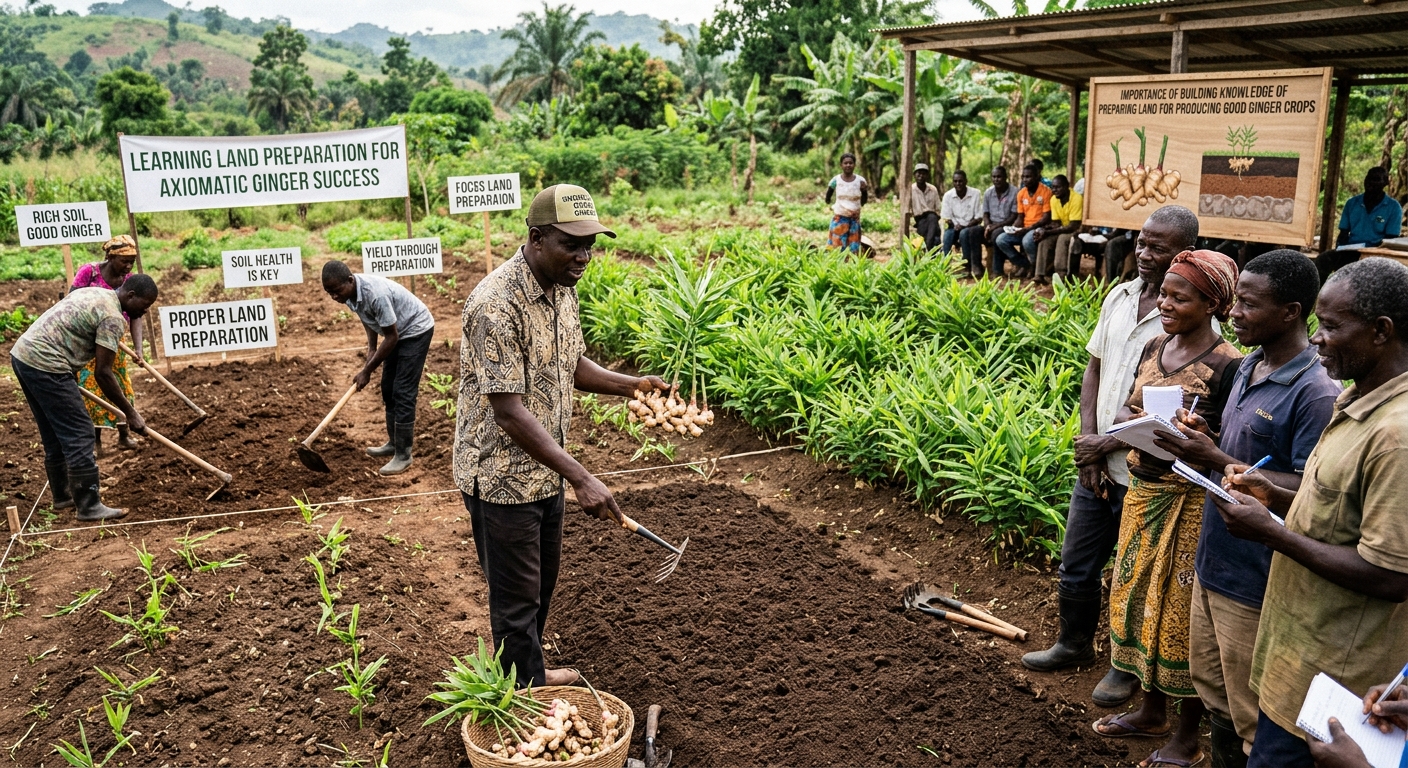
Ginger farming is an important agricultural activity that can contribute to food production, household income, employment, business development and the growth of the agricultural economy. However, producing a healthy and productive ginger crop begins long before planting. It begins with understanding the land.
Knowledge of land preparation is one of the foundations of successful ginger farming. Farmers who understand soil structure, drainage, fertility, soil acidity, organic matter, climate and water management are better equipped to create the conditions ginger needs to develop healthy roots, strong shoots and valuable rhizomes.
Ginger (Zingiber officinale) is a tropical herbaceous plant whose commercially valuable part is its underground rhizome. Unlike crops grown primarily for their fruits or seeds, ginger production depends heavily on the condition of the soil surrounding its developing rhizomes.
Poorly prepared land can contribute to waterlogging, rhizome rot, poor emergence, uneven growth and low yields. Proper preparation, on the other hand, can improve soil conditions, reduce avoidable production risks and help farmers use their land, water, labour and financial resources more efficiently.
The purpose of this article is to explain why developing agricultural knowledge about land preparation matters, how that knowledge can be applied, and how careful preparation can contribute to better ginger production.
Chapter 1: Understanding the relationship between land and ginger production

Land is not simply an empty space where a farmer places planting material. It is a living agricultural environment made up of mineral particles, organic matter, water, air, microorganisms and plant roots.
These components interact continuously. Their combined condition influences whether a ginger crop can establish itself, absorb nutrients, withstand environmental stress and develop healthy rhizomes.
1.1 Soil as the foundation of plant growth
Healthy soil performs several essential functions:
- Physical support: Holds the plant in position and provides space for roots and rhizomes to develop.
- Water storage: Retains enough moisture to support growth between rainfall or irrigation events.
- Air circulation: Supplies oxygen to roots and beneficial soil organisms.
- Nutrient supply: Stores and releases nutrients required for plant development.
- Biological activity: Supports organisms that help decompose organic matter and cycle nutrients.
These functions must work together. Soil that contains nutrients but remains waterlogged may still produce a poor ginger crop. Likewise, soil with excellent drainage but very low fertility may not support vigorous growth.
1.2 Why ginger needs suitable soil conditions
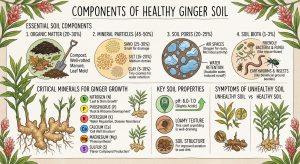
Ginger generally performs best in fertile, loose, well-drained soil rich in organic matter. Sandy loam and loam soils can be suitable when they retain sufficient moisture without becoming saturated.
Ginger rhizomes develop underground. They therefore need enough physical space for expansion, reliable access to moisture and oxygen, and protection from conditions that encourage disease.
The farmer’s objective is not simply to make the soil look neat. It is to create a suitable environment for the entire growing cycle.
Chapter 2: Why building land-preparation knowledge is important
Agricultural knowledge allows farmers to make decisions based on observation, measurement and evidence instead of relying entirely on guesswork.

2.1 Better decisions before planting
A farmer who understands soil conditions can identify unsuitable areas, assess drainage, recognise compaction and decide whether the land needs amendments or improved bed design before planting material is purchased.

2.2 Improved crop establishment
Proper preparation can create a more uniform planting environment, supporting more consistent emergence and early root development.

2.3 More efficient nutrient management
Soil testing helps determine which nutrients are deficient and whether soil acidity needs correction. This can prevent unnecessary fertiliser applications and help avoid nutrient imbalances.
2.4 Reduced production risks
Understanding water movement, field history and soil health helps farmers reduce risks associated with waterlogging, erosion, compaction and soil-borne diseases.
2.5 Improved profitability and resource management
Land preparation requires resources, including labour, equipment, water, soil amendments and time. Knowledge helps farmers determine which activities are necessary and which may be wasteful.
For example, a soil test may reveal that the soil already has adequate phosphorus. Applying additional phosphorus without a demonstrated need may increase production costs without improving yields.
The economic principle is straightforward: invest in the soil conditions that the crop actually needs rather than spending money on practices that have not been justified.
Chapter 3: The scientific principles of preparing land for ginger

3.1 Understanding soil texture
Soil texture describes the proportions of sand, silt and clay in the soil.
| Soil type | Main characteristics | Suitability for ginger |
|---|---|---|
| Sandy soil | Drains quickly and holds relatively little water | May need organic matter to improve moisture retention |
| Sandy loam | Good drainage with moderate moisture retention | Often suitable |
| Loam soil | Balanced water retention, drainage and workability | Often highly suitable |
| Heavy clay | Holds considerable water and may become compacted | Can be challenging without good drainage and soil-structure management |
The best decision depends on the actual soil conditions, not merely its name. A loam soil that becomes saturated after heavy rainfall may still be unsuitable without drainage improvements.
3.2 Understanding soil structure
Soil structure refers to the way individual soil particles form aggregates. A well-structured soil contains pores of different sizes.
- Larger pores help excess water drain and allow air to enter.
- Smaller pores retain water that plants can absorb.
- Spaces between aggregates allow roots and developing rhizomes to expand.
Repeated traffic by heavy machinery, especially when the soil is wet, can compress these pores. This causes compaction, making it more difficult for roots to grow and water to move through the soil.
Practical lesson: Work the soil when its moisture condition is suitable. Avoid unnecessary machinery movements and excessive tillage, which can damage soil structure and increase erosion.
agroinvest.gov.jm+1
3.3 Understanding soil pH
Soil pH measures how acidic or alkaline the soil is. It influences the availability of nutrients and the activity of soil organisms.
Ginger production guides commonly recommend mildly acidic soil. A useful starting target is approximately pH 5.5–6.5, although the precise optimum depends on local soil conditions and production recommendations.
Iccoa+1
A soil test helps determine whether the soil requires correction.
- If the soil is excessively acidic, agricultural lime may be recommended.
- If the pH is already suitable, unnecessary liming should be avoided.
- Fertiliser decisions should consider both pH and measured nutrient levels.
The amount of lime required cannot be determined reliably from pH alone. Soil type, buffering capacity and laboratory recommendations also matter.
3.4 The importance of organic matter
Organic matter comes from decomposed plant residues, compost and other suitable organic materials.
It contributes to:
- Better soil aggregation and workability.
- Improved water retention in soils that dry too quickly.
- Greater biological activity.
- Nutrient storage and gradual nutrient release.
- Improved conditions for root and rhizome development.
However, not every organic material is safe or suitable. Poorly decomposed manure can introduce pathogens, weed seeds or excessive nutrients.
Use mature, well-decomposed compost or manure from a reliable source, and incorporate it according to soil-test results and local recommendations. Organic matter improves soil conditions, but it does not replace the need for appropriate drainage and balanced nutrition.
Texas A&M AgriLife Extension Service+1
Chapter 4: The importance of drainage and water management

Water management is one of the most important parts of ginger land preparation.
Ginger requires adequate moisture, especially during establishment and rhizome development. However, its underground rhizomes are vulnerable to excessive moisture and soil-borne diseases. The objective is to retain sufficient water while allowing surplus water to escape.
4.1 What happens when drainage is poor?
Waterlogged soil contains less oxygen in its pores. Roots become stressed, and conditions may favour organisms responsible for root and rhizome diseases.
Possible consequences include:
- Poor plant establishment.
- Yellowing or wilting.
- Rhizome decay.
- Uneven crop growth.
- Increased losses and reduced marketable yield.
Waterlogged land should not be considered suitable simply because it is fertile.
4.2 How to assess drainage before planting
Farmers should observe the field after rainfall or irrigation.
Look for:
- Puddles that remain for long periods.
- Low-lying sections where water collects.
- Compacted layers that prevent water from moving downward.
- Runoff entering the field from surrounding land.
- Signs of erosion or soil being washed away.
A soil profile inspection and, where necessary, professional drainage assessment can help identify the underlying problem.
4.3 Why raised beds are useful
Raised beds elevate the planting zone above surrounding ground level. Furrows between beds provide pathways for excess water to drain.
Raised beds can also make field operations easier and improve access to the crop.
Some ginger production guides describe beds around 15 cm high and approximately 1 m wide, but these are examples rather than universal dimensions. The appropriate height and width depend on rainfall, soil texture, field slope, irrigation and the machinery used. Wetter or heavier soils may require a different design.
AgriTech+1
On sloping land, beds and drainage channels must be designed to avoid concentrating runoff and washing away topsoil. Follow the land’s contours where appropriate and obtain local advice for steep slopes.
Chapter 5: Step-by-step preparation of land for ginger
The following sequence provides a practical framework for preparing a field before planting.

Step 1: Select suitable land
Choose a warm, well-lit site with suitable soil depth, good drainage and reliable access to irrigation or rainfall. Avoid flood-prone land and investigate the field’s previous crops and disease history.

Step 2: Collect soil samples
Collect representative samples following the soil laboratory’s instructions. Test pH, nutrient status and, where appropriate, organic matter and salinity. Ask whether disease testing is advisable based on the field’s history.

Step 3: Clear weeds and unsuitable residues
Remove troublesome weeds and manage previous crop residues responsibly. Do not move potentially infected soil or plant material into clean fields.

Step 4: Loosen the soil where necessary
Use suitable cultivation methods to break up compaction and create a loose planting zone. Avoid working wet soil or repeatedly tilling it more than necessary.

Step 5: Improve soil fertility
Apply mature compost, suitable manure, lime or fertilisers only as justified by the soil test and production plan. Mix amendments evenly where appropriate.
Step 6: Form planting beds and drainage channels
Create a planting surface that supports rhizome expansion and allows excess water to leave the field safely. Check the design before planting.

Step 7: Complete a pre-planting inspection
Confirm that the soil is suitable for planting, drainage works, weeds are controlled and planting material is healthy and disease-free. Make sure irrigation and mulching plans are ready.
These steps follow the main principles found in ginger production guidance: assess the soil, prepare a suitable planting zone, manage organic matter, prevent water stagnation and use healthy planting material.
agroinvest.gov.jm+1
Chapter 6: Preventing soil-borne diseases through land management
One of the most important lessons in ginger farming is that a productive field must also be a healthy field.
Some disease-causing organisms survive in soil or infected plant material. A field may appear fertile and still carry risks that affect the next ginger crop.
6.1 Crop rotation
Crop rotation means growing different crop species in sequence rather than planting the same crop continuously on the same land.
Rotation can help reduce the build-up of certain pests and pathogens, although its effectiveness depends on the organisms involved and the crops selected.
Ginger is particularly vulnerable to some soil-borne diseases. South African production experience highlights the importance of allowing sufficient time between ginger crops and selecting suitable rotation crops.
Farmer’s Weekly SA
A farmer should:
- Keep records of previous crops and disease outbreaks.
- Choose rotation crops that are not hosts for the relevant pathogens.
- Avoid assuming that any unrelated-looking crop will automatically break a disease cycle.
- Seek local agricultural advice on the appropriate rotation interval.
6.2 Hygiene and contamination control
Machinery, tools, footwear, planting material and irrigation water can move contaminated soil or plant pathogens between fields.
Clean equipment before moving between fields, use healthy planting rhizomes and investigate the safety of water sources. Do not transfer suspect soil or infected ginger residues to clean production areas.
6.3 Soil solarisation
Where suitable conditions exist, soil solarisation uses transparent plastic to heat moist soil through solar energy. It may reduce certain soil-borne pests, weeds and pathogens when properly applied.
Its effectiveness depends on local temperatures, soil moisture, treatment duration and the depth at which organisms survive. It is not a universal solution and should be assessed with local agricultural guidance.
AgriTech
Chapter 7: Understanding soil fertility and nutrient management
Soil fertility is the ability of soil to provide the nutrients necessary for plant growth. Good ginger production requires balanced nutrition throughout the crop’s development.
7.1 The major nutrients
| Nutrient | Main function in ginger production |
|---|---|
| Nitrogen (N) | Supports leaf and shoot development. |
| Phosphorus (P) | Supports energy transfer, root development and early plant establishment. |
| Potassium (K) | Supports water regulation, enzyme activity and general plant development. |
| Calcium (Ca) | Supports cell walls and normal tissue development. |
| Magnesium (Mg) | Forms part of chlorophyll, which is essential for photosynthesis. |
| Sulphur (S) | Supports protein formation and plant metabolism. |
Micronutrients such as boron, zinc, iron and manganese are also important, but the crop needs them in much smaller quantities.
The correct nutrient balance depends on soil test results, the production environment, expected yield and the crop’s growth stage.
7.2 Why fertiliser should be applied scientifically
Applying more fertiliser does not automatically produce more ginger. Excessive or poorly timed applications may waste money, damage plants, contribute to nutrient imbalances or pollute water.
A responsible nutrient-management programme should:
- Test the soil before planting.
- Calculate nutrient requirements using reliable local recommendations.
- Account for nutrients already supplied by compost and manure.
- Monitor crop development during the season.
- Adjust applications according to crop needs and professional advice.
For commercial production, a soil laboratory or agricultural adviser can help turn test results into a practical fertiliser programme.
Chapter 8: Weed control and soil conservation
8.1 Why weeds must be controlled
Weeds compete with ginger for light, water, nutrients and growing space. They may also provide shelter for certain pests.
Clearing weeds before planting helps the ginger establish itself without unnecessary competition.
After planting, weeds should be managed using methods appropriate to the crop’s growth stage. Because ginger rhizomes grow close to the soil surface, deep or careless cultivation can damage them.
8.2 Protecting topsoil
Topsoil contains much of the soil’s organic matter, biological activity and available nutrients. Losing it through erosion can reduce long-term productivity.
Useful soil-conservation practices include:
- Keeping the soil covered with suitable mulch.
- Maintaining drainage channels that do not cause erosion.
- Establishing beds that suit the slope and rainfall.
- Avoiding unnecessary soil disturbance.
- Managing runoff from surrounding land.
Mulching can help conserve moisture, moderate soil temperature and suppress weeds. However, mulch should be managed carefully so that it does not create unsuitable conditions around the crop or introduce diseased plant material.
Texas A&M AgriLife Extension Service+1
Chapter 9: Applying land-preparation knowledge in South Africa

South African farmers need to consider the considerable differences in rainfall, temperature, soil type and water availability between farming regions.
For example, a ginger field in a warmer, wetter area may face different drainage and disease risks from a field in a drier area that depends heavily on irrigation.
The following considerations are particularly important.
1. Understand the local climate. Plan planting around suitable soil temperatures, frost risk, rainfall patterns and the length of the growing season.
2. Test water availability. Determine whether rainfall and irrigation can provide reliable moisture during establishment and rhizome development.
3. Test the soil. Do not assume that land is suitable because neighbouring farmers successfully grow other crops.
4. Plan for disease prevention. Check the field’s history and establish an appropriate crop rotation before investing in planting material.
5. Budget for the whole growing cycle. Include land preparation, soil testing, irrigation, labour, planting material, crop protection, harvesting and marketing.
For a farmer in Limpopo, for example, it would be sensible to evaluate local rainfall, heat, soil characteristics and irrigation capacity before deciding on field size or production methods.
The South African ginger industry has also explored protected and hydroponic production systems. These are alternative approaches worth investigating where conventional soil production presents substantial disease or land-management challenges. They require their own technical and financial assessment.
Farmer’s Weekly SA
Chapter 10: The economic importance of preparing land correctly
Land preparation is an investment in the productive capacity of a farm.
A farmer may spend money on quality planting material, irrigation and fertiliser, but these investments can be undermined by poor drainage, compacted soil or inappropriate nutrient management.
Consider two hypothetical farmers.
Farmer A: Preparation based on guesswork
- Plants without testing the soil.
- Uses fertiliser without knowing the nutrient requirements.
- Plants in a low-lying field without checking drainage.
- Discovers production problems after investing in the crop.
Farmer B: Preparation based on knowledge
- Tests the soil and examines the field’s history.
- Corrects identified soil limitations.
- Plans beds and drainage before planting.
- Budgets for nutrients, irrigation and disease prevention.
Farmer B has a stronger foundation for managing risk. This does not guarantee a successful harvest, because weather, pests, diseases, planting material and market conditions also matter. Nevertheless, informed preparation improves the quality of the decisions made before the growing season begins.
A simple economic principle
A farmer can evaluate land-preparation expenditure using:
\[ \text{Net profit}=\text{Total revenue}-\text{Total production costs} \]
The objective is not to spend as much as possible on preparing the land. It is to spend appropriately on the improvements that generate real agronomic and economic benefits.
Keeping records of soil tests, preparation costs, disease incidence, yields and sales enables farmers to compare seasons and improve their decisions over time.
Chapter 11: A practical pre-planting checklist
The following checklist can be used before planting ginger.
Ginger farm readiness
0/12 completedThe field has been assessed for drainage and flooding risk.The previous crops and soil-borne disease history have been reviewed.Representative soil samples have been submitted for testing.Soil pH and nutrient requirements have been assessed.Compaction and soil depth have been checked.Suitable compost or manure has been sourced, if needed.Weeds and problematic crop residues have been managed.Planting beds and drainage channels have been planned.Irrigation and moisture management have been arranged.Healthy, disease-free ginger planting material is available.The crop rotation and disease-prevention plan is ready.A budget and production record system have been prepared.
Reset checklistCopy checklist
Chapter 12: Conclusion — Knowledge transforms land into productive agricultural capital
The importance of land preparation extends far beyond ploughing, clearing weeds or making planting beds. It involves understanding the physical, chemical and biological properties of soil and using that understanding to build a suitable environment for crop development.
For ginger farmers, the essential principles are clear:
- Select land with suitable soil depth and drainage.
- Test the soil before applying amendments and fertilisers.
- Improve soil structure without unnecessary disturbance.
- Manage organic matter, nutrients and moisture carefully.
- Prevent erosion and reduce the spread of soil-borne diseases.
- Use crop rotation and healthy planting material.
- Record results and improve the production system from season to season.
The central lesson is that successful ginger farming begins with informed decisions about the land. The more accurately a farmer understands the soil and its limitations, the better equipped that farmer is to use resources wisely, protect the productive capacity of the land and work towards a healthy, marketable ginger harvest.
Preparing the land correctly does not guarantee a high yield, but it establishes many of the conditions on which successful production depends.
Further reading and agricultural references
- Texas A&M AgriLife Extension — Ginger: Soil preparation and cultivation guidance.
- University of Florida IFAS Extension — Ginger: Planting and care.
- Tamil Nadu Agricultural University — Ginger production technology.
- National Institute for Horticultural Research — Ginger production guide.
- Department of Agriculture, Trinidad and Tobago — Ginger production technical bulletin.
Recommended next step
Before purchasing planting material, the most useful next step is to develop a ginger land-preparation plan for your specific farm, including soil testing, suitable bed dimensions, drainage, compost requirements, estimated costs and the planting calendar. These details can be adapted to your land size and local conditions so that the plan becomes a practical farming document rather than theory alone.




Be First to Comment