
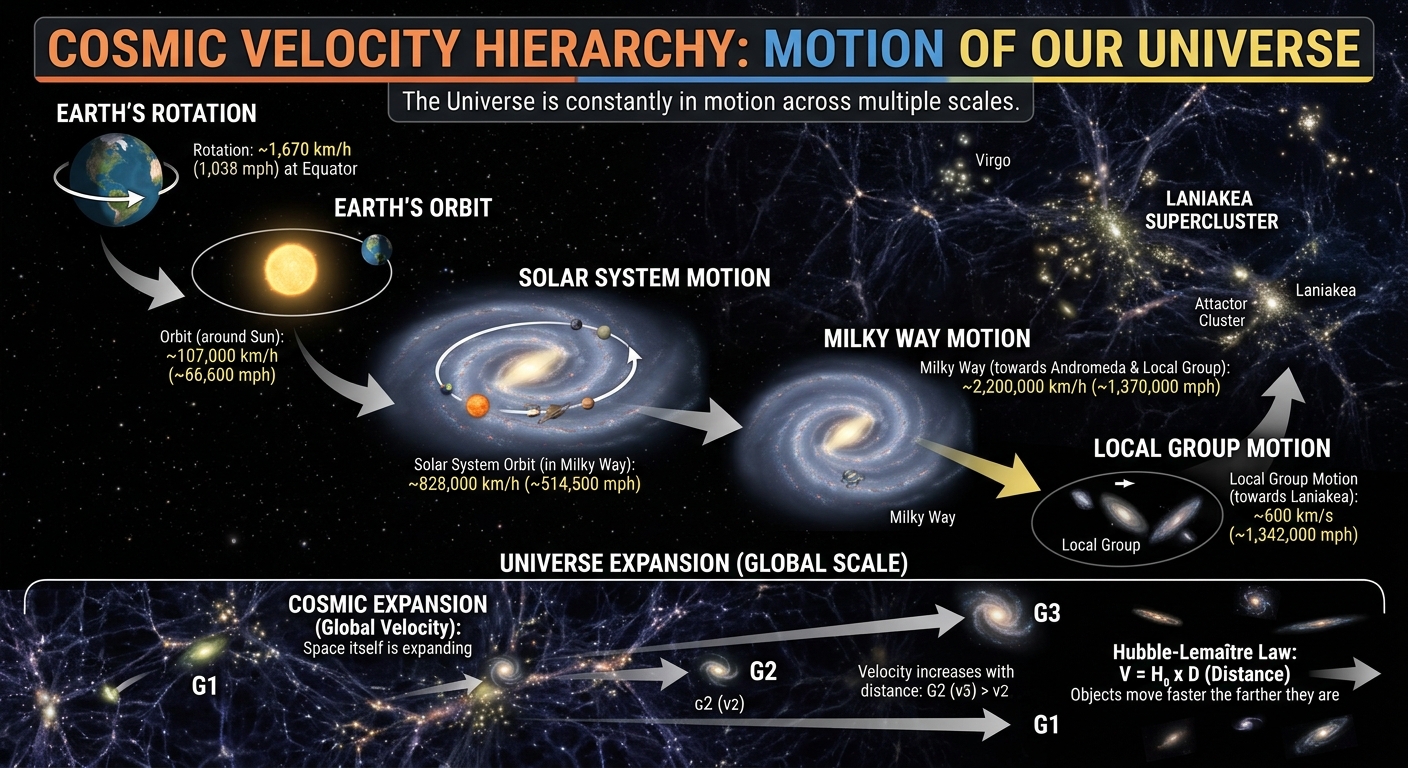
A scientific tutorial on cosmic expansion, the motion of galaxies, Earth’s movement, the speed of light, and the evolution of the universe.


5
Abstract
The universe is not a stationary collection of stars and planets. It is a dynamic physical system in which planets rotate, moons orbit planets, planets orbit stars, stars move within galaxies, galaxies move relative to one another, and the large-scale fabric of space itself expands.
However, one important scientific distinction must be understood from the beginning:
There is no single, universally defined speed of the entire universe. The universe has several kinds of motion, and each must be measured using the appropriate physical reference frame.
For example:
- Earth rotates on its axis at approximately 1,670 kilometres per hour at the equator.
- Earth orbits the Sun at approximately 107,000 kilometres per hour.
- Our Solar System moves around the centre of the Milky Way at roughly 790,000 kilometres per hour.
- The universe’s expansion is described by the Hubble constant, which relates the distance of a sufficiently distant galaxy to its recession speed.
- Light travels through a vacuum at approximately 1.08 billion kilometres per hour.
These figures describe different phenomena. They cannot simply be added together to produce the speed of the universe.
This thesis develops the scientific principles needed to understand these motions, from the movement of Earth to the expansion and possible long-term future of the cosmos.
Chapter 1: What does motion mean in the universe?
In physics, motion means a change in an object’s position relative to a reference frame over time.
The basic equation is:
\[ v=\frac{d}{t} \]
Where:
- \(v\) = average speed
- \(d\) = distance travelled
- \(t\) = elapsed time
If a spacecraft travels 1,000 kilometres in 10 seconds, its average speed is:
\[ v=\frac{1000}{10}=100\text{ km/s} \]
But measuring cosmic motion requires more than measuring distance and time. We must also know what is moving, relative to what, and whether the measured motion results from gravity, local movement through space, or the expansion of space.
The six major categories of cosmic motion

1. Rotation
An object spins around its own axis. Earth rotates once approximately every 23 hours, 56 minutes, relative to distant stars.

2. Orbital motion
An object travels around another object under gravity. Earth completes one orbit around the Sun in approximately one year.

3. Galactic motion
Stars, gas, dust, and dark matter move within galaxies under gravity. Our Sun orbits the Milky Way’s centre.

4. Gravitational motion
Galaxies and galaxy clusters attract one another, producing complicated motions that may oppose cosmic expansion locally.

5. Cosmic expansion
On sufficiently large scales, the distances between galaxies that are not gravitationally bound to one another increase as space expands.

6. Evolution of the universe
The universe changes over time as it expands, cools, forms structures, and evolves through the interaction of matter, radiation, and dark energy.
These categories are connected, but they are not interchangeable. Rotation and orbital motion describe objects moving, while cosmic expansion describes how the large-scale distances represented by the universe’s geometry change.
Chapter 2: The speed of Earth and our cosmic neighbourhood
Our journey begins with Earth. Although we may feel stationary while sitting at home, we are participating in several motions simultaneously.
The cosmic motion ladder
Approximate speeds of selected motions
Earth’s rotation at the equator
1,670 km/h
Earth orbiting the Sun
107,000 km/h
Solar System orbiting the Milky Way
828,000 km/h
Light in a vacuum
1.08 billion km/h
The bars use a common linear scale relative to light speed. The speeds describe different motions and reference frames; they are not a single combined velocity.
NASA gives the Solar System’s orbital speed around the Milky Way as approximately 828,000 km/h, with one orbit taking about 230 million years.
NASA Science
+1
2.1 Earth’s rotation
Earth rotates from west to east. This rotation produces the familiar cycle of day and night.
At the equator, Earth’s surface travels roughly 465 metres per second, equivalent to about 1,670 kilometres per hour.
The rotational speed decreases as you move towards either pole because the circles travelled become smaller. At the geographic poles, the surface does not travel around Earth’s axis in the same way it does at the equator.
2.2 Earth’s orbit around the Sun
Earth’s average orbital speed is approximately:
\[ v_{\text{Earth}}\approx29.8\text{ km/s} \]
To convert this to kilometres per hour:
\[ 29.8\times3,600=107,280\text{ km/h} \]
Earth’s orbit is slightly elliptical, so its speed changes throughout the year. The average is about 107,000 km/h.
NASA Space Science Data Center
+1
Why do we not feel this speed?
Because we, the atmosphere, and most of our surroundings move with Earth. We generally feel changes in motion, such as acceleration, rather than steady motion itself. Earth’s gravity also keeps us on its surface.
2.3 The Solar System’s galactic orbit
The Sun is not fixed in the Milky Way. It and its planets orbit the galaxy’s centre.
- Approximate speed: 230 km/s.
- Equivalent speed: 828,000 km/h.
- Approximate orbital period: 230 million years.
One complete orbit is sometimes called a galactic year. Since the Sun formed about 4.6 billion years ago, it has completed roughly 20 galactic orbits.
NASA Science
+1
These figures reveal something remarkable: our planet is travelling through space continuously, even when everything around us appears still.
Chapter 3: How fast is the universe expanding?

This is the central question of modern cosmology.
The universe is approximately 13.8 billion years old, and observations show that space has been expanding over cosmic history.
NASA Science
+1
However, the expansion of the universe is not the same as an explosion into empty space.
In the standard cosmological model, space itself expands. On large scales, distances between galaxies that are not gravitationally bound to one another increase over time.
3.1 Hubble’s law
Astronomers describe the present-day expansion using the Hubble constant, usually written as \(H_0\).
For relatively nearby galaxies, after accounting for local motions, a useful approximation is:
\[ v=H_0d \]
Where:
- \(v\) = the galaxy’s recession speed associated with expansion
- \(H_0\) = the present-day Hubble constant
- \(d\) = its distance from the observer
A representative value is approximately 70 kilometres per second per megaparsec, although measurements using different methods disagree. A megaparsec is about 3.26 million light-years.
NASA Science
+1
3.2 A practical example
Using \(H_0=70\text{ km/s/Mpc}\), consider these illustrative distances:
| Galaxy distance | Approximate recession speed from expansion |
|---|---|
| 1 megaparsec | 70 km/s |
| 10 megaparsecs | 700 km/s |
| 100 megaparsecs | 7,000 km/s |
| 1,000 megaparsecs | 70,000 km/s |
These are simplified calculations, not measurements of four particular galaxies. At very large distances, cosmological models and the definition of distance matter, so the simple linear approximation must be used with care.
The essential principle is that, on sufficiently large scales, the farther away a galaxy is, the faster its distance from us generally increases because of cosmic expansion.
3.3 Does that mean Earth is the centre of the universe?
No.
An observer in another distant galaxy would also see many sufficiently distant galaxies receding. This is a natural result of expansion throughout space, not evidence that Earth occupies a privileged central position.
An expanding universe can have no special centre within the observable region. The analogy is the surface of an expanding balloon: points on its surface move apart without any point on that surface being the centre of the surface itself. The analogy has limitations because our universe is three-dimensional in space, not simply the two-dimensional surface of a balloon.
Chapter 4: Can the universe expand faster than the speed of light?
Yes. In cosmology, the distance between sufficiently remote galaxies can increase at a rate greater than the speed of light without those galaxies locally travelling through space faster than light.
This distinction is essential to understanding modern physics.
4.1 The speed of light
The speed of light in a vacuum is a fundamental constant:
\[ c=299,792,458\text{ m/s} \]
This is approximately 300,000 kilometres per second, or 1.08 billion kilometres per hour.
According to special relativity, an object with mass cannot be accelerated through its local surroundings to the speed of light. Light itself travels at that speed in a vacuum.
However, general relativity allows the distance between very remote objects to increase because the geometry of space changes. That rate of increasing distance is not subject to the same local speed limit.
NASA Science
+1
4.2 Three different meanings of speed
Local velocity
The speed of an object measured relative to a nearby observer. The local speed of light in a vacuum is the ultimate speed limit for matter and information.
Relative velocity
How quickly one object changes position relative to another. Galaxies can approach one another despite overall cosmic expansion.
Cosmological recession rate
How quickly the large-scale distance between distant objects increases as space expands. This rate can exceed the speed of light.
4.3 Did cosmic expansion ever happen faster than light?
According to the leading cosmological picture, an early period called cosmic inflation involved an extremely rapid expansion of space. During that period, distances could increase faster than light could cross them.
Scientists have strong reasons to study inflation because it helps explain several observed features of the universe, but its exact physical mechanism remains unknown.
NASA Science
+1
The Big Bang should therefore not be pictured simply as an ordinary explosion of matter from a single point into pre-existing empty space.
Chapter 5: How fast is our galaxy moving through the universe?


This question is more complicated than it first appears.
Our Solar System orbits the Milky Way. The Milky Way interacts gravitationally with neighbouring galaxies, and our local galactic environment has motion relative to the large-scale distribution of matter and the cosmic microwave background.
The cosmic microwave background, or CMB, is ancient radiation left over from the early universe. It provides a useful reference for measuring our motion relative to the radiation’s average rest frame.
There is no single universal number for the Milky Way’s speed independent of a reference frame. Different published figures can describe different motions, reference frames and combinations of motions. NASA has described the Sun’s galactic orbital speed as approximately 230–250 km/s in its educational material.
NASA Science
+1
Why the numbers cannot simply be added
Imagine you are sitting inside a moving train:
- You walk towards the front of the train.
- The train moves along the railway.
- The railway is on Earth.
- Earth orbits the Sun.
- The Sun orbits the Milky Way.
All these motions occur simultaneously. Yet their velocities have directions, not just magnitudes.
To calculate a combined velocity, we need to know the direction of each motion and the reference frame in which it was measured. In relativity, the rules for combining velocities also differ from ordinary addition when speeds approach that of light.
Consequently, it is misleading to add Earth’s rotation speed, its orbital speed, the Sun’s galactic speed and a supposed universal speed into one final number without defining the measurements.
Chapter 6: How scientists measure cosmic motion
Astronomers cannot place a speedometer beside a distant galaxy. They infer motion from light, distance measurements and mathematical models.

1. Spectroscopy
Scientists split light into its component wavelengths. Comparing spectral lines with their known wavelengths helps reveal redshift or blueshift.

2. Distance measurement
Astronomers use methods such as parallax, variable stars and supernovae to estimate astronomical distances. These measurements help determine how recession speed relates to distance.

3. Cosmic microwave background
Tiny temperature differences across the sky reveal information about the early universe and help measure our motion relative to the radiation’s average frame.

4. Cosmological modelling
Researchers combine observations with general relativity and models of matter, radiation and dark energy to reconstruct the universe’s expansion history.
One unresolved problem is the Hubble tension. Methods based on relatively nearby astronomical distance measurements tend to produce a higher expansion rate than methods that infer it from the early universe’s cosmic microwave background. The difference is an active subject of scientific investigation.
NASA Science
+1
This is a good example of how science works: measurements are tested, compared and refined rather than simply accepted because they come from a respected instrument.
Chapter 7: What determines the universe’s motion?
The universe’s large-scale evolution is described by general relativity, Einstein’s theory of gravity.
In modern cosmology, several components play important roles.
| Component | Role in cosmic evolution |
|---|---|
| Ordinary matter | Forms stars, planets, gas and living organisms |
| Dark matter | Provides additional gravitational attraction and helps cosmic structures form |
| Radiation | Dominated the energy density in the early universe |
| Dark energy | A name for whatever drives the observed late-time acceleration in the standard cosmological model |
| Gravity and spacetime geometry | Determine how matter, energy and the expansion of space evolve together |
Dark matter and dark energy are not the same thing. Dark matter behaves gravitationally like additional matter, while dark energy is associated with the accelerated expansion observed in the late universe. The precise nature of dark matter is unknown, and the physical explanation of dark energy remains an open research question.
7.1 The expansion equation
A simplified form of the Friedmann equation, which describes cosmic expansion in general relativity, is:
\[ H^2=\left(\frac{\dot a}{a}\right)^2 =\frac{8\pi G}{3}\rho-\frac{kc^2}{a^2} +\frac{\Lambda c^2}{3} \]
Here:
- \(a\) is the cosmic scale factor, which tracks large-scale expansion.
- \(\dot a\) is its rate of change with time.
- \(H\) is the expansion rate at a given time.
- \(G\) is Newton’s gravitational constant.
- \(\rho\) is the mass-equivalent density of matter and radiation.
- \(k\) represents spatial curvature in this form of the equation.
- \(\Lambda\) is the cosmological constant, one possible representation of dark energy.
This equation shows why the universe’s expansion is not adequately described by a single speed. The expansion rate evolves over time according to the contents and geometry of the universe.
The equation is written in a common form of the standard cosmological model; more general models can describe different forms of dark energy or other physical effects.
Chapter 8: The future motion of the universe

What will happen to the universe in the distant future?
Scientists study several possible scenarios, but the long-term outcome depends on the behaviour of dark energy and the laws governing cosmic evolution.

1. Continued expansion
If dark energy behaves approximately like a cosmological constant, the universe is expected to keep expanding. Distant galaxies will become increasingly separated on large scales.

2. Heat death
In a long-term expanding universe, usable energy differences may gradually diminish. Star formation will eventually decline, and the universe may become increasingly cold and dilute.

3. Possible contraction
Some theoretical models permit expansion to reverse into contraction. Current evidence does not establish that this will happen.
4. More extreme accelerated expansion
If dark energy changes with time in certain ways, expansion could become more extreme. Such outcomes are model-dependent and are not established predictions.
NASA’s account of cosmic history describes an early period of expansion that slowed under gravity, followed by accelerated expansion becoming dominant roughly five billion years ago.
NASA Science
+1
These possibilities are scientific scenarios, not equally likely predictions. The standard model with a cosmological constant currently provides a successful description of many observations, while the nature of dark energy remains under investigation.
Chapter 9: Practical calculations for understanding cosmic speed
You can use the following calculator to explore how distance and time determine average speed.
Average speed calculator
Enter distance in kilometres and elapsed time in seconds.Distance (km)Time (seconds)
Calculated average speed
27.7778 km/s
100,000 km/h
This calculator computes ordinary average speed. It does not calculate the universe’s expansion rate.
Reset example
For example, if a hypothetical spacecraft travels 100,000 km in 3,600 seconds, its average speed is approximately 27.78 km/s, or 100,000 km/h.
Cosmic expansion requires a different calculation because the distance between distant galaxies changes with the expansion of space.
Chapter 10: Common misconceptions about the speed of the universe
| Misconception | Scientific explanation |
|---|---|
| The universe has one total speed. | There is no unique total speed without defining a reference frame and a particular physical quantity. |
| Earth is stationary. | Earth rotates, orbits the Sun and participates in galactic motion. |
| The Big Bang was an explosion into empty space. | The standard model describes the expansion of space from an early hot, dense state. |
| Nothing can ever recede faster than light. | Cosmic distances can increase faster than light crosses them, even though local motion and information transfer obey relativity. |
| All galaxies are moving away from one another. | Nearby galaxies can approach because of gravitational attraction and local motion. |
| The Hubble constant tells us one universal speed. | It is an expansion rate per unit distance, not a speed assigned to the entire universe. |
Chapter 11: Key scientific findings
The most important results can be summarised as follows.
Motion is relative
Speed must be defined with respect to a reference frame.
Earth participates in multiple motions
Rotation, solar orbit and galactic orbit are distinct motions occurring simultaneously.
Space expands on large scales
The Hubble constant describes the present relationship between distance and cosmic recession in the nearby-universe approximation.
The speed of light remains fundamental
Cosmic expansion does not violate the local speed limit established by relativity.
Important questions remain unanswered
The nature of dark matter, dark energy, the earliest moments of cosmic history and the Hubble tension remain subjects of research.
Conclusion
The universe is a continuously evolving physical system. At the smallest astronomical scale considered here, Earth rotates. At a larger scale, Earth orbits the Sun. The Sun orbits the Milky Way, and galaxies participate in local gravitational motions while the universe expands on sufficiently large scales.
The most important distinction is between the speed of an object moving through space and the rate at which space itself expands. These are different physical quantities and must be measured differently.
We can measure many aspects of cosmic motion with remarkable precision, but we cannot assign one definitive speed to the entire universe. Instead, we use observations, mathematical models and reference frames to understand how the cosmos changes over time.
Recommended scientific references
- NASA, Hubble Constant and Tension. Read the scientific explanation.
- NASA, Hubble and the Big Bang. Explore the history of the universe.
- NASA, Solar System Facts. Explore Solar System measurements.
- National Institute of Standards and Technology, How Fast Is the Universe Expanding?. Read about measuring cosmic expansion.






Be First to Comment