
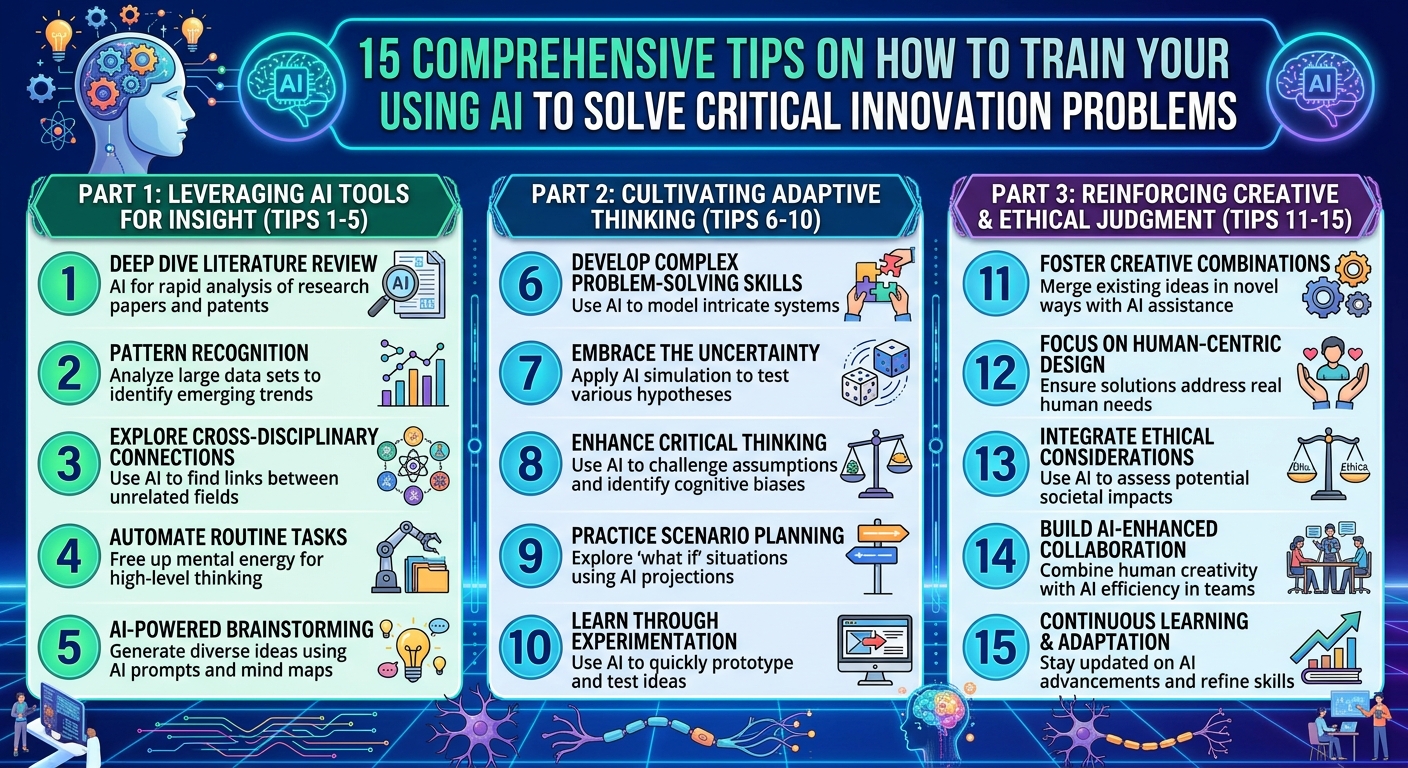
Introduction: Building a Human–AI Innovation System
Artificial intelligence (AI) is more than a tool for answering questions. When used correctly, it can become a powerful learning partner that helps you develop analytical reasoning, creativity, scientific thinking, business intelligence, and practical problem-solving skills.
The real objective is not to make your brain dependent on AI. It is to train yourself to think more clearly, ask better questions, recognise patterns, test ideas, and turn knowledge into useful solutions.
The central principle is simple: let your brain attempt the problem, let AI challenge your thinking, and then use evidence to determine whether the solution works.
This approach is relevant to entrepreneurship, information technology, science, mathematics, agriculture, accounting, engineering, financial systems, and modern economic development.

Concept: human reasoning, AI assistance, evidence and experimentation working together.
1. Understanding the science of training your brain
Your brain learns through experience-dependent neuroplasticity: the nervous system changes its connections and activity patterns as you practise, learn, receive feedback, and develop skills.
AI can support this process by helping you:
- Learn concepts at the right level of difficulty.
- Practise reasoning instead of merely memorising information.
- Receive feedback on your explanations and proposed solutions.
- Explore alternative perspectives.
- Identify gaps in your knowledge.
- Apply knowledge to new and unfamiliar problems.
However, using AI frequently does not automatically improve intelligence. Improvement depends on the quality of your practice, the effort you invest, the feedback you receive, and whether you can perform the skill independently afterward.
A useful learning cycle is:
1. Think independently
Define the problem and propose an initial solution.
2. Collaborate with AI
Explore explanations, alternatives and counterarguments.
3. Test the reasoning
Check facts, calculations, assumptions and evidence.
4. Apply the solution
Build, simulate, experiment or solve a real problem.
5. Reflect and improve
Explain what you learned and solve a similar problem without AI.
This five-stage cycle is the foundation for the following 15 comprehensive tips.
Part I: The 15 comprehensive tips
Tip 1. Train yourself to ask powerful questions

Skill to develop: intellectual curiosity and problem definition
Innovative thinkers do not simply ask for answers. They investigate why a problem exists, what causes it, what is unknown, and what could be changed.
AI can help you transform a vague question into a structured research problem.
For example, instead of asking, “How can AI improve agriculture?”, ask:
- Why do small farms lose productivity?
- Which constraints matter most: water, soil, electricity, labour, or market access?
- Which of these problems can technology realistically solve?
- What evidence would demonstrate an improvement?
- What low-cost experiment could test the proposed solution?
Practical exercise: Every day, take one ordinary problem and generate five deeper questions about it before asking AI for an answer.
AI prompt to practise:
Act as my critical-thinking tutor. Give me one complex real-world problem. Do not immediately solve it. Help me identify the central question, the unknowns, the assumptions and the evidence I need. Ask me to propose my own solution first. Copy prompt
Tip 2. Strengthen logical reasoning
Skill to develop: distinguishing facts, assumptions and conclusions.
Logic enables you to determine whether a conclusion follows from the information available. It helps you avoid being persuaded by confident language, attractive ideas, or misleading statistics.
Train yourself to separate four things:
- Fact: What can be verified?
- Assumption: What are we accepting without proof?
- Inference: What conclusion follows from the evidence?
- Unknown: What still needs investigation?
Consider this business argument:
- Fact: A shop receives 100 customers daily.
- Assumption: All customers would buy a new product.
- Conclusion: The shop will make 100 sales daily.
The conclusion does not follow because customer visits do not guarantee purchases.
AI can generate examples of weak arguments, logical fallacies, and alternative explanations for you to analyse.
Daily exercise: Ask AI to present three arguments. Identify the premises, conclusion, assumptions and any logical errors before requesting its evaluation.
Tip 3. Train your brain to think scientifically
Skill to develop: hypothesis formation, experimentation and evidence-based decisions.
Scientific thinking replaces unsupported certainty with testable explanations.
Suppose you want to investigate whether a digital learning application improves mathematics performance.
- Observation: Learners struggle with certain mathematical concepts.
- Hypothesis: Short, interactive practice sessions improve their understanding.
- Experiment: Compare learning progress using an appropriate study design.
- Measurement: Assess understanding before and after practice.
- Conclusion: Determine what the evidence supports, including limitations.
AI can help you formulate hypotheses, identify variables, design questionnaires and interpret data. It cannot substitute for reliable data or a properly conducted experiment.
Daily exercise: Select one claim you encounter and ask: “What evidence would prove or disprove this claim?”
Tip 4. Develop systems thinking

Skill to develop: understanding relationships between interconnected parts.
Major problems rarely exist in isolation. Transport affects employment; electricity affects production; education affects skills; and skills affect economic productivity.
Systems thinking trains you to investigate how these relationships influence one another.
For example, a community’s unemployment problem might involve several connected factors:
- Limited access to transport.
- Inadequate technical training.
- Weak internet connectivity.
- Low business investment.
- Limited access to markets.
Providing training alone may not solve the problem if learners cannot access jobs or start viable businesses.
AI exercise: Ask AI to map a problem into its components, stakeholders, dependencies, feedback loops, root causes and possible unintended consequences.
Your objective is to stop treating complex challenges as isolated events and begin understanding the entire system.
Tip 5. Practise root-cause analysis
Skill to develop: identifying underlying causes instead of treating symptoms.
A common mistake is to address the visible problem without investigating why it happens.
Imagine a small business repeatedly running out of stock.
You might initially assume that it needs more inventory. However, the underlying cause could be inaccurate sales records, unreliable suppliers, poor demand forecasting or delayed payments.
Use the following procedure:
- Define the problem precisely.
- Collect evidence about when and where it occurs.
- Ask why it happens, repeatedly where appropriate.
- Separate direct causes from contributing conditions.
- Verify the most plausible causes.
- Design interventions that address those causes.
AI can help you construct a fishbone diagram, conduct a structured “Five Whys” investigation, and compare competing explanations.
Important: Repeatedly asking “why?” does not automatically reveal the true cause. Each proposed cause must be checked against evidence.
Tip 6. Expand your creative thinking

Skill to develop: generating multiple original possibilities.
Creativity improves when you explore different combinations of existing knowledge, challenge conventional approaches and consider unfamiliar perspectives.
AI can help you explore possibilities, but you should contribute your own observations and judge which ideas are useful and original.
Try four creative techniques:
- Analogy: How would another industry solve this problem?
- Combination: Can two existing technologies work together?
- Constraint reversal: What if the usual limitation disappeared? What if resources became even scarcer?
- Perspective switching: How would a scientist, engineer, customer or small-business owner approach the same challenge?
For example, a farmer with limited irrigation could investigate soil-moisture sensors, rainwater collection, crop selection and improved scheduling rather than assuming expensive equipment is the only answer.
Daily exercise: Generate ten possible solutions before evaluating them. Aim for diversity rather than ten minor variations of the same idea.
Tip 7. Master first-principles thinking
Skill to develop: rebuilding a problem from fundamental truths.
First-principles thinking means breaking a complicated issue into its basic components instead of accepting conventional assumptions.
Suppose you want to make digital education more affordable.
Instead of immediately asking which commercial platform to purchase, investigate:
- What must learners actually learn?
- What devices do they already have?
- Which activities require internet access?
- Which resources can be provided offline?
- Which costs are essential and which are optional?
You may discover that a simpler offline-first learning system can deliver much of the desired value at lower cost.
AI exercise: Ask AI to list the assumptions behind a proposed solution, distinguish physical or technical constraints from habits and conventions, and reconstruct the solution from the essential requirements.
First principles do not mean ignoring existing expertise. They mean understanding why a practice works before deciding whether to retain or replace it.
Tip 8. Use AI to strengthen mathematical and computational reasoning
Skill to develop: quantitative analysis, modelling and algorithmic thinking.
Mathematics provides a language for expressing relationships, estimating outcomes and testing competing decisions.
Start with these core areas:
- Arithmetic, percentages and ratios.
- Algebra and equations.
- Probability and statistics.
- Functions and graphs.
- Optimisation and constraints.
- Algorithms and computational logic.
Imagine that a small farm must allocate 100 units of water among several crops. Each crop has different water requirements and expected yields.
You can use mathematical models to investigate how water allocation affects expected production, subject to crop needs and available resources.
AI can explain equations, create practice problems, generate code and check calculations. However, verify important outputs independently, particularly when assumptions or units could change the answer.
Daily exercise: Solve a problem yourself first. Then ask AI for a second method and compare the assumptions, calculations and results.
Tip 9. Learn to challenge AI answers
Skill to develop: critical evaluation and intellectual independence.
AI can produce convincing explanations that contain errors, unsupported assumptions, incomplete reasoning or outdated information. Treat its output as a proposal to evaluate, not as automatic proof.
Use this verification checklist:
- Is the claim supported by credible evidence?
- Are the calculations correct?
- Are the sources genuine and relevant?
- Does the conclusion follow from the evidence?
- Are important alternatives missing?
- What would change the conclusion?
Ask AI to act as a critical reviewer:
“Challenge your proposed solution. Identify the three strongest objections, the weakest assumptions, the evidence still missing and the conditions under which your recommendation would fail.”
Then independently check important factual claims against reliable sources or actual measurements.
The goal: Develop the confidence to disagree with AI when the evidence supports a different conclusion.
Tip 10. Train yourself to think in probabilities and uncertainty
Skill to develop: making decisions without pretending to know everything.
Real-world innovation often involves incomplete information. You may not know whether a new product will succeed, whether a technology will reduce costs, or whether a proposed intervention will produce the expected benefit.
Instead of asking only, “Will this work?”, ask:
- How likely is success under the stated assumptions?
- What evidence supports that assessment?
- What are the best and worst plausible outcomes?
- What information would change the decision?
- How costly would failure be?
For a business idea, construct optimistic, central and pessimistic scenarios. Estimate revenues, expenses and risks under each scenario.
AI can help you build the scenarios, but it should not invent precise probabilities when the necessary data is unavailable.
Daily exercise: Make one prediction, record your reasoning and revisit it later. Over time, assess whether your estimates are becoming better calibrated.
Tip 11. Develop interdisciplinary thinking
Skill to develop: connecting knowledge from different fields.
Many significant innovations emerge when ideas from one discipline are applied to another.

Mathematics and statistics
Measure performance, uncertainty, patterns and optimisation.

Computer science and AI
Automate processes, analyse information and simulate alternatives.

Economics and accounting
Understand costs, incentives, cash flow and resource allocation.

Natural and engineering sciences
Understand physical constraints, materials, energy and biological processes.
Consider an agricultural technology project. Computer science might provide a monitoring application, mathematics could analyse water usage, engineering could support sensor design, and accounting could determine whether the system is economically viable.
Daily exercise: Choose one problem and examine it through three different disciplines. Ask AI to explain what each discipline contributes and where their assumptions differ.
Tip 12. Use design thinking to convert problems into solutions
Skill to develop: understanding people, prototyping and iterative improvement.
An elegant technical solution is not necessarily a useful innovation. It must solve a problem that matters to the people who will use it.
Follow this process:
- Empathise: Understand the needs and difficulties of the people affected.
- Define: State the specific problem to solve.
- Ideate: Generate alternative solutions.
- Prototype: Build a simple, low-cost representation.
- Test: Observe how real users respond.
- Improve: Use the results to revise the design.
Suppose you want to create an educational AI application for young people. Before building a complex platform, test whether a small group understands the lessons, can use the interface and benefits from the feedback.
AI can help you develop interview questions, mock-ups, lesson structures, test cases and evaluation criteria.
Daily exercise: Take one idea and define the smallest experiment that could establish whether it is worth developing further.
Tip 13. Develop strategic thinking and decision-making
Skill to develop: choosing actions that produce the greatest value under real constraints.
Strategic thinking means looking beyond the immediate answer to consider consequences, resources, timing and future options.
When evaluating a proposed project, consider:
- Expected benefits.
- Initial and recurring costs.
- Skills and infrastructure required.
- Dependencies and implementation risks.
- Short-term and long-term outcomes.
- Reversibility of the decision.
- Effects on other people and systems.
For example, a business deciding whether to develop its own AI software should compare building a custom system, adapting an open-source model and purchasing an existing service.
AI can prepare a decision matrix and scenario analysis. You must still validate the estimates, licensing terms, security requirements and practical constraints.
Daily exercise: Take one decision and compare at least three options against clearly defined criteria before choosing a preferred option.
Tip 14. Strengthen your ability to concentrate, learn and remember
Skill to develop: sustained attention, retrieval practice and durable understanding.
Innovation requires more than generating ideas. You must also retain knowledge and combine it with what you already know.
Use these learning methods:
- Active recall: Close your notes and explain what you remember.
- Spaced repetition: Revisit important concepts at increasing intervals.
- Interleaving: Practise different but related types of problems.
- Self-explanation: Explain why a solution works, not just what the answer is.
- Transfer practice: Apply the same principle to a different situation.
- Focused study: Work on one demanding task at a time and take breaks when attention declines.
AI can act as a tutor by asking questions, giving hints and generating progressively harder exercises.
For example, after studying neural networks, ask AI to test whether you can explain how a model learns, how it uses data and why it can make incorrect predictions.
If you notice your attention fading, begin with a manageable study interval, such as 10–15 minutes, followed by a short break. Adjust gradually according to your needs rather than forcing prolonged concentration.
Daily exercise: At the end of each session, explain the main concept in your own words without looking at AI’s answer. This reveals whether you have learned it or merely recognised a convincing explanation.
Tip 15. Build a personal AI innovation laboratory
Skill to develop: integrating reasoning, knowledge, experimentation and execution into a repeatable system.
The most important step is to bring the previous 14 skills together to solve meaningful problems.
Your personal innovation laboratory can be a notebook, spreadsheet, folder of research, programming environment or a combination of these tools.
For every project, maintain a record containing:
| Component | What to record |
|---|---|
| Problem | What needs to change and for whom? |
| Evidence | What do you know, and how do you know it? |
| Hypothesis | What do you believe will work? |
| Alternatives | What other solutions are possible? |
| AI contribution | What ideas, analyses or tools did AI provide? |
| Human judgement | What did you accept, reject or modify, and why? |
| Experiment | What test will establish whether the solution works? |
| Results | What happened when you tested it? |
| Lessons | What would you do differently next time? |
Start with a small project. Examples include building a basic expense-analysis tool, designing a water-use monitoring plan, creating a learning application prototype, or investigating a business inventory problem.
Your objective is to create a portfolio of demonstrated problem-solving ability, not merely a collection of AI-generated answers.
Part II: Your daily brain-training programme with AI
You do not need to practise all 15 skills every day. A sustainable routine that combines independent thinking, focused learning and practical application is more useful than trying to master everything at once.
Here is a 30-minute programme you can adjust to your schedule.
Your 30-minute innovation workout
Use one problem per session and record what you learn.
5 min
Independent thinking
Define a problem and write down your own explanation.
7 min
AI-guided investigation
Explore causes, assumptions and alternative explanations.
7 min
Critical challenge
Find weaknesses, verify facts and compare possible solutions.
7 min
Practical application
Solve an exercise, construct a model or design a small experiment.
4 min
Memory and reflection
Summarise what you learned without looking at AI’s answer.
Part III: Your master AI prompt for critical innovation thinking
Save this prompt and reuse it whenever you want to train your reasoning skills.
My Personal AI Critical Innovation Coach
Act as my AI tutor, scientific reasoning coach, innovation mentor and critical-thinking partner.
My objective is to strengthen my ability to solve complex problems independently and develop practical innovations.
For each learning session:
- Present one meaningful real-world problem.
- Help me define the problem precisely.
- Ask me to explain my initial understanding before providing a complete solution.
- Identify the knowledge, mathematics, science or technical skills I need.
- Help me investigate root causes, assumptions and interconnected systems.
- Encourage me to generate at least five possible solutions.
- Challenge my ideas with counterarguments and alternative explanations.
- Distinguish verified facts, uncertain claims and assumptions.
- Help me compare solutions by effectiveness, cost, feasibility, risks and social impact.
- Guide me in designing a small experiment or prototype.
- Evaluate my reasoning constructively and explain how I can improve it.
- Finish with a related problem that I must attempt without AI.
Do not simply provide answers for me to memorise. Use questions, hints, examples and progressively harder exercises to help me develop independent reasoning.
Adapt the difficulty to my demonstrated understanding. Explain technical concepts clearly, but introduce advanced mathematics, science, computer science and economic models when appropriate.
My ultimate goal is to turn knowledge into verified solutions, useful inventions, sustainable businesses and measurable improvements in society.
Part IV: How to measure your progress
Do not measure your development only by how many questions you ask AI or how many answers you receive. Measure what you can actually do.
Use this weekly self-assessment:
Rate each skill from 1 (needs substantial practice) to 5 (consistently demonstrated). Assess yourself using real examples.
Problem definition
Can I identify the real problem and its constraints?
—
12345
Logical reasoning
Can I distinguish evidence, assumptions and conclusions?
—
12345
Creativity
Can I generate several meaningfully different solutions?
—
12345
Verification
Can I check whether AI’s claims and calculations are reliable?
—
12345
Practical application
Can I test an idea and learn from the results?
—
12345
Independent learning
Can I explain and apply the concept without AI?
—
12345
Rate all six skills to see your self-assessment summary.Reset assessment
This is a reflection tool, not a validated intelligence test. Repeat it weekly and compare your ratings with evidence from actual work.
Part V: The most important principles to remember
- Think before prompting. Make your own attempt before asking AI to solve the problem.
- Understand before memorising. Learn why a solution works.
- Question before accepting. Treat AI outputs as claims that may need verification.
- Connect different disciplines. Combine science, mathematics, computing, economics and practical experience.
- Experiment before investing heavily. Test ideas on a small scale before committing substantial resources.
- Reflect after every attempt. Mistakes become useful when you understand their causes.
- Protect your independence. Regularly solve problems without AI assistance.
Final conclusion
Training your brain with AI is a long-term process of developing better questions, stronger reasoning, wider knowledge and more disciplined experimentation.
The most valuable outcome is not simply learning to use artificial intelligence. It is learning to become a person who can identify important problems, understand their underlying structure, develop original solutions and establish through evidence whether those solutions work.
Let AI expand your thinking, but let your own understanding, judgement and evidence guide your decisions.
To help turn this thesis into a more personalised training programme, I can tailor the exercises to your current priorities and available study time.
Personalise your AI brain-training programme around the skills you most want to develop.



Be First to Comment