
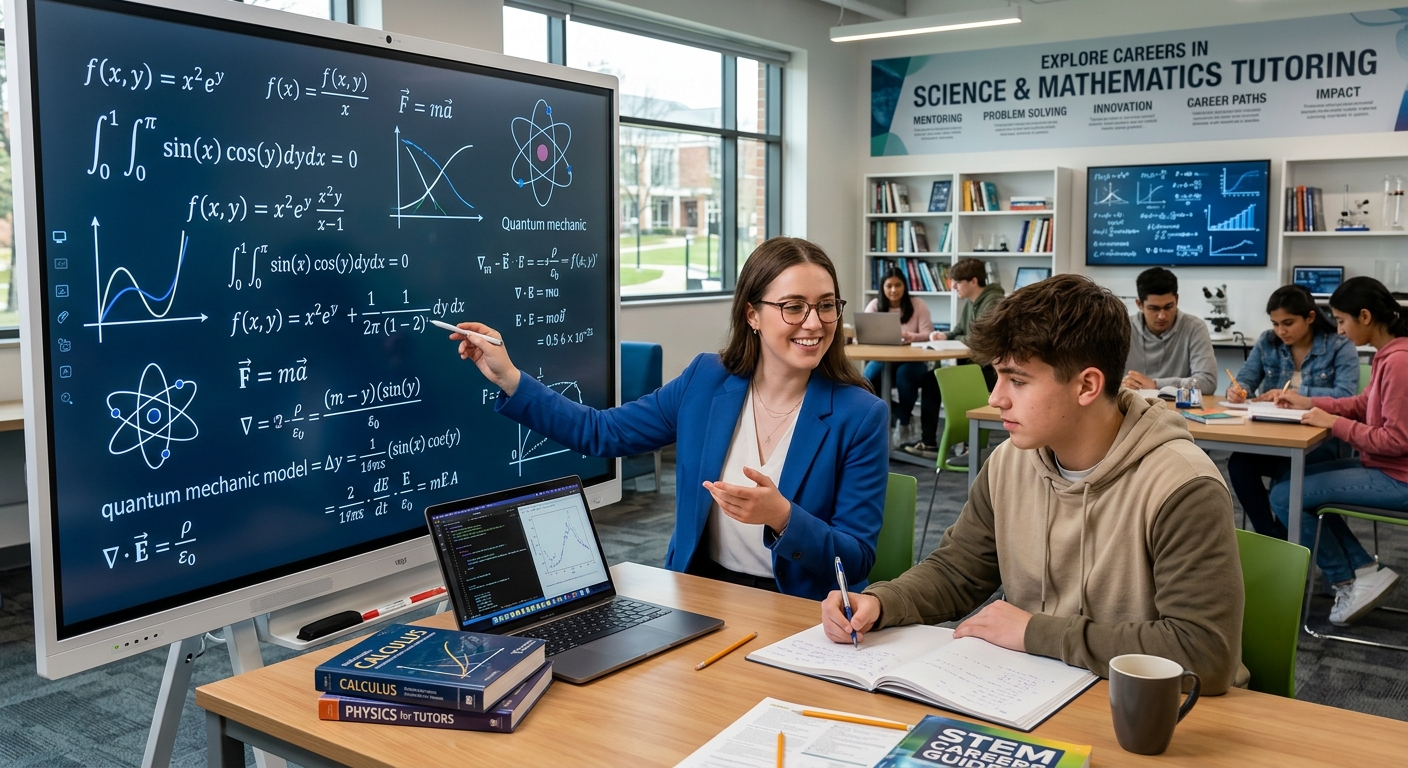
The Foundations of Knowledge, Innovation, and Human Progress
Abstract
Science and mathematics are among the most important foundations of modern civilisation. Science helps humanity understand the natural world, while mathematics provides the language, structures, and methods used to describe, measure, predict, and solve problems. Together, they support medicine, agriculture, engineering, telecommunications, computing, economics, environmental management, and countless other fields.
This thesis examines the historical development of science and mathematics, their relationship, their role in education and technological progress, and the careers that emerge from them. It also provides a practical tutorial framework for learners, beginning with foundational knowledge and progressing toward advanced study and professional application.
The central argument is that science and mathematics are not merely school subjects. They are systems of thinking, discovery, measurement, and problem-solving that enable individuals and societies to understand reality and develop useful solutions.
Keywords: Science, mathematics, education, scientific method, mathematical reasoning, technology, careers, innovation, research, development.
Chapter 1: Introduction
1.1 The meaning of science
Science is the systematic study of the natural and physical world through observation, measurement, experimentation, reasoning, and evidence.
The word science is associated with knowledge, but modern science involves more than simply knowing facts. It involves asking questions such as:
- What is happening?
- Why is it happening?
- How can we measure it?
- Can we test an explanation?
- What evidence supports the conclusion?
- Can another person repeat the investigation?
For example, observing that plants grow toward light is an observation. Investigating whether different amounts of light affect plant growth is a scientific investigation.
Science therefore develops knowledge through a process of question → observation → hypothesis → experiment → evidence → conclusion.
1.2 The meaning of mathematics
Mathematics is the study of numbers, quantities, structures, patterns, relationships, space, change, and logical reasoning.
It includes:
- Arithmetic
- Algebra
- Geometry
- Trigonometry
- Calculus
- Statistics
- Probability
- Number theory
- Discrete mathematics
- Mathematical logic
Mathematics is not only about calculating answers. It also teaches people how to recognise patterns, construct arguments, analyse relationships, and solve problems.
For example, the equation
describes the area of a circle. This relationship can be used in engineering, construction, agriculture, astronomy, and many other fields.
1.3 The relationship between science and mathematics
Science investigates the world, while mathematics helps describe and analyse what is discovered.
For example:
| Scientific question | Mathematical contribution |
|---|---|
| How fast is an object moving? | Speed and velocity equations |
| How much rainfall has occurred? | Measurement and statistical analysis |
| How does a disease spread? | Mathematical modelling |
| How much electricity is being used? | Power and energy calculations |
| How does a population change? | Growth models |
| How accurately can a measurement be made? | Uncertainty and error analysis |
Mathematics can be described as the language of scientific relationships.
However, mathematics also exists independently of science. Pure mathematics investigates abstract structures that may later become useful in physics, computing, engineering, or other disciplines.
Chapter 2: Historical Development of Science and Mathematics
2.1 Early human knowledge
The earliest forms of science developed from practical human needs.
Early communities needed to understand:
- Seasons
- Weather
- Animal behaviour
- Plant growth
- Fire
- Water
- Materials
- Human health
- The movement of the Sun, Moon, and stars
This knowledge was often developed through observation and passed from one generation to another.
Agriculture encouraged people to study rainfall, soil, planting seasons, and the behaviour of crops. Navigation encouraged the study of stars and directions. Construction encouraged measurement and geometry.
2.2 The development of mathematics
Early mathematics developed from the need to count, measure, trade, build, and organise societies.
Important early mathematical developments included:
- Counting systems
- Units of measurement
- Fractions
- Geometry
- Calendars
- Accounting
- Surveying
- Astronomical calculations
Ancient Egyptian mathematics supported construction, land measurement, and administration. Babylonian mathematics developed sophisticated numerical and astronomical methods.
Greek mathematicians contributed significantly to mathematical proof and geometry. Euclid’s work became one of the most influential foundations of mathematical education.
2.3 Mathematics in Africa and the ancient world
African societies made important contributions to knowledge, measurement, engineering, and mathematical practice.
The Ishango bone, discovered in Central Africa, is frequently discussed in the history of early numerical notation. Its markings demonstrate that early humans engaged in organised counting or marking practices, although their exact meaning remains debated.
Ancient Egyptian mathematics supported architecture, surveying, taxation, and administration. The development of calendars and astronomical observation also required mathematical reasoning.
It is important to distinguish between evidence of numerical activity and claims that a particular object proves a complete mathematical theory. Historical interpretation must remain based on evidence.
2.4 Greek mathematics and scientific reasoning
Greek thinkers developed important ideas about geometry, logic, nature, and explanation.
Notable contributors include:
- Pythagoras — associated with the Pythagorean theorem.
- Euclid — developed a systematic treatment of geometry.
- Archimedes — contributed to geometry, mechanics, and mathematical physics.
- Aristotle — contributed to the development of systematic reasoning and natural philosophy.
Their work helped establish the importance of definitions, logical arguments, and mathematical relationships.
2.5 Mathematics in the Islamic Golden Age
During the medieval period, scholars working in the Islamic world preserved, translated, expanded, and developed mathematical and scientific knowledge.
Muhammad ibn Musa al-Khwarizmi made major contributions to algebra and numerical computation. The word algorithm is derived from the Latinised form of his name.
His work helped establish systematic methods for solving equations.
For example, a simple linear equation:
can be solved by subtracting 4:
and dividing by 2:
This illustrates the general mathematical principle of performing equivalent operations on both sides of an equation.
2.6 The Scientific Revolution
Between approximately the sixteenth and seventeenth centuries, European science experienced major changes in observation, experimentation, mathematical analysis, and the study of nature.
Important contributors included:
- Nicolaus Copernicus — proposed a Sun-centred model of the planetary system.
- Galileo Galilei — contributed to astronomy, mechanics, and experimental investigation.
- Johannes Kepler — developed mathematical laws describing planetary motion.
- Isaac Newton — developed major theories of mechanics and gravitation.
Newton’s work demonstrated how mathematics could describe physical motion.
A simplified form of Newton’s second law is:
where:
- = force
- = mass
- = acceleration
This equation connects a physical cause with a measurable effect.
2.7 Modern science and mathematics
The nineteenth and twentieth centuries brought major developments in:
- Electricity
- Thermodynamics
- Chemistry
- Evolutionary biology
- Electromagnetism
- Quantum physics
- Relativity
- Genetics
- Computing
- Statistics
Modern science increasingly depends on advanced mathematics, instruments, computation, and international collaboration.
Today, scientific research may involve laboratories, satellites, supercomputers, sensors, artificial intelligence, and large databases.
Chapter 3: The Scientific Method
3.1 Why the scientific method matters
The scientific method provides a structured approach to investigating questions.
A typical investigation follows these stages:
- Observation
- Question
- Background research
- Hypothesis
- Experiment or data collection
- Analysis
- Conclusion
- Communication and review
The process is not always perfectly linear. Scientists may return to earlier stages when new evidence appears.
3.2 Observation
Observation involves collecting information using the senses or instruments.
Examples include:
- Measuring temperature
- Recording rainfall
- Observing plant growth
- Monitoring electricity consumption
- Recording the motion of an object
A good observation should be as clear and measurable as possible.
3.3 Hypothesis
A hypothesis is a testable explanation or prediction.
For example:
If a plant receives more suitable light, then its growth rate may increase, provided that water, nutrients, and other conditions remain appropriate.
A hypothesis is not automatically a fact. It must be tested.
3.4 Variables
Scientific experiments commonly involve:
- Independent variable: What the researcher changes.
- Dependent variable: What the researcher measures.
- Controlled variables: Conditions kept as constant as possible.
For example, in a plant-growth experiment:
- Independent variable: Amount of light
- Dependent variable: Plant height
- Controlled variables: Water, soil, plant species, and temperature
3.5 Evidence and measurement
Scientific conclusions should be based on evidence rather than personal preference.
Measurements may include:
- Length
- Mass
- Time
- Temperature
- Pressure
- Voltage
- Current
- Concentration
- Population size
The International System of Units, or SI, provides widely used standards for scientific measurement.
3.6 Scientific uncertainty
Measurements are not always perfectly exact.
For example, if a ruler measures a length as approximately 12.4 cm, the actual value may differ slightly because of instrument limitations or reading uncertainty.
Scientific work therefore considers:
- Measurement precision
- Accuracy
- Experimental error
- Reproducibility
- Statistical variation
Understanding uncertainty is essential in medicine, engineering, climate science, and laboratory research.
Chapter 4: Major Branches of Science
4.1 Physics
Physics studies matter, energy, motion, forces, space, time, and the fundamental interactions of nature.
Major areas include:
- Mechanics
- Thermodynamics
- Electromagnetism
- Optics
- Quantum physics
- Relativity
- Nuclear physics
- Astrophysics
- Condensed-matter physics
Physics supports technologies such as:
- Electricity generation
- Telecommunications
- Medical imaging
- Satellites
- Semiconductors
- Renewable energy
- Space exploration
4.2 Chemistry
Chemistry studies matter, its composition, properties, structure, and transformations.
Chemistry is important in:
- Medicine
- Agriculture
- Food production
- Materials science
- Water treatment
- Energy storage
- Manufacturing
- Environmental protection
For example, the chemical equation for the formation of water is:
This represents a chemical reaction in which hydrogen and oxygen form water.
4.3 Biology
Biology studies living organisms and the processes that sustain life.
Major areas include:
- Cell biology
- Genetics
- Microbiology
- Botany
- Zoology
- Ecology
- Physiology
- Evolution
- Neuroscience
Biology contributes to:
- Healthcare
- Agriculture
- Conservation
- Biotechnology
- Food security
- Environmental management
4.4 Earth and environmental sciences
These fields study the Earth and its systems.
They include:
- Geology
- Geography
- Meteorology
- Hydrology
- Oceanography
- Environmental science
- Climate science
Applications include:
- Water-resource management
- Disaster risk reduction
- Mining
- Agriculture
- Urban planning
- Environmental conservation
4.5 Astronomy and space science
Astronomy studies objects and processes beyond Earth.
It investigates:
- Stars
- Planets
- Galaxies
- Black holes
- Cosmic radiation
- Planetary systems
- The origin and evolution of the universe
Space science combines physics, mathematics, engineering, computing, and observational technology.
4.6 Computer science
Computer science studies computation, algorithms, information, software, and computational systems.
Major areas include:
- Programming
- Algorithms
- Data structures
- Artificial intelligence
- Cybersecurity
- Computer networks
- Databases
- Computer architecture
- Human-computer interaction
Computer science is closely connected to mathematics and engineering.
Chapter 5: Major Branches of Mathematics
5.1 Arithmetic
Arithmetic is the study of basic numerical operations:
It is used in everyday activities such as budgeting, shopping, measurement, and accounting.
5.2 Algebra
Algebra studies symbols and relationships between quantities.
For example:
This equation describes a relationship in which changes according to the value of .
Algebra is essential in physics, economics, engineering, computing, and statistics.
5.3 Geometry
Geometry studies shapes, sizes, distances, angles, and spatial relationships.
Examples include:
Geometry is important in architecture, construction, surveying, engineering, and computer graphics.
5.4 Trigonometry
Trigonometry studies relationships between angles and sides of triangles.
For a right-angled triangle:
Trigonometry is used in navigation, construction, telecommunications, astronomy, and engineering.
5.5 Calculus
Calculus studies change and accumulation.
It includes:
- Differentiation
- Integration
- Differential equations
The derivative describes a rate of change.
For example, if:
then:
This means that the velocity changes according to time.
Calculus is central to physics, engineering, economics, biology, and many computational models.
5.6 Statistics
Statistics involves collecting, organising, analysing, and interpreting data.
Important concepts include:
- Mean
- Median
- Mode
- Range
- Variance
- Standard deviation
- Correlation
- Regression
- Probability
For a dataset:
the mean is:
Statistics is essential in medicine, business, agriculture, education, economics, and scientific research.
5.7 Probability
Probability measures the likelihood of an event.
For a fair six-sided die, the probability of rolling a 3 is:
Probability supports risk analysis, insurance, genetics, artificial intelligence, and decision-making.
5.8 Discrete mathematics
Discrete mathematics studies structures that are separate or countable rather than continuously varying.
It includes:
- Logic
- Sets
- Graph theory
- Combinatorics
- Algorithms
- Number theory
It is particularly important in computer science, cybersecurity, and network design.
Chapter 6: Mathematics as a Tutorial Skill
6.1 The mathematics learning ladder
A learner can develop mathematical ability through a progressive sequence:
Level 1: Numerical foundations
Learn:
- Counting
- Place value
- Addition
- Subtraction
- Multiplication
- Division
- Fractions
- Decimals
- Percentages
Level 2: Pre-algebra
Learn:
- Negative numbers
- Ratios
- Proportions
- Basic equations
- Powers
- Roots
- Order of operations
Level 3: Algebra and geometry
Learn:
- Linear equations
- Graphs
- Quadratic equations
- Angles
- Area
- Volume
- Coordinate geometry
Level 4: Advanced mathematics
Learn:
- Trigonometry
- Functions
- Calculus
- Statistics
- Probability
- Vectors
- Matrices
Level 5: Applied mathematics
Apply mathematics to:
- Physics
- Engineering
- Economics
- Computer science
- Agriculture
- Business
- Data analysis
6.2 A practical problem-solving method
A useful mathematical method is:
- Understand the problem.
- Identify the known quantities.
- Identify the unknown quantity.
- Select an appropriate formula or method.
- Substitute the values.
- Calculate carefully.
- Check whether the answer is reasonable.
- Explain the result.
Example
A farm has 200 plants, and each plant requires 2 litres of water per day.
This simple calculation can support irrigation planning.
6.3 Mathematics and real-world modelling
Mathematical modelling converts a real-world situation into a mathematical representation.
For example, a simplified population model is:
where:
- = initial population
- = growth rate
- = time
Real populations are more complicated because food, disease, migration, resources, and environmental conditions affect growth.
A model is therefore a useful representation, not necessarily a complete description of reality.
Chapter 7: Science and Mathematics in Education
7.1 The purpose of science education
Science education develops:
- Curiosity
- Observation
- Reasoning
- Problem-solving
- Evidence-based thinking
- Practical investigation
- Understanding of the natural world
A strong science education should combine theory with practical activities.
7.2 The purpose of mathematics education
Mathematics education develops:
- Numerical fluency
- Logical reasoning
- Abstract thinking
- Pattern recognition
- Quantitative literacy
- Problem-solving
- Modelling skills
Mathematics is useful even for people who do not become professional mathematicians.
7.3 Science, technology, engineering, and mathematics
The term STEM refers to:
- Science
- Technology
- Engineering
- Mathematics
These fields are closely connected.
For example, developing a solar-powered irrigation system may require:
- Physics to understand energy
- Mathematics to calculate water requirements
- Engineering to design the system
- Technology to monitor and control it
7.4 STEAM education
STEAM adds Arts to STEM.
The arts contribute:
- Creativity
- Communication
- Design
- Visualisation
- Human-centred thinking
A successful technology project often requires both technical accuracy and good design.
7.5 Learning through projects
Project-based learning allows students to apply knowledge to real problems.
Example project:
Design a small water-monitoring system.
Students may investigate:
- How water is measured
- How sensors work
- How data is recorded
- How graphs are created
- How water usage can be reduced
This connects science, mathematics, computing, and environmental responsibility.
Chapter 8: Science, Mathematics, and Technological Development
8.1 The relationship between discovery and invention
Scientific discovery seeks to understand something that exists or occurs in nature.
Invention involves creating a new device, process, or method.
For example:
- Physics explains electrical behaviour.
- Engineering uses that knowledge to design electrical systems.
- Mathematics helps calculate their performance.
- Manufacturing produces the equipment.
- Computer science may control or optimise it.
Scientific knowledge and technological development therefore influence each other.
8.2 Electricity and energy
Electricity is central to modern civilisation.
Important relationships include:
where:
- = voltage
- = current
- = resistance
Electrical power is:
These equations are used in electrical engineering and energy management.
8.3 Telecommunications
Telecommunications depends on:
- Electromagnetism
- Signal processing
- Information theory
- Mathematics
- Computer engineering
- Network design
Digital communication converts information into signals that can be transmitted, received, and processed.
Applications include:
- Mobile networks
- Fibre-optic communication
- Satellite communication
- Internet services
- Radio systems
8.4 Computing and artificial intelligence
Modern computing depends on several layers:
- Mathematics
- Logic
- Algorithms
- Software
- Computer architecture
- Semiconductor technology
- Electrical power
- Data networks
Artificial intelligence uses mathematics, statistics, computing, and data to build systems that perform tasks such as classification, prediction, language processing, and pattern recognition.
8.5 Agriculture and food security
Science and mathematics support agriculture through:
- Soil science
- Plant biology
- Weather analysis
- Irrigation planning
- Crop breeding
- Pest management
- Agricultural economics
- Data analysis
For example, farmers can use rainfall measurements and soil data to improve water management.
8.6 Medicine and healthcare
Medicine uses:
- Biology
- Chemistry
- Physics
- Statistics
- Computer science
- Engineering
Examples include:
- Medical imaging
- Laboratory testing
- Drug development
- Epidemiology
- Biomedical engineering
- Health data analysis
8.7 Environmental sustainability
Science and mathematics help societies understand:
- Climate systems
- Biodiversity
- Water resources
- Pollution
- Energy use
- Waste management
- Ecosystem change
Mathematical models can help estimate future environmental conditions, but their conclusions depend on the quality of data and assumptions.
Chapter 9: Careers in Science and Mathematics
9.1 Why science and mathematics careers matter
Science and mathematics careers contribute to:
- Research
- Innovation
- Infrastructure
- Healthcare
- Agriculture
- Education
- Manufacturing
- Environmental protection
- Digital transformation
- Economic development
A career does not necessarily require becoming a university professor. Many opportunities exist in technical, practical, commercial, educational, and research environments.
9.2 Scientific careers
Biologist
Studies living organisms, ecosystems, cells, or biological processes.
Possible work environments:
- Laboratories
- Universities
- Conservation organisations
- Agriculture
- Healthcare
- Biotechnology companies
Chemist
Studies substances, chemical reactions, and materials.
Possible applications:
- Pharmaceuticals
- Food science
- Water treatment
- Manufacturing
- Environmental testing
Physicist
Studies matter, energy, motion, and fundamental physical processes.
Possible applications:
- Research
- Engineering
- Medical physics
- Energy
- Materials science
- Space science
Environmental scientist
Studies environmental systems and human impacts on nature.
Possible applications:
- Environmental assessment
- Conservation
- Water management
- Pollution monitoring
- Climate research
Geologist
Studies the Earth, rocks, minerals, and geological processes.
Possible applications:
- Mining
- Groundwater
- Environmental management
- Geological surveying
- Natural-resource research
Astronomer
Studies celestial objects and the universe.
Possible applications:
- Research
- Observatories
- Space science
- Data analysis
- Scientific education
9.3 Mathematics careers
Mathematician
Develops and studies mathematical theories, structures, and methods.
Mathematicians may work in:
- Universities
- Research institutes
- Finance
- Computing
- Government
- Industry
Statistician
Collects and analyses data to support decisions.
Applications include:
- Healthcare
- Agriculture
- Business
- Government
- Scientific research
Actuary
Uses mathematics and statistics to analyse financial risk.
Applications include:
- Insurance
- Pensions
- Investment
- Financial planning
Data scientist
Uses statistics, programming, and mathematical modelling to analyse data.
Applications include:
- Business intelligence
- Healthcare
- Artificial intelligence
- Research
- Public policy
Operations research analyst
Uses mathematical models to improve decisions involving resources, logistics, scheduling, and planning.
Applications include:
- Transport
- Manufacturing
- Supply chains
- Public services
- Business operations
9.4 Engineering careers
Engineering applies scientific and mathematical knowledge to design and improve systems.
Major branches include:
- Civil engineering
- Mechanical engineering
- Electrical engineering
- Chemical engineering
- Computer engineering
- Electronic engineering
- Agricultural engineering
- Environmental engineering
- Aerospace engineering
Civil engineering
Designs and maintains:
- Roads
- Bridges
- Buildings
- Water systems
- Drainage
- Public infrastructure
Electrical engineering
Works with:
- Electricity
- Power systems
- Electronics
- Control systems
- Renewable energy
- Telecommunications
Computer engineering
Combines electronics, computer architecture, and software.
Applications include:
- Processors
- Embedded systems
- Robotics
- Computing hardware
- Digital devices
9.5 Computing careers
Software developer
Creates and maintains software applications.
Network engineer
Designs and manages communication networks.
Cybersecurity analyst
Helps protect systems, networks, and information.
Artificial intelligence engineer
Develops computational systems that use machine learning and other AI methods.
Database administrator
Manages systems that store and organise information.
Systems analyst
Studies organisational needs and designs technology solutions.
9.6 Education careers
Mathematics teacher
Helps learners develop numerical and mathematical reasoning skills.
Science teacher
Guides students through scientific concepts and investigations.
University lecturer
Teaches advanced subjects and may conduct research.
Educational researcher
Studies how people learn and how education can be improved.
Curriculum developer
Designs learning materials, courses, and educational programmes.
9.7 Business and economics careers
Science and mathematics also support:
- Economist
- Financial analyst
- Business analyst
- Market researcher
- Supply-chain analyst
- Management consultant
- Entrepreneur
- Technology product manager
These careers use quantitative reasoning to understand markets, costs, risks, and opportunities.
Chapter 10: Career Development Tutorial
10.1 Stage 1: Discover your interests
Ask:
- Do I enjoy solving numerical problems?
- Do I enjoy understanding nature?
- Do I like building or repairing things?
- Do I enjoy computers?
- Do I like working with people?
- Do I enjoy explaining ideas?
- Do I prefer laboratory work, outdoor work, or office work?
Interest is useful, but career decisions should also consider skills, opportunities, education requirements, and working conditions.
10.2 Stage 2: Build foundational skills
Important skills include:
- Mathematics
- Scientific literacy
- Reading
- Writing
- Communication
- Computer literacy
- Problem-solving
- Teamwork
- Time management
10.3 Stage 3: Select a field
A learner may choose a broad direction:
| Interest | Possible fields |
|---|---|
| Numbers and patterns | Mathematics, statistics, economics |
| Nature and living systems | Biology, agriculture, environmental science |
| Machines and structures | Engineering, physics |
| Computers and technology | Computer science, software, cybersecurity |
| Health and the human body | Medicine, biomedical science |
| Teaching and explanation | Education, academic research |
| Business and decision-making | Economics, finance, operations research |
10.4 Stage 4: Develop practical experience
Practical experience may include:
- Science experiments
- Mathematics projects
- Programming exercises
- School competitions
- Community projects
- Research assignments
- Internships
- Technical volunteering
- Building prototypes
A learner interested in agriculture, for example, might combine biology, mathematics, soil science, and business planning in a small crop-production project.
10.5 Stage 5: Choose appropriate education
Depending on the career, education may include:
- Secondary school
- Technical and vocational education
- College
- University
- Professional certification
- Apprenticeship
- Short courses
- Postgraduate study
Different careers have different requirements. A laboratory scientist, electrician, software developer, and civil engineer do not necessarily follow the same educational pathway.
10.6 Stage 6: Build a portfolio
A portfolio is a collection of work demonstrating skills.
Examples include:
- Research reports
- Scientific experiments
- Mathematical solutions
- Programming projects
- Engineering designs
- Data analyses
- Presentations
- Community projects
A portfolio can help learners demonstrate practical ability beyond examination results.
10.7 Stage 7: Continue learning
Science and technology change continuously.
Professionals may need to learn:
- New software
- New instruments
- New research methods
- New mathematical techniques
- New safety standards
- New industry practices
A successful career therefore requires lifelong learning.
Chapter 11: Research Methodology for Science and Mathematics
11.1 What is research?
Research is a systematic investigation designed to develop knowledge, test ideas, solve problems, or answer questions.
A research project normally includes:
- Research topic
- Problem statement
- Research questions
- Objectives
- Literature review
- Methodology
- Data collection
- Analysis
- Findings
- Conclusion
- Recommendations
- References
11.2 Example research topic
Topic: The relationship between mathematics education and scientific problem-solving skills.
Research question
How does mathematical understanding influence students’ ability to solve scientific problems?
Possible hypothesis
Students with stronger mathematical foundations may perform better on scientific problems involving measurement, equations, graphs, and quantitative reasoning.
This is a testable hypothesis, not a guaranteed conclusion.
11.3 Quantitative research
Quantitative research uses numerical data.
Examples:
- Test scores
- Survey results
- Temperature measurements
- Crop yields
- Electricity consumption
- Population statistics
11.4 Qualitative research
Qualitative research studies experiences, explanations, behaviour, and meaning.
Examples:
- Interviews
- Classroom observations
- Case studies
- Open-ended responses
11.5 Mixed-methods research
Mixed-methods research combines quantitative and qualitative approaches.
For example, a study of science education might analyse examination results and also interview students about their learning experiences.
11.6 Data analysis
A researcher may use:
- Tables
- Graphs
- Averages
- Percentages
- Correlations
- Regression
- Statistical tests
The choice of method depends on the research question and the type of data.
Chapter 12: Challenges in Science and Mathematics Education
12.1 Unequal access to resources
Some learners have access to:
- Laboratories
- Computers
- Internet services
- Qualified teachers
- Textbooks
- Scientific equipment
Others may have limited access.
This can affect educational opportunities and career development.
12.2 Mathematics anxiety
Some learners experience fear or frustration when studying mathematics.
Helpful approaches include:
- Building understanding gradually
- Practising regularly
- Using practical examples
- Asking questions
- Learning from mistakes
- Avoiding the belief that mathematical ability is fixed
12.3 The gap between theory and practice
Learners may understand a formula but struggle to apply it.
For example, knowing the formula
is different from understanding how electrical power is measured and used in a real system.
Practical activities help connect theory with reality.
12.4 Misinformation
Science education must help learners distinguish between:
- Evidence and opinion
- Correlation and causation
- Hypothesis and established theory
- Reliable sources and unsupported claims
Scientific literacy is increasingly important in a world of rapid information exchange.
12.5 The need for interdisciplinary education
Many modern problems cannot be solved by one subject alone.
For example, improving rural water infrastructure may require:
- Hydrology
- Civil engineering
- Mathematics
- Economics
- Environmental science
- Community planning
Interdisciplinary education helps learners understand how knowledge works together.
Chapter 13: Science, Mathematics, and Economic Development
13.1 Human capital
Human capital refers to the knowledge, skills, experience, and abilities that people develop.
Science and mathematics education contribute to human capital by preparing people for:
- Skilled employment
- Research
- Entrepreneurship
- Innovation
- Technical work
- Public service
13.2 Innovation
Innovation involves developing or applying new ideas, products, processes, or methods.
Examples include:
- Improved agricultural systems
- Medical technologies
- Renewable energy
- Digital financial services
- Efficient manufacturing
- Better water-management systems
13.3 Infrastructure development
Infrastructure requires scientific and mathematical knowledge.
Examples include:
- Roads
- Bridges
- Electricity networks
- Water systems
- Telecommunications
- Hospitals
- Schools
- Transport systems
13.4 Entrepreneurship
Science and mathematics can support entrepreneurship through:
- Product development
- Cost calculations
- Market analysis
- Quality control
- Risk assessment
- Inventory management
- Business forecasting
A technology entrepreneur may need both technical knowledge and business skills.
13.5 Sustainable development
Sustainable development seeks to improve human wellbeing while protecting environmental resources for future generations.
Science and mathematics support this through:
- Renewable energy
- Water conservation
- Efficient agriculture
- Environmental monitoring
- Climate research
- Sustainable construction
Chapter 14: A Practical Learning Programme
14.1 Beginner programme
Mathematics
Study:
- Whole numbers
- Fractions
- Decimals
- Percentages
- Basic equations
- Measurement
Science
Study:
- Living things
- Matter
- Energy
- Forces
- Earth and space
- Scientific observation
Practical activities
- Measure objects around the home.
- Record daily temperature.
- Observe plant growth.
- Calculate household electricity usage.
- Create simple graphs.
14.2 Intermediate programme
Mathematics
Study:
- Algebra
- Geometry
- Trigonometry
- Statistics
- Probability
Science
Study:
- Biology
- Chemistry
- Physics
- Environmental science
Practical activities
- Conduct controlled experiments.
- Analyse data.
- Build simple circuits.
- Study soil and plant growth.
- Use spreadsheets to calculate results.
14.3 Advanced programme
Mathematics
Study:
- Calculus
- Linear algebra
- Differential equations
- Mathematical modelling
- Advanced statistics
Science
Choose a specialisation such as:
- Physics
- Chemistry
- Biology
- Environmental science
- Computer science
- Engineering
Practical activities
- Conduct research.
- Develop mathematical models.
- Analyse datasets.
- Build technical projects.
- Write research reports.
- Present findings.
Chapter 15: Conclusion
Science and mathematics are fundamental to understanding the world and developing solutions to human problems. Science provides methods for investigating nature, while mathematics provides powerful tools for describing patterns, relationships, quantities, and change.
Their combined influence can be seen in nearly every part of modern civilisation, from agriculture and medicine to telecommunications, computing, engineering, and environmental management.
The development of scientific and mathematical knowledge has been a long, international process involving many cultures, scholars, engineers, educators, and communities. Modern progress depends not only on discovering new knowledge but also on teaching it effectively and applying it responsibly.
For learners, the most important lesson is that science and mathematics are not limited to examinations. They are practical skills that support curiosity, reasoning, creativity, employment, entrepreneurship, and lifelong learning.
A strong future in science and mathematics begins with a simple process:
Ask questions → Learn the foundations → Practise → Investigate → Solve problems → Apply knowledge → Continue learning.
Appendix A: Essential Mathematical Formulae
| Concept | Formula |
|---|---|
| Rectangle area | |
| Triangle area | |
| Circle area | |
| Speed | |
| Force | |
| Electrical power | |
| Ohm’s law | |
| Mean | |
| Probability | |
| Simple interest | |
| Compound growth |
These formulae are introductory tools. Their correct use depends on understanding the quantities, units, and assumptions involved.
Appendix B: Suggested Career Preparation Checklist
- Develop strong reading and writing skills.
- Build mathematical foundations.
- Study scientific concepts.
- Learn computer literacy.
- Practise problem-solving.
- Participate in practical projects.
- Explore different career fields.
- Research education requirements.
- Develop communication skills.
- Build a portfolio.
- Seek guidance from teachers and professionals.
- Continue learning throughout life.
Selected Bibliography
- Euclid. Elements.
- Newton, Isaac. Philosophiæ Naturalis Principia Mathematica. 1687.
- Darwin, Charles. On the Origin of Species. 1859.
- Maxwell, James Clerk. A Treatise on Electricity and Magnetism. 1873.
- Einstein, Albert. Relativity: The Special and General Theory. 1916.
- Kuhn, Thomas S. The Structure of Scientific Revolutions. 1962.
- Popper, Karl. The Logic of Scientific Discovery. 1959.
- National Research Council. National Science Education Standards. National Academies Press.
- National Research Council. How People Learn: Brain, Mind, Experience, and School. National Academies Press.
- OpenStax. College Physics.
- OpenStax. College Algebra.
- OpenStax. Biology 2e.
- Stewart, James. Calculus.
- Devore, Jay L. Probability and Statistics for Engineering and the Sciences.
- International Bureau of Weights and Measures. The International System of Units (SI).



Be First to Comment