
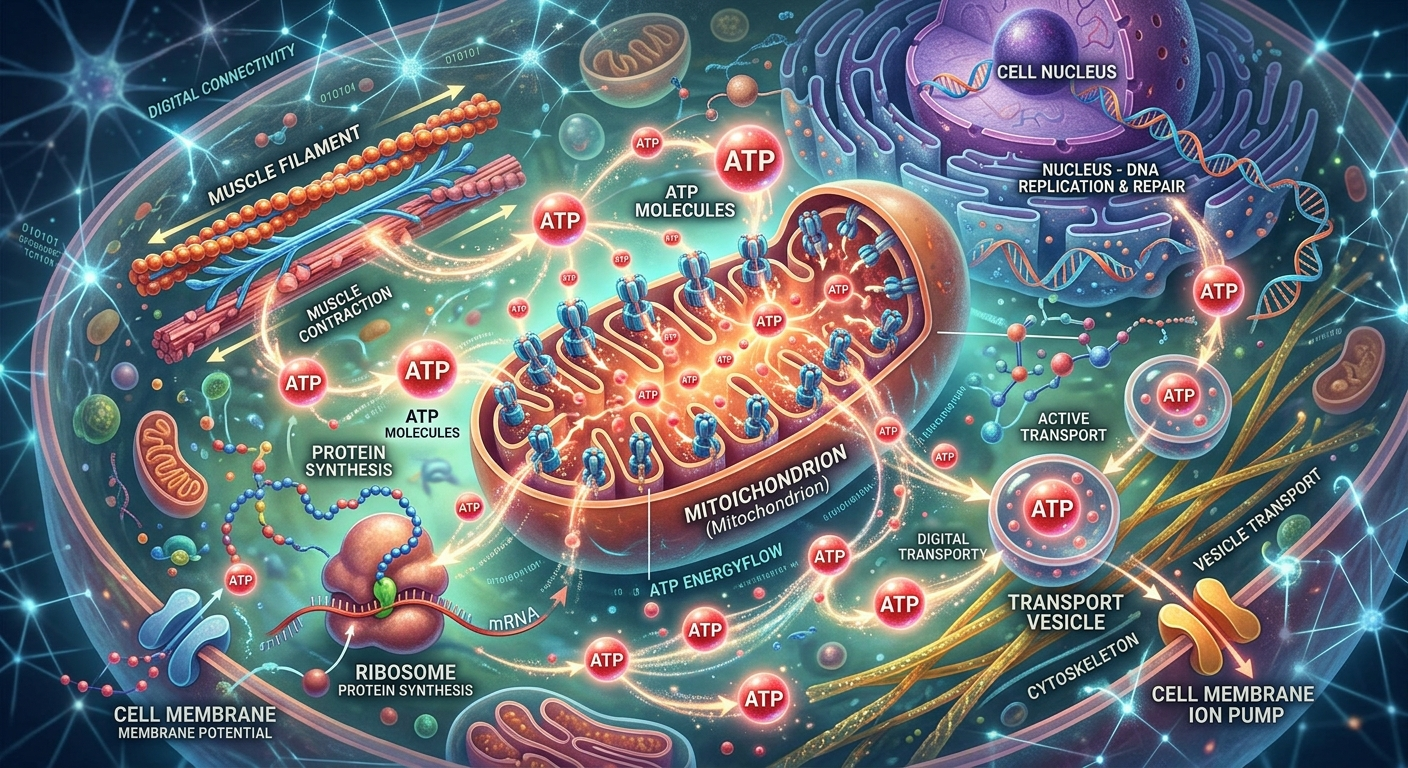
A Comprehensive Tutorial on Cellular Energy, Connections, and Digitalization
Abstract
A living cell is a remarkably organized system that continuously converts energy into movement, construction, communication, repair, and reproduction. At the centre of this activity is ATP, or adenosine triphosphate. ATP is a small molecule that temporarily stores and transfers usable chemical energy.
ATP does not function like a battery that simply holds electricity. Instead, it acts more like a rechargeable energy-transfer molecule: cells produce ATP, use it to power molecular processes, and then recycle the resulting ADP back into ATP.
Understanding ATP provides a foundation for understanding how muscles contract, how nerves communicate, how plants grow, how microorganisms survive, and how the enormous complexity of life emerges from chemistry.
1. What Is ATP?
ATP stands for adenosine triphosphate.
It is a molecule found in virtually every living cell.
Its structure contains three main components:
- Adenine — a nitrogen-containing base.
- Ribose — a five-carbon sugar.
- Three phosphate groups — a chain of phosphorus-containing groups.
A simplified representation is:
Adenine + Ribose + Phosphate + Phosphate + Phosphate
The molecule is commonly written as:
ATP
When ATP loses one phosphate group, it becomes:
ATP → ADP + Pi
Where:
- ADP = adenosine diphosphate
- Pi = inorganic phosphate
This reaction releases energy that can be coupled to cellular work.
A simple analogy
Imagine a delivery truck carrying energy packages.
- ATP = truck loaded with energy.
- ADP = truck after delivering one package.
- Pi = the phosphate package.
- Cellular machinery = the equipment receiving the energy.
The cell continually reloads the truck.
2. Why Does a Cell Need ATP?
A cell is not a passive object. It is constantly performing work.
ATP helps power:
| Cellular activity | What ATP helps accomplish |
|---|---|
| Muscle contraction | Powers molecular motors |
| Nerve signalling | Supports ion pumps that maintain electrical gradients |
| Protein synthesis | Helps assemble proteins |
| DNA replication | Supports the construction of new DNA |
| Active transport | Moves substances against concentration gradients |
| Cell division | Supports chromosome movement and cellular organization |
| Chemical synthesis | Drives reactions that build larger molecules |
| Movement of cilia and flagella | Powers microscopic movement |
| Repair | Supports many repair and maintenance processes |
Without a continuous supply of usable energy, these processes cannot continue.
ATP is therefore central to the operation of living cells.
3. ATP Is Not the Same as Electricity
This distinction is important.
ATP stores chemical potential energy.
Electricity involves the movement of electric charge.
However, the two are connected.
For example:
Chemical energy → ATP → Ion pumps → Electrical gradient → Nerve signalling
A nerve cell uses ATP to operate pumps that move ions across its membrane. This creates an electrical difference between the inside and outside of the cell.
When ions subsequently move through specific channels, that electrical gradient contributes to the transmission of nerve signals.
So ATP is not electricity itself, but it helps maintain the conditions that allow biological electricity to exist.
4. The ATP–ADP Energy Cycle
The central cycle is:
ATP → ADP + Pi + usable energy
Then:
ADP + Pi + energy → ATP
This is the fundamental recycling process.
Step-by-step
Step 1: ATP is produced
Energy from food or sunlight is used to form ATP.
Step 2: ATP travels or is used near cellular machinery
ATP transfers energy to processes that need it.
Step 3: ATP loses a phosphate
ATP becomes ADP.
Step 4: The cell captures more energy
That energy is used to convert ADP back into ATP.
Step 5: The cycle repeats
This happens continuously.
Important principle
The cell does not need to manufacture a completely new ATP molecule for every task.
It recycles ATP molecules repeatedly.
5. Where Is ATP Produced?
ATP is produced in several cellular locations, depending on the organism and the process.
5.1 Mitochondria
In many eukaryotic cells, mitochondria are major sites of ATP production.
They are often called the powerhouses of the cell, although this is a simplified description.
Mitochondria use energy extracted from nutrients to produce ATP through a process called oxidative phosphorylation.
5.2 Cytoplasm
Some ATP is produced directly in the cytoplasm during glycolysis.
Glycolysis breaks down glucose into smaller molecules and produces a modest amount of ATP.
5.3 Chloroplasts
In plants and algae, chloroplasts produce ATP during the light-dependent reactions of photosynthesis.
This ATP is then used to help build sugars.
5.4 Other organisms
Bacteria and archaea do not have mitochondria, but they still produce ATP using specialized membranes and biochemical pathways.
This shows that ATP is not dependent on one particular type of cell.
6. Cellular Respiration: How Food Becomes ATP
Cellular respiration is one of the major ways cells obtain usable energy from nutrients.
A simplified overall equation is:
Glucose + Oxygen → Carbon dioxide + Water + ATP
The actual process involves many intermediate reactions.
The main stages
Stage 1: Glycolysis
Location: Cytoplasm
Glucose is broken down into smaller molecules.
This produces:
- A small amount of ATP.
- NADH, an electron carrier.
- Pyruvate.
Stage 2: Pyruvate oxidation and the citric acid cycle
Location: Mitochondrial matrix in eukaryotic cells
Pyruvate is processed, and carbon dioxide is released.
The cycle produces:
- NADH.
- FADH₂.
- A small amount of ATP or an equivalent energy-carrying molecule.
Stage 3: Electron transport chain
Location: Inner mitochondrial membrane
Electrons carried by NADH and FADH₂ are transferred through a series of protein complexes.
This process helps establish a proton gradient.
Stage 4: ATP synthase
The proton gradient powers an enzyme called ATP synthase.
ATP synthase uses this energy to form ATP from ADP and phosphate.
ADP + Pi → ATP
This is one of the most important molecular energy-conversion processes in biology.
7. ATP Synthase: The Molecular Machine
ATP synthase is a remarkable enzyme.
It is often described as a molecular rotary machine.
Its structure contains components that allow proton movement to drive conformational changes that promote ATP formation.
A simplified model:
Proton gradient → ATP synthase → ATP
The connection to engineering
ATP synthase resembles a microscopic energy-conversion machine.
It does not burn fuel directly like a car engine.
Instead, it uses a gradient—a difference in proton concentration and electrical potential across a membrane.
This is an example of chemiosmosis.
Why this matters
The cell converts:
Chemical energy in nutrients → Electron energy → Proton gradient → ATP → Cellular work
This is a chain of energy transformations.
8. ATP and the Cell Membrane
The cell membrane is not merely a wall.
It is an active control system.
It separates the inside of the cell from the outside environment and helps regulate:
- Ions.
- Nutrients.
- Waste products.
- Electrical gradients.
- Communication signals.
Many membrane proteins require ATP.
For example, the sodium–potassium pump uses ATP to move sodium and potassium ions across the membrane.
A simplified representation is:
ATP → Sodium–potassium pump → Ion gradient → Electrical and chemical potential
This gradient is essential for many functions, including nerve and muscle activity.
9. ATP and Biological Electricity
Living cells can generate electrical differences across their membranes.
This is especially important in:
- Neurons.
- Muscle cells.
- Sensory cells.
- Certain microorganisms.
ATP supports the pumps that maintain ion gradients.
For example:
ATP powers ion transport → Ion gradient is maintained → Membrane voltage is possible
When channels open, ions move according to electrochemical forces.
This can produce changes in membrane voltage.
A useful analogy
Think of ATP as helping recharge a small biological electrical system.
The ATP-powered pumps establish the gradient.
The ion channels allow controlled discharge or redistribution.
The resulting electrical changes can carry information.
This is one reason ATP is connected to both energy and communication.
10. ATP and Protein Synthesis
Proteins are essential cellular machines.
They form:
- Enzymes.
- Receptors.
- Transporters.
- Structural components.
- Signalling molecules.
- Molecular motors.
The cell uses ATP and other energy-rich molecules during protein synthesis.
Simplified process
DNA information → RNA → Ribosome → Protein
ATP helps support several steps involved in preparing and assembling the components required for protein production.
However, ATP is not the only energy-carrying molecule involved. GTP also plays important roles in protein synthesis.
Connection to information technology
A protein is not simply energy.
It is a molecular structure built according to biological information.
The cell uses energy to turn information into a functioning physical object.
This resembles:
Digital instructions → Computer processing → Physical output
But biological systems are far more chemically complex than ordinary digital computers.
11. ATP and DNA Replication
DNA contains the hereditary information of living organisms.
When a cell divides, its DNA must be copied.
This process requires energy.
ATP helps support the operation of many proteins involved in DNA replication, repair, and maintenance.
Simplified relationship
DNA information + Cellular machinery + Energy → New DNA
The energy comes from several sources, including ATP and the chemical energy contained in nucleotide triphosphates used during DNA synthesis.
Important distinction
ATP is both:
- An energy-transfer molecule.
- A component related to nucleic-acid chemistry.
But its role in energy transfer should not be confused with the role of DNA as an information-storage molecule.
12. ATP and Active Transport
Substances naturally tend to move down concentration gradients.
However, cells often need to move substances against those gradients.
This requires energy.
For example:
ATP → Transport protein → Substance moved against gradient
This is called active transport.
Examples include:
- Sodium–potassium pumping.
- Calcium pumping.
- Proton pumping.
- Transport of certain nutrients.
Connection to infrastructure
A city may need pumps to move water uphill.
The water does not move uphill simply because it is water.
Energy must be supplied.
Similarly, a cell uses ATP to move substances where they would not naturally go.
13. ATP and Muscle Contraction
Muscles contract through interactions between proteins such as actin and myosin.
ATP is essential to the molecular cycle that allows myosin to generate movement.
A simplified sequence is:
ATP binds → Myosin changes state → Force-producing movement → ATP is used → Cycle repeats
This is an example of chemical energy becoming mechanical work.
Energy transformation
ATP chemical energy → Molecular movement → Muscle contraction
This principle applies to:
- Human muscles.
- Animal movement.
- Cilia.
- Flagella.
- Many intracellular transport systems.
14. ATP and Cellular Transport
Cells transport materials internally.
For example, molecular motors can move cargo along structures called microtubules.
These motors use ATP.
A simplified relationship is:
ATP → Molecular motor → Cargo movement
Cargo may include:
- Vesicles.
- Proteins.
- Organelles.
- Other cellular materials.
This is a microscopic logistics system.
Connection to transport networks
A modern logistics network uses:
- Energy.
- Vehicles.
- Routes.
- Information.
- Coordination.
A cell also uses:
- ATP.
- Molecular motors.
- Cytoskeletal tracks.
- Chemical signals.
- Regulatory systems.
The analogy is useful, but the cell is not literally a miniature city. It is a chemically integrated living system.
15. ATP and Photosynthesis
Plants, algae, and certain microorganisms capture energy from sunlight.
This process is called photosynthesis.
A simplified equation is:
Carbon dioxide + Water + Light → Sugars + Oxygen
ATP is produced during the light-dependent reactions.
It is then used, together with other energy and reducing-power molecules, to help build carbohydrates.
Simplified flow
Sunlight → Electron transport → Proton gradient → ATP → Sugar production
This demonstrates that ATP connects the energy of the Sun to the construction of biological matter.
16. ATP and the Origin of Biological Complexity
ATP is one of the important molecules that make complex life possible.
However, ATP alone is not sufficient.
A living cell also requires:
- Genetic information.
- Membranes.
- Enzymes.
- Metabolic pathways.
- Regulation.
- Reproduction.
- Environmental interaction.
ATP is part of a larger system.
The central relationship
Information + Matter + Energy + Regulation → Living cellular organization
This is one of the most important ideas in modern biology.
17. ATP and the Laws of Thermodynamics
ATP can be understood through thermodynamics.
17.1 First law of thermodynamics
Energy cannot be created or destroyed.
It can be transformed.
For example:
Food energy → ATP → Cellular work + Heat
The energy changes form.
17.2 Second law of thermodynamics
Energy transformations increase overall entropy.
Cells maintain internal organization by using energy and releasing heat and waste products into their surroundings.
Important point
A cell does not violate thermodynamics.
It maintains order by continuously exchanging energy and matter with its environment.
18. ATP and Chemical Coupling
Many chemical reactions that build cellular structures are not energetically favourable on their own.
ATP helps drive them.
This is called energy coupling.
Example
A reaction that requires energy can be linked to ATP hydrolysis.
ATP hydrolysis + Cellular reaction → Overall process becomes energetically favourable
This is one of the central principles of metabolism.
Simple analogy
Imagine a machine that cannot move unless a motor is switched on.
ATP hydrolysis provides the energy that helps drive the machine.
19. ATP and Digitalization: What Is the Connection?
The word digitalization usually refers to converting information and processes into digital systems.
ATP is not digital information.
However, ATP can be connected to digitalization through the study of biological information processing.
A useful comparison
| Digital system | Living cell |
|---|---|
| Electrical power | Chemical energy, including ATP |
| Processor | Enzymes and molecular machinery |
| Memory | DNA and other information systems |
| Communication network | Chemical and electrical signalling |
| Sensors | Receptors |
| Actuators | Molecular motors |
| Operating rules | Biochemical regulation |
| Feedback control | Cellular signalling and metabolic regulation |
This comparison helps explain cellular organization, but it should not be taken literally.
A cell is not simply a computer made of molecules.
It is a living chemical system capable of self-maintenance, adaptation, and reproduction.
20. ATP as the “Energy Currency” of the Cell
The phrase energy currency is a useful analogy.
Money is used to transfer purchasing power between different activities.
ATP transfers usable chemical energy between different cellular processes.
For example:
Food → ATP → Protein synthesis
Food → ATP → Muscle movement
Food → ATP → Ion pumping
Sunlight → ATP → Sugar production
ATP acts as a common energy-transfer molecule across many different processes.
Why this is useful
The cell does not need a completely different energy system for every task.
ATP provides a shared chemical energy-transfer mechanism.
21. ATP Is Not the Cell’s Only Energy Molecule
Although ATP is central, it is not the only energy-related molecule.
Other important molecules include:
- NADH — carries high-energy electrons.
- FADH₂ — carries high-energy electrons.
- GTP — participates in several cellular processes.
- NADPH — important in biosynthesis and photosynthesis.
- Proton gradients — store electrochemical potential energy.
A broader energy network
Nutrients → NADH/FADH₂ → Electron transport → Proton gradient → ATP
And:
ATP → Cellular work
This is a network of energy transformations rather than a single isolated reaction.
22. ATP and Cellular Communication
Cells communicate through chemical and electrical signals.
ATP participates in this communication in several ways.
It can:
- Provide energy for signalling processes.
- Support ion pumps.
- Participate in phosphorylation reactions.
- Act as an extracellular signalling molecule in certain contexts.
Phosphorylation
A phosphate group can be transferred to a protein.
This may change the protein’s activity.
A simplified representation is:
ATP + Protein → ADP + Phosphorylated protein
Phosphorylation is one of the major ways cells regulate biochemical activity.
Connection to software
A phosphorylation event can be compared loosely to changing a setting in a control system.
For example:
Signal received → Protein modified → Cellular response
This resembles:
Input → Processing → Output
But biological regulation is chemical, dynamic, and highly interconnected.
23. ATP and Cellular Feedback Systems
Living cells must maintain balance.
They regulate:
- Energy production.
- Energy consumption.
- Nutrient availability.
- Waste removal.
- Growth.
- Repair.
If ATP levels fall, cells can activate processes that increase energy production.
If energy is abundant, some energy-consuming processes may be reduced.
This is an example of feedback regulation.
Simplified control loop
Energy demand rises → ATP is consumed → Energy production increases → ATP is restored
This resembles an engineered control system.
24. ATP and the Human Body
The human body contains trillions of cells, each carrying out energy-dependent processes.
ATP supports:
- Heart muscle contraction.
- Breathing muscles.
- Brain activity.
- Movement.
- Digestion.
- Cellular repair.
- Immune responses.
- Temperature regulation.
Important clarification
The body does not store large amounts of ATP for long periods.
Instead, it continually produces and uses ATP.
This is why the body must continuously obtain energy from food and, indirectly, from stored nutrients.
25. ATP and the Brain
The brain requires a continuous energy supply.
Neurons use ATP to maintain ion gradients and support signalling.
A simplified relationship is:
ATP production → Ion pumps → Electrical gradients → Neural communication
This is one reason the brain is highly dependent on a reliable energy supply.
Connection to computing
Modern computers require electrical power to maintain memory, perform calculations, and communicate.
Neurons require chemical energy to maintain their electrical and biochemical functions.
Both systems depend on energy, but their mechanisms are fundamentally different.
26. ATP and Agriculture
ATP is also important in plants and agricultural systems.
Plants use ATP for:
- Root growth.
- Nutrient uptake.
- Photosynthesis.
- Cell division.
- Sugar production.
- Transport of water and minerals.
- Response to environmental stress.
Connection to crop production
Healthy plant growth depends on the interaction of:
Light + Water + Nutrients + Carbon dioxide + Cellular energy metabolism
ATP is part of the internal machinery that converts these resources into growth.
27. ATP and Microorganisms
Microorganisms use ATP in many different environments.
Examples include:
- Soil bacteria.
- Yeasts.
- Algae.
- Aquatic microorganisms.
- Microbes living in animal digestive systems.
Some microorganisms use oxygen.
Others use alternative electron acceptors.
Some obtain energy from sunlight or inorganic chemicals.
Despite these differences, ATP remains a major energy-transfer molecule.
28. ATP and Evolution
ATP is found across a vast range of living organisms.
This suggests that ATP-based energy transfer is deeply conserved in biology.
The exact pathways differ between organisms, but the central principle remains:
Capture energy → Transfer energy through ATP → Perform cellular work
This is one reason ATP is so important in understanding the unity of life.
29. ATP and Artificial Intelligence
ATP is not an AI system.
However, ATP can help us understand the difference between energy, information, and computation.
A simplified comparison
ATP = energy-transfer mechanism
DNA = biological information storage
Proteins = molecular machines
Cellular signalling = information processing
Metabolism = energy and material transformation
AI computation = mathematical information processing using hardware
The comparison is useful because modern AI systems also require:
- Energy.
- Hardware.
- Information.
- Processing.
- Communication.
- Feedback.
But biological cells and AI systems operate through very different physical mechanisms.
30. ATP and the Future of Biotechnology
Understanding ATP is important for many modern technologies.
These include:
- Synthetic biology.
- Cellular engineering.
- Medical research.
- Biotechnology.
- Bioenergy.
- Drug development.
- Metabolic engineering.
- Artificial cells.
- Molecular machines.
Scientists study ATP to understand how cells work and how cellular processes might be modified for useful purposes.
31. A Complete ATP Connection Map
Here is a simplified map of the major relationships:
Sunlight / Food / Chemical Energy
↓
Electron carriers and metabolic pathways
↓
Proton gradients and other energy-transfer processes
↓
ATP production
↓
ATP hydrolysis
↓
Cellular work
↓
Movement / Transport / Synthesis / Signalling / Repair
↓
Living cellular organization
A more detailed version:
Nutrients
→ Glycolysis
→ Citric acid cycle
→ NADH and FADH₂
→ Electron transport chain
→ Proton gradient
→ ATP synthase
→ ATP
→ Protein synthesis / Ion pumping / Movement / DNA maintenance
→ Cell survival and growth
32. ATP Compared with a Digital Battery
A battery stores electrical energy.
ATP stores chemical potential energy.
| Feature | Battery | ATP |
|---|---|---|
| Energy form | Chemical energy converted to electrical energy | Chemical potential energy |
| Main role | Supplies electrical power | Transfers chemical energy |
| Recharging | Electrical or chemical process | Cellular metabolic processes |
| Location | Engineered device | Living cells |
| Energy use | Electrical circuits | Biochemical reactions |
| Control | Electronic systems | Enzymes and cellular regulation |
The comparison is useful, but ATP is more like a recyclable molecular energy-transfer unit than a conventional battery.
33. ATP and the Meaning of “Living”
One of the defining features of life is the ability to maintain organized processes using energy.
ATP is deeply involved in this.
A living cell must continuously:
- Obtain energy.
- Transform energy.
- Maintain internal conditions.
- Build and repair structures.
- Respond to its environment.
- Reproduce when appropriate.
ATP supports many of these activities.
However, ATP alone does not define life.
Life requires a coordinated system of chemistry, information, boundaries, regulation, and reproduction.
34. A Simple Tutorial Experiment in Thought
Imagine a cell with no ATP production.
What happens?
- ATP levels begin to fall.
- Energy-dependent processes slow down.
- Ion gradients become difficult to maintain.
- Transport processes are disrupted.
- Protein synthesis and other cellular work are affected.
- Cellular organization begins to fail.
Now imagine a cell with functioning ATP production.
- Nutrients or sunlight provide energy.
- ATP is produced.
- ATP powers cellular machinery.
- ADP is regenerated into ATP.
- The cycle continues.
This illustrates why ATP production and consumption must remain coordinated.
35. The Most Important Scientific Idea
The deepest lesson is that life is not powered by one single energy source or one single molecule.
Instead, life is powered by a network of transformations.
ATP is one of the central links in that network.
Energy enters the biological system.
Cells transform it into usable chemical forms.
ATP transfers that energy to cellular machinery.
The machinery performs work.
The products and waste are processed, and the cycle continues.
This is the foundation of cellular metabolism.
Conclusion
ATP is one of the most important molecules in biology because it connects energy transformation to cellular activity.
It helps power:
- Movement.
- Transport.
- Protein synthesis.
- DNA maintenance.
- Electrical signalling.
- Growth.
- Repair.
- Reproduction.
Its importance extends beyond biology because it provides a powerful example of how energy, information, machinery, and regulation work together in a complex system.
The cell can be understood as a highly organized chemical network in which ATP acts as a major energy-transfer molecule.
In simple terms: ATP is the molecule that helps a living cell turn available energy into the work required to stay alive.
A final one-line summary
Food or sunlight provides energy → the cell converts that energy into ATP → ATP powers cellular machinery → the machinery maintains life.


Be First to Comment