
A Comprehensive Thesis on the Capabilities, Applications, Benefits, Challenges, and Future of AI
Abstract
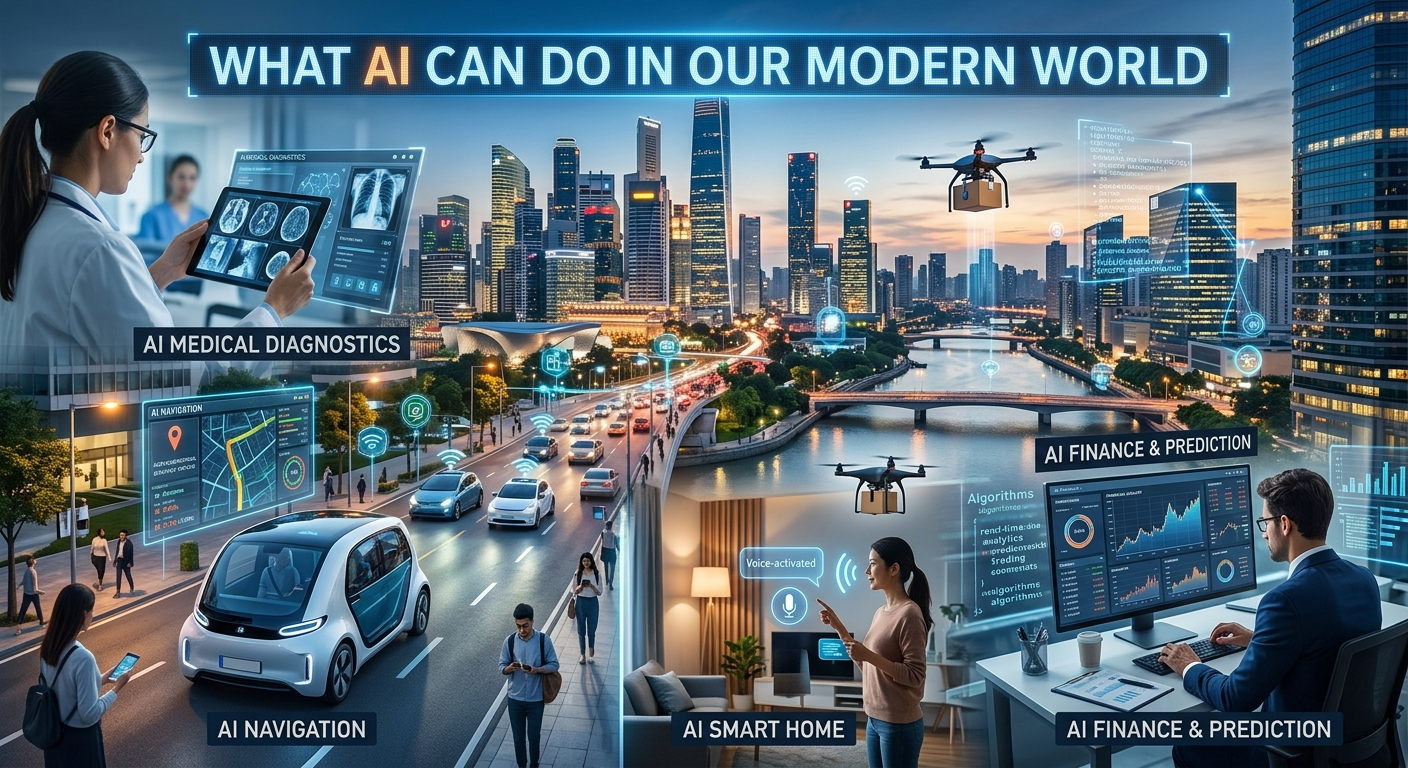
Artificial Intelligence (AI) is one of the most important technological developments of the modern world. It enables computers and machines to perform tasks that traditionally require human intelligence, including learning, reasoning, recognizing patterns, understanding language, solving problems, and making predictions. AI is already transforming education, healthcare, agriculture, manufacturing, finance, transportation, telecommunications, government, scientific research, and everyday life.
However, AI is not simply a machine that “thinks like a human.” It is a collection of technologies that process information, identify patterns, generate outputs, and assist people in making decisions. Its capabilities depend on its design, training data, computing resources, and the environment in which it operates.
This thesis examines what AI can do today, how it works, where it creates value, what its limitations are, and how society can use it responsibly to build a more productive, innovative, and inclusive future.
Keywords: Artificial Intelligence, Machine Learning, Generative AI, Robotics, Automation, Digital Transformation, Human–AI Collaboration, Modern Economy, Responsible AI.
1. Introduction
The modern world is increasingly built upon information, communication, computation, and automation. Every day, people generate enormous quantities of data through telephones, computers, businesses, scientific instruments, satellites, vehicles, hospitals, banks, and industrial systems.
The challenge is no longer simply collecting information. The challenge is understanding it, finding useful patterns, making decisions, and converting knowledge into practical action.
Artificial Intelligence addresses this challenge.
AI allows machines to perform tasks such as:
- Recognizing objects in images.
- Understanding and generating human language.
- Translating between languages.
- Predicting future events from historical data.
- Detecting unusual financial transactions.
- Assisting doctors with medical image analysis.
- Optimizing agricultural production.
- Controlling industrial machinery.
- Helping scientists discover new materials.
- Supporting businesses with planning and analysis.
- Generating text, images, audio, software, and other digital content.
AI can therefore be understood as a general-purpose technology: a technology that can be applied across many different industries and activities.
Its importance is comparable, in a broad historical sense, to earlier transformative technologies such as electricity, the internal combustion engine, computers, and the internet. Like those technologies, AI can change not only individual products but also the way entire economies operate.
2. What Is Artificial Intelligence?
Artificial Intelligence is the field of computer science concerned with creating systems that can perform tasks requiring capabilities commonly associated with human intelligence.
These capabilities include:
- Perception — interpreting information from cameras, microphones, sensors, and other inputs.
- Learning — improving performance from examples or experience.
- Reasoning — drawing conclusions from information.
- Language processing — understanding and producing human language.
- Planning — selecting actions to achieve a goal.
- Decision support — helping people evaluate choices.
- Generation — producing new text, images, code, audio, or other content.
AI does not necessarily perform these activities in the same way humans do. A machine may recognize thousands of images without possessing human-like understanding of what those images mean.
2.1 AI Is Not One Single Technology
AI includes several related fields:
| Field | Main purpose | Example |
|---|---|---|
| Machine Learning | Learning patterns from data | Predicting equipment failure |
| Deep Learning | Learning complex patterns using neural networks | Speech recognition |
| Natural Language Processing | Working with human language | AI assistants |
| Computer Vision | Understanding images and video | Detecting objects |
| Generative AI | Creating new content | Writing, images, and software |
| Robotics | Combining intelligence with physical machines | Industrial robots |
| Expert Systems | Applying rules and specialized knowledge | Technical diagnosis |
| Reinforcement Learning | Learning through actions and feedback | Game-playing systems |
| AI Agents | Planning and carrying out tasks using tools | Research or workflow assistants |
These fields often work together. A modern autonomous machine may use computer vision to perceive its surroundings, machine learning to interpret them, planning algorithms to choose an action, and robotics to execute that action.
3. How AI Works
Although AI systems differ considerably, many modern systems follow a general process:
Data → Training → Model → Inference → Output → Evaluation → Improvement
3.1 Data
AI systems learn from information such as:
- Text.
- Images.
- Audio.
- Video.
- Sensor readings.
- Scientific measurements.
- Business records.
- Maps.
- Computer code.
- Human feedback.
The quality of the data strongly influences the quality of the system.
Poor, incomplete, biased, or incorrectly labeled data can produce unreliable results.
3.2 Training
During training, an AI model processes examples and adjusts its internal parameters to improve its performance.
For example, a model trained to recognize agricultural diseases may examine many images of healthy and diseased plants. Over time, it learns patterns associated with different conditions.
3.3 The Model
A model is the computational system that has learned patterns from data.
Some models specialize in one task, such as recognizing faces or predicting electricity demand. Others are designed to perform many tasks.
3.4 Inference
Inference is the process of using a trained model to produce an output.
For example:
A farmer photographs a plant → the AI analyzes the image → the system identifies possible disease symptoms → the farmer receives guidance for further investigation.
3.5 Evaluation and Human Oversight
AI outputs must be evaluated. A system may produce an answer that sounds convincing but is incorrect.
For important decisions, AI should be tested against reliable information and, where necessary, reviewed by qualified people.
4. What AI Can Do in the Modern World
4.1 AI Can Understand and Generate Language
One of the most visible capabilities of modern AI is language processing.
AI can:
- Answer questions.
- Explain difficult subjects.
- Summarize documents.
- Translate languages.
- Correct grammar.
- Draft letters and reports.
- Generate educational material.
- Assist with research.
- Extract information from large documents.
- Convert spoken language into text.
- Help people communicate across language barriers.
Large language models can process and generate human-like text by learning statistical patterns in language.
Example
A small business owner can ask an AI system to help prepare:
- A business plan.
- A marketing strategy.
- A customer-service response.
- A financial projection.
- A product description.
- A training manual.
This does not eliminate the need for human judgment. The business owner must still verify facts, understand the market, and make decisions.
4.2 AI Can Transform Education
Education is one of the areas where AI can create substantial benefits.
AI can act as a:
- Tutor.
- Writing assistant.
- Language-learning partner.
- Mathematics explainer.
- Research assistant.
- Study planner.
- Accessibility tool.
- Teacher-support system.
Personalized Learning
Traditional classrooms often teach many students at the same pace. AI can help provide explanations at different levels of difficulty.
For example:
A student struggles with fractions → AI explains the concept using simple examples → provides practice questions → identifies mistakes → offers another explanation.
Teacher Support
AI can help teachers:
- Prepare lesson plans.
- Generate practice exercises.
- Create quizzes.
- Organize educational material.
- Translate learning resources.
- Identify topics requiring additional explanation.
Important Limitation
AI should support education rather than replace learning. Students still need to develop independent thinking, creativity, communication, and the ability to verify information.
4.3 AI Can Improve Healthcare
AI is increasingly used in healthcare research, administration, and clinical support.
Potential applications include:
- Analyzing medical images.
- Identifying patterns in patient data.
- Supporting disease research.
- Assisting drug discovery.
- Predicting hospital demand.
- Helping manage medical records.
- Supporting clinical decision-making.
- Monitoring equipment.
- Improving appointment scheduling.
Medical Imaging
AI can assist trained professionals by identifying patterns in X-rays, scans, and other medical images.
However, an AI output is not automatically a medical diagnosis. Medical decisions require appropriate clinical evaluation.
Drug Discovery
AI can help researchers examine large numbers of chemical compounds and predict which may be promising for further investigation.
This can reduce the time required to identify potential candidates, although laboratory testing and clinical trials remain essential.
4.4 AI Can Modernize Agriculture
Agriculture is an important area for AI because farming depends on weather, soil, water, plant health, machinery, and market conditions.
AI can support:
- Crop monitoring.
- Soil analysis.
- Irrigation planning.
- Pest and disease detection.
- Yield prediction.
- Weather-based decision support.
- Agricultural machinery.
- Livestock monitoring.
- Supply-chain management.
- Market forecasting.
Precision Agriculture
Precision agriculture uses data and technology to apply resources more accurately.
For example:
Satellite imagery + soil data + weather information + AI analysis → better-informed farming decisions.
AI may help identify areas of a field that require more attention, allowing farmers to use water, fertilizer, and other resources more efficiently.
Smallholder Farmers
AI can also support small-scale farmers through mobile applications that provide:
- Crop information.
- Weather alerts.
- Agricultural education.
- Disease-identification assistance.
- Market information.
- Record-keeping tools.
The greatest benefits occur when AI is combined with practical agricultural knowledge and reliable local information.
4.5 AI Can Improve Manufacturing
Manufacturing involves repetitive tasks, complex machinery, quality control, and supply-chain management.
AI can help factories:
- Detect product defects.
- Predict machine failures.
- Optimize production schedules.
- Reduce waste.
- Improve energy efficiency.
- Control robots.
- Monitor workplace safety.
- Forecast demand.
- Improve inventory management.
Predictive Maintenance
Instead of waiting for a machine to break, AI can analyze vibration, temperature, sound, and other sensor readings to identify possible problems.
This can help companies schedule maintenance before a major failure occurs.
Quality Control
Computer vision systems can inspect products more consistently and rapidly than manual inspection alone.
Human workers remain important for handling exceptions, improving processes, and making decisions about quality standards.
4.6 AI Can Improve Transportation
AI is used in many transportation systems.
Applications include:
- Traffic prediction.
- Route optimization.
- Public transport scheduling.
- Vehicle safety systems.
- Logistics planning.
- Fleet management.
- Driver assistance.
- Warehouse automation.
- Autonomous vehicle research.
Driver Assistance
Modern vehicles may use AI to recognize road markings, vehicles, pedestrians, and other objects.
These systems can assist drivers, but their capabilities and limitations vary. Driver responsibility and attention remain essential where required.
Logistics
AI can help companies determine:
- Which route is most efficient.
- How to organize deliveries.
- Where goods should be stored.
- How much inventory is needed.
- How to reduce transportation costs.
4.7 AI Can Strengthen Telecommunications and Connectivity
Telecommunications networks are becoming more complex as demand for mobile data, cloud services, video, and connected devices increases.
AI can help network operators:
- Predict network congestion.
- Detect equipment failures.
- Optimize traffic.
- Improve energy efficiency.
- Identify unusual activity.
- Automate network management.
- Improve customer support.
- Support network planning.
Example
A telecommunications operator may use AI to predict when a particular network area will experience heavy traffic and allocate resources more efficiently.
AI can therefore contribute to more reliable and responsive communication infrastructure.
4.8 AI Can Transform Finance and Banking
Financial institutions process large amounts of data and must manage risk, fraud, customer service, and regulatory requirements.
AI can assist with:
- Fraud detection.
- Credit-risk analysis.
- Customer support.
- Financial forecasting.
- Transaction monitoring.
- Document processing.
- Investment research.
- Compliance support.
- Personalized financial education.
Fraud Detection
AI can identify unusual transaction patterns that may require investigation.
For example, a sudden change in transaction behavior may trigger additional verification.
Financial Inclusion
AI-powered services may help people access financial information and basic services, particularly where traditional banking infrastructure is limited.
However, financial AI must be carefully designed to avoid unfair discrimination and protect sensitive information.
4.9 AI Can Support Scientific Research
Scientific research increasingly depends on the ability to analyze enormous quantities of data.
AI can help scientists:
- Identify patterns in experimental results.
- Analyze astronomical observations.
- Predict molecular properties.
- Study climate systems.
- Develop mathematical models.
- Search scientific literature.
- Generate research hypotheses.
- Optimize experiments.
- Analyze biological data.
AI and Discovery
AI does not replace the scientific method. Instead, it can help researchers explore possibilities more quickly.
A typical research process remains:
Observation → Hypothesis → Experiment → Analysis → Verification → Knowledge
AI can assist at several stages, but scientific conclusions still require evidence.
4.10 AI Can Improve Energy and Environmental Management
Energy systems must balance supply, demand, reliability, and environmental impact.
AI can support:
- Electricity-demand forecasting.
- Renewable-energy prediction.
- Smart-grid management.
- Energy-efficiency optimization.
- Building temperature control.
- Industrial energy management.
- Environmental monitoring.
- Climate research.
- Waste-management planning.
Smart Buildings
AI can analyze occupancy, temperature, and energy consumption to help buildings use energy more efficiently.
Renewable Energy
Solar and wind power depend on weather conditions. AI can help predict energy production and improve the coordination of renewable resources with electricity demand.
4.11 AI Can Improve Government and Public Services
Governments manage large populations, infrastructure, public finances, healthcare, education, and emergency services.
AI can assist with:
- Public-service administration.
- Document processing.
- Traffic management.
- Infrastructure planning.
- Disaster preparedness.
- Tax administration.
- Public-health analysis.
- Citizen information services.
- Environmental monitoring.
Public Administration
AI can help process large volumes of applications and documents, potentially reducing delays.
However, public-sector AI must be transparent, accountable, and subject to appropriate human oversight.
4.12 AI Can Assist in Construction and Infrastructure
Infrastructure development requires planning, engineering, budgeting, and maintenance.
AI can help with:
- Building design.
- Construction scheduling.
- Cost estimation.
- Safety monitoring.
- Structural analysis.
- Road maintenance.
- Water-system management.
- Infrastructure inspection.
- Urban planning.
Digital Infrastructure
AI can also help cities understand how roads, water systems, electricity networks, and public facilities are being used.
This can support better long-term planning.
4.13 AI Can Transform Business and Entrepreneurship
AI is becoming an important tool for businesses of all sizes.
A small enterprise can use AI to support:
- Market research.
- Customer communication.
- Product development.
- Accounting assistance.
- Inventory management.
- Marketing.
- Website development.
- Business analysis.
- Staff training.
- Strategic planning.
AI as a Business Assistant
For example, an entrepreneur may use AI to move from an idea to an initial business plan:
Idea → Market research → Business model → Financial estimates → Marketing plan → Implementation
AI can accelerate preparation, but the entrepreneur must still validate the market and manage the business.
4.14 AI Can Improve Cybersecurity
AI can assist cybersecurity professionals by analyzing large volumes of network and system activity.
Applications include:
- Detecting unusual behavior.
- Identifying potential malware.
- Monitoring network traffic.
- Prioritizing security alerts.
- Supporting incident investigation.
- Finding software vulnerabilities.
- Improving security operations.
However, AI can also be misused by attackers. This creates an ongoing technological competition between defensive and offensive capabilities.
Therefore, cybersecurity requires:
- Strong security practices.
- Regular updates.
- Human expertise.
- Access controls.
- Monitoring.
- Responsible use of AI.
4.15 AI Can Assist Creativity and Digital Production
Generative AI can help people create:
- Articles.
- Illustrations.
- Presentations.
- Music concepts.
- Video scripts.
- Software code.
- Educational materials.
- Product designs.
- Website content.
AI can reduce the time required to produce an initial draft.
However, creativity is not only the production of content. It also includes:
- Original ideas.
- Personal experience.
- Cultural understanding.
- Judgment.
- Purpose.
- Emotional meaning.
- Responsibility.
AI can assist creative work, but human direction remains important.
5. AI and the Modern Economy
AI is not merely a software feature. It can influence the structure of the economy.
5.1 Productivity
AI can help workers complete certain tasks more quickly.
For example:
- A researcher can search and summarize information faster.
- A programmer can receive assistance with code.
- A business can automate repetitive document processing.
- A farmer can analyze crop information more efficiently.
However, productivity gains depend on how AI is integrated into real work.
5.2 New Industries
AI is creating opportunities in:
- AI software development.
- Data services.
- Robotics.
- Cloud computing.
- Semiconductor manufacturing.
- AI education.
- Cybersecurity.
- Digital healthcare.
- Agricultural technology.
- Autonomous systems.
5.3 Transformation of Existing Industries
AI may change how companies compete.
Businesses that use AI effectively may improve:
- Speed.
- Quality.
- Efficiency.
- Customer service.
- Innovation.
- Decision-making.
But technology alone does not guarantee success. Organizations also need skilled people, reliable infrastructure, and good management.
6. AI and Human Work
One of the most important questions is whether AI will replace human workers.
The answer is complex.
AI is more likely to replace or reduce some tasks than to eliminate every part of an occupation.
For example, an accountant may use AI to automate certain calculations, while still being responsible for interpretation, communication, and professional judgment.
A teacher may use AI to prepare exercises, while still providing mentorship and understanding students.
A farmer may use AI for crop monitoring, while still managing the physical realities of farming.
Human Skills That Remain Important
- Critical thinking.
- Communication.
- Leadership.
- Empathy.
- Creativity.
- Ethical judgment.
- Practical experience.
- Problem-solving.
- Adaptability.
- Responsibility.
The future of work is likely to involve increasing collaboration between people and intelligent tools.
7. AI and the Future of Learning
As AI becomes more capable, education must evolve.
Students will need to learn not only how to use AI, but also how to evaluate it.
Important AI literacy skills include:
- Understanding what AI is.
- Knowing what AI can and cannot do.
- Checking information.
- Protecting personal data.
- Recognizing bias.
- Using AI ethically.
- Developing independent reasoning.
- Understanding the difference between assistance and evidence.
The most valuable education will combine AI tools with strong human knowledge.
8. AI and Scientific and Technological Progress
AI can accelerate progress in several areas simultaneously.
For example:
Better AI models → improved scientific analysis → new discoveries → better technologies → more data → improved AI models.
This creates a feedback loop between computation, science, engineering, and industry.
AI is also closely connected to other technologies:
- Semiconductors.
- Cloud computing.
- High-performance computing.
- Quantum computing research.
- Robotics.
- Telecommunications.
- Biotechnology.
- Renewable energy.
- Advanced manufacturing.
The future of AI will therefore depend not only on algorithms, but also on physical infrastructure.
9. The Infrastructure Behind AI
Modern AI requires a technological foundation.
9.1 Semiconductors
AI systems depend on processors capable of performing large numbers of mathematical operations.
These include:
- CPUs.
- GPUs.
- AI accelerators.
- Memory systems.
- Networking chips.
9.2 Data Centers
Large AI models require substantial computing resources.
Data centers provide:
- Computing power.
- Storage.
- Networking.
- Cooling.
- Electricity.
- Security.
9.3 Data
AI systems depend on data for training, evaluation, and operation.
9.4 Software
AI requires:
- Algorithms.
- Models.
- Programming frameworks.
- Databases.
- Operating systems.
- Deployment tools.
9.5 Human Expertise
AI development requires people with knowledge of:
- Mathematics.
- Computer science.
- Engineering.
- Statistics.
- Data management.
- Ethics.
- Industry-specific problems.
AI is therefore an entire technological ecosystem.
10. The Limitations of AI
AI is powerful, but it is not perfect.
10.1 AI Can Make Mistakes
An AI system may produce an incorrect answer, even when the answer sounds confident.
10.2 AI Can Reflect Bias
If training data contains unfair patterns, the model may reproduce them.
10.3 AI Does Not Automatically Understand the World
AI can recognize patterns without possessing human-like experience or common sense.
10.4 AI Can Be Sensitive to Context
A system that performs well in one environment may perform poorly in another.
10.5 AI Requires Resources
Advanced AI systems may require substantial computing power, electricity, and data.
10.6 AI Can Be Misused
AI can be used to create misinformation, automate harmful activities, or invade privacy.
10.7 AI Does Not Replace Responsibility
People and organizations remain responsible for how AI is used.
11. Ethical Challenges of AI
The development of AI raises important ethical questions.
11.1 Privacy
AI systems may process sensitive information. Data must be handled responsibly.
11.2 Fairness
AI decisions should not unfairly discriminate against people.
11.3 Transparency
People should understand, where appropriate, how AI systems influence important decisions.
11.4 Accountability
There must be clear responsibility when AI systems cause harm or make serious mistakes.
11.5 Human Autonomy
AI should support human decision-making rather than remove people’s ability to make meaningful choices.
11.6 Misinformation
AI-generated content can make it easier to produce misleading information.
11.7 Employment
AI may change jobs and require workers to develop new skills.
12. Responsible AI
Responsible AI means designing and using AI in ways that are safe, fair, reliable, transparent, and beneficial.
Important principles include:
- Human oversight.
- Data protection.
- Security.
- Fairness.
- Accuracy.
- Accountability.
- Transparency.
- Accessibility.
- Environmental responsibility.
A responsible AI system should be evaluated not only by what it can do, but also by how it affects people and society.
13. AI and Africa
AI has significant potential to support development across Africa.
Possible applications include:
- Agricultural advisory services.
- Healthcare support.
- Education.
- Financial inclusion.
- Language translation.
- Infrastructure planning.
- Public-service delivery.
- Environmental monitoring.
- Small-business development.
- Telecommunications optimization.
African Languages
AI can help improve access to information in African languages through translation, speech recognition, and language-learning tools.
However, many African languages remain underrepresented in digital datasets. Developing better language resources is therefore important.
Local Innovation
African countries can benefit from AI not only by using imported systems, but also by developing local applications that address local needs.
Examples include:
- Agricultural technology.
- Local-language education.
- Healthcare information systems.
- Small-business software.
- Smart infrastructure.
- Environmental monitoring.
14. AI and South Africa
South Africa has opportunities to apply AI across several sectors.
Potential areas include:
- Mining.
- Agriculture.
- Manufacturing.
- Financial services.
- Telecommunications.
- Healthcare.
- Education.
- Energy.
- Public administration.
- Small and medium-sized businesses.
AI can support the modernization of infrastructure and services, but successful implementation requires investment in:
- Digital connectivity.
- Electricity reliability.
- Data infrastructure.
- Skills development.
- Research.
- Cybersecurity.
- Responsible governance.
AI should be viewed as part of a broader development strategy rather than a replacement for infrastructure investment.
15. AI and Small Businesses
Small businesses can use AI to become more efficient without building large technology departments.
Example: A Small Online Business
AI can assist with:
- Product research.
- Product descriptions.
- Customer communication.
- Website content.
- Inventory records.
- Marketing ideas.
- Sales analysis.
- Business planning.
- Staff training.
- Customer-service automation.
However, businesses should verify AI-generated information and avoid entering sensitive customer or financial data into systems without understanding how that data is handled.
16. AI and the Future of Human Civilization
AI may influence civilization in several broad ways.
16.1 Knowledge
AI can make information easier to access and understand.
16.2 Productivity
AI can help people perform certain tasks more efficiently.
16.3 Science
AI can assist researchers in exploring complex problems.
16.4 Health
AI can support medical research and healthcare delivery.
16.5 Agriculture
AI can help improve agricultural decision-making.
16.6 Infrastructure
AI can support the planning and management of complex systems.
16.7 Communication
AI can reduce language barriers and improve access to information.
16.8 Innovation
AI can help people develop new products, services, and ideas.
The long-term impact of AI will depend on how societies choose to develop and use it.
17. What AI Cannot Do Reliably
It is important to distinguish between what AI can generate and what it can truly establish.
AI cannot automatically guarantee:
- That every answer is correct.
- That every prediction will happen.
- That every decision is fair.
- That every source is reliable.
- That every generated image is historically accurate.
- That every piece of code is safe.
- That every medical suggestion is appropriate.
- That every business prediction will succeed.
AI is a tool for analysis and assistance. It is not a substitute for evidence, professional responsibility, or human judgment.
18. A Practical Framework for Using AI
Organizations and individuals can use AI more effectively by following a structured approach.
Step 1: Identify the Problem
What task needs improvement?
Step 2: Determine Whether AI Is Appropriate
Not every problem requires AI.
Step 3: Prepare Reliable Data
Good data improves the quality of AI outputs.
Step 4: Select the Right Tool
Different AI systems are designed for different purposes.
Step 5: Test the System
Evaluate accuracy, reliability, and usefulness.
Step 6: Keep Humans Involved
Important decisions should receive appropriate human oversight.
Step 7: Monitor Performance
AI systems may need regular evaluation and improvement.
Step 8: Protect Information
Use appropriate privacy and security measures.
Step 9: Measure Results
Determine whether AI actually improves the task.
19. The Future of AI
The future of AI is likely to involve increasingly capable systems that can work with multiple types of information, use tools, and assist with complex workflows.
Possible developments include:
- More capable AI assistants.
- Better scientific research tools.
- Improved agricultural systems.
- More advanced robotics.
- Better language translation.
- More efficient industrial systems.
- Improved healthcare support.
- Greater integration with everyday software.
- More personalized education.
- More intelligent infrastructure.
However, future progress is not guaranteed to be equally distributed. Access to computing, data, skills, electricity, and connectivity will influence who benefits.
20. Conclusion
Artificial Intelligence is one of the most significant technological developments of the modern world.
It can help people understand information, automate repetitive tasks, improve decision-making, support scientific research, transform industries, and create new opportunities for innovation.
Its applications extend from education and healthcare to agriculture, manufacturing, finance, telecommunications, transportation, government, and scientific discovery.
However, AI is not magic, and it is not infallible. It can make mistakes, reflect bias, require substantial resources, and create new risks.
The most important question is therefore not simply:
“What can AI do?”
It is:
“What should AI do, how should it be used, and how can it improve human life responsibly?”
The future of AI will depend on the cooperation of scientists, engineers, educators, businesses, governments, and communities.
When combined with human knowledge, ethical responsibility, reliable infrastructure, and inclusive education, AI can become a powerful instrument for building a more productive, innovative, and connected world.
Final Summary
AI can:
Learn → Analyze → Predict → Understand → Generate → Automate → Optimize → Assist → Discover → Innovate.
But humans must still:
Think → Verify → Decide → Create → Take responsibility.
The future is not simply a world controlled by machines. It is a world in which intelligent tools may help people solve problems that were previously too difficult, too expensive, or too time-consuming to address.

Be First to Comment