
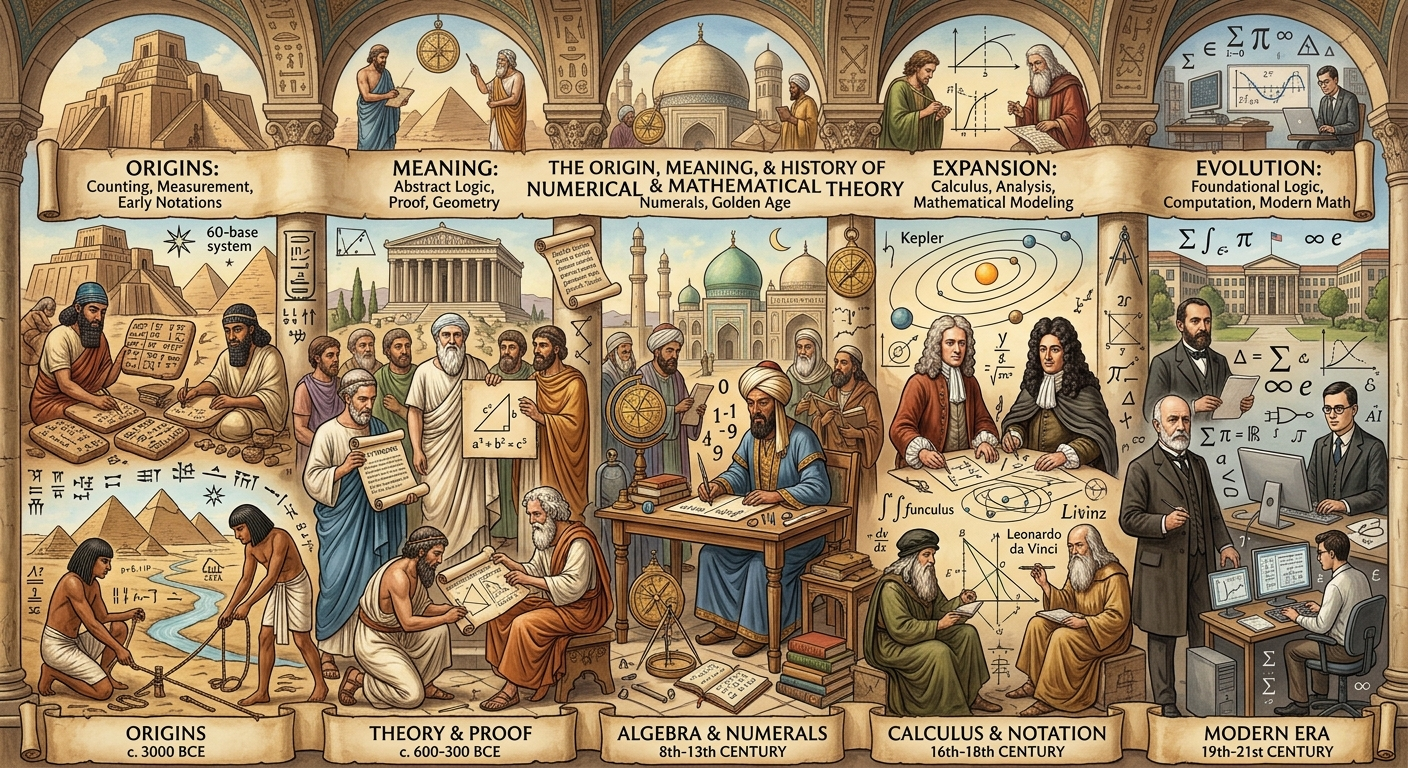
Abstract
Numerical and mathematical theory is one of humanity’s oldest intellectual achievements. It began with the practical need to count objects, measure land, record trade, organise time, and understand patterns in nature. Over thousands of years, these practical activities developed into sophisticated systems of numbers, arithmetic, geometry, algebra, and eventually the abstract mathematical theories used in modern science and technology.
Mathematics is more than the manipulation of numbers. It is a language for describing relationships, a system for reasoning about patterns, and a foundation for understanding quantity, space, change, uncertainty, and structure. Numerical theory, particularly number theory, investigates the properties of numbers themselves, while mathematical theory encompasses the broader principles and structures through which mathematics explains the world.
This thesis examines the origins of numerical thinking, the development of ancient mathematical civilisations, the contributions of Greek, Indian, Chinese, Islamic, European, and modern mathematicians, and the significance of mathematics in contemporary civilisation. It also explains the relationship between numbers, mathematical symbols, computation, scientific discovery, and future technologies.
Keywords: Numbers, mathematics, numerical theory, number theory, arithmetic, geometry, algebra, calculus, mathematical logic, computation, mathematical history.
1. Introduction
Human civilisation depends on the ability to recognise quantity, compare objects, identify patterns, and reason about relationships. A farmer must estimate the size of a field. A trader must calculate prices and quantities. An engineer must measure distances and forces. A scientist must express physical laws. A computer must process numerical and logical instructions.
All these activities depend on mathematics.
The word mathematics comes from the Ancient Greek mathēma, meaning learning, knowledge, or study. In its broadest sense, mathematics is the systematic study of quantity, structure, space, change, and patterns.
The word numerical relates specifically to numbers and their use. Numerical reasoning includes counting, calculating, comparing quantities, representing measurements, and analysing numerical relationships.
Mathematical theory develops these ideas further. It asks questions such as:
- What is a number?
- How can numbers be represented?
- Why do mathematical rules work?
- What relationships exist between quantities?
- How can mathematical statements be proved?
- How can mathematics describe physical reality?
- What kinds of structures can exist even when they are not directly visible?
The history of mathematics is therefore not simply a history of calculations. It is the history of humanity learning to represent reality through increasingly powerful systems of thought.
2. The Meaning of Numbers
2.1 What is a number?
A number is an abstract mathematical concept used to represent quantity, position, measurement, or relationships.
For example:
- 3 represents a quantity of three.
- 0 represents the absence of a quantity in a particular numerical context.
- −5 represents a negative quantity or position.
- ½ represents a fraction.
- π represents the ratio of a circle’s circumference to its diameter.
- √2 represents a particular irrational number.
- i is the imaginary unit used in complex numbers.
A number is not the same thing as the object it describes. The number 3 is not three apples, three stones, or three people. It is the abstract idea of “three,” which can apply to all of them.
2.2 Numerals and numbers
A numeral is a symbol used to write a number.
For example, the number seven can be written as:
- 7 in the Hindu-Arabic numeral system
- VII in Roman numerals
- ٧ in Arabic-Indic numerals
- 七 in Chinese numerals
The number remains the same, but its written representation changes.
This distinction is fundamental:
A number is an abstract mathematical object; a numeral is a written representation of that object.
2.3 Numbers as representations of reality
Numbers allow human beings to transform observations into organised information.
For example:
| Real-world observation | Numerical representation |
|---|---|
| Five animals | 5 |
| Ten metres | 10 m |
| Three hours | 3 h |
| A temperature below zero | −5°C |
| Half a quantity | ½ |
| A probability of one quarter | 0.25 |
Numerical representation makes comparison, calculation, prediction, and communication possible.
3. The Origin of Numerical Thinking
3.1 Before written mathematics
The earliest mathematical thinking probably began long before writing.
Human beings could recognise:
- One object versus many objects
- More versus fewer
- Equal versus unequal quantities
- Near versus far
- Larger versus smaller
- Repeated patterns
- Approximate amounts of time
A person did not need written symbols to understand that one animal was different from two animals. This ability to recognise quantity is sometimes called numerosity.
Early numerical thinking was closely connected to survival. People needed to know how many animals they possessed, how much food was available, how many people belonged to a group, and how much time had passed.
3.2 Tally marks and counting
One of the earliest known methods of recording quantity was the use of tally marks.
A person could record one mark for each object:
| | | | |
This represents five objects.
Tallying transformed temporary memory into a permanent record. It allowed people to count beyond what they could remember directly.
Archaeological discoveries include ancient objects with repeated marks that may have been used for counting or recording cycles. However, the exact meaning of many prehistoric marks remains uncertain.
3.3 The development of one-to-one correspondence
A major step in numerical reasoning was one-to-one correspondence.
This means matching each object in one group with one object in another group.
For example:
Animals:  ● ● ● ●
Marks:    | | | |
If every animal has one corresponding mark, the total is four.
This principle is the foundation of counting and is still used in modern mathematics.
3.4 Counting words and numerical language
As human languages developed, many societies created words for numbers.
Counting systems often reflected everyday experience:
- Fingers and toes
- Pairs of objects
- Groups of five
- Groups of ten
- Groups of twenty
The widespread use of base-ten systems is commonly associated with counting on ten fingers, although not every civilisation used base ten.
Some cultures developed base-five, base-twenty, or other systems. The existence of different counting systems demonstrates that numbers are abstract concepts that can be represented through different conventions.
4. The First Written Numerical Systems
4.1 Why writing numbers became necessary
As settlements grew, people needed to record information that could not be preserved reliably through memory alone.
Numerical records became important for:
- Agriculture
- Taxation
- Trade
- Property ownership
- Labour organisation
- Religious calendars
- Construction
- Government administration
The development of writing and numerical notation was therefore closely connected to the development of organised civilisation.
4.2 Mesopotamia and the origins of written mathematics
Ancient Mesopotamia, located largely in the region between the Tigris and Euphrates rivers, was one of the earliest centres of written mathematics.
The Sumerians and later Babylonian civilisations used cuneiform writing on clay tablets. Their mathematical records included calculations involving:
- Addition
- Subtraction
- Multiplication
- Division
- Fractions
- Areas
- Volumes
- Equations
- Commercial transactions
Babylonian mathematics is especially important because it used a sexagesimal, or base-sixty, numerical system.
This system influenced the division of:
- A circle into 360 degrees
- An hour into 60 minutes
- A minute into 60 seconds
The persistence of these conventions demonstrates how ancient numerical systems continue to influence modern life.
4.3 Ancient Egyptian mathematics
Ancient Egyptian mathematics developed in connection with agriculture, architecture, administration, and astronomy.
Egyptian mathematical documents include the Rhind Mathematical Papyrus, which contains problems involving arithmetic, fractions, geometry, and practical measurement.
Egyptian mathematics was particularly important for:
- Measuring land after the Nile floods
- Calculating quantities of grain
- Planning construction
- Managing taxation
- Recording trade
Egyptian builders used mathematical knowledge in the construction of monumental architecture, although the precise methods used for every ancient structure are not always known.
4.4 The development of fractions
Fractions emerged because many real-world quantities cannot be represented by whole numbers alone.
For example:
- Half a loaf
- One quarter of a field
- Three-fifths of a quantity
A fraction has the form:
where is the numerator and is the denominator, with .
Fractions allowed ancient mathematicians to represent quantities between whole numbers and perform more precise calculations.
5. The Meaning and Development of Mathematical Theory
5.1 What is mathematical theory?
A mathematical theory is an organised body of definitions, principles, propositions, and proofs that explains a particular area of mathematics.
Examples include:
- Number theory
- Geometry
- Algebra
- Calculus
- Probability theory
- Set theory
- Graph theory
- Mathematical logic
A mathematical theory does not merely list calculations. It explains why mathematical statements are true and how different ideas are connected.
5.2 Definitions, axioms, theorems, and proofs
Mathematics is built through several important components.
Definitions
A definition gives precise meaning to a mathematical concept.
For example:
An even integer is an integer divisible by 2.
Axioms
An axiom is a foundational statement accepted as a starting point within a mathematical system.
For example, Euclidean geometry begins with foundational assumptions about points, lines, and space.
Theorems
A theorem is a mathematical statement that has been established through reasoning.
Proofs
A proof is a logical argument demonstrating why a mathematical statement follows from accepted definitions, axioms, and previously established results.
For example, the statement that the sum of two even integers is even can be proved as follows.
Let:
and
where and are integers.
Then:
Since is an integer, is divisible by 2. Therefore, the sum of two even integers is even.
This illustrates how mathematical theory converts an intuitive observation into a general proof.
6. The Historical Development of Mathematics
6.1 Ancient mathematical civilisations
Mathematics developed independently and through cultural exchange in several major civilisations.
Important centres included:
- Mesopotamia
- Egypt
- India
- China
- Greece
- The Islamic world
- Europe
- Mesoamerica
These civilisations developed different numerical systems, methods, and mathematical traditions.
6.2 Greek mathematics
Ancient Greek mathematics made a major contribution by emphasising logical proof and abstract reasoning.
Important Greek mathematicians included:
Pythagoras
Pythagoras is traditionally associated with the theorem concerning right-angled triangles:
Although the relationship was known in earlier mathematical traditions, Greek mathematics helped establish the importance of formal mathematical reasoning.
Euclid
Euclid wrote Elements, one of the most influential mathematical works in history.
Euclidean geometry organised mathematical knowledge through definitions, axioms, propositions, and proofs.
Archimedes
Archimedes made major contributions to geometry, measurement, mechanics, and the study of areas and volumes.
His work helped establish mathematical methods that later influenced the development of calculus.
6.3 Indian mathematics
Indian mathematicians made fundamental contributions to numerical notation, arithmetic, algebra, and mathematical astronomy.
The development of zero
The concept of zero developed through several historical stages. Ancient cultures used symbols for empty positions, but the development of zero as a number with arithmetic properties was especially important in Indian mathematics.
Brahmagupta, writing in the seventh century CE, gave rules for arithmetic involving zero and negative numbers.
Zero became essential for:
- Place-value notation
- Arithmetic
- Algebra
- Calculus
- Computing
- Digital electronics
Decimal place-value notation
The modern decimal numeral system developed through historical processes in India and was later transmitted through the Islamic world to Europe.
The system uses ten symbols:
Its power comes from place value.
For example:
This makes large numbers and calculations much easier to represent.
6.4 Chinese mathematics
Chinese mathematicians developed sophisticated methods for arithmetic, algebra, geometry, and practical problem-solving.
The mathematical classic The Nine Chapters on the Mathematical Art contains problems involving:
- Fractions
- Linear equations
- Areas
- Volumes
- Surveying
- Commercial calculations
Liu Hui contributed important commentaries and mathematical methods, including work related to geometry and approximations.
6.5 Mathematics in the Islamic world
From approximately the eighth century onward, scholars working in the Islamic world played a major role in preserving, developing, and transmitting mathematical knowledge.
Important centres included Baghdad and other scholarly cities.
Al-Khwarizmi
Muhammad ibn Musa al-Khwarizmi made major contributions to arithmetic and algebra.
His work on solving equations helped establish algebra as a systematic mathematical discipline.
The word algorithm is derived from the Latinised form of his name, while the word algebra comes from the title of his influential work on equations.
Omar Khayyam
Omar Khayyam contributed to the study of cubic equations and geometry.
Ibn al-Haytham
Ibn al-Haytham made important contributions to geometry, optics, and mathematical reasoning.
The Islamic mathematical tradition helped connect Greek, Indian, Persian, and other mathematical knowledge, while also producing new discoveries.
6.6 European mathematics and the Renaissance
During the European Renaissance, mathematical knowledge expanded through trade, printing, education, astronomy, engineering, and scientific investigation.
Important developments included:
- Wider use of Hindu-Arabic numerals
- Advances in algebra
- Development of symbolic notation
- Improved trigonometry
- Mathematical astronomy
- New approaches to geometry
Fibonacci
Fibonacci helped popularise Hindu-Arabic numerals in medieval Europe through his book Liber Abaci.
His work demonstrated the practical advantages of the decimal place-value system.
Descartes
René Descartes helped develop analytic geometry, which connects algebra with geometry.
The Cartesian coordinate system allows points to be represented by ordered pairs:
This created a powerful connection between numerical equations and geometric shapes.
7. The Major Branches of Mathematics
7.1 Arithmetic
Arithmetic is the study of basic numerical operations.
The fundamental operations are:
- Addition
- Subtraction
- Multiplication
- Division
For example:
Arithmetic is the foundation of everyday calculation, accounting, engineering, and computing.
7.2 Number theory
Number theory is the branch of mathematics that studies the properties of numbers, especially integers.
Important topics include:
- Prime numbers
- Divisibility
- Factors
- Congruences
- Diophantine equations
- Perfect numbers
- Number patterns
Prime numbers
A prime number is an integer greater than 1 that has exactly two positive divisors: 1 and itself.
Examples include:
Prime numbers are important in mathematics and modern cryptography.
The fundamental theorem of arithmetic
Every integer greater than 1 can be expressed uniquely as a product of prime numbers, apart from the order of the factors.
For example:
This theorem explains why prime numbers are considered the basic building blocks of the positive integers.
7.3 Algebra
Algebra studies symbols and rules for representing unknown quantities and relationships.
For example:
Solving the equation gives:
Algebra allows general mathematical statements to be expressed without calculating every individual case.
7.4 Geometry
Geometry studies shapes, sizes, positions, distances, and spatial relationships.
Important concepts include:
- Points
- Lines
- Angles
- Triangles
- Circles
- Polygons
- Solids
- Coordinates
The area of a rectangle is:
where is length and is width.
The area of a circle is:
where is the radius.
7.5 Trigonometry
Trigonometry studies relationships between angles and sides of triangles.
For a right-angled triangle:
Trigonometry is used in surveying, navigation, engineering, astronomy, and physics.
7.6 Calculus
Calculus studies change, motion, accumulation, and continuous processes.
It has two major branches:
- Differential calculus, which studies rates of change
- Integral calculus, which studies accumulation and areas
For example, if position is represented by , velocity can be expressed as:
Calculus is essential in physics, engineering, economics, biology, and many modern technologies.
7.7 Probability and statistics
Probability studies uncertainty and the likelihood of events.
For an event :
when all outcomes are equally likely.
Statistics studies the collection, analysis, interpretation, and presentation of data.
Statistics is important in:
- Medicine
- Agriculture
- Economics
- Education
- Government
- Scientific research
- Artificial intelligence
7.8 Discrete mathematics
Discrete mathematics studies mathematical structures that are separate or countable rather than continuously varying.
It includes:
- Graph theory
- Combinatorics
- Logic
- Algorithms
- Discrete probability
- Coding theory
Discrete mathematics is particularly important in computer science.
7.9 Mathematical logic
Mathematical logic studies formal reasoning and the structure of mathematical statements.
It includes:
- Propositions
- Predicates
- Proof systems
- Formal languages
- Computability
- Foundations of mathematics
Logic provides a foundation for computer programming, automated reasoning, and the study of mathematical truth.
8. The Development of Mathematical Symbols
8.1 Why symbols matter
Mathematical symbols make complex ideas easier to express.
For example, the statement:
The square of the length of the hypotenuse equals the sum of the squares of the other two sides.
Can be written as:
Symbols reduce repetition and make relationships easier to analyse.
8.2 The evolution of notation
Mathematical notation developed gradually.
Important developments included:
- Numerals
- Place-value notation
- Symbols for equality
- Symbols for addition and subtraction
- Algebraic variables
- Exponents
- Fractions
- Coordinate systems
- Integral and differential notation
The modern mathematical language is the result of centuries of refinement.
8.3 The importance of place value
In a place-value system, the position of a digit determines its value.
For example:
The zero indicates that there are no tens in this number.
Place-value notation made large calculations more efficient and became essential to modern numerical computation.
9. The Relationship Between Mathematics and Science
Mathematics is often described as the language of science because it allows scientific observations to be expressed precisely.
9.1 Physics
Physics uses mathematics to describe:
- Motion
- Energy
- Gravity
- Electricity
- Magnetism
- Waves
- Heat
- Quantum phenomena
For example, Newton’s second law is expressed as:
where:
- is force
- is mass
- is acceleration
9.2 Astronomy
Mathematics allows astronomers to calculate:
- Planetary orbits
- Distances between celestial objects
- Stellar motion
- Gravitational relationships
- The expansion of the universe
9.3 Biology
Mathematics is used to model:
- Population growth
- Disease transmission
- Genetics
- Ecosystems
- Biological networks
- Evolutionary processes
9.4 Chemistry
Chemistry uses mathematics to calculate:
- Molecular quantities
- Reaction rates
- Concentrations
- Energy changes
- Chemical equilibria
9.5 Earth sciences
Mathematics supports:
- Weather forecasting
- Climate modelling
- Geological surveying
- Hydrology
- Seismology
- Agricultural planning
10. Mathematics and the Development of Computation
10.1 From counting to computing
Modern computing developed from mathematical ideas about numbers, logic, algorithms, and information.
An algorithm is a finite sequence of instructions for solving a problem or performing a task.
For example, a simple algorithm for finding the larger of two numbers is:
- Read the first number.
- Read the second number.
- Compare them.
- Output the larger number.
Algorithms are fundamental to software, artificial intelligence, and digital systems.
10.2 Binary numbers
Computers commonly represent information using the binary system, which has two digits:
A binary number such as:
represents:
Binary arithmetic is closely connected to digital electronics because electronic circuits can represent two distinct states.
10.3 Boolean logic
Boolean logic uses values such as:
- True
- False
It is named after George Boole.
Boolean operations include:
- AND
- OR
- NOT
These operations form the logical foundation of digital circuits and computer programming.
10.4 Mathematics and artificial intelligence
Artificial intelligence depends on several mathematical fields, including:
- Linear algebra
- Calculus
- Probability
- Statistics
- Optimisation
- Information theory
- Discrete mathematics
For example, machine-learning models often represent data using vectors and matrices.
A vector may be written as:
Matrices allow large collections of numerical relationships to be processed efficiently.
11. Important Mathematical Theories and Their Historical Significance
11.1 Euclidean geometry
Euclidean geometry describes relationships between points, lines, angles, and shapes in a classical geometric system.
It became one of the most influential mathematical frameworks in history.
11.2 Algebraic theory
Algebra developed from practical equation-solving into a broad study of mathematical structures.
Modern algebra includes:
- Groups
- Rings
- Fields
- Vector spaces
- Polynomial equations
11.3 Calculus
Calculus was developed independently in important ways by:
Isaac Newton
and
Gottfried Wilhelm Leibniz.
Their work transformed mathematics by providing systematic methods for studying motion, change, and accumulation.
11.4 Non-Euclidean geometry
In the nineteenth century, mathematicians developed geometries that do not follow all the assumptions of Euclidean geometry.
These developments became important in modern physics, particularly in the study of curved space and general relativity.
11.5 Set theory
Set theory studies collections of objects.
For example:
Set theory became an important foundation for modern mathematics.
11.6 Mathematical logic and incompleteness
Kurt Gödel demonstrated important results concerning the limits of formal mathematical systems.
His incompleteness theorems showed that sufficiently powerful consistent formal systems cannot prove every mathematical statement that is true within the intended interpretation.
These results changed the understanding of mathematical foundations and the limits of formal reasoning.
11.7 Chaos theory
Chaos theory studies systems that can be highly sensitive to initial conditions.
A small difference in the starting state can produce a very different outcome.
Chaos theory is important in:
- Weather
- Climate
- Fluid dynamics
- Biology
- Engineering
11.8 Game theory
Game theory studies strategic decision-making between individuals or organisations.
It is used in:
- Economics
- Business
- Political science
- Biology
- Artificial intelligence
12. Mathematics as a Universal Language
Mathematics is often called a universal language because mathematical relationships can be communicated across many spoken languages.
For example:
has the same mathematical meaning regardless of whether it is explained in English, Arabic, Chinese, or another language.
However, mathematical notation is not completely independent of culture. Different societies have developed different symbols, terminology, and conventions.
The universality of mathematics lies primarily in the relationships it expresses, while its written forms are shaped by human history.
13. Mathematics, Society, and Civilisation
13.1 Agriculture
Mathematics supports:
- Land measurement
- Crop spacing
- Seed quantities
- Irrigation planning
- Yield estimation
- Financial budgeting
13.2 Architecture and engineering
Mathematics is essential for:
- Structural design
- Building measurements
- Bridge construction
- Road planning
- Electrical systems
- Mechanical engineering
13.3 Trade and economics
Mathematics supports:
- Prices
- Interest
- Profit and loss
- Taxation
- Currency conversion
- Economic modelling
13.4 Government
Governments use mathematics for:
- Population censuses
- Public budgets
- Infrastructure planning
- Statistics
- Economic policy
- Resource allocation
13.5 Education
Mathematics develops:
- Logical reasoning
- Problem-solving
- Quantitative literacy
- Abstract thinking
- Analytical skills
13.6 Medicine
Mathematics is used in:
- Medical imaging
- Dosage calculations
- Epidemiology
- Clinical trials
- Medical statistics
- Biomedical engineering
14. The Philosophy of Mathematics
14.1 Is mathematics discovered or invented?
This is one of the oldest philosophical questions concerning mathematics.
The discovery view
Some philosophers argue that mathematical truths exist independently of human beings and are discovered through reasoning.
The invention view
Others argue that mathematics is a human-created system of symbols, definitions, and rules.
A balanced interpretation
Mathematics contains both human-created representations and relationships that appear to have objective properties.
For example, humans invented the symbol:
But once the rules of arithmetic are established, the relationship:
follows necessarily within that system.
14.2 Mathematical truth
Mathematical truth depends on the system in which a statement is interpreted.
For example, Euclidean geometry and non-Euclidean geometry use different foundational assumptions.
This does not make mathematics arbitrary. Rather, it demonstrates that mathematical theories can be constructed from different consistent starting points.
14.3 The limits of mathematics
Mathematics is extremely powerful, but it does not answer every question.
Mathematical models depend on:
- Assumptions
- Definitions
- Available data
- Logical consistency
- The limits of the model
A mathematical model may describe a system accurately within certain conditions without representing every aspect of reality.
15. The Evolution of Numerical Systems
15.1 Natural numbers
Natural numbers are used for counting:
Some mathematical conventions include zero in the natural numbers.
15.2 Whole numbers
Whole numbers commonly include:
15.3 Integers
Integers include positive numbers, negative numbers, and zero:
15.4 Rational numbers
Rational numbers can be expressed as:
where and are integers and .
Examples include:
15.5 Irrational numbers
Irrational numbers cannot be expressed as a ratio of two integers.
Examples include:
Their decimal expansions continue indefinitely without repeating a fixed pattern.
15.6 Real numbers
The real numbers include both rational and irrational numbers.
They are used to represent quantities along a continuous number line.
15.7 Complex numbers
Complex numbers have the form:
where and are real numbers and:
Complex numbers are important in electrical engineering, physics, signal processing, and advanced mathematics.
16. The Importance of Zero
Zero deserves special attention because it changed the history of mathematics.
16.1 Zero as a placeholder
In a place-value system, zero indicates an empty position.
For example:
contains no tens.
16.2 Zero as a number
Zero also represents a quantity and participates in arithmetic.
For example:
16.3 Zero in modern technology
Zero is fundamental to:
- Decimal arithmetic
- Binary computation
- Digital logic
- Algebra
- Calculus
- Physics
- Computer programming
Without zero, modern numerical systems would be far more difficult to construct and use.
17. Mathematics and Measurement
Measurement is the process of assigning numerical values to physical quantities.
Important measurable quantities include:
- Length
- Mass
- Time
- Temperature
- Area
- Volume
- Speed
- Energy
For example, speed can be expressed as:
where is distance and is time.
Measurement connects abstract mathematics with the physical world.
18. Mathematics and the Structure of the Universe
Mathematics is used to describe patterns in nature, including:
- Planetary motion
- Waves
- Electromagnetic fields
- Atomic structures
- Biological forms
- Population systems
- Cosmic expansion
However, mathematics is not itself a physical substance. It is a conceptual and symbolic framework used to describe relationships.
A mathematical equation may describe a physical law, but the equation is not the physical phenomenon itself.
19. Modern Mathematics
Modern mathematics is a vast field containing many specialised disciplines.
These include:
- Pure mathematics
- Applied mathematics
- Computational mathematics
- Mathematical physics
- Financial mathematics
- Mathematical biology
- Mathematical economics
- Operations research
- Cryptography
- Data science
- Mathematical statistics
19.1 Pure mathematics
Pure mathematics investigates mathematical structures and relationships for their own sake.
Examples include:
- Number theory
- Abstract algebra
- Topology
- Mathematical logic
- Geometry
19.2 Applied mathematics
Applied mathematics uses mathematical methods to solve practical problems.
Examples include:
- Engineering
- Economics
- Medicine
- Agriculture
- Climate science
- Computer science
19.3 Computational mathematics
Computational mathematics studies numerical methods and algorithms for solving mathematical problems using computers.
It is important when exact solutions are difficult or impossible to obtain.
20. Mathematics in the Digital Age
Modern digital systems depend on mathematics at nearly every level.
20.1 Hardware
Mathematics supports:
- Circuit design
- Semiconductor engineering
- Signal processing
- Computer architecture
- Communication systems
20.2 Software
Mathematics supports:
- Algorithms
- Programming languages
- Data structures
- Optimisation
- Cryptography
- Artificial intelligence
20.3 Telecommunications
Mathematics is used in:
- Radio transmission
- Fibre-optic communication
- Wireless networks
- Error correction
- Signal modulation
- Network optimisation
20.4 Cybersecurity
Modern cryptography uses mathematical concepts such as:
- Prime numbers
- Modular arithmetic
- Elliptic curves
- Finite fields
- Computational complexity
20.5 Artificial intelligence
AI systems use mathematics to represent data, optimise models, estimate probabilities, and identify patterns.
21. The Future of Mathematical Theory
Mathematics will continue to develop as new scientific and technological questions emerge.
Important future areas include:
- Quantum information
- Artificial intelligence
- Mathematical biology
- Climate modelling
- Advanced cryptography
- Computational number theory
- Complex systems
- Space science
- Mathematical foundations of computation
The future of mathematics is not limited to larger calculations. It also includes discovering new structures, new ways of reasoning, and new relationships between mathematics and the physical world.
22. Summary of Major Historical Contributions
| Period or civilisation | Major contribution |
|---|---|
| Prehistoric societies | Counting, tallying, measurement |
| Mesopotamia | Written arithmetic, fractions, base-sixty mathematics |
| Ancient Egypt | Practical arithmetic, geometry, surveying |
| Ancient Greece | Proof, geometry, deductive reasoning |
| Ancient India | Decimal place-value notation, zero, algebra |
| Ancient China | Arithmetic, equations, geometry, practical mathematics |
| Islamic Golden Age | Algebra, arithmetic, astronomy, mathematical transmission |
| Medieval Europe | Wider adoption of Hindu-Arabic numerals |
| Renaissance Europe | Symbolic algebra, analytic geometry |
| Seventeenth century | Calculus, mathematical physics |
| Eighteenth and nineteenth centuries | Probability, analysis, abstract algebra, non-Euclidean geometry |
| Twentieth century | Logic, computation, modern physics, advanced mathematical theories |
| Twenty-first century | AI, data science, cryptography, computational mathematics |
23. Conclusion
The origin of numerical and mathematical theory lies in humanity’s earliest attempts to understand quantity, order, measurement, and pattern. Counting began as a practical activity, but it gradually developed into a sophisticated intellectual discipline.
Ancient civilisations created numerical systems to support agriculture, trade, construction, astronomy, and government. Greek mathematicians strengthened the importance of proof. Indian mathematicians made fundamental contributions to zero and decimal notation. Chinese mathematicians developed powerful methods for solving practical and theoretical problems. Scholars in the Islamic world advanced algebra and helped transmit mathematical knowledge across cultures. European mathematicians later developed symbolic algebra, analytic geometry, calculus, and modern mathematical analysis.
Today, mathematics is both a practical tool and a system of abstract reasoning. It supports science, engineering, economics, medicine, agriculture, computing, telecommunications, and artificial intelligence.
The history of mathematics demonstrates that human progress is closely connected to the ability to represent reality through numbers and logical relationships.
Mathematics began with the question “How many?” and developed into the much broader question “How does the world work?”
24. Final Perspective
The significance of mathematics is not merely that it helps people calculate faster. Its deeper importance is that it allows human beings to move from observation to explanation, from measurement to prediction, and from practical problems to general theories.
Numbers provide the language of quantity. Mathematical structures provide the language of relationships. Proof provides the language of certainty within a formal system. Computation provides the means to process mathematical information at enormous scale.
Together, these developments form one of the central foundations of human civilisation.
Mathematics is therefore not only a subject taught in schools. It is a historical achievement, a scientific instrument, a technological foundation, and one of humanity’s most powerful methods for understanding the world.



Be First to Comment