
Abstract
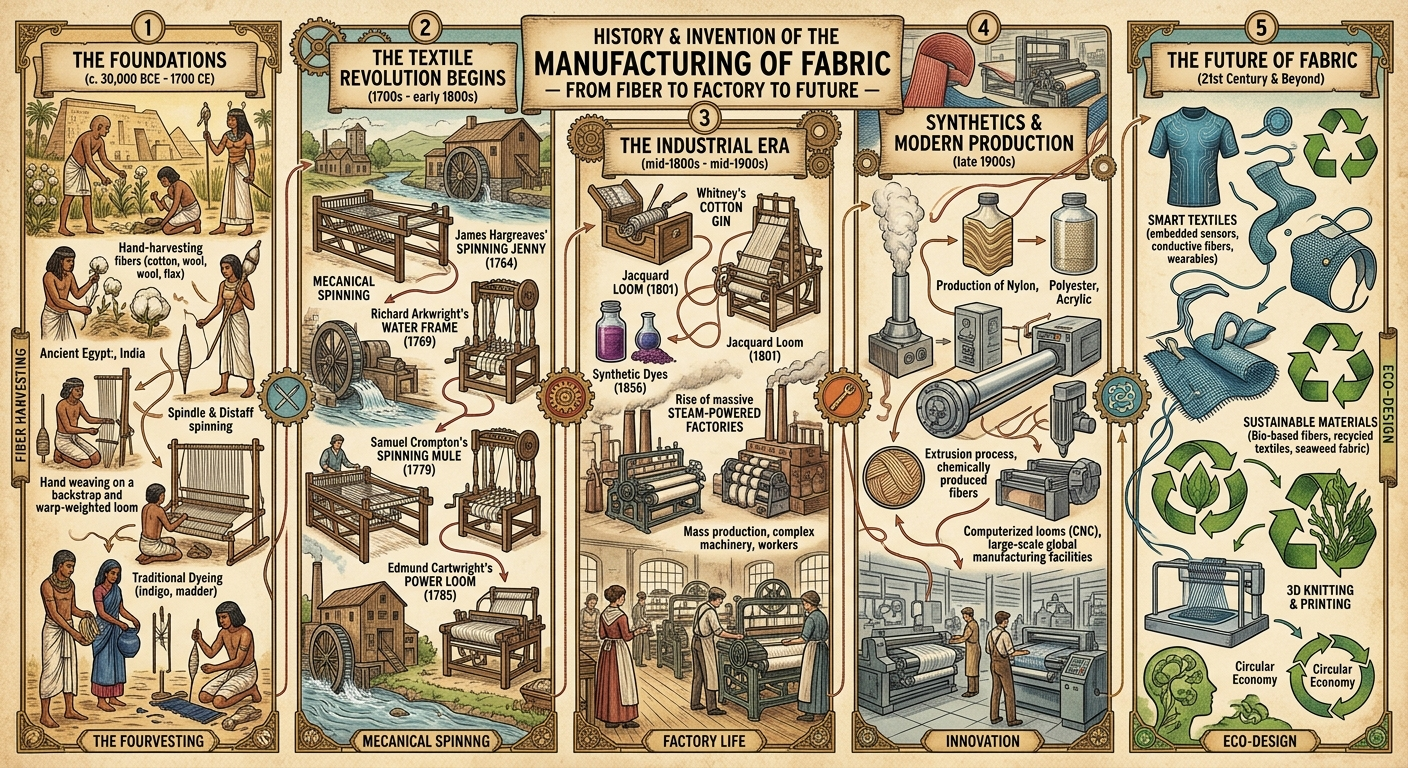
Fabric manufacturing is one of humanity’s oldest and most transformative technologies. It is the process of turning raw fiber into a continuous, flexible, protective sheet. This thesis traces its evolution through 5 revolutions: by hand, by wheel, by machine, by chemistry, and by computation.
1. What is Fabric Manufacturing?
Fabric manufacturing has 4 universal steps that have not changed in 30,000 years, only how we do them:
- Fiber Production: Grow or create fiber (flax, wool, cotton, silk, polyester)
- Spinning: Twist fibers into yarn
- Weaving/Knitting: Interlace yarn into cloth
- Finishing: Dye, bleach, soften, waterproof, strengthen
Every invention in history is an improvement to one of these 4 steps.
2. Origin: The Hand Age (30,000 BC – 1000 AD)
A. Paleolithic Origins
- 30,000 BC: First fiber – impressions of woven flax in Dzudzuana Cave, Georgia.
- 25,000 BC: Venus figurines show string skirts.
- Early method: Hand-spinning with a drop spindle – a stick with a stone whorl. One person could spin 10-30 meters per hour.
B. Neolithic Revolution (10,000 BC)
Agriculture gives us consistent fiber:
- Flax: First cultivated in Fertile Crescent. Linen found in 8,000 BC.
- Wool: Domesticated sheep ∼9,000 BC. Wool fiber invented.
- Cotton: Independent domestication in Indus Valley (∼6000 BC), Peru, and Mexico.
- Silk: China, ∼2700 BC. Legend of Empress Leizu. Silk kept secret for 2,000 years.
C. Invention of the Loom
- Vertical Warp-Weighted Loom: 6000 BC. Threads hang from a frame.
- Horizontal Ground Loom: Egypt, ∼4000 BC. Allowed longer cloth.
- Drawloom: China, 200 BC. Could weave complex patterns like damask and brocade automatically using a figure harness – first programmable machine.
For 99% of human history, fabric was made by women, by hand, at home. It was so valuable that cloth was used as money.
3. First Industrial Revolution of Fabric (1000 – 1760)
Inventions that changed speed:
- Spinning Wheel: Invented in India/China ∼1000 AD, reached Europe 1280s. Increased spinning productivity 10x. One wheel could do work of 6 drop spindles.
- Spinning Jenny? No – First: The Indian Charkha and later the Great Wheel. Cotton from India (Calico, Muslin) became so good that Britain banned it in 1721 to protect its own wool industry.
- Horizontal Treadle Loom: 1100s Europe. Weaver uses feet to lift harnesses, freeing hands. Doubled weaving speed.
By 1700s: Britain imports raw cotton but cannot spin and weave fast enough. Bottleneck creates pressure for mechanization.
4. Second Revolution: The Mechanization (1760 – 1850) – The Birth of Modern Manufacturing
This is where manufacturing as we know it was invented, and fabric was the trigger for the entire Industrial Revolution.
The Critical Inventions in Order:
1764 – Spinning Jenny (James Hargreaves): 8 spindles at once, then 80. One worker, many threads.
1769 – Water Frame (Richard Arkwright): Water-powered spinning. Produced strong warp thread. First factory: Cromford Mill, 1771. First time workers left home to work in a building with machines.
1779 – Spinning Mule (Samuel Crompton): Combined Jenny + Water Frame. Could spin fine, strong cotton yarn. Productivity: 300x a drop spindle.
1785 – Power Loom (Edmund Cartwright): First loom powered by water/steam. A hand weaver made 1 piece of cloth per week. A power loom made 7.
1793 – Cotton Gin (Eli Whitney): Separated cotton fiber from seed 50x faster. Made American cotton profitable, tragically expanded slavery to supply British mills.
1804 – Jacquard Loom (Joseph Jacquard): Punched cards control which threads lift. Can weave any image automatically. This is the direct ancestor of computer programming. Charles Babbage copied the idea for his computer.
Result: 1770 to 1800, raw cotton consumption in Britain went from 1,000 tons to 25,000 tons. Price of cloth fell 90%. Clothes went from being heirlooms to disposable.
Chemical Invention:
- Bleaching: Chlorine bleach discovered 1799 – bleaching time from 3 months in sun to 1 day.
- Dyeing: Before 1856, all dyes were natural (madder, indigo, Tyrian purple). Color was expensive.
5. Third Revolution: Chemistry and Scale (1850 – 1960)
A. Synthetic Dye
1856: William Perkin at 18 years old accidentally makes first synthetic dye, Mauveine, while trying to make quinine. Within 10 years, Germany dominates chemical industry. Color becomes cheap.
B. Synthetic Fiber
- 1884: Rayon (artificial silk) – first man-made fiber from cellulose.
- 1935: Nylon – Wallace Carothers at DuPont. First fully synthetic fiber from petroleum. Made from nothing but chemistry. Announced as stronger than steel. Stockings sold 64 million pairs in first year.
- 1941: Polyester (Terylene). Wrinkle-free, durable.
- 1958: Spandex / Lycra. Stretchable.
Now fabric could be engineered for function, not just taken from nature.
C. Mechanization Completed
- Ring Spinning (1828/1870): Continuous spinning, basis of modern yarn.
- Northrop Automatic Loom (1894): Automatically changes shuttle when thread breaks. One worker could run 20 looms.
- Circular Knitting Machine: Made knits (T-shirts, socks) by machine.
6. Fourth Revolution: Mass Production and Globalization (1960 – 2000)
- Open-End Spinning (1963): Spins without spindle, 5x faster than ring.
- Shuttleless Looms: Projectile, rapier, air-jet, water-jet looms. Air-jet loom weaves at 1,500 picks per minute vs 150 for power loom.
- Nonwovens: Fabric made without weaving – fibers glued/heat-pressed. For diapers, masks, medical gowns.
- Manufacturing moves: Fabric production leaves US/Europe for Japan, then Korea, Taiwan, then China, then Bangladesh/Vietnam due to labor cost.
- Today: China produces >50% of world’s fabric.
7. Fifth Revolution: Smart and Sustainable Fabric (2000 – 2026)
A. Sustainable Manufacturing
The textile industry is 10% of global CO2. New methods:
- Waterless Dyeing: Supercritical CO2 dyeing.
- Regenerated Fibers: Lyocell/Tencel from eucalyptus in closed-loop solvent.
- Recycled Polyester: From PET bottles.
- Organic Cotton & Hemp Revival.
B. Technical / Smart Fabrics
- Performance: Gore-Tex (waterproof breathable 1969), Kevlar (bulletproof), Nomex (fireproof).
- Smart: Conductive yarns, fabrics that sense heart rate, change color, generate electricity.
C. Digital Manufacturing
- 3D knitting (WholeGarment – knit a whole sweater with no seams in one machine).
- Digital printing: Print any design directly on fabric, no screens, minimal water.
- AI pattern optimization reduces waste 15-20%.
8. Significance: Why Fabric Manufacturing Matters
Fabric was the first industry to be industrialized, and it established the template for all manufacturing:
- Division of Labor: Factory system invented in cotton mills.
- Global Trade: Cotton triangle linked America, Britain, Africa, India – first global supply chain.
- Labor Rights: Luddites (1811) smashed looms. First labor movements started in textile mills.
- Gender and Economy: Spinning wheel to factory moved economic power from women at home to men in factories, then back to women in garment factories.
Fabric is not just clothing. It is economy, technology, and culture woven together.
9. Conclusion
From a hand-twisted flax fiber in a cave 30,000 years ago to an air-jet loom weaving 1,500 threads per minute and a 3D knitter printing a shirt in 30 minutes, the arc is clear: we have gone from scarcity to abundance, from natural to engineered, from local to global.
The invention of fabric manufacturing was not one invention. It was a cascade: spindle, wheel, loom, card, gin, mule, power loom, chemical fiber, computer-controlled loom. Each solved a bottleneck and created a new one.
In 2026, the challenge is no longer how to make enough fabric, but how to make it without destroying the planet, and how to make it intelligent.


Be First to Comment