
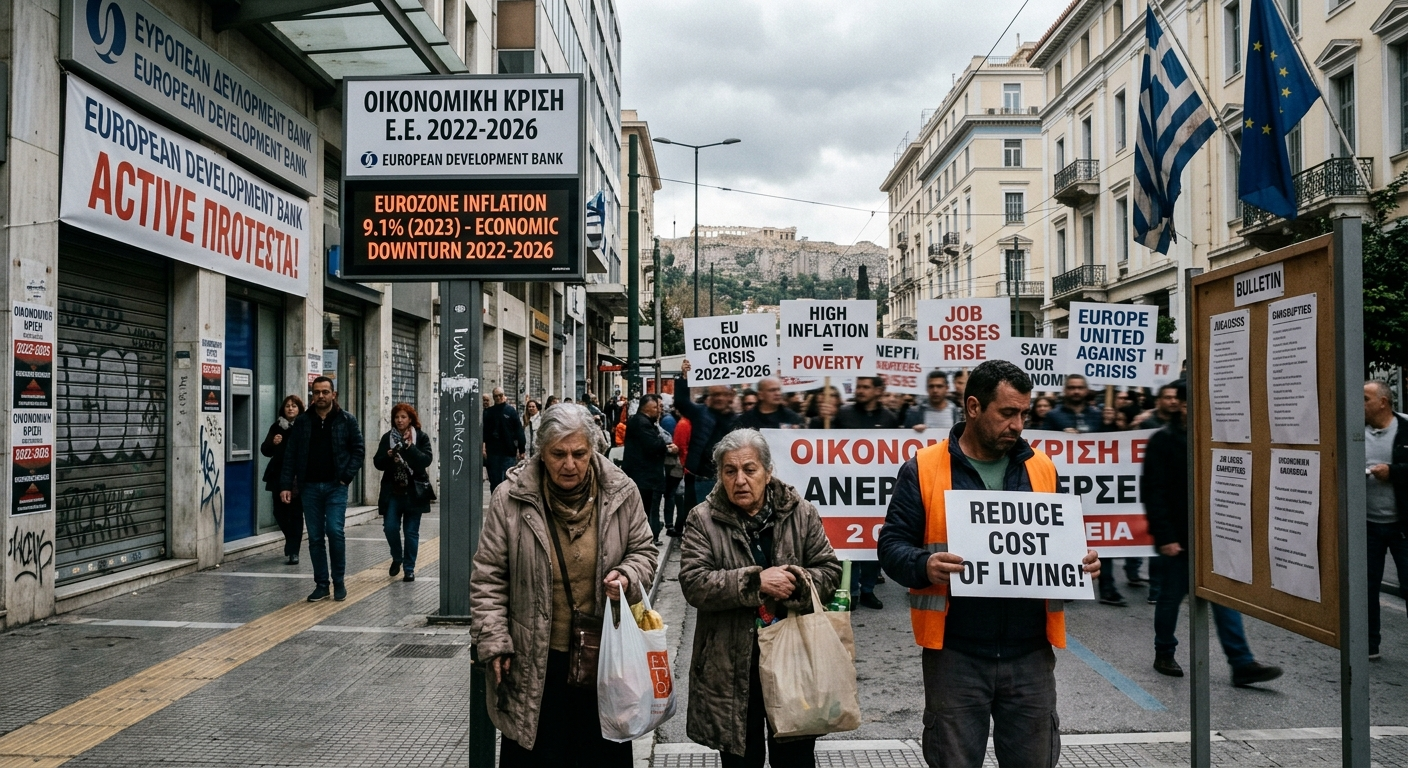
Energy, Inflation, War, Growth, Debt and the Transformation of the European Economy
Abstract
The European Union (EU) experienced one of the most complicated economic periods in its modern history between 2022 and 2026. What initially appeared to be a post-pandemic recovery evolved into a sequence of interconnected shocks involving energy, inflation, interest rates, geopolitics, industrial competitiveness, public finances, trade, supply chains and household purchasing power.
The Russian invasion of Ukraine in February 2022 transformed Europe’s economic environment. Europe had become heavily dependent on imported energy, particularly natural gas, and the disruption of Russian energy supplies contributed to an extraordinary energy-price shock. The resulting increase in electricity, gas, transport, food and production costs pushed inflation to levels not seen in decades. The European Central Bank (ECB) responded with a rapid tightening of monetary policy after years of exceptionally low interest rates. Higher borrowing costs subsequently affected households, businesses, construction, investment and governments.
The crisis did not, however, produce a uniform collapse across the EU. Some economies proved considerably more resilient than others. The EU maintained employment, developed alternative energy supplies, expanded renewable-energy investment, mobilised large-scale fiscal support and continued investment through programmes such as NextGenerationEU. By 2025, the EU and euro-area economies had returned to positive growth, although growth remained relatively weak. Eurostat estimated 2025 GDP growth at 1.6% for the EU and 1.5% for the euro area.
By 2026, a new energy shock associated with conflict in the Middle East demonstrated that Europe’s vulnerability to global energy prices had not disappeared. The European Commission’s Spring 2026 forecast projected slower growth as higher energy prices pushed inflation upward.
The central conclusion of this thesis is that the EU crisis of 2022–2026 should not be understood simply as a recession. It was a structural economic stress test of Europe’s energy system, monetary union, industrial model, welfare state, fiscal architecture and geopolitical position.
1. Introduction
The European economy entered 2022 after an extraordinary period.
The COVID-19 pandemic had disrupted:
- manufacturing;
- international trade;
- transport;
- tourism;
- labour markets;
- semiconductor supply chains;
- energy demand;
- public finances;
- household consumption.
European governments responded with unprecedented fiscal intervention, while the ECB maintained highly accommodative monetary policy.
The recovery initially appeared strong. However, supply constraints and rising energy and commodity prices were already creating inflationary pressure.
Then came Russia’s invasion of Ukraine.
The invasion dramatically changed Europe’s economic environment. The EU had to simultaneously address:
- energy security;
- inflation;
- military and humanitarian support for Ukraine;
- refugee integration;
- industrial competitiveness;
- food security;
- household living costs;
- government debt;
- monetary tightening;
- geopolitical fragmentation.
The result was not a single conventional economic crisis. Instead, Europe experienced a chain of overlapping crises.
2. What Was the EU Economic Crisis?
The expression “EU economic crisis” describes a combination of economic stresses rather than one event.
The principal components were:
2.1 Energy crisis
Europe experienced major increases in the cost and volatility of natural gas, electricity and petroleum products.
2.2 Inflation crisis
High energy prices spread throughout the economy.
Energy affects almost every economic activity because businesses require electricity, fuel and transportation.
2.3 Cost-of-living crisis
Households experienced declining purchasing power as food, energy, housing and other necessities became more expensive.
2.4 Interest-rate crisis
The ECB raised interest rates sharply to control inflation.
This reduced inflationary pressure but increased borrowing costs.
2.5 Industrial competitiveness crisis
European manufacturers faced comparatively high energy costs while competing with economies possessing cheaper energy or larger domestic markets.
2.6 Fiscal crisis
Governments simultaneously needed to:
- subsidise households;
- support businesses;
- invest in defence;
- finance energy infrastructure;
- service public debt;
- fund social programmes.
2.7 Geopolitical crisis
Europe’s economic relationship with Russia deteriorated dramatically, while competition with the United States and China intensified.
2.8 Growth crisis
Even after inflation declined, European growth remained relatively weak.
Therefore, the crisis was simultaneously an energy crisis, inflation crisis, monetary-policy crisis, industrial crisis, fiscal challenge and geopolitical transformation.
3. Europe Before the 2022 Shock
To understand the crisis, it is necessary to examine the structure of the European economy before 2022.
Europe had several strengths:
- sophisticated manufacturing;
- highly developed financial markets;
- advanced infrastructure;
- educated labour forces;
- strong social institutions;
- large consumer markets;
- world-class engineering;
- globally competitive companies;
- the euro;
- extensive international trade.
But Europe also had structural weaknesses.
These included:
- ageing populations;
- relatively high energy costs;
- dependence on imported raw materials;
- dependence on imported fossil fuels;
- slow productivity growth;
- complicated regulation;
- fragmented capital markets;
- relatively weak technology platforms compared with the US;
- increasing competition from China;
- high public debt in some countries.
The energy dependency became particularly important after 2022.
4. 2022: The Beginning of the Great European Economic Shock
4.1 Russia’s invasion of Ukraine
Russia’s invasion of Ukraine fundamentally changed Europe’s economic conditions.
Before the war, Russia was an important energy supplier to Europe.
The subsequent reduction in Russian energy supplies forced European economies to rapidly find alternatives.
This generated a major economic problem:
Europe needed energy immediately while simultaneously attempting to restructure its energy system for the long term.
5. The European Energy Crisis
Energy became the transmission mechanism through which geopolitical conflict entered almost every part of the European economy.
Natural gas was particularly important.
Gas prices influence:
- electricity generation;
- heating;
- chemical production;
- fertiliser;
- metals;
- glass;
- ceramics;
- food processing;
- transportation;
- manufacturing.
Consequently, an energy shock becomes a general production shock.
The ECB has described the 2021–2022 inflation surge as involving energy shocks, pandemic-related factors and the Russian invasion of Ukraine.
6. Inflation: From Energy to the Entire Economy
Inflation became one of the defining economic problems of 2022–2023.
The process can be simplified as:
Energy shock → higher production costs → higher transportation costs → higher food prices → higher consumer prices → wage pressures → monetary tightening
Energy therefore acted as an economic multiplier.
The consequences included:
- reduced real household income;
- weaker consumption;
- higher business costs;
- lower investment;
- reduced competitiveness;
- pressure for higher wages.
The ECB’s objective is to maintain medium-term inflation at approximately 2%, making the inflation shock particularly important for monetary policy.
7. The Cost-of-Living Crisis
Inflation is not merely a statistical phenomenon.
For households, it translates into purchasing-power pressure.
A family whose income increases by 5% while essential expenses increase by 10% can become poorer in real terms despite receiving a nominal pay increase.
The most sensitive areas were:
- food;
- electricity;
- gas;
- petrol;
- rent;
- mortgages;
- transport;
- household necessities.
Low-income households were particularly exposed because essential goods represent a larger proportion of their budgets.
8. The ECB’s Monetary Response
The ECB faced a difficult policy dilemma.
It had to reduce inflation without creating an unnecessarily severe recession.
During the pandemic period, interest rates had been extremely low.
When inflation accelerated, monetary policy changed direction.
The ECB increased interest rates substantially.
The basic mechanism was:
Higher interest rates → more expensive borrowing → lower credit demand → lower investment and consumption → weaker demand → lower inflation.
The problem is that this mechanism also reduces economic activity.
The ECB itself noted that when the 2022 invasion began, its deposit rate was -0.5% and monetary policy was still highly accommodative. By 2026, interest rates and fiscal conditions were considerably different.
9. The Interest-Rate Transmission to European Households
Higher interest rates affected households through:
Mortgages
Variable-rate borrowers experienced higher payments.
New housing
Higher mortgage costs reduced housing affordability.
Construction
Developers faced increased financing costs.
Consumer credit
Car loans and other borrowing became more expensive.
Savings
Higher interest rates benefited some savers.
Thus monetary tightening produced winners and losers.
10. European Businesses Under Pressure
European companies faced a combination of:
- expensive energy;
- expensive credit;
- weak consumer demand;
- supply-chain uncertainty;
- wage pressure;
- global competition.
Energy-intensive industries were particularly exposed.
These included:
- steel;
- chemicals;
- aluminium;
- cement;
- glass;
- paper;
- fertiliser.
For some businesses, the central question became whether production in Europe remained economically viable.
11. Germany: The Industrial Heart Under Pressure
Germany deserves special attention because its economic model historically depended heavily on:
- advanced manufacturing;
- exports;
- relatively inexpensive energy;
- integration with global supply chains;
- strong automotive production.
The energy shock challenged several assumptions behind this model.
The German economy was also exposed to:
- China’s increasing automotive competition;
- the transition from internal-combustion vehicles to electric vehicles;
- weak global industrial demand;
- higher energy prices.
The European Commission’s 2026 forecast continued to identify elevated energy prices as an inflationary problem for Germany.
Germany’s difficulties therefore became symbolic of a wider European competitiveness debate.
12. France and the Role of the State
France has a somewhat different economic structure.
Its economy benefits from:
- a large domestic market;
- nuclear electricity generation;
- major aerospace industries;
- advanced services;
- strong government institutions.
However, France has also faced:
- high public expenditure;
- fiscal pressures;
- political disputes over reforms;
- weak growth;
- public-debt concerns.
In 2026, France was among the EU countries recording a contraction in GDP during the first quarter, according to Eurostat.
13. Southern Europe
Countries such as:
- Italy;
- Spain;
- Greece;
- Portugal;
entered the crisis with different economic structures and varying levels of public debt.
Tourism provided important support for several southern economies after the pandemic.
EU investment programmes also became important.
For example, the European Commission expected Greece’s investment to remain supported by EU funding even as energy prices weakened consumption.
This demonstrates that the EU’s recovery instruments were an important stabilising mechanism.
14. The European Industrial Competitiveness Problem
One of the deepest questions created by the crisis was:
Can Europe maintain high-value industrial production while simultaneously facing high energy costs, strict environmental requirements and increasingly intense global competition?
Europe possesses advanced engineering and research capabilities.
However, competing economies can sometimes offer:
- cheaper energy;
- cheaper labour;
- larger subsidies;
- larger domestic markets;
- faster investment decisions.
The crisis therefore became a competitiveness crisis.
15. The China Challenge
China became increasingly important to Europe’s economic debate.
European companies depend on China for:
- manufacturing;
- components;
- consumer markets;
- critical minerals;
- batteries;
- solar technology;
- electronics.
At the same time, Chinese companies increasingly compete directly with European companies.
This is especially visible in:
- electric vehicles;
- batteries;
- solar panels;
- telecommunications equipment;
- industrial technology.
Europe therefore faces a difficult balance:
trade with China versus economic security from excessive dependence on China.
16. The United States and the European Economic Relationship
The United States became increasingly important to Europe’s energy and security architecture.
Europe expanded imports of alternative energy supplies, including liquefied natural gas.
At the same time, US industrial policy created concerns in Europe about investment competition.
American advantages include:
- large technology companies;
- deep capital markets;
- abundant energy resources;
- strong venture capital;
- major semiconductor companies;
- globally dominant digital platforms.
Europe’s challenge is therefore not only recovery from the 2022 crisis but also maintaining technological competitiveness.
17. Fiscal Policy: Governments Become the Shock Absorber
European governments attempted to protect households and businesses.
Measures included:
- energy subsidies;
- tax reductions;
- transfers;
- price-support mechanisms;
- business assistance;
- investment programmes.
These policies reduced the immediate social impact.
However, they also cost governments money.
The challenge became:
How long can governments subsidise energy without creating unsustainable fiscal burdens?
The European Commission reported that EU Member States adopted substantial measures to mitigate the 2026 energy-price shock, with measures incorporated into its Spring 2026 forecast amounting to approximately €14.5 billion, equivalent to around 0.07% of EU GDP.
18. Public Debt
Debt became more complicated because European governments entered the energy crisis after the enormous fiscal response to COVID-19.
The sequence was approximately:
COVID spending → high public debt → energy crisis → subsidies → higher interest rates → increased debt-service costs
Countries with large debt burdens became particularly sensitive to interest rates.
This created a fundamental policy tension between:
- fiscal support;
- investment;
- defence;
- social protection;
- debt sustainability.
19. The EU Recovery Architecture
One of Europe’s most important responses was the continued implementation of the EU recovery framework.
NextGenerationEU and related programmes supported investment in:
- digitalisation;
- renewable energy;
- infrastructure;
- public services;
- green technologies;
- economic resilience.
This changed the nature of the crisis.
Rather than responding only through emergency spending, the EU attempted to use the crisis to accelerate structural transformation.
20. The Energy Transition Accelerates
One of the paradoxes of the crisis is that an energy crisis accelerated Europe’s energy transition.
The crisis increased incentives to develop:
- solar power;
- wind power;
- batteries;
- energy storage;
- electricity grids;
- energy efficiency;
- hydrogen;
- alternative gas supplies;
- nuclear energy in countries supporting it.
The strategic lesson was clear:
Energy security is economic security.
Europe increasingly recognised that dependence on a single external supplier could create macroeconomic vulnerability.
21. 2023: From Inflation Shock to Stagnation
By 2023, the immediate energy emergency had moderated from its peak.
However, the economy was dealing with the consequences.
The ECB’s higher interest rates began transmitting through the economy.
The resulting environment contained:
- weaker credit;
- weaker investment;
- slower housing markets;
- weaker manufacturing;
- declining inflation momentum;
- cautious consumers.
The crisis therefore changed from an inflation crisis into a growth crisis.
22. 2024: Stabilisation Without Strong Expansion
By 2024, inflation was moving significantly closer to normal levels in many European economies.
However, the recovery remained uneven.
Services often performed better than manufacturing.
This created an important structural distinction:
Services
More resilient in many countries.
Manufacturing
More exposed to:
- energy;
- exports;
- China;
- global industrial demand;
- interest rates.
Europe therefore began recovering unevenly.
23. 2025: Evidence of Recovery
The EU economy demonstrated greater resilience than the most pessimistic scenarios suggested.
Eurostat estimated that annual GDP growth in 2025 was:
- EU: 1.6%
- euro area: 1.5%
The fourth quarter of 2025 also showed year-on-year growth.
This is important because it demonstrates that describing 2022–2026 simply as an “economic collapse” would be inaccurate.
Europe experienced severe economic stress, but the EU economy continued to expand overall.
24. 2026: A New Energy Shock
The year 2026 introduced another major challenge.
The conflict in the Middle East generated a new energy shock.
The European Commission’s Spring 2026 forecast described the situation as a slowdown in growth caused by higher energy prices and renewed inflationary pressure.
This demonstrated an important structural weakness:
Europe’s exposure to global energy prices remained significant even after reducing its dependence on Russian energy.
25. The 2026 Inflation Reacceleration
Eurostat reported euro-area annual inflation at approximately 3.2% in May 2026, up from 3.0% in April. EU inflation was approximately 3.3%.
This was significant because inflation had previously been moving toward the ECB’s target.
The new energy shock therefore complicated monetary policy.
The ECB had to consider:
- inflation;
- economic growth;
- household purchasing power;
- energy prices;
- wages;
- financial conditions.
26. 2026 Economic Growth
The EU entered 2026 with a weak but positive growth environment.
Eurostat reported that in the second quarter of 2026:
- euro-area GDP increased by 0.4% quarter-on-quarter;
- EU GDP increased by 0.5%.
This is evidence that Europe was not experiencing a generalized depression.
Instead, the economy was experiencing slow, uneven growth under continuing structural pressure.
27. Employment Resilience
One of the most remarkable features of the crisis was labour-market resilience.
In May 2026:
- euro-area unemployment was about 6.2%;
- EU unemployment was about 5.9%.
This demonstrates that the relationship between weak GDP growth and unemployment was not as severe as during some previous European crises.
European labour markets benefited from:
- labour shortages;
- demographic ageing;
- employment protection;
- government support;
- services-sector resilience.
28. The Productivity Problem
A deeper problem goes beyond inflation.
Europe has struggled with productivity growth.
Productivity determines how rapidly living standards can rise without creating inflationary pressure.
The European productivity challenge involves:
- slow digital adoption;
- limited scale-up of technology companies;
- fragmented capital markets;
- regulatory complexity;
- weak investment;
- demographic pressures;
- insufficient private-sector R&D in some areas.
Therefore, solving the European crisis requires more than reducing inflation.
Europe needs higher productivity.
29. Demography and the European Economy
Population ageing is one of Europe’s largest long-term challenges.
An ageing population creates pressure on:
- pensions;
- healthcare;
- labour supply;
- tax revenue;
- public expenditure.
If fewer workers support more retirees, economic growth becomes harder to maintain.
Europe therefore needs:
- higher productivity;
- increased labour participation;
- appropriate migration policies;
- technological automation;
- skills development.
30. The Housing Problem
The crisis also exposed Europe’s housing shortage.
Higher interest rates made mortgages more expensive.
At the same time:
- construction costs increased;
- energy costs increased;
- urban populations remained concentrated;
- housing supply remained insufficient in many areas.
The result was a difficult combination of:
high house prices + expensive financing + insufficient housing supply.
By the first quarter of 2026, Eurostat reported that house prices had increased by 4.7% year-on-year in the euro area and 5.1% in the EU.
31. The European Banking System
The banking system faced the crisis from a stronger position than during the global financial crisis of 2008.
Higher interest rates initially benefited banks through wider interest margins.
However, prolonged economic weakness could increase:
- corporate defaults;
- mortgage stress;
- commercial-property risks;
- credit losses.
The financial system therefore had to balance higher profitability with increasing credit risks.
32. The European Green Transition
The economic crisis created an apparent conflict between:
decarbonisation and industrial competitiveness.
However, a more strategic interpretation is possible.
Renewable energy can reduce Europe’s dependence on imported fossil fuels.
Therefore:
Green investment → domestic energy production → reduced import dependence → greater energy security → improved economic resilience.
The transition therefore became both an environmental strategy and an economic-security strategy.
33. Digitalisation as an Economic Solution
Europe’s recovery also depends on digital transformation.
Important technologies include:
- artificial intelligence;
- cloud computing;
- semiconductors;
- robotics;
- industrial automation;
- cybersecurity;
- telecommunications;
- digital finance;
- advanced manufacturing.
Digitalisation can raise productivity by allowing businesses to produce more output with fewer resources.
Europe therefore needs to convert its scientific and engineering capabilities into commercially scalable technology companies.
34. Artificial Intelligence and European Competitiveness
AI represents a particularly important opportunity.
Europe has:
- universities;
- research institutions;
- industrial companies;
- engineering expertise;
- large datasets;
- substantial consumer markets.
However, Europe has historically produced fewer globally dominant digital platforms than the United States.
The challenge is therefore not simply inventing AI.
It is building an ecosystem capable of commercialising AI at enormous scale.
That requires:
- computing infrastructure;
- data centres;
- semiconductors;
- electricity;
- investment capital;
- research;
- skilled workers;
- entrepreneurship.
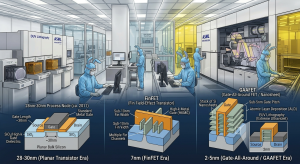
35. Semiconductors and Strategic Autonomy
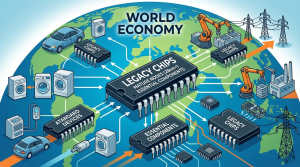
The crisis highlighted the importance of semiconductor supply chains.
Modern economies depend on chips for:
- automobiles;
- telecommunications;
- defence;
- healthcare;
- industrial machinery;
- AI;
- consumer electronics.
Europe therefore has an economic-security interest in maintaining domestic semiconductor capabilities while remaining integrated into global supply chains.
36. The Automotive Crisis
The automobile industry represents another major European transformation.
Traditional European strengths included:
- Germany;
- France;
- Italy;
- Sweden;
- Central European manufacturing networks.
However, the industry is undergoing a transition toward:
- electric vehicles;
- software-defined vehicles;
- batteries;
- autonomous driving;
- advanced semiconductors.
Competition from China has intensified.
Therefore, Europe’s automotive problem is not merely about energy prices.
It is about the transformation of the technological architecture of the automobile.
37. Trade and Globalisation
The 2022–2026 period demonstrated that globalisation creates both opportunities and vulnerabilities.
Europe depends on international trade for:
- energy;
- minerals;
- components;
- technology;
- food;
- export markets.
The lesson is not necessarily that Europe should abandon globalisation.
Rather, Europe needs resilient globalisation.
That means diversifying critical supply chains instead of depending excessively on one supplier or region.
38. Economic Security
The crisis expanded the meaning of economic security.
Previously, economic security was largely associated with:
- financial stability;
- employment;
- government debt.
By 2026, it increasingly included:
- energy;
- semiconductors;
- critical minerals;
- telecommunications;
- cybersecurity;
- food;
- data;
- AI;
- transport infrastructure.
This is one of the most important long-term changes produced by the 2022–2026 period.
39. The EU Versus the United States
The European economic model differs from the American model.
Europe generally provides:
- stronger social protection;
- broader public services;
- stronger labour protections;
- more extensive regulation.
The US generally possesses:
- deeper venture capital;
- larger technology companies;
- greater energy production;
- stronger capital-market integration;
- greater scale in some high-growth industries.
Europe’s challenge is therefore to preserve its social model while increasing productivity and innovation.
40. The EU Versus China
China presents a different challenge.
China combines:
- large-scale manufacturing;
- state-supported industrial policy;
- enormous domestic markets;
- rapidly expanding technological capabilities;
- strong infrastructure investment.
European companies remain globally competitive in many sectors.
However, the competitive gap is narrowing in several technologies.
This creates pressure for Europe to increase:
- investment;
- industrial policy;
- innovation;
- research commercialisation;
- infrastructure.
41. Was Europe in Recession?
A critical academic distinction must be made.
Europe experienced periods of stagnation and recession-like conditions in individual economies and sectors.
But the entire EU did not experience a continuous economic collapse from 2022 through 2026.
Indeed:
- EU GDP continued to grow over much of the period;
- employment remained relatively resilient;
- inflation eventually declined;
- investment continued;
- energy dependence on Russia was reduced;
- GDP returned to positive growth.
The better description is:
The EU experienced a prolonged period of economic stress and structural transformation rather than one uninterrupted recession.
42. The Crisis as a Multi-Layer System
The EU economy can be represented as an interconnected system:
Geopolitical conflict
↓
Energy disruption
↓
Higher energy prices
↓
Higher production costs
↓
Higher consumer prices
↓
Inflation
↓
Higher interest rates
↓
Lower credit and investment
↓
Slower economic growth
↓
Fiscal intervention
↓
Higher government expenditure
↓
Debt and fiscal pressure
↓
Need for structural reform
↓
Energy transition + digitalisation + industrial transformation
This explains why the crisis was so complex.
43. Major Winners and Losers
The crisis did not affect every sector equally.
More resilient areas
- technology;
- digital services;
- healthcare;
- defence;
- renewable energy;
- infrastructure;
- some professional services.
More vulnerable areas
- energy-intensive manufacturing;
- construction;
- heavily indebted businesses;
- low-income households;
- gas-dependent industries;
- interest-sensitive sectors.
44. Social Consequences
The crisis had important social consequences.
Inflation can increase inequality because lower-income households generally spend a larger proportion of their income on necessities.
The crisis therefore increased political pressure around:
- wages;
- pensions;
- energy subsidies;
- taxation;
- housing;
- social protection.
Economic policy became increasingly connected to social stability.
45. Political Consequences
Economic hardship can influence political behaviour.
Issues such as:
- immigration;
- energy prices;
- taxation;
- agricultural costs;
- unemployment;
- housing;
- public spending;
became increasingly politically important.
The economic crisis therefore contributed to wider debates about the future direction of European integration.
46. The European Fiscal Architecture
The crisis also raised questions about the future of European fiscal policy.
The EU contains countries with very different:
- debt levels;
- productivity;
- industrial structures;
- demographics;
- tax systems.
A common monetary policy therefore has to operate across very different economies.
This is one of the fundamental challenges of monetary union.
47. The Euro’s Role
The euro provided major benefits during the crisis.
It facilitated:
- cross-border trade;
- financial integration;
- price comparison;
- monetary coordination;
- international transactions.
However, the euro area also faces limitations because individual countries cannot independently set their own national monetary policy.
The ECB must therefore design policy for the euro area as a whole.
48. Energy Independence as Economic Independence
One of the clearest lessons from 2022–2026 is:
Energy dependency can become economic dependency.
A country may possess excellent factories and highly educated workers, but if energy prices suddenly become unaffordable, industrial competitiveness can deteriorate rapidly.
Europe therefore increasingly views energy infrastructure as strategic infrastructure.
49. Europe’s New Energy Architecture
The future European energy system is likely to involve a combination of:
- solar;
- wind;
- nuclear power in supportive countries;
- hydroelectricity;
- energy storage;
- electricity interconnections;
- LNG;
- hydrogen;
- energy efficiency;
- smart grids.
The objective is not simply to produce more energy.
It is to produce reliable, affordable and strategically secure energy.
50. The 2026 Outlook
The European Commission’s Spring 2026 forecast warned that the renewed energy shock was weakening growth and raising inflation.
Its downside scenario illustrated the danger: EU GDP growth could fall to approximately 0.7% in 2026 and 2027 under a more severe energy shock, compared with higher baseline projections.
This demonstrates how strongly energy prices can still affect Europe’s macroeconomic performance.
51. The Most Important Structural Problems
The EU’s long-term economic problems can be summarised as:
- Energy costs.
- Low productivity growth.
- Demographic ageing.
- Public debt.
- Industrial competitiveness.
- Fragmented capital markets.
- Technology competition.
- Housing shortages.
- Skills shortages.
- Geopolitical uncertainty.
- Trade fragmentation.
- Infrastructure investment requirements.
52. Strategic Solutions
52.1 Build abundant energy
Europe needs reliable electricity at competitive prices.
52.2 Expand energy infrastructure
Investment should focus on:
- transmission networks;
- storage;
- interconnections;
- renewable generation;
- resilient gas infrastructure where necessary.
52.3 Increase productivity
Productivity should become a central European economic objective.
52.4 Complete the digital single market
Businesses should be able to scale across Europe more easily.
52.5 Strengthen capital markets
Europe needs more private investment in:
- technology;
- infrastructure;
- startups;
- advanced manufacturing.
52.6 Accelerate AI adoption
AI should become a productivity technology across:
- manufacturing;
- healthcare;
- finance;
- logistics;
- agriculture;
- government;
- education.
52.7 Strengthen semiconductor supply chains
Europe should develop strategic capacity while remaining connected to global semiconductor ecosystems.
52.8 Increase research commercialisation
European universities produce substantial research, but more research should become globally competitive companies.
52.9 Reform housing supply
Increasing housing supply can improve:
- labour mobility;
- affordability;
- construction employment;
- urban productivity.
52.10 Maintain sustainable public finances
Fiscal policy must balance:
investment + social protection + defence + debt sustainability.
53. A European Economic Recovery Model
A successful European recovery strategy could be represented as:
Affordable Energy
Digital Infrastructure
AI
Advanced Manufacturing
Semiconductors
Skills
Capital Investment
Trade Diversification
Fiscal Discipline
=
Higher European Productivity
Higher productivity then creates:
Higher wages → stronger consumption → greater investment → stronger tax revenues → stronger public finances.
54. Lessons for the World
The European experience contains lessons relevant beyond Europe.
Lesson 1: Energy security is economic security.
Lesson 2: Inflation can originate outside traditional monetary causes.
Lesson 3: Global supply chains require diversification.
Lesson 4: Monetary policy has powerful real-economy consequences.
Lesson 5: Government intervention can stabilise economies but cannot replace productivity growth.
Lesson 6: Technological leadership is increasingly an economic-security issue.
Lesson 7: Climate policy and energy security can become complementary rather than opposing objectives.
Lesson 8: Demographic structure matters enormously for economic growth.
55. Timeline: 2022–2026
| Year | Major Economic Development |
|---|---|
| 2022 | Russia’s invasion of Ukraine; energy shock; inflation accelerates |
| 2022–23 | European energy crisis and major cost-of-living pressure |
| 2022–23 | ECB rapidly tightens monetary policy |
| 2023 | Inflation begins declining; growth weakens |
| 2024 | Economic stabilisation but persistent weak industrial activity |
| 2025 | EU growth strengthens modestly; EU GDP grows about 1.6% |
| 2026 | New energy shock; inflation rises again |
| 2026 | EU economy continues expanding but faces weaker growth and major structural challenges |
Eurostat’s 2025 estimate and 2026 quarterly indicators provide important evidence that the period was characterised by weak and uneven growth rather than continuous economic contraction.
56. EU Economic Crisis: Core Cause-and-Effect Model
The entire period can be understood through five major layers.
Layer 1 — External shocks
- COVID-19;
- Russia-Ukraine war;
- Middle East conflict;
- commodity shocks.
Layer 2 — Economic transmission
- energy;
- supply chains;
- inflation;
- trade.
Layer 3 — Monetary response
- higher interest rates;
- tighter financial conditions;
- reduced credit.
Layer 4 — Social and fiscal response
- subsidies;
- transfers;
- public investment;
- social protection.
Layer 5 — Structural transformation
- renewable energy;
- digitalisation;
- AI;
- industrial policy;
- economic security.
57. Final Assessment
The EU economic crisis from 2022 to 2026 was not simply a story of economic decline.
It was a transition from one European economic model to another.
The old model relied heavily on:
- relatively predictable energy;
- extensive globalisation;
- strong manufacturing exports;
- inexpensive Russian energy;
- deep trade relationships with China;
- low interest rates;
- relatively stable geopolitical conditions.
The new European model is increasingly based on:
- energy diversification;
- renewable electricity;
- strategic autonomy;
- resilient supply chains;
- digitalisation;
- AI;
- defence investment;
- semiconductor security;
- technological competitiveness;
- diversified international partnerships.
The crisis exposed weaknesses that had accumulated over decades, but it also accelerated reforms that might otherwise have taken much longer.
Conclusion
The period from 2022 to 2026 represents one of the most important economic turning points in the European Union since the global financial crisis.
The Russian invasion of Ukraine produced an energy shock. The energy shock produced inflation. Inflation forced monetary tightening. Monetary tightening weakened credit and investment. Governments responded with fiscal support, increasing the importance of public finances. Meanwhile, European industry confronted competition from the United States and China, while the energy transition and digital revolution fundamentally changed the structure of production.
By 2025 and 2026, the EU had demonstrated considerable resilience. GDP was growing again, employment remained relatively strong and inflation had previously moved substantially downward. Nevertheless, the renewed 2026 energy shock showed that Europe remained exposed to global energy conditions. Eurostat’s latest figures showed positive GDP growth in the second quarter of 2026, while unemployment remained comparatively low.
The central economic challenge for Europe is therefore no longer simply “How does Europe recover from the crisis?”
The deeper question is:
How does Europe construct a more productive, technologically advanced, energy-secure and globally competitive economy capable of absorbing future shocks?
The answer will depend on Europe’s ability to combine energy security, industrial competitiveness, digital transformation, artificial intelligence, infrastructure investment, capital-market development, demographic adaptation and responsible fiscal policy.
If Europe succeeds, the crisis of 2022–2026 may ultimately be remembered not only as a period of inflation and stagnation, but as the beginning of a major restructuring of the European economic system.
If Europe fails to address its structural weaknesses, however, the continent could face a prolonged period of low productivity, high fiscal pressure, industrial decline and declining global economic influence.
The decisive variable will therefore be productivity.
Europe’s future prosperity will depend less on returning to the economic conditions of the pre-2022 world and more on building an economy capable of competing in the world of AI, advanced manufacturing, clean energy, semiconductors, robotics, digital infrastructure and strategic economic security.
Key official sources
- European Commission, Spring 2026 Economic Forecast: the Commission’s assessment of slower growth and renewed inflation from the 2026 energy shock.
- European Central Bank, 2026 Eurosystem projections and economic analysis.
- Eurostat, official EU GDP, inflation, unemployment and economic indicators.
- Eurostat, 2025 annual GDP estimates.



Be First to Comment