
Introduction
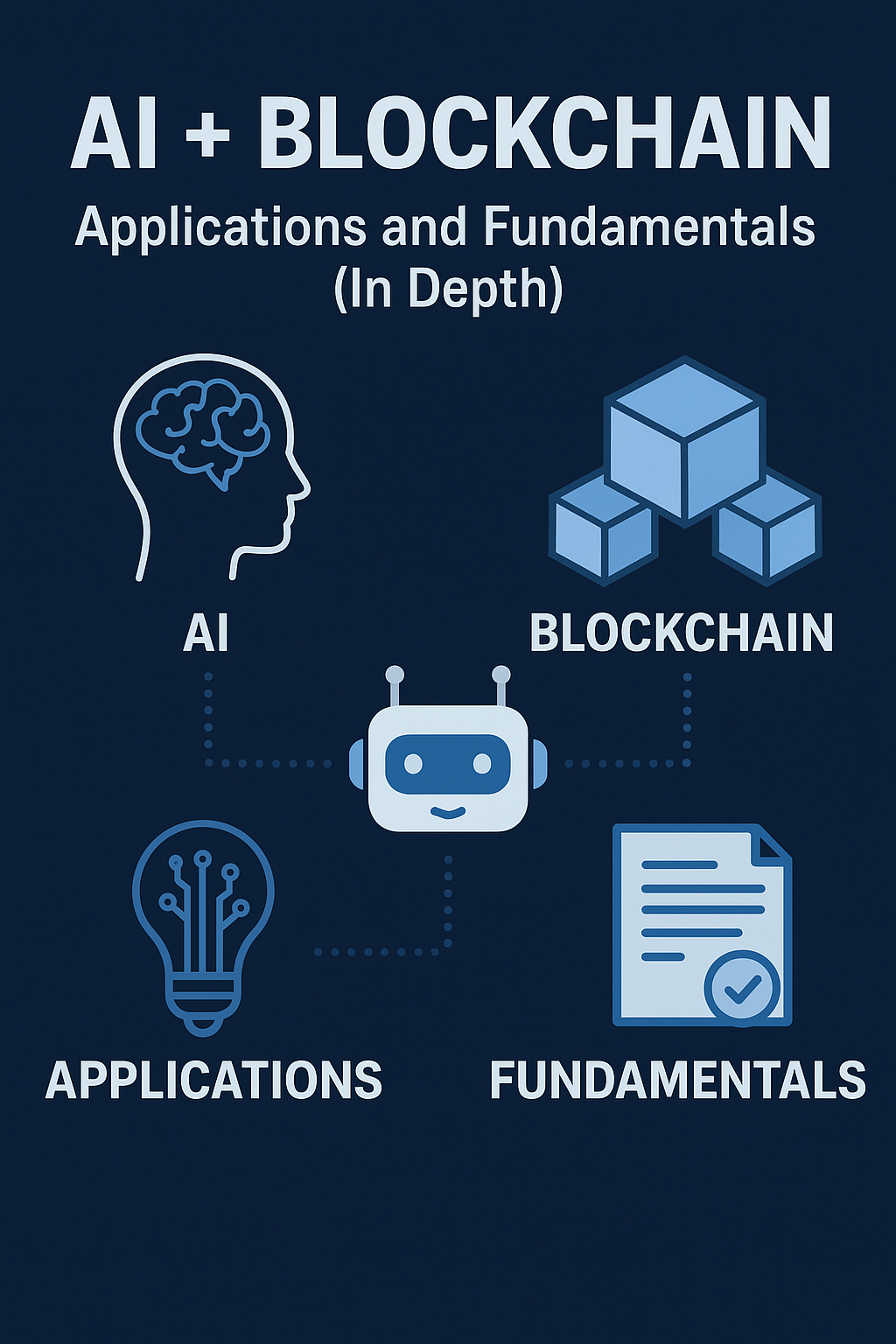
The convergence of Artificial Intelligence (AI) and blockchain technology represents one of the most transformative developments in modern computing. While AI excels at pattern recognition, decision-making, and automation, blockchain provides decentralization, transparency, and immutability. Together, these technologies are reshaping industries from finance to healthcare, creating new possibilities for secure, intelligent, and distributed systems.
This comprehensive guide explores the fundamentals of both technologies, their intersection, and provides in-depth tutorials for understanding and implementing AI-blockchain solutions.
Part 1: Understanding Blockchain Fundamentals
What is Blockchain?
Blockchain is a distributed ledger technology that maintains a continuously growing list of records, called blocks, which are linked and secured using cryptography. Each block contains a cryptographic hash of the previous block, a timestamp, and transaction data.
Core Concepts of Blockchain
Decentralization: Unlike traditional databases controlled by a central authority, blockchain distributes data across a network of computers (nodes). Each node maintains a complete copy of the ledger, eliminating single points of failure and reducing the risk of manipulation.
Immutability: Once data is recorded in a block and added to the chain, it becomes extremely difficult to alter. Any attempt to change historical data would require recalculating all subsequent blocks and gaining consensus from the majority of the network.
Consensus Mechanisms: These are protocols that ensure all nodes in the network agree on the current state of the blockchain. Common mechanisms include Proof of Work (PoW), Proof of Stake (PoS), and Practical Byzantine Fault Tolerance (PBFT).
Smart Contracts: Self-executing contracts with the terms directly written into code. They automatically execute when predetermined conditions are met, eliminating the need for intermediaries.
How Blockchain Works
The blockchain process follows these steps:
- A transaction is initiated and broadcast to all nodes in the network
- Nodes validate the transaction using predetermined rules
- Validated transactions are combined with other transactions to form a new block
- The new block is added to the chain through consensus mechanism
- The updated blockchain is distributed across the network
- The transaction is complete and permanently recorded
Types of Blockchains
Public Blockchains: Open to anyone, completely decentralized (Bitcoin, Ethereum)
Private Blockchains: Restricted access, controlled by specific organizations (Hyperledger Fabric)
Consortium Blockchains: Semi-decentralized, controlled by a group of organizations (R3 Corda)
Hybrid Blockchains: Combination of public and private elements (Dragonchain)
Part 2: Understanding AI Fundamentals
What is Artificial Intelligence?
Artificial Intelligence refers to the simulation of human intelligence in machines programmed to think, learn, and problem-solve. AI systems can perform tasks that typically require human intelligence, such as visual perception, speech recognition, decision-making, and language translation.
Core Concepts of AI
Machine Learning (ML): A subset of AI that enables systems to learn and improve from experience without being explicitly programmed. ML algorithms build mathematical models based on sample data to make predictions or decisions.
Deep Learning: A specialized form of machine learning using artificial neural networks with multiple layers. These networks can automatically learn hierarchical representations of data, making them particularly effective for complex tasks like image recognition and natural language processing.
Natural Language Processing (NLP): The ability of computers to understand, interpret, and generate human language. NLP powers applications like chatbots, translation services, and sentiment analysis.
Computer Vision: The field focused on enabling computers to interpret and understand visual information from the world, including image recognition, object detection, and facial recognition.
Types of Machine Learning
Supervised Learning: The algorithm learns from labeled training data, making predictions based on input-output pairs. Common applications include classification and regression tasks.
Unsupervised Learning: The algorithm finds patterns in unlabeled data without predefined categories. Clustering and dimensionality reduction are typical examples.
Reinforcement Learning: The algorithm learns by interacting with an environment, receiving rewards or penalties based on actions taken. This approach is used in robotics, game playing, and autonomous systems.
Neural Networks and Deep Learning
Neural networks are computing systems inspired by biological neural networks. They consist of interconnected nodes (neurons) organized in layers:
- Input Layer: Receives the initial data
- Hidden Layers: Process information through weighted connections
- Output Layer: Produces the final prediction or classification
Deep learning networks contain multiple hidden layers, allowing them to learn complex, hierarchical features from raw data. Popular architectures include Convolutional Neural Networks (CNNs) for image processing, Recurrent Neural Networks (RNNs) for sequential data, and Transformers for language understanding.
Part 3: The Intersection of AI and Blockchain
Why Combine AI and Blockchain?
The integration of AI and blockchain addresses limitations inherent in each technology:
Blockchain’s Limitations Addressed by AI:
- Limited scalability can be optimized through AI-driven algorithms
- Data analysis capabilities are enhanced through machine learning
- Smart contract complexity can be managed through AI decision-making
- Network optimization benefits from predictive analytics
AI’s Limitations Addressed by Blockchain:
- Data privacy concerns are mitigated through decentralized storage
- Model transparency improves through immutable records
- Trust in AI decisions increases through verifiable audit trails
- Data marketplace creation enables fair compensation for data providers
Key Applications of AI-Blockchain Integration
Decentralized AI Marketplaces: Platforms where AI models, algorithms, and computing resources can be traded securely. Blockchain ensures fair transactions while AI provides the intelligent services.
Federated Learning on Blockchain: A privacy-preserving machine learning approach where models are trained across multiple decentralized devices without exchanging raw data. Blockchain coordinates the process and validates model updates.
AI-Powered Smart Contracts: Intelligent contracts that can adapt based on changing conditions, learn from historical data, and make complex decisions beyond simple if-then logic.
Supply Chain Intelligence: AI analyzes supply chain data stored on blockchain to predict disruptions, optimize routes, and detect anomalies while maintaining data integrity.
Healthcare Data Management: AI algorithms analyze medical data stored on blockchain, enabling personalized treatment recommendations while protecting patient privacy.
Financial Fraud Detection: Machine learning models identify suspicious patterns in blockchain transactions, providing enhanced security for cryptocurrency and digital asset platforms.
Part 4: In-Depth Tutorial – Building AI-Blockchain Solutions
Tutorial 1: Understanding Blockchain Development Basics
Setting Up Your Development Environment
To begin blockchain development, you’ll need several tools and frameworks. For Ethereum development, install Node.js, which provides the JavaScript runtime environment. Next, install Truffle Suite, a development framework that simplifies smart contract creation, testing, and deployment. Ganache provides a personal blockchain for testing, while MetaMask serves as a browser-based wallet for interacting with blockchain networks.
Creating Your First Smart Contract
Smart contracts are written in Solidity, Ethereum’s programming language. A basic contract structure includes state variables that store data on the blockchain, a constructor function that initializes the contract, and public functions that define contract behavior.
Consider a simple data storage contract that allows storing and retrieving values. The contract maintains a mapping between addresses and stored values, enabling each user to store their own data. Functions include methods to set values, retrieve values, and emit events when data changes.
Deploying and Testing
Deployment involves compiling the Solidity code into bytecode, configuring network settings, and using migration scripts to deploy contracts to the blockchain. Testing ensures contract functionality through unit tests that verify state changes, event emissions, and error handling for invalid inputs.
Tutorial 2: Machine Learning Fundamentals
Building Your First Neural Network
Understanding neural networks begins with data preparation, including normalization, splitting into training and testing sets, and handling missing values. Network architecture design involves choosing the number of layers, neurons per layer, and activation functions.
A classification network typically starts with an input layer matching your feature dimensions, followed by hidden layers with decreasing neuron counts, and an output layer sized according to the number of classes. Common activation functions include ReLU for hidden layers and softmax for output layers in classification tasks.
Training Process
Training involves forward propagation where inputs pass through the network to generate predictions, followed by loss calculation comparing predictions to actual labels. Backpropagation computes gradients, and an optimizer updates weights to minimize loss. This process repeats for multiple epochs until the model converges.
Model Evaluation
Evaluating model performance requires testing on unseen data, calculating metrics like accuracy, precision, recall, and F1-score, and analyzing confusion matrices to understand prediction patterns. Cross-validation ensures the model generalizes well beyond the training data.
Tutorial 3: Integrating AI with Blockchain
Architecture Design
A practical AI-blockchain integration architecture separates concerns into distinct layers. The blockchain layer handles data storage, smart contract execution, and transaction management. The AI layer processes data, trains models, and generates predictions. An API layer bridges these components, facilitating communication and data exchange.
Storing AI Models on Blockchain
Rather than storing entire models on-chain due to size constraints, use a hybrid approach. Store model metadata, version information, and IPFS hashes on the blockchain, while the actual model files reside on decentralized storage like IPFS or Arweave. Smart contracts track model ownership, usage rights, and performance metrics.
Decentralized Model Training
Federated learning enables collaborative model training without centralizing data. Participants train local models on their data, then submit encrypted model updates to the blockchain. A smart contract aggregates these updates, creating a global model that benefits from diverse data sources while preserving privacy.
Implementation Steps:
- Initialize a global model and store its hash on-chain
- Distribute the model to participating nodes
- Each node trains on local data and computes gradient updates
- Nodes submit encrypted updates to the smart contract
- The contract verifies submissions and triggers aggregation
- Aggregated updates create a new global model
- The updated model hash is stored on-chain
- The cycle repeats for subsequent training rounds
Tutorial 4: Building a Decentralized AI Marketplace
Marketplace Components
A decentralized AI marketplace requires several interconnected components. Smart contracts manage model listings, handle transactions, enforce licensing terms, and distribute payments. A discovery layer helps users find relevant models through search and filtering. The execution layer enables model inference through APIs or containerized deployments.
Model Registration Process
Model providers package their trained models with metadata describing inputs, outputs, performance metrics, and pricing. They upload the model to decentralized storage and receive a content identifier. A smart contract transaction registers the model, recording the provider’s address, model hash, pricing structure, and usage terms.
Model Consumption Flow
Consumers browse available models, select one matching their needs, and pay the required fee through a smart contract. The contract verifies payment, grants access credentials, and records the transaction. The consumer receives an API endpoint or download link to access the model. Usage metrics are tracked and periodically written to the blockchain for transparency and billing purposes.
Revenue Distribution
Smart contracts automatically distribute payments based on predefined rules. The majority goes to the model creator, a percentage funds platform maintenance, and a portion may reward data contributors if the model was trained on community-provided datasets. All transactions are transparent and verifiable on the blockchain.
Tutorial 5: Privacy-Preserving AI on Blockchain
Homomorphic Encryption
Homomorphic encryption allows computations on encrypted data without decryption. AI models can process encrypted inputs and produce encrypted outputs, which only the data owner can decrypt. While computationally intensive, this technique ensures complete privacy during inference.
Zero-Knowledge Proofs
Zero-knowledge proofs enable one party to prove possession of information without revealing the information itself. In AI contexts, these proofs can verify that a model was trained on specific data or achieves certain performance metrics without exposing the model or data.
Secure Multi-Party Computation
Multiple parties can jointly compute a function over their inputs while keeping those inputs private. This approach enables collaborative model training where participants contribute data without exposing it to others. The blockchain coordinates the computation and ensures honest participation.
Implementation Considerations
Privacy-preserving techniques introduce computational overhead and complexity. Choose techniques appropriate for your use case based on privacy requirements, performance constraints, and threat model. Hybrid approaches combining multiple techniques often provide the best balance.
Part 5: Advanced Topics and Future Directions
Scaling AI-Blockchain Systems
Layer 2 Solutions
Layer 2 protocols process transactions off the main blockchain while inheriting its security. State channels, sidechains, and rollups enable high-throughput AI applications by moving computation off-chain and periodically anchoring results to the main chain.
Sharding
Sharding divides the blockchain into parallel segments that process transactions simultaneously. AI workloads can be distributed across shards, increasing overall system capacity while maintaining decentralization.
Edge Computing Integration
Combining edge computing with blockchain enables AI inference at network edges, reducing latency and bandwidth requirements. Edge devices process data locally, submitting only results or model updates to the blockchain.
Governance and Ethics
Decentralized Autonomous Organizations (DAOs)
DAOs govern AI-blockchain systems through community voting on proposals. Token holders influence decisions about model deployment, data usage policies, and system upgrades, ensuring democratic control over AI infrastructure.
Bias Detection and Mitigation
Blockchain’s transparency enables auditing AI models for bias. Training data provenance, model decision logs, and performance metrics across demographic groups can be recorded immutably, facilitating accountability and fairness assessments.
Regulatory Compliance
Smart contracts can enforce regulatory requirements automatically, such as data retention periods, consent management, and right-to-explanation provisions. Immutable audit trails simplify compliance verification for regulators.
Emerging Trends
AI-Optimized Consensus Mechanisms
Machine learning algorithms are being developed to optimize blockchain consensus, predicting network conditions, identifying malicious actors, and dynamically adjusting parameters for improved performance and security.
Quantum-Resistant Cryptography
As quantum computing advances threaten current cryptographic methods, quantum-resistant algorithms are being integrated into blockchain systems. AI helps identify vulnerabilities and optimize new cryptographic schemes.
Cross-Chain AI Services
Interoperability protocols enable AI services to operate across multiple blockchains, accessing diverse data sources and serving users on different platforms. Machine learning models coordinate these interactions, managing complexity and ensuring consistency.
Conclusion
The integration of AI and blockchain represents a paradigm shift in how we build intelligent, trustworthy, and decentralized systems. Blockchain provides the foundation of trust, transparency, and decentralization that AI needs to achieve broader adoption and accountability. Meanwhile, AI enhances blockchain capabilities through intelligent optimization, complex decision-making, and advanced data analysis.
As these technologies mature, we can expect increasingly sophisticated applications that leverage the strengths of both. From healthcare systems that protect patient privacy while enabling personalized medicine, to financial platforms that democratize access to AI-powered investment strategies, the possibilities are vast.
Success in this space requires understanding both technologies deeply, recognizing their complementary nature, and thoughtfully designing systems that balance decentralization with efficiency, transparency with privacy, and automation with human oversight. The tutorials and fundamentals covered in this guide provide a foundation for building the next generation of AI-blockchain applications.
The future belongs to systems that are not only intelligent but also trustworthy, not only powerful but also accountable, and not only efficient but also fair. By combining AI and blockchain, we move closer to realizing this vision, creating technology that serves humanity while respecting individual rights and collective well-being.


Be First to Comment