
COMPREHENSIVE SCIENTIFIC THESIS
A scientific thesis, anatomical architecture and simple practical guide
Abstract
Human breath is more than the movement of air into and out of the lungs. It is also a chemical signal containing gases, water vapour and microscopic volatile compounds originating from the mouth, tongue, teeth, respiratory system and, occasionally, other parts of the body.
Breath freshness refers to the absence, or low concentration, of unpleasant-smelling compounds in exhaled air.
The scientific study of unpleasant breath is known as halitosis research. Halitosis is the medical term for persistent unpleasant breath odour.
This thesis explores five central questions:
- What makes human breath fresh or unpleasant?
- Which organs and microorganisms contribute to breath odour?
- How can a person check their breath freshness?
- What technologies can detect and measure bad breath?
- How can oral hygiene and healthy routines maintain fresh breath?
The central principle is that breath freshness is largely influenced by the biological environment inside the mouth, especially the tongue, saliva, teeth and oral microorganisms.
CHAPTER 1: Understanding the architecture of human breath
1.1 What happens when we breathe?
Breathing is a biological exchange system involving several interconnected structures.
Why do coughs linger after a cold? | Live Science
The respiratory system includes:
- Nose and nasal cavity.
- Mouth and throat.
- Pharynx.
- Larynx.
- Trachea.
- Bronchi.
- Lungs.
- Alveoli.
- Diaphragm.
When we inhale, oxygen enters the lungs and travels into the bloodstream. When we exhale, carbon dioxide and other gases leave the body.
However, the smell of breath is not determined by oxygen and carbon dioxide alone.
It is also influenced by volatile organic compounds (VOCs).
1.2 What are volatile compounds?
Volatile compounds are chemical substances that evaporate easily and can enter the air.
Some are responsible for unpleasant breath odours.
The most important groups include:
| Compound | General significance |
|---|---|
| Hydrogen sulphide | Rotten-egg-like odour |
| Methyl mercaptan | Strong sulphurous odour |
| Dimethyl sulphide | Can contribute to breath odour |
| Other volatile organic compounds | May contribute to different odours |
These substances are often produced when oral bacteria break down proteins and other organic material.
Revisiting Standard and Novel Therapeutic Approaches in Halitosis: A Review | MDPI
CHAPTER 2: The biological architecture of bad breath
2.1 The tongue: A major source of breath odour
The tongue is one of the most important structures in the development of oral malodour.
Its upper surface contains numerous small structures called papillae. Between these structures, bacteria, food particles, dead cells and other organic material can accumulate.
This creates an environment where certain microorganisms break down proteins and release unpleasant-smelling gases.
Coated Tongue: Causes & Evidence-Based Remedies
Why the tongue matters:
- Its textured surface can retain debris.
- Bacteria can form biofilms.
- Protein breakdown can produce sulphur-containing compounds.
- A thick tongue coating can contribute to persistent bad breath.
2.2 The teeth and gums
The teeth and gums provide additional environments for bacterial growth.
Important contributing conditions include:
- Dental plaque.
- Food trapped between teeth.
- Tooth decay.
- Gum inflammation.
- Periodontal disease.
- Poorly cleaned dental appliances.
Gum Disease Explained: Signs, Symptoms, and Treatments
When gum tissues become inflamed, bacteria and inflammatory processes can contribute to unpleasant breath.
2.3 Saliva: The natural cleaning system
Saliva is one of the body’s most important natural oral-cleaning mechanisms.
It is produced mainly by three pairs of major salivary glands:
- Parotid glands.
- Submandibular glands.
- Sublingual glands.
Salivary Diagnostics Explained: Non-Invasive Health Testing – Los Angeles Times
Saliva performs several important functions:
| Function | Importance |
|---|---|
| Washing | Helps remove food debris |
| Lubrication | Keeps oral tissues moist |
| Buffering | Helps control oral acidity |
| Protection | Contains antimicrobial components |
| Remineralisation | Helps protect tooth enamel |
When saliva production decreases, the mouth becomes dry. This allows odour-producing substances and bacteria to accumulate more easily.
This explains why morning breath is often less pleasant: saliva production generally decreases during sleep.
CHAPTER 3: The main causes of unpleasant breath
Bad breath does not always indicate illness. It can be temporary or persistent.
3.1 Temporary causes
| Cause | Biological explanation |
|---|---|
| Sleeping | Reduced saliva production |
| Garlic and onions | Food-derived odorous compounds |
| Coffee | Can contribute to oral dryness and odour |
| Dehydration | Reduced moisture in the mouth |
| Fasting or long periods without eating | Can contribute to dry mouth and altered breath |
| Poor oral hygiene | Accumulation of bacteria and debris |
3.2 Dental and medical causes
Persistent bad breath can be associated with:
- Tooth decay.
- Gum disease.
- Oral infections.
- Tonsil stones.
- Sinus infections.
- Chronic dry mouth.
- Certain respiratory conditions.
- Occasionally, metabolic or other systemic diseases.
It is important to understand that most persistent bad breath originates in the mouth, rather than the stomach. PubMed Central (PMC)+2
3.3 The role of the tonsils
What are Tonsil Stones? Causes, symptoms and treatments | Live Science
The tonsils contain small natural openings called crypts.
Food debris, mucus and microorganisms can accumulate in these openings and sometimes form tonsil stones (tonsilloliths).
These can produce unpleasant odours because of bacterial activity.
CHAPTER 4: A simple guide to checking breath freshness
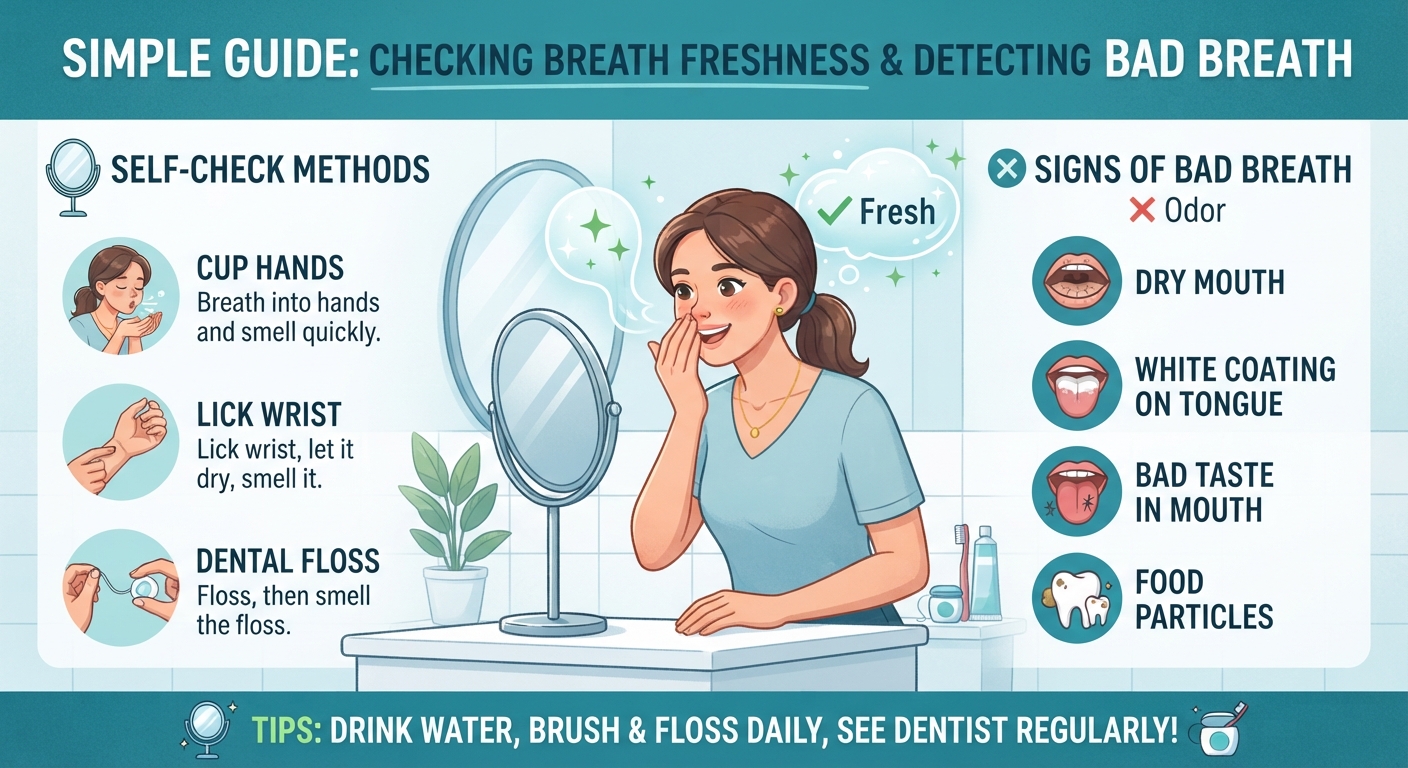
There are several ways to assess breath freshness at home. None of these methods can establish a medical diagnosis.
4.1 Method 1: The clean-spoon test
Empty spoon on white background
How to perform the observation:
- Use a clean spoon.
- Gently touch the back surface of your tongue.
- Remove the spoon.
- Allow the sample to dry briefly.
- Notice whether there is an unpleasant odour.
A strong unpleasant smell may indicate that tongue coating is contributing to breath odour.
This is only a rough screening observation, not a reliable measurement of breath freshness.
4.2 Method 2: The wrist test
This is a simple informal observation:
- Clean your hands.
- Lightly touch a small area of your inner wrist with your tongue.
- Allow the moisture to dry.
- Notice whether an unpleasant smell remains.
Limitations: saliva on the wrist does not perfectly represent the air you exhale. Therefore, this method cannot reliably confirm whether your breath is fresh.
4.3 Method 3: Checking tongue appearance
White Tongue: Symptoms, Causes, Diagnosis, Treatment and Home Remedies
Observe the tongue in a mirror under good lighting.
| Observation | Possible interpretation |
|---|---|
| Pink tongue with little coating | Often consistent with normal oral conditions |
| Thin white coating | Can be normal |
| Thick white coating | May indicate accumulated debris or other oral conditions |
| Dry-looking tongue | May suggest reduced saliva |
| Painful patches or unusual lesions | Should be assessed by a dental professional |
Important: tongue colour alone cannot establish whether someone has bad breath.
4.4 Method 4: Ask for an independent assessment
A trusted family member or dental professional may provide a more useful assessment than repeatedly checking your own breath.
People can become accustomed to their own smell, making self-assessment unreliable.
A dentist can assess the actual odour and examine the likely source.
CHAPTER 5: Modern scientific technologies for detecting bad breath
Modern dentistry uses several methods to identify and measure breath odour.
Mundgeruch| Parodontologie und Zahnerhaltung | UKM
Analyser To Test Volatile Substances Directly From Human Breath-Hanon
Halitosis Treatment in Austin, TX | Clover Smile Studio
9
5.1 Organoleptic testing
This is a clinical method in which a trained dental professional assesses the smell of exhaled breath.
It remains an important reference method for clinical assessment.
The professional may separately assess breath from the mouth and nose.
5.2 Halimeter technology
A Halimeter is a portable instrument that measures certain volatile sulphur compounds in breath.
Its advantages include:
- Rapid measurements.
- Quantitative readings.
- Monitoring changes over time.
Its limitation is that it does not detect every chemical responsible for unpleasant breath.
5.3 Gas chromatography
Spectrométrie de masse – Institut de Chimie de Clermont-Ferrand
Gas chromatography separates chemical substances within a sample.
For breath analysis, it can help identify and quantify different volatile compounds, including:
- Hydrogen sulphide.
- Methyl mercaptan.
- Dimethyl sulphide.
This offers a more detailed chemical analysis than simply assessing odour.
5.4 Electronic nose technology
An electronic nose is a system that uses multiple chemical sensors to recognise patterns of gases.
PEN3(目前世界上最先进的电子鼻——德国)-生物感知与多模态智能信息处理重庆市重点实验室
Its architecture can be understood as:
Breath sample
Air containing different chemical compounds
Chemical sensor array
Detects responses to gas molecules
Data processing
Analyses chemical response patterns
Estimated odour classification
A model-generated assessment, not a medical diagnosis
Artificial intelligence can help analyse sensor patterns, but these systems still require clinical validation before their results can be trusted for diagnosis. PubMed Central (PMC)+1
CHAPTER 6: The daily architecture of maintaining fresh breath
Fresh breath is best maintained through consistent oral hygiene rather than perfumes, sweets or breath sprays.
6.1 The morning routine
| Activity | Purpose |
|---|---|
| Brush teeth for two minutes | Removes plaque and food debris |
| Clean the tongue gently | Reduces accumulated tongue coating |
| Clean between teeth | Removes trapped food and plaque |
| Drink water | Supports normal saliva production |
| Eat breakfast | Helps establish normal daily oral activity |
6.2 The evening routine
The evening routine is particularly important because the mouth generally produces less saliva during sleep.
Recommended activities:
- Brush twice daily with fluoride toothpaste.
- Clean between teeth daily.
- Gently clean the tongue.
- Spit out toothpaste rather than rinsing extensively with water immediately afterwards.
- Keep hydrated throughout the day.
6.3 Foods and substances that influence breath
| Category | Possible influence |
|---|---|
| Water | Supports oral moisture |
| Fresh vegetables | Form part of a healthy diet |
| Apples and other fibrous foods | Encourage chewing and saliva flow |
| Garlic and onions | Can produce temporary odour |
| Sugary foods | Encourage tooth decay when consumed frequently |
| Tobacco products | Can contribute to unpleasant breath and oral disease |
Sugar-free chewing gum can temporarily stimulate saliva production. Choose products without added sugar.
6.4 Understanding mouthwash
Mouthwash can be useful as an additional oral hygiene measure, but it cannot replace brushing and cleaning between teeth.
Some formulations contain ingredients such as zinc or antimicrobial agents that help reduce odour.
However, the appropriate product depends on the individual’s oral health. Some mouthwashes may also cause irritation or dryness.
Ask a dentist or pharmacist for guidance, especially if persistent bad breath is present. healthdirect+1
CHAPTER 7: How dentists identify the source of bad breath
A professional assessment should examine the entire oral environment.
Dentist examining a patient with angle mirror
A dental examination may include:
| Structure | What the dentist investigates |
|---|---|
| Tongue | Coating and bacterial accumulation |
| Teeth | Cavities and trapped food |
| Gums | Inflammation and periodontal disease |
| Salivary glands | Possible dryness or reduced saliva |
| Tonsils and throat | Infection or tonsil stones |
| Nose and sinuses | Possible respiratory sources |
A useful distinction is whether the unpleasant smell is stronger from the mouth or nose. This can help guide the investigation, although it cannot independently establish the diagnosis.
If dental causes are excluded, a doctor may investigate other possible causes. Merck Manual Professional Edition+1
7.1 When should someone seek professional attention?
Arrange a dental examination if:
- Bad breath continues despite good oral hygiene.
- Gums repeatedly bleed or become swollen.
- Tooth pain or suspected decay is present.
- There is persistent dry mouth.
- There are recurring tonsil or throat problems.
- An unusual mouth lesion does not resolve.
Seek medical attention promptly if bad breath occurs with significant illness, fever, difficulty swallowing or breathing, or other concerning symptoms.
Do not assume that persistent bad breath means a serious internal disease. The cause needs to be investigated rather than guessed.
CHAPTER 8: The future of breath detection — AI, sensors and digital dentistry
Breath analysis is an interesting area of scientific innovation.
Future systems may combine several technologies:
Monitoring ammonia and alkaline gases in breath – Sciencemission
13
8.1 Five potential innovations
1. Miniaturised chemical sensors: Small devices capable of identifying selected compounds in exhaled air.
2. Smartphone-connected breath analysers: Devices that transmit sensor measurements to mobile applications.
3. AI chemical pattern recognition: Algorithms that identify patterns across several chemical measurements.
4. Digital dental monitoring: Systems that track changes in oral health over time.
5. Personalised oral-health systems: Technology that helps users understand hygiene patterns and seek professional assessment when needed.
8.2 The scientific data architecture
A future breath-analysis platform could use this architecture:
Digital breath-monitoring ecosystem
Biological input
Breath, saliva and oral health observations
Sensor infrastructure
Chemical sensors and measurement devices
Digital data infrastructure
Collection, storage and quality control
AI analytical engine
Chemical pattern interpretation
Professional interpretation
Dental or medical assessment and appropriate care
The opportunity is to transform breath odour assessment from a subjective experience into a more objective, measurable scientific process.
However, digital devices must not be confused with validated medical diagnostic equipment.
CHAPTER 9: Practical breath freshness assessment checklist
The following checklist can help someone maintain a simple oral-health routine.
Daily oral-health checklist
0/8 completedMy teeth are brushed twice daily with fluoride toothpaste.I clean between my teeth daily.I gently clean my tongue.I drink sufficient water throughout the day.My mouth does not feel persistently dry.I pay attention to bleeding or swollen gums.I arrange regular dental examinations.I seek dental advice if unpleasant breath persists.
Reset checklist
CHAPTER 10: Scientific conclusions
Breath freshness is a result of several interconnected biological processes.
The most important components are:
- Tongue: Its surface can harbour odour-producing bacteria.
- Saliva: Maintains moisture and helps control oral bacteria.
- Teeth: Require regular cleaning to prevent plaque and decay.
- Gums: Healthy gum tissues help prevent periodontal-related odour.
- Microbiome: The community of microorganisms influences the production of volatile compounds.
- Respiratory system: Can contribute to breath odour in certain conditions.
- Chemical analysis: Provides opportunities to measure compounds responsible for unpleasant breath.
The most important practical lesson is that fresh breath begins with a healthy oral environment. Persistent bad breath deserves investigation rather than simply being covered up with mints or sprays.
Scientific reference library
For further academic study:
- The Underestimated Problem of Intra-Oral Halitosis in Dental Practice — Scientific consensus review.
- Clinical Practice Guidelines on the Diagnosis and Treatment of Halitosis — Diagnostic methods and emerging technologies.
- Healthdirect: Halitosis — Practical prevention and treatment.
- Merck Manual: Evaluation of Halitosis — Clinical examination and diagnosis.
- South African Dental Association: Bad Breath — South African dental guidance.
Final scientific perspective: The human mouth is a complex biological ecosystem. Understanding its microorganisms, saliva, chemical compounds and anatomical structures provides the foundation for understanding breath freshness, detecting halitosis and developing future breath-analysis technologies.





Be First to Comment