
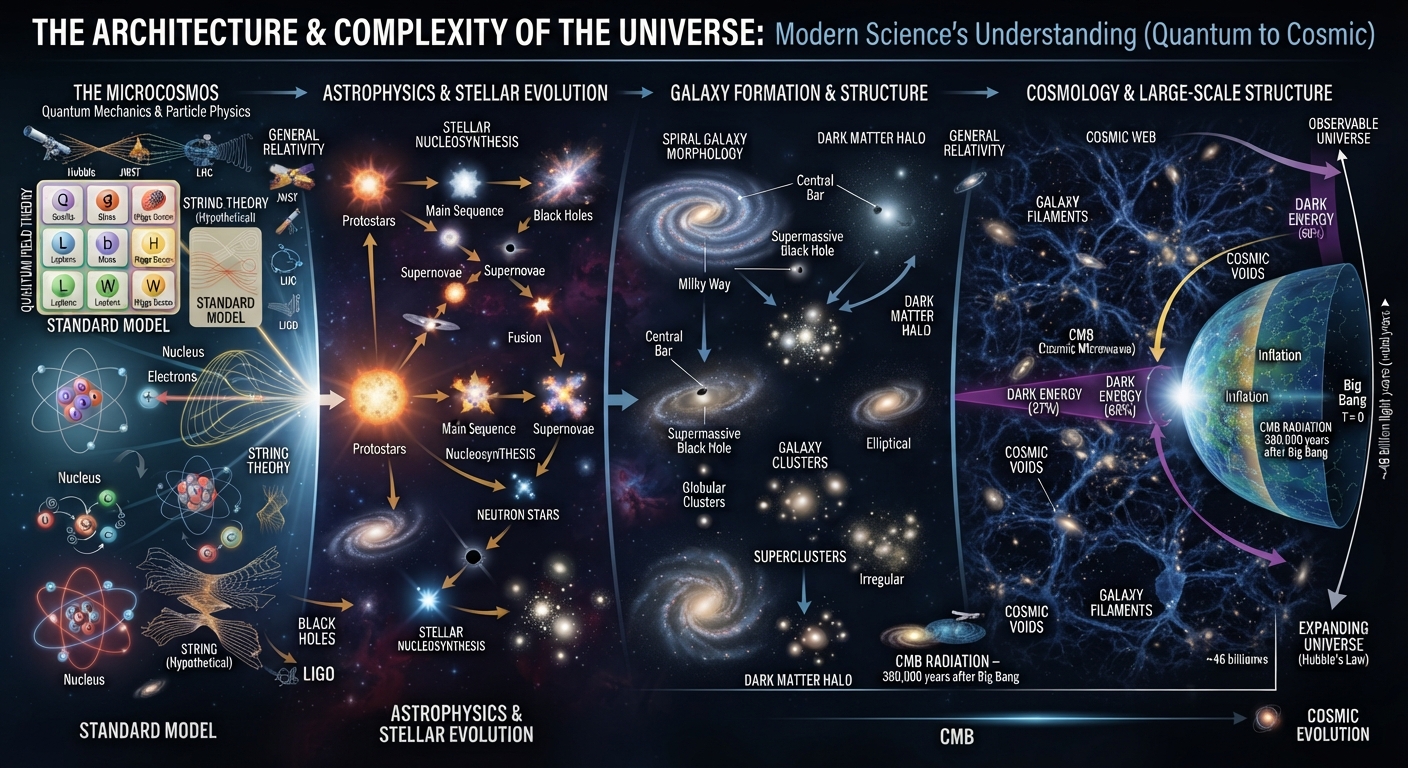
A Comprehensive Scientific Thesis on How Far Modern Science Has Advanced in Understanding the Universe, from the Birth of the Cosmos to Its Deepest Unknowns
Vast swarms of hidden galaxies may be secretly bathing the universe in a soft glow | Space
APOD: 2022 March 16 – The Observable Universe
Vistas de Gaia de la Vía Láctea | ESO España
7
Central research question: How deeply does modern science understand the architecture, physical laws, composition, evolution, dimensions, energy systems and fundamental complexity of the universe, and how much remains undiscovered?
Abstract
Humanity has made extraordinary progress in understanding the universe. What was once interpreted primarily through philosophical speculation and naked-eye astronomy has developed into a sophisticated scientific discipline combining mathematics, physics, chemistry, astronomy, cosmology, particle physics, computer science and advanced observational technology.
Modern science can explain many aspects of the universe with remarkable precision:
- How the universe evolved from an extremely hot, dense early state approximately 13.8 billion years ago.
- How stars, galaxies and planetary systems form.
- How gravity governs the motion of planets, stars and galaxies.
- How atoms, molecules and chemical elements develop.
- How light, electromagnetic radiation and other signals travel through space.
- How black holes, neutron stars and other extreme astronomical objects behave.
- How the universe is expanding.
However, significant mysteries remain. Scientists do not yet know the fundamental nature of dark matter or dark energy, what happened at the earliest conceivable moment of cosmic history, whether our universe is the only universe, or how to reconcile quantum mechanics with general relativity into a complete theory of quantum gravity.
The central conclusion is that modern science understands many of the universe’s observable structures and governing physical relationships, but does not yet possess a complete explanation of the universe’s ultimate origin, composition or fundamental nature.
PART I: THE HISTORICAL DEVELOPMENT OF HUMAN UNDERSTANDING
Chapter 1. From ancient astronomy to modern cosmology
The investigation of the universe is one of humanity’s oldest intellectual activities.
Before telescopes, computers and spacecraft existed, ancient civilizations studied the movements of the Sun, Moon, planets and stars.
Ancient Astronomy: Babylonians Used Surprising Math Leap to Track Jupiter | Space
Introduction | Copernico. Geschichte und kulturelles Erbe im östlichen Europa
7
| Historical period | Major development | Scientific significance |
|---|---|---|
| Ancient Mesopotamia | Systematic astronomical observations | Recorded planetary movements |
| Ancient Egypt | Calendar and solar observations | Timekeeping and seasonal prediction |
| Ancient Greece | Mathematical astronomy | Geometrical models of the heavens |
| 3rd century BCE | Aristarchus | Proposed a heliocentric arrangement |
| 2nd century CE | Ptolemy | Developed a mathematical geocentric model |
| 16th century | Copernicus | Advanced heliocentric astronomy |
| 17th century | Galileo | Telescopic astronomical observations |
| 17th century | Kepler and Newton | Mathematical laws of planetary motion and gravity |
| 20th century | Einstein and Hubble | Modern gravitational theory and expanding-universe evidence |
| 21st century | Space telescopes and gravitational-wave observatories | Detailed investigation of cosmic structure |
The scientific revolution
Three developments transformed our understanding:
1. The Copernican revolution
The Earth was no longer considered the central stationary object around which everything else revolved. Earth became understood as one planet orbiting the Sun.
2. Newtonian mechanics
Gravitation Concept Maps — Madhya Pradesh 9 | Super Tutor
Isaac Newton demonstrated that the same gravitational principles could explain falling objects on Earth and the orbital movements of celestial bodies.
3. Einstein’s general theory of relativity
時空のゆがみ | ギャラリー | 国立天文台 重力波プロジェクト
In 1915, Einstein introduced a revolutionary description of gravity. Gravity is understood as the manifestation of spacetime curvature associated with matter and energy.
This theory is fundamental to modern cosmology, black-hole physics and our understanding of the large-scale universe.
PART II: THE COMPLETE ARCHITECTURE OF THE UNIVERSE
Chapter 2. What is the universe?
The universe encompasses all known physical space, time, matter, energy and the physical processes connecting them.
It includes:
- Fundamental particles.
- Atomic structures.
- Molecules and chemical systems.
- Stars and planetary systems.
- Galaxies.
- Galaxy clusters.
- Superclusters and cosmic filaments.
- Vast cosmic voids.
- Spacetime and gravitational structures.
- The observable cosmic horizon.
The universe is not simply an enormous empty container holding celestial objects. It is a dynamic physical system in which matter, energy, radiation, fields, gravity and spacetime interact.
Chapter 3. The hierarchy of cosmic architecture
Lecture 2: Tools of the Trade – ASTR 201: Astronomy for Science Majors (Spring 2026)
We can understand the universe by examining its structures from the smallest scales to the largest.
| Level | Structure | Approximate scale |
|---|---|---|
| 1 | Elementary particles | Subatomic |
| 2 | Atomic nuclei | Around \(10^{-15}\) metres |
| 3 | Atoms | Around \(10^{-10}\) metres |
| 4 | Molecules | Nanometres |
| 5 | Planets | Thousands to hundreds of thousands of kilometres |
| 6 | Stars | Hundreds of thousands to billions of kilometres |
| 7 | Solar systems | Billions of kilometres and beyond |
| 8 | Galaxies | Thousands to hundreds of thousands of light-years |
| 9 | Galaxy clusters | Millions of light-years |
| 10 | Cosmic web | Hundreds of millions to billions of light-years |
| 11 | Observable universe | Approximately 93 billion light-years in diameter |
These structures are connected by physical processes, but they do not all behave according to identical dominant forces.
At the smallest scales, quantum physics becomes essential. At astronomical scales, gravity dominates the organization of matter.
Chapter 4. The observable universe: how far can we see?
One of the greatest achievements of modern astronomy is measuring the scale of the observable universe.
There are two important measurements:
- Age of the universe: approximately 13.8 billion years.
- Diameter of the observable universe: approximately 93 billion light-years.
Why is the observable universe 93 billion light-years across if the universe is only 13.8 billion years old?
The answer is the expansion of space.
Light has been travelling towards us for billions of years. During that journey, the universe itself expanded. Consequently, the objects that emitted the oldest light we can now detect are much farther away today than 13.8 billion light-years.
A light-year is a unit of distance, not time.
\[ 1\text{ light-year}=9.46\times10^{15}\text{ metres} \]
The observable universe is therefore approximately:
\[ 8.8\times10^{26}\text{ metres in diameter} \]
Important distinction: The observable universe is not necessarily the entire universe. The complete universe could be considerably larger, potentially infinite. We currently cannot establish its total size.
Chapter 5. The cosmic web: the universe’s largest known architecture
Large-scale structure of the Universe | ESO Supernova
Hydrodynamic Simulations Visualize the Large-Scale Structure of Galaxies
Local supercluster | ESO Supernova
8
One of the most remarkable discoveries of modern cosmology is that galaxies are not distributed randomly.
They form an enormous interconnected structure known as the cosmic web.
The architecture consists of four major elements:
1. Filaments
Long, interconnected structures containing galaxies, gas and dark matter.
2. Galaxy clusters
Enormous gravitationally bound collections of galaxies.
3. Superclusters
Large concentrations of galaxy groups and clusters. Some are not gravitationally bound as a single permanent structure.
4. Cosmic voids
Vast regions containing relatively little matter compared with surrounding filaments.
How does the cosmic web develop?
The leading explanation is that tiny density variations in the early universe gradually grew under gravity.
The process can be simplified:
Early density fluctuations
Small differences in the distribution of matter
Gravitational attraction
Matter accumulates in regions of greater density
Formation of filaments and halos
Dark matter and ordinary matter become structured
Galaxy formation
Gas cools and forms stars inside gravitational structures
Large-scale cosmic architecture
Clusters, filaments, superclusters and voids
This is one of the most important connections between the physics of the early universe and the large-scale structure observed today.
Chapter 6. The Milky Way: our galactic home
El sondeo Califa desvela la evolución de galaxias en el tiempo y el espacio
Our Solar System is situated inside the Milky Way, a barred spiral galaxy.
Its architecture includes:
- Galactic nucleus.
- Central supermassive black hole.
- Stellar populations.
- Spiral arms.
- Interstellar gas and dust.
- Star-forming regions.
- Globular star clusters.
- Dark matter halo.
The Milky Way contains at least 100 billion stars, with estimates varying according to the methods used.
The Solar System’s position
Our Sun is not at the centre of the Milky Way. It is located in a smaller spiral feature known as the Orion Spur.
The Sun moves around the galactic centre, taking approximately 225–250 million years to complete one galactic orbit.
This means that Earth and humanity exist within a much larger moving astronomical system.
Chapter 7. Stars: the universe’s natural nuclear laboratories
This is what the first stars looked like as they were being born | National Geographic
12
Stars are among the most important structures in the universe because they produce energy and manufacture many of the chemical elements required for planets and living systems.
A star’s development can be understood through several stages.
| Stage | Scientific process |
|---|---|
| 1. Molecular cloud | Gas and dust accumulate |
| 2. Gravitational collapse | Material contracts |
| 3. Protostar | A developing star heats up |
| 4. Nuclear ignition | Hydrogen fusion begins |
| 5. Main sequence | The star maintains a long period of relative stability |
| 6. Stellar evolution | Its internal fuel changes |
| 7. Final stage | White dwarf, neutron star or black hole, depending on its mass |
Nuclear fusion: the engine of stars
Inside the Sun, hydrogen nuclei combine through nuclear reactions to produce helium.
A small amount of mass is converted into energy.
Einstein’s famous equation describes the relationship:
\[ E=mc^2 \]
Where:
- \(E\) = energy.
- \(m\) = mass converted.
- \(c\) = speed of light.
This relationship explains why even a relatively small amount of converted mass can produce enormous energy.
Where did the elements in our bodies originate?
The early universe produced mostly hydrogen and helium, together with small amounts of lithium.
Later generations of stars created many heavier elements through nuclear fusion and other nuclear processes. Stellar explosions and neutron-star mergers also contributed to the production and distribution of heavy elements.
Elements such as carbon, oxygen, calcium and iron are therefore connected to the history of stars.
The atoms in human bodies are part of the universe’s long chemical evolution.
PART III: THE FUNDAMENTAL PHYSICS OF THE UNIVERSE
Chapter 8. The four fundamental interactions
Modern physics recognises four fundamental interactions.
Grand Unification May Be A Dead End For Physics | by Ethan Siegel | Starts With A Bang! | Medium
| Interaction | What it does | Where it is important |
|---|---|---|
| Gravity | Attracts energy and matter through spacetime curvature | Planets, stars, galaxies |
| Electromagnetism | Governs electric and magnetic interactions | Atoms, light, electricity |
| Strong nuclear interaction | Binds quarks into hadrons and helps bind atomic nuclei | Atomic nuclei |
| Weak nuclear interaction | Enables certain particle transformations and radioactive processes | Nuclear reactions and particle physics |
These four interactions form the foundation of our understanding of physical processes.
8.1 Gravity
Gravity controls much of the universe’s large-scale architecture.
It explains:
- Planetary orbits.
- Stellar systems.
- Galaxy formation.
- Galaxy clusters.
- Black-hole formation.
- Gravitational lensing.
Einstein’s general relativity describes gravity through spacetime geometry.
8.2 Electromagnetism
Electromagnetism is responsible for much of the physical behaviour we encounter in everyday life.
It explains:
- Light.
- Electricity.
- Magnetism.
- Chemical bonding.
- Atomic structure.
- Radio waves.
- Microwaves.
- Infrared radiation.
- X-rays.
Without electromagnetism, the familiar structures of atoms, molecules and ordinary matter would not exist in their present form.
8.3 The strong nuclear interaction
The strong interaction binds quarks into particles such as protons and neutrons.
A residual effect of this interaction helps hold atomic nuclei together.
It is essential to the existence of ordinary atomic matter.
8.4 The weak nuclear interaction
The weak interaction is involved in processes such as beta decay and important stages of stellar nuclear reactions.
It is also essential to understanding neutrinos.
Chapter 9. Quantum mechanics: understanding the microscopic universe
At microscopic scales, nature behaves differently from our everyday experience.
Classical physics is not sufficient to explain all atomic and subatomic phenomena.
Quantum mechanics describes the behaviour of matter and energy at these scales.
Its central principles include:
1. Quantisation
Some physical quantities, such as bound-state energy levels in atoms, occur in discrete allowed values.
2. Wave-particle behaviour
Quantum objects can exhibit both wave-like and particle-like behaviour.
3. Superposition
A quantum system can be described as a combination of possible states until an appropriate measurement is made.
4. Uncertainty principle
Certain pairs of physical properties, such as position and momentum, cannot simultaneously have arbitrarily precise values.
5. Quantum entanglement
Two or more quantum systems can share correlations that cannot be explained by classical local theories.
Why quantum mechanics matters to the universe
Quantum mechanics helps explain:
- The structure of atoms.
- The formation of molecules.
- Nuclear reactions.
- The behaviour of elementary particles.
- The early universe’s quantum fluctuations.
- The physics of extremely dense astronomical objects.
Quantum field theory, which combines quantum principles with special relativity, is the foundation of the Standard Model of particle physics.
Chapter 10. The Standard Model: what is matter made of?
The Standard Model describes the known elementary particles and three of the four fundamental interactions: electromagnetic, weak and strong.
It includes two major families of matter particles.
| Particle family | Members |
|---|---|
| Quarks | Up, down, charm, strange, top, bottom |
| Leptons | Electron, muon, tau, three corresponding neutrinos |
It also includes force-carrying particles and the Higgs boson.
| Particle | Scientific function |
|---|---|
| Photon | Electromagnetic interaction |
| Gluons | Strong interaction |
| W and Z bosons | Weak interaction |
| Higgs boson | Associated with the Higgs field |
The Higgs field is associated with the generation of the masses of elementary particles through their interactions with it.
An important limitation: The Standard Model is extraordinarily successful, but it does not provide a complete description of gravity, dark matter or the entire universe.
PART IV: THE MOST EXTREME OBJECTS IN THE UNIVERSE
Chapter 11. Black holes: where gravity reaches extraordinary extremes
APOD: 11 kwietnia 2019 – Pierwszy obraz czarnej dziury w skali horyzontu zdarzeń
Black Hole Week – NASA Science
Are We Living in a Black Hole? | by Brian Koberlein
5
Black holes are among the most remarkable predictions of general relativity.
They are regions of spacetime in which gravity is so strong that, inside the event horizon, nothing can escape outwards, not even light.
Main components
- Event horizon.
- Central region where classical general relativity predicts a singularity.
- Accretion disk, when surrounding material is present.
- Relativistic jets, in some systems.
- Strong gravitational fields.
How do scientists study black holes?
Scientists use several techniques:
- Observing stars orbiting invisible massive objects.
- Measuring radiation from hot material around black holes.
- Studying gravitational lensing.
- Detecting gravitational waves from black-hole mergers.
- Imaging the immediate surroundings of certain black holes using very-long-baseline radio interferometry.
One major achievement was the Event Horizon Telescope’s imaging of the black hole in galaxy M87 in 2019, followed by the image of Sagittarius A* in 2022.
What remains unknown?
Although scientists understand many external properties of black holes, the deepest interior physics remains unresolved.
The apparent singularity in classical relativity indicates that a more complete theory involving quantum gravity may be necessary.
Chapter 12. Neutron stars and pulsars
Neutron stars are extraordinarily dense remnants of certain massive stars.
Their matter is compressed into a remarkably small volume.
Some neutron stars produce regular beams of electromagnetic radiation. When these beams sweep across Earth, astronomers can detect periodic pulses. These objects are called pulsars.
Scientists study neutron stars to investigate:
- Extreme gravity.
- Nuclear matter at extraordinary densities.
- Strong magnetic fields.
- Relativistic physics.
- Gravitational waves.
- The behaviour of matter under extreme conditions.
They provide a natural laboratory for testing physical theories that cannot easily be reproduced on Earth.
PART V: THE UNIVERSE’S COMPOSITION AND ITS BIGGEST MYSTERIES
Chapter 13. What is the universe made of?
NASA SVS | Content of the Universe Pie Chart
This is arguably one of the most astonishing discoveries in modern cosmology.
Scientists estimate that the universe’s total mass-energy composition is approximately:
The cosmic composition
68%
Dark energy
27%
Dark matter
5%
Ordinary matter
Rounded representative values of the cosmic mass-energy budget. Actual estimates depend on the cosmological model and observational data.
Source: NASA’s explanation of the universe’s building blocks. NASA Science+2
This means that the familiar matter making up stars, planets, oceans, buildings, plants, animals and human beings represents only a small proportion of the universe’s total mass-energy budget.
13.1 Dark matter
Dark matter is inferred from its gravitational effects.
Evidence includes:
- Galaxy rotation patterns.
- Gravitational lensing.
- Galaxy cluster dynamics.
- The formation of large-scale cosmic structures.
- Observations of the cosmic microwave background.
Scientists have strong evidence that something behaves gravitationally like dark matter.
However, its fundamental particle identity remains unknown.
13.2 Dark energy
Dark energy is the name given to whatever is responsible for the observed accelerated expansion of the universe, within the standard cosmological interpretation.
It is not simply ordinary energy or a known material floating between galaxies.
One possibility is that it represents a cosmological constant associated with the energy density of empty space.
Other possibilities involve new physical fields or modifications to our understanding of gravity.
Its fundamental nature remains unresolved.
13.3 The missing-mass problem
The dark matter problem asks:
Why do galaxies and clusters exhibit gravitational behaviour that cannot be adequately explained by their observed ordinary matter alone?
This question has been investigated for decades and remains one of the major research areas in astrophysics.
Chapter 14. The cosmic microwave background: observing the universe’s ancient light
Best Map Ever of the Universe – NASA Science
One of the strongest pieces of evidence supporting the Big Bang model is the cosmic microwave background (CMB).
It is ancient electromagnetic radiation released when the universe became sufficiently cool for electrons and nuclei to combine into neutral atoms.
This happened approximately 380,000 years after the beginning of the hot early-universe expansion.
Before this period, the universe was an extremely hot plasma in which photons were repeatedly scattered by free electrons.
After neutral atoms formed, light could travel much more freely through space.
That ancient radiation is still detectable today, although cosmic expansion has stretched it into microwave wavelengths.
Why is the CMB important?
It provides information about:
- The early universe’s temperature.
- The distribution of matter and energy.
- The universe’s geometry.
- The density fluctuations that later developed into galaxies.
- The age and expansion history of the universe.
The CMB is effectively a scientific photograph of the universe at an extremely early stage.
Its tiny temperature variations provide evidence about the initial conditions from which the cosmic web eventually developed. NASA Science+2
Chapter 15. The Big Bang: how far back can science investigate?
History of the Universe – NASA Science
The Big Bang theory is the leading scientific model describing the universe’s development from an extremely hot, dense early state.
It is important to understand what the theory actually says.
It does not describe an ordinary explosion of matter into an already-existing empty space.
Rather, it describes the expansion of space itself, together with the changing physical conditions of the universe.
A simplified cosmic timeline
| Approximate time | Major event |
|---|---|
| Earliest known physical era | Our current theories reach their limits |
| Extremely early universe | Proposed cosmic inflation |
| First few minutes | Formation of light atomic nuclei |
| 380,000 years | Formation of neutral atoms; CMB released |
| First hundreds of millions of years | First stars and galaxies develop |
| First billion years | Galaxies grow and cosmic structure develops |
| Several billion years | Galaxies merge and evolve |
| 4.6 billion years ago | Solar System forms |
| 3.8 billion years ago or earlier | Evidence of early terrestrial life |
| Present | Universe approximately 13.8 billion years old |
The precise earliest history is still being investigated.
What happened before the Big Bang?
This is one of the greatest unanswered scientific questions.
There are several theoretical possibilities:
- The universe may have originated from a quantum cosmological process.
- A previous cosmic phase may have preceded the current expansion.
- The universe may have experienced a bounce rather than an absolute beginning.
- Time itself may have emerged as part of the universe’s early development.
These are research possibilities, not established facts.
The Big Bang model successfully explains many observations about the universe’s evolution, but it does not independently establish what, if anything, preceded its earliest describable state.
PART VI: THE GEOMETRY, DIMENSIONS AND MATHEMATICAL STRUCTURE OF THE UNIVERSE
Chapter 16. Spacetime: the relationship between space and time
일반상대성 이론의 중요성, 물리적 의미 그리고 이론적 배경
Before Einstein, space and time were commonly treated as separate physical concepts.
Einstein’s theories established that space and time are interconnected components of a four-dimensional structure called spacetime.
Three dimensions describe spatial position:
- Length.
- Width.
- Height.
The fourth dimension is time.
An event can therefore be described using four coordinates:
\[ (x,y,z,t) \]
This framework is fundamental to modern physics.
How does spacetime behave?
Spacetime is not a rigid, unchanging background in general relativity.
Matter and energy influence its geometry.
That geometry, in turn, determines the motion of freely falling objects.
For example:
- Earth moves around the Sun along a path shaped by spacetime geometry.
- Light passing near massive objects can be deflected.
- Time passes at different rates depending on gravitational potential and relative motion.
- Gravitational waves propagate through spacetime.
Is there a fifth dimension?
Some advanced theories propose additional spatial dimensions.
Examples include certain versions of string theory and Kaluza–Klein theory.
However, no additional spatial dimension has been experimentally confirmed.
Scientists must distinguish mathematical possibilities from experimentally established physical reality.
Chapter 17. The mathematical language of the universe
Mathematics is one of the most powerful tools ever developed for understanding nature.
Modern cosmology relies on several mathematical disciplines.
| Mathematical discipline | Application in cosmology |
|---|---|
| Algebra | Physical relationships and equations |
| Geometry | Spatial structures and curvature |
| Calculus | Motion, change and expansion |
| Differential equations | Evolution of physical systems |
| Linear algebra | Quantum mechanics and data analysis |
| Statistics | Astronomical measurements and uncertainty |
| Probability theory | Quantum phenomena |
| Tensor mathematics | General relativity |
| Numerical computation | Cosmic simulations |
| Information theory | Analysis of complex physical systems |
Three foundational equations
1. Einstein’s mass-energy relationship
\[ E=mc^2 \]
This connects mass and energy.
2. Newton’s gravitational relationship
\[ F=G\frac{m_1m_2}{r^2} \]
This describes gravitational attraction between two masses in the Newtonian approximation.
3. Hubble-Lemaître relationship
\[ v=H_0d \]
Where:
- \(v\) = recession velocity in the simple nearby-galaxy approximation.
- \(H_0\) = Hubble expansion parameter today.
- \(d\) = distance.
This relationship helps describe the expansion of the universe.
At very large distances, relativistic cosmological models are needed rather than treating the expression as a universal ordinary velocity law.
Chapter 18. Is the universe flat, curved or spherical?
Cosmic Inflation Confirmed and Why We Need It – Reasons to Believe
Scientists investigate the large-scale geometry of the universe using measurements of the cosmic microwave background, galaxy distributions and other astronomical observations.
Three broad possibilities are:
1. Positive curvature
Space has a geometry analogous to the surface of a sphere, although in three spatial dimensions.
2. Zero curvature
Space is geometrically flat on sufficiently large scales.
3. Negative curvature
Space has a hyperbolic geometry.
Current cosmological observations are consistent with the universe being very close to spatially flat.
But spatial flatness does not prove that the universe is infinite. A space can be flat and still have a more complicated global topology.
The complete global shape and topology of the universe remain open scientific questions.
PART VII: HOW MODERN SCIENCE ACTUALLY INVESTIGATES THE UNIVERSE
Chapter 19. The scientific instruments that reveal the cosmos
Modern astronomy is no longer limited to looking through optical telescopes.
Scientists investigate the universe using multiple forms of electromagnetic radiation, particles and gravitational signals.
James Webb Space Telescope reaches its final destination — 1 million miles from Earth
1. James Webb Space Telescope
Observes infrared radiation, including light from distant early galaxies, star-forming regions and exoplanet atmospheres.
2. Hubble Space Telescope
Observes visible, ultraviolet and some infrared light to investigate stars, galaxies and cosmic evolution.
3. Event Horizon Telescope
Combines radio observatories around Earth to study the immediate surroundings of supermassive black holes.
4. LIGO
Detects tiny changes in distance caused by passing gravitational waves, including signals from merging black holes and neutron stars.
Physique. Le plus grand accélérateur de particules au monde redémarre
5. Large Hadron Collider
Studies fundamental particles and interactions by colliding particles at extremely high energies.
6. IceCube Neutrino Observatory
Detects neutrinos and helps investigate high-energy astrophysical phenomena.
The six major observational windows
| Scientific observation | What it reveals |
|---|---|
| Radio astronomy | Pulsars, gas clouds and cosmic background radiation |
| Infrared astronomy | Dust, star formation and distant galaxies |
| Visible-light astronomy | Stars, galaxies and planetary systems |
| Ultraviolet astronomy | Hot stars and energetic cosmic environments |
| X-ray astronomy | Neutron stars, hot gas and black-hole environments |
| Gamma-ray astronomy | Extremely energetic astrophysical processes |
| Gravitational-wave astronomy | Accelerating massive objects and compact-object mergers |
| Neutrino astronomy | Nuclear and high-energy processes in cosmic environments |
The major breakthrough is that scientists can now investigate the universe through different types of signals rather than relying exclusively on light.
Chapter 20. Computer science, artificial intelligence and the universe
أكبر محاكاة للكون تم إنشاؤها باستخدام أسرع حاسوب فائق في العالم| صور | بوابة أخبار اليوم الإلكترونية
New video simulations shows the birth of a galaxy over billions of years
Astrophysicien / Astrophysicienne : Formation, Salaire & Débouchés en Belgique 2026
13
Modern astronomy generates enormous quantities of data.
A single major astronomical research programme can involve millions or billions of measurements.
Computer science has consequently become an essential part of modern cosmology.
Five major computational technologies
1. Supercomputing
Simulates the evolution of galaxies, gravitational structures and cosmic matter.
2. Artificial intelligence
Helps classify galaxies, identify astronomical objects and detect patterns in complex datasets.
3. Machine learning
Identifies relationships and patterns that might otherwise be difficult to discover manually.
4. Numerical modelling
Solves mathematical equations to simulate the evolution of physical systems.
5. Big-data architecture
Stores, organizes, processes and analyses observations from multiple telescopes and research institutions.
The relationship between AI and cosmology
AI can help researchers:
- Discover previously unidentified astronomical objects.
- Analyse gravitational-lensing patterns.
- Identify unusual signals.
- Classify millions of galaxies.
- Improve computational simulations.
- Compare scientific predictions against observations.
However, AI does not independently establish that a scientific theory is true.
Its discoveries must be evaluated through physical reasoning, statistical testing and independent observations.
PART VIII: WHAT SCIENCE DOES NOT YET UNDERSTAND
Chapter 21. The ten greatest unresolved mysteries of the universe
Le temps ralentit près d’un trou noir, vrai ou faux ?
This is where we begin to understand the difference between knowing the universe’s observable architecture and understanding its ultimate nature.
| No. | Unresolved mystery | What scientists still need to understand |
|---|---|---|
| 1 | Dark matter | What particles or physical mechanism produce its gravitational effects? |
| 2 | Dark energy | What causes the accelerated cosmic expansion? |
| 3 | Quantum gravity | How can quantum mechanics and general relativity be reconciled? |
| 4 | The earliest universe | What physical conditions existed at the earliest accessible times? |
| 5 | Cosmic inflation | Did inflation happen, and what physical mechanism drove it? |
| 6 | Matter-antimatter asymmetry | Why does the observable universe contain so much more matter than antimatter? |
| 7 | Black-hole interiors | What happens to matter and information under extreme gravitational conditions? |
| 8 | Neutrino physics | What is the absolute neutrino mass scale and are neutrinos their own antiparticles? |
| 9 | Cosmic expansion tension | Why do different measurement methods produce different estimates of the present expansion rate? |
| 10 | The universe’s total extent | Is the universe finite or infinite, and what is its global topology? |
Mystery 1: What is dark matter?
We have strong gravitational evidence for its existence, but its underlying physical identity has not been established.
Mystery 2: What is dark energy?
We observe accelerated expansion within our standard cosmological interpretation, but the physical explanation remains uncertain.
Mystery 3: How does quantum gravity work?
General relativity describes gravity at large scales exceptionally well.
Quantum theory describes microscopic physical systems exceptionally well.
However, a complete experimentally verified theory combining both descriptions remains unavailable.
Mystery 4: What happened at the earliest moment?
Our known theories become incomplete when attempting to describe the earliest conditions at which quantum gravitational effects should dominate.
Mystery 5: Why is there more matter than antimatter?
Known physical processes do not yet provide a complete explanation for the matter-dominated observable universe.
Mystery 6: Why do measurements of cosmic expansion disagree?
The Hubble tension refers to differences between some determinations of the present expansion rate.
Measurements based on the early universe and those using relatively local astronomical distance methods have produced different results.
Whether this is due to measurement uncertainties, systematic effects or new physics remains an active research question.
Chapter 22. The possibility of life elsewhere in the universe
The TRAPPIST-1 Habitable Zone – NASA Science
One of the most profound questions in cosmology and astronomy is whether life exists beyond Earth.
Scientists have already discovered thousands of exoplanets, which are planets orbiting stars outside our Solar System.
Research investigates:
- Planetary composition.
- Atmospheric chemistry.
- Liquid-water possibilities.
- Stellar radiation.
- Planetary temperatures.
- Organic molecules.
- Chemical conditions associated with habitability.
What is an exoplanet?
An exoplanet is a planet outside our Solar System.
Scientists detect exoplanets using techniques such as:
- Transit observations.
- Radial velocity measurements.
- Direct imaging.
- Gravitational microlensing.
- Astrometric measurements.
Does life exist elsewhere?
There is currently no confirmed scientific evidence of extraterrestrial life.
However, the discovery of potentially habitable environments makes the search scientifically important.
An essential distinction must be maintained:
A planet that could support life is not necessarily a planet on which life actually exists.
PART IX: THE FUTURE OF OUR UNDERSTANDING OF THE UNIVERSE
Chapter 23. What will future science investigate?
Hello, World! NASA Shares New Home for Roman Space Telescope Updates – NASA Science
How the Einstein Telescope will study gravitational waves | BBC Sky at Night Magazine
SKA (Square Kilometer Array) Radio Telescopes – eoPortal
6
The next generations of scientific instruments are expected to improve our understanding of the universe substantially.
Some important research directions include:
| Scientific development | Expected research contribution |
|---|---|
| Nancy Grace Roman Space Telescope | Dark energy, exoplanets and wide-field infrared surveys |
| Euclid mission | Dark matter distribution and cosmic expansion |
| Square Kilometre Array | Radio astronomy, galaxies and cosmic magnetism |
| Next-generation gravitational-wave detectors | More sensitive investigation of cosmic mergers |
| Advanced particle experiments | Better understanding of fundamental particles |
| Quantum technology | More precise measurements and new experimental methods |
| AI-assisted astronomy | Improved analysis of enormous scientific datasets |
The importance of the Square Kilometre Array in South Africa
Astrophysics in Crisis? Mystery Object Discovered That Could Change Everything
The Square Kilometre Array Observatory is particularly important to Africa.
South Africa hosts the MeerKAT radio telescope and is a major host country for the SKA-Mid component.
This represents an important opportunity for African scientific development.
The infrastructure supports research in:
- Radio astronomy.
- Cosmic evolution.
- Pulsar science.
- Galaxy formation.
- Cosmic magnetism.
- Fundamental physics.
- Scientific computing and data engineering.
The project also illustrates how large scientific infrastructure can contribute to human capital development, engineering, mathematics and technological innovation.
Chapter 24. Predicting the long-term future of the universe
Cosmology: Out of the darkness | Nature
The universe is not static. It is evolving.
Scientists use cosmological models to investigate its possible future.
Three broad historical scenarios are:
1. Heat death or Big Freeze
If accelerated expansion continues in a manner similar to the standard cosmological model, the universe may become increasingly dilute and cold.
Star formation will eventually cease, and usable energy differences will become increasingly scarce.
2. Big Rip
If dark energy evolves in certain extreme ways, cosmic expansion could eventually become strong enough to disrupt gravitationally bound structures.
This is speculative and not the standard expectation.
3. Big Crunch
If the universe’s expansion were eventually reversed, the universe might contract.
Current observations do not favour this as the standard future prediction.
The future depends significantly on the true physical nature of dark energy.
PART X: MEASURING HOW MUCH SCIENCE REALLY KNOWS
Chapter 25. The scientific knowledge boundary
A particularly important way of understanding modern cosmology is to distinguish between what scientists have directly observed, what they have established through mathematical models, and what remains hypothetical.
The following is a qualitative assessment, not a numerical measurement of scientific knowledge.
Our present scientific understanding
Planetary motion and orbital mechanics
Very well established
Newtonian mechanics and general relativity provide highly accurate predictions in their respective domains.
Atomic and particle physics
Very well established
Extensive experimental confirmation, although important questions remain.
Stellar and galaxy evolution
Strong understanding
Supported by observations, spectroscopy and computational modelling.
Cosmic expansion
Strong evidence
Expansion is well established, but its precise rate and underlying physics remain under investigation.
Dark matter
Identity unknown
Strong gravitational evidence, but no confirmed identification of its fundamental nature.
Dark energy
Nature unknown
Accelerated expansion is observed; its physical explanation remains uncertain.
Quantum gravity
Unresolved
No experimentally confirmed complete theory.
Ultimate origin of existence
Unknown
Science has not established why the universe exists or what, if anything, preceded its earliest describable state.
This comparison demonstrates something important: scientific knowledge is not equally advanced across every part of the universe.
We understand certain physical processes exceptionally well while other fundamental questions remain unanswered.
Chapter 26. The relationship between 12 major scientific disciplines
Understanding the universe requires the integration of many scientific fields.
| Scientific discipline | Contribution to understanding the universe |
|---|---|
| 1. Mathematics | Describes physical relationships |
| 2. Physics | Explains matter, energy, forces and spacetime |
| 3. Quantum mechanics | Explains microscopic phenomena |
| 4. Cosmology | Studies the universe’s origin, structure and evolution |
| 5. Astronomy | Observes celestial objects |
| 6. Astrophysics | Investigates the physical behaviour of astronomical objects |
| 7. Chemistry | Explains elements, molecules and chemical evolution |
| 8. Particle physics | Investigates fundamental particles |
| 9. Thermodynamics | Explains energy, temperature and entropy |
| 10. Computer science | Processes astronomical information |
| 11. Statistics | Tests observations and scientific predictions |
| 12. Biology | Investigates life and its relationship with planetary environments |
The most significant lesson is that no single scientific discipline can independently explain the entire universe.
Modern cosmology is an integrated scientific architecture.
PART XI: A MASTER FRAMEWORK FOR UNDERSTANDING THE UNIVERSE
Chapter 27. From the smallest particle to the largest cosmic structure
The following framework brings together the complete scientific hierarchy.
The Scale of the Universe Infographic | LivePhysics™
The 10 interconnected layers of cosmic architecture
- Fundamental physical fields and particlesThe underlying ingredients of known particle physics.
- Atomic and molecular architectureThe organization of matter into atoms and molecules.
- Complex chemical systemsChemical reactions, minerals and organic molecules.
- Planetary architecturePlanets, moons, atmospheres and geological systems.
- Stellar architectureStars, nuclear fusion and stellar evolution.
- Solar and planetary systemsGravitationally organized planetary environments.
- Galactic architectureStars, gas, dust, black holes and dark matter halos.
- Galaxy clusters and superclustersLarge gravitationally organized collections of galaxies.
- The cosmic webFilaments, clusters and enormous cosmic voids.
- Observable universe and spacetimeThe largest region of the universe accessible to our observations.
These layers are not a simple chain in which each structure is made exclusively from the layer immediately below it. They are interconnected levels of physical organization.
For example, the formation of a galaxy depends on gravity, dark matter, gas dynamics, radiation, nuclear physics and the expansion history of the universe.
PART XII: FINAL SCIENTIFIC CONCLUSIONS
Chapter 28. How far has modern science actually progressed?
The answer is extraordinary: humanity has progressed from observing points of light in the night sky to measuring the expansion of the universe, detecting gravitational waves, identifying elementary particles, imaging black-hole environments and observing galaxies whose light has travelled for more than 13 billion years.
Consider the following achievements.
Cosmic observation
We can observe galaxies from extremely early cosmic history.
APOD: 11 kwietnia 2019 – Pierwszy obraz czarnej dziury w skali horyzontu zdarzeń
Black-hole research
We can image the surroundings of supermassive black holes.
The Black Hole Collision That Reshaped Physics | Scientific American
Gravitational waves
We can detect disturbances in spacetime.
Se cumplen siete años del descubrimiento del Bosón de Higgs
Particle physics
We have experimentally confirmed the Higgs boson and developed the Standard Model.
Five major conclusions
Conclusion 1: We understand much of the universe’s observable architecture.
Scientists can describe the relationships between planets, stars, galaxies, clusters and cosmic structures through established physical laws.
Conclusion 2: We understand many of the fundamental mechanisms governing nature.
Quantum mechanics, electromagnetism, nuclear physics and general relativity explain an enormous range of physical phenomena.
Conclusion 3: We understand the historical evolution of the universe remarkably well.
The Big Bang model, cosmic microwave background and observed expansion provide a powerful framework for understanding cosmic history.
Conclusion 4: Most of the universe’s mass-energy composition remains physically mysterious.
Dark matter and dark energy represent approximately 95% of the cosmic mass-energy budget, yet their fundamental natures are unknown.
Conclusion 5: Understanding the universe is an unfinished scientific undertaking.
The ultimate nature of spacetime, the earliest cosmic conditions, the total extent of the universe and the fundamental origin of existence remain open questions.
My overall scientific assessment
I would distinguish three different levels of human achievement:
- Observational understanding: We have extraordinary instruments that reveal an immense amount about the observable universe.
- Mathematical understanding: We have highly successful mathematical models that predict many physical processes with exceptional accuracy.
- Fundamental understanding: We still lack a complete explanation connecting all physical phenomena into one experimentally verified theory.
The distinction is important.
Being able to observe a galaxy does not mean we understand every process inside it. Being able to calculate the expansion of the universe does not mean we understand the fundamental nature of dark energy.
Scientific progress involves continuously reducing the distance between observation, mathematical explanation and fundamental understanding.
PART XIII: RECOMMENDED ADVANCED STUDY CURRICULUM
For someone wanting to develop deep scientific understanding of the universe, I recommend the following 12-stage learning programme.
| Stage | Subject | Main research question |
|---|---|---|
| 1 | Mathematics | How does mathematics describe nature? |
| 2 | Classical physics | How do matter and energy move? |
| 3 | Electromagnetism | How do light and electromagnetic fields work? |
| 4 | Quantum mechanics | What governs microscopic reality? |
| 5 | Relativity | How do space, time and gravity interact? |
| 6 | Particle physics | What are the fundamental building blocks? |
| 7 | Nuclear physics | How are atomic nuclei formed? |
| 8 | Astrophysics | How do stars and black holes develop? |
| 9 | Cosmology | How did the universe evolve? |
| 10 | Computational science | How can we simulate the universe? |
| 11 | Observational astronomy | How do we test cosmological theories? |
| 12 | Advanced theoretical physics | What fundamental questions remain unanswered? |
Recommended scientific reference institutions
These are excellent starting points for continued research:
- NASA — Universe science and research.
- European Space Agency — Space science and missions.
- CERN — Particle physics research.
- European Space Agency Euclid mission — Dark matter and dark energy research.
- LIGO Scientific Collaboration — Gravitational-wave science.
- Square Kilometre Array Observatory — Radio astronomy research.
Additional scientific reading: NASA’s James Webb early-universe research and The building blocks of the universe. NASA Science+3
The ultimate question
There is a profound scientific and philosophical distinction between three questions:
- What is the universe made of? Physics and astronomy have answered much of this, but dark matter and dark energy remain mysterious.
- How does the universe operate? Modern science has established many of its governing physical laws.
- Why does the universe exist at all? This remains an unanswered fundamental question.
The greatest achievement of modern science is not that humanity has discovered everything about the universe.
It is that we have developed the mathematical, technological and experimental capabilities to investigate questions that were once beyond our imagination.
The universe is no longer simply something humanity observes. It is a complex physical system that humanity can measure, model, investigate and progressively understand.
And perhaps the most important lesson is this:
The more deeply science investigates the universe, the more clearly it discovers how much there is still to understand.






Be First to Comment