
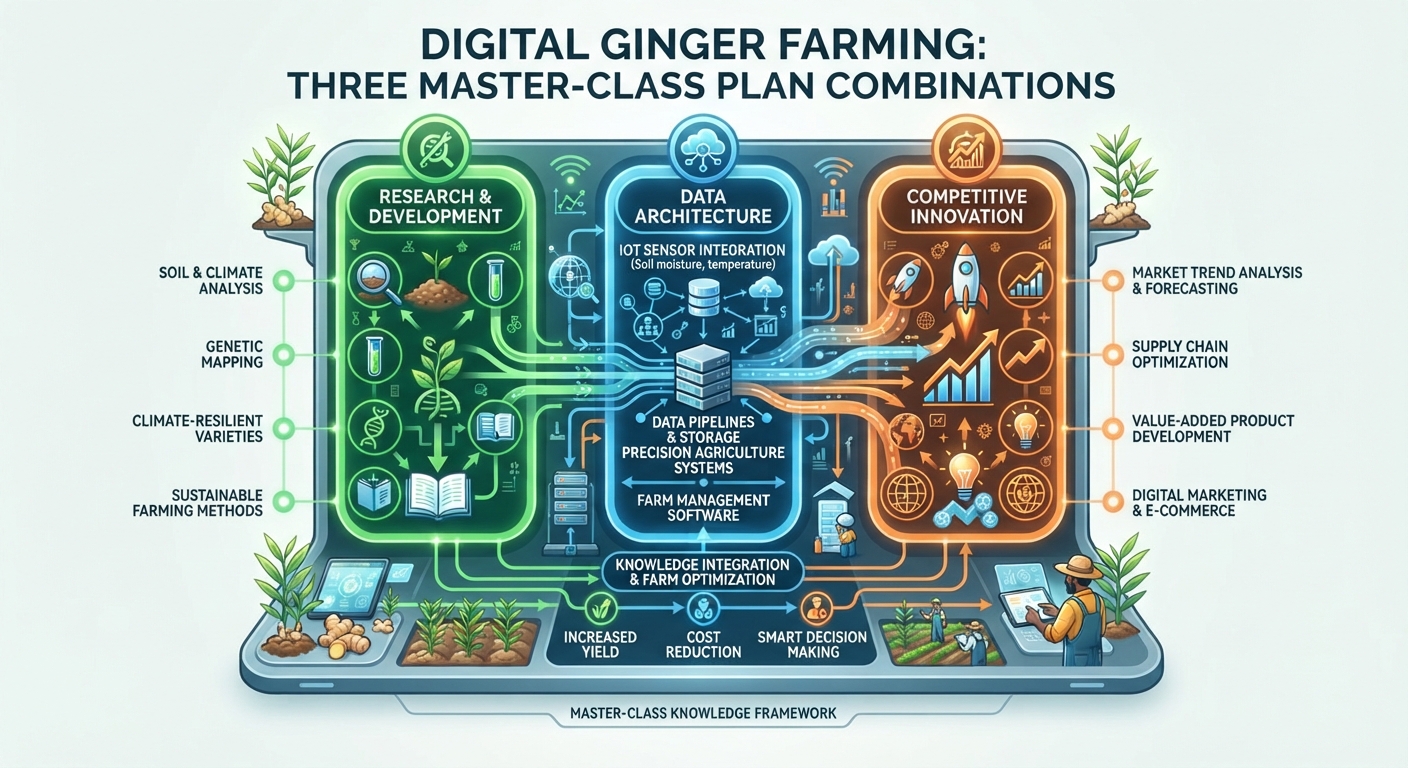
Integrating Research, Data Architecture and Competitive Innovation into a Modern Agricultural Enterprise
A three-master-class research, technology, business and agricultural development framework | South Africa and the global agricultural economy | 2026–2035
尼日利亚高附加值作物合作:Deko集团企业农业战略 – 100公顷试验及10000公顷规模生产 高效种植与出口
‘Bentong ginger farmers to get new site’ | New Straits Times
14
Executive abstract
Digital ginger farming represents the integration of agricultural science, information technology, mathematics, artificial intelligence, business intelligence and competitive innovation into one coordinated agricultural production system.
Traditional farming relies heavily on physical observation, seasonal experience and manual decision-making. Digital farming introduces an additional capability: the ability to measure, record, analyse, predict and continuously improve agricultural operations.
The objective is not simply to grow ginger. It is to build an intelligent agricultural enterprise capable of understanding the entire ginger value chain, from soil preparation and seed-rhizome selection to production, harvesting, processing, distribution and market development.
This thesis develops three interconnected master-class disciplines:
The spice is right? Researchers explore growing ginger in Illinois | Illinois Extension | Illinois
MASTER CLASS 1 — RESEARCH INTELLIGENCE
Agricultural science, soil, climate, ginger biology, experimentation, production data and evidence-based decisions.
AgriSense – Agricultura Inteligente
MASTER CLASS 2 — DATA ARCHITECTURE
Farm databases, IoT sensors, AI, cloud computing, GIS mapping, financial systems and digital management.
GR Ginger Washing Plant | Hi-Tech Ginger Cleaning, Processing & Export
MASTER CLASS 3 — COMPETITIVE INNOVATION
Productivity, quality control, agricultural processing, market intelligence, logistics, entrepreneurship and competitive advantage.
Central research proposition: The competitive future of ginger farming will increasingly depend on the quality of agricultural knowledge, the accuracy of farm data, the efficiency of production systems and the ability to convert agricultural output into higher-value products.
PART I — MASTER CLASS 1: AGRICULTURAL RESEARCH INTELLIGENCE
Chapter 1. Understanding ginger as a biological and commercial crop
Имбирь аптечный. Легенды, мифы, символизм, описание, выращивание, способы применения
Ginger (Zingiber officinale) is a tropical and subtropical herbaceous plant belonging to the Zingiberaceae family.
Its commercially valuable component is the rhizome, an underground modified stem. It is not technically a root.
The rhizome contains compounds responsible for ginger’s characteristic flavour and biological properties, including gingerols and shogaols.
1.1 Biological architecture
| Plant component | Scientific function |
|---|---|
| Rhizome | Storage, propagation and commercial harvest |
| Buds | Development of new shoots |
| Roots | Absorption of water and nutrients |
| Shoots | Above-ground plant development |
| Leaves | Photosynthesis and energy production |
| Stems | Support and transport |
The farming process must therefore manage two connected production environments:
- The underground environment, where rhizomes develop.
- The above-ground environment, where leaves capture solar energy and support plant growth.
1.2 The ginger production lifecycle
Ginger plant growth stages, root and leaves, freshly harvested
- Selection of healthy planting rhizomes.
- Land preparation and soil testing.
- Planting and establishment.
- Germination and shoot development.
- Vegetative growth.
- Rhizome development and enlargement.
- Crop maturity assessment.
- Harvesting and post-harvest handling.
- Cleaning, grading, storage and marketing.
Commercial ginger production commonly takes approximately 8–10 months, although the period depends on variety, environment, planting date and intended market.
Chapter 2. Soil science: the foundation of digital ginger farming
Im Blickpunkt: Tag der Erde – Ackerboden ist wichtiger Lebensraum
The first major investment in ginger production should be scientific understanding of the soil.
Ginger requires soil that supports:
- Adequate drainage.
- Good aeration.
- Organic matter.
- Moisture retention without waterlogging.
- Appropriate nutrient availability.
- Healthy soil biological activity.
2.1 Soil characteristics to measure
| Parameter | What it tells the farmer |
|---|---|
| Soil pH | Acidity or alkalinity |
| Nitrogen | Vegetative development |
| Phosphorus | Root and early plant development |
| Potassium | Plant regulation and rhizome development |
| Organic carbon | Soil organic matter status |
| Electrical conductivity | Soluble salt concentration |
| Soil texture | Sand, silt and clay proportions |
| Soil moisture | Water availability |
| Drainage | Risk of excessive water accumulation |
A mildly acidic soil is generally suitable. A practical preliminary target is approximately pH 5.5–6.5, but actual amendments must follow a laboratory soil test.
2.2 Soil data architecture
Every production field should have a digital soil record.
For example:
| Field record | Example |
|---|---|
| Farm identification | Farm 001 |
| Field identification | Block A |
| Soil pH | Laboratory result |
| Nitrogen | Laboratory result |
| Phosphorus | Laboratory result |
| Potassium | Laboratory result |
| Soil texture | Laboratory classification |
| Organic carbon | Laboratory result |
| Drainage classification | Field assessment |
| Sampling date | Recorded date |
The objective is to develop a historical soil database.
Instead of repeatedly guessing what the land requires, the farmer can compare soil conditions across planting seasons.
Chapter 3. Climate, temperature and water intelligence
Ginger production is influenced by temperature, rainfall, humidity, sunlight and soil moisture.
A digital farm should measure these environmental conditions continuously or at suitable intervals.
| Environmental variable | Agricultural importance |
|---|---|
| Temperature | Influences plant development |
| Rainfall | Determines natural water supply |
| Relative humidity | Influences disease conditions |
| Solar radiation | Supports photosynthesis |
| Wind speed | Influences water loss and plant conditions |
| Soil moisture | Helps guide irrigation |
| Soil temperature | Influences rhizome establishment |
3.1 Smart irrigation
生姜畑の写真素材|写真素材なら「写真AC」無料(フリー)ダウンロードOK
A smart irrigation system combines:
- Soil-moisture sensors.
- Weather information.
- Crop growth-stage records.
- Irrigation valves.
- Water-flow meters.
- Digital monitoring software.
The system helps determine when irrigation is necessary, rather than relying exclusively on a fixed watering schedule.
However, sensors require calibration and field verification. A moisture reading from one location cannot automatically represent an entire field.
Chapter 4. Ginger diseases and agricultural biosecurity
Selected ginger rhizomes ready for planting as seed-pieces. | Download Scientific Diagram
14
Disease management is a central component of commercial ginger farming.
Important risks include:
- Bacterial wilt.
- Soft rot and rhizome rot.
- Nematode damage.
- Soil-borne fungal diseases.
- Poor-quality or infected planting material.
Digital disease management should record:
- Field location.
- Date of observation.
- Plant growth stage.
- Symptoms observed.
- Weather conditions.
- Laboratory diagnosis where necessary.
- Corrective action.
- Subsequent field observations.
A digital warning system cannot replace plant pathology expertise, but it can help identify patterns early and improve traceability.
Chapter 5. Agricultural experimentation and scientific research
A modern ginger farm should operate partly as a research laboratory.
The farmer should not simply assume that a particular variety, soil amendment or irrigation schedule is best. These should be tested under local conditions.
5.1 Establishing agricultural experiments
Consider three experimental plots:
| Research plot | Experiment | Measurement |
|---|---|---|
| Plot A | Standard soil preparation | Growth and yield |
| Plot B | Improved organic matter | Growth and yield |
| Plot C | Improved moisture management | Growth and yield |
Keep other important variables as consistent as possible.
Measure:
- Germination percentage.
- Plant survival.
- Leaf development.
- Soil moisture.
- Disease incidence.
- Rhizome weight.
- Marketable yield.
- Production cost per kilogram.
This creates evidence for selecting the most effective production method.
5.2 Scientific mathematics in ginger farming
Several mathematical models can improve agricultural decisions.
Germination percentage
\[ G=\frac{\text{Number germinated}}{\text{Number planted}}\times100 \]
Marketable yield per hectare
\[ Y=\frac{\text{Marketable ginger harvested (kg)}}{\text{Area (ha)}} \]
Water-use productivity
\[ WUE=\frac{\text{Marketable yield (kg)}}{\text{Water used (m}^3\text{)}} \]
Disease incidence
\[ DI=\frac{\text{Affected plants}}{\text{Total plants inspected}}\times100 \]
Gross margin
\[ GM=\text{Sales revenue}-\text{Variable production costs} \]
These calculations transform farm observations into measurable management information.
Chapter 6. South African ginger production research
South Africa offers different production environments, but ginger is not equally suited to every agricultural region.
The Agricultural Research Council (ARC) identifies ginger as a crop grown commercially as an annual, with an approximate eight-to-nine-month growing period under its South African production description. arc.agric.za
A game-changer for ginger production
The coming ginger crop will exceed expectations, South African grower says – Worldnews.com
A game-changer for ginger production
13
Regional assessment should consider:
| Region | Research priorities |
|---|---|
| Limpopo | Heat management, irrigation, humidity and water availability |
| KwaZulu-Natal | Rainfall distribution, humidity and drainage |
| Mpumalanga | Local temperature, rainfall and soil conditions |
| Gauteng | Temperature management and protection against cold |
| Eastern Cape | Local climate suitability and irrigation requirements |
An important South African example is commercial ginger production around Makhado in Limpopo. A Farmers Weekly case study describes protected cultivation, temperature management, irrigation monitoring and market-oriented variety selection. It illustrates how local production experience can inform research, but its results should not automatically be applied to every farm. Farmer’s Weekly SA
Research principle: Determine the suitability of a site before investing in large-scale production. A location’s name alone does not establish its agricultural suitability.
PART II — MASTER CLASS 2: DIGITAL DATA ARCHITECTURE
Chapter 7. Building the digital ginger farm
The digital farm should function as an integrated information system.
It must connect the physical agricultural environment with digital records, analytical software and management decisions.
7.1 The seven-layer digital farming architecture
Digital ginger farm architecture
LAYER 7 — BUSINESS INTELLIGENCE
Profitability • Market demand • Productivity • Strategic decisions
LAYER 6 — ARTIFICIAL INTELLIGENCE
Forecasting • Disease alerts • Yield prediction • Recommendations
LAYER 5 — DATA STORAGE AND CLOUD
Farm database • Historical records • Backups • Data security
LAYER 4 — CONNECTIVITY
Internet • Mobile networks • Wi-Fi • Sensor gateways
LAYER 3 — MONITORING AND CONTROL
Irrigation • Environmental monitoring • Equipment management
LAYER 2 — SENSORS AND DATA COLLECTION
Soil • Water • Temperature • Weather • Drone imagery
LAYER 1 — PHYSICAL FARM
Land • Soil • Plants • Water • Labour • Machinery
Information travels upwards for analysis. Management decisions travel downwards to guide farm operations.
The seven layers form one connected agricultural management architecture.
Chapter 8. Internet of Things (IoT): creating a measurable farm
IoT Based Irrigation System | Nationin
The Internet of Things allows physical agricultural equipment and sensors to communicate with digital systems.
8.1 Essential digital equipment
| Equipment | Data collected | Application |
|---|---|---|
| Soil-moisture sensor | Soil water content | Irrigation decisions |
| Temperature sensor | Soil and air temperature | Climate monitoring |
| Humidity sensor | Relative humidity | Disease-risk assessment |
| Weather station | Rainfall, wind and radiation | Weather planning |
| Water-flow meter | Irrigation volume | Water accounting |
| Soil EC sensor | Electrical conductivity | Salinity monitoring |
| Drone | Aerial imagery | Crop inspection |
| GPS receiver | Field coordinates | Field mapping |
Not every farm needs every instrument immediately. Begin with measurements that influence the most important decisions.
8.2 Example of an automated irrigation information process
Ginger farm with drip irrigation.
- A sensor measures soil moisture.
- The gateway sends the reading to the farm database.
- Software compares it with a locally calibrated irrigation threshold.
- Weather and crop-stage information are considered.
- The farmer receives an irrigation recommendation.
- An authorised operator confirms the action or an appropriately configured controller operates the irrigation equipment.
- Water usage and subsequent moisture readings are recorded.
The system must include manual override, equipment-failure alerts and safeguards against over-irrigation.
Chapter 9. Database architecture and agricultural information management
A serious digital farm requires a structured database rather than disconnected spreadsheets.
9.1 Core database entities
| Database table | Information |
|---|---|
| Farms | Farm identity and location |
| Fields | Field boundaries and area |
| Soil tests | Laboratory measurements |
| Planting records | Variety, date and seed lot |
| Crop observations | Growth and plant condition |
| Sensors | Device identification |
| Sensor readings | Measurements and timestamps |
| Irrigation | Water application records |
| Fertilisation | Nutrient applications |
| Disease records | Symptoms and diagnoses |
| Harvests | Weight, grade and quality |
| Inventory | Inputs and harvested stock |
| Sales | Buyers, quantities and prices |
| Expenses | Labour, energy and inputs |
Each record should have a unique identifier, date, field reference and responsible person.
9.2 How the data connects
FARM
  |
  +---- FIELD
          |
          +---- SOIL TEST
          |
          +---- PLANTING RECORD
          |
          +---- CROP OBSERVATIONS
          |
          +---- SENSOR READINGS
          |
          +---- IRRIGATION RECORDS
          |
          +---- DISEASE RECORDS
          |
          +---- HARVEST
                   |
                   +---- GRADING
                   |
                   +---- INVENTORY
                   |
                   +---- SALES
This creates a complete digital history from the original soil assessment to the final sale.
Chapter 10. Artificial intelligence and machine learning
SatAgro.AI — Satellite & AI Crop Monitoring Platform
Artificial intelligence can analyse information that would be difficult to evaluate manually across many fields and production seasons.
10.1 Ten applications of AI in ginger farming
| AI application | Agricultural intelligence |
|---|---|
| 1. Soil analysis | Identifies patterns in soil measurements |
| 2. Weather forecasting | Supports planting and irrigation planning |
| 3. Water management | Estimates irrigation requirements |
| 4. Crop monitoring | Detects unusual crop patterns |
| 5. Disease detection | Flags possible disease symptoms |
| 6. Growth analysis | Compares development between plots |
| 7. Yield forecasting | Estimates potential harvest |
| 8. Inventory management | Tracks planting material and stock |
| 9. Market forecasting | Analyses historical prices and demand |
| 10. Financial forecasting | Models production costs and revenue |
10.2 Machine learning architecture
A predictive system needs historical observations.
For example, to predict ginger yield, the system could analyse:
- Soil properties.
- Planting material.
- Plant population.
- Weather conditions.
- Irrigation volumes.
- Nutrient management.
- Disease incidence.
- Previous harvest results.
Its output would be an estimated yield, ideally accompanied by a prediction range and confidence level.
Importantly, AI predictions are not guaranteed agricultural facts. Their quality depends on the reliability, quantity and relevance of training data.
10.3 Satellite imagery and drones
How Drones Help You Catch Problems Before They Spread – Candrone
Internet of Fields: Drones & variable rate application | Pix4D
Terrion — Precision Agriculture Platform | NDVI, SAR, AI
12
Remote sensing can help assess:
- Crop canopy development.
- Differences in plant vigour.
- Water-stress patterns.
- Changes in vegetation.
- Field variability.
However, satellite imagery cannot directly confirm underground rhizome quality or diagnose every plant disease. Field inspection and laboratory testing remain important.
Chapter 11. Cloud computing and digital farm security
Cloud computing makes it possible to access farm records from different devices and locations.
A suitable architecture includes:
- A mobile farm-management application.
- A central agricultural database.
- Cloud backups.
- Sensor communication services.
- Data analytics.
- Management dashboards.
- User access controls.
Security should include strong authentication, restricted permissions, encrypted communications, regular backups and documented data ownership.
A farmer should retain access to their original records even if a technology supplier changes its service.
11.1 Digital farm dashboard
A practical management dashboard should contain:
Crop health
Live
Field observation status
Water management
m³
Water consumption records
Disease monitoring
%
Plants affected, if any
Production
kg
Harvest and yield records
Farm finances
R
Costs and revenue
Market intelligence
R/kg
Recorded selling prices
The dashboard should display actual collected data, not fabricated values or unverified predictions.
PART III — MASTER CLASS 3: COMPETITIVE INNOVATION AND AGRICULTURAL BUSINESS INTELLIGENCE
Chapter 12. Transforming ginger farming into a competitive enterprise
Procuring Ginger Oil Wholesale: Navigating Quality and Regulation – Shiva Exports India
Producing ginger is only the first stage of the agricultural economy.
A competitive ginger enterprise must understand five economic activities:
- Agricultural production.
- Post-harvest management.
- Processing and manufacturing.
- Distribution and logistics.
- Marketing and commercial relationships.
The greatest opportunity may not always be in producing more ginger. It may be in improving the quality, consistency, processing, storage and delivery of the ginger.
Chapter 13. The ginger value-chain architecture
How Is Ginger Processed from Farm to Export? – Laizhou Wildfire Biotechnology Co., Ltd.
The complete commercial value chain can be divided into eight interconnected stages.
01
Agricultural inputs
Land, planting material, compost, irrigation and equipment.
02
Primary production
Planting, crop management, monitoring and disease prevention.
03
Harvesting
Maturity assessment, lifting and field sorting.
04
Post-harvest handling
Cleaning, trimming, curing and grading.
05
Processing
Fresh preparation, drying, powder and other ginger products.
06
Packaging and storage
Quality protection, labelling and inventory management.
07
Distribution
Transport, wholesalers, retailers and food manufacturers.
08
Market intelligence
Customer feedback, prices, demand and product development.
The commercial objective is to develop a system in which every stage generates information that improves the next stage.
Chapter 14. Ginger processing and value addition
How to Peel and Slice Ginger – Jinan Jiaruichang Machinery Equipment Co., Ltd.
面姜新贵:莱芜大面姜如何“煮”出姜面条啊的爆款商机? – 一亩田
Цагаан гааны нунтаг юунд сайн вэ? – Scigroundbio
14
Ginger has several commercial product opportunities.
| Product | Processing requirement | Potential customer |
|---|---|---|
| Fresh ginger | Cleaning, grading and packaging | Retailers and wholesalers |
| Dried ginger | Controlled drying | Spice manufacturers |
| Ginger powder | Drying and milling | Food industry |
| Ginger paste | Controlled food processing | Food manufacturers |
| Ginger extracts | Specialist extraction and quality control | Ingredient manufacturers |
| Ginger tea ingredients | Drying and blending | Beverage producers |
Value addition requires more than buying processing machinery. It requires food safety, product consistency, suitable packaging, shelf-life testing, production records and compliance with applicable regulations.
14.1 Understanding the processing economics
A farmer must calculate the conversion rate from raw ginger to processed products.
For example, the following is an illustrative calculation, not a guaranteed industry yield:
Suppose a processing experiment begins with 1,000 kg of fresh ginger and produces 220 kg of dried product.
\[ \text{Conversion rate}= \frac{220}{1000}\times100=22\% \]
The remaining weight is primarily moisture loss, together with any material removed during cleaning and preparation.
This conversion ratio should be measured for the actual variety and processing method.
Chapter 15. Market intelligence and competitive positioning
A digital ginger enterprise must understand the difference between production intelligence and market intelligence.
Production intelligence answers:
- How much ginger can we produce?
- How healthy is the crop?
- What will production cost?
- What quality can we achieve?
Market intelligence answers:
- Who buys ginger?
- What quantities do they require?
- Which grades do they prefer?
- What prices do they pay?
- What packaging do they require?
- How frequently do they purchase?
- What are their delivery requirements?
15.1 Potential customer segments
Ginger paves way to prosperity in Laiwu district_news_english_QiluNet
14
| Market | Main commercial requirement |
|---|---|
| Fresh produce wholesalers | Volume and consistent supply |
| Supermarkets | Appearance, grading and traceability |
| Restaurants | Freshness and reliable deliveries |
| Spice manufacturers | Dry matter, flavour and processing quality |
| Food processors | Consistent raw material |
| Export markets | Strict quality and phytosanitary requirements |
Before production begins, conduct buyer interviews and obtain realistic price and quality information.
Do not build a production budget around an assumed selling price.
Chapter 16. Agricultural economics and financial intelligence
The financial architecture must connect every farming operation to its cost.
16.1 Main investment categories
| Investment category | Examples |
|---|---|
| Land development | Land preparation and drainage |
| Water infrastructure | Borehole assessment, pumps and storage |
| Irrigation | Pipes, filters, valves and drip lines |
| Planting material | Healthy ginger rhizomes |
| Soil improvement | Laboratory tests and amendments |
| Technology | Sensors, connectivity and software |
| Labour | Planting, maintenance and harvesting |
| Processing | Washing, grading and drying |
| Logistics | Transport and storage |
| Administration | Insurance, compliance and management |
16.2 Essential financial formulas
Total production cost
\[ TC=FC+VC \]
Where:
- \(FC\) = fixed costs.
- \(VC\) = variable costs.
Revenue
\[ R=Q\times P \]
Where:
- \(Q\) = quantity sold.
- \(P\) = selling price per unit.
Net operating profit
\[ NP=R-TC \]
This simplified calculation assumes the cost figure includes all relevant operating and fixed costs and excludes financing and tax adjustments unless separately incorporated.
Cost per kilogram
\[ C_{kg}=\frac{\text{Total production cost}}{\text{Marketable kilograms}} \]
16.3 Illustrative financial simulation
Consider a hypothetical one-hectare ginger farm.
| Financial variable | Illustrative assumption |
|---|---|
| Harvested marketable ginger | 20,000 kg |
| Average selling price | R25/kg |
| Gross sales | R500,000 |
| Total costs | R350,000 |
| Operating surplus | R150,000 |
Illustrative one-hectare financial model
Hypothetical figures, not a South African market quotation or production forecast.
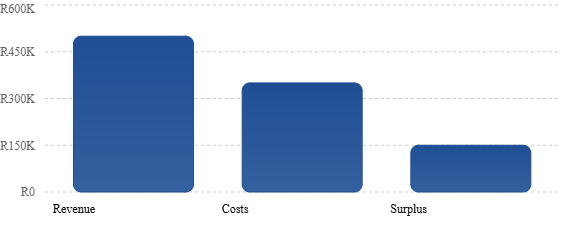
The figures are teaching assumptions only. Actual profitability depends on yield, seed costs, water, labour, disease, processing losses, market prices and financing.
Break-even price:
\[ P_{BE}=\frac{TC}{Q} \]
Using the example:
\[ P_{BE}=\frac{350000}{20000}=R17.50/kg \]
This means the enterprise would need to realise R17.50 per kilogram to cover the assumed total costs, before considering any omitted costs.
Chapter 17. Competitive innovation: the next generation of ginger farming
Innovation means creating a better way of solving agricultural problems.
It does not necessarily mean purchasing the most expensive machinery or installing the greatest number of sensors.
The best innovation is one that produces measurable improvements in cost, quality, productivity, reliability or market access.
17.1 Fifteen agricultural innovation opportunities
01
Precision soil management
Use mapped soil measurements to understand differences between field areas.
02
Intelligent irrigation
Combine moisture measurements and weather information.
03
Digital planting records
Trace every planting batch and field.
04
AI disease surveillance
Flag unusual plant symptoms for expert inspection.
05
Predictive crop analytics
Estimate harvest volumes using actual historical data.
06
Digital farm automation
Coordinate selected irrigation and monitoring tasks.
07
Agricultural robotics
Explore appropriate mechanical assistance for repetitive tasks.
08
Digital quality control
Record grading, defects and processing quality.
09
Smart storage
Monitor temperature, humidity and stock condition.
10
Agricultural traceability
Link product batches to their production history.
11
Market intelligence
Record buyer preferences, prices and demand.
12
Collective purchasing
Use farmer networks to reduce selected input costs.
13
Shared processing facilities
Improve access to value-addition infrastructure.
14
Circular agriculture
Investigate safe reuse of suitable organic residues.
15
Climate-smart production
Improve water efficiency and resilience to climate variability.
Chapter 18. Agricultural competition: building a sustainable advantage
A ginger enterprise should evaluate its competitive performance using measurable indicators.
| Competitive indicator | Measurement |
|---|---|
| Production efficiency | Marketable kg per hectare |
| Water efficiency | kg per cubic metre |
| Product quality | Percentage meeting grade |
| Disease management | Disease incidence |
| Labour efficiency | kg harvested per labour hour |
| Financial efficiency | Cost per kg |
| Delivery performance | Percentage delivered on time |
| Customer retention | Repeat purchase rate |
| Waste management | Percentage of production rejected or wasted |
| Digital maturity | Completeness and reliability of farm records |
The ultimate objective is to build an enterprise that can consistently produce quality ginger, control costs and fulfil customer requirements.
PART IV — THE INTEGRATED THREE-MASTER-CLASS MODEL
Chapter 19. Combining research, data and innovation into one operating system
The three disciplines must not function independently.
Their real value emerges when they communicate with one another.
The integrated ginger intelligence model
MASTER CLASS 1 — RESEARCH
Discover • Measure • Test • Validate
MASTER CLASS 2 — DATA ARCHITECTURE
Collect • Connect • Store • Analyse • Predict
MASTER CLASS 3 — COMPETITIVE INNOVATION
Innovate • Optimise • Process • Market • Grow
Feedback loop: commercial results inform the next research and production cycle.
Example: solving an irrigation problem
Imagine that one ginger field repeatedly experiences uneven growth.
Research discipline: Investigate soil texture, drainage, moisture and crop development.
Data discipline: Compare sensor readings, rainfall, irrigation volumes and field locations.
Innovation discipline: Test an improved irrigation layout and evaluate its effect on water consumption, plant survival and marketable yield.
Final result: A documented, measurable improvement that can be replicated if the evidence supports it.
This is the foundation of a scientific agricultural innovation culture.
Chapter 20. The ginger farm as a digital twin
A digital twin is a digital representation of a physical system.
For ginger farming, this means creating a digital model of the farm’s fields, infrastructure, crop cycles and operating conditions.
How Real Cities Are Using Digital Twins to Rethink Urban Life | by Toobler | Medium
A ginger farm digital twin could represent:
- Individual fields and planting areas.
- Soil characteristics.
- Irrigation infrastructure.
- Sensor locations.
- Crop development.
- Water consumption.
- Disease observations.
- Harvest estimates.
- Processing and storage facilities.
The digital twin could help managers compare scenarios.
For example:
- What happens if irrigation capacity is reduced?
- What happens if planting is delayed?
- How would different planting densities affect the production budget?
- What happens if a portion of the crop fails to meet the target grade?
These are simulations, not guaranteed predictions. They become more reliable as the digital model is calibrated using real farm observations.
PART V — IMPLEMENTATION MASTER PLAN: FROM ZERO TO A DIGITAL GINGER ENTERPRISE
Chapter 21. The 36-month implementation roadmap
The most sensible approach is to develop the agricultural operation progressively, test the technology and expand only when production and financial evidence justify it.
36-month development programme
- MONTHS 1–3: Research and feasibility
- Assess agricultural land.
- Conduct soil and water tests.
- Study local climate.
- Identify potential buyers.
- Investigate planting material.
- Prepare an initial business model.
- MONTHS 4–6: Infrastructure and digital foundation
- Prepare the land and drainage.
- Establish irrigation infrastructure.
- Build the farm database.
- Install essential monitoring equipment.
- Establish planting and traceability records.
- MONTHS 7–12: Production and experimentation
- Establish the ginger crop.
- Monitor plant development.
- Collect soil and irrigation data.
- Conduct controlled experiments.
- Monitor disease and crop health.
- MONTHS 13–18: Harvest and commercial evaluation
- Record harvest weights.
- Evaluate marketable quality.
- Assess post-harvest losses.
- Compare actual costs with the budget.
- Evaluate customer feedback.
- MONTHS 19–24: Processing and optimisation
- Evaluate washing and grading systems.
- Conduct processing trials.
- Improve inventory management.
- Introduce yield forecasting.
- Evaluate additional customer segments.
- MONTHS 25–36: Expansion and competitive innovation
- Improve automation.
- Expand only proven production systems.
- Develop value-added products.
- Strengthen distribution networks.
- Introduce advanced AI analytics.
- Develop long-term commercial partnerships.
Note: The calendar is a development programme, not a promise of harvest dates. Ginger’s biological growing period must be incorporated into the planting and harvesting schedule.
Chapter 22. Infrastructure requirements
Community of Gardens | Africa Projects
Demand for Peruvian ginger softens as China and Brazil enter the market
13
A digitally managed commercial farm requires several interconnected infrastructure systems.
| Infrastructure | Purpose |
|---|---|
| Agricultural land | Production |
| Soil laboratory access | Scientific testing |
| Water source | Irrigation |
| Water storage | Supply management |
| Irrigation network | Crop water distribution |
| Nursery area | Planting-material management |
| Shade structures where appropriate | Environmental protection |
| Digital connectivity | Information transmission |
| Farm office | Administration and records |
| Storage facility | Post-harvest protection |
| Processing facility | Value addition |
| Transport | Market distribution |
Open-field versus protected production
| Characteristic | Open field | Protected cultivation |
|---|---|---|
| Initial infrastructure | Generally lower | Generally higher |
| Climate control | Limited | Greater |
| Rainfall exposure | High | More controlled |
| Disease management | Requires strong field hygiene | Requires strong sanitation |
| Automation | Possible | Often easier to integrate |
| Production costs | Context-dependent | Context-dependent |
Protected cultivation does not automatically guarantee greater profitability. A South African commercial case study in Limpopo illustrates the potential of shade structures and controlled irrigation, while also highlighting the importance of managing heat and disease. Farmer’s Weekly SA+1
Chapter 23. Important agricultural risks and management
| Risk | Potential consequence | Management priority |
|---|---|---|
| Poor soil drainage | Rhizome rot | Site assessment and drainage |
| Infected planting material | Disease introduction | Verified healthy planting material |
| Water shortage | Reduced crop development | Reliable water planning |
| Excessive irrigation | Root-zone disease conditions | Moisture monitoring |
| Extreme temperatures | Plant stress | Local climate management |
| Nutrient imbalance | Poor growth | Soil and plant testing |
| Market price fluctuations | Lower revenue | Buyer diversification |
| Poor storage | Post-harvest losses | Storage monitoring |
| Equipment failure | Interrupted operations | Maintenance and manual backup |
| Inaccurate data | Poor decisions | Data validation |
Bacterial wilt deserves particular attention. Once established in soil, it can be difficult to manage. Prevention, sanitation, clean planting material and integrated disease management are therefore important. Farm Africa+1
Chapter 24. Building a ginger farming knowledge institution
One particularly valuable innovation would be to establish a digital ginger knowledge centre alongside the agricultural enterprise.
This would bring together agricultural research, farm management, technology and business development.
The institution could contain five departments:
1. Agricultural research department
Soil science, plant biology, crop experiments and disease research.
2. Digital technology department
IoT, AI, machine learning, databases and agricultural software.
3. Production and engineering department
Irrigation, mechanisation, harvesting, processing and quality control.
4. Business intelligence department
Accounting, financial models, market analysis and supply chains.
5. Human capital development department
Agricultural training, digital literacy, research skills and innovation education.
This model could eventually support agricultural education, research partnerships, farmer development and commercial production.
PART VI — THE KNOWLEDGE AND TECHNOLOGY TOOLKIT
Chapter 25. Technologies to investigate
| Technology | Role in the enterprise |
|---|---|
| GIS | Agricultural land mapping |
| GPS | Field location and mapping |
| IoT | Sensor communication |
| AI | Intelligent analysis |
| Machine learning | Predictive models |
| Cloud computing | Data infrastructure |
| Remote sensing | Crop monitoring |
| Blockchain | Potential supply-chain traceability |
| Robotics | Selected production tasks |
| Business intelligence | Financial and operational dashboards |
| Mobile applications | Field-level data collection |
An important South African development is the CSIR’s precision-agriculture work with the Department of Science, Technology and Innovation and the Agricultural Research Council. Its approach incorporates satellite information, AI analytics, drones, IoT applications and cloud computing. This provides a useful local reference for the direction of digital agricultural development. CSIR
Chapter 26. Research institutions and educational references
The following institutions and publications provide a foundation for further investigation.
- Agricultural Research Council — South African ginger production information.
- Council for Scientific and Industrial Research — Precision agriculture research.
- National Horticultural Research Institute — Ginger production guide.
- University of Cape Town — 2025 research on agricultural IoT readiness.
- Food and Agriculture Organization — Agricultural science, food systems and digital agriculture resources.
- South African ginger production case study.
PART VII — MASTER-CLASS LEARNING AND PERFORMANCE FRAMEWORK
Chapter 27. Twenty essential competencies
A successful digital ginger entrepreneur needs to develop knowledge across several disciplines.
| No. | Competency | Master class |
|---|---|---|
| 1 | Soil science | Research |
| 2 | Plant biology | Research |
| 3 | Agricultural chemistry | Research |
| 4 | Plant pathology | Research |
| 5 | Agricultural mathematics | Research |
| 6 | Experimental methodology | Research |
| 7 | Database design | Data |
| 8 | IoT architecture | Data |
| 9 | Cloud computing | Data |
| 10 | Artificial intelligence | Data |
| 11 | Machine learning | Data |
| 12 | GIS and remote sensing | Data |
| 13 | Agricultural engineering | Innovation |
| 14 | Automation | Innovation |
| 15 | Quality management | Innovation |
| 16 | Agricultural accounting | Innovation |
| 17 | Supply-chain management | Innovation |
| 18 | Marketing | Innovation |
| 19 | Product development | Innovation |
| 20 | Strategic management | Innovation |
Chapter 28. The permanent innovation culture
The ultimate objective is to establish a continuous improvement culture.
Every production season should generate new knowledge.
A useful management cycle is:
The continuous agricultural innovation cycle
1
OBSERVE
Identify agricultural conditions and problems.
2
RESEARCH
Investigate causes using scientific methods.
3
MEASURE
Collect reliable agricultural data.
4
ANALYSE
Compare results and identify patterns.
5
INNOVATE
Develop and test better solutions.
6
EVALUATE
Measure productivity, quality and cost.
7
IMPROVE
Apply validated improvements to the next cycle.
The seventh stage feeds new information back into observation and research.
Final conclusion: The future of digital ginger farming
Digital ginger farming represents a transition from conventional agricultural production towards an integrated scientific, technological and commercial ecosystem.
Its strength lies in combining three forms of intelligence:
First: Scientific intelligence. Understanding the biological, chemical and environmental conditions that determine ginger production.
Second: Digital intelligence. Using sensors, databases, cloud computing, AI and predictive analytics to transform agricultural observations into useful information.
Third: Competitive intelligence. Converting scientific knowledge and digital information into better productivity, quality, processing, market access and commercial performance.
The most important principle is that technology must solve real agricultural problems. An expensive digital system without reliable agricultural data is not intelligent farming. Equally, excellent agricultural production without financial and market intelligence can struggle to become a sustainable enterprise.
The long-term vision should be a ginger enterprise that understands its soil, measures its water, monitors its crops, predicts its production, controls its costs, manages its quality and understands its customers.
That is the foundation of a modern digital agricultural economy.
Recommended next development: Build the actual digital ginger farm blueprint
The thesis provides the intellectual and operational foundation. The next step is to turn it into a practical farm development project.
I would recommend developing a complete South African digital ginger farming blueprint with the following deliverables:
Digital ginger farming project blueprint
1. Agricultural master plan
Foundation
Soil composition, climate, water, planting material, field preparation and crop lifecycle.
2. Farm infrastructure and engineering
Land layout, irrigation, water storage, protected cultivation, processing and machinery.
3. Complete digital architecture
IoT sensors, AI, databases, cloud infrastructure, mobile applications and dashboards.
4. Financial and investment model
Capital expenditure, operating expenditure, production costs, break-even analysis and profitability scenarios.
5. Commercial value-chain strategy
Processing, packaging, wholesale, retail, distribution and export readiness.
6. Implementation and performance management
36-month execution plan, research programme, risk management and measurable performance indicators.
One important planning decision: What province and farm size should this blueprint be designed around? This will determine the climate research, water requirements, infrastructure design, production capacity and financial model.





Be First to Comment