
A Comprehensive Thesis and Tutorial
Abstract
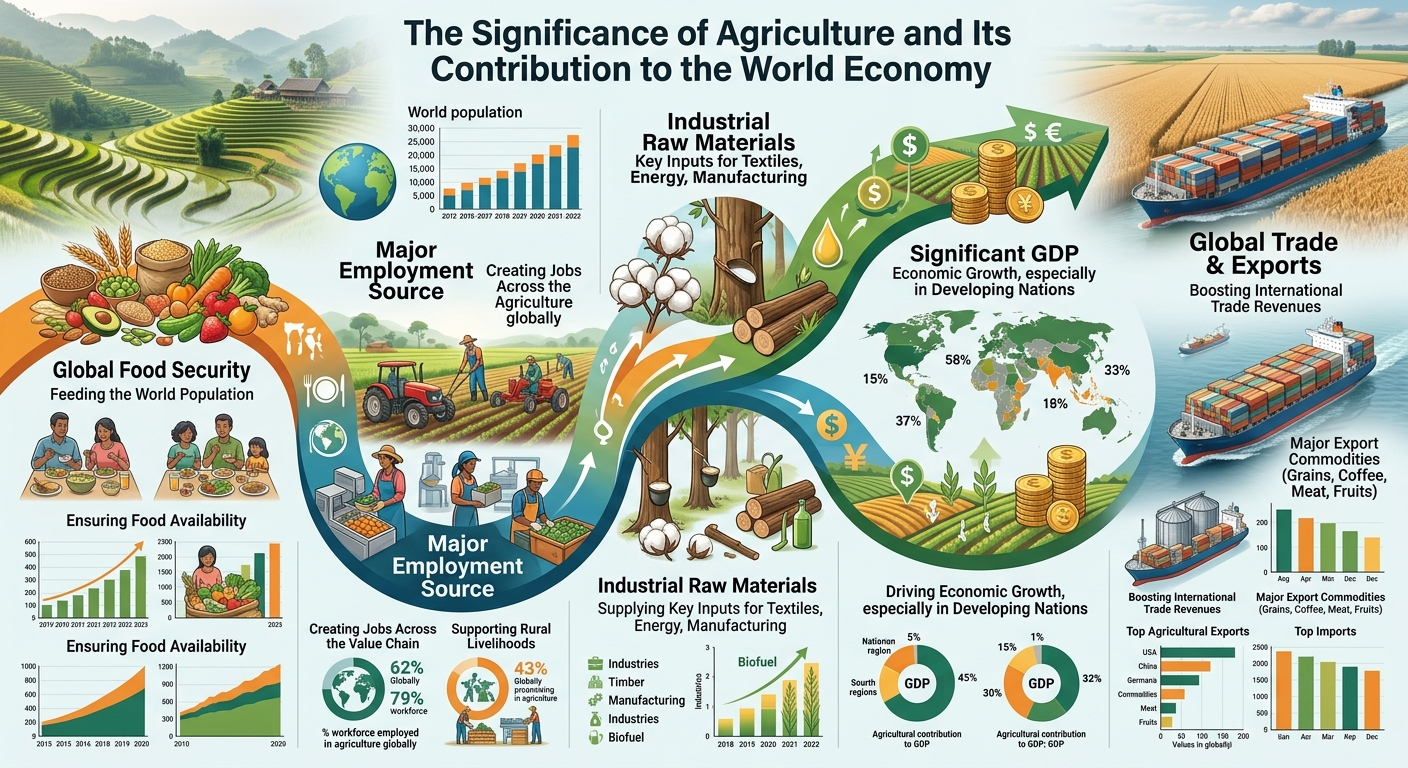
Agriculture is one of the oldest and most fundamental economic activities in human civilization. It supplies food, animal feed, fibres, industrial raw materials, bioenergy resources and, increasingly, data and ecosystem services. Although agriculture directly accounts for only a portion of global economic output, its economic importance extends far beyond farms. Agriculture supports food-processing industries, transportation, logistics, manufacturing, retail, financial services, biotechnology, energy and international trade.
This thesis examines agriculture as an economic system rather than simply as farming. It explains the historical development of agriculture, its contribution to gross domestic product (GDP), employment, food security, international trade, rural development, industrialization and technological innovation. It also examines the major challenges facing the sector—including climate change, water scarcity, soil degradation, population growth, supply-chain disruptions and technological inequality—and explains how artificial intelligence, Internet of Things (IoT), robotics, biotechnology, precision agriculture and digital finance may transform agricultural production.
1. Introduction
Agriculture can be described as the organized production of biological resources for human use.
At its simplest:
Agriculture = land + water + sunlight + biological systems + human knowledge + capital + technology → food, fibre, feed and raw materials
However, modern agriculture is much more than planting crops and raising animals.
It is a vast economic ecosystem involving:
- farmers;
- farm workers;
- seed companies;
- fertilizer manufacturers;
- agricultural machinery producers;
- irrigation companies;
- veterinary services;
- banks and insurers;
- transport companies;
- food processors;
- wholesalers;
- supermarkets;
- exporters and importers;
- biotechnology companies;
- software companies;
- telecommunications providers;
- governments;
- research institutions; and
- consumers.
Consequently, the true economic significance of agriculture cannot be measured solely by the value of crops and livestock produced on farms.
2. Why Agriculture Is Fundamentally Important
Agriculture performs several functions simultaneously.
2.1 Food production
The most obvious function is supplying human food.
Agriculture produces:
- cereals;
- fruits;
- vegetables;
- legumes;
- roots and tubers;
- meat;
- milk;
- eggs;
- fish through aquaculture;
- oils;
- sugar;
- nuts; and
- numerous other foods.
Without a sufficiently productive agricultural system, modern civilization cannot maintain large urban populations.
2.2 Animal feed
Agriculture also supplies feed for livestock and aquaculture.
Examples include:
- maize;
- soybeans;
- wheat;
- barley;
- forage crops;
- oilseed meals;
- fishmeal;
- agricultural by-products.
Therefore, crop agriculture and livestock production are economically interconnected.
2.3 Industrial raw materials
Agriculture supplies materials used by manufacturing industries.
Examples include:
| Agricultural product | Major applications |
|---|---|
| Cotton | Textiles |
| Sugarcane | Sugar, ethanol |
| Soybeans | Food, animal feed, industrial products |
| Maize | Food, feed, starch, ethanol |
| Rubber | Tyres and industrial products |
| Timber | Construction and paper |
| Oilseeds | Vegetable oils, biodiesel |
| Flax | Textiles and industrial materials |
| Hemp | Fibre and industrial products |
| Animal hides | Leather |
Thus, agriculture is part of the industrial supply chain.
3. Agriculture and the Global Economy
Agriculture’s economic importance can be understood through several interconnected channels.
A simplified economic chain is:
Natural resources → Agricultural production → Processing → Manufacturing → Distribution → Retail → Consumers
Money then flows in the opposite direction:
Consumers → Retailers → Processors → Farmers → Input suppliers → Workers → Financial institutions
This creates a circular economic system.
4. Agriculture’s Contribution to Global GDP
Agriculture, forestry and fishing constitute a significant global economic sector.
However, agriculture’s direct share of world GDP should not be confused with its total economic footprint.
The distinction is important.
Direct contribution
This is the economic value generated directly by:
- crop production;
- livestock;
- forestry;
- fishing and related primary activities.
Indirect contribution
Agriculture creates demand for:
- tractors;
- trucks;
- fertilizers;
- pesticides;
- irrigation equipment;
- seeds;
- fuel;
- electricity;
- software;
- financial services;
- insurance;
- storage;
- packaging.
Downstream contribution
Agricultural products subsequently enter:
- food processing;
- restaurants;
- supermarkets;
- textile manufacturing;
- beverage production;
- biofuel industries;
- cosmetics;
- pharmaceutical and biotechnology industries.
Therefore:
The economic footprint of agriculture is considerably larger than the value recorded under the agricultural sector alone.
5. Agriculture and Employment
Agriculture remains one of the world’s largest sources of employment.
Its employment importance is particularly strong in:
- Africa;
- South Asia;
- Southeast Asia;
- parts of Latin America;
- rural economies worldwide.
Agricultural employment includes much more than farmers.
It includes:
Primary employment
- farmers;
- farm managers;
- agricultural technicians;
- livestock workers;
- agricultural labourers.
Secondary employment
- machinery technicians;
- veterinarians;
- agronomists;
- irrigation specialists;
- seed specialists;
- agricultural engineers.
Tertiary employment
- agricultural bankers;
- insurers;
- logistics specialists;
- commodity traders;
- food retailers;
- agricultural consultants.
Consequently, agricultural employment creates a large economic multiplier.
6. Agriculture and Food Security
Food security is one of the most important strategic functions of agriculture.
A country requires reliable access to sufficient and nutritious food.
Food security has several dimensions:
- Availability — sufficient food exists.
- Access — people can obtain it.
- Utilization — food contributes to nutrition and health.
- Stability — access remains reliable over time.
Agriculture therefore has implications for:
- national security;
- public health;
- political stability;
- poverty reduction;
- economic development.
A country that cannot reliably secure essential food supplies can become vulnerable to international price shocks and supply disruptions.
7. Agriculture and Poverty Reduction
Agriculture has historically played a major role in reducing poverty.
This is particularly important in developing economies because many lower-income households live in rural areas and depend directly or indirectly on agriculture.
Higher agricultural productivity can increase:
farm output → farm income → household consumption → local business activity → employment → economic development
A productive agricultural sector can therefore stimulate entire rural economies.
8. The Agricultural Multiplier Effect
One of the most important economic concepts is the multiplier effect.
Suppose a farmer earns more money from producing maize.
The farmer may spend the additional income on:
- farm equipment;
- labour;
- transportation;
- household goods;
- education;
- construction;
- banking services.
The businesses receiving this money then spend part of it elsewhere.
Thus:
Agricultural income → local spending → business revenue → employment → additional income
Agricultural development can therefore produce economic activity far beyond the farm.
9. Agriculture and Industrialization
Agriculture and industrialization are historically connected.
Industrial economies require:
- food for workers;
- raw materials;
- markets for manufactured goods;
- investment capital.
Agricultural productivity can release labour from subsistence farming into manufacturing and services.
Historically, this transition contributed to the development of industrial economies.
A simplified development pathway is:
Subsistence agriculture
↓
Productivity improvements
↓
Agricultural surplus
↓
Urbanization
↓
Industrialization
↓
Manufacturing and services
↓
Modern knowledge economy
This does not mean agriculture becomes unimportant after industrialization.
Instead, agriculture becomes increasingly mechanized, specialized, commercialized and technologically sophisticated.
10. Agriculture and International Trade
Agricultural commodities constitute a major component of international trade.
Countries export products in which they have:
- suitable climates;
- fertile land;
- water resources;
- technological advantages;
- infrastructure;
- specialized knowledge;
- competitive production costs.
Major agricultural commodities include:
- wheat;
- maize;
- rice;
- soybeans;
- coffee;
- cocoa;
- tea;
- sugar;
- cotton;
- palm oil;
- beef;
- dairy products;
- fruits;
- vegetables;
- seafood.
International agricultural trade allows countries to specialize while accessing foods and materials they cannot efficiently produce domestically.
11. Agriculture and Foreign Exchange
Agricultural exports can generate foreign currency.
For developing countries, agricultural exports can be particularly important.
For example:
Agricultural exports → foreign exchange → imports of machinery, technology and energy → economic development
Agriculture can therefore contribute to a country’s balance of payments.
12. Agriculture and Rural Development
Agriculture is deeply connected to rural communities.
A successful agricultural economy can support:
- rural roads;
- electricity;
- telecommunications;
- schools;
- clinics;
- markets;
- banking;
- housing;
- transportation.
This is why agricultural policy is also rural-development policy.
13. Agriculture and Infrastructure
Agricultural production depends heavily on infrastructure.
Important infrastructure includes:
Physical infrastructure
- roads;
- railways;
- ports;
- warehouses;
- irrigation systems;
- electricity networks;
- cold-storage facilities.
Digital infrastructure
- mobile networks;
- broadband;
- cloud computing;
- satellite systems;
- IoT networks;
- digital marketplaces.
Modern agriculture increasingly requires both.
14. Agriculture and the Manufacturing Sector
Agriculture creates demand for manufactured goods.
Consider a commercial farm.
It may require:
- tractors;
- harvesters;
- pumps;
- generators;
- solar systems;
- irrigation equipment;
- refrigeration;
- fencing;
- storage tanks;
- sensors;
- computers;
- telecommunications equipment.
Therefore:
Agricultural expansion → industrial demand
This makes agriculture an important customer of manufacturing.
15. The Agricultural Value Chain
One of the most useful ways to understand agriculture is through the value chain.
A simplified agricultural value chain is:
Inputs
↓
Seeds + fertilizer + machinery + water + finance
↓
Production
↓
Crops + livestock + aquaculture
↓
Aggregation
↓
Collection + storage
↓
Processing
↓
Milling + packaging + preservation + manufacturing
↓
Distribution
↓
Transportation + wholesale
↓
Retail
↓
Supermarkets + restaurants + markets
↓
Consumer
At every stage, economic value can be added.
16. Agriculture as a Biological Manufacturing System
A useful modern perspective is to view agriculture as a form of biological manufacturing.
Factories use:
raw materials + energy + machines → products
Agriculture uses:
sunlight + water + soil + genetics + nutrients + biological organisms + human management → biological products
Plants effectively convert solar energy into chemical energy through photosynthesis.
This makes agriculture fundamentally different from conventional manufacturing.
17. Agriculture and Energy
Agriculture is connected to the energy system in both directions.
Agriculture consumes:
- diesel;
- electricity;
- natural gas indirectly through fertilizer production;
- fuel for transportation;
- energy for irrigation and refrigeration.
Agriculture can also produce energy resources.
Examples include:
- ethanol;
- biodiesel;
- biogas;
- agricultural residues;
- biomass.
This creates an important relationship:
Energy → Agriculture → Bioenergy → Energy
18. Agriculture and Climate Change
Agriculture is highly exposed to climate conditions.
Important risks include:
- drought;
- floods;
- heat waves;
- changing rainfall;
- storms;
- pests;
- diseases;
- soil degradation.
At the same time, agriculture interacts with climate change through:
- greenhouse-gas emissions;
- land-use change;
- livestock production;
- fertilizer use;
- deforestation.
The challenge is therefore to produce more food while reducing environmental pressure.
19. Sustainable Agriculture
Sustainable agriculture seeks to maintain agricultural productivity without destroying the natural resource base required for future production.
Important principles include:
Soil conservation
- reduced erosion;
- crop rotation;
- cover crops;
- organic matter management.
Water conservation
- drip irrigation;
- precision irrigation;
- water recycling;
- improved watershed management.
Biodiversity
- diversified crops;
- agroforestry;
- integrated pest management;
- protection of pollinators.
Resource efficiency
- efficient fertilizer application;
- efficient machinery;
- renewable energy;
- reduced food waste.
20. Precision Agriculture
Precision agriculture represents a major technological transformation.
Instead of treating an entire field identically, farmers can increasingly manage different areas according to their specific requirements.
Technologies include:
- GPS;
- satellite imagery;
- drones;
- soil sensors;
- weather stations;
- IoT devices;
- automated machinery;
- AI;
- data analytics.
The basic model is:
Sense → Collect data → Analyze → Decide → Act → Measure results
This can improve:
- fertilizer efficiency;
- irrigation;
- pest management;
- yield forecasting;
- machinery utilization.
21. Artificial Intelligence in Agriculture
Artificial intelligence is becoming increasingly important in agriculture.
AI can analyze:
- satellite images;
- weather data;
- soil measurements;
- crop images;
- machinery data;
- market prices;
- historical yields.
Applications include:
Crop disease detection
Computer vision can identify patterns associated with diseases.
Yield prediction
Machine-learning models can estimate potential yields using environmental and historical data.
Irrigation optimization
AI can help determine when and how much water should be applied.
Agricultural robotics
Robotic systems can assist with:
- planting;
- harvesting;
- weeding;
- crop monitoring.
22. IoT and Agriculture
The Internet of Things allows physical agricultural equipment to become connected.
Examples include:
- soil-moisture sensors;
- livestock trackers;
- weather sensors;
- irrigation controllers;
- greenhouse sensors;
- machinery telemetry.
The architecture can be represented as:
Sensor → Network → Cloud/Edge → AI/Analytics → Decision → Actuator
This creates increasingly automated farms.
23. Robotics and Autonomous Agriculture
Agricultural robotics may become increasingly important as labour costs rise and labour availability changes.
Potential applications include:
- autonomous tractors;
- robotic weeders;
- harvesting robots;
- drone monitoring;
- robotic milking systems;
- autonomous irrigation.
The long-term objective is not necessarily a completely human-free farm.
Instead, it is often:
Human intelligence + machine intelligence + biological systems
working together.
24. Biotechnology and Agriculture
Biotechnology has transformed agricultural science.
Modern agricultural biotechnology includes:
- plant breeding;
- molecular genetics;
- genomics;
- marker-assisted selection;
- gene editing;
- microbial technologies;
- livestock genetics.
These technologies can contribute to crops with characteristics such as:
- disease resistance;
- drought tolerance;
- improved nutritional properties;
- improved productivity;
- improved resilience.
25. Agricultural Finance
Agriculture requires substantial capital.
Farmers may need financing for:
- land preparation;
- irrigation;
- machinery;
- seeds;
- fertilizer;
- livestock;
- buildings;
- storage;
- transportation.
Financial institutions therefore play an important role.
Agricultural finance includes:
- bank loans;
- cooperative finance;
- agricultural development banks;
- insurance;
- digital finance;
- commodity financing.
26. Agricultural Insurance
Agriculture is exposed to unusually high uncertainty because production depends on biological and environmental conditions.
Insurance can protect farmers against certain risks, including:
- drought;
- floods;
- storms;
- crop losses;
- livestock losses.
New technologies may enable more sophisticated insurance models based on:
- satellite data;
- weather data;
- IoT sensors;
- historical production data.
27. Agriculture and Food Processing
Raw agricultural products often have relatively limited shelf life.
Processing can increase:
- shelf life;
- convenience;
- transportation efficiency;
- food safety;
- market value.
For example:
Wheat → flour → bread → packaged food
or:
Milk → pasteurized milk → cheese → packaged dairy products
The more advanced the processing system, the greater the potential value added.
28. Agriculture and Retail
The modern supermarket is effectively the final interface between agricultural production and consumers.
The agricultural ecosystem therefore connects farmers to:
- supermarkets;
- restaurants;
- food-service companies;
- online grocery platforms;
- traditional markets.
Retail demand then influences agricultural production.
This creates a feedback loop:
Consumer demand → Retail → Processors → Farmers → Agricultural inputs
29. Agriculture and Population Growth
Global population growth creates continuing pressure on food systems.
The challenge is not simply:
“Produce more food.”
It is:
Produce sufficient nutritious food while using land, water, energy and ecosystems efficiently.
This is one of the central agricultural challenges of the 21st century.
30. Agriculture and Urbanization
Urbanization changes food systems.
As populations move toward cities:
- fewer people work directly in agriculture;
- food must travel farther;
- supply chains become more complex;
- cold storage becomes more important;
- food processing becomes more sophisticated.
This makes logistics a critical component of modern agriculture.
31. Food Loss and Food Waste
Agricultural productivity can be undermined by losses after production.
Losses can occur during:
- harvesting;
- transportation;
- storage;
- processing;
- retail;
- household consumption.
Reducing losses can effectively increase food availability without producing additional crops.
Therefore:
More efficient supply chains = more usable food from existing production.
32. Agriculture and National Security
Agriculture has strategic importance.
Countries need reliable access to:
- food;
- water;
- agricultural inputs;
- fertilizer;
- seeds;
- energy.
Major disruptions to food supplies can create:
- inflation;
- social instability;
- political pressure;
- humanitarian crises.
Food security is therefore closely connected to national security.
33. Agriculture and Inflation
Food prices have a major influence on household budgets.
Agricultural shocks can influence inflation through:
Drought → reduced production → lower supply → higher prices
or:
Higher fuel/fertilizer costs → higher production costs → higher food prices
Agricultural productivity can therefore help moderate food-price pressures over the long term.
34. Agriculture and Africa
Agriculture is particularly significant for Africa.
The continent possesses:
- extensive agricultural land;
- diverse climates;
- substantial water resources in some regions;
- a large rural population;
- major potential for agricultural expansion.
However, significant constraints remain:
- inadequate infrastructure;
- limited access to finance;
- low productivity in many farming systems;
- post-harvest losses;
- limited irrigation;
- market fragmentation;
- climate risks;
- technology gaps.
Agricultural modernization therefore represents one of Africa’s major economic opportunities.
35. Agriculture and South Africa
South Africa has a highly diversified agricultural economy.
Important sectors include:
- maize;
- wheat;
- citrus;
- grapes;
- wine;
- sugar;
- livestock;
- poultry;
- dairy;
- wool;
- forestry;
- fisheries.
South Africa demonstrates how agriculture can operate simultaneously as:
primary production + agribusiness + processing + logistics + export industry
Agricultural development also has significant implications for rural employment and regional economic development.
36. Agriculture and Developing Countries
In developing economies, agriculture can serve as a foundation for broader economic transformation.
A possible development pathway is:
Smallholder production
↓
Improved inputs
↓
Higher productivity
↓
Market participation
↓
Agro-processing
↓
Agricultural exports
↓
Industrial development
↓
Higher incomes
This is why agricultural policy is often central to economic-development strategies.
37. Smallholder Farmers
Smallholder farmers are extremely important to global food systems, especially in developing regions.
Their challenges can include:
- limited access to credit;
- expensive inputs;
- inadequate storage;
- weak market access;
- limited mechanization;
- climate vulnerability.
Digital technologies can potentially improve their position through:
- mobile payments;
- agricultural information services;
- digital marketplaces;
- weather information;
- remote sensing;
- digital credit.
38. The Future Agricultural Economy
The agricultural sector is moving from traditional farming toward increasingly integrated AgTech ecosystems.
The future farm may combine:
- biotechnology;
- AI;
- IoT;
- robotics;
- drones;
- satellite imaging;
- autonomous machinery;
- renewable energy;
- digital finance;
- blockchain-based traceability;
- advanced logistics.
The farm becomes increasingly data-driven.
39. Agriculture 4.0
Agriculture can be understood through several technological eras.
| Era | Main characteristics |
|---|---|
| Agriculture 1.0 | Manual labour and traditional tools |
| Agriculture 2.0 | Mechanization and industrial inputs |
| Agriculture 3.0 | Automation, GPS and precision farming |
| Agriculture 4.0 | AI, IoT, robotics, big data and biotechnology |
| Emerging Agriculture 5.0 | Human-machine collaboration, autonomy and highly integrated biological-digital systems |
Agriculture 4.0 represents the convergence of:
Biology + Engineering + Computing + Data + AI + Telecommunications
40. The Agricultural Data Economy
Data is becoming an increasingly valuable agricultural resource.
Examples include:
- soil data;
- weather data;
- satellite imagery;
- crop-growth data;
- machinery data;
- livestock data;
- market data.
This creates a new economic layer:
Physical farm → digital representation → analytics → optimization
The future agricultural company may therefore resemble a combination of:
farm + laboratory + factory + software platform + logistics company
41. Major Challenges Facing Agriculture
The agricultural sector faces numerous challenges.
Environmental
- climate change;
- soil degradation;
- water scarcity;
- biodiversity loss.
Economic
- volatile commodity prices;
- high input costs;
- limited finance;
- trade disruptions.
Social
- rural poverty;
- ageing farming populations in some countries;
- labour shortages;
- unequal access to technology.
Technological
- digital infrastructure;
- cybersecurity;
- technology affordability;
- lack of technical skills.
Political
- agricultural subsidies;
- trade policies;
- land policies;
- food-security policies.
42. A Strategic Framework for Agricultural Development
A successful agricultural-development strategy can be organized around ten pillars:
Pillar 1 — Land
Secure and productive access to agricultural land.
Pillar 2 — Water
Efficient irrigation and water management.
Pillar 3 — Inputs
Reliable access to quality seeds, fertilizer and other inputs.
Pillar 4 — Finance
Affordable agricultural finance and insurance.
Pillar 5 — Technology
Mechanization, AI, IoT, biotechnology and digital platforms.
Pillar 6 — Infrastructure
Roads, electricity, storage, ports and telecommunications.
Pillar 7 — Markets
Reliable domestic and international markets.
Pillar 8 — Skills
Education, training and agricultural research.
Pillar 9 — Processing
Development of agro-processing industries.
Pillar 10 — Sustainability
Protection of soil, water and ecosystems.
43. Tutorial: How to Analyze the Economic Importance of Agriculture
When analyzing agriculture in any country, follow these steps.
Step 1: Measure agricultural production
Determine:
- crop production;
- livestock production;
- fisheries;
- forestry.
Step 2: Measure agricultural GDP
Determine agriculture’s contribution to national GDP.
Step 3: Measure employment
Determine:
- agricultural employment;
- rural employment;
- indirect employment.
Step 4: Analyze exports
Identify major agricultural exports.
Step 5: Analyze imports
Determine which agricultural products the country depends upon externally.
Step 6: Analyze the value chain
Map:
Inputs → Farm → Processing → Distribution → Retail → Consumer
Step 7: Analyze infrastructure
Assess:
- roads;
- irrigation;
- electricity;
- storage;
- logistics;
- telecommunications.
Step 8: Analyze technology
Determine the level of:
- mechanization;
- precision agriculture;
- AI;
- biotechnology;
- digital agriculture.
Step 9: Analyze environmental sustainability
Evaluate:
- water use;
- soil health;
- emissions;
- biodiversity;
- land degradation.
Step 10: Calculate economic opportunities
Identify opportunities for:
- productivity growth;
- exports;
- agro-processing;
- employment;
- technology;
- rural development.
44. The Complete Agricultural Economic System
A useful way to remember the entire subject is:
NATURAL RESOURCES
Land + Water + Sunlight + Biodiversity
↓
AGRICULTURAL INPUTS
Seeds + Fertilizer + Machinery + Finance + Knowledge
↓
PRODUCTION
Crops + Livestock + Fisheries + Forestry
↓
AGGREGATION
Storage + Collection
↓
PROCESSING
Food + Feed + Fibre + Industrial Products
↓
LOGISTICS
Road + Rail + Ports + Cold Chain
↓
MARKETS
Domestic + International
↓
CONSUMERS
Households + Restaurants + Industry
↓
ECONOMIC OUTCOMES
GDP + Employment + Trade + Income + Food Security
↓
NATIONAL DEVELOPMENT
Rural Development + Industrialization + Poverty Reduction + Economic Growth
45. Agriculture’s Broader Economic Contribution
Agriculture contributes to the world economy through at least ten major channels:
- Food production
- Employment
- GDP
- International trade
- Industrial raw materials
- Rural development
- Manufacturing demand
- Food-processing industries
- Energy and bioeconomy
- Technological innovation
Its importance therefore cannot be represented by a single GDP percentage.
46. The Central Economic Equation
A useful conceptual equation is:
Agricultural Economic Impact
= Direct production
- Input demand
- Processing
- Logistics
- Retail
- Trade
- Employment
- Rural multiplier
- Innovation
- Ecosystem services
This explains why agriculture remains strategically important even as developed economies become dominated by services and technology.
47. Conclusion
Agriculture is not simply an ancient occupation that produces food. It is one of the foundational systems upon which civilization and the global economy are constructed.
It provides the biological resources required for human survival while simultaneously supporting:
food systems + manufacturing + trade + transportation + finance + employment + rural development + energy + biotechnology + technology
The agricultural sector is also undergoing a profound transformation.
The traditional farm is increasingly becoming a technologically connected production system in which:
soil sensors collect data → telecommunications transmit information → AI analyzes conditions → automated systems make recommendations → machinery executes operations → new data is generated.
This represents a transition from conventional agriculture toward digital, precision and intelligent agriculture.
The central challenge of the coming decades will be to produce sufficient nutritious food while using natural resources more efficiently and ensuring that agricultural development remains economically inclusive and environmentally sustainable.
The future of agriculture will therefore not be determined by farming alone. It will be determined by the convergence of agriculture, economics, engineering, biotechnology, artificial intelligence, telecommunications, finance, energy and environmental science.
In that sense, agriculture should be understood as one of the foundational operating systems of the world economy.
Key takeaway
Agriculture feeds the population, supplies industry, creates employment, generates trade, supports rural economies and increasingly serves as a platform for advanced technologies. Its true contribution to the world economy extends far beyond the farm gate.

Be First to Comment