
Introduction
When people hear the word farming, they usually imagine human beings planting crops, raising livestock, irrigating fields, harvesting grain, and managing agricultural land. Yet agriculture is not exclusively a human invention. Long before humans developed organized farming, several groups of insects had already evolved remarkably sophisticated systems for producing their own food.
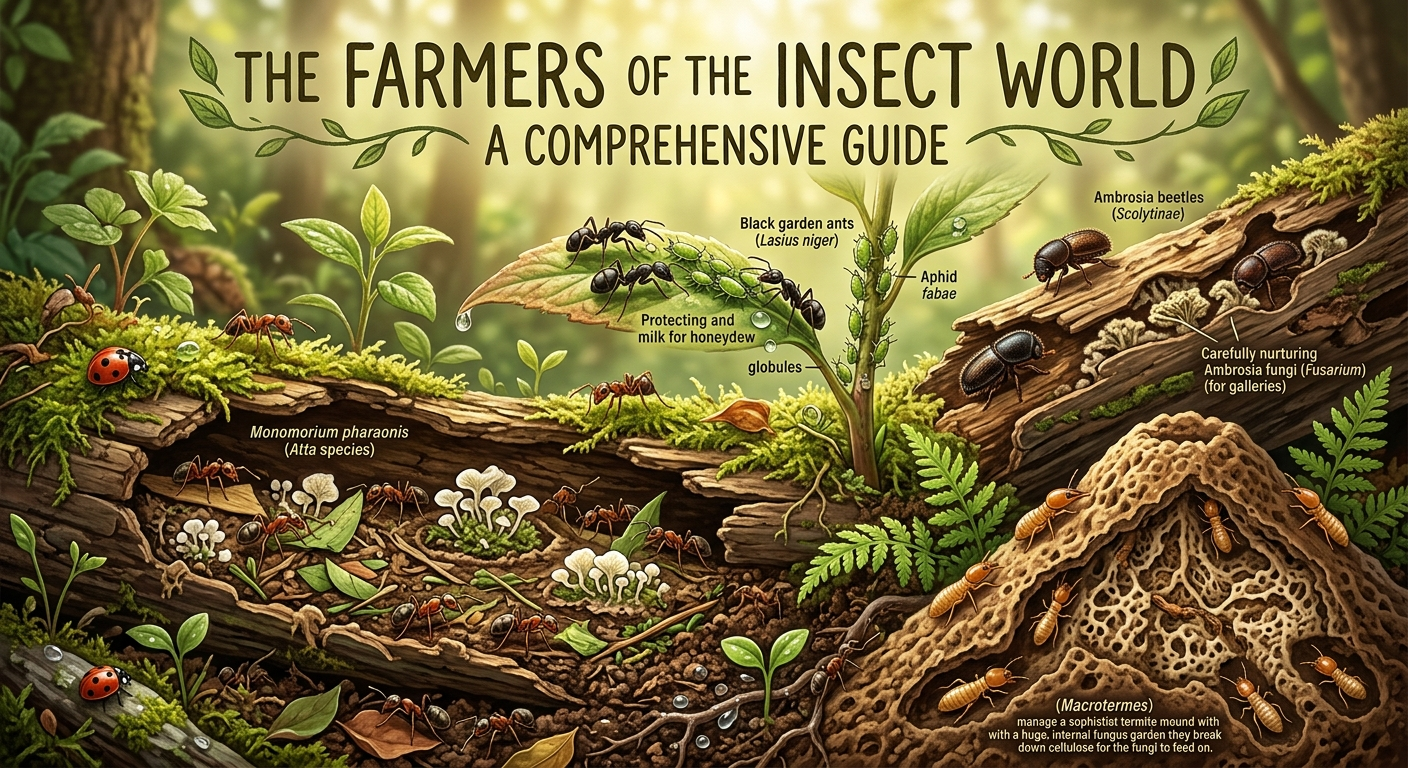
Among the most extraordinary examples are leafcutter ants, fungus-growing termites, and fungus-farming beetles. These insects collect plant material or other resources, cultivate fungi, protect their crops from competitors and pathogens, regulate their agricultural environments, and harvest the resulting food. Ants also provide an especially fascinating example of insect “livestock farming”: some species protect aphids and other sap-feeding insects in exchange for their sugary honeydew.
The phrase “farmers of the insect world” therefore describes more than an interesting analogy. These animals demonstrate that agriculture can evolve independently through natural selection when organisms benefit from controlling a reliable food-producing system. Scientific research indicates that fungus cultivation evolved independently in several insect lineages, including ants, termites, and beetles.
The result is one of nature’s most remarkable examples of symbiosis, specialization, division of labour, domestication, environmental management, and biological engineering.
1. What Does It Mean to Be an Insect Farmer?
A farmer does more than consume food. Farming involves some degree of cultivation and management.
A useful biological definition of farming includes several activities:
- Obtaining a resource that can become food.
- Establishing or maintaining a food-producing organism.
- Providing suitable growing conditions.
- Protecting the food source from competitors or disease.
- Harvesting the resulting food.
- Repeating the process as part of the organism’s normal life cycle.
Several insects meet these criteria surprisingly well.
Their farms are not fields of maize, wheat, or vegetables. Instead, their “crops” may consist of:
- fungi;
- microorganisms;
- or, indirectly, other insects that produce nutritious secretions.
The most sophisticated systems are based on fungiculture, meaning the cultivation of fungi for food.
2. The Ancient Origins of Insect Agriculture
Human agriculture is relatively recent in evolutionary terms. Insects began cultivating fungi tens of millions of years before the emergence of human agriculture.
Research indicates that fungus farming evolved independently in several insect groups. Fungus-growing beetles represent particularly ancient agricultural lineages, while fungus-growing ants and termites subsequently developed their own highly specialized agricultural systems.
Fungus cultivation by attine ants is estimated to have originated roughly 55–60 million years ago, followed by increasingly sophisticated forms of cultivation and domestication.
This gives insect agriculture an extraordinary evolutionary history.
A simplified evolutionary picture
Ancient insects
↓
Discovery of edible fungi
↓
Repeated association with particular fungi
↓
Protection and cultivation
↓
Specialized nests or galleries
↓
Selective association between insect and fungus
↓
Highly integrated agricultural symbiosis
In other words, insect farming was not created overnight. It emerged through millions of years of evolutionary experimentation.
3. Leafcutter Ants: Perhaps the Most Famous Insect Farmers
Leafcutter ants are among the most spectacular agricultural organisms on Earth.
Genera such as Atta and Acromyrmex contain species that cut pieces of fresh vegetation and transport them back to their underground colonies.
However, the ants do not primarily eat the leaves themselves.
Instead, the leaves are used as agricultural raw material.
The ants process the plant material and place it into specialized fungal gardens. The cultivated fungus breaks down plant material and produces nutritious structures that the ants consume.
Research has demonstrated that the fungal cultivar can convert carbon derived from cellulose in plant material into edible fungal tissue.
The leaf therefore functions somewhat like agricultural feedstock.
The basic cycle
Plant
↓
Leaf fragment
↓
Worker ant transports it
↓
Leaf is processed
↓
Fungal garden receives plant material
↓
Fungus grows
↓
Ants harvest fungus
↓
Colony receives food
This is a genuine biological production system.
4. The Ants Are Not Simply Collectors
A leafcutter colony behaves like a highly organized agricultural enterprise.
Different workers perform different tasks.
Some ants specialize in:
- cutting vegetation;
- transporting material;
- processing leaves;
- cultivating the fungal garden;
- removing waste;
- maintaining nest conditions;
- defending the colony;
- caring for developing young.
This is an example of division of labour.
The colony functions as a biological superorganism in which individual ants perform specialized roles while the colony as a whole behaves like an integrated system.
Research on attine ants has described their agriculture as operating on an industrial scale relative to their body size.
5. The Fungus Is the Crop
The most important conceptual point is this:
The leaves are not the main crop. The fungus is.
The ants are essentially growing a biological food factory.
The cultivated fungus processes plant material that the ants would otherwise have difficulty exploiting directly.
Scientific studies show that fungal symbionts provide insects with access to nutrients contained in plant biomass through microbial digestion.
This represents an extraordinary evolutionary partnership.
Ant contribution
The ants provide:
- plant material;
- transportation;
- cultivation;
- protection;
- environmental management;
- and waste management.
Fungus contribution
The fungus provides:
- digestion of plant material;
- conversion of complex biomass;
- nutritional compounds;
- and edible fungal tissue.
The relationship is therefore a mutualistic partnership.
6. The Ants Manage Their Agricultural Environment
Human farmers control variables such as:
- temperature;
- moisture;
- soil quality;
- pests;
- weeds;
- fertilizers;
- disease.
Leafcutter ants face similar challenges.
Their fungal crop can be attacked by unwanted microorganisms. Consequently, the ants maintain their gardens through behaviors including cleaning, grooming, removing undesirable fungi, controlling environmental conditions, and using antimicrobial compounds.
This is remarkably similar to crop protection.
The ants must distinguish between:
Useful fungus → protect
and
Harmful fungus → remove
That requires sophisticated chemical and behavioral recognition.
7. The Hidden Microbial Workforce
The insect farm is even more complicated than it initially appears.
The ant and fungus are not necessarily the only partners.
Certain bacteria associated with fungus-growing ants can produce compounds that help suppress pathogens attacking the fungal crop. Researchers have described this relationship as a biological form of crop protection.
The system can therefore be represented as:
Plants
→ raw agricultural material
Ants
→ farmers
Fungus
→ crop
Beneficial bacteria
→ biological crop protection
This is effectively a miniature agricultural ecosystem.
8. Termites: The Other Great Insect Farmers
Termites provide another extraordinary example.
Certain termites in the subfamily Macrotermitinae cultivate fungi belonging to the genus Termitomyces.
Unlike leafcutter ants, which typically transport freshly cut vegetation into their gardens, fungus-growing termites use processed plant material and construct specialized fungal gardens.
The fungus helps transform relatively difficult-to-digest plant material into food that the termite colony can exploit.
Research suggests that fungus-growing termites developed their agricultural system independently from fungus-growing ants.
This is a classic example of convergent evolution.
Two unrelated evolutionary groups independently arrived at a similar solution:
Cultivate microorganisms that can transform plant material into useful food.
9. Termite Mounds as Agricultural Infrastructure
A termite colony is not merely a collection of insects living together.
It is an engineered environment.
Large termite colonies can construct elaborate structures containing:
- chambers;
- tunnels;
- fungus gardens;
- nursery areas;
- waste zones;
- ventilation systems;
- protected entrances.
The architecture helps regulate environmental conditions.
Temperature, humidity, airflow and substrate conditions can all influence fungal growth.
The colony therefore behaves like a biological combination of:
farm + factory + warehouse + ventilation system + waste-management facility.
This demonstrates how social insects can manipulate their physical environment without possessing human-style technology.
10. Fungus-Growing Beetles
Beetles provide another important example of insect agriculture.
Ambrosia beetles bore into wood and establish galleries inside trees. They cultivate fungi within these galleries and use the fungi as their primary food resource.
Instead of carrying leaves to an underground garden, the beetles effectively construct agricultural tunnels inside their food source.
Specialized structures known as mycangia can help certain beetles transport fungal propagules.
The relationship between beetles and their fungal crops is therefore highly specialized.
Some research places the origin of ambrosia-beetle fungus cultivation extremely far back in geological time, making these beetles some of the oldest known animal farmers.
11. Ants as Livestock Farmers
Fungus farming is not the only agricultural behavior found among ants.
Some ants also maintain relationships with aphids, scale insects, mealybugs and other sap-feeding insects.
These insects consume plant fluids and produce a sugary secretion known as honeydew.
Ants may protect these insects from predators and sometimes move them to new feeding locations.
In return, the ants obtain honeydew.
This relationship resembles a very simplified form of livestock management.
The comparison
| Human agriculture | Ant agriculture |
|---|---|
| Cattle | Aphids and related insects |
| Milk | Honeydew |
| Pasture | Plant feeding sites |
| Herd protection | Ant protection |
| Herd movement | Relocation by ants |
| Farmer | Worker ants |
The comparison should not be taken literally—aphids are not domesticated cattle—but it illustrates how similar ecological principles can arise independently.
12. The Concept of Biological Domestication
One of the most fascinating aspects of insect farming is domestication.
Humans have domesticated plants and animals through generations of selective breeding.
Insect farmers can also become evolutionarily dependent upon particular organisms.
In fungus-growing ants, long-term association between ants and fungal cultivars has produced substantial evolutionary changes in both partners. Genomic research demonstrates reciprocal evolutionary changes in ants and their cultivated fungi.
This is sometimes described as non-human domestication.
The important distinction is that insects did not consciously decide:
“We are going to domesticate this fungus.”
Instead, natural selection favored insect colonies that successfully cultivated useful fungi and fungal strains that successfully interacted with their insect partners.
Over millions of years, the relationship became increasingly specialized.
13. Agriculture Without Conscious Planning
This leads to a fundamental biological lesson.
Human farmers consciously plan.
An ant does not need to understand:
- genetics;
- ecology;
- fungal physiology;
- nutrient chemistry;
- microbiology.
Yet the colony can nevertheless perform behaviors that produce sophisticated agricultural outcomes.
This happens because natural selection acts on successful behaviors over enormous periods of time.
A colony that:
- maintains healthier fungi,
- removes harmful organisms,
- obtains better food,
- protects its garden,
- and successfully reproduces
has an evolutionary advantage.
Over countless generations, these behaviors become increasingly refined.
Thus, complexity does not necessarily require conscious design.
14. The Insect Farm as a Supply Chain
Modern agriculture can be understood as a supply chain:
Raw materials → processing → production → protection → harvesting → consumption
Insect agriculture follows a remarkably similar pattern.
Leafcutter system
Vegetation
→ harvesting
→ transportation
→ processing
→ fungal cultivation
→ crop protection
→ fungal harvest
→ colony nutrition
Termite system
Plant material
→ collection
→ processing
→ fungal garden
→ fungal growth
→ consumption
Beetle system
Wood
→ gallery construction
→ fungal inoculation
→ fungal cultivation
→ consumption
These systems demonstrate that the basic concept of a food-production network is much older than human civilization.
15. Waste Management
Successful agriculture produces waste.
Human farms deal with:
- crop residues;
- animal manure;
- spoiled food;
- dead organisms;
- contaminated material.
Insect colonies have similar problems.
Leafcutter ants, for example, must keep waste away from productive fungal gardens.
Specialized workers transport waste to designated areas.
This separation is important because decomposing material can contain microorganisms capable of damaging the cultivated crop.
The colony therefore maintains a form of biological sanitation system.
16. Disease Management
Disease is one of agriculture’s greatest challenges.
A pathogen that destroys a major crop can threaten an entire farming system.
Insect farmers face the same problem.
A fungal pathogen entering a fungus garden could potentially reduce food production and threaten colony survival.
Consequently, ants have evolved:
- grooming;
- removal of contaminated material;
- chemical defenses;
- environmental control;
- microbial partnerships;
- and behavioral recognition.
Research has documented selective removal of unwanted fungi from leafcutter gardens.
This represents an early form of integrated biological crop protection.
17. Nutrient Management
Agriculture is ultimately about nutrients.
A crop requires an appropriate balance of:
- carbon;
- nitrogen;
- minerals;
- water;
- and other essential compounds.
Leafcutter ants do not simply throw random leaves into their gardens.
Research has shown that nutritional interactions between ants and their fungal cultivars can be actively regulated and that ant farming behavior can influence the nutritional stability of the fungal crop.
This suggests that the ant-fungus relationship is not simply:
leaf in → fungus out.
It is a dynamic nutritional system.
18. Agriculture as a Three-Level System
The most sophisticated insect farms can be viewed as three interacting levels.
Level 1: The physical environment
Includes:
- soil;
- wood;
- leaves;
- water;
- temperature;
- humidity.
Level 2: The cultivated organism
Usually:
- fungus;
- or another food-producing symbiont.
Level 3: The insect society
Includes:
- workers;
- reproductive individuals;
- defensive individuals;
- gardeners;
- transporters;
- waste managers.
The success of the colony depends on all three levels functioning together.
19. The Superorganism
Social insects provide one of biology’s most interesting organizational models.
An individual worker ant is limited.
It cannot:
- maintain an enormous farm;
- defend a huge colony;
- manage complex food production;
- or reproduce independently.
But thousands or millions of individuals can cooperate.
The colony effectively becomes a superorganism.
Information is distributed through:
- chemical signals;
- physical contact;
- pheromones;
- environmental changes;
- behavioral feedback.
There may be no central manager.
Instead, complex organization emerges from many simple interactions.
This principle has fascinated scientists because it provides insights into:
- artificial intelligence;
- robotics;
- distributed computing;
- optimization;
- logistics;
- swarm intelligence.
20. What Insect Farmers Teach Us About Technology
Insect agriculture offers important lessons for human engineering.
20.1 Distributed systems
There is often no central controller.
Thousands of insects independently respond to local information.
Yet the entire colony can produce coordinated behavior.
This resembles distributed computing.
20.2 Swarm intelligence
Ant colonies can solve collective problems through simple local rules.
Examples include:
- finding food;
- selecting routes;
- allocating workers;
- defending the nest;
- maintaining gardens.
Computer scientists have studied similar principles for optimization algorithms and robotic systems.
20.3 Self-organization
The colony does not necessarily require a supervisor assigning every task.
Organization emerges from interactions between individuals and their environment.
This concept is important in:
- robotics;
- autonomous systems;
- AI;
- network engineering.
20.4 Biological recycling
Insect farming demonstrates how difficult plant biomass can be transformed through microbial partnerships.
This is relevant to research into:
- biomass conversion;
- enzymes;
- sustainable materials;
- biotechnology;
- biofuels.
Researchers have specifically identified fungal symbionts of fungus-farming insects as potential sources of carbohydrate-active enzymes with biotechnology applications.
21. The Ecological Importance of Leafcutter Ants
Leafcutter ants are not merely fascinating farmers.
They can significantly influence ecosystems.
Their activities include:
- removing vegetation;
- transporting organic matter;
- excavating soil;
- altering soil structure;
- redistributing nutrients;
- creating underground habitats.
Research has estimated that leafcutter ants can account for a substantial fraction of herbivory in some Neotropical forests and can move significant quantities of vegetation into their nests.
Their nests can become localized areas of biological activity.
Thus, the farmer itself becomes an ecosystem engineer.
22. Insect Agriculture Compared With Human Agriculture
| Feature | Human farming | Insect farming |
|---|---|---|
| Origin | Relatively recent | Tens of millions of years old |
| Main crops | Plants and animals | Mostly fungi or microbial resources |
| Farmers | Individual humans and organizations | Colonies |
| Technology | Tools and machines | Biological adaptations |
| Crop protection | Chemicals, biological control, physical methods | Grooming, chemicals, symbiotic microbes |
| Irrigation | Often artificial | Environmental/nest management |
| Fertilization | Manure and synthetic fertilizers | Organic material and microbial processes |
| Waste management | Human-designed systems | Specialized colony behavior |
| Labour | Organized human workforce | Division of labour |
| Communication | Language and technology | Chemical and behavioral signals |
| Evolution | Cultural and genetic | Primarily biological evolution |
The similarities are remarkable, but the mechanisms are fundamentally different.
23. Why Insect Agriculture Is So Successful
Several factors explain its evolutionary success.
1. Reliable food production
Cultivating food can reduce dependence on unpredictable food sources.
2. Environmental control
The insects can create protected conditions for their crops.
3. Division of labour
Different colony members perform specialized tasks.
4. Disease management
The insects actively protect their crops.
5. Symbiosis
The insects obtain capabilities they could not efficiently perform alone.
6. Recycling
Plant material that is difficult to digest can be converted into usable nutrients.
7. Evolutionary specialization
Millions of years of coevolution have refined the relationships.
24. The Farm Is an Ecosystem
An insect farm should not be viewed as a simple two-organism relationship.
A leafcutter colony can involve:
Plant
↓
Ant
↓
Cultivated fungus
↓
Beneficial bacteria
↓
Competing microorganisms
↓
Soil organisms
↓
Waste decomposition
The farm is therefore a miniature ecosystem.
Every participant influences the others.
This makes insect agriculture an excellent example of ecological networks.
25. What Happens When the System Breaks?
Agricultural systems are vulnerable to disruption.
If:
- the fungus becomes unhealthy;
- harmful microorganisms invade;
- suitable plant material becomes unavailable;
- environmental conditions change;
- the colony loses workers;
the agricultural system can become less productive.
The same principle applies to human agriculture.
A farm is not simply a collection of crops. It is a network of relationships involving:
soil + water + climate + organisms + nutrients + farmers + technology.
Insect farms demonstrate this principle on a smaller biological scale.
26. Climate Change and Insect Agriculture
Environmental change raises important questions about insect agricultural systems.
Changes in:
- temperature;
- rainfall;
- vegetation;
- drought frequency;
- humidity;
- pathogen distribution;
could affect the balance between insects and their cultivated organisms.
Because the insects’ food system depends on specific biological relationships, environmental disruption could alter the productivity of their farms.
Studying these relationships may therefore help scientists understand how tightly interconnected ecological systems respond to environmental change.
27. Lessons for Sustainable Agriculture
Insect farmers provide several conceptual lessons for sustainable agriculture.
Lesson 1: Waste can become a resource
Plant material that appears unusable can become valuable through microbial processing.
Lesson 2: Biological partnerships matter
Farming does not have to depend entirely on synthetic inputs.
Lesson 3: Disease prevention can be ecological
The ants use behavioral and microbial strategies rather than relying on a single intervention.
Lesson 4: Local control can improve resilience
The colony continuously responds to conditions rather than following one rigid agricultural procedure.
Lesson 5: Diversity of functions creates resilience
Different organisms perform complementary roles.
28. Insect Agriculture and the Future of Biotechnology
The biology of insect farmers may eventually contribute to human technologies.
Potential research areas include:
- fungal biotechnology;
- enzyme discovery;
- biomass conversion;
- agricultural microbiology;
- biological pest management;
- sustainable food systems;
- waste recycling;
- biomaterials;
- distributed robotics.
The ability of fungal symbionts to process plant biomass is particularly interesting because cellulose and other plant polymers represent enormous renewable resources.
Scientists are investigating microbial enzymes capable of converting complex plant material into useful compounds.
29. Insect Farmers and Artificial Intelligence
The relationship between insect farming and AI may initially seem surprising.
Yet both systems demonstrate the power of distributed decision-making.
An ant colony does not need a computer server to coordinate thousands of workers.
Instead, individual insects respond to local information.
A simplified model is:
Local information
→ Individual decision
→ Interaction with other individuals
→ Collective behavior
→ Emergent intelligence
This principle has inspired algorithms based on swarm intelligence.
Researchers and engineers can study biological systems to understand how complex outcomes can emerge from relatively simple rules.
30. Insect Farms as Biological Factories
A factory transforms raw materials into products.
Consider the leafcutter system:
Leaves
→ raw material
Ant workers
→ harvesting and logistics
Fungal enzymes
→ processing machinery
Fungal tissue
→ finished product
Workers
→ harvesting and distribution
Waste chambers
→ waste-management system
This is effectively a biological factory operating underground.
The factory is powered not by electricity but by:
- metabolism;
- chemical energy;
- evolutionary adaptation;
- cooperative behavior.
31. The Extraordinary Age of Non-Human Agriculture
One of the most important lessons from insect farmers is chronological.
Humans often think of agriculture as one of civilization’s defining inventions.
That is true culturally and technologically.
But agriculture as a biological strategy is much older.
Fungus-growing insects developed agricultural systems tens of millions of years before humans began cultivating crops.
Some insect agricultural lineages have persisted through enormous environmental changes, geological transformations and evolutionary transitions.
Their farms are therefore living examples of deep-time biological engineering.
32. A New Definition of the Farmer
The insect world forces us to reconsider the meaning of a farmer.
A farmer does not necessarily need:
- a tractor;
- a plough;
- a field;
- a greenhouse;
- a computer;
- or even conscious knowledge of agriculture.
A farmer can be an organism that has evolved a system for:
cultivating → protecting → maintaining → harvesting → consuming
another biological resource.
Under this broader definition, the insect world contains some of Earth’s oldest agricultural societies.
33. The Great Insect Agricultural Model
The major systems can be summarized as follows:
Leafcutter ants
Crop: fungus
Raw material: fresh vegetation
Farm: underground fungal garden
Farmers: worker ants
Fungus-growing termites
Crop: Termitomyces fungi
Raw material: plant material
Farm: fungus combs
Farmers: termite colonies
Ambrosia beetles
Crop: cultivated fungi
Raw material: tree material
Farm: galleries inside wood
Farmers: beetles
Aphid-tending ants
Resource: honeydew
“Livestock”: aphids and related insects
Farmers: ants
Product: sugary honeydew
These systems evolved independently or through distinct evolutionary pathways, demonstrating that agricultural strategies can emerge repeatedly when ecological conditions make cultivation advantageous.
34. The Bigger Scientific Meaning
The farmers of the insect world reveal several fundamental principles of life.
Evolution can produce cooperation
Species that were once independent can become tightly interconnected.
Microorganisms can expand an animal’s capabilities
Fungi can perform biochemical processes that insects cannot efficiently perform alone.
Intelligence can emerge collectively
A colony can produce complex behavior without a central commander.
Agriculture is an ecological strategy
It is not exclusively a human cultural invention.
Domestication can happen without humans
Long-term evolutionary relationships can produce highly specialized biological partnerships.
Technology can have biological equivalents
Ventilation, sanitation, crop protection, logistics and recycling all have analogues in insect societies.
35. Conclusion
The farmers of the insect world represent one of nature’s most extraordinary experiments in agriculture.
Leafcutter ants cultivate fungi using harvested vegetation. Fungus-growing termites maintain fungal gardens that transform plant material into food. Ambrosia beetles cultivate fungi inside tree galleries. Other ants maintain relationships with aphids and related insects, obtaining honeydew in exchange for protection and management.
These organisms demonstrate that agriculture is not merely a human technological achievement. It is also an evolutionary strategy that can emerge when cooperation, resource management and food production provide substantial survival advantages.
The most remarkable feature is the sophistication of the systems.
Insect farmers harvest raw materials, transport them, process them, cultivate food-producing organisms, control environmental conditions, manage disease, remove waste and distribute nutrition throughout their colonies. Some even cooperate with microbial partners that help protect their crops.
Modern science is increasingly revealing that these systems are more complex than earlier generations of researchers imagined. Genomic, microbiological and ecological studies are uncovering intricate relationships among insects, fungi, bacteria, plants and their environments. Recent research continues to show that ants can influence the nutritional stability of their fungal crops and that their fungal partners perform sophisticated biochemical transformations.
The lesson is profound:
Agriculture did not begin with humans. Humans perfected agriculture culturally and technologically, but nature had already been experimenting with farming for tens of millions of years.
Deep beneath forests, inside termite mounds, and within the galleries of trees, insect societies operate biological farms that function simultaneously as food-production systems, microbial laboratories, factories, waste-management facilities and ecological engineering projects.
The insect farmer is therefore not simply a metaphor.
It is a remarkable example of how evolution can transform cooperation between organisms into a sophisticated, self-maintaining agricultural civilization on a microscopic scale.


Be First to Comment