
Abstract
Ants are among the most successful social organisms on Earth, but some species have achieved something particularly remarkable: they practice agriculture. Fungus-growing ants cultivate fungal crops inside carefully maintained nests, regulate environmental conditions, transport agricultural material, remove waste, defend their gardens against pathogens, and distribute food among colony members. In this sense, the colony functions as a highly integrated biological agricultural system.
The best-known examples are leaf-cutting ants of the genera Atta and Acromyrmex. These ants do not primarily eat the leaves they cut. Instead, they process plant material and use it as a substrate for cultivating fungi that provide their principal food. Modern research indicates that ant agriculture originated tens of millions of years ago, far earlier than human agriculture. Genetic evidence places the beginning of attine fungus farming around 55–60 million years ago, with later transitions toward increasingly specialized and domesticated fungal crops.
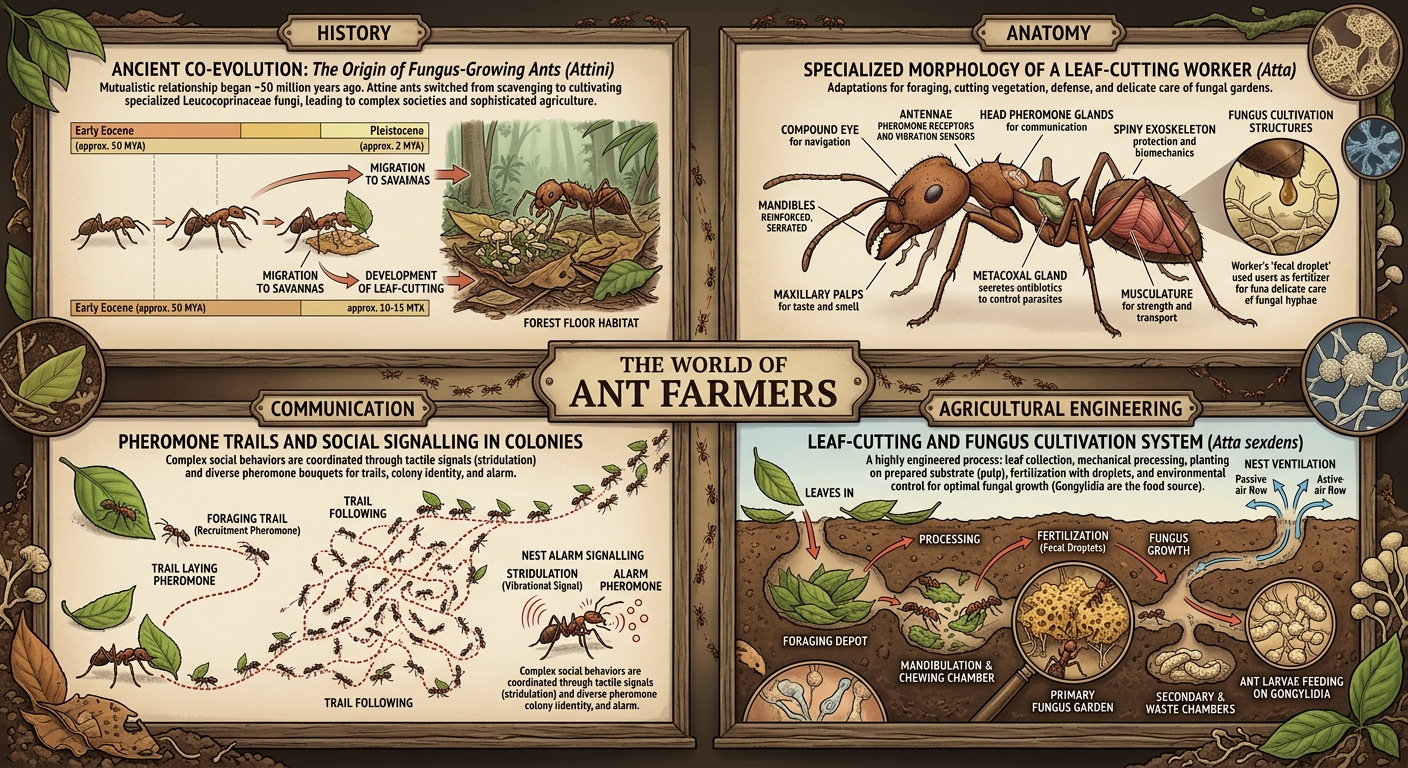
This thesis examines ant farmers from four interconnected perspectives: history and evolution, anatomy and physiology, communication and social organization, and agricultural engineering. It argues that ant farming is not merely an interesting animal behavior but a sophisticated biological technology involving environmental management, division of labour, microbial management, logistics, architecture, waste recycling, and symbiosis.
1. Introduction
Agriculture is usually associated with human civilization.
Human beings select plants, prepare soil, sow crops, control pests, harvest food and construct increasingly sophisticated agricultural infrastructure. However, humans are not the only organisms that practice agriculture.
Several groups of insects have independently developed farming relationships with other organisms. Among the most remarkable are fungus-growing ants.
Ant farmers have developed a system in which:
plants → collected biomass → fungal cultivation → food → colony
The system is especially impressive because the fungus is not simply growing accidentally inside the nest. The ants actively maintain the agricultural environment.
They:
- select and collect appropriate plant material;
- transport it to the nest;
- prepare it for cultivation;
- maintain fungal gardens;
- remove unwanted organisms;
- manage waste;
- protect the crop;
- regulate nest conditions;
- feed developing ants;
- and coordinate thousands or millions of workers.
Smithsonian educational material therefore describes leaf-cutting ants as genuine agricultural organisms and uses them as an important example for understanding social insects, adaptation and evolution.
The central question of this thesis is:
How did ants transform a colony into a functioning agricultural system?
To answer that question, we must examine the ant not as an isolated insect but as one component of a larger biological machine consisting of:
ant + fungus + plants + microbes + nest + communication + colony organization + environment.
2. What Is an Ant Farmer?
An ant farmer is an ant species that deliberately maintains another organism as a resource.
The most famous agricultural relationship is between fungus-growing ants and their fungal cultivars.
The basic process is:
- Workers leave the nest.
- Workers locate suitable organic material.
- Leaf-cutting species cut plant fragments.
- Workers transport the fragments underground.
- Plant material is processed.
- The material becomes part of the fungal garden.
- The fungus grows.
- Ants harvest nutritional structures from the fungus.
- Workers distribute food throughout the colony.
- Waste material is removed from the productive environment.
Importantly, leaf-cutting ants generally do not eat the leaves directly. The leaves are agricultural inputs into the fungal production system.
This makes ant agriculture fundamentally different from ordinary herbivory.
A grasshopper eats a plant.
A leaf-cutting ant uses a plant to feed another organism that produces food for the colony.
3. The Deep History of Ant Agriculture
3.1 Agriculture older than human civilization
Human agriculture emerged comparatively recently in geological terms.
The development of agriculture by humans occurred roughly within the last 10,000–12,000 years, although domestication was a complex and geographically distributed process.
Fungus-growing ants, however, have been practicing agriculture for tens of millions of years.
Genomic research estimates that attine ant agriculture probably originated during the early Tertiary, approximately 55–60 million years ago.
This means that ant agriculture predates:
- modern humans;
- written civilization;
- cities;
- industrial agriculture;
- mechanized farming;
- and modern agricultural science.
The Smithsonian has summarized genetic evidence indicating that fungus farming by ants began approximately 50 million years ago.
4. Evolutionary Stages of Ant Farming
Ant agriculture did not appear fully developed.
It evolved through successive stages.
A simplified evolutionary sequence is:
foraging → accidental association → cultivation → specialization → domestication → industrial-scale agriculture
4.1 Stage One: Collection
Early fungus-growing ants probably collected organic material that naturally supported fungi.
The ants could exploit fungal growth without possessing an elaborate agricultural system.
4.2 Stage Two: Cultivation
Over evolutionary time, ants increasingly influenced where fungi grew and what materials were supplied to them.
This changed the relationship from simple exploitation toward cultivation.
4.3 Stage Three: Mutual dependence
The ants increasingly depended upon their fungal partners, while cultivated fungi became increasingly dependent upon the ants.
This is a major evolutionary transition.
4.4 Stage Four: Domestication
Eventually, some fungal lineages became highly specialized for ant cultivation.
Genomic studies have identified signatures consistent with long-term domestication in the fungal crop Leucoagaricus gongylophorus.
The result is a remarkable biological partnership:
ant provides infrastructure and agricultural labour
while
fungus provides food.
5. The Rise of the Leaf-Cutting Ants
Leaf-cutting ants represent one of the most spectacular forms of insect agriculture.
The principal genera are:
- Atta
- Acromyrmex
Their evolutionary innovation was particularly important because they shifted toward using freshly cut plant material as an input for fungal cultivation.
Research describes this as a major transition in attine agriculture.
The ants became extraordinarily effective harvesters.
A colony can organize extensive foraging networks through which workers repeatedly move between vegetation and the underground nest.
The result resembles an agricultural supply chain:
forest vegetation
↓
harvesting
↓
transport
↓
processing
↓
fungal cultivation
↓
harvesting of fungal food
↓
distribution
↓
colony nutrition
6. Anatomy of the Ant Farmer
Ant agricultural technology begins with anatomy.
The individual ant possesses a specialized body adapted for movement, manipulation, sensing, communication and colony work.
The major body regions are:
- head;
- thorax;
- abdomen.
7. The Head: Agricultural Control Centre
The head contains several structures essential to farming.
7.1 Antennae
The antennae are extremely important sensory organs.
They help ants detect:
- chemical signals;
- nestmates;
- food-related cues;
- environmental information;
- colony odors;
- and potentially changes associated with the fungal garden.
Ant communication depends heavily on chemical information.
8. Mandibles: Biological Agricultural Tools
The mandibles are among the most important agricultural instruments of leaf-cutting ants.
They function as:
- cutting tools;
- gripping devices;
- processing instruments;
- defensive structures;
- material-handling equipment.
A leaf-cutting ant can cut plant tissue into manageable fragments and transport the material back to the colony.
Thus the mandibles effectively operate as a combination of:
cutter + clamp + transport tool.
9. Thorax and Locomotion
The thorax contains the principal structures associated with locomotion.
The three pairs of legs allow ants to:
- walk over complex terrain;
- climb vegetation;
- transport material;
- navigate trails;
- work inside nests.
Some workers carry loads that are substantial relative to their own body size.
This demonstrates an important principle of biological engineering:
A relatively small individual becomes an extremely effective transport unit when integrated into a coordinated colony.
10. Abdomen and Internal Systems
The abdomen contains major internal organs and systems involved in:
- digestion;
- metabolism;
- reproduction in reproductive individuals;
- chemical production;
- waste handling;
- and communication-related chemistry.
Different castes may exhibit substantial differences in body size and function.
11. Caste Anatomy
Ant colonies frequently contain specialized individuals.
A simplified structure includes:
Queen
The reproductive centre of the colony.
Males
Primarily associated with reproduction.
Workers
Responsible for most colony maintenance.
Specialized workers
In leaf-cutting ants, worker morphology can correspond to different tasks.
Large workers may be particularly effective in cutting, carrying or defending, while smaller workers can perform other activities inside the nest.
This is an example of morphological division of labour.
The colony does not need every ant to perform every job.
Instead:
different bodies → different capabilities → different tasks.
12. The Ant Colony as a Superorganism
One of the most useful ways to understand ant farmers is to treat the colony as a distributed organism.
An individual ant has limited capabilities.
The colony has enormous collective capabilities.
Consider:
| Individual capability | Colony-level capability |
|---|---|
| Senses chemicals | Maintains communication network |
| Cuts material | Harvests vegetation |
| Carries fragments | Operates transport system |
| Detects threats | Maintains agricultural security |
| Handles fungus | Maintains fungal farm |
| Removes waste | Operates sanitation system |
| Responds locally | Produces coordinated colony behaviour |
The colony therefore resembles a distributed biological computer.
There is no single worker controlling the entire agricultural operation.
Instead:
local information + simple rules + communication + cooperation = complex global behaviour.
13. Communication Among Ant Farmers
Communication is one of the foundations of ant agriculture.
Ants cannot use human speech.
Instead, they communicate through combinations of:
- chemical signals;
- touch;
- vibration;
- movement;
- environmental traces;
- and other sensory cues.
Research into ant interactions emphasizes communication as a major component of ant social organization.
14. Chemical Communication
Chemical communication is particularly important.
Ants produce and detect chemical substances that can communicate information about:
- identity;
- alarm;
- trails;
- food;
- colony membership;
- reproductive status;
- nest conditions;
- and threats.
This creates a form of biological information network.
A useful conceptual model is:
signal → detection → interpretation → behavioural response.
15. Pheromone Trails
Foraging ants can establish chemical trails between resources and the nest.
A simplified system is:
worker discovers resource
↓
chemical trail established
↓
other workers detect trail
↓
workers follow route
↓
resource harvesting increases
This creates positive feedback.
The more useful a route becomes, the more workers may reinforce the route.
Consequently, the colony can rapidly organize efficient transport pathways without a central traffic controller.
16. Communication and Collective Intelligence
Ant agriculture demonstrates an important form of collective intelligence.
No individual worker necessarily understands:
- the complete colony population;
- the entire agricultural system;
- the full fungal production cycle;
- or the global logistics network.
Nevertheless, the colony can collectively accomplish these tasks.
This is called emergent organization.
In simplified form:
individual rules + interactions → colony-level intelligence.
This concept has influenced research into:
- swarm robotics;
- optimization algorithms;
- distributed computing;
- logistics;
- autonomous systems;
- and artificial intelligence.
17. Communication Between Ants and Fungi
The farming relationship is even more sophisticated because communication does not occur exclusively among ants.
The fungus itself can influence the agricultural environment.
Research has investigated chemical interactions among plants, ants, fungi and associated microorganisms.
The fungal garden therefore functions as both:
food-production system
and
information-rich biological environment.
18. Agricultural Engineering of Ant Farmers
The term agricultural engineering normally refers to human-designed systems involving machinery, structures, water, soil, energy and production processes.
Ants do not design machines in the human sense.
Yet they perform many functions that can reasonably be compared with agricultural engineering.
Their system involves:
- land excavation;
- environmental control;
- crop production;
- transportation;
- sanitation;
- resource allocation;
- pest management;
- waste management;
- and infrastructure maintenance.
19. The Underground Farm
Leaf-cutting ant colonies construct extensive underground environments.
The nest can contain:
- entrances;
- tunnels;
- chambers;
- fungal gardens;
- waste areas;
- transport pathways;
- ventilation structures.
Recent research emphasizes how leaf-cutting ants construct large nests while responding to local environmental conditions such as soil temperature, moisture and carbon dioxide.
This is a form of environmental engineering.
20. Climate Control
Fungal cultivation requires suitable environmental conditions.
Therefore, the nest must provide an appropriate microenvironment.
The ants’ architecture can influence:
- temperature;
- humidity;
- gas exchange;
- airflow;
- moisture;
- and physical protection.
This resembles controlled-environment agriculture.
A human greenhouse regulates environmental conditions for plants.
An ant nest regulates environmental conditions for fungi.
21. Agricultural Inputs
Every agricultural system needs inputs.
For leaf-cutting ants, major inputs include:
Plant biomass
Leaves and other plant material.
Labour
Worker ants.
Infrastructure
The nest.
Biological crop
The cultivated fungus.
Energy
Primarily chemical energy obtained ultimately from plant-derived resources.
Information
Chemical and behavioural signals.
This can be represented as:
INPUTS → PROCESSING → PRODUCTION → DISTRIBUTION → CONSUMPTION
22. Leaf Harvesting
Leaf-cutting workers search vegetation for suitable material.
Selection can depend upon multiple environmental and biological factors.
The colony must avoid wasting excessive energy on material that provides poor agricultural value.
Thus foraging involves an economic problem:
energy gained from crop production
versus
energy spent obtaining agricultural inputs.
This resembles the optimization problems encountered in human agriculture.
23. Transportation Engineering
Ant trails can be considered biological transportation networks.
The system contains:
- source;
- route;
- workers;
- destination;
- traffic;
- information;
- maintenance.
A leaf fragment becomes a cargo unit.
The ant becomes a transport vehicle.
The trail becomes a road.
Chemical signals function partly like dynamic traffic information.
The nest becomes the processing and production centre.
24. Processing the Crop
The leaves are not simply dumped into the nest.
They are incorporated into a carefully maintained fungal cultivation system.
The fungal crop breaks down plant-derived material into forms that become nutritionally useful to the ants.
This illustrates a biological form of bioprocessing.
The ant therefore does not need to possess all the enzymes required to digest complex plant material directly.
Instead, the fungus performs important biochemical transformation.
25. Fungal Cultivation
The fungal garden is the centre of the agricultural system.
The ants:
- provide substrate;
- maintain the garden;
- protect it;
- remove contaminants;
- manage waste;
- and harvest nutritional fungal structures.
The mutualism is highly specialized.
The fungus benefits from:
- reliable substrate;
- protected growing conditions;
- transportation;
- and agricultural maintenance.
The ants benefit from:
- a dependable food source.
26. Crop Protection
Agriculture inevitably faces threats.
Human farmers manage:
- weeds;
- insects;
- fungi;
- bacteria;
- viruses;
- drought;
- and other environmental problems.
Ant farmers face analogous biological problems.
Their fungal gardens can be attacked by unwanted microorganisms.
Research has documented sophisticated social-immunity mechanisms associated with fungal-crop protection.
27. Biological Pest Management
Ants can detect and respond to harmful organisms within their farming environment.
Potential mechanisms include:
- chemical recognition;
- grooming;
- removal;
- antimicrobial activity;
- waste isolation;
- behavioural changes;
- and colony-level responses.
This is effectively a form of biological crop protection.
28. Social Immunity
The colony can be regarded as possessing a distributed immune system.
An individual animal has an immune system.
A social insect colony can supplement individual immunity with collective behaviours.
Workers can:
- detect problems;
- isolate contaminated material;
- remove threats;
- clean nestmates;
- protect the fungal garden.
This phenomenon is commonly described as social immunity.
29. Waste Management
Agriculture creates waste.
Human farms must deal with:
- crop residues;
- animal waste;
- spoiled food;
- contaminated material;
- wastewater.
Ant colonies also produce waste.
Fungus-growing ants transport unsuitable material away from productive areas.
Some specialized workers can be involved in waste handling.
This separation between:
productive zone
and
waste zone
reduces contamination risk.
30. Agricultural Zoning
The nest can therefore be understood as a zoned production facility.
A simplified conceptual architecture is:
FOREST
↓
FORAGING ZONE
↓
TRANSPORT TRAILS
↓
NEST ENTRANCE
↓
PROCESSING AREA
↓
FUNGAL GARDENS
↓
FOOD DISTRIBUTION
↓
WASTE MANAGEMENT
This is remarkably similar to industrial production systems.
31. Division of Labour
One of the greatest achievements of ant agriculture is division of labour.
Different workers can specialize in:
- foraging;
- cutting;
- carrying;
- nest construction;
- fungus maintenance;
- waste management;
- defense;
- brood care.
This allows simultaneous operations.
Instead of:
one ant performs everything
the colony operates as:
many ants performing specialized tasks.
32. Dynamic Labour Allocation
Ant colonies do not necessarily operate with a rigid organizational chart.
Task allocation can respond to:
- environmental conditions;
- food availability;
- colony needs;
- worker age;
- worker size;
- chemical signals;
- and local interactions.
This creates a flexible workforce.
If a resource becomes abundant, foraging activity can increase.
If the nest faces a disturbance, workers can redirect effort toward defense or repair.
33. Ant Agriculture as a Supply Chain
The complete system can be compared with a modern supply chain:
| Ant system | Agricultural/industrial equivalent |
|---|---|
| Vegetation | Raw material |
| Foragers | Procurement workers |
| Mandibles | Harvesting tools |
| Trails | Transport infrastructure |
| Nest | Production facility |
| Fungus | Biological processing system |
| Workers | Production workforce |
| Chemical signals | Information network |
| Waste chambers | Waste facility |
| Colony | Integrated enterprise |
This analogy should not be taken literally: ants do not possess human institutions, plans or economic concepts. But their collective behaviour performs functionally comparable tasks.
34. Energy Economics
Agriculture is fundamentally an energy-management problem.
A worker spends energy:
searching → cutting → carrying → returning.
The colony receives energy through:
plant biomass → fungal metabolism → ant nutrition.
For the system to persist:
energy obtained > energy spent
over the appropriate ecological timescale.
Natural selection therefore favours strategies that improve the balance between agricultural costs and benefits.
35. Industrial-Scale Agriculture
Leaf-cutting ants have achieved extraordinary colony-level agricultural productivity.
Smithsonian research has described leaf-cutter agriculture as reaching an industrial scale, with some colonies containing enormous numbers of workers.
The important point is not simply colony size.
It is the integration of:
labour + infrastructure + biological crop + logistics + environmental management.
That combination produces an agricultural system far more sophisticated than simple feeding behaviour.
36. Domestication of the Fungal Crop
The relationship between ant and fungus provides an extraordinary example of biological domestication.
Research on Leucoagaricus gongylophorus has identified genomic changes associated with life under ant cultivation, including changes related to plant-fragment processing, nutrition, communication and antimicrobial defence.
The fungus has therefore been shaped by its long relationship with the ants.
The ants have also evolved in response to their dependence on the fungus.
This is coevolution.
37. Reciprocal Evolution
The relationship can be represented as:
Ant adaptation → fungal adaptation → ant adaptation → fungal adaptation
Over millions of years, natural selection operates on both partners.
The result is a tightly integrated biological system.
Researchers describe this as reciprocal genomic evolution between farming ants and their fungal cultivars.
38. The Fungus as a Biological Machine
The fungus effectively performs biochemical work for the colony.
It converts plant-derived material into nutritional compounds.
In conceptual terms:
complex plant material
↓
fungal biochemical processing
↓
nutritionally useful products
↓
ant consumption
This is comparable to a biological processing factory.
39. Ants as Ecosystem Engineers
Leaf-cutting ants do not merely live within ecosystems.
They modify them.
Their activities can influence:
- vegetation;
- soil;
- nutrient movement;
- decomposition;
- microbial communities;
- and local ecological interactions.
Their nests can alter physical properties of soil and create structures used by other organisms.
Consequently, ants can function as ecosystem engineers.
40. Ant Agriculture and Human Agriculture
There are important parallels.
| Human agriculture | Ant agriculture |
|---|---|
| Farmers | Worker ants |
| Crops | Fungal cultivars |
| Fields/farms | Fungal gardens |
| Roads | Foraging trails |
| Harvesting tools | Mandibles |
| Irrigation/environmental control | Nest microclimate management |
| Pest control | Social immunity |
| Storage/processing | Nest production system |
| Waste management | Waste chambers |
| Labour specialization | Caste/task specialization |
But there are also major differences.
Humans use conscious planning, symbolic language, machines, formal institutions and accumulated technological knowledge.
Ant agricultural organization emerges primarily from evolved biological behaviour and local interactions.
41. Why Ant Agriculture Is So Successful
Several factors explain its evolutionary success.
41.1 Specialization
Different workers perform different tasks.
41.2 Cooperation
Workers operate collectively.
41.3 Communication
Chemical and sensory information coordinates activity.
41.4 Symbiosis
The fungus provides nutritional benefits.
41.5 Infrastructure
The nest protects and supports agricultural production.
41.6 Pest management
Workers protect the fungal crop.
41.7 Environmental management
Nest architecture helps maintain suitable conditions.
41.8 Continuous feedback
Colony behaviour responds to changing conditions.
42. Feedback Loops
Ant farming contains numerous feedback loops.
For example:
more food demand
↓
more foraging
↓
more plant material
↓
more fungal production
↓
more food
↓
reduced food shortage
Another example:
fungal contamination
↓
worker detection
↓
removal/defence
↓
reduced contamination
↓
healthier crop
These feedback systems allow the colony to regulate itself.
43. Decentralized Agricultural Intelligence
A particularly important lesson from ants is that complex systems do not necessarily require centralized control.
There is no agricultural manager sitting inside the nest.
Instead, information is distributed among workers.
Each ant responds to local information.
Collectively, these responses produce organized global behaviour.
This principle is relevant to modern engineering.
Researchers studying:
- swarm robotics;
- distributed computing;
- autonomous vehicles;
- network optimization;
- and artificial intelligence
can learn from biological systems in which complex outcomes emerge from relatively simple local rules.
44. Ants and Robotics
The agricultural colony provides a model for autonomous robotic systems.
Imagine a future agricultural robot swarm in which:
- some robots harvest;
- others transport;
- others inspect crops;
- others remove waste;
- others repair infrastructure;
- and no central controller directs every movement.
This would resemble distributed ant organization.
The biological lesson is:
Coordination can emerge from communication and local decision-making rather than requiring one central controller.
45. Ant-Inspired Logistics
Ant trails have inspired mathematical and computational approaches to optimization.
The basic idea is that decentralized agents can discover efficient pathways through repeated interaction and reinforcement.
This has influenced concepts associated with ant colony optimization, a family of computational methods inspired by collective ant foraging behaviour.
The agricultural colony therefore represents not only a biological system but also a source of engineering inspiration.
46. Ants as Environmental Sensors
Because ants respond to environmental conditions, their behaviour can provide information about their surroundings.
Relevant variables can include:
- temperature;
- humidity;
- food availability;
- chemical changes;
- pathogens;
- physical disturbance.
A colony is therefore simultaneously:
farmer + construction system + logistics network + sensor network.
47. Nest Architecture as Engineering
The nest deserves special attention.
It is not simply a hole in the ground.
It can contain a complex arrangement of:
- chambers;
- corridors;
- entrances;
- ventilation structures;
- agricultural zones;
- waste areas.
Research published in 2026 emphasizes that leaf-cutting ants’ nest construction responds to local environmental variables and produces architecture suitable for fungal cultivation.
Thus nest construction is directly connected to agricultural productivity.
48. Ventilation and Gas Management
A fungal garden is a living biological system.
Microbial metabolism affects the atmosphere inside the nest.
Consequently, airflow and gas exchange can become important.
Nest architecture can influence the movement of:
- oxygen;
- carbon dioxide;
- heat;
- and water vapour.
This is another example of environmental engineering without human-designed machinery.
49. Temperature and Moisture
Fungi are sensitive to environmental conditions.
The ants therefore benefit from maintaining suitable:
temperature + humidity + substrate + ventilation.
Nest construction can create spatial differences between areas.
This is analogous to zoning in modern controlled-environment agriculture.
50. Agricultural Security
A farm must protect its crop.
Ant colonies face threats from:
- competing fungi;
- bacteria;
- parasites;
- predators;
- environmental disturbances;
- and other insects.
Their response combines:
physical defence + chemical defence + behavioural defence + social organization.
51. The Ant-Fungus-Microbe Triangle
The agricultural system is more complicated than simply:
ant ↔ fungus
There can be interactions involving:
ant ↔ fungus ↔ bacteria ↔ competing fungi ↔ plant material.
The fungal garden is therefore a miniature ecosystem.
Researchers have documented complex microbial interactions associated with fungus-growing ants and their crops.
52. Ant Agriculture as a Circular System
Ant agriculture also demonstrates elements of biological recycling.
A conceptual cycle is:
vegetation
↓
leaf material
↓
fungal cultivation
↓
ant nutrition
↓
waste
↓
decomposition
↓
nutrients
↓
ecosystem
The system therefore participates in larger ecological cycles.
53. Agricultural Efficiency
The success of ant agriculture cannot be measured only by the amount of vegetation harvested.
Efficiency also includes:
- minimizing unnecessary travel;
- optimizing worker allocation;
- protecting the fungal crop;
- maintaining suitable conditions;
- reducing contamination;
- and distributing food effectively.
The entire colony functions as an integrated production system.
54. The Four Engineering Layers of Ant Farming
Ant agriculture can be analyzed through four engineering layers.
Layer 1: Biological engineering
The fungus converts plant material into nutritional resources.
Layer 2: Structural engineering
The ants construct the nest.
Layer 3: Logistics engineering
Workers move raw materials through trail networks.
Layer 4: Information engineering
Chemical and behavioural communication coordinates the system.
Together:
biology + structure + logistics + information = ant agricultural engineering.
55. Lessons for Sustainable Agriculture
Ant farming does not provide a direct blueprint for human farming, but it demonstrates useful principles.
Principle 1: Waste reduction
Use biological processes to transform waste into useful resources.
Principle 2: Local production
Produce food close to the organisms consuming it.
Principle 3: Biological partnerships
Use beneficial organisms rather than relying exclusively on external chemical inputs.
Principle 4: Distributed management
Allow local decision-making to respond to changing conditions.
Principle 5: Environmental control
Design infrastructure around the biological requirements of the crop.
Principle 6: Integrated pest management
Protect crops through biological and ecological mechanisms.
56. Relevance to Agricultural Technology
Modern agriculture increasingly incorporates:
- sensors;
- drones;
- robotics;
- artificial intelligence;
- machine learning;
- automated irrigation;
- satellite monitoring;
- precision agriculture.
Many of these technologies address problems that ant colonies solve biologically.
For example:
ant sensory system → agricultural sensors
ant trails → autonomous logistics
ant division of labour → robot swarms
fungal cultivation → controlled biological production
nest climate regulation → smart agricultural environments
social immunity → biological crop protection
57. Ants and Artificial Intelligence
Ant colonies offer an important conceptual lesson for AI.
A centralized AI system may depend upon a powerful central model.
A swarm system can instead distribute intelligence among many relatively simple agents.
Ant colonies demonstrate that:
intelligence can be collective.
This does not mean ants possess human-like intelligence.
Rather, the colony can produce sophisticated outcomes through decentralized interactions.
58. Ant-Inspired Smart Farms
A future smart farm could theoretically combine:
- autonomous harvesting robots;
- AI crop monitoring;
- soil sensors;
- microbial management;
- automated transport;
- distributed decision-making;
- robotic waste management.
Such a farm would resemble an engineered version of principles already visible in ant colonies.
The conceptual architecture could be:
SENSORS
↓
LOCAL AGENTS
↓
COMMUNICATION NETWORK
↓
DECENTRALIZED DECISIONS
↓
HARVESTING
↓
PROCESSING
↓
DISTRIBUTION
↓
FEEDBACK
59. Why the Ant Farmers Matter to Science
Ant farmers are valuable scientific models because they unite multiple fields.
Biology
Evolution, anatomy and physiology.
Ecology
Species interactions and ecosystem engineering.
Microbiology
Fungus, bacteria and disease.
Genetics
Coevolution and domestication.
Agriculture
Cultivation and crop management.
Engineering
Architecture and logistics.
Computer science
Distributed systems and optimization.
Robotics
Swarm intelligence.
Environmental science
Resource flows and ecosystem effects.
60. Major Scientific Questions Still Open
Despite decades of research, many questions remain.
Scientists continue investigating:
- How exactly did fungus farming originate?
- How did the first ant-fungus relationship become stable?
- How do ants distinguish beneficial and harmful microbes?
- How does the fungal crop communicate chemically with ants?
- How do colonies allocate workers dynamically?
- How do nests regulate their microclimates?
- How did fungal domestication alter fungal genomes?
- How does climate change affect ant-fungus agriculture?
- How do pathogens evolve against ant social immunity?
- How can ant-inspired principles improve autonomous systems?
Research on fungal-crop recognition, for example, indicates that chemical cues and associative processes may contribute to how ants respond to harmful microorganisms, while emphasizing that important mechanisms remain incompletely understood.
61. Climate Change and Ant Agriculture
Environmental change could influence ant agricultural systems.
Potential pressures include:
- temperature changes;
- altered rainfall;
- drought;
- vegetation changes;
- pathogen distributions;
- changes in soil conditions;
- and shifts in microbial communities.
Because ants and fungi are tightly connected, disruption of one partner can affect the other.
This makes the ant-fungus relationship an important system for studying ecological resilience.
62. The Agricultural Genome
The deepest level of ant farming exists in DNA.
The ant genome contains adaptations associated with:
- social organization;
- sensory systems;
- metabolism;
- immunity;
- and fungal dependence.
The fungal genome also reflects long-term cultivation.
Research has identified genomic signatures associated with domestication in the leaf-cutter fungal cultivar.
Thus agriculture has left an evolutionary signature in both farmer and crop.
63. A Biological Definition of Farming
From the ant example, agriculture can be broadly understood as:
A sustained biological relationship in which an organism actively manages another living resource to obtain predictable benefits.
This definition is broader than conventional human agriculture.
It allows us to recognize that farming has evolved independently in different branches of life.
64. The Ant Farmer as a Biological Engineer
The phrase “agricultural engineer” is metaphorical when applied to ants, but it captures something important.
Ants manipulate:
- materials;
- architecture;
- biological organisms;
- information;
- environmental conditions;
- and labour.
Their engineering is not based on blueprints.
It emerges from evolutionary adaptation and collective behaviour.
65. The Complete Ant Agricultural System
The entire process can be summarized as:
1. Sensing
Ants detect environmental opportunities.
↓
2. Decision
Workers initiate appropriate behaviour.
↓
3. Harvesting
Plant material is collected.
↓
4. Transportation
Workers move material through trails.
↓
5. Processing
Material is prepared for fungal cultivation.
↓
6. Cultivation
The fungal crop grows.
↓
7. Protection
Workers defend the crop.
↓
8. Environmental management
The nest maintains suitable conditions.
↓
9. Harvesting
Nutritional fungal material is collected.
↓
10. Distribution
Food reaches colony members.
↓
11. Waste management
Unwanted material is removed.
↓
12. Feedback
Colony behaviour changes according to conditions.
This is a complete agricultural production cycle.
66. Comparison With a Modern Smart Farm
| Ant colony | Smart human farm |
|---|---|
| Ant antennae | Sensors |
| Pheromone communication | Wireless communication |
| Worker specialization | Specialized machines |
| Leaf cutting | Automated harvesting |
| Ant trails | Roads/conveyors |
| Fungal garden | Crop-production facility |
| Nest climate control | Greenhouse/HVAC |
| Social immunity | Integrated pest management |
| Waste chambers | Waste-processing facilities |
| Colony feedback | AI control systems |
| Distributed decision-making | Edge computing/robot swarm |
The comparison reveals an important principle:
Nature often solves engineering problems through distributed biological systems.
67. The Philosophical Significance of Ant Agriculture
Ant farming challenges the assumption that agriculture is uniquely human.
Humans developed agriculture through cultural evolution.
Ants developed fungus farming through biological evolution.
These two histories are independent.
The result is a fascinating convergence:
different organisms
↓
different evolutionary pathways
↓
similar functional problem
↓
resource production
This is an example of evolutionary convergence at the level of function.
68. The Greatest Lesson: Cooperation Creates Complexity
The most important lesson of ant agriculture may not be fungal farming itself.
It is cooperation.
A single worker cannot operate the entire agricultural system.
But thousands of workers can collectively:
- harvest;
- transport;
- cultivate;
- protect;
- construct;
- repair;
- clean;
- and distribute.
Therefore:
The power of the colony comes from coordination rather than individual strength.
69. Conclusion
Ant farmers represent one of nature’s most extraordinary examples of agriculture, engineering and collective intelligence.
Fungus-growing ants began their agricultural relationship tens of millions of years ago, long before human farming. Over evolutionary time, the relationship between ants and fungi became increasingly specialized, producing sophisticated agricultural systems involving domesticated fungal cultivars, division of labour and extensive nest infrastructure.
Leaf-cutting ants demonstrate the full complexity of this system. They harvest plant material, transport it through organized trails, cultivate fungi underground, regulate the agricultural environment, defend their crops, manage waste and distribute food throughout the colony.
Their anatomy provides the tools.
Their communication provides the information network.
Their social organization provides the workforce.
Their nests provide infrastructure.
Their fungal partners provide the crop.
Their evolutionary history provides the accumulated adaptation.
Together these components form an integrated biological agricultural machine.
The deepest lesson is therefore not simply that ants farm fungi.
It is that nature can construct highly sophisticated production systems without factories, computers, written instructions or centralized managers.
The ant colony demonstrates an alternative model of engineering:
many small agents + local information + specialization + cooperation + feedback + environmental adaptation = extraordinary collective capability.
For modern science, this makes ant farmers more than an interesting subject in entomology. They are living laboratories for understanding agriculture, evolution, symbiosis, microbial ecology, architecture, logistics, distributed intelligence, robotics and sustainable systems engineering.
The farmer of the insect world is therefore not merely a tiny insect carrying a piece of a leaf.
It is a member of one of Earth’s oldest agricultural civilizations.
Selected References and Further Reading
- Smithsonian National Museum of Natural History — educational resources on ants as social insects and farmers.
- Smithsonian Institution — research on the evolutionary history of fungus-farming ants.
- Nature Communications — genomic research on reciprocal evolution in ant-fungus agricultural symbiosis.
- Annual Review of Entomology — 2026 review of nest construction and environmental engineering in leaf-cutting ants.
- Frontiers in Ecology and Evolution — research on microbial recognition and social immunity in leaf-cutting ant agriculture.
- Ecology and Evolution — review of mutualistic interactions between ants and fungi.
- Molecular Biology and Evolution — genomic signatures of domestication in the fungal crop of leafcutter ants.

Be First to Comment