
Introduction
Telecommunications is the technology, infrastructure, science, and organizational system through which information is transmitted from one point to another. The word encompasses far more than telephones and mobile networks. It includes optical signals, electrical wires, radio waves, satellites, submarine cables, fiber-optic networks, data centers, Internet protocols, cellular systems, and the increasingly intelligent networks that connect people, machines, vehicles, sensors, and artificial intelligence systems.
The history of telecommunications is therefore also a history of humanity’s attempt to overcome distance, time, geography, and information limitations.
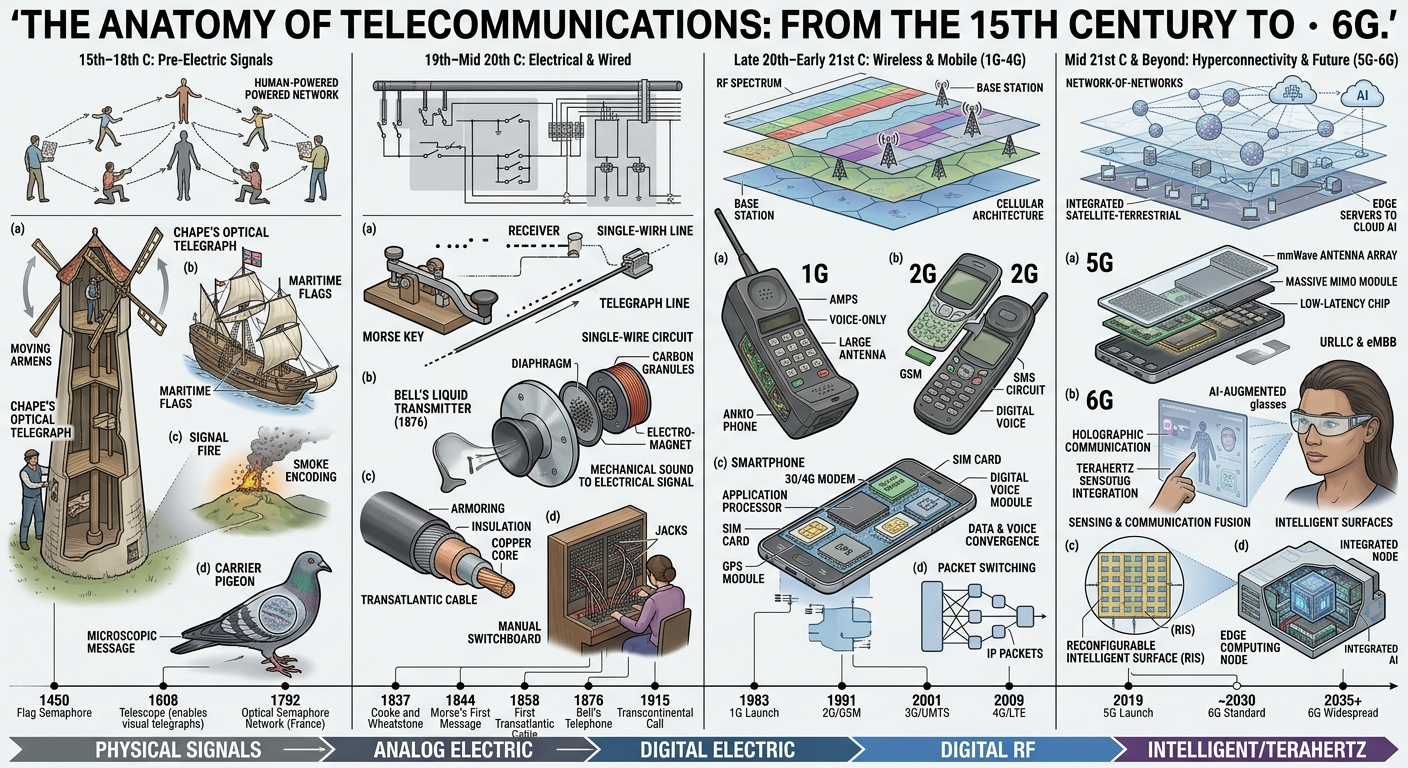
In the 15th century, information could travel only as fast as a person, animal, ship, or visual signal could carry it. By the 19th century, electrical telegraphy had separated communication from physical transportation. By the 20th century, radio, telephone networks, television, satellites, computers, and digital switching transformed communication into a global infrastructure. By the beginning of the 21st century, the Internet and mobile broadband turned telecommunications into the foundation of the digital economy.
The next stage is being shaped by 5G and the emerging 6G/IMT-2030 architecture, in which communication is expected to become increasingly integrated with artificial intelligence, sensing, positioning, distributed computing, automation, and ubiquitous connectivity. The International Telecommunication Union (ITU) describes IMT-2030 as the framework for the next generation of mobile communications and, as of 2026, has established technical performance requirements for the emerging 6G era.
The anatomy of telecommunications can therefore be understood as a continuous transformation:
Human messenger → visual signaling → electrical telegraph → telephone → radio → television → satellite → digital networks → Internet → mobile broadband → 5G → AI-native and sensing-enabled 6G.
1. What Exactly Is Telecommunications?
At its simplest, telecommunications consists of five fundamental functions:
- Information generation
- Encoding
- Transmission
- Reception and decoding
- Delivery to the intended user or machine
A modern communication system can therefore be represented conceptually as:
Source → Encoder → Transmitter → Channel → Receiver → Decoder → Destination
For example, when someone makes a mobile phone call:
Voice → microphone → digital conversion → radio transmission → cellular network → core network → destination network → radio transmission → receiving phone → speaker → human ear
A similar principle operates when sending a text message, streaming video, operating an industrial robot remotely, or transmitting data from a satellite.
The technologies change, but the underlying problem remains the same:
How can information be represented, transported, protected, reconstructed, and delivered accurately across distance?
2. Telecommunications Before Electricity
Although modern telecommunications is associated with electronics, long-distance communication existed thousands of years before electrical technology.
Ancient civilizations used:
- messengers;
- signal fires;
- drums;
- horns;
- flags;
- mirrors;
- smoke signals;
- beacon systems;
- semaphore;
- organized courier networks.
These systems created the earliest communication networks.
Their fundamental limitation was that information remained tied to a physical carrier or a visible/audible phenomenon.
A messenger physically transported information.
A signal fire transmitted information through light.
A drum transmitted information through sound.
The major technological revolution occurred when humanity learned to represent information as an electrical signal.
That transition fundamentally changed telecommunications.
3. The 15th Century: The Age of Physical Information
The 15th century was still dominated by physical transportation of information.
Letters, manuscripts, government orders, commercial records, and news traveled through:
- horse riders;
- ships;
- merchants;
- military couriers;
- postal systems;
- religious networks.
The invention of the printing press in Europe during the 15th century dramatically increased the ability to reproduce information, although printing itself was not telecommunications in the modern technical sense.
The important transformation was that information became increasingly reproducible.
Before mass printing:
One message → one physical manuscript
After printing:
One message → many copies
This distinction became important because telecommunications would eventually separate information from its physical medium altogether.
4. The 16th–18th Centuries: Organized Communication Networks
As states expanded, governments needed increasingly sophisticated communication systems.
Military commanders needed information from distant battlefields.
Governments needed administrative communication.
Merchants needed information about markets and ships.
Postal systems consequently became important components of national infrastructure.
The basic model was still:
Information → physical document → transportation → recipient
Communication speed was therefore limited by transportation.
The arrival of faster ships, improved roads, postal routes, and organized courier systems improved communication but did not fundamentally eliminate the relationship between information and physical movement.
The next major breakthrough would.
5. Semaphore: Communication at the Speed of Visibility
In the late 18th century, optical semaphore networks demonstrated that information could be transmitted without physically transporting the message itself.
Claude Chappe developed a visual semaphore system in France consisting of stations positioned within line of sight.
A message could be represented by the position of mechanical arms and observed by the next station.
The structure was approximately:
Station A → Station B → Station C → Station D → Destination
This was an early telecommunications network because the information itself did not have to physically travel between every location.
However, semaphore had severe limitations:
- it required line of sight;
- it depended on daylight and weather;
- stations had to be constructed;
- operators were required;
- bandwidth was limited;
- geographical obstacles constrained deployment.
Nevertheless, semaphore introduced an important concept:
communication networks could transmit representations of information rather than physical documents.
6. The Electrical Revolution
The decisive transformation came with electricity.
Electrical telegraphy converted information into electrical signals that could travel through wires.
This meant that communication speed was no longer determined primarily by the physical transportation of a person or document.
The ITU records that practical telegraph experiments developed during the 1830s, with early systems associated with William Fothergill Cooke and Charles Wheatstone. The world’s first commercial telegraph service opened in London in 1839, while Samuel Morse’s telegraph system became a major development in the United States, including his famous 1844 demonstration.
This was one of the greatest transformations in human history.
7. The Telegraph: The First Global Digital-Like Network
The telegraph represented information using coded electrical signals.
Morse code became particularly influential because it represented letters and numbers through combinations of short and long signals.
Conceptually:
Letter → Code → Electrical pulses → Wire → Electrical pulses → Decoder → Letter
This resembles modern digital communications surprisingly closely.
Modern telecommunications also follows the principle:
Information → Encoding → Transmission → Decoding → Information
The difference is that modern systems use sophisticated digital encoding, modulation, error correction, packetization, encryption, and computer processing.
8. Submarine Telegraph Cables
Once telegraph networks expanded across countries, the next challenge was international communication.
Telegraph cables were placed beneath seas and oceans.
A submarine telegraph cable was laid between Britain and France in 1850, with regular service beginning the following year. In 1858, the first transatlantic telegraph cable was laid.
This created the foundation of an international communication network.
The conceptual architecture became:
London → submarine cable → continental Europe
and eventually:
Europe → Atlantic cable → North America
For the first time, continents could be electronically connected.
The economic and geopolitical consequences were enormous.
Financial information could move more rapidly.
Governments could communicate faster.
News organizations could distribute information internationally.
Military communications became more immediate.
International commerce became increasingly dependent on telecommunications.
9. 1865: The Birth of International Telecommunications Governance
As telegraph networks crossed national borders, a new problem emerged.
Different countries could have different:
- technical standards;
- operating procedures;
- tariffs;
- accounting systems;
- equipment;
- regulations.
International communication therefore required coordination.
In 1865, representatives of 20 states met in Paris and created the International Telegraph Union, the predecessor of today’s ITU.
This event established a principle that remains fundamental today:
Global telecommunications requires global standards.
Modern networks depend on international coordination for matters including:
- radio spectrum;
- numbering;
- interoperability;
- satellite coordination;
- technical standards;
- mobile communications;
- international connectivity.
10. The Telephone Revolution
The telegraph transmitted coded information.
The telephone transmitted human speech.
The invention of the telephone fundamentally changed telecommunications because people could communicate using natural voice rather than coded messages.
The telephone became associated particularly with Alexander Graham Bell’s 1876 patent and demonstrations, while many other inventors and engineers contributed to the development of telephony.
The ITU notes that telephone development soon required international regulatory attention; by 1885, telephone service had become significant enough for international telephone provisions to be incorporated into the telegraph regulatory framework.
The basic telephone system consisted of:
Voice → microphone/transducer → electrical signal → network → electrical signal → speaker → voice
This introduced another foundational principle:
analog telecommunications.
The continuously varying characteristics of speech were represented by continuously varying electrical signals.
11. The Telephone Network
A telephone becomes much more powerful when connected to millions of other telephones.
The network therefore became the real innovation.
Instead of:
Telephone A → Telephone B
the architecture became:
Telephone A → Local Exchange → Trunk Network → Exchange → Telephone B
Telephone exchanges enabled switching.
The network had to determine:
- who was calling;
- where the destination was;
- which route should be used;
- which circuit was available;
- when the call ended.
This produced the discipline of telecommunications switching.
12. From Manual Operators to Automatic Switching
Early telephone systems depended heavily on human operators.
An operator physically connected callers using switchboards.
Automatic switching later replaced much of this manual work.
Mechanical switching systems evolved into increasingly sophisticated electronic switching.
Eventually, computer-controlled digital switching became dominant.
This transition is important because telecommunications gradually became less dependent on human intermediaries and more dependent on machines.
13. Radio: Telecommunications Without Wires
Telephone and telegraph systems initially depended heavily on physical wires.
Radio changed that.
Wireless signaling developed rapidly during the late 19th and early 20th centuries. The ITU identifies important experimental contributions from figures including Nikola Tesla, Jagadish Chandra Bose, Alexander Popov, Guglielmo Marconi, and David Edward Hughes. Marconi achieved a transatlantic wireless transmission in 1901.
Radio introduced a completely different transmission medium:
electromagnetic waves through space.
The general architecture became:
Information → transmitter → antenna → electromagnetic wave → antenna → receiver → information
This eliminated the requirement for a continuous physical wire between transmitter and receiver.
14. Broadcasting
Radio evolved from point-to-point communication into broadcasting.
Instead of:
One transmitter → One receiver
broadcasting enabled:
One transmitter → Many receivers
This changed society.
Radio became a major medium for:
- news;
- entertainment;
- education;
- public information;
- emergency communication;
- politics;
- international broadcasting.
The telecommunications network was no longer merely connecting two people.
It was connecting entire populations.
15. Television and the Era of Mass Communication
Television extended broadcasting from audio into moving images.
A television communication system had to transmit:
- brightness;
- color;
- synchronization information;
- sound;
- increasingly complex image data.
Early television systems used analog signals.
Later, digital television transformed the medium into a computer-like information system.
The transition from radio to television demonstrated another recurring telecommunications principle:
More information requires greater network capacity.
As content becomes richer:
Voice → audio → images → video → high-resolution video → immersive media
the required bandwidth increases.
16. The Semiconductor Revolution
Telecommunications was transformed by the invention and mass adoption of semiconductor electronics.
Transistors replaced many bulky vacuum-tube systems.
Integrated circuits placed large numbers of electronic components onto small pieces of semiconductor material.
The consequences included:
- smaller equipment;
- lower energy consumption;
- greater reliability;
- higher switching speeds;
- greater processing capability;
- lower costs.
Telecommunications increasingly became intertwined with computing.
The telephone network was no longer simply an electrical infrastructure.
It was becoming a computer-controlled information network.
17. Digital Telecommunications
One of the most important transitions in telecommunications was the move from analog to digital.
Analog systems represent information as continuously varying signals.
Digital systems represent information using discrete numerical values, ultimately represented by binary data.
A simplified process is:
Analog information → Sampling → Quantization → Binary encoding → Transmission → Reconstruction
Digital communication brought enormous advantages.
It enabled:
- error detection;
- error correction;
- compression;
- encryption;
- computer processing;
- efficient switching;
- storage;
- copying without progressive analog degradation.
Most importantly, voice, text, images, and video could all be represented as data.
18. The Rise of Computer Networks
Computers initially operated largely as independent machines.
Networking changed that.
Computers became capable of exchanging digital information across local and wide-area networks.
This eventually produced the Internet.
The Internet introduced a fundamentally different architecture from traditional circuit-switched telephone systems.
Instead of reserving a dedicated communication circuit for the entire duration of a session, packet-switched networks divide information into packets.
Conceptually:
Message → Packets → Network → Multiple routes → Destination → Reassembly
Each packet can contain addressing information allowing network equipment to determine where it should go.
19. The Internet Revolution
The Internet transformed telecommunications into a general-purpose global information infrastructure.
It connected:
- computers;
- servers;
- smartphones;
- businesses;
- governments;
- universities;
- sensors;
- cloud platforms;
- industrial systems.
The ITU describes the Internet as one of the major stages in its historical evolution from telegraphy toward today’s information society.
The crucial transformation was convergence.
Previously:
Telephone network = voice
Television network = video
Telegraph network = text
The digital Internet increasingly transformed all three into:
Data
20. Fiber-Optic Telecommunications
Copper cables dominated earlier telecommunications.
Fiber optics introduced a dramatically different medium.
Instead of electrical signals moving through metal, information is encoded into pulses or modulated patterns of light traveling through glass or specialized optical fiber.
The simplified system is:
Electrical data → Optical transmitter → Light → Fiber → Optical receiver → Electrical data
Fiber offers enormous transmission capacity and low attenuation compared with many earlier transmission systems.
Modern global telecommunications therefore depends heavily on fiber.
Fiber exists in:
- terrestrial backbone networks;
- metropolitan networks;
- data centers;
- access networks;
- submarine cables.
21. The Hidden Global Backbone: Submarine Cables
Much of the world’s international digital communication depends on submarine fiber-optic cables.
These cables cross oceans and connect continents.
A simplified global path can look like:
Data Center → Terrestrial Fiber → Coastal Landing Station → Submarine Cable → Landing Station → Terrestrial Fiber → Data Center
This infrastructure carries enormous volumes of:
- Internet traffic;
- financial transactions;
- cloud traffic;
- video;
- business communications;
- government communications;
- international data.
The modern digital world therefore still depends on physical infrastructure, despite the apparent “wirelessness” of smartphones and cloud services.
22. Satellites and Telecommunications
Telecommunications expanded beyond Earth with communication satellites.
The Space Age began with Sputnik 1 in 1957. Communication satellites soon followed. The ITU records the U.S. Echo satellite in 1960 and Telstar 1 in 1962, the latter enabling direct relay communications across the Atlantic.
Satellite telecommunications introduced global and regional connectivity across enormous geographical areas.
Satellite systems are particularly valuable where terrestrial infrastructure is difficult or expensive to deploy.
Modern satellite communications support:
- broadband;
- navigation-related services;
- broadcasting;
- aviation;
- maritime communications;
- remote connectivity;
- emergency communications;
- scientific missions.
23. The Cellular Revolution
Traditional telephone networks were strongly associated with fixed locations.
Cellular telecommunications introduced mobility.
A geographical area is divided into cells.
Each cell contains radio equipment capable of communicating with mobile devices.
As a user moves:
Cell A → Cell B → Cell C → Cell D
the network performs handovers to maintain connectivity.
This created a new telecommunications paradigm:
Communication while moving.
24. 1G: The First Generation of Mobile Networks
The first generation of cellular networks primarily delivered analog voice.
Characteristics included:
- analog radio;
- voice communication;
- limited capacity;
- large devices;
- relatively expensive service.
1G proved that cellular mobility could become a practical mass-market telecommunications service.
25. 2G: Digital Mobile Telecommunications
2G introduced digital cellular communication.
Digital technology enabled:
- improved voice efficiency;
- text messaging;
- better security;
- improved network capacity;
- data services.
SMS became one of the most influential applications of mobile telecommunications.
A phone was no longer simply a mobile voice terminal.
It became a digital communication device.
26. 3G: The Mobile Internet
3G significantly expanded mobile data capabilities.
The mobile phone evolved toward a general-purpose Internet terminal.
Users could increasingly access:
- websites;
- email;
- multimedia;
- applications;
- mobile services.
The distinction between telecommunications and computing began to disappear.
27. 4G: Broadband Becomes Mobile
4G brought substantially higher mobile data performance and an increasingly IP-based network architecture.
The smartphone emerged as a powerful computing and communications platform.
Mobile networks became essential infrastructure for:
- social platforms;
- streaming;
- cloud applications;
- navigation;
- mobile commerce;
- digital banking;
- video conferencing;
- app ecosystems.
The telecommunications network had effectively become a mobile Internet infrastructure.
28. 5G: Telecommunications Becomes an Industrial Platform
5G represents more than a faster version of 4G.
It is designed to support multiple classes of use cases, including:
- enhanced mobile broadband;
- massive machine-type communication;
- ultra-reliable and low-latency communication.
This means the network increasingly connects not just people, but machines.
Examples include:
Sensors → Network → Cloud/Edge → AI → Machine
This is particularly important for:
- smart factories;
- autonomous systems;
- connected vehicles;
- agriculture;
- logistics;
- energy;
- healthcare;
- robotics;
- smart cities.
29. The Anatomy of a Modern Telecommunications Network
A modern telecommunications ecosystem can be divided into several layers.
Layer 1: End Devices
Examples include:
- smartphones;
- computers;
- sensors;
- cameras;
- vehicles;
- industrial machines;
- satellites;
- IoT devices.
Layer 2: Access Network
This is how devices connect to the network.
Examples include:
- Wi-Fi;
- 4G;
- 5G;
- fiber-to-the-home;
- fixed wireless;
- satellite access.
Layer 3: Transport Network
The transport layer moves large quantities of information between network locations.
It includes:
- optical fiber;
- microwave links;
- high-capacity routers;
- optical transport systems.
Layer 4: Core Network
The core provides centralized or distributed network functions such as:
- routing;
- authentication;
- mobility management;
- policy;
- traffic management;
- service orchestration.
Layer 5: Cloud and Edge Computing
Modern telecommunications increasingly incorporates computing.
Cloud infrastructure provides large-scale processing.
Edge computing places processing closer to users and devices.
Layer 6: Applications
The final layer includes:
- voice;
- messaging;
- video;
- gaming;
- financial services;
- industrial applications;
- AI services;
- IoT applications.
30. The Role of Spectrum
Wireless telecommunications depends on electromagnetic spectrum.
Different frequencies have different propagation characteristics.
Lower frequencies generally provide longer propagation distances and better penetration characteristics, while higher frequencies can provide greater bandwidth but may experience greater propagation challenges.
Spectrum is therefore one of the most valuable resources in wireless telecommunications.
Governments and international organizations coordinate its use to reduce harmful interference and enable interoperable systems.
The history of telecommunications is consequently also a history of humanity learning how to manage the electromagnetic environment.
31. Modulation: Turning Information Into Radio Signals
Digital data cannot simply be transmitted through the air without a suitable physical representation.
Wireless systems use modulation.
The transmitter changes properties of a carrier signal according to information.
Modern systems use sophisticated forms of modulation and coding to maximize the amount of information that can be transmitted through available spectrum.
The conceptual chain is:
Bits → Coding → Modulation → Radio signal → Wireless channel → Demodulation → Decoding → Bits
This is one of the fundamental mechanisms underlying mobile telecommunications.
32. Antennas
Antennas convert electrical signals into electromagnetic radiation and electromagnetic radiation back into electrical signals.
Modern cellular systems increasingly use advanced antenna technologies.
Multiple antennas can be used to:
- improve capacity;
- improve coverage;
- spatially separate signals;
- improve reliability;
- direct energy toward particular users.
Technologies such as MIMO and beamforming have therefore become central to modern wireless communications.
33. Network Intelligence
Traditional networks relied heavily on fixed hardware and predetermined configurations.
Modern telecommunications is becoming software-defined.
Network functions can increasingly be implemented through software running on general-purpose computing infrastructure.
This enables:
- automation;
- network slicing;
- virtualization;
- dynamic resource allocation;
- programmable networks;
- AI-assisted optimization.
The telecommunications network is therefore becoming increasingly similar to a distributed computer.
34. Edge Computing and Telecommunications
Cloud computing concentrates computing resources in large data centers.
Edge computing moves some processing closer to the user or device.
Consider an industrial sensor.
Instead of:
Sensor → distant cloud → analysis → response
an edge architecture may use:
Sensor → Local Edge Computer → AI analysis → Immediate response
This reduces the amount of information that must travel across the network and can improve responsiveness.
Telecommunications and computing are consequently becoming increasingly inseparable.
35. Artificial Intelligence Enters Telecommunications
AI can operate at several levels of the telecommunications ecosystem.
It can assist with:
- traffic prediction;
- network optimization;
- anomaly detection;
- energy management;
- spectrum management;
- predictive maintenance;
- cybersecurity;
- customer-service automation;
- radio resource management.
The relationship is becoming bidirectional.
Telecommunications enables AI by transporting massive quantities of data.
AI improves telecommunications by making networks more adaptive and autonomous.
This produces an emerging feedback loop:
Connectivity → Data → AI → Network Optimization → Better Connectivity
36. From IoT to AIoT
The Internet of Things expanded telecommunications beyond conventional computers and smartphones.
IoT devices can include:
- agricultural sensors;
- industrial machines;
- environmental monitors;
- connected appliances;
- vehicles;
- meters;
- cameras.
When AI is integrated into IoT, the architecture becomes increasingly intelligent.
Sensor → Connectivity → Data → AI → Decision → Action
This is often described as the convergence of AI and IoT.
37. Why 6G Is Being Developed
6G is not simply intended to make smartphones faster.
The emerging ITU IMT-2030 framework identifies six broad usage scenarios:
- immersive communication;
- hyper-reliable and low-latency communication;
- massive communication;
- ubiquitous connectivity;
- AI and communication;
- integrated sensing and communication.
This reveals an important conceptual change.
Earlier generations primarily focused on:
Connecting people.
5G increasingly focused on:
Connecting people and machines.
6G is expected to move toward:
Connecting, computing, sensing, positioning, and intelligence as an integrated system.
38. IMT-2030: The International Framework for 6G
The ITU’s IMT-2030 framework establishes an international foundation for 6G development.
In 2026, ITU reported that its expert group had completed draft minimum technical performance requirements for IMT-2030 radio interfaces. The requirements include enhanced capabilities and new areas such as AI integration, sensing, improved coverage, positioning, sustainability, security, and resilience.
The ITU’s current development process anticipates technology proposals and evaluation leading toward eventual standardization around 2030.
39. Expected 6G Performance
The ITU’s published IMT-2030 material identifies ambitious performance targets.
Depending on scenario, targets include peak data rates in the range of approximately 50–200 Gbit/s, user-experienced rates around 300–500 Mbit/s or higher, substantially improved spectrum efficiency, very high connection density, and radio-network latency targets down toward 0.1–1 millisecond.
These figures should be understood as framework targets and evaluation criteria rather than guarantees that every user will experience those values.
The importance of 6G is therefore not one number.
It is the combination of:
speed + latency + reliability + intelligence + sensing + coverage + positioning + sustainability.
40. Integrated Sensing and Communication
One of the most interesting aspects of 6G is the possibility of combining communication and sensing.
Today’s systems generally separate:
Communication system
from
Radar/sensing system
6G research envisions situations where radio infrastructure can potentially perform both functions.
A network could therefore:
Transmit information + detect objects + estimate position + understand the environment
This could contribute to applications involving:
- transportation;
- robotics;
- industrial automation;
- smart infrastructure;
- environmental monitoring;
- spatial awareness.
The ITU explicitly identifies integrated sensing and communication as one of the six IMT-2030 usage scenarios.
41. AI and Communication Become One System
Another important 6G concept is the integration of AI directly into telecommunications.
Instead of:
Network → transports AI data
future architectures may increasingly involve:
Network + AI → jointly optimized system
AI could help determine:
- how resources should be allocated;
- which route information should take;
- where computation should occur;
- how spectrum should be used;
- how energy should be minimized;
- how network failures should be predicted.
The network may consequently become increasingly autonomous.
42. Positioning and Spatial Telecommunications
6G is also expected to improve positioning capabilities.
The ITU’s IMT-2030 framework identifies positioning as a new capability, with ambitious accuracy targets in appropriate conditions.
This could enable telecommunications infrastructure to become increasingly aware of:
- where devices are;
- how they are moving;
- their spatial relationships;
- the surrounding environment.
Communication therefore moves toward a more spatially aware architecture.
43. Ubiquitous Connectivity
One of the greatest remaining telecommunications challenges is connecting places where conventional infrastructure is difficult to deploy.
6G is being considered in a broader ecosystem involving terrestrial and potentially non-terrestrial connectivity.
The objective is increasingly:
Connectivity anywhere → anytime → across multiple network technologies.
This could be particularly significant for:
- rural communities;
- remote industries;
- maritime environments;
- aircraft;
- disaster zones;
- sparsely populated regions.
44. Telecommunications and the Digital Divide
Technological progress does not automatically create universal connectivity.
A country can possess advanced telecommunications technology while millions of people remain poorly connected.
The digital divide can result from:
- infrastructure costs;
- geography;
- electricity shortages;
- affordability;
- lack of devices;
- digital skills;
- spectrum availability;
- insufficient backhaul;
- regulatory barriers.
Consequently, telecommunications development must be considered not only in terms of technology but also in terms of accessibility and inclusion.
45. Telecommunications in Africa
Africa presents a particularly important telecommunications environment.
The continent contains:
- enormous geographical distances;
- rapidly growing populations;
- major urban centers;
- rural communities;
- islands and remote areas;
- diverse regulatory environments.
Mobile telecommunications has therefore been particularly transformative.
For many people, the mobile phone became the first major Internet access device.
Telecommunications infrastructure can support:
- mobile banking;
- education;
- healthcare;
- agriculture;
- commerce;
- government services;
- entrepreneurship.
The future challenge is to extend high-capacity connectivity beyond major metropolitan areas.
46. South Africa’s Position in the Telecommunications Ecosystem
South Africa has an important role in African telecommunications through its:
- mobile networks;
- Internet exchanges;
- data centers;
- terrestrial fiber;
- submarine cable connectivity;
- cloud infrastructure;
- enterprise telecommunications;
- technology ecosystem.
The country’s strategic geographic position and relatively developed digital infrastructure make it an important connectivity hub for southern Africa.
The broader challenge is to translate infrastructure into affordable, reliable, high-quality connectivity across both urban and rural communities.
47. Telecommunications and the Economy
Telecommunications is no longer a separate industry operating at the edge of the economy.
It is foundational infrastructure.
Consider modern industries:
Banking
Customer → Mobile Network → Bank Platform → Payment System
Agriculture
Sensor → Network → Cloud/Edge → AI → Farmer
Manufacturing
Machine → Industrial Network → Analytics → Automated Decision
Transport
Vehicle → Cellular/Satellite Network → Cloud → Traffic Intelligence
Education
Student → Network → Learning Platform → Teacher/Content
Healthcare
Device → Secure Network → Medical Platform → Clinician
The telecommunications network has therefore become a general-purpose economic infrastructure.
48. Telecommunications and National Security
Modern nations depend heavily on communications infrastructure.
Critical telecommunications assets include:
- fiber networks;
- mobile networks;
- satellite systems;
- Internet exchanges;
- data centers;
- submarine cables;
- radio infrastructure.
Network disruption can affect:
- financial services;
- transport;
- emergency communications;
- healthcare;
- businesses;
- government services.
Consequently, telecommunications resilience is becoming increasingly important.
49. Cybersecurity
As telecommunications becomes more digital, cybersecurity becomes inseparable from network design.
Threats can involve:
- unauthorized access;
- malware;
- denial-of-service attacks;
- identity theft;
- data interception;
- infrastructure compromise;
- supply-chain vulnerabilities.
Modern telecommunications therefore requires security at multiple levels:
Device → Access → Transport → Core → Cloud → Application
Security cannot be added only at the end.
It must be integrated throughout the architecture.
50. Energy and Sustainability
Telecommunications networks consume substantial energy.
Large-scale mobile networks, data centers, routers, optical systems, and cooling infrastructure all require electricity.
Future telecommunications therefore faces a dual challenge:
More connectivity + lower environmental impact
6G’s framework explicitly incorporates sustainability as an important design consideration.
Potential approaches include:
- more energy-efficient hardware;
- intelligent sleep modes;
- renewable energy;
- improved network planning;
- AI-based energy optimization;
- more efficient cooling;
- lower-power devices.
51. The Evolution of the Telecommunications Business Model
The telecommunications industry has undergone several business transformations.
Telegraph Era
Revenue came primarily from:
Messages
Telephone Era
Revenue came primarily from:
Calls + network access
Mobile Era
Revenue expanded to:
Voice + SMS + mobile data
Internet Era
Value increasingly shifted toward:
Connectivity + digital services
5G/6G Era
The ecosystem increasingly expands toward:
Connectivity + cloud + edge + AI + IoT + sensing + enterprise platforms
This means telecommunications companies increasingly compete not simply on connectivity but on digital infrastructure.
52. The Convergence of Telecommunications and Computing
The historical separation between telecommunications and computing is disappearing.
Previously:
Telecommunications = move information
Computing = process information
Modern infrastructure combines both:
Move information + store information + process information + understand information + act on information
This convergence is one of the defining characteristics of the 21st-century network.
53. The Telecommunications Stack of the Future
A future communications system can be conceptualized as a layered stack:
Physical Layer
Fiber, radio spectrum, antennas, satellites, cables.
↓
Transmission Layer
Modulation, coding, optical transport, radio access.
↓
Network Layer
Routing, switching, mobility, addressing.
↓
Computing Layer
Cloud and edge computing.
↓
Intelligence Layer
AI and machine learning.
↓
Sensing Layer
Environmental awareness and positioning.
↓
Application Layer
Human and machine services.
↓
Economic/Social Layer
Commerce, healthcare, education, government and society.
This represents the movement from a communication network toward an intelligent digital infrastructure.
54. From Communication to Cognition
The deepest historical transformation may be expressed as follows:
First era
Transport the person
Second era
Transport the document
Third era
Transport the signal
Fourth era
Transport the voice
Fifth era
Transport digital information
Sixth era
Connect billions of devices
Emerging era
Connect communication, computing, sensing and intelligence
The network is gradually becoming more than a pipe for information.
It is becoming a distributed computational environment.
55. The Complete Historical Timeline
| Period | Major Development | Fundamental Transformation |
|---|---|---|
| 15th century | Postal and physical communication | Movement of information through people |
| 16th–17th centuries | Organized postal systems | Larger communication networks |
| 18th century | Optical semaphore | Information represented visually |
| 1830s–1840s | Electrical telegraph | Information becomes electrical |
| 1850s | Submarine telegraph | International electronic communication |
| 1865 | International Telegraph Union | International standards |
| 1870s | Telephone | Voice becomes transmissible |
| 1890s–1900s | Radio | Wireless communication |
| 1920s onward | Broadcasting | One-to-many communication |
| 1940s–1960s | Electronics and satellites | Global electronic communication |
| 1960s–1980s | Digital computing/networking | Communication becomes computational |
| 1980s–1990s | Fiber and Internet expansion | Global digital connectivity |
| 1990s | 2G | Digital mobile communications |
| 2000s | 3G | Mobile Internet |
| 2010s | 4G | Mobile broadband |
| 2020s | 5G | Massive machine and industrial connectivity |
| Late 2020s–2030s | 6G/IMT-2030 | AI, sensing, ubiquitous and immersive connectivity |
The dates should not be interpreted as exact worldwide replacement points. Telecommunications generations overlap, and deployment varies considerably between countries and operators.
56. The Central Engineering Problem
Despite more than five centuries of technological evolution, the central telecommunications problem remains remarkably consistent:
How do we move information accurately, efficiently, securely and economically from one location to another?
The engineering variables have changed.
Early systems struggled with:
distance
Telegraph systems struggled with:
signal degradation and international interoperability
Telephone networks struggled with:
capacity and switching
Radio networks struggled with:
spectrum and interference
Digital networks struggled with:
bandwidth and routing
Mobile networks struggle with:
capacity, coverage, mobility and energy
6G increasingly confronts:
complexity, intelligence, sensing, sustainability, security and ubiquitous connectivity.
57. The Future: Beyond 6G
6G is not the end of telecommunications.
Just as 5G emerged from decades of developments before it, future generations will build upon 6G.
Potential future directions include:
- increasingly autonomous networks;
- advanced AI-native communications;
- integrated terrestrial and non-terrestrial networks;
- increasingly precise positioning;
- communication-sensing integration;
- immersive communications;
- distributed intelligence;
- advanced optical communications;
- quantum communication research;
- extremely dense machine connectivity.
The boundary between telecommunications, computing, AI, robotics and sensing may become increasingly difficult to define.
58. A New Definition of Telecommunications
The traditional definition of telecommunications is:
The transmission of information over distance.
A more contemporary definition could be:
Telecommunications is the global technological infrastructure for transporting, processing, coordinating, sensing and increasingly understanding information between humans, machines and intelligent systems.
This broader definition better captures the direction of modern networks.
Conclusion
The anatomy of telecommunications is a story of humanity progressively eliminating the limitations imposed by distance.
In the 15th century, information traveled with people.
Semaphore allowed information to travel through visual representations.
The telegraph converted information into electrical signals.
The telephone transformed those signals into human voice communication.
Radio removed the requirement for physical wires.
Television created mass audiovisual communication.
Satellites extended telecommunications beyond terrestrial geography.
Digital networks transformed voice, text, images and video into data.
The Internet connected billions of computers and devices.
Mobile networks transformed connectivity into a continuous, portable service.
4G turned the smartphone into a broadband computer.
5G began transforming telecommunications into a platform for machines, industries and IoT.
Now 6G is being developed as a broader architecture in which communications may increasingly merge with artificial intelligence, sensing, positioning, computing, automation, security and sustainability.
The ITU’s IMT-2030 framework reflects this transition, with six major usage scenarios spanning immersive communications, highly reliable low-latency communication, massive communication, ubiquitous connectivity, AI and communication, and integrated sensing and communication.
The deepest lesson of telecommunications history is therefore not simply that networks have become faster.
They have become more capable.
The journey has moved from:
messages → signals → voice → data → mobile broadband → connected machines → intelligent networks.
The next transformation may be from a world in which networks merely carry information to one in which networks participate in computing, sensing, reasoning and coordinated action.
In that sense, the history of telecommunications is not finished.
It is evolving from a technology for connecting places into an infrastructure for connecting the increasingly intelligent systems of civilization.
`


Be First to Comment