

Comprehensive Scientific and Technological Thesis
Abstract
Everything encountered in ordinary physical life—from the human body and the atmosphere to oceans, computers, buildings, stars, and planets—is ultimately connected to the behaviour of matter at microscopic and subatomic scales.
The atom provides the first major level of this hierarchy. At its centre lies the atomic nucleus, containing protons and neutrons, while electrons occupy quantum states associated with the surrounding electron cloud. Yet modern particle physics reveals a deeper layer: electrons belong to the lepton family and appear to be elementary, whereas protons and neutrons are composite hadrons built from quarks and held together by the strong interaction.
This thesis examines the subatomic ecosystem as an interconnected system rather than simply a list of particles. It explores the discovery of electrons, protons and neutrons; their masses, charges and quantum properties; atomic structure; quantum mechanics; nuclear forces; quarks and gluons; electromagnetic interactions; nuclear stability; isotopes; radioactivity; antimatter; particle accelerators; detectors; nuclear energy; medicine; electronics; semiconductors; spectroscopy; astrophysics; and the continuing search for physics beyond the Standard Model.
1. Introduction: What Is the Subatomic Ecosystem?
The word subatomic refers to structures smaller than atoms.
For centuries, matter was treated as if it were fundamentally continuous. The development of atomic theory changed this picture. Later experiments demonstrated that atoms themselves possess internal structure.
The basic hierarchy can be represented approximately as:
Universe → galaxies → stars → planets → matter → molecules → atoms → nucleus/electron cloud → protons/neutrons → quarks and gluons
The important modern qualification is that this hierarchy does not simply continue indefinitely in the same way. Electrons are currently classified as elementary particles, while protons and neutrons are composite particles. CERN describes quarks and electrons as among the elementary particles in the Standard Model.
The subatomic ecosystem therefore consists of:
- matter particles;
- force-carrying particles;
- quantum fields;
- electromagnetic interactions;
- strong interactions;
- weak interactions;
- nuclear structures;
- quantum states;
- conservation laws;
- and the physical vacuum.
The atom is consequently not a static miniature solar system. It is a quantum system governed by probability, fields and interactions.
2. The Three Famous Constituents of the Atom
The traditional introductory description identifies three major constituents:
| Particle | Electric charge | Location in ordinary atoms | Modern classification |
|---|---|---|---|
| Electron | −1 | Atomic electron cloud | Elementary lepton |
| Proton | +1 | Atomic nucleus | Composite baryon |
| Neutron | 0 | Atomic nucleus | Composite baryon |
The electron is a member of the lepton family.
The proton and neutron belong to the hadron family and are made from quarks. A proton contains two up quarks and one down quark in its simplest valence-quark description, while a neutron contains one up quark and two down quarks. Gluons mediate the strong interaction that binds quarks together.
This distinction is fundamental.
3. The Electron
3.1 Discovery
The electron was identified experimentally by J. J. Thomson in the late nineteenth century through experiments involving cathode rays.
The discovery demonstrated that atoms were not indivisible.
The electron became the first clearly established elementary constituent of ordinary matter.
3.2 Fundamental Characteristics
The electron possesses:
- negative electric charge;
- mass;
- spin 1/2;
- intrinsic angular momentum;
- magnetic properties;
- quantum-mechanical wave behaviour.
Unlike the proton and neutron, the electron is not known to contain smaller constituents.
4. The Electron Is Not Simply a Tiny Planet
One of the most persistent misconceptions in introductory physics is the idea that electrons orbit nuclei exactly like planets orbit the Sun.
Quantum mechanics provides a fundamentally different description.
An electron in an atom is represented by a quantum state or wavefunction. The square of the wavefunction’s magnitude gives a probability density associated with finding the electron in a particular region.
Thus, an electron orbital represents a probability distribution, not a conventional planetary trajectory.
This quantum description explains:
- atomic spectra;
- chemical bonding;
- periodic trends;
- semiconductor behaviour;
- lasers;
- molecular structure;
- and much of modern electronics.
5. Electron Energy Levels
Electrons in atoms can occupy permitted quantum states.
These states are characterized by quantum numbers.
Important quantum numbers include:
- principal quantum number;
- orbital angular-momentum quantum number;
- magnetic quantum number;
- spin quantum number.
The quantization of electron states produces discrete energy levels.
When an electron changes between allowed energy states, energy can be absorbed or emitted.
The energy of an emitted or absorbed photon is related to the energy difference:
ΔE = hf
where:
- ΔE = energy difference;
- h = Planck’s constant;
- f = electromagnetic frequency.
This principle is fundamental to spectroscopy, lasers and many optical technologies.
6. Electrons and Electricity
Electric current is fundamentally connected with the movement of electric charge.
In metals, conduction is primarily associated with mobile electrons.
In semiconductors, electrical behaviour depends on:
- electrons;
- holes;
- energy bands;
- doping;
- electric fields;
- crystal structures;
- and quantum mechanics.
This is the foundation of:
- transistors;
- integrated circuits;
- CPUs;
- memory;
- sensors;
- LEDs;
- solar cells;
- and modern telecommunications.
The digital world therefore rests on phenomena occurring at the quantum and electronic levels.
7. The Proton
The proton is a positively charged particle found in atomic nuclei.
Its electric charge determines the identity of an element.
For example:
- hydrogen has one proton;
- helium has two;
- carbon has six;
- oxygen has eight;
- silicon has fourteen.
The number of protons is called the atomic number.
Consequently:
Atomic number = number of protons
Changing the number of protons changes the element itself.
8. Discovery of the Proton
Ernest Rutherford’s experiments involving nuclear structure established the existence of a positively charged nuclear constituent associated with hydrogen.
The discovery followed the realization that the atom contains a tiny, dense nucleus.
This represented a major transition from the nineteenth-century conception of atoms toward nuclear physics.
9. The Proton Is Composite
The proton is not elementary.
Its internal structure is governed by quantum chromodynamics, or QCD, the theory describing the strong interaction.
A simplified valence-quark description is:
Proton = up + up + down
The quark electric charges are:
- up quark = +2/3;
- down quark = −1/3.
Therefore:
(+2/3) + (+2/3) + (−1/3) = +1
giving the proton its net positive electric charge.
However, a real proton is considerably more complicated than three permanently separated particles. Its internal quantum state includes gluons and transient quark-antiquark contributions.
10. The Neutron
The neutron is electrically neutral but has substantial internal structure.
In the simplified valence-quark picture:
Neutron = up + down + down
Thus:
(+2/3) + (−1/3) + (−1/3) = 0
giving the neutron zero net electric charge.
The neutron is nevertheless not electrically featureless. Its internal charged constituents produce measurable electromagnetic properties.
11. Discovery of the Neutron
James Chadwick established the neutron as an independent particle in 1932.
The discovery solved a major problem in nuclear physics.
If nuclei consisted only of positively charged protons, the observed masses and nuclear structures could not be adequately explained.
The neutron provided a neutral nuclear constituent and opened the door to modern nuclear physics.
12. The Nucleus
The atomic nucleus contains:
- protons;
- neutrons.
Together they are called nucleons.
The nucleus contains almost all of an atom’s mass.
Yet its physical dimensions are extraordinarily small compared with the overall scale of an atom.
A useful conceptual relationship is:
Atom ≫ nucleus ≫ proton/neutron ≫ quark-scale structure
This enormous difference in scale explains why matter contains so much apparently empty space at the atomic level.
13. Atomic Identity
The proton number determines the chemical identity of an atom.
For an atom:
Z = proton number
The total number of nucleons is:
A = Z + N
where:
- Z = proton number;
- N = neutron number;
- A = mass number.
Therefore:
N = A − Z
This relationship is central to nuclear science.
14. Isotopes
Atoms of the same element can contain different numbers of neutrons.
These are called isotopes.
For example, carbon exists naturally in several isotopic forms.
All carbon isotopes have six protons, but their neutron numbers differ.
Isotopes may be:
- stable;
- radioactive;
- naturally occurring;
- artificially produced.
Isotopes are important in:
- medicine;
- archaeology;
- geology;
- nuclear physics;
- biological tracing;
- industrial measurement;
- environmental science.
15. The Strong Nuclear Interaction
The strong interaction is one of the fundamental interactions of nature.
At the deepest Standard Model level, gluons mediate the strong interaction between quarks.
The strong interaction produces color confinement, meaning quarks are not normally observed as isolated free particles.
Instead, they form composite particles such as:
- protons;
- neutrons;
- mesons;
- other hadrons.
CERN identifies the gluon as the carrier associated with the strong force.
16. From Quarks to Nuclei
There are several layers of interaction:
Level 1 — Quarks
Up and down quarks form nucleons.
Level 2 — Gluons
Gluons mediate the strong interaction among quarks.
Level 3 — Nucleons
Protons and neutrons form nuclei.
Level 4 — Residual nuclear interaction
A residual form of the strong interaction binds nucleons within nuclei.
Level 5 — Electrons and nuclei
Electromagnetic interaction binds electrons to atomic nuclei.
Level 6 — Atoms
Atoms combine to produce molecules and materials.
This hierarchy is the essence of the subatomic ecosystem.
17. Electromagnetism
Electromagnetism governs interactions involving electric charge.
The photon is the quantum carrier of the electromagnetic interaction.
Electromagnetism explains:
- atomic structure;
- chemical bonding;
- electricity;
- magnetism;
- light;
- radio waves;
- microwaves;
- X-rays;
- optics;
- electronics;
- telecommunications.
The enormous technological importance of electromagnetism makes the electron-photon relationship one of the most consequential relationships in modern civilization.
18. The Weak Interaction
The weak interaction plays a central role in processes involving changes among particle types.
It is particularly important in:
- radioactive beta decay;
- neutrino interactions;
- nuclear reactions inside stars;
- transformations between quark flavours.
The W and Z bosons are the associated force carriers in the Standard Model.
For example, beta-minus decay can be represented schematically as:
neutron → proton + electron + antineutrino
This process demonstrates that nuclear physics is connected directly to particle physics.
19. The Standard Model
The Standard Model provides the leading theoretical framework for elementary particles and three fundamental interactions: electromagnetic, weak and strong.
Its matter particles are divided into:
Quarks
- up;
- down;
- charm;
- strange;
- top;
- bottom.
Leptons
- electron;
- electron neutrino;
- muon;
- muon neutrino;
- tau;
- tau neutrino.
The model also contains force-carrying bosons and the Higgs boson.
20. Fermions and Bosons
Particles can broadly be separated into two classes.
Fermions
Fermions have half-integer spin and constitute matter.
Examples include:
- electrons;
- quarks;
- neutrinos.
Bosons
Bosons have integer spin.
They include particles associated with interactions, such as:
- photons;
- gluons;
- W bosons;
- Z bosons.
The Higgs boson is also a boson, associated with the Higgs field.
21. The Higgs Field
The Higgs field is present throughout space.
Elementary particles interact with this field to different degrees, contributing to their observed masses through the Higgs mechanism.
The Higgs boson was discovered experimentally in 2012 by the ATLAS and CMS experiments at CERN.
The Higgs mechanism is one component of the modern explanation of why elementary particles possess mass.
22. Quantum Fields
Modern particle physics goes deeper than the idea of tiny billiard-ball particles.
Quantum field theory treats fundamental particles as excitations of underlying quantum fields.
In this framework:
- the electron corresponds to an electron field;
- the photon corresponds to the electromagnetic field;
- quarks correspond to quark fields;
- the Higgs boson corresponds to the Higgs field.
The particle is therefore understood as a quantized excitation of a field.
This represents one of the most profound conceptual developments in modern physics.
23. Matter and Antimatter
Many particles possess corresponding antiparticles.
For the electron, the antiparticle is the positron.
The positron has:
- the same mass as the electron;
- opposite electric charge;
- opposite relevant quantum numbers.
Matter-antimatter interactions can result in annihilation, converting their rest energy and kinetic energy into other particles.
Antimatter is important in fundamental physics and has practical applications such as positron-emission tomography.
24. Radioactivity
Some atomic nuclei are unstable.
They can transform into more stable configurations through radioactive decay.
Major categories include:
- alpha decay;
- beta decay;
- gamma emission.
Radioactive processes provide natural laboratories for studying:
- nuclear forces;
- weak interactions;
- quantum tunnelling;
- conservation laws;
- nuclear structure.
Radioactivity also has major applications in medicine, industry and scientific measurement.
25. Nuclear Energy
Nuclear energy originates from changes in nuclear binding and mass-energy relationships.
Two major mechanisms are:
Fission
A heavy nucleus splits into smaller nuclei.
Fusion
Light nuclei combine to form heavier nuclei.
Stars are powered by nuclear fusion.
The Sun’s energy ultimately originates from nuclear processes occurring deep inside its interior.
26. Mass-Energy Equivalence
Einstein’s relationship:
E = mc²
expresses the equivalence between mass and energy.
Because the speed of light squared is enormous, even small changes in mass correspond to substantial amounts of energy.
This principle is fundamental to:
- nuclear physics;
- particle physics;
- astrophysics;
- nuclear energy;
- cosmology.
27. Particle Accelerators
Scientists investigate subatomic physics by accelerating particles to very high energies and studying collisions.
Accelerators allow researchers to:
- probe matter at extremely small scales;
- discover new particles;
- test theoretical predictions;
- study nuclear matter;
- investigate fundamental interactions.
The Large Hadron Collider at CERN is one of the most powerful particle accelerators ever constructed.
28. Particle Detectors
Particles are often detected indirectly.
Detectors measure physical consequences such as:
- ionization;
- energy deposition;
- particle tracks;
- electromagnetic signals;
- Cherenkov radiation;
- timing;
- momentum.
Modern particle detectors combine:
materials science + electronics + computing + statistics + mathematics + physics
This makes experimental particle physics a multidisciplinary technological ecosystem.
29. The Computing Connection
Modern particle physics generates enormous volumes of experimental data.
Consequently, particle research depends on:
- high-performance computing;
- distributed computing;
- data centres;
- machine learning;
- artificial intelligence;
- advanced networking;
- statistical inference;
- data visualization.
Particle physics therefore contributes not only to fundamental knowledge but also to the development of sophisticated computational systems.
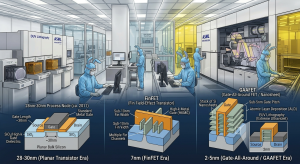
30. Subatomic Physics and Semiconductor Technology
Modern semiconductor engineering ultimately depends upon controlling electrons.
Engineers manipulate:
- electron energy bands;
- charge carriers;
- electric fields;
- quantum effects;
- semiconductor junctions;
- tunnelling;
- nanoscale structures.
The transistor is therefore a technological manifestation of our understanding of electronic behaviour in matter.
From a smartphone to a supercomputer, modern digital technology depends upon this subatomic foundation.
31. Subatomic Physics and Medical Technology
Particle and nuclear physics have transformed medicine.
Applications include:
- X-ray imaging;
- CT scanning;
- nuclear medicine;
- PET;
- radiation therapy;
- particle-beam therapy;
- radioactive tracers;
- medical isotope production.
These technologies depend upon controlled interactions between radiation, particles and biological matter.
32. Subatomic Physics and Astronomy
Astrophysics relies heavily on subatomic physics.
Stars, supernovae, neutron stars and black-hole environments involve extreme conditions.
Subatomic processes determine:
- stellar energy production;
- element formation;
- neutrino production;
- supernova dynamics;
- neutron-star properties;
- cosmic-ray interactions.
The history of the universe itself is inseparable from particle physics.
33. Neutron Stars: A Natural Nuclear Laboratory
Neutron stars are among the most extreme objects known.
They contain matter compressed to extraordinary densities.
Their interiors may involve:
- dense nuclear matter;
- neutrons;
- protons;
- electrons;
- exotic phases of matter;
- intense magnetic fields.
They provide natural laboratories that cannot easily be reproduced on Earth.
34. The Early Universe
The early universe was far hotter and denser than today’s universe.
At sufficiently high energies, ordinary distinctions between familiar forms of matter become less intuitive.
The universe underwent transitions as it expanded and cooled.
Particle physics is therefore essential to understanding:
- the early universe;
- matter-antimatter asymmetry;
- primordial nucleosynthesis;
- neutrinos;
- dark matter;
- cosmic evolution.
35. What the Standard Model Does Not Explain
Despite its extraordinary success, the Standard Model is incomplete.
Major open questions include:
- What is dark matter?
- Why is there much more matter than antimatter?
- Why do neutrinos have mass?
- Why are there three generations of matter particles?
- How can gravity be incorporated into a quantum theory?
- What is the deeper structure of spacetime?
- Are quarks and leptons truly elementary?
- Are additional particles or interactions waiting to be discovered?
CERN explicitly identifies several of these as outstanding questions beyond the Standard Model.
36. The Possibility of Deeper Structure
Physics has repeatedly revealed deeper layers.
Matter was once thought to consist of indivisible atoms.
Then atoms were found to contain:
electrons + nucleus
The nucleus contains:
protons + neutrons
Protons and neutrons contain:
quarks + gluons
The next question is whether quarks and leptons are genuinely fundamental.
Experiments continue to test this possibility. ATLAS describes searches for evidence that known particles may themselves have deeper constituents.
37. The Subatomic Ecosystem as a System
The subatomic world can be represented as a connected system:
Quantum fields
↓
Elementary particles
↓
Quarks + leptons
↓
Hadrons + electrons
↓
Protons + neutrons
↓
Atomic nuclei
↓
Atoms
↓
Molecules
↓
Materials
↓
Cells
↓
Living organisms
↓
Technology and civilization
This illustrates a fundamental scientific principle:
Macroscopic reality emerges from microscopic interactions.
38. The Technology Chain
A second ecosystem can be constructed from science to technology:
Quantum physics
→ semiconductor physics
→ transistors
→ integrated circuits
→ processors
→ computers
→ networks
→ data centres
→ artificial intelligence
→ modern digital civilization.
At another branch:
Nuclear physics
→ radiation detection
→ medical imaging
→ nuclear medicine
→ radiation therapy
→ advanced medical technologies.
At another:
Particle physics
→ accelerators
→ detectors
→ superconducting technologies
→ high-performance computing
→ advanced scientific instrumentation.
39. The Deepest Conceptual Lesson
The most important lesson is that electrons, protons and neutrons are not isolated objects.
They participate in an enormous network of interactions.
The electron connects:
quantum mechanics → electromagnetism → chemistry → materials → electronics
The proton connects:
quarks → gluons → nuclear physics → atoms → chemistry
The neutron connects:
quarks → strong interaction → nuclear stability → isotopes → stars
Together they provide a bridge between fundamental physics and everyday civilization.
40. Conclusion
The subatomic ecosystem represents one of humanity’s deepest attempts to understand physical reality.
The electron is an elementary lepton whose quantum behaviour governs electricity, chemistry and much of modern electronics.
The proton and neutron are composite particles whose internal quark-gluon structure connects atomic matter to quantum chromodynamics.
At the next level, protons and neutrons form atomic nuclei. Electrons interact electromagnetically with those nuclei to produce atoms. Atoms form molecules, molecules produce materials, and materials form the physical foundations of technology and life.
The modern picture is therefore not simply:
electron + proton + neutron = atom.
It is much richer:
quantum fields → elementary particles → quarks and leptons → hadrons → nuclei → atoms → molecules → materials → technology → civilization.
The Standard Model provides an extraordinarily successful description of much of this subatomic world, but it is not the final theory of nature. Gravity remains outside the Standard Model, and major mysteries—including dark matter and the matter-antimatter asymmetry—remain unresolved.
The investigation therefore continues.
The fundamental question has evolved from:
“What is an atom made of?”
to:
“What are the fundamental fields, particles, interactions and principles from which physical reality emerges?”
That question places the electron, proton and neutron not at the end of our understanding of matter, but at one of the most important gateways into the deeper architecture of the universe.



Be First to Comment