
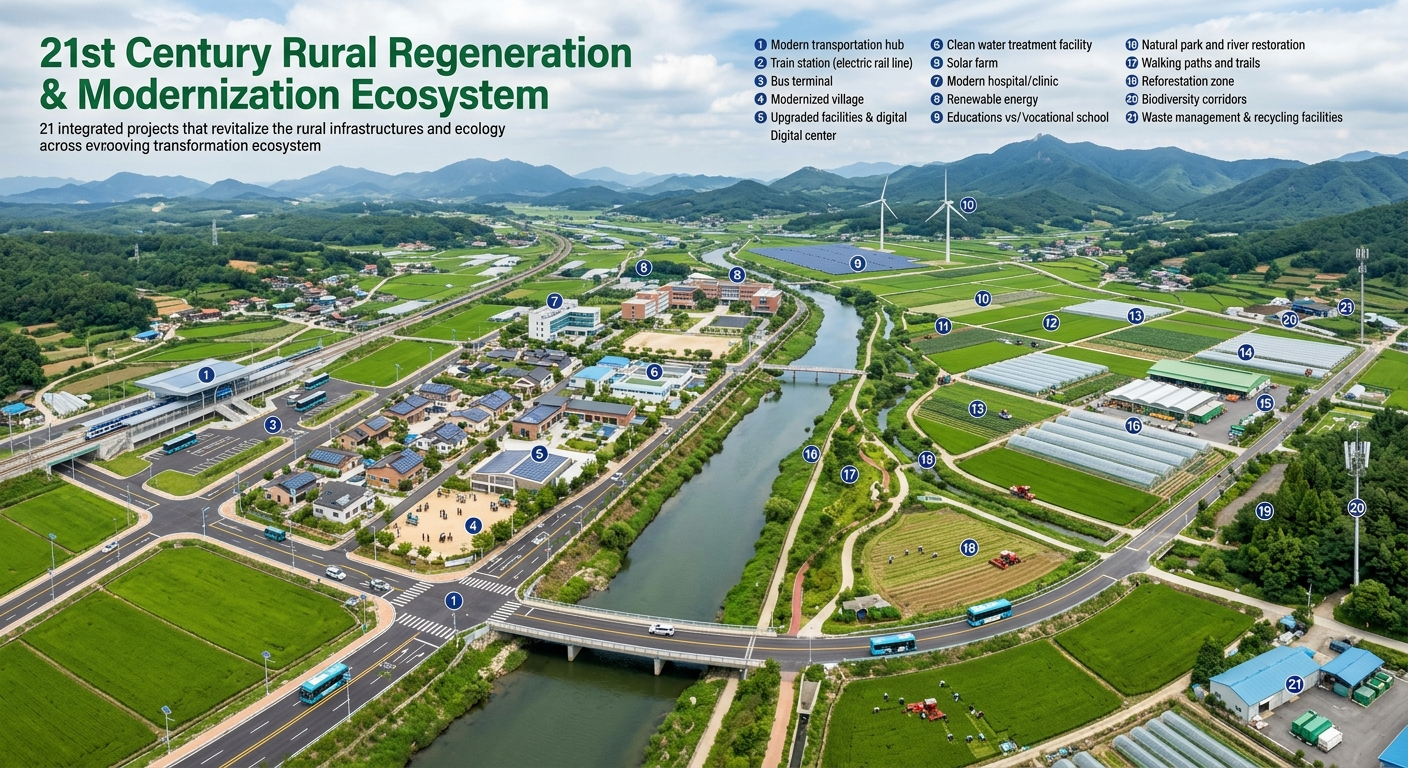
Comprehensive Strategic Thesis for Transforming Rural Areas into Modern, Connected, Productive and Sustainable Communities
Executive Summary
Rural areas are not simply places that require assistance; they are major economic, ecological, agricultural, cultural and human-development assets. They contain land, water resources, agricultural potential, minerals, forests, biodiversity, renewable-energy resources, tourism opportunities and communities whose knowledge and labour are essential to national development.
Yet many rural communities continue to experience infrastructure deficits involving roads, electricity, water, sanitation, housing, telecommunications, healthcare, education, financial services, markets and digital connectivity. These deficits can reinforce poverty, unemployment, migration and economic exclusion.
This thesis proposes a 21-point Rural Infrastructure Modernisation Master Plan designed to transform rural areas from infrastructure-deficient settlements into integrated rural economic ecosystems.
The master plan is based on one central principle:
Rural development should not merely bring urban services to rural communities; it should create modern rural economies capable of generating wealth, employment, innovation, food, energy and sustainable livelihoods locally.
The 21 master-plan pillars are:
- Rural Spatial Planning and Development Zones
- Roads, Bridges and Transport Infrastructure
- Water Security and Water Infrastructure
- Sanitation and Wastewater Systems
- Electricity and Energy Modernisation
- Renewable Energy and Rural Microgrids
- Telecommunications and Digital Connectivity
- Digital Rural Economy and Smart Villages
- Housing and Human Settlements
- Healthcare and Rural Medical Infrastructure
- Education, Skills and Knowledge Infrastructure
- Agriculture and Food Production Ecosystems
- Rural Industrialisation and Manufacturing
- Small Business and Entrepreneurship Ecosystems
- Financial Inclusion and Rural Banking
- Logistics, Markets and Rural Trading Centres
- Environmental Restoration and Climate Resilience
- Tourism, Culture and Creative Industries
- Public Safety, Governance and Community Infrastructure
- Research, Innovation and Technology Centres
- Integrated Rural Economic Corridors and Long-Term Development Governance
1. INTRODUCTION
1.1 The Rural Transformation Challenge
Modern economies are increasingly dependent upon infrastructure.
Electricity powers industry. Roads connect producers to markets. Water supports households and agriculture. Telecommunications connect businesses to customers. Schools create human capital. Hospitals protect the productive capacity of communities. Digital infrastructure enables participation in the modern economy.
Consequently, rural infrastructure should not be viewed as a collection of isolated government projects.
A road without markets may have limited economic impact.
Electricity without productive businesses may increase household consumption without creating sufficient employment.
Internet connectivity without digital skills may leave communities connected but economically excluded.
Agricultural production without storage and logistics may result in significant post-harvest losses.
Therefore, rural infrastructure must be designed as an ecosystem.
2. THE MASTER-PLAN PHILOSOPHY
The proposed model is based on five interconnected objectives:
CONNECT
Connect rural communities physically and digitally.
POWER
Provide reliable and affordable electricity and energy.
PRODUCE
Create agricultural, industrial and service-sector production.
PROTECT
Protect people, water, land, biodiversity and infrastructure.
PROSPER
Convert infrastructure investment into employment, businesses, income and long-term economic growth.
The ultimate objective is therefore:
Infrastructure → Services → Production → Businesses → Employment → Income → Investment → Sustainable Rural Development
3. MASTER PLAN 1: RURAL SPATIAL PLANNING AND DEVELOPMENT ZONES
The first requirement is proper spatial planning.
Many rural settlements develop without coordinated planning. Houses, schools, agricultural fields, businesses, roads and public facilities can become geographically separated, increasing infrastructure costs.
A modern rural master plan should therefore identify:
- residential zones;
- agricultural zones;
- industrial zones;
- commercial centres;
- transport corridors;
- conservation areas;
- tourism zones;
- water-resource protection areas;
- renewable-energy zones;
- public-service centres;
- digital infrastructure corridors.
Rural Development Nodes
Instead of attempting to build identical infrastructure everywhere, governments can establish strategically located Rural Development Nodes.
A node could contain:
- clinic;
- school;
- police facility;
- municipal services;
- bank or financial centre;
- supermarket;
- agricultural market;
- public transport terminal;
- internet centre;
- business incubator;
- renewable-energy system;
- water infrastructure;
- warehouse;
- vocational-training centre.
Smaller villages would then be connected to these nodes.
This creates a network of rural settlements rather than isolated communities.
4. MASTER PLAN 2: ROADS, BRIDGES AND TRANSPORT INFRASTRUCTURE
Road infrastructure is one of the foundations of rural economic development.
Farmers need roads to transport crops.
Children need roads to reach schools.
Patients need transport to hospitals.
Businesses need roads to receive supplies.
Tourists need reliable access to attractions.
Infrastructure Programme
The rural transportation programme should include:
- national and provincial roads;
- district roads;
- village roads;
- farm-to-market roads;
- bridges;
- drainage systems;
- pedestrian paths;
- bicycle infrastructure;
- public transport terminals;
- rural bus systems;
- freight routes.
Particular attention should be given to all-weather roads capable of operating during heavy rainfall.
Rural Road Maintenance
Construction alone is insufficient.
A permanent road-maintenance programme should establish:
Inspection → Maintenance → Repair → Reconstruction
rather than waiting for roads to collapse before intervention.
5. MASTER PLAN 3: WATER SECURITY AND WATER INFRASTRUCTURE
Water is one of the most important rural-development assets.
The master plan should integrate:
- dams;
- reservoirs;
- boreholes;
- groundwater management;
- pipelines;
- water-treatment plants;
- community storage tanks;
- irrigation systems;
- rainwater harvesting;
- water-quality monitoring.
Water-Energy-Food Nexus
Water infrastructure should be planned together with agriculture and energy.
For example:
Solar electricity → pumps → water → irrigation → agriculture → food processing → markets
This creates an integrated productive ecosystem.
Water infrastructure must also protect groundwater from over-extraction and contamination.
6. MASTER PLAN 4: SANITATION AND WASTEWATER SYSTEMS
Rural modernisation requires dignified sanitation.
Infrastructure should include:
- household sanitation;
- community sanitation;
- wastewater treatment;
- drainage;
- septic systems where appropriate;
- decentralised wastewater systems;
- sludge management;
- stormwater management;
- hygiene facilities.
Wastewater can potentially be treated and reused for appropriate non-potable applications, including certain forms of agricultural irrigation, subject to health and environmental standards.
The principle should be:
No rural modernisation without water and sanitation.
7. MASTER PLAN 5: ELECTRICITY AND ENERGY MODERNISATION
Reliable electricity is the foundation of modern rural economic activity.
Electricity enables:
- refrigeration;
- irrigation;
- manufacturing;
- telecommunications;
- schools;
- hospitals;
- workshops;
- businesses;
- household appliances;
- digital services.
The master plan should modernise:
- transmission;
- distribution;
- substations;
- transformers;
- household connections;
- industrial connections;
- street lighting;
- backup systems.
Electricity planning should also anticipate future demand rather than merely supplying today’s consumption.
8. MASTER PLAN 6: RENEWABLE ENERGY AND RURAL MICROGRIDS
Rural areas often possess significant renewable-energy potential.
Depending on geography, this may include:
- solar;
- wind;
- small hydro;
- biogas;
- agricultural biomass;
- geothermal resources in suitable locations.
Rural Microgrid Model
A rural microgrid can combine:
Solar + Battery Storage + Grid Connection + Backup Generation + Smart Controls
This can improve resilience where conventional grid infrastructure is expensive or unreliable.
Energy should also be connected to productive applications.
For example:
Solar → cold storage → agricultural products → processing → market
rather than solar being treated only as a household-electrification project.
9. MASTER PLAN 7: TELECOMMUNICATIONS AND DIGITAL CONNECTIVITY
A modern rural economy requires digital infrastructure.
The programme should expand:
- fibre-optic networks;
- mobile networks;
- broadband;
- community Wi-Fi;
- satellite connectivity where appropriate;
- rural data centres and edge infrastructure where economically justified;
- telecommunications towers;
- emergency communications.
Schools, clinics, government offices, businesses and community centres should become priority connectivity locations.
Digital Infrastructure Principle
A rural road connects physical economies.
A broadband network connects digital economies.
Both are essential.
10. MASTER PLAN 8: DIGITAL RURAL ECONOMY AND SMART VILLAGES
Once connectivity exists, rural communities need opportunities to use it.
A Smart Rural Village could integrate:
- digital government;
- online education;
- telehealth;
- agricultural information;
- e-commerce;
- digital banking;
- weather information;
- agricultural sensors;
- business-management software;
- geographic information systems;
- digital identity systems;
- online employment services.
Artificial intelligence could support rural development through applications such as:
- agricultural forecasting;
- crop disease detection;
- water management;
- infrastructure monitoring;
- education assistance;
- business planning;
- translation;
- public-service optimisation.
Technology should complement people rather than replace essential human services.
11. MASTER PLAN 9: HOUSING AND HUMAN SETTLEMENTS
Rural housing programmes should move beyond simply constructing houses.
A modern settlement requires:
House + Water + Electricity + Sanitation + Roads + Connectivity + Services + Economic Opportunity
Housing developments should therefore be located near:
- transport;
- schools;
- clinics;
- commercial centres;
- employment;
- agricultural production;
- public facilities.
Appropriate local materials can also create employment and reduce construction costs.
12. MASTER PLAN 10: HEALTHCARE AND RURAL MEDICAL INFRASTRUCTURE
Rural healthcare should operate as a network.
Level 1
Community health facilities.
Level 2
Primary healthcare clinics.
Level 3
District hospitals.
Level 4
Regional specialist hospitals.
Digital technologies can connect smaller facilities with specialists through telemedicine.
Modern rural clinics should also have reliable:
- electricity;
- water;
- sanitation;
- refrigeration;
- communications;
- medicine-storage systems;
- emergency transport.
Healthcare infrastructure is also an economic asset because a healthy population has greater capacity to learn and work.
13. MASTER PLAN 11: EDUCATION, SKILLS AND KNOWLEDGE INFRASTRUCTURE
Rural modernisation depends heavily on human capital.
The education ecosystem should include:
- early childhood development;
- primary schools;
- secondary schools;
- vocational colleges;
- agricultural training;
- engineering training;
- digital skills;
- entrepreneurship education;
- adult education;
- research centres.
Rural Skills Academies
Each major rural development node could contain a skills academy focused on local economic opportunities.
Potential programmes include:
- agriculture;
- construction;
- electrical engineering;
- plumbing;
- renewable energy;
- information technology;
- telecommunications;
- mechanics;
- food processing;
- business management.
This connects education directly to economic development.
14. MASTER PLAN 12: AGRICULTURE AND FOOD PRODUCTION ECOSYSTEMS
Agriculture should become one of the central engines of rural development.
The strategy should cover the entire value chain:
Land → Inputs → Production → Irrigation → Harvest → Storage → Processing → Packaging → Transport → Markets → Export
Infrastructure should include:
- irrigation;
- farm roads;
- agricultural machinery centres;
- seed and input facilities;
- storage;
- silos;
- cold chains;
- slaughter and processing facilities where appropriate;
- food-processing plants;
- agricultural markets.
The objective is to move from selling raw agricultural commodities toward value-added production.
For example:
Raw crop → flour → packaged food → branded product → retail market
creates considerably more economic activity than selling the raw crop alone.
15. MASTER PLAN 13: RURAL INDUSTRIALISATION AND MANUFACTURING
Rural areas should not depend entirely on agriculture.
Agricultural production can become the foundation for rural manufacturing.
Potential industries include:
- food processing;
- furniture;
- textiles;
- construction materials;
- agricultural machinery;
- packaging;
- renewable-energy equipment;
- recycling;
- local building components.
Rural Industrial Parks
Strategically located rural industrial parks could provide:
- serviced land;
- electricity;
- water;
- telecommunications;
- warehouses;
- transport access;
- waste-management services;
- business support.
This can reduce the geographic concentration of economic activity in major cities.
16. MASTER PLAN 14: SMALL BUSINESS AND ENTREPRENEURSHIP ECOSYSTEM
Infrastructure must create opportunities for local entrepreneurs.
A rural business ecosystem should provide:
- business incubators;
- training;
- accounting support;
- legal assistance;
- digital platforms;
- market information;
- procurement opportunities;
- financing;
- mentorship.
Potential rural businesses include:
- agricultural services;
- transport;
- construction;
- tourism;
- food processing;
- repair workshops;
- IT services;
- retail;
- logistics;
- renewable-energy maintenance.
Local businesses should participate in infrastructure construction and maintenance wherever possible.
17. MASTER PLAN 15: FINANCIAL INCLUSION AND RURAL BANKING
Economic modernisation requires access to financial services.
The ecosystem should provide:
- bank branches;
- mobile banking;
- digital payments;
- savings services;
- agricultural finance;
- small-business finance;
- insurance;
- cooperative finance;
- financial literacy.
Digital financial systems can reduce the physical distance between rural communities and financial institutions.
However, financial inclusion must be accompanied by consumer protection and financial education.
18. MASTER PLAN 16: LOGISTICS, MARKETS AND RURAL TRADING CENTRES
Production has little value if products cannot reach customers.
Rural logistics infrastructure should include:
- warehouses;
- cold-storage facilities;
- collection centres;
- wholesale markets;
- transport terminals;
- distribution centres;
- e-commerce collection points.
Rural Market Hub
A Rural Market Hub could integrate:
Farmers + Transporters + Processors + Retailers + Financial Services + Digital Commerce
This creates a local economic marketplace.
19. MASTER PLAN 17: ENVIRONMENTAL RESTORATION AND CLIMATE RESILIENCE
Rural development must protect the natural systems upon which rural economies depend.
The environmental programme should address:
- soil erosion;
- deforestation;
- wetland degradation;
- river pollution;
- invasive species;
- biodiversity loss;
- uncontrolled waste;
- land degradation.
Climate-resilience infrastructure should include:
- flood-management systems;
- drought planning;
- water conservation;
- resilient roads;
- resilient bridges;
- fire-management systems;
- climate-smart agriculture.
Circular Rural Economy
Waste should increasingly become a resource.
Examples include:
Organic waste → compost
Agricultural residues → energy/materials
Wastewater → treated water
Recyclable materials → secondary raw materials
20. MASTER PLAN 18: TOURISM, CULTURE AND CREATIVE INDUSTRIES
Rural areas often contain enormous cultural and natural assets.
Potential sectors include:
- cultural tourism;
- heritage tourism;
- wildlife tourism;
- eco-tourism;
- adventure tourism;
- traditional crafts;
- music;
- arts;
- food tourism;
- historical tourism.
Infrastructure should include:
- access roads;
- visitor centres;
- accommodation;
- sanitation;
- telecommunications;
- signage;
- safety infrastructure;
- cultural facilities.
Tourism should be designed so that communities receive meaningful economic benefits.
21. MASTER PLAN 19: PUBLIC SAFETY, GOVERNANCE AND COMMUNITY INFRASTRUCTURE
A modern community requires effective institutions.
Infrastructure should support:
- police services;
- emergency response;
- fire services;
- disaster management;
- municipal services;
- public administration;
- community halls;
- libraries;
- youth centres;
- sports facilities.
Smart Governance
Digital government systems can improve:
- service requests;
- infrastructure monitoring;
- municipal billing;
- land records;
- procurement;
- project tracking;
- public communication.
Transparent infrastructure dashboards can allow communities to monitor major projects.
22. MASTER PLAN 20: RESEARCH, INNOVATION AND TECHNOLOGY CENTRES
Rural development should become increasingly knowledge-driven.
Regional innovation centres can bring together:
- universities;
- colleges;
- government;
- businesses;
- farmers;
- technology companies;
- engineering organisations;
- entrepreneurs.
Research priorities could include:
- drought-resistant agriculture;
- water technologies;
- renewable energy;
- rural telecommunications;
- agricultural robotics;
- artificial intelligence;
- construction technologies;
- local manufacturing;
- environmental restoration.
The goal is to turn rural communities from technology consumers into technology participants and producers.
23. MASTER PLAN 21: INTEGRATED RURAL ECONOMIC CORRIDORS
The final master plan integrates all 20 previous components.
Instead of treating villages individually, governments should create Rural Economic Corridors.
A corridor could connect:
Village → Rural Node → Agricultural Area → Industrial Park → Logistics Hub → Regional City → National/International Market
Along the corridor would be:
- roads;
- electricity;
- water;
- telecommunications;
- agricultural production;
- warehouses;
- businesses;
- schools;
- healthcare;
- housing;
- tourism;
- industrial facilities.
This creates a continuous economic ecosystem.
24. THE INTEGRATED RURAL ECOSYSTEM
The 21 master plans should not operate independently.
They should be connected through an integrated architecture:
LAND
↓
WATER + ENERGY
↓
ROADS + TELECOMMUNICATIONS
↓
HOUSING + HEALTHCARE + EDUCATION
↓
AGRICULTURE + INDUSTRY
↓
BUSINESSES + FINANCE
↓
LOGISTICS + MARKETS
↓
DIGITAL ECONOMY + INNOVATION
↓
EMPLOYMENT + INCOME
↓
INVESTMENT
↓
SUSTAINABLE RURAL DEVELOPMENT
This is the central ecosystem of the master plan.
25. RURAL DEVELOPMENT TECHNOLOGY STACK
A modern rural area can be understood as a multi-layer infrastructure system.
Layer 1 — Natural Resources
Land, water, forests, minerals, biodiversity and climate.
Layer 2 — Physical Infrastructure
Roads, bridges, buildings, water systems and energy infrastructure.
Layer 3 — Digital Infrastructure
Fibre, mobile networks, cloud services, sensors and digital platforms.
Layer 4 — Human Infrastructure
Schools, healthcare, skills and institutions.
Layer 5 — Economic Infrastructure
Agriculture, manufacturing, commerce, finance and logistics.
Layer 6 — Innovation
Research, AI, automation, biotechnology and advanced engineering.
Layer 7 — Governance
Planning, regulation, financing, monitoring and accountability.
26. PHASED IMPLEMENTATION STRATEGY
A rural master plan should be implemented progressively rather than attempting to construct everything simultaneously.
Phase 1: Assessment — Years 1–2
Map:
- population;
- roads;
- water;
- electricity;
- telecommunications;
- schools;
- healthcare;
- agriculture;
- businesses;
- land;
- environmental conditions.
Create a national or regional Rural Infrastructure Digital Map.
Phase 2: Basic Infrastructure — Years 2–5
Prioritise:
- roads;
- water;
- sanitation;
- electricity;
- telecommunications;
- clinics;
- schools.
This establishes the foundation.
Phase 3: Economic Infrastructure — Years 4–8
Develop:
- agricultural hubs;
- markets;
- warehouses;
- cold storage;
- industrial parks;
- logistics centres;
- business incubators.
Phase 4: Digital and Innovation Transformation — Years 6–12
Expand:
- broadband;
- smart villages;
- digital government;
- AI-enabled services;
- innovation centres;
- advanced vocational training.
Phase 5: Regional Economic Integration — Years 10–20
Connect rural regions into:
- national supply chains;
- regional markets;
- export corridors;
- tourism networks;
- manufacturing networks;
- agricultural value chains.
27. FINANCING THE MASTER PLAN
No rural transformation programme can succeed without a sustainable financing model.
Potential funding sources include:
Government
- national government;
- provincial/state government;
- municipalities;
- infrastructure agencies.
Development Finance
- development banks;
- infrastructure funds;
- international development institutions.
Private Sector
- telecommunications companies;
- energy companies;
- construction companies;
- banks;
- agricultural businesses;
- manufacturers.
Community
- cooperatives;
- community enterprises;
- local investment structures.
Public-Private Partnerships
PPP models can be used for appropriate infrastructure such as:
- renewable energy;
- telecommunications;
- logistics;
- industrial parks;
- water infrastructure;
- tourism facilities.
28. LOCAL EMPLOYMENT MODEL
The master plan should maximise local participation.
Instead of:
External contractor → construction → leaves community
the model should become:
Infrastructure investment → local training → local contractors → local employment → local businesses → local economic growth
A Rural Infrastructure Skills Programme could train young people in:
- bricklaying;
- plumbing;
- electrical work;
- welding;
- road maintenance;
- solar installation;
- telecommunications;
- machinery operation;
- construction management;
- digital technology.
29. THE ROLE OF YOUTH
Young people should be treated as builders of the rural economy rather than merely beneficiaries of government programmes.
Youth programmes should connect:
Education → Skills → Entrepreneurship → Technology → Employment → Ownership
Young entrepreneurs could operate:
- technology businesses;
- agricultural enterprises;
- repair centres;
- transport companies;
- renewable-energy services;
- digital businesses;
- tourism businesses;
- food-processing enterprises.
30. THE ROLE OF WOMEN
Women should have equal access to:
- land opportunities;
- finance;
- education;
- technology;
- entrepreneurship;
- procurement;
- agricultural value chains;
- leadership.
Rural transformation is unlikely to achieve its full economic potential if half of the population is excluded from productive opportunities.
31. INFRASTRUCTURE MAINTENANCE MASTER SYSTEM
One of the greatest weaknesses of infrastructure programmes is inadequate maintenance.
Every new asset should therefore have a complete lifecycle plan:
Design → Construction → Commissioning → Operation → Maintenance → Rehabilitation → Replacement
An infrastructure asset register should record:
- location;
- age;
- condition;
- capacity;
- responsible authority;
- maintenance schedule;
- estimated replacement cost.
Modern sensors and digital monitoring can increasingly assist with infrastructure maintenance.
32. KEY PERFORMANCE INDICATORS
The programme should be measured scientifically.
Important indicators include:
Infrastructure
- percentage of households with electricity;
- percentage with clean water;
- sanitation coverage;
- road accessibility;
- broadband coverage.
Economic
- employment;
- household income;
- number of businesses;
- agricultural production;
- manufacturing output;
- exports.
Social
- school attendance;
- educational achievement;
- healthcare access;
- housing quality;
- public safety.
Environmental
- water quality;
- land restoration;
- forest cover;
- waste recycling;
- emissions;
- biodiversity indicators.
Digital
- internet access;
- digital-literacy rate;
- e-commerce participation;
- digital-government usage.
33. GOVERNANCE ARCHITECTURE
A successful master plan requires coordination between multiple levels.
National Level
Sets:
- policy;
- national standards;
- financing frameworks;
- major infrastructure priorities.
Provincial/Regional Level
Coordinates:
- regional infrastructure;
- economic corridors;
- healthcare;
- education;
- transport.
Municipal Level
Manages:
- local roads;
- water;
- sanitation;
- waste;
- settlement planning.
Community Level
Participates in:
- planning;
- monitoring;
- maintenance;
- local enterprise;
- accountability.
Private Sector
Provides:
- capital;
- technology;
- construction;
- operations;
- innovation.
Universities
Provide:
- research;
- skills;
- data;
- engineering;
- innovation.
34. THE RURAL DIGITAL TWIN
One advanced component of the master plan could be a Rural Digital Twin.
This would be a continuously updated digital representation of the rural region.
It could contain:
- roads;
- buildings;
- electricity;
- water infrastructure;
- telecommunications;
- agricultural land;
- population;
- environmental conditions;
- public facilities.
Authorities could use this system to simulate infrastructure decisions before investing.
For example:
Where should a new clinic be built?
Where should a new road be constructed?
Which villages require water infrastructure first?
Where should an industrial park be located?
Data-driven planning can improve investment decisions.
35. SMART AGRICULTURAL VILLAGES
The agricultural village of the future could integrate:
- solar energy;
- irrigation;
- weather monitoring;
- soil monitoring;
- agricultural machinery;
- digital marketplaces;
- cold storage;
- processing;
- financial services.
The objective is to create a complete production ecosystem.
36. RURAL INDUSTRIAL CITY MODEL
Some strategically located rural centres could eventually evolve into small industrial towns.
The development sequence could be:
Village
↓
Rural Service Centre
↓
Rural Development Node
↓
Agricultural Processing Centre
↓
Industrial Hub
↓
Regional Economic Town
This creates an alternative pathway to development that does not require every young person to migrate to a major metropolitan city.
37. ENVIRONMENTAL PRINCIPLE
Modernisation must not mean destruction.
The master plan should follow the principle:
Develop the economy while increasing the ecological resilience of the rural environment.
Infrastructure projects should therefore consider:
- biodiversity;
- water resources;
- soil;
- climate;
- forests;
- wetlands;
- wildlife;
- community livelihoods.
38. THE RURAL ECONOMIC MULTIPLIER
Infrastructure can generate economic multiplier effects.
For example:
A new road can:
reduce transport costs → increase market access → increase agricultural sales → increase farmer income → increase local consumption → increase business activity → increase employment.
Similarly:
Electricity can:
enable refrigeration → reduce food losses → enable processing → increase product value → create businesses → create employment.
Broadband can:
connect businesses → enable e-commerce → expand markets → provide digital services → create new occupations.
This demonstrates why infrastructure should be viewed as an economic production system, not merely public expenditure.
39. THE 21-POINT RURAL TRANSFORMATION MODEL
The entire programme can therefore be summarised as follows:
| No. | Master Plan | Primary Objective |
|---|---|---|
| 1 | Spatial Planning | Organised rural settlements |
| 2 | Roads & Transport | Physical connectivity |
| 3 | Water | Water security |
| 4 | Sanitation | Public health |
| 5 | Electricity | Reliable power |
| 6 | Renewable Energy | Energy resilience |
| 7 | Telecommunications | Digital connectivity |
| 8 | Smart Villages | Digital economy |
| 9 | Housing | Quality settlements |
| 10 | Healthcare | Healthy population |
| 11 | Education | Human capital |
| 12 | Agriculture | Food production |
| 13 | Industry | Rural manufacturing |
| 14 | Entrepreneurship | Local businesses |
| 15 | Finance | Capital access |
| 16 | Logistics | Market connectivity |
| 17 | Environment | Ecological resilience |
| 18 | Tourism & Culture | Diversified economy |
| 19 | Governance & Safety | Effective institutions |
| 20 | Innovation | Technology development |
| 21 | Economic Corridors | Regional integration |
40. CONCLUSION
The modernisation of rural areas should be regarded as one of the most important long-term infrastructure and economic-development projects of the 21st century.
Rural transformation is not simply about building houses, roads or clinics.
It is about constructing an interconnected ecosystem in which:
people have water,
homes have electricity,
villages have roads,
schools have technology,
clinics have modern equipment,
farmers have markets,
businesses have finance,
young people have skills,
communities have broadband,
industries have reliable infrastructure,
entrepreneurs have opportunities,
and natural resources are protected.
The ultimate objective is to transform rural areas from peripheral settlements into productive, connected, resilient and economically integrated regions.
The most important principle of this master plan is therefore:
Do not build rural infrastructure as isolated projects. Build an integrated rural ecosystem in which infrastructure, people, technology, agriculture, industry, finance, education, healthcare and the environment reinforce one another.
If implemented correctly, the 21-point master plan can create a new development model in which rural communities become centres of food production, renewable energy, manufacturing, digital services, tourism, innovation and entrepreneurship.
For countries such as South Africa and other African nations, this approach could also help address the interconnected challenges of rural poverty, unemployment, infrastructure backlogs, regional inequality, urban migration and economic concentration.
The rural community of the future should therefore not be defined by its distance from the city.
It should be defined by its quality of infrastructure, connectivity, economic productivity, human capital, environmental sustainability and capacity for innovation.
That is the foundation of a modern rural civilisation.


Be First to Comment