
Abstract
Search engines have been among the most influential technologies in the development of the modern Internet. From the early directories and keyword-based retrieval systems to sophisticated global search infrastructures, traditional search engines transformed an enormous and rapidly expanding digital information environment into an index that humans could navigate.
The emergence of large language models (LLMs), retrieval-augmented generation (RAG), multimodal artificial intelligence, semantic search and autonomous agents is now producing another major transformation: the transition from searching for information toward asking intelligent systems to discover, interpret, synthesize and explain information.
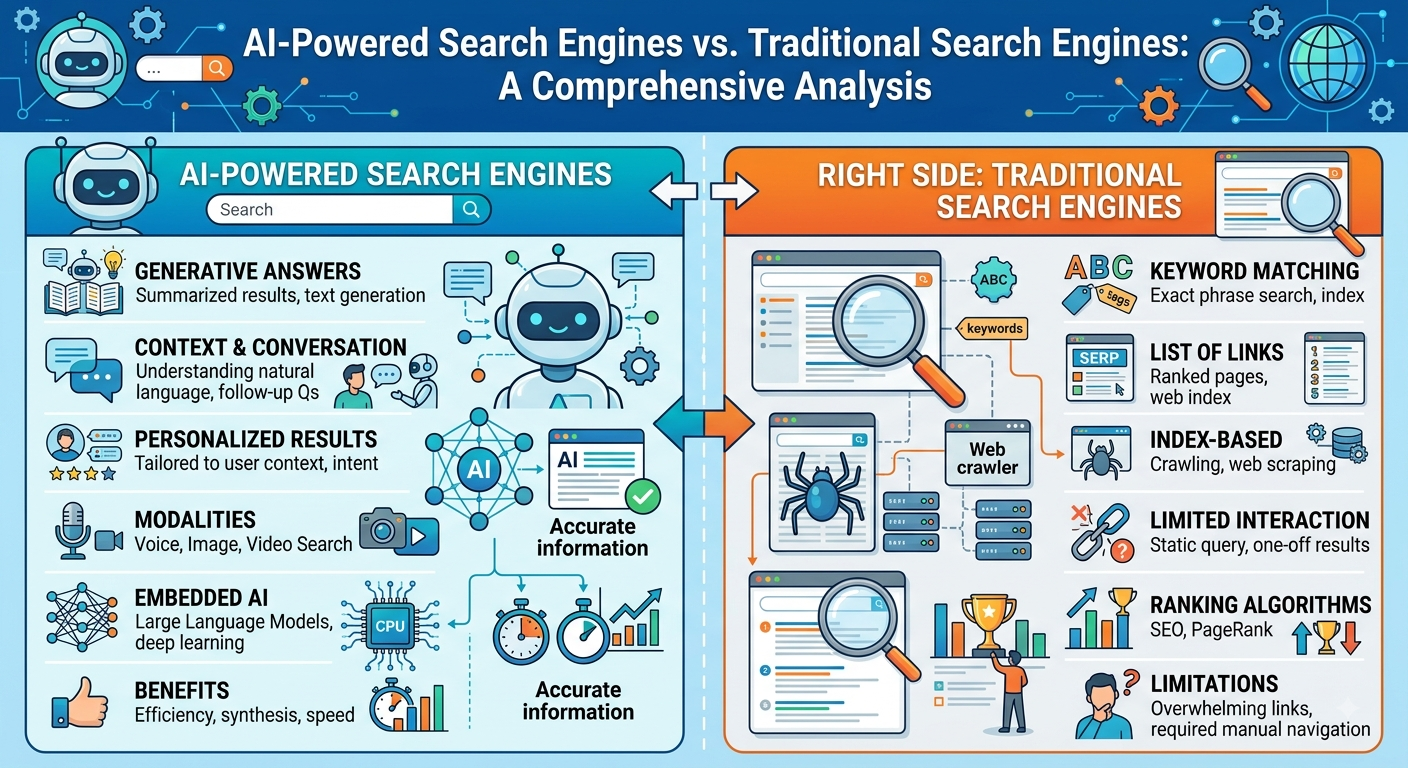
Traditional search engines principally retrieve and rank documents. AI-powered search systems increasingly combine retrieval with machine reasoning and natural-language generation, allowing them to produce synthesized answers, follow conversational context, compare sources and, in some systems, perform multi-step research. Perplexity, for example, describes its service as searching the web and returning conversational answers supported by citations, while conventional search remains strongly oriented toward ranked results and direct navigation.
This thesis examines the technological evolution of search, the architectures of traditional and AI-powered systems, their differences in information retrieval, ranking, computation, indexing, language understanding, citations, personalization and user interaction, and the emerging implications for journalism, education, science, commerce, digital marketing and the economics of the Web.
The central argument is that AI search does not simply represent a faster version of traditional search. It represents a change in the information-processing model of the Internet: from document retrieval to machine-mediated information synthesis.
Chapter 1 — Introduction
1.1 The Search Problem
The Internet contains an enormous quantity of information distributed across websites, databases, documents, books, scientific publications, videos, images, social networks and increasingly machine-generated content.
The fundamental search problem is therefore:
Given a user’s information need, identify the most relevant, useful and trustworthy information from an enormous information space.
Traditional search engines solve this problem primarily through:
- crawling;
- indexing;
- query processing;
- ranking;
- retrieval;
- presentation of results.
AI-powered search adds additional computational stages:
- natural-language interpretation;
- semantic understanding;
- query expansion;
- multi-step retrieval;
- source comparison;
- synthesis;
- natural-language generation;
- citation or attribution;
- conversational interaction.
Chapter 2 — Historical Evolution of Internet Search
2.1 Before Search Engines
Early Internet information discovery depended heavily on:
- manually maintained directories;
- FTP archives;
- institutional databases;
- mailing lists;
- human-curated indexes.
As the Web expanded, manual organization became increasingly impractical.
2.2 The First Generation
Early Web search systems demonstrated that automated indexing could transform information discovery.
Search engines began constructing databases containing:
- URLs;
- page titles;
- keywords;
- textual content;
- hyperlinks;
- metadata.
2.3 The PageRank Era
The next major development was the recognition that hyperlinks could provide information about the importance and authority of pages.
The resulting ranking paradigm transformed Web search.
Instead of asking only:
“Does this page contain the words in my query?”
the system could increasingly ask:
“How important, authoritative and relevant is this page within the Web?”
2.4 Semantic Search
Search subsequently evolved beyond exact keyword matching.
Modern systems increasingly understand:
- synonyms;
- entities;
- concepts;
- intent;
- relationships;
- geographic context;
- language;
- user context.
2.5 The Generative AI Era
Large language models introduced another paradigm.
Instead of returning only documents, an AI system can:
retrieve information → interpret it → synthesize it → explain it.
Research published in 2026 found substantial differences between conventional Google results and generative AI results, including differences in the sources selected and reduced consistency between repeated AI-generated searches.
Chapter 3 — Anatomy of a Traditional Search Engine
A simplified architecture is:
             USER
               │
               ▼
        Search Query
               │
               ▼
       Query Processing
               │
               ▼
        Search Index
               │
               ▼
       Ranking Algorithms
               │
               ▼
      Ranked Web Documents
               │
               ▼
        Search Results
               │
               ▼
             USER
3.1 Web Crawling
Automated crawlers discover Web pages.
They follow hyperlinks and collect information such as:
- text;
- links;
- metadata;
- structured data;
- images;
- documents.
3.2 Indexing
The collected information is transformed into searchable indexes.
Conceptually:
Web
 │
 ├── Page A
 ├── Page B
 ├── Page C
 └── Page D
       │
       ▼
   Processing
       │
       ▼
 Search Index
3.3 Query Processing
A user’s query is analyzed for:
- words;
- spelling;
- entities;
- intent;
- language;
- location;
- context.
3.4 Ranking
Ranking systems estimate which documents are most useful.
Factors can include:
- relevance;
- authority;
- freshness;
- content quality;
- links;
- user context;
- geographic relevance;
- technical accessibility.
3.5 Results Presentation
Traditional search commonly presents:
- organic results;
- advertisements;
- maps;
- images;
- videos;
- news;
- shopping results;
- knowledge panels.
The user generally performs the final synthesis.
Chapter 4 — Anatomy of an AI-Powered Search Engine
The emerging architecture can be represented as:
                     USER
                       │
                       ▼
              Natural-Language Query
                       │
                       ▼
               Intent Understanding
                       │
                       ▼
               Query Decomposition
                       │
             ┌─────────┴─────────┐
             ▼                   ▼
       Web Retrieval        Internal Knowledge
             │                   │
             └─────────┬─────────┘
                       ▼
                Source Evaluation
                       │
                       ▼
              Evidence Selection
                       │
                       ▼
                LLM Reasoning
                       │
                       ▼
             Answer Generation
                       │
                       ▼
             Citation / Attribution
                       │
                       ▼
                 User Interface
4.1 Large Language Models
LLMs provide the language-understanding and generation layer.
They can:
- interpret natural language;
- maintain conversational context;
- summarize documents;
- compare information;
- translate;
- classify information;
- generate explanations.
4.2 Retrieval-Augmented Generation
RAG connects language models to external information.
Simplified:
Question
   │
   ▼
Retriever
   │
   ▼
Relevant Documents
   │
   ▼
Context
   │
   ▼
Language Model
   │
   ▼
Answer
This reduces dependence on information stored solely within model parameters.
4.3 Query Fan-Out
Complex AI search systems may transform one question into several related searches.
For example:
Original Question
       │
       ▼
 ┌─────┼─────┬─────┐
 ▼     ▼     ▼     ▼
Topic  Data  History Sources
Search Search Search Search
 └─────┴─────┴─────┘
          │
          ▼
     Evidence Pool
          │
          ▼
       Synthesis
This enables systems to investigate multiple dimensions of a complex question.
Chapter 5 — Traditional Search vs. AI Search
| Dimension | Traditional Search | AI-Powered Search |
|---|---|---|
| Primary output | Ranked links | Synthesized answer |
| Query style | Keywords | Natural language |
| Context | Relatively limited | Conversational |
| Retrieval | Document-focused | Evidence + document retrieval |
| Synthesis | User performs it | AI performs much of it |
| Citations | Links to pages | Often embedded citations |
| Interaction | Query → results | Conversation |
| Reasoning | Primarily user | AI-assisted |
| Multistep research | Manual | Increasingly automated |
| Hallucination risk | Lower in direct retrieval | Higher if generation is poorly grounded |
| Verification | User opens sources | User should verify citations |
| Best use | Finding specific pages | Understanding complex questions |
Chapter 6 — The Fundamental Difference
The deepest distinction is not simply AI versus non-AI.
It is:
Traditional search
Retrieve → Rank → Display
Generative search
Understand → Retrieve → Evaluate → Synthesize → Generate → Cite
Traditional search gives the user a collection of information resources.
AI search attempts to give the user an interpretation of those resources.
This distinction fundamentally changes the role of the search engine.
Chapter 7 — Search as an Information Retrieval System
Traditional information retrieval can be conceptualized mathematically.
Let:
[
Q = \text{user query}
]
and
[
D = {d_1,d_2,…,d_n}
]
represent the collection of documents.
The search engine attempts to calculate:
[
R(d_i,Q)
]
where (R) represents relevance.
Documents are then ordered:
[
d_{(1)},d_{(2)},…,d_{(n)}
]
according to estimated relevance.
AI search introduces another function:
[
S(D,Q,M)
]
where:
- (D) = retrieved evidence;
- (Q) = user question;
- (M) = language model;
- (S) = synthesis process.
The output becomes:
[
A = S(D,Q,M)
]
where (A) is a generated answer.
Therefore, AI search changes the computational objective from:
[
\text{Find relevant documents}
]
to:
[
\text{Find relevant evidence and construct an answer}
]
Chapter 8 — Artificial Intelligence and Semantic Understanding
Traditional keyword search can struggle with ambiguous language.
For example:
“What is the best way to protect a computer?”
An AI system can infer that the user might mean:
- cybersecurity;
- antivirus protection;
- backups;
- operating-system updates;
- password security;
- network security.
Semantic models transform language into representations of meaning.
Conceptually:
Words
  │
  ▼
Tokens
  │
  ▼
Embeddings
  │
  ▼
Semantic Representation
  │
  ▼
Similarity / Reasoning
This allows search systems to understand relationships rather than simply matching strings.
Chapter 9 — Multimodal Search
Modern AI systems increasingly process multiple information types.
             MULTIMODAL AI SEARCH
                     │
       ┌─────────────┼─────────────┐
       ▼             ▼             ▼
      Text         Images         Audio
       │             │             │
       └─────────────┼─────────────┘
                     ▼
                  AI Model
                     │
                     ▼
                Unified Answer
Potential modalities include:
- text;
- images;
- audio;
- video;
- documents;
- diagrams;
- code.
This creates a search environment in which the user does not necessarily need to convert every information need into text.
Chapter 10 — Conversational Search
Traditional interaction:
Query 1 → Results
Query 2 → Results
Query 3 → Results
AI interaction:
Question
   ↓
Answer
   ↓
Follow-up
   ↓
Refinement
   ↓
Deeper research
Conversation allows the search system to maintain context.
For example:
“Explain semiconductor manufacturing.”
followed by:
“Now explain lithography.”
followed by:
“Compare EUV and DUV.”
The user does not necessarily need to restate the complete context.
Chapter 11 — The Rise of Answer Engines
The terminology surrounding AI search includes:
- AI Search;
- Answer Engines;
- Generative Search;
- Retrieval-Augmented Search;
- Answer Engine Optimization;
- Generative Engine Optimization.
Research has explicitly identified the emergence of GEO as a response to the changing visibility model created by generative search.
The objective therefore changes from:
“How do I make my webpage rank?”
toward:
“How do I make reliable information about my organization discoverable, understandable and citable by AI systems?”
Chapter 12 — Search Engine Optimization Becomes Multidimensional
Traditional SEO remains important because AI systems still need access to Web information.
However, the optimization environment is expanding.
              DIGITAL VISIBILITY
                     │
       ┌─────────────┼─────────────┐
       ▼             ▼             ▼
      SEO           AEO           GEO
       │             │             │
   Search Rank   Answer Rank   AI Visibility
SEO
Search Engine Optimization.
AEO
Answer Engine Optimization.
GEO
Generative Engine Optimization.
These should not necessarily be viewed as replacements for one another.
They increasingly form a combined digital-discovery strategy.
Chapter 13 — Accuracy and Hallucination
One of the major differences between traditional and generative search is that a generated answer can sound authoritative even when individual claims are incorrect.
Potential failure modes include:
- hallucinated facts;
- incorrect citations;
- outdated information;
- source misinterpretation;
- incomplete evidence;
- biased source selection;
- overconfident conclusions.
Consequently:
AI-generated answers should not automatically be treated as authoritative simply because they are fluent.
Research in 2026 has found that generative search can also be less consistent across repeated runs and sensitive to small changes in query wording.
Chapter 14 — Citations and Source Verification
A major advantage of citation-based AI search is that users can potentially move from:
AI Answer
    ↓
Claim
    ↓
Citation
    ↓
Original Source
    ↓
Verification
This creates an important principle:
The future of AI search must be evidence-oriented.
A high-quality system should distinguish between:
- established facts;
- conflicting evidence;
- expert interpretation;
- uncertainty;
- speculation.
Chapter 15 — The Economics of Search
Traditional search developed an enormous advertising economy.
The model can be represented as:
Users
  │
  ▼
Search Engine
  │
  ├── Organic Results
  │
  └── Advertising
          │
          ▼
      Advertisers
AI search potentially disrupts this model.
If the user receives the answer immediately, fewer clicks may reach external websites.
This creates a difficult economic question:
Who pays for the information infrastructure when users stop clicking through to publishers?
Research on AI search has highlighted concerns about publisher traffic, information-production incentives and concentration within the information ecosystem.
Chapter 16 — The Publisher Problem
The traditional Web created a circular ecosystem:
Publisher
   ↓
Creates Information
   ↓
Search Engine Indexes It
   ↓
User Finds Publisher
   ↓
Traffic
   ↓
Advertising / Subscription / Commerce
   ↓
Revenue
   ↓
Publisher Creates More Information
Generative search can alter this:
Publisher
   ↓
Creates Information
   ↓
AI Retrieves Information
   ↓
AI Synthesizes Answer
   ↓
User Receives Answer
   ↓
Possible Reduced Click
This creates a major question for the future of digital publishing.
Chapter 17 — AI Search and Scientific Research
AI search has considerable potential for scientific work.
A researcher can ask an AI system to:
- identify relevant literature;
- compare studies;
- summarize competing theories;
- explain technical terminology;
- identify research gaps;
- organize evidence;
- generate research questions.
However, scientific research requires stronger verification standards.
The preferred workflow is:
AI Discovery
      ↓
Primary Sources
      ↓
Peer-Reviewed Literature
      ↓
Methodology Examination
      ↓
Independent Verification
      ↓
Scientific Conclusion
AI should therefore accelerate research rather than replace scientific judgment.
Chapter 18 — AI Search and Education
AI search can transform education by making complex concepts conversational.
Students can request:
- explanations;
- examples;
- historical context;
- comparisons;
- practice questions;
- simplified explanations.
However, education must distinguish:
learning with AI
from
outsourcing learning to AI.
The educational objective should remain the development of human reasoning.
Chapter 19 — AI Search and Business
Businesses increasingly need visibility across several discovery systems.
A modern digital strategy may therefore require:
- conventional SEO;
- structured data;
- authoritative content;
- customer reviews;
- independent references;
- AI-readable documentation;
- strong brand identity;
- factual consistency.
The company’s objective becomes:
Be discoverable by humans and machines.
Chapter 20 — Privacy and Personalization
AI search can potentially provide highly personalized experiences.
Personalization can use:
- search history;
- conversational context;
- location;
- preferences;
- device;
- previous interactions.
This produces useful results but raises questions about:
- privacy;
- surveillance;
- profiling;
- data retention;
- consent;
- algorithmic manipulation.
The more intelligent the search system becomes, the more important governance becomes.
Chapter 21 — Search Bias
Every search architecture can contain biases.
Traditional search can be influenced by:
- ranking algorithms;
- link structures;
- popularity;
- personalization;
- commercial incentives.
AI search adds additional potential biases from:
- training data;
- model architecture;
- retrieval systems;
- source selection;
- safety policies;
- generation algorithms.
Therefore:
[
AI\ Answer \neq Objective\ Reality
]
An AI answer is an algorithmically constructed representation of available evidence.
Chapter 22 — Search Diversity
One important emerging research question is whether AI systems expose users to fewer sources than traditional search.
A large-scale 2026 study reported that AI search produced fewer long-tail information sources and different source patterns from conventional search.
This creates a potential information concentration problem.
If millions of people receive similar answers from a small number of AI systems, those systems could become extremely influential information intermediaries.
Chapter 23 — Traditional Search Is Not Disappearing
It would be incorrect to conclude that AI search will simply eliminate conventional search.
Traditional search remains particularly valuable when users want:
- a specific website;
- official documentation;
- exact documents;
- original sources;
- product pages;
- local businesses;
- current listings;
- multiple viewpoints;
- direct navigation.
The two technologies are therefore likely to coexist.
Chapter 24 — The Hybrid Search Engine
The likely future architecture is hybrid.
                   USER
                    │
                    ▼
             AI Understanding
                    │
          ┌─────────┴─────────┐
          ▼                   ▼
   Traditional Search      AI Retrieval
          │                   │
          └─────────┬─────────┘
                    ▼
             Evidence Layer
                    │
                    ▼
             AI Synthesis
                    │
                    ▼
       Links + Answer + Sources
                    │
                    ▼
                  USER
This combines the strengths of both paradigms.
Chapter 25 — Major AI Search Ecosystem
The contemporary ecosystem includes several different approaches.
Examples include:
- Google Search with AI-generated experiences;
- Microsoft Bing and Copilot;
- Perplexity;
- ChatGPT search;
- Gemini-based search experiences;
- Brave AI search;
- You.com;
- specialized research engines.
These systems should not be assumed to behave identically.
Different systems can retrieve different sources and produce different answers.
Chapter 26 — Comparative Technology Matrix
| Technology | Primary Function | Major Strength |
|---|---|---|
| Traditional search | Retrieve documents | Breadth and navigation |
| Semantic search | Understand meaning | Better relevance |
| AI search | Generate evidence-based answers | Synthesis |
| RAG | Ground models in external data | Current information |
| LLM | Understand/generate language | Conversational intelligence |
| Multimodal AI | Process multiple data types | Rich interaction |
| AI agents | Execute multi-step tasks | Automation |
| Knowledge graphs | Represent relationships | Structured knowledge |
Chapter 27 — Computational Infrastructure
AI search is computationally expensive.
A simplified infrastructure is:
             INTERNET
                 │
                 ▼
             Crawlers
                 │
                 ▼
          Distributed Index
                 │
        ┌────────┴────────┐
        ▼                 ▼
   Search Servers      AI Servers
        │                 │
        │            GPU / AI Compute
        │                 │
        └────────┬────────┘
                 ▼
          Answer Generation
                 │
                 ▼
                User
AI search therefore depends on:
- data centers;
- CPUs;
- GPUs;
- AI accelerators;
- high-speed networking;
- storage;
- distributed databases;
- power;
- cooling;
- cloud infrastructure.
The future of search is consequently also a story about the global expansion of computational infrastructure.
Chapter 28 — Energy Consumption
Traditional search primarily performs retrieval and ranking.
Generative search adds substantial model inference.
Conceptually:
[
Energy_{AI\ Search}
Energy_{Retrieval}
+
Energy_{Inference}
+
Energy_{Storage}
+
Energy_{Networking}
+
Energy_{Cooling}
]
As AI search scales globally, computational efficiency becomes strategically important.
Future systems will therefore require:
- smaller models;
- optimized inference;
- specialized accelerators;
- caching;
- quantization;
- efficient retrieval;
- renewable energy;
- advanced cooling.
Chapter 29 — Agentic Search
The next stage may be agentic search.
Instead of:
“Find information about semiconductor manufacturing.”
the user might eventually ask:
“Research semiconductor manufacturing, compare the major technologies, identify the leading companies, organize the evidence and prepare a report.”
The system could then:
Understand Goal
      ↓
Plan Research
      ↓
Search
      ↓
Read
      ↓
Compare
      ↓
Verify
      ↓
Synthesize
      ↓
Produce Report
This represents the transition from:
search engine
to:
research agent.
Chapter 30 — The Future of the Search Box
The traditional search box was designed around:
keywords.
The AI interface is designed around:
intent.
This is a profound human-computer interaction change.
Old paradigm
Human → Keywords → Search Engine → Documents
New paradigm
Human → Goal → AI System → Research → Answer → Action
The search engine increasingly becomes an intelligent intermediary.
Chapter 31 — Risks of AI-Dominated Search
Major risks include:
31.1 Hallucination
The system may generate incorrect information.
31.2 Source concentration
A small number of platforms could control information discovery.
31.3 Publisher displacement
AI summaries could reduce direct traffic to original sources.
31.4 Algorithmic bias
Models may systematically favor certain sources or perspectives.
31.5 Information homogenization
Users may receive increasingly similar answers.
31.6 Reduced critical thinking
Users may stop examining primary evidence.
31.7 Manipulation
Organizations could attempt to influence AI-generated answers through strategically created information.
Chapter 32 — The New Information Literacy
The digital citizen of the AI era needs more than the ability to “Google something.”
A modern information-literacy framework should include:
- questioning the source;
- identifying primary evidence;
- checking dates;
- comparing independent sources;
- recognizing uncertainty;
- detecting unsupported claims;
- examining citations;
- understanding AI limitations.
The critical skill becomes:
Knowing when an answer is sufficiently trustworthy to act upon.
Chapter 33 — A New Search Philosophy
The traditional philosophy was:
“Search and discover.”
The emerging philosophy is:
“Ask, investigate, verify and understand.”
This means that search becomes increasingly intertwined with:
- artificial intelligence;
- knowledge representation;
- machine reasoning;
- natural-language processing;
- data science;
- information science;
- human-computer interaction.
Chapter 34 — The 2026 Transition
By 2026, AI search is no longer merely an experimental feature added to conventional search.
Major search and AI platforms are integrating generative systems directly into information discovery. Contemporary analysis describes the industry as moving toward synthesized answers, conversational interaction and citation-backed responses.
At the same time, empirical research demonstrates that this transition introduces new challenges involving source selection, consistency, information diversity and publisher economics.
Therefore, 2026 can reasonably be viewed as an important phase in the transition from Web search to AI-mediated knowledge discovery.
Chapter 35 — Future Architecture: Search 2030+
A possible future architecture is:
                         HUMAN
                           │
                           ▼
                    Natural Language
                           │
                           ▼
                 Intent Understanding
                           │
                           ▼
                    AI Research Agent
                           │
        ┌──────────────────┼──────────────────┐
        ▼                  ▼                  ▼
   Web Search        Knowledge Graphs     Databases
        │                  │                  │
        └──────────────────┼──────────────────┘
                           ▼
                    Evidence Engine
                           │
                           ▼
                  Verification Layer
                           │
                           ▼
                  Reasoning Engine
                           │
                           ▼
                 Generative Interface
                           │
             ┌─────────────┼─────────────┐
             ▼             ▼             ▼
          Answer         Sources        Actions
The search engine becomes less like a directory and more like an intelligent knowledge infrastructure.
Chapter 36 — Scientific Thesis
The transformation can be summarized as five technological generations:
| Generation | Paradigm | Primary Objective |
|---|---|---|
| I | Directory | Organize websites |
| II | Keyword search | Retrieve documents |
| III | Semantic search | Understand meaning |
| IV | Generative search | Synthesize answers |
| V | Agentic search | Research and execute tasks |
This progression represents a movement along the following continuum:
[
Directory
\rightarrow
Retrieval
\rightarrow
Understanding
\rightarrow
Synthesis
\rightarrow
Reasoning
\rightarrow
Action
]
Chapter 37 — Conclusion
AI-powered search engines and traditional search engines should not be viewed simply as competitors.
They represent two stages in the evolution of information technology.
Traditional search transformed the Internet by making billions of documents discoverable.
AI search is attempting to transform that discovery system into an intelligent interface capable of interpreting questions, retrieving evidence, synthesizing information and communicating conclusions.
The most important technological distinction is therefore:
Traditional search primarily helps humans find information. AI search increasingly helps humans understand information.
However, the second capability creates responsibilities that are considerably greater.
A traditional search result can usually be inspected directly.
An AI-generated answer can conceal the complexity of its underlying retrieval, source selection and reasoning process.
Consequently, the future of search must not be defined only by intelligence.
It must be defined by:
accuracy + transparency + evidence + diversity + privacy + accountability + human judgment.
The optimal future is therefore unlikely to be a world in which traditional search disappears.
Instead, the likely destination is a hybrid intelligent search ecosystem in which:
- traditional retrieval provides breadth;
- semantic search provides relevance;
- AI provides interpretation;
- RAG provides current evidence;
- citations provide traceability;
- knowledge graphs provide structure;
- humans provide judgment.
The ultimate transformation is from a search engine into a knowledge engine.
And beyond the knowledge engine lies the next technological frontier:
the autonomous research and action agent.
Selected References
- Brin, S. & Page, L. The Anatomy of a Large-Scale Hypertextual Web Search Engine. Stanford University.
- Manning, C. D., Raghavan, P. & Schütze, H. Introduction to Information Retrieval. Cambridge University Press.
- Vaswani, A. et al. Attention Is All You Need. 2017.
- Lewis, P. et al. Retrieval-Augmented Generation for Knowledge-Intensive NLP Tasks. 2020.
- Chen, M., Wang, X. & Koudas, N. Generative Engine Optimization: How to Dominate AI Search. 2025.
- Chen, M., Wang, X. & Koudas, N. Navigating the Shift: A Comparative Analysis of Web Search and Generative AI Response Generation. 2026.
- Grossman, R. et al. How Generative AI Disrupts Search: An Empirical Study of Google Search, Gemini, and AI Overviews. 2026.
- Aral, S., Li, H. & Zuo, R. The Rise of AI Search: Implications for Information Markets and Human Judgement at Scale. 2026.
- Perplexity. What is Perplexity? Updated May 2026.
Final Thesis Statement
The history of search is evolving from organizing information, to retrieving information, to understanding information, and ultimately toward intelligent systems capable of researching, reasoning about and acting upon information.
The traditional search engine created the information Web.
AI-powered search is creating the intelligent knowledge Web.

Be First to Comment