
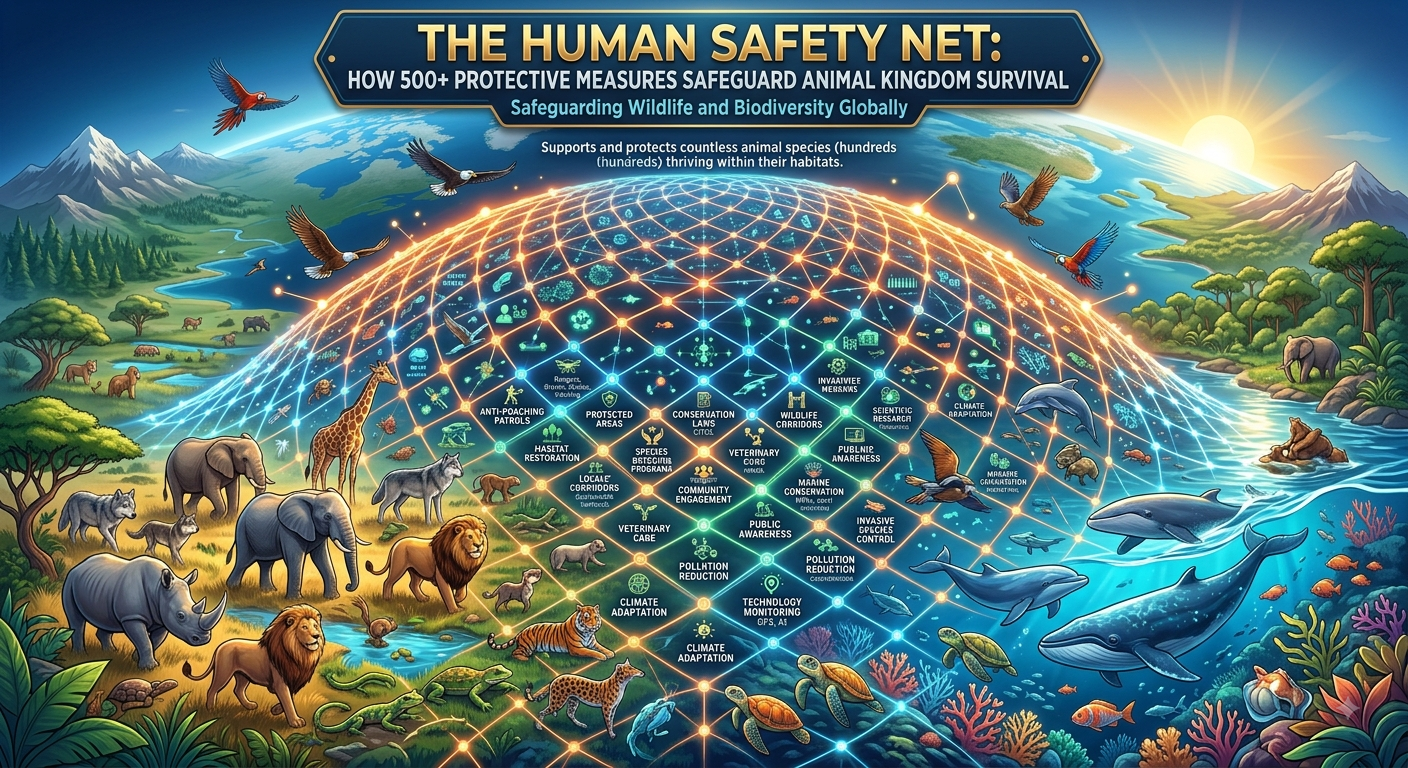
A Comprehensive Scientific Framework of Animal Protection, Survival, Adaptation, and Conservation
Abstract
Animal survival is not governed by a single protective mechanism. It is the outcome of a vast interconnected safety net composed of biological structures, physiological systems, behaviours, ecological relationships, reproductive strategies, environmental adaptations, social cooperation, and—in the modern era—human conservation measures.
This study develops a framework of 500+ protective measures and survival mechanisms across the animal kingdom. These mechanisms range from microscopic barriers and immune responses to shells, scales, feathers, camouflage, warning signals, migration, burrowing, social defence, parental care, biodiversity, habitat protection, wildlife corridors, veterinary science, and conservation policy.
An important scientific distinction is that not every survival mechanism is a deliberate “safety system.” Many are evolved characteristics shaped by natural selection. Camouflage, for example, can reduce detection by predators, and its effectiveness can depend not only on body coloration but also on behaviour, positioning, background selection, and environmental conditions.
The central proposition of this thesis is therefore:
Animal survival emerges from layers of protection operating from molecules and cells to individuals, families, populations, ecosystems, and human-managed conservation systems.
1. Introduction: The Animal Safety Net
Every animal exists within a field of potential hazards.
These include:
- predators;
- pathogens;
- parasites;
- starvation;
- dehydration;
- extreme temperatures;
- environmental toxins;
- injury;
- competition;
- habitat destruction;
- reproductive failure;
- climate variability;
- natural disasters;
- human activities.
Yet animals have persisted for hundreds of millions of years because evolution has generated extraordinarily diverse mechanisms for dealing with these pressures.
The “safety net” is therefore best understood as a multi-layer biological and ecological protection architecture.
A simplified model is:
DNA → cells → tissues → organs → body → behaviour → social group → population → ecosystem → conservation system
Failure at one level may sometimes be compensated for at another.
2. The 10 Major Layers of Animal Protection
The 500+ measures can be organized into ten major layers:
- Molecular protection
- Cellular protection
- Anatomical protection
- Physiological protection
- Immune protection
- Behavioural protection
- Social protection
- Reproductive and parental protection
- Ecological protection
- Human conservation protection
Together these create a nested survival architecture.
3. Molecular and Genetic Protection
At the smallest scale, survival begins with biological information.
Protective mechanisms include:
- DNA replication accuracy
- DNA repair
- DNA proofreading
- Chromosome stability
- Gene regulation
- Epigenetic regulation
- Protein folding
- Molecular chaperones
- Antioxidant enzymes
- Cellular stress responses
- Heat-shock proteins
- DNA damage responses
- Apoptosis
- Telomere regulation
- Genetic diversity
- Mutation filtering
- Natural selection
- Gene duplication
- Genetic redundancy
- Developmental regulation
These mechanisms help organisms maintain functional biological systems despite constant molecular damage and environmental stress.
4. Cellular Safety Systems
Cells themselves possess multiple protective mechanisms.
Examples include:
- Cell membranes
- Membrane repair
- Cytoskeletal support
- Lysosomes
- Autophagy
- Mitochondrial quality control
- Antioxidant systems
- Intracellular waste processing
- Ion regulation
- Calcium regulation
- Cellular signalling
- DNA damage checkpoints
- Controlled cell death
- Cellular regeneration
- Stem-cell activity
- Protein degradation
- Protein recycling
- Osmotic regulation
- pH regulation
- Energy regulation
The cell can therefore be viewed as a microscopic survival environment.
5. Physical Barriers
Animals possess physical structures that separate vulnerable internal tissues from the outside environment.
Protective structures include:
- Skin
- Scales
- Feathers
- Fur
- Hair
- Keratinized tissues
- Shells
- Exoskeletons
- Plates
- Spines
- Horns
- Antlers
- Claws
- Hooves
- Thick connective tissue
- Mucous membranes
- Protective eye surfaces
- Ear structures
- Nasal filtration structures
- Protective coverings around organs
These structures can simultaneously provide protection, temperature regulation, movement, sensory functions, and communication.
6. Camouflage and Concealment
Camouflage is one of the most recognizable animal safety systems.
Scientific research shows that camouflage can involve morphology, coloration, behaviour, body orientation, positioning, and selection of an appropriate background.
Camouflage mechanisms include:
- Background matching
- Disruptive coloration
- Countershading
- Pattern matching
- Seasonal colour change
- Transparency
- Reflective surfaces
- Shape concealment
- Shadow reduction
- Behavioural concealment
- Background selection
- Immobility
- Nocturnal activity
- Habitat matching
- Masquerade
- Mimicry
- Cryptic body posture
- Concealed nesting
- Concealed resting locations
- Environmental colour adaptation
Camouflage is not exclusively defensive: predators can also use camouflage to approach prey without detection.
7. Warning and Deterrence Systems
Some animals survive not by disappearing but by communicating:
“Do not attack me.”
Examples include:
- Warning coloration
- Threat displays
- Body enlargement
- Defensive postures
- Startle displays
- Visual signals
- Auditory warnings
- Chemical warnings
- Alarm calls
- Territorial displays
- Defensive coloration
- Mimicry of dangerous species
- Unpalatable appearance
- Defensive odours
- Defensive secretions
- Protective clustering
- Threat vocalization
- Intimidation displays
- False-eye patterns
- Sudden visual displays
Warning systems can reduce the probability that an encounter becomes an attack.
8. Structural Defence
Some animals possess physical characteristics that make attack difficult.
Examples include:
- Hard shells
- Thick armour
- Bony plates
- Spines
- Protective scales
- Tough skin
- Reinforced skulls
- Protective horns
- Defensive claws
- Strong jaws
- Body armour
- Protective carapaces
- Thickened exoskeletons
- Defensive quills
- Protective feathers
- Strong beaks
- Reinforced limbs
- Protective tail structures
- Thickened body coverings
- Compact defensive posture
9. Escape and Evasion
Avoiding danger is often safer than confronting it.
Escape mechanisms include:
- Rapid running
- Flying away
- Swimming away
- Sudden acceleration
- Direction changes
- Zigzag movement
- Diving
- Climbing
- Burrowing
- Hiding
- Freezing
- Retreating into shelter
- Group escape
- Early predator detection
- Avoidance routes
- Terrain use
- Vertical escape
- Water refuge
- Vegetation refuge
- Underground refuge
The effectiveness of escape depends on sensory detection, reaction speed, terrain, body structure, and predator behaviour.
10. Sensory Protection
Animals cannot avoid danger unless they can detect relevant information.
Sensory systems include:
- Vision
- Hearing
- Smell
- Taste
- Touch
- Vibration detection
- Pressure detection
- Temperature sensing
- Chemical sensing
- Electroreception
- Magnetoreception
- Echolocation
- Infrared sensing
- Ultraviolet perception
- Water-motion detection
- Acoustic communication
- Peripheral vision
- Predator detection
- Social monitoring
- Environmental monitoring
Sensory systems effectively function as an animal’s biological early-warning network.
11. Immune Protection
The immune system represents one of the most important internal safety networks.
Protective mechanisms include:
- Physical barriers
- Mucus
- Innate immunity
- Adaptive immunity
- Immune cells
- Antibodies
- Complement systems
- Inflammatory responses
- Fever responses
- Immune memory
- Antimicrobial molecules
- Microbiome protection
- Pathogen recognition
- Tissue repair
- Wound healing
- Immune surveillance
- Removal of infected cells
- Parasite resistance
- Viral defence
- Bacterial defence
Immune strategies vary substantially across animals because species experience different pathogen environments and evolutionary pressures.
12. Microbiome Protection
Animals do not live biologically alone.
Their bodies host communities of microorganisms that can influence digestion, metabolism, immunity, and resistance to some pathogens.
Protective functions include:
- Competitive exclusion
- Production of antimicrobial compounds
- Digestive assistance
- Nutrient processing
- Immune-system interaction
- Gut barrier support
- Microbial community stability
- Fermentation
- Metabolic cooperation
- Host-microbe signalling
The animal body can therefore be considered an ecosystem within an ecosystem.
13. Temperature Protection
Animals live across extraordinarily different thermal environments.
Survival mechanisms include:
- Fur insulation
- Feather insulation
- Fat insulation
- Counter-current heat exchange
- Shivering
- Sweating
- Panting
- Evaporative cooling
- Blood-flow regulation
- Behavioural thermoregulation
- Sun basking
- Shade seeking
- Huddling
- Burrowing
- Seasonal adaptation
- Torpor
- Hibernation
- Migration
- Heat avoidance
- Cold avoidance
14. Water and Osmotic Protection
Water balance is fundamental to animal survival.
Mechanisms include:
- Water conservation
- Kidney regulation
- Concentrated urine
- Reduced water loss
- Waterproof coverings
- Behavioural water seeking
- Metabolic water production
- Salt regulation
- Osmoregulation
- Aquatic ion regulation
- Desert adaptation
- Humidity management
- Nocturnal activity
- Water storage
- Efficient respiration
15. Feeding and Energy Protection
An animal must obtain enough energy to maintain its safety systems.
Mechanisms include:
- Efficient digestion
- Specialized teeth
- Specialized beaks
- Specialized jaws
- Grazing adaptations
- Hunting adaptations
- Filter feeding
- Scavenging
- Food caching
- Fat storage
- Seasonal feeding
- Migration to food
- Cooperative hunting
- Dietary flexibility
- Nutrient recycling
- Energy conservation
- Metabolic adjustment
- Feeding specialization
- Opportunistic feeding
- Foraging intelligence
16. Behavioural Protection
Behaviour is one of the most flexible components of survival.
Protective behaviours include:
- Hiding
- Freezing
- Fleeing
- Fighting when necessary
- Seeking shelter
- Avoiding predators
- Changing activity times
- Migration
- Hibernation
- Torpor
- Burrowing
- Climbing
- Swimming
- Flying
- Grouping
- Alarm signalling
- Territory defence
- Food storage
- Nest building
- Habitat selection
Behaviour can sometimes compensate for physical limitations.
17. Social Protection
Living in groups creates another layer of safety.
Social mechanisms include:
- Group vigilance
- Alarm calls
- Cooperative defence
- Sentinel behaviour
- Group movement
- Predator mobbing
- Collective shelter
- Cooperative hunting
- Food sharing
- Social learning
- Information transfer
- Protection of offspring
- Group thermoregulation
- Social grooming
- Parasite removal
- Territorial cooperation
- Collective migration
- Social hierarchy
- Conflict management
- Group recognition
The group can effectively become a distributed biological warning system.
18. Reproductive Protection
Survival of an individual is only one component of evolutionary success.
A population must also reproduce.
Reproductive safeguards include:
- Mate selection
- Courtship
- Nest construction
- Egg protection
- Incubation
- Gestation
- Placental support
- Protective birth locations
- Reproductive timing
- Seasonal breeding
- Mate guarding
- Sperm storage
- Seed-like reproductive strategies in some invertebrates
- Parental investment
- Offspring recognition
19. Parental Protection
Young animals are often more vulnerable than adults.
Protective mechanisms include:
- Nest guarding
- Nursing
- Feeding offspring
- Carrying offspring
- Teaching survival behaviours
- Predator warning
- Shelter construction
- Group childcare
- Protective positioning
- Concealed nests
- Defensive parent behaviour
- Temperature regulation
- Grooming
- Social learning
- Migration with offspring
20. Developmental Protection
Animals must survive not only adulthood but also development.
Mechanisms include:
- Embryonic protection
- Egg shells
- Amniotic protection
- Placental exchange
- Maternal nutrition
- Controlled development
- Juvenile shelter
- Growth regulation
- Developmental timing
- Metamorphosis
- Juvenile camouflage
- Nursery habitats
- Parental feeding
- Social education
- Developmental plasticity
21. Shelter as a Safety System
Physical habitat can function as a protective structure.
Natural shelters include:
- Burrows
- Caves
- Tree hollows
- Nests
- Dense vegetation
- Coral structures
- Rock crevices
- Underground chambers
- Mud shelters
- Ice shelters
- Water-column refuges
- Leaf shelters
- Termite structures
- Beaver structures
- Shell refuges
Animals frequently modify their environments to increase protection.
22. Migration as a Survival Strategy
Migration allows animals to change their environmental conditions.
Migration can help animals:
- Follow food
- Escape seasonal cold
- Escape drought
- Reach breeding grounds
- Reach nursery habitats
- Avoid seasonal predators
- Exploit temporary resources
- Track temperature conditions
- Access water
- Maintain reproductive cycles
- Reduce competition
Migration demonstrates that survival can involve movement through space rather than resistance to conditions in place.
23. Seasonal Adaptation
Animals may alter their physiology or behaviour according to predictable environmental cycles.
Mechanisms include:
- Seasonal coat changes
- Seasonal colour changes
- Breeding-season changes
- Migration
- Hibernation
- Torpor
- Seasonal food storage
- Seasonal fat accumulation
- Seasonal activity changes
- Seasonal habitat shifts
- Seasonal reproductive timing
- Seasonal behaviour changes
24. Chemical and Biological Defences
Some animals possess biochemical mechanisms that discourage predators or competitors.
Examples include:
- Defensive secretions
- Irritating compounds
- Bitter compounds
- Toxic compounds
- Venomous systems
- Chemical signalling
- Defensive odours
- Skin secretions
- Digestive deterrents
- Chemical mimicry
- Predator deterrence
- Parasite-repelling compounds
These systems should be understood scientifically as evolved biological mechanisms rather than deliberate technologies.
25. Mimicry
Mimicry allows one organism to resemble another organism or environmental feature.
Forms include:
- Batesian mimicry
- Müllerian mimicry
- Aggressive mimicry
- Masquerade
- Visual mimicry
- Behavioural mimicry
- Acoustic mimicry
- Chemical mimicry
- Structural mimicry
- Predator-confusion patterns
26. Predator-Prey Coevolution
The animal safety net is not static.
Predators evolve better detection and hunting strategies.
Prey evolve better avoidance and defence.
This creates an evolutionary feedback loop:
Predator improvement → prey defence → predator adaptation → prey adaptation
Camouflage is a classic example of this evolutionary arms race. Modern research continues to investigate how camouflage interacts with behaviour, environmental change, and predator perception.
27. Ecological Safety
An animal’s survival depends on the condition of its ecosystem.
Important ecological safeguards include:
- Habitat availability
- Food-web stability
- Predator-prey balance
- Pollination networks
- Seed dispersal
- Nutrient cycling
- Decomposition
- Water availability
- Vegetation cover
- Biodiversity
- Genetic diversity
- Ecological connectivity
- Healthy soils
- Clean water
- Stable climate conditions
- Marine habitat integrity
- Wetland protection
- Forest protection
- Grassland protection
- Coral-reef protection
28. Population-Level Protection
An individual animal may survive, but a species needs a viable population.
Population safeguards include:
- Adequate population size
- Genetic diversity
- Reproductive success
- Juvenile survival
- Adult survival
- Migration connectivity
- Genetic exchange
- Habitat availability
- Food availability
- Disease management
- Predator balance
- Population monitoring
- Demographic stability
- Recolonization
- Natural dispersal
29. Human Conservation as the Modern Safety Net
Human beings have become an additional force capable of either increasing or decreasing animal survival.
Modern conservation can provide another protective layer through:
- Protected areas
- National parks
- Wildlife reserves
- Marine protected areas
- Habitat restoration
- Reforestation
- Wetland restoration
- Wildlife corridors
- Species monitoring
- Population surveys
- Anti-poaching enforcement
- Pollution reduction
- Invasive-species management
- Captive breeding
- Reintroduction programmes
- Genetic conservation
- Seed and gene banks
- Wildlife veterinary care
- Disease surveillance
- Environmental education
30. Habitat Connectivity
Fragmented habitats can isolate populations.
Connectivity can allow animals to:
- move between habitats;
- find food;
- locate mates;
- migrate;
- recolonize areas;
- maintain gene flow;
- respond to environmental change.
Thus, ecological corridors can act as movement infrastructure for biodiversity.
31. Human-Wildlife Coexistence
A comprehensive safety net must protect both animals and human communities.
Important approaches include:
- Habitat planning
- Wildlife-friendly agriculture
- Responsible land use
- Ecological urban planning
- Safe wildlife crossings
- Protection of breeding sites
- Reduction of unnecessary disturbance
- Responsible tourism
- Sustainable fisheries
- Sustainable forestry
- Pollution prevention
- Waste management
- Water-resource protection
- Community conservation
- Environmental education
32. Scientific Monitoring
Modern technology adds another layer to animal protection.
Scientific tools include:
- Camera traps
- Satellite tracking
- GPS telemetry
- Acoustic monitoring
- Environmental DNA
- Genetic analysis
- Population modelling
- Remote sensing
- Drone-based surveys
- Automated species recognition
- Bioacoustic analysis
- Disease surveillance
- Climate modelling
- Habitat mapping
- Long-term ecological databases
These technologies allow scientists to detect changes that might otherwise remain invisible.
33. Veterinary and Rehabilitation Protection
When animals are injured, sick, orphaned, or displaced, humans can sometimes provide temporary assistance.
Measures include:
- Veterinary diagnosis
- Medical treatment
- Injury assessment
- Rehabilitation
- Nutritional support
- Recovery environments
- Orphan care
- Wildlife rescue
- Disease monitoring
- Safe release programmes
These interventions should complement—not replace—the conservation of functioning ecosystems.
34. Disaster Protection
Animals can face floods, droughts, fires, storms, heat waves, and other environmental disturbances.
Protection may involve:
- Disaster monitoring
- Early warning systems
- Habitat refuges
- Emergency wildlife response
- Restoration after disasters
- Population monitoring after disturbance
- Protection of refugia
- Maintaining ecological corridors
- Climate-resilient habitats
- Emergency veterinary response
35. The Final Five: System-Level Safety
The final mechanisms in this 500+ framework are not single biological adaptations but broad principles.
- Biodiversity — multiple species create ecological redundancy.
- Genetic diversity — variation provides populations with evolutionary options.
- Habitat diversity — different environments provide alternative refuges and resources.
- Ecological connectivity — connected habitats allow movement and genetic exchange.
- Human stewardship — responsible conservation can preserve the biological systems on which animal survival depends.
36. The 500+ Safety-Net Architecture
The entire system can be represented as:
Molecules
↓
Cells
↓
Tissues
↓
Organs
↓
Individual animal
↓
Behaviour
↓
Family
↓
Social group
↓
Population
↓
Species
↓
Food web
↓
Ecosystem
↓
Biosphere
↓
Human conservation systems
This hierarchy demonstrates an important principle:
Animal survival is an interconnected system rather than a single defence mechanism.
37. The Safety-Net Principle
An animal does not necessarily need to be the strongest organism.
Survival can result from combining many smaller advantages.
For example:
Good vision + camouflage + rapid reaction + shelter + social warning + reproductive success
may provide greater survival value than any one characteristic alone.
This resembles engineered safety systems in which several independent layers reduce overall risk.
38. Redundancy in Nature
Nature frequently provides multiple ways of addressing the same problem.
For example, protection from predators can involve:
detection → camouflage → hiding → escape → group warning → physical defence
If one mechanism fails, another may still work.
This is analogous to defence in depth.
39. Adaptation Is a Trade-Off
No adaptation is universally beneficial.
A thick protective shell may provide defence but increase mass.
Camouflage may improve concealment but restrict visual signalling.
Large horns may provide defence but require biological resources.
Migration can provide access to resources but requires substantial energy.
Thus:
Protection has costs.
Natural selection tends to favour combinations of traits whose benefits outweigh their costs under particular environmental conditions.
40. Survival Is Not the Same as Invulnerability
The existence of hundreds of protective mechanisms does not make animals invincible.
Animals remain vulnerable to:
- new diseases;
- rapid environmental change;
- habitat destruction;
- severe resource shortages;
- extreme climate events;
- invasive species;
- ecosystem collapse;
- genetic isolation;
- human-caused pressures.
The safety net reduces risk; it does not eliminate risk.
41. Why Biodiversity Matters
A healthy ecosystem contains many interacting species.
One species may:
- pollinate plants;
- disperse seeds;
- control another population;
- provide food;
- recycle nutrients;
- modify habitat;
- contribute to decomposition.
Therefore, protecting one animal can sometimes require protecting an entire ecological network.
42. The Animal Kingdom as a Global Survival Laboratory
Across insects, fish, amphibians, reptiles, birds, mammals, and other animal groups, evolution has generated different solutions to similar problems.
The major survival problems are universal:
How do I obtain energy?
How do I avoid being eaten?
How do I resist disease?
How do I survive environmental extremes?
How do I find a mate?
How do I protect offspring?
How do I survive long enough to reproduce?
Different species answer these questions differently.
43. Scientific Significance
Studying animal protective systems contributes to:
- evolutionary biology;
- ecology;
- zoology;
- genetics;
- immunology;
- neuroscience;
- physiology;
- conservation biology;
- veterinary science;
- biomimicry;
- environmental science;
- climate adaptation research.
Animal adaptations can also inspire human technologies. Camouflage research, for example, has connections to computer vision, materials science, and the study of visual perception.
44. The 500+ Measures as a Unified System
The 500+ mechanisms can ultimately be reduced to several fundamental survival functions:
1. Detect
Identify danger and environmental change.
2. Prevent
Reduce exposure to hazards.
3. Resist
Withstand environmental or biological threats.
4. Escape
Move away from danger.
5. Defend
Make attack more difficult.
6. Recover
Repair damage and restore function.
7. Reproduce
Transfer biological information to another generation.
8. Cooperate
Use social relationships to increase survival.
9. Adapt
Respond to changing conditions over an individual’s lifetime or across generations.
10. Preserve
Maintain populations and ecosystems.
45. Conclusion
The animal kingdom is protected by an extraordinary network of biological, behavioural, ecological, and evolutionary mechanisms.
From DNA repair inside a cell to camouflage on an animal’s body, from immune surveillance to social alarm calls, from parental care to migration, and from individual adaptations to protected ecosystems, survival is produced by layers of interconnected protection.
The most important lesson is that there is no single universal animal safety mechanism.
Instead, life operates through systems of systems.
A shell protects an organism externally.
An immune system protects it internally.
Camouflage reduces detection.
Sensory systems detect danger.
Behaviour enables escape.
Social groups provide collective vigilance.
Parents protect offspring.
Reproduction maintains populations.
Biodiversity stabilizes ecosystems.
And conservation can provide an additional human-created layer of protection when natural systems are under pressure.
Therefore, the Human Safety Net for the Animal Kingdom should ultimately be understood not as humans controlling animal survival, but as humanity becoming responsible for protecting the ecological conditions that allow animals’ own evolved safety systems to continue functioning.
The deepest principle is:
The greatest protection for an animal is not merely protecting the individual; it is protecting the biological system that allows the individual, its population, its species, and its ecosystem to continue surviving.





Be First to Comment