
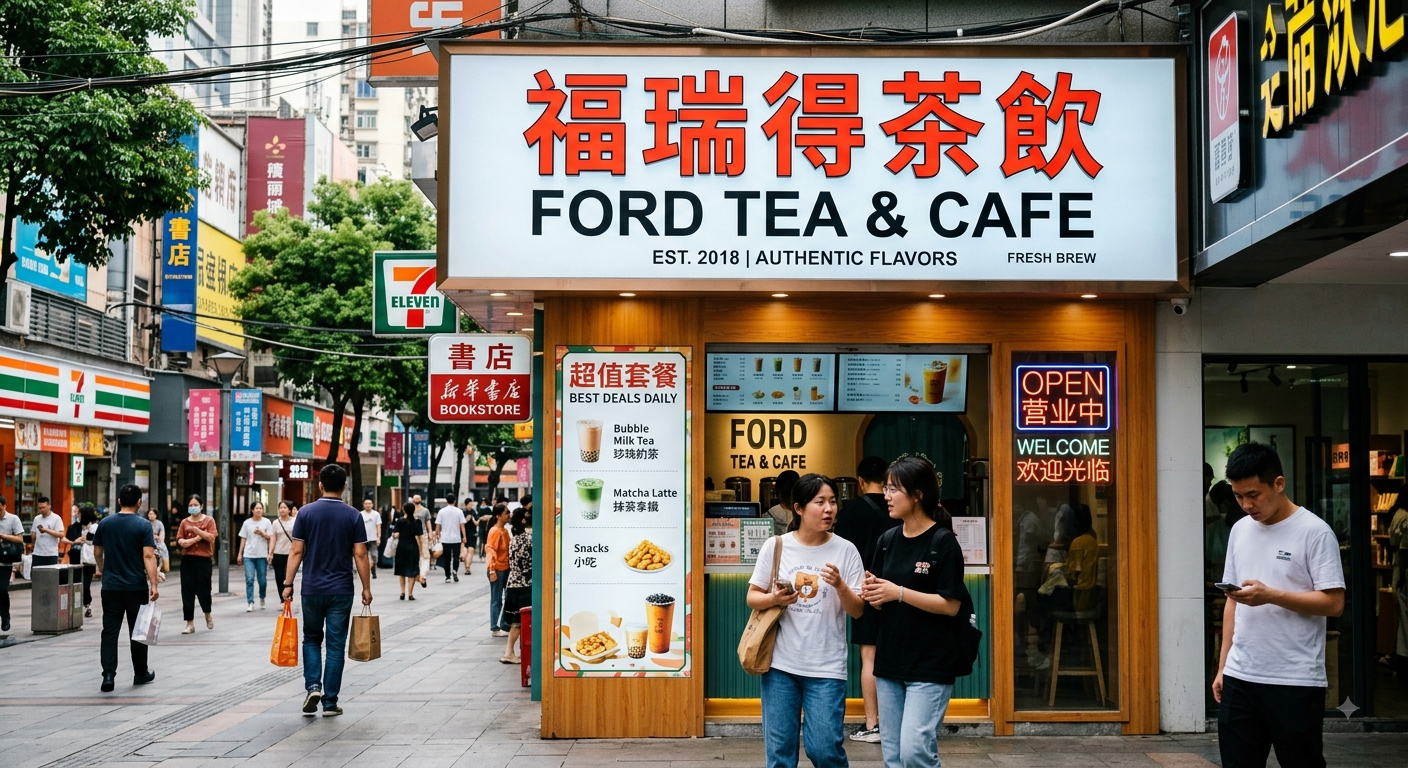
A Comprehensive Comparative Study of Two Major Writing Systems
Abstract
Chinese characters and English alphabetic writing represent two fundamentally different solutions to the same human problem: how to preserve and communicate language through visual symbols.
English uses an alphabetic writing system based on a relatively small inventory of letters. Modern English normally uses the 26-letter Latin alphabet, with letters and combinations of letters representing speech sounds. Chinese writing, by contrast, is based primarily on Chinese characters, traditionally called 漢字 / 汉字 (Hànzì). Characters are not simply equivalent to English letters. They are generally associated with morphemes and syllables and contain structural components that provide semantic and, in many cases, phonetic information.
It is therefore misleading to describe Chinese as simply having a “different alphabet.” Chinese does not use an alphabet in the same fundamental sense as English. Modern Chinese does, however, interact extensively with alphabetic systems, particularly Hanyu Pinyin, which uses Roman letters to represent the pronunciation of Standard Mandarin.
The comparison between Chinese characters and English writing reveals important differences in literacy, pronunciation, meaning, visual structure, education, printing, computing, keyboards, information technology, and global communication.
1. Introduction
Human civilization depends heavily on the ability to record information.
Before writing, knowledge had to be transmitted primarily through speech, memory, demonstration, ritual, and physical artifacts. Writing transformed this process by allowing information to survive beyond the individual speaker.
Writing made it possible to preserve:
- laws;
- history;
- scientific observations;
- religious and philosophical ideas;
- commercial records;
- literature;
- maps;
- administrative information;
- technical knowledge;
- mathematical calculations; and
- communication across generations.
Different civilizations developed different writing systems.
Chinese civilization developed and maintained a character-based writing tradition over thousands of years. European languages eventually became dominated by alphabetic systems derived from ancient Mediterranean traditions.
English ultimately adopted the Latin alphabet, while Chinese retained characters as the principal writing system.
These systems should not be judged simply as “easy” versus “difficult.” They are optimized around different relationships between sound, meaning, language structure, and visual symbols.
2. The Fundamental Difference
The simplest distinction is:
English: letters → sounds → words
Chinese: characters → primarily morphemes/syllables → words and compounds
This is an oversimplification, but it is useful as an introductory model.
English words are constructed from letters.
For example:
computer
contains:
C + O + M + P + U + T + E + R
The individual letters do not normally carry the complete meaning of “computer.”
Chinese can express the same concept using:
电脑
where:
- 电 means electricity/electric
- 脑 means brain
Together, 电脑 means computer.
This illustrates an important characteristic of Chinese vocabulary: compounds can combine meaningful character units.
Chinese characters therefore provide information about meaning and linguistic structure in ways that individual English letters generally do not.
3. Chinese Is Not Simply a Picture Language
A common misconception is that every Chinese character is a picture representing an object.
That is not correct.
Some ancient characters had pictographic origins, but the modern Chinese writing system contains many different structural and historical categories.
Modern scholarship emphasizes that the majority of Chinese characters are not simply pictures. Many contain combinations of semantic and phonetic components.
For example, a character can contain:
- a component suggesting a semantic category; and
- another component providing a clue to pronunciation.
This makes Chinese writing considerably more systematic than the popular idea of “thousands of pictures.”
4. The Structure of a Chinese Character
Chinese characters are constructed from strokes and components.
A simplified hierarchy can be represented as:
Stroke → Component → Character → Morpheme → Word → Sentence
For example:
人
means person.
It can also occur as a component inside more complex characters.
Chinese characters occupy approximately equal visual blocks in ordinary horizontal writing. This creates a very different visual appearance from English text.
English:
technology
Chinese:
技术
The English word contains a sequence of letters of different visual shapes and widths, while the Chinese expression consists of two character units.
Research on Chinese writing emphasizes the importance of strokes, components, radicals, and internal character structure.
5. The English Alphabet
English uses the Latin alphabet.
The modern English alphabet contains:
26 letters
Uppercase
A B C D E F G H I J K L M N O P Q R S T U V W X Y Z
Lowercase
a b c d e f g h i j k l m n o p q r s t u v w x y z
These letters are combined to represent English speech.
For example:
C + A + T = cat
The letters themselves are relatively small building blocks.
This gives alphabetic writing an enormous combinatorial advantage: a small number of symbols can generate an extremely large vocabulary.
6. Alphabetic Writing Is Not Perfectly Phonetic
It is important not to assume that English letters always correspond neatly to sounds.
English spelling contains many historical irregularities.
For example, identical letters can participate in different pronunciations, while the same sound can be represented in different ways.
Therefore:
English alphabet ≠ perfect sound code
English spelling reflects many centuries of linguistic change, borrowing, pronunciation changes, and historical spelling conventions.
Consequently, learning English literacy requires learning both the alphabetic system and many spelling conventions.
7. Chinese Characters and Pronunciation
Chinese characters also do not provide a simple one-to-one pronunciation code.
A character may have a pronunciation that cannot be reliably predicted solely from its visual appearance.
This creates an important distinction:
English: spelling is strongly connected to phonology, although imperfectly.
Chinese: characters generally encode morphemic/syllabic information rather than individual phonemes.
Research comparing Chinese and English specifically identifies this difference in the relationship between written symbols and speech sounds.
8. The Role of Pinyin
Modern Chinese has an important bridge between Chinese characters and alphabetic writing:
Hanyu Pinyin.
Pinyin uses Roman letters to represent the pronunciation of Standard Mandarin.
For example:
中国
is represented in Pinyin as:
Zhōngguó
Pinyin therefore makes extensive use of the Latin alphabet, but it should not be confused with the fundamental Chinese character writing system.
Its principal purpose is phonetic representation, pronunciation guidance, education, indexing, and computer input.
9. Chinese Characters and Meaning
One major strength of Chinese characters is their connection to morphemes.
Consider:
电
electricity
脑
brain
Together:
电脑
computer
Similarly:
火
fire
车
vehicle
Together:
火车
train
This compositional characteristic means that Chinese vocabulary can contain considerable internal semantic information.
English has similar processes, but they operate differently.
For example:
black + board = blackboard
English can also construct compounds, but the basic written units remain alphabetic letters.
10. The Role of Radicals
Radicals are important components used in the classification and analysis of Chinese characters.
Some radicals provide semantic clues.
For example, characters containing the water-related radical 氵 are often associated with water or liquids.
Examples include characters such as:
河
river
海
sea
湖
lake
The relationship is not absolute, but it provides a useful structural clue.
Radicals also play an important role in dictionaries and traditional character classification.
11. Stroke Order
Chinese characters are written according to conventional stroke-order principles.
Common principles include:
- top before bottom;
- left before right;
- horizontal before vertical in many configurations;
- outside before inside in many structures;
- closing an enclosing component after its interior in certain characters.
Stroke order is important because Chinese characters are not merely collections of lines.
Their visual structure is organized.
Learning to write Chinese therefore involves learning:
stroke → component → character → vocabulary
This differs considerably from learning English handwriting, where the fundamental symbols are only 26 letters.
12. Vocabulary Scale
The number of distinct Chinese characters is much larger than the number of letters in the English alphabet.
But this does not mean Chinese speakers memorize every character in existence.
There are:
- rare historical characters;
- specialized scientific characters;
- literary characters;
- regional characters;
- names;
- technical characters; and
- commonly used characters.
Literacy depends primarily on mastering the characters required for ordinary communication.
This creates a different learning curve from alphabetic literacy.
An English learner first needs a relatively small alphabet and then progressively learns vocabulary.
A Chinese learner must progressively acquire a substantial inventory of characters while also learning vocabulary, pronunciation, grammar, and writing conventions.
13. Why Chinese Characters Survived for So Long
One historically important feature of Chinese characters is that they can preserve written distinctions even when spoken pronunciation changes.
China contains enormous linguistic diversity.
Different varieties of Chinese can have substantially different pronunciations.
A written character can therefore provide a common visual representation even where pronunciation differs.
This is one reason scholars have considered the historical relationship between Chinese writing and China’s linguistic diversity significant.
However, the idea that Chinese characters are completely independent of pronunciation is also incorrect. Chinese characters contain phonetic information, and spoken language remains fundamental to literacy.
14. English and Regional Pronunciation
English developed differently.
The same alphabetic writing system is used across countries including:
- England;
- the United States;
- Canada;
- Australia;
- New Zealand;
- South Africa;
- India; and
- many other countries.
Pronunciation can differ dramatically between varieties.
For example, the written word remains recognizable despite differences in accent.
This demonstrates another major property of writing:
writing can stabilize language while spoken language changes.
15. Reading Direction
Traditional Chinese writing has historically been written vertically, with columns proceeding from right to left.
Modern Chinese is frequently written horizontally from left to right, particularly in digital and international contexts.
English is normally written horizontally from left to right.
Thus modern Chinese can visually resemble English in page orientation while retaining a fundamentally different character system.
16. Punctuation
Modern Chinese uses punctuation systems that overlap considerably with those of other modern writing systems.
Chinese text can therefore contain punctuation such as:
- commas;
- periods;
- question marks;
- quotation marks;
- parentheses;
- colons; and
- semicolons.
Modern written Chinese is consequently not an isolated visual system.
It has adapted extensively to the requirements of modern publishing, education, science, engineering, administration, and computing.
17. Traditional and Simplified Characters
Modern Chinese writing includes two major character forms:
Traditional Chinese
and
Simplified Chinese
Traditional characters retain many historical forms.
Simplified Chinese uses officially standardized simplified forms for many characters.
For example:
Traditional:
國
Simplified:
国
Traditional:
學
Simplified:
学
The distinction is important culturally, historically, geographically, and technologically.
Traditional characters remain widely used in places including Taiwan and Hong Kong, while simplified characters are dominant in mainland China and Singapore.
18. The Information Density Question
A fascinating comparison concerns visual information density.
Chinese writing often represents grammatical or lexical information using relatively compact character units.
English words require sequences of letters.
For example:
computer
contains eight letters.
Chinese:
电脑
contains two characters.
However, it would be incorrect to conclude that Chinese is automatically “twice as efficient.”
Written information density depends on:
- language;
- vocabulary;
- grammar;
- context;
- typography;
- encoding;
- compression;
- reader familiarity; and
- the specific text being compared.
The apparent compactness of Chinese characters is real, but it should not be converted into a simplistic claim about universal superiority.
19. Learning Difficulty
The two systems distribute difficulty differently.
English
Early learning:
26 letters
Then:
- spelling;
- vocabulary;
- grammar;
- pronunciation;
- reading;
- exceptions.
Chinese
Early learning:
- pronunciation;
- tones;
- Pinyin;
- basic characters;
- stroke order;
- components;
- vocabulary;
- grammar.
Chinese therefore places a much greater burden on visual-character acquisition.
English places greater difficulty on alphabetic spelling and the irregular relationship between spelling and pronunciation.
Neither system eliminates complexity.
They simply distribute complexity differently.
20. Writing and Memory
Chinese characters require significant visual memory.
A learner may need to remember:
- shape;
- stroke sequence;
- component arrangement;
- pronunciation;
- tone;
- meaning;
- grammatical use.
English requires memory of:
- letter sequences;
- spelling;
- pronunciation;
- word meaning;
- grammatical usage.
The cognitive tasks overlap but are not identical.
Research into Chinese-English biliteracy has found that different writing systems impose different cognitive and orthographic demands.
21. Dictionaries and Alphabetical Order
English dictionaries can easily be organized alphabetically:
A → B → C → … → Z
Chinese requires other indexing mechanisms.
Traditional dictionary methods can use:
- radicals;
- stroke count;
- pronunciation;
- character components.
Modern digital systems can also sort Chinese words according to their Pinyin representations.
This illustrates an important technological development:
the computer can transform a non-alphabetic writing system into an alphabetically searchable digital environment.
22. Chinese Characters and Computers
The computer age initially created serious challenges for character-based writing.
Early computers were designed primarily around Latin alphabets and relatively small character sets.
Chinese required systems capable of representing thousands of characters.
Technology eventually solved this through:
- character encoding;
- input methods;
- fonts;
- keyboard systems;
- Pinyin input;
- handwriting recognition;
- optical character recognition;
- Unicode;
- predictive text;
- speech recognition.
The history of Chinese computing is therefore an important chapter in the history of information technology.
23. Unicode
Unicode fundamentally changed international digital writing.
Instead of treating Chinese, English, Arabic, Cyrillic, and other scripts as incompatible computer worlds, Unicode provides a common framework for representing characters across writing systems.
This makes it possible for a single modern device to display:
Hello 世界 Привет مرحبا
within the same digital environment.
This is one of the greatest achievements of modern computing:
the universal digital representation of human writing.
24. Chinese Input on an English Keyboard
A particularly interesting technological development is that Chinese users can type Chinese characters using keyboards containing Latin letters.
For example, a user can type a Pinyin sequence and select the desired Chinese character.
Thus:
Roman alphabet → pronunciation input → Chinese character
The physical keyboard does not need thousands of physical keys.
This demonstrates how software can separate:
physical interface
from
linguistic representation.
25. English Input
English is comparatively straightforward on a conventional keyboard.
The keyboard contains letters that correspond directly to the alphabet.
Typing:
computer
produces:
computer
Chinese input is more mediated:
Pinyin / other input method → candidate selection → Chinese character
Other Chinese input methods can use character shape, handwriting, or speech.
26. Artificial Intelligence and Writing Systems
Artificial intelligence has created another major convergence between Chinese and English.
Modern AI systems can process:
- Chinese characters;
- English words;
- Pinyin;
- speech;
- handwriting;
- images;
- translations;
- multilingual documents.
This means that AI increasingly functions as an intermediary between different writing systems.
A person can enter information in Chinese and receive English output, or vice versa.
AI therefore reduces the technological barriers created by differences between writing systems.
27. Machine Translation
Chinese-English machine translation is technically challenging because the systems do not share identical linguistic structures.
The differences include:
- character-based versus alphabetic orthography;
- word segmentation;
- grammar;
- morphology;
- word order;
- pronunciation;
- cultural context;
- idioms;
- ambiguity.
Research on Chinese-English translation specifically identifies the gap between the two writing systems as an important computational challenge.
Modern neural machine translation has substantially reduced these barriers.
28. Word Segmentation in Chinese
One particularly interesting difference is that conventional written Chinese does not normally separate every word with spaces in the way English does.
English:
Artificial intelligence is transforming computing.
Chinese can be written continuously:
人工智能正在改变计算。
Computers therefore need to determine appropriate linguistic units during natural-language processing.
This is called Chinese word segmentation.
It is an important problem in computational linguistics.
29. Information Technology as a Great Equalizer
Historically, the two writing systems operated in very different technological environments.
Printing technology favored different mechanisms.
Typewriters created different challenges.
Telegraph systems created different constraints.
Early computers were strongly optimized for alphabetic writing.
Modern computing has changed the situation.
Today, digital systems can process:
- Chinese;
- English;
- Japanese;
- Korean;
- Arabic;
- Hebrew;
- Hindi;
- Cyrillic scripts;
- African writing systems; and
- many other scripts.
The computer has therefore become a universal linguistic platform.
30. Comparative Table
| Feature | Chinese Characters | English Alphabetic Writing |
|---|---|---|
| Basic writing units | Characters | Letters |
| Main script principle | Morphosyllabic/non-alphabetic | Alphabetic |
| Number of basic alphabet letters | Not applicable | 26 |
| Pronunciation representation | Indirect/partial | Relatively direct but irregular |
| Meaning information | Often substantial at character/morpheme level | Usually carried by whole words |
| Strokes | Fundamental | Not normally treated as linguistic units |
| Radicals/components | Important | Not comparable in the same way |
| Word spacing | Limited compared with English | Standard |
| Pinyin | Used for Mandarin romanization | Not applicable |
| Character learning | Significant | Relatively limited alphabet learning |
| Digital input | Multiple specialized methods | Direct alphabetic typing |
| Historical continuity | Extremely long | Long, through predecessor scripts |
| Computer encoding | Unicode | Unicode |
| Main modern advantage | Compact character/morpheme representation | Small symbol inventory and productive spelling |
31. Neither System Is Simply “Better”
It is tempting to ask:
Which is better—Chinese characters or the English alphabet?
There is no universal answer.
A writing system should be evaluated according to the purposes it serves.
Chinese characters provide:
- strong visual identity;
- morphemic information;
- historical continuity;
- compact representation;
- powerful compound formation;
- communication across pronunciation differences in certain contexts.
Alphabetic English provides:
- a very small basic symbol inventory;
- relatively systematic sound representation;
- simple keyboard input;
- easy alphabetical indexing;
- highly productive spelling through combinations of letters.
Both systems have advantages and disadvantages.
32. The Deeper Lesson
The comparison demonstrates that writing is not merely a collection of symbols.
A writing system is an information architecture.
It determines how human language is converted into visual information.
The process can be represented as:
Human thought
↓
Language
↓
Speech
↓
Writing system
↓
Visual symbols
↓
Paper / print / screen
↓
Digital encoding
↓
Computer processing
↓
Global communication
Chinese characters and English letters occupy different positions in this architecture.
33. From Ancient Writing to Artificial Intelligence
The historical progression can be viewed as:
Ancient symbols
↓
Early writing systems
↓
Chinese characters / alphabetic traditions
↓
Manuscripts
↓
Printing
↓
Telegraph
↓
Typewriters
↓
Electronic computers
↓
Unicode
↓
Internet
↓
Machine translation
↓
Large language models
↓
Multimodal artificial intelligence
This is especially important for understanding the future of communication.
The ultimate technological objective is no longer merely to store letters or characters.
It is to enable machines to understand and transform human information regardless of the writing system in which that information originated.
34. The Future: Beyond Characters and Letters
The future of communication may increasingly become multimodal.
Instead of communicating exclusively through writing, humans can communicate through:
- text;
- voice;
- images;
- diagrams;
- video;
- gestures;
- mathematical notation;
- computer code;
- virtual environments;
- AI-generated representations.
Artificial intelligence can translate between these forms.
For example:
Chinese text → English text
English text → Chinese text
Speech → Chinese characters
Speech → English
Image → text
Text → image
Text → computer program
The traditional distinction between writing systems is therefore becoming less restrictive.
35. A Millennium Perspective
From a long-term technological perspective, Chinese characters and English alphabetic writing represent two major branches of humanity’s information architecture.
Chinese demonstrates the extraordinary durability of a character-based system.
English demonstrates the scalability of alphabetic writing across a global linguistic network.
Computing has brought the two systems together.
A modern smartphone can contain thousands of Chinese characters and the complete Latin alphabet.
A modern computer can process both within the same document.
An AI system can translate between them almost instantaneously.
Therefore, the technological story is no longer:
Chinese versus English.
It is increasingly:
Chinese + English + every other human writing system → universal digital information.
36. Conclusion
Chinese characters and English alphabetic writing are not merely two different ways of spelling words. They represent fundamentally different approaches to encoding language.
English relies on a small alphabetic inventory whose letters combine to represent words and sounds.
Chinese relies primarily on characters that operate at the level of morphemes and syllables and are constructed from structured graphic components.
Chinese characters are not simply pictures, and Chinese should not be described as merely a language without an alphabet. Modern Chinese operates within a sophisticated ecosystem involving characters, Pinyin, pronunciation, radicals, components, digital input methods, Unicode, and computational linguistics.
English, meanwhile, demonstrates the enormous flexibility of alphabetic writing: 26 basic letters can generate an immense vocabulary and support communication across a global network of countries and cultures.
The computer revolution has changed the relationship between the two systems. Digital encoding, Unicode, keyboards, mobile devices, machine translation, natural-language processing, and artificial intelligence have transformed what was once a major technological separation into an increasingly interoperable global information environment.
The deeper lesson is that writing systems are technologies for storing human knowledge.
Chinese characters and English letters are two different technological architectures for the same fundamental human objective:
to convert human thought into durable information that can travel across space, survive time, and be understood by other people.
In the emerging AI civilization, the most important development may not be the replacement of one writing system by another, but the creation of computational systems capable of understanding all major human writing systems and connecting them into one global knowledge network.
Key Concept
Chinese characters preserve meaning-rich visual units; alphabetic English organizes language through a small set of combinable sound-oriented symbols; modern computing increasingly allows both systems—and many others—to coexist within a universal digital information architecture.



Be First to Comment