
Introduction
Artificial Intelligence (AI) has become one of the most transformative technologies of the 21st century. It is revolutionizing healthcare, finance, education, manufacturing, transportation, scientific research, agriculture, government, and defense. At the heart of this revolution are AI foundation models, which are generally categorized into two broad groups:
- Open AI Models (Open-Weight or Open-Source Models)
- Closed AI Models (Proprietary Models)
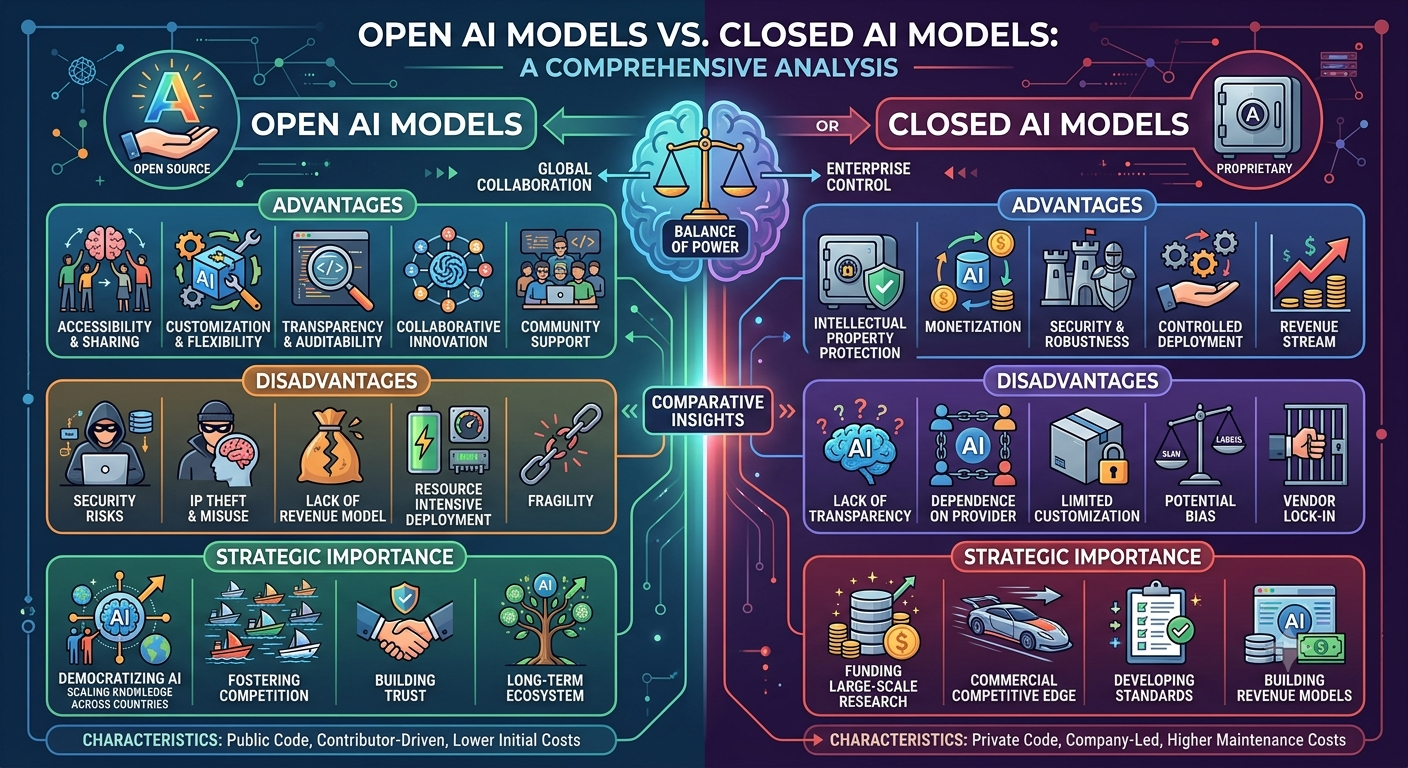
Although both types aim to solve complex problems through machine learning, they differ significantly in accessibility, transparency, governance, customization, security, innovation, and commercial strategy.
Chapter 1: What Is an Open AI Model?
An open AI model is an AI system whose model weights, architecture, or source code are made publicly available under an open or permissive license. Developers, researchers, universities, startups, and businesses can inspect, modify, fine-tune, and deploy these models.
Examples include:
- Meta’s Llama family (subject to its license)
- Mistral AI models
- DeepSeek models
- Qwen models
- Falcon models
- BLOOM
- Stable Diffusion (image generation)
Chapter 2: What Is a Closed AI Model?
A closed AI model is proprietary software owned and controlled by a company. Users access it through applications or APIs, but the model weights, training data, and internal architecture are generally not publicly available.
Examples include:
- OpenAI’s GPT series
- Anthropic’s Claude series
- Google’s Gemini proprietary models
- xAI’s Grok proprietary offerings
- Cohere proprietary enterprise models
Chapter 3: Major Differences
| Feature | Open Models | Closed Models |
|---|---|---|
| Source code | Often available | Not available |
| Model weights | Often downloadable | Hidden |
| Customization | Extensive | Limited |
| Transparency | High | Lower |
| Deployment | Local or cloud | Mostly cloud |
| Cost | Often free | Subscription/API fees |
| Vendor lock-in | Low | Higher |
| Privacy | Can run locally | Data handled by provider |
| Innovation | Community-driven | Company-driven |
| Support | Community | Professional |
Chapter 4: Advantages of Open AI Models
1. Transparency
Researchers can inspect how the model is built, improving trust and scientific understanding.
2. Lower Cost
Many open models are free to download, reducing licensing costs.
3. Customization
Organizations can fine-tune models for legal, medical, financial, educational, or industrial tasks.
4. Privacy
Sensitive information can remain within an organization’s own infrastructure when models are deployed locally.
5. Faster Innovation
Global communities contribute improvements, accelerating research and development.
6. Independence
Organizations are less dependent on a single vendor’s pricing or product roadmap.
7. Educational Value
Students and universities can study model architectures directly.
Chapter 5: Disadvantages of Open AI Models
- Higher infrastructure costs for self-hosting
- Greater technical expertise required
- Variable documentation and support
- Security responsibilities fall on the user
- Performance may lag behind the strongest proprietary models in some domains
- Potential misuse if powerful models are released without safeguards
Chapter 6: Advantages of Closed AI Models
High Performance
Closed models are often optimized using substantial computational resources and extensive post-training.
Reliability
Commercial providers typically offer stable APIs, uptime guarantees, and enterprise support.
Safety Features
Providers invest heavily in content moderation, monitoring, and alignment.
Ease of Use
Users can access advanced AI without managing hardware or software infrastructure.
Continuous Updates
Providers regularly improve model quality without requiring customers to retrain or redeploy.
Chapter 7: Disadvantages of Closed AI Models
- Subscription and API costs
- Limited transparency into training data and architecture
- Vendor lock-in
- Less flexibility for customization
- Dependence on internet connectivity for most services
- Organizations may have less control over deployment environments
Chapter 8: Security Comparison
Open Models
- Full control over deployment
- Suitable for secure, offline environments
- Security depends on the organization’s own practices
Closed Models
- Managed security by the provider
- Professional monitoring and patching
- Requires trust in the provider’s infrastructure and policies
Chapter 9: Economic Impact
Both open and closed AI models contribute to economic growth in different ways.
Open Models
- Lower barriers for startups
- Encourage entrepreneurship
- Foster academic collaboration
- Reduce software development costs
Closed Models
- Drive commercial AI services
- Support enterprise-grade products
- Fund large-scale AI research through subscription and API revenue
- Enable managed solutions for organizations without AI infrastructure
Chapter 10: Research and Innovation
Open models encourage broad experimentation, peer review, and reproducibility.
Closed models often benefit from substantial private investment, enabling advances in large-scale training, specialized infrastructure, and production-ready systems.
Together, these ecosystems frequently influence one another, with ideas flowing between academic research, open communities, and commercial development.
Chapter 11: Government Applications
Governments may use:
Open Models
- National research
- Education
- Local-language AI
- Secure on-premises deployments
Closed Models
- Productivity tools
- Customer service
- Data analysis
- Managed enterprise solutions
Deployment choices often depend on procurement policies, security requirements, and available technical expertise.
Chapter 12: Industry Applications
Both model types are used across:
- Healthcare
- Banking
- Manufacturing
- Logistics
- Education
- Agriculture
- Telecommunications
- Retail
- Scientific research
- Energy
The choice depends on requirements for cost, customization, regulatory compliance, performance, and operational control.
Chapter 13: Strategic Comparison
| Category | Open Models | Closed Models |
|---|---|---|
| Cost | Lower licensing costs | Higher recurring costs |
| Transparency | Excellent | Limited |
| Security Control | Organization-controlled | Provider-managed |
| Customization | Excellent | Moderate |
| Ease of Deployment | More complex | Simpler |
| Vendor Dependence | Low | Higher |
| Enterprise Support | Community and some commercial providers | Strong commercial support |
| Innovation | Broad community contributions | Company-led research |
Chapter 14: Future Trends
The future of AI is likely to include both open and closed ecosystems:
- Increasing adoption of open-weight models for specialized and sovereign AI deployments.
- Continued investment in proprietary frontier models with advanced capabilities and managed services.
- Greater focus on responsible AI, security, and governance across both approaches.
- Growth of hybrid strategies, where organizations combine open models for internal tasks with proprietary models for specific high-performance applications.
Conclusion
Open AI models and closed AI models each play a vital role in the global AI ecosystem. Open models promote transparency, customization, affordability, and collaborative innovation, making them valuable for education, research, startups, and organizations seeking greater control over deployment. Closed models provide highly optimized performance, managed infrastructure, enterprise support, and integrated safety features, making them attractive for businesses that prioritize convenience, reliability, and commercial support.
Rather than viewing the two approaches as competitors, they are increasingly complementary. Open models expand access to AI and accelerate scientific progress, while closed models continue to push the frontiers of large-scale AI capabilities through significant private investment. As AI becomes more deeply integrated into society, organizations will increasingly choose the approach—or combination of approaches—that best matches their technical, economic, regulatory, and strategic objectives.


Be First to Comment