
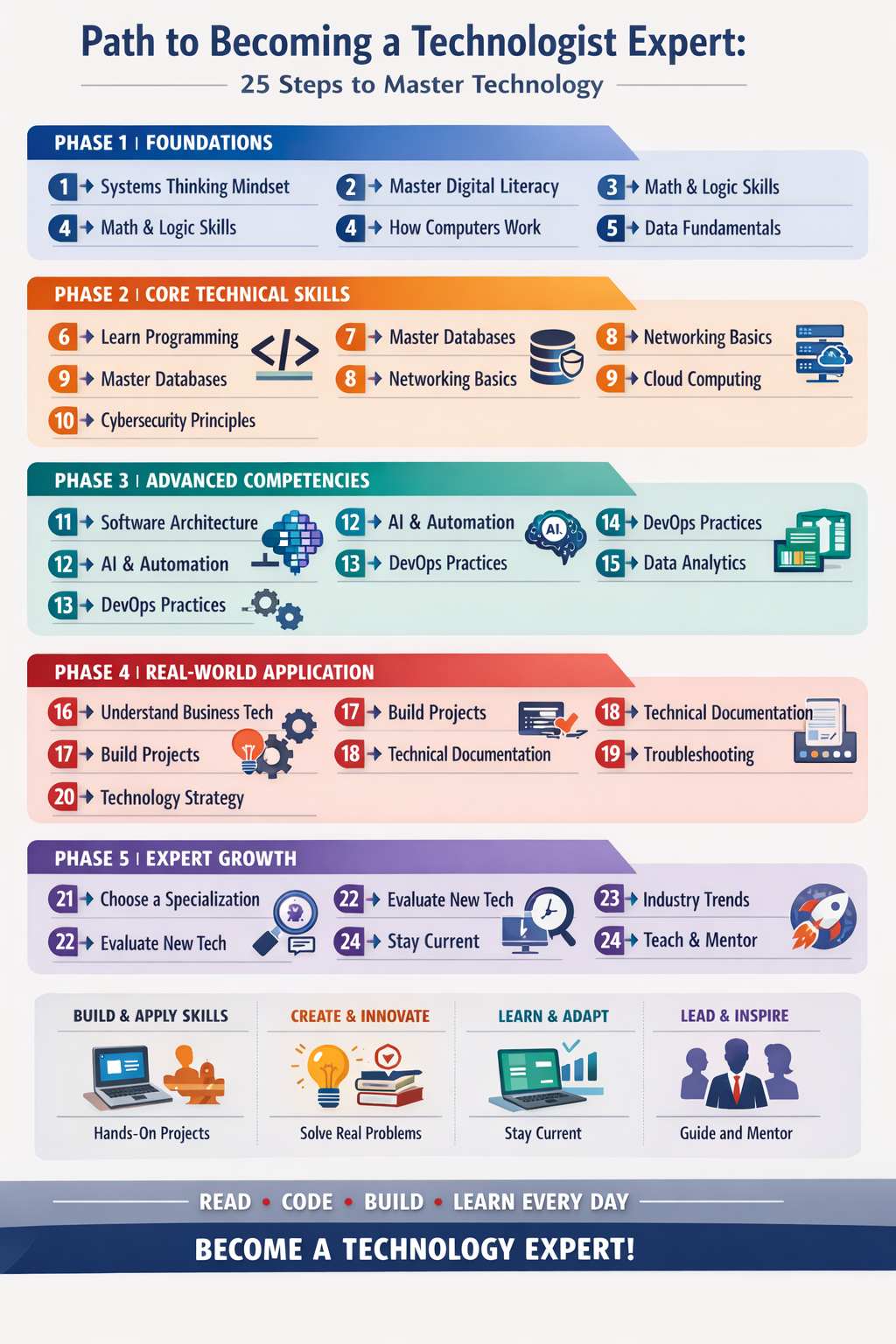
PHASE 1 — Mindset & Foundations
1. Develop a Systems Thinking Mindset
A technologist sees technology as connected systems, not isolated tools.
Focus on:
- Inputs → Processing → Outputs → Feedback loops
- Understanding dependencies between software, hardware, data, and people
- Thinking in architectures, not just features
How to practice
- Map how apps you use daily actually work behind the scenes.
- Learn basic architecture diagrams.
2. Master Digital Literacy
You must be extremely comfortable with:
- Operating systems
- Cloud tools
- Networking basics
- Cyber hygiene
Goal: Technology must feel like your native language.
3. Build Strong Mathematical & Logical Thinking
You don’t need advanced math for everything, but you need:
- Statistics
- Logic reasoning
- Probability
- Basic algebra
These power:
- AI
- Data science
- Cybersecurity
- Algorithms
4. Learn How Computers Actually Work
Understand:
- CPU
- RAM
- Storage
- Networks
- Operating systems
Without this, higher-level tech knowledge becomes shallow.
5. Understand Data as the New Infrastructure
Modern tech is data-driven.
Learn:
- Data lifecycle
- Data storage
- Data pipelines
- Data quality
PHASE 2 — Core Technical Skills
6. Learn Programming (At Least One Deeply)
Recommended path:
- Start with Python
- Then learn SQL
- Then learn a system language (optional but powerful)
Focus on:
- Writing clean code
- Debugging
- Version control
7. Master Databases
You must understand:
- Relational databases
- NoSQL databases
- Data modeling
- Query optimization
8. Learn Networking Fundamentals
Understand:
- IP addressing
- DNS
- HTTP / HTTPS
- Cloud networking
9. Learn Cloud Computing
Cloud is now core infrastructure.
Learn:
- Virtual machines
- Containers
- Serverless computing
- Storage services
10. Understand Cybersecurity Principles
Even if not a security specialist, learn:
- Encryption basics
- Identity management
- Threat models
- Secure design
PHASE 3 — Advanced Technology Competencies
11. Learn Software Architecture
Understand:
- Microservices
- APIs
- Event-driven systems
- Scalability design
12. Learn AI and Automation Fundamentals
Focus on:
- Machine learning basics
- Prompt engineering
- AI agents
- Automation workflows
13. Understand DevOps & Automation Culture
Learn:
- CI/CD pipelines
- Infrastructure as code
- Monitoring systems
14. Learn Data Analytics & Visualization
Be able to:
- Extract insights from data
- Build dashboards
- Tell stories with data
15. Learn Technology Product Thinking
Understand:
- User needs
- Product-market fit
- Technical feasibility vs business value
PHASE 4 — Real-World Application Skills
16. Learn How Businesses Use Technology
Study:
- Supply chains
- Finance systems
- Marketing tech
- Government tech systems
17. Build Real Projects
Examples:
- Build an app
- Automate a workflow
- Create a data dashboard
- Build an AI chatbot
18. Learn Technical Documentation
Experts communicate clearly.
Learn to write:
- System design docs
- API docs
- Technical proposals
19. Develop Troubleshooting Expertise
Top technologists solve problems fast.
Practice:
- Root cause analysis
- Log analysis
- Failure simulation
20. Learn Technology Strategy
Understand:
- Tech cost vs ROI
- Technology roadmaps
- Risk assessment
PHASE 5 — Expert-Level Professional Growth
21. Specialize in a Domain
Choose one or two:
- AI / Data
- Cybersecurity
- Cloud architecture
- Software engineering
- Fintech
- Logistics tech
- GovTech
22. Learn How to Evaluate New Technologies
Ask:
- Is it scalable?
- Is it secure?
- Is it maintainable?
- Does it solve a real problem?
23. Build Industry Awareness
Track:
- Tech trends
- New frameworks
- Industry disruptions
24. Teach and Mentor Others
Teaching accelerates mastery.
Ways:
- Write articles
- Make tutorials
- Mentor juniors
25. Think Like a Technology Leader
Expert technologists:
- Influence decisions
- Design future systems
- Connect business and engineering
🧠 Daily Habits of Top Technologist Experts
- Read technical material daily
- Build something every month
- Break and fix systems intentionally
- Study real production architectures
- Learn continuously
🚀 Example 3-Year Mastery Path
Year 1: Foundations + Coding + Databases
Year 2: Cloud + AI + Architecture
Year 3: Specialization + Leadership + Strategy
⭐ Final Expert Mindset
A true technologist expert:
✔ Understands technology deeply
✔ Applies it to real problems
✔ Communicates technical ideas clearly
✔ Keeps learning forever


Be First to Comment