
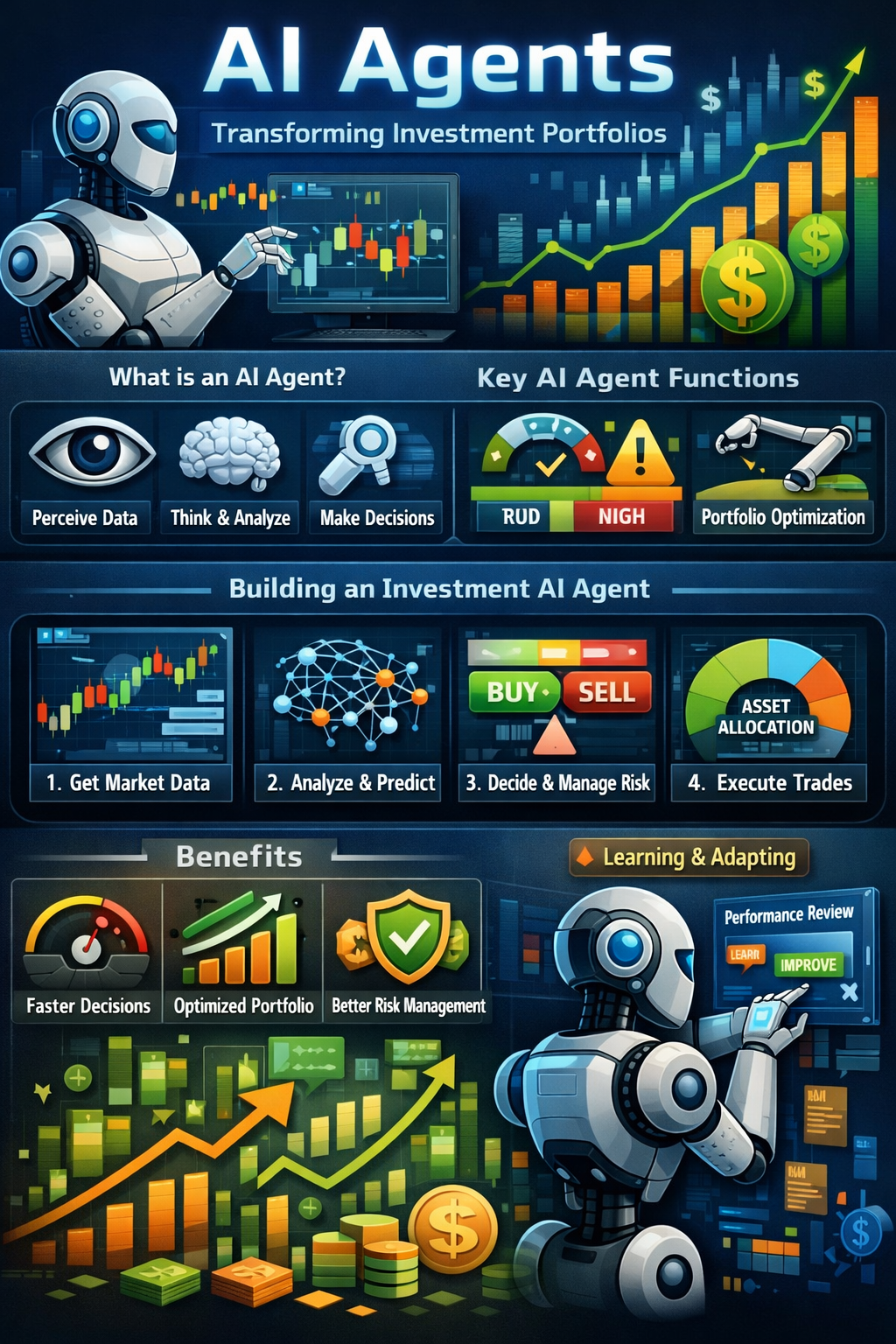
1. Introduction: The Rise of Autonomous Digital Intelligence
Artificial Intelligence has moved from passive tools (like calculators or simple chatbots) to autonomous systems capable of acting independently. These systems are called AI agents. Modern AI agents can observe data, reason about it, make decisions, and execute actions with minimal human intervention.
AI agents are now considered a major shift in computing — similar to how the internet changed communication or how smartphones changed daily life. Many industries are moving toward “AI co-workers” that help humans complete complex tasks automatically. Recent enterprise platforms are even being designed specifically to manage large numbers of AI agents across companies.
2. What is an AI Agent (Technical Definition)
An AI agent is a goal-driven system that:
- Perceives its environment
- Makes decisions
- Takes actions
- Learns from outcomes
In technical terms, an AI agent is software that combines perception, memory, reasoning, and action to achieve objectives autonomously.
AI agents differ from normal software because they:
- Keep context and memory across interactions
- Act proactively (not only when commanded)
- Can adapt using learning models
3. Core Architecture of AI Agents
Most AI agents are built around these main modules:
3.1 Perception
Collects data from environment:
- Market data
- Text
- Sensors
- APIs
Agents convert raw data into structured information.
3.2 Memory
Stores knowledge:
- Short-term session context
- Long-term historical learning
Memory allows agents to improve performance over time.
3.3 Reasoning and Planning
Decides:
- What actions to take
- When to take them
- Risk vs reward tradeoffs
Planning modules evaluate scenarios and select optimal actions.
3.4 Action Execution
Carries out decisions:
- Place trades
- Send emails
- Trigger workflows
- Move robots
Action modules convert decisions into real-world effects.
4. Types of AI Agents
Reactive Agents
Respond to current data only
Example: price alert bot
Proactive / Deliberative Agents
Plan long-term strategies
Example: portfolio optimizer
Multi-Agent Systems
Multiple agents collaborate
Example: macro agent + risk agent + execution agent in trading systems
These classifications are widely used in modern AI architecture design.
5. Industries That Need AI Agents
AI agents are rapidly being deployed across sectors.
Finance and Investment
- Portfolio management
- Trading signal generation
- Risk monitoring
- Market research automation
Many financial institutions now use AI to process research and improve decision speed.
Healthcare
- Diagnosis support
- Drug discovery
- Patient monitoring
Logistics and Supply Chain
- Route optimization
- Demand forecasting
- Warehouse automation
E-Commerce & Marketing
- Customer behavior prediction
- Dynamic pricing
- Personalized recommendations
Government and Security
- Fraud detection
- Cybersecurity monitoring
- Intelligence analysis
6. AI Agents in Finance — Research Perspective
Financial markets are ideal environments for AI agents because they are:
- Data rich
- Dynamic
- Competitive
Modern trading agent architectures include multiple specialized agents:
- Strategy agent
- Risk control agent
- Portfolio allocation agent
- Execution agent
- Backtesting agent
Research shows multi-agent trading systems can outperform benchmarks when properly designed.
Advanced multi-agent investing models combine:
- Macro economic analysis
- Company fundamentals
- Technical signals
- News sentiment
- Risk optimization
These systems can outperform traditional models on risk-adjusted returns.
7. How to Build Your Own AI Agent (Practical Framework)
Step 1 — Define Goal
Example:
- Beat market benchmark
- Reduce portfolio risk
- Generate trade signals
Step 2 — Choose Agent Type
For investment:
- Start with single agent
- Later move to multi-agent system
Step 3 — Choose Technology Stack
Typical modern stack:
Core AI
- LLM or ML models
- Reinforcement learning (optional)
Data
- Market data APIs
- News APIs
- Economic indicators
Infrastructure
- Python
- Cloud hosting
- Databases
Step 4 — Design Agent Loop
Investment agent loop:
Get market data
↓
Analyze signals
↓
Evaluate risk
↓
Generate decision
↓
Execute trade or alert
↓
Learn from result
This loop matches standard agent lifecycle (perception → planning → action → learning).
8. Example — Simple Investment AI Agent Architecture
Inputs
- Stock prices
- Volume
- News sentiment
- Macro indicators
Models
- Signal prediction model
- Risk model
- Portfolio optimizer
Output
- Buy / Sell / Hold decision
- Portfolio allocation changes
9. Realistic Beginner Path (Important)
Start simple:
Level 1 — Data Analysis Agent
- Reads portfolio
- Gives insights
- Suggests rebalancing
Level 2 — Signal Agent
- Generates trade ideas
- Sends alerts
Level 3 — Semi-Automated Trading Agent
- Suggests trades
- You approve manually
Level 4 — Fully Autonomous Agent
(Advanced, regulated, risky)
10. Tools You Can Use (Practical)
Beginner
- Python
- Pandas
- Yahoo Finance API
- OpenAI or LLM APIs
Intermediate
- LangChain or agent frameworks
- Vector databases
- Backtesting libraries
Advanced
- Reinforcement learning
- Multi-agent orchestration
- Real-time execution systems
11. Risks (Very Important for Investment Agents)
Research shows AI trading agents can fail if:
- Risk control is weak
- Data is noisy
- Market regime changes
Risk management is the main factor in trading success.
12. Future of AI Agents
AI agents are moving toward:
- Fully autonomous business workflows
- Multi-agent collaborative intelligence
- AI managing AI
Many companies are investing heavily in agent-based automation.
Conclusion
AI agents represent the next generation of software — systems that can:
- Think
- Learn
- Decide
- Act
In finance, AI agents will likely become standard tools for portfolio management, research, and trading, but success depends heavily on risk control, data quality, and regulatory compliance.


Be First to Comment