
Introduction
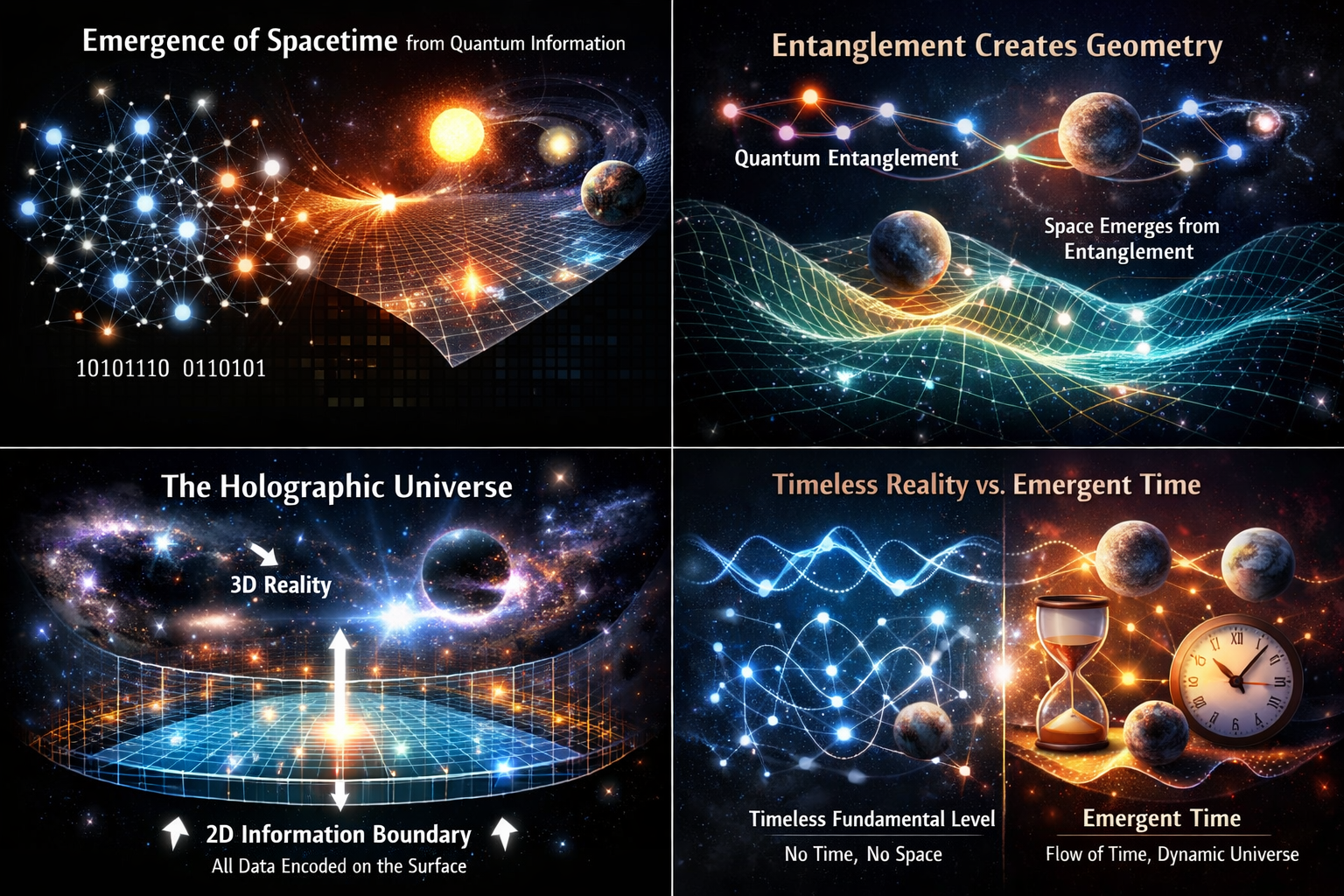
The notion that space and time are not fundamental constituents of reality represents one of the most profound shifts in contemporary physics and philosophy of science. For centuries, we’ve treated spacetime as the stage upon which the universe performs—a fixed backdrop against which particles move and fields fluctuate. Yet mounting evidence from quantum mechanics, quantum gravity research, and theoretical physics suggests this intuition may be fundamentally mistaken. Space and time, rather than being the bedrock of existence, may instead be emergent phenomena—secondary features arising from deeper, more primitive structures that bear little resemblance to our everyday experience.
This essay explores the theoretical foundations, empirical motivations, and philosophical implications of this radical hypothesis. We’ll examine how various approaches to quantum gravity, from string theory to loop quantum gravity to more recent developments in quantum information theory, converge on the idea that spacetime is derivative rather than fundamental. We’ll also consider what might actually be fundamental if space and time are not, and what this means for our understanding of reality itself.
The Classical Picture and Its Cracks
The Newtonian Stage
In Newtonian mechanics, space and time were treated as absolute, independent entities. Space was an infinite three-dimensional container, unchanging and uniform, providing a coordinate system in which to locate objects. Time was a universal parameter ticking away uniformly throughout the cosmos, the same for all observers regardless of their motion or location. This “container” view of spacetime proved remarkably successful for describing terrestrial and celestial mechanics.
Yet even in Newton’s era, philosophers like Leibniz questioned this absolutist picture. Leibniz argued that space and time were merely relations between objects and events—they had no independent existence apart from the things they related. Without matter, Leibniz contended, spatial and temporal concepts would be meaningless. This relational view, while philosophically intriguing, lacked the mathematical precision to challenge Newton’s framework effectively.
Einstein’s Revolution
Einstein’s theories of relativity fundamentally transformed our understanding of spacetime while still treating it as a fundamental entity. Special relativity revealed that space and time are not separate but interwoven into a four-dimensional spacetime continuum. Different observers, moving relative to one another, would disagree about spatial distances and temporal durations, but would agree on spacetime intervals—a geometric invariant combining both.
General relativity went further, revealing spacetime as dynamical rather than fixed. Matter and energy don’t simply exist within spacetime; they curve it, and this curvature is what we experience as gravity. John Wheeler’s famous aphorism captures this beautifully: “Matter tells spacetime how to curve, and spacetime tells matter how to move.” Spacetime became a physical field in its own right, with its own dynamics described by Einstein’s field equations.
Yet even this revolutionary picture treats spacetime as fundamental. The Einstein field equations presuppose the existence of a smooth, continuous manifold—a differentiable structure with well-defined notions of distance, angle, and curvature at every point. This assumption works magnificently at macroscopic scales but begins to break down when we probe the quantum realm.
The Quantum Challenge
Quantum mechanics introduced profound conceptual challenges to the classical spacetime picture. At microscopic scales, particles don’t have definite positions until measured—they exist in superpositions of multiple locations simultaneously. The uncertainty principle establishes fundamental limits on how precisely we can know both position and momentum, suggesting that the very concept of a definite spatial location may be idealized.
When physicists attempted to combine quantum mechanics with general relativity—to create a theory of quantum gravity—they encountered severe difficulties. Straightforward attempts to “quantize” the gravitational field led to mathematical inconsistencies and non-renormalizable infinities. The usual techniques that worked for quantum electrodynamics and the other forces failed spectacularly for gravity.
These failures hinted at something deeper: perhaps the fundamental incompatibility between quantum mechanics and general relativity stems from trying to quantize spacetime itself. If spacetime is not fundamental but emergent, then the project of quantum gravity should not be about quantizing the gravitational field on a fixed spacetime background, but rather about identifying the more fundamental quantum degrees of freedom from which both spacetime and gravity emerge.
Theoretical Frameworks for Emergent Spacetime
String Theory and the Holographic Principle
String theory approaches the problem by replacing point particles with one-dimensional extended objects—strings—whose vibrational modes correspond to different particles, including the graviton that mediates gravity. In string theory, spacetime emerges from the collective behavior of these strings in ways that challenge our intuitions.
One of the most striking discoveries in string theory is the holographic principle, crystallized in the AdS/CFT correspondence discovered by Juan Maldacena in 1997. This correspondence reveals an exact mathematical equivalence between a gravitational theory in a higher-dimensional space (Anti-de Sitter space) and a quantum field theory without gravity on its lower-dimensional boundary (a Conformal Field Theory).
This equivalence is deeply counterintuitive: a fully gravitational, spacetime-based physics in five dimensions is completely equivalent to a theory without gravity in four dimensions. Spacetime itself, along with an entire extra dimension, emerges from the quantum entanglement structure of the boundary theory. The dimension perpendicular to the boundary can be understood as encoding the scale of entanglement in the boundary theory—systems that are more strongly entangled correspond to regions deeper in the bulk spacetime.
The holographic principle suggests that spacetime is not fundamental but rather emerges from quantum information theoretic structures. The geometry of spacetime encodes patterns of quantum entanglement in more fundamental quantum degrees of freedom. Distance in spacetime corresponds roughly to the difficulty of transmitting quantum information between different regions.
Loop Quantum Gravity
Loop quantum gravity takes a different approach, attempting to quantize general relativity directly without embedding it in a larger structure like string theory. In this framework, spacetime is not continuous but discrete at the smallest scales—the Planck scale of approximately 10^-35 meters.
The fundamental objects in loop quantum gravity are spin networks—graphs whose edges and nodes are labeled with quantum numbers related to angular momentum. These spin networks represent quantum states of the gravitational field itself. Spacetime geometry emerges from the connectivity and labels of these networks, with the discrete quantum geometry replacing the smooth classical spacetime manifold.
In this picture, space is fundamentally relational—it consists of quantum relationships between different regions, encoded in the spin network structure. There is no background spacetime on which these networks live; instead, they constitute space itself. Time, similarly, emerges from the evolution of these networks, rather than being a primitive structure.
The discrete nature of quantum geometry in loop quantum gravity provides a natural ultraviolet cutoff that eliminates the infinities plaguing earlier approaches to quantum gravity. At the Planck scale, the smooth spacetime of general relativity gives way to a quantum foam of fluctuating geometry, where the very notions of distance and duration become fuzzy and ill-defined.
Causal Set Theory
Causal set theory represents another approach to quantum gravity that treats spacetime as fundamentally discrete. In this framework, spacetime is replaced by a causal set—a discrete collection of events with a causal ordering relation specifying which events can influence which others.
The continuum spacetime of general relativity emerges in the large-scale limit, much as a smooth fluid emerges from the collective behavior of discrete molecules. The metric structure of spacetime—which specifies distances and durations—is derived from the causal structure and the counting of events. In a precise sense, the dimensionality and geometry of spacetime are features that emerge statistically from the underlying causal structure.
This approach resonates with a long philosophical tradition emphasizing the primacy of causation in physics. Rather than taking spatial and temporal relations as fundamental, causal set theory treats causal relations—which events can affect which others—as the primary structure from which spacetime emerges.
Quantum Information Approaches
Perhaps the most radical proposals suggest that quantum information—not matter, energy, or even abstract geometric structures—is the most fundamental constituent of reality. In this “it from qubit” paradigm, championed by physicists like John Wheeler and more recently by researchers studying quantum entanglement, spacetime emerges from the entanglement structure of quantum information.
Recent work has shown that the geometry of spacetime in the AdS/CFT correspondence is intimately connected to quantum entanglement. The Einstein equations, which govern spacetime curvature, can be derived from the first law of thermodynamics applied to entanglement entropy. This suggests that spacetime geometry is fundamentally a reflection of how quantum information is organized and correlated.
Mark Van Raamsdonk demonstrated that in AdS/CFT, disconnecting spacetime by cutting it in two corresponds to eliminating quantum entanglement between the corresponding regions of the boundary theory. Spacetime connectivity—the fact that different regions are connected by paths along which information can propagate—emerges from quantum entanglement. Without entanglement, there is no continuous spacetime, only disconnected fragments.
This perspective suggests that distance in spacetime reflects the difficulty of creating quantum entanglement between different regions. Regions that are far apart in space require many intermediate quantum systems to establish entanglement between them, while nearby regions can become entangled more easily. Space itself might be understood as a measure of quantum informational separation.
What Might Be Fundamental?
If space and time are not fundamental, what takes their place? Different approaches suggest different answers, but several themes recur across frameworks.
Quantum Entanglement and Correlations
Quantum entanglement has emerged as a leading candidate for a more fundamental structure. Entanglement represents non-local quantum correlations—ways in which quantum systems can be related that don’t depend on spatial proximity. Einstein famously called this “spooky action at a distance,” but from the perspective of emergent spacetime, it’s not action at a distance at all—spatial distance is itself an emergent concept derivative from entanglement structure.
The pattern of entanglement in a quantum system determines which degrees of freedom are strongly correlated and which are relatively independent. These correlation patterns might be the fundamental structure from which spacetime geometry emerges. Strongly entangled regions correspond to nearby locations in space, while weakly entangled regions correspond to distant locations.
This inverts our usual understanding: we typically think that things become entangled because they’re nearby in space and can interact. In the emergent spacetime picture, causation runs the other way—things are nearby in space because they’re entangled. Spatial proximity is a reflection of strong quantum correlation, not its cause.
Causal Structure
Another candidate for a fundamental structure is causation itself—the relation specifying which events can influence which others. Causal structure doesn’t require space or time; it’s purely a matter of which events are in the causal future or past of which others. From this primitive causal ordering, the metric structure of spacetime—distances and durations—might be derivable.
The appeal of causal structure as fundamental lies in its operational character. We can directly observe causal relations by checking whether changing one event affects another. By contrast, spatial and temporal coordinates are more abstract constructions that we infer from observations rather than observing directly.
Causal structure also respects the principle of locality in a deep way. Information cannot propagate faster than light, so events can only influence other events within their future light cone. This causal locality might be more fundamental than spatial locality—indeed, spatial locality might emerge from it.
Pre-Geometric Algebra
Some approaches suggest that spacetime emerges from more abstract algebraic structures that bear no resemblance to geometry. In loop quantum gravity, for example, spin networks are essentially combinatorial structures—graphs with labels. The geometric properties of space emerge from these graphs in the large-scale limit, but the networks themselves are pre-geometric.
Similarly, in some formulations of string theory, spacetime coordinates emerge as expectation values of quantum operators—they’re not fundamental variables but rather derived quantities that characterize the average behavior of more fundamental quantum fields. The algebra of operators, describing how quantum observables combine and interact, might be more fundamental than the spacetime on which those operators appear to act.
This algebraic perspective resonates with the increasing abstraction in modern physics. Symmetries, conservation laws, and algebraic structures often prove more fundamental than the specific geometric or dynamical details they constrain. Perhaps geometry itself is just another emergent approximate concept, useful for describing large-scale physics but irrelevant at the deepest level.
Empirical Motivations and Potential Tests
While the notion of emergent spacetime is primarily motivated by theoretical consistency—resolving the tension between quantum mechanics and general relativity—there are also indirect empirical motivations and potential experimental signatures.
Black Hole Thermodynamics
Black holes provide one of the clearest hints that spacetime is not fundamental. Jacob Bekenstein and Stephen Hawking discovered that black holes have entropy proportional to their surface area (not their volume), and that they emit thermal radiation with a characteristic temperature. This black hole thermodynamics suggests deep connections between gravity, quantum mechanics, and information theory.
The holographic principle emerged partly from trying to understand black hole entropy. The fact that the maximum entropy that can be contained in a region is proportional to its boundary area, not its volume, suggests that the fundamental degrees of freedom live on surfaces, not in volumes. This is incompatible with a picture of space as a fundamental three-dimensional container.
The information paradox—the question of what happens to information that falls into a black hole—remains unresolved but strongly suggests that spacetime as described by classical general relativity is incomplete. The resolution likely requires understanding how quantum information is encoded in gravity and geometry, pointing toward emergent spacetime.
Planck Scale Physics
At the Planck scale—the incredibly tiny scale of 10^-35 meters where quantum gravitational effects become important—spacetime itself is expected to become ill-defined. The uncertainty principle implies that attempting to probe arbitrarily small distances requires arbitrarily high energies, which eventually becomes enough energy to create black holes that obscure the very regions being probed.
This suggests a fundamental limit to the divisibility of space, much as quantum mechanics implies fundamental limits to the divisibility of energy (into quanta). If space cannot be meaningfully subdivided below the Planck length, then the continuum picture of spacetime as infinitely divisible must break down. What replaces it is presumably some discrete or fundamentally quantum structure.
While directly probing Planck-scale physics remains far beyond current experimental capabilities, there might be indirect signatures in phenomena like cosmic rays or gravitational waves that could constrain theories of quantum gravity and emergent spacetime.
Cosmology and the Nature of Time
Cosmology raises profound questions about the nature of time. What happened “before” the Big Bang? What does time mean at the origin of the universe, when spacetime itself came into existence? These questions become even more puzzling in quantum cosmology, where the universe’s initial state is described by a quantum wavefunction.
The Wheeler-DeWitt equation, which describes quantum cosmology, famously contains no explicit time parameter—it’s a timeless equation for the quantum state of the universe. Time emerges from correlations between different parts of the universe, much as temperature emerges from the collective motion of particles without being a fundamental property of individual atoms.
This “problem of time” in quantum cosmology strongly suggests that time is not fundamental but emerges from more basic quantum structures. The flow of time might be a feature of certain quantum states rather than a universal backdrop for all physical processes.
Philosophical Implications
The possibility that space and time are not fundamental has profound philosophical implications that extend far beyond physics.
Ontological Implications
If spacetime is emergent, our basic ontology—our catalog of what exists—must be radically revised. We cannot say that reality fundamentally consists of objects located in space and evolving in time, because space and time are not fundamental categories. Instead, reality consists of whatever the fundamental structures turn out to be: quantum information states, causal relations, spin networks, or something else entirely.
This challenges our most basic intuitions about existence. We naturally think of existence as being somewhere at some time. But if space and time are emergent, existence must be something more abstract—perhaps instantiation of certain patterns in a more fundamental structure, or participation in certain quantum correlations.
The concept of persistence through time also becomes problematic. If time is not fundamental, in what sense do objects persist? The answer might be that persistence is itself an emergent concept: objects persist in the sense that certain patterns remain stable in the underlying fundamental structure, creating the appearance of enduring entities in emergent spacetime.
The Nature of Reality
Emergent spacetime suggests a layered view of reality: the manifest world of objects in space and time emerges from an underlying reality that’s radically different. This raises questions about which level is “more real.” Is the spacetime we experience merely an illusion, a convenient fiction our brains construct from more fundamental but incomprehensible quantum structures?
One response is to adopt a pluralistic view: both levels are real, but in different ways. Spacetime is real as an emergent structure—it has genuine causal powers and features that cannot be reduced to simple sums over fundamental degrees of freedom. But it’s not fundamental; it depends on and is constituted by more basic structures.
This perspective parallels how we think about other emergent phenomena. Temperature is real—it has genuine physical effects and features. But it’s not fundamental; it emerges from molecular motion. Similarly, spacetime might be real but emergent, a large-scale effective description of more fundamental quantum structures.
Implications for Philosophy of Science
The emergent spacetime program exemplifies several important themes in philosophy of science. It demonstrates how theoretical considerations—the need for mathematical consistency between different frameworks—can motivate radical revisions to our fundamental ontology, even in advance of direct empirical evidence.
It also illustrates the underdetermination of theory by evidence. Multiple distinct approaches—string theory, loop quantum gravity, causal sets—all point toward emergent spacetime but disagree about what’s fundamental. Current evidence doesn’t decisively favor any particular framework, suggesting that empirical constraints alone may be insufficient to determine the fundamental structure of reality.
The emergent spacetime program raises questions about reductionism. If macroscopic structures like spacetime emerge from microscopic quantum structures, does this mean macroscopic phenomena are “nothing but” arrangements of microscopic degrees of freedom? Or do emergent structures have autonomous reality and explanatory power that cannot be reduced to their constituents?
Consciousness and Experience
Some philosophers have noted intriguing parallels between emergent spacetime and questions about consciousness. Just as spacetime might emerge from more fundamental non-spatial, non-temporal structures, consciousness and subjective experience might emerge from neural processes that individually lack phenomenal qualities.
The “hard problem of consciousness”—explaining how subjective experience arises from objective physical processes—bears some resemblance to explaining how spacetime arises from pre-geometric structures. Both involve the emergence of familiar, seemingly irreducible features from fundamentally different underlying structures.
Of course, these parallels might be merely superficial. But they suggest that understanding emergence in physics might inform our thinking about other seemingly irreducible features of reality, from consciousness to causation to time’s arrow.
Challenges and Open Questions
Despite its theoretical appeal, the emergent spacetime program faces significant challenges and leaves many questions unanswered.
The Emergence Problem
The primary challenge is to demonstrate precisely how spacetime emerges from more fundamental structures. While various approaches suggest mechanisms—entanglement structure in AdS/CFT, spin network dynamics in loop quantum gravity, coarse-graining in causal sets—a complete, detailed derivation remains elusive in most cases.
We need to show not just that spacetime can emerge, but that it must emerge, and that the emergent spacetime has exactly the properties we observe: three spatial dimensions plus one time dimension, approximately flat at large scales but curved by matter, obeying Einstein’s field equations. This is an enormous technical challenge that remains largely unmet.
Universality and Uniqueness
An important question is whether emergent spacetime is universal—does every possible fundamental structure give rise to some kind of spacetime, or only special ones? And if only special fundamental structures produce spacetime, what distinguishes them?
Conversely, we might ask about uniqueness: do different fundamental structures always give rise to the same emergent spacetime, or can different microscopic theories produce different macroscopic spacetimes? The AdS/CFT correspondence suggests the latter—different boundary theories correspond to different bulk geometries. Understanding these mapping relations is crucial.
The Nature of Time
While most emergent spacetime approaches focus on the emergence of spatial geometry, the emergence of time is particularly subtle and problematic. Time seems to play a different role than space—it’s the parameter describing change and evolution, not just another dimension.
How does the temporal direction emerge? What distinguishes past from future in a fundamental theory that might be time-symmetric? The thermodynamic arrow of time—entropy increase—might be connected to the emergence of time itself, but these connections remain speculative and poorly understood.
Observational Consequences
A major challenge for emergent spacetime theories is generating distinctive observational predictions. Many approaches make predictions only at the Planck scale, far beyond current experimental reach. Without empirical tests, it’s difficult to adjudicate between competing frameworks or to confirm that spacetime is indeed emergent rather than fundamental.
Some researchers are investigating possible indirect signatures: modified dispersion relations for high-energy cosmic rays, distinctive patterns in the cosmic microwave background, or novel features in gravitational wave signals. But detecting these subtle effects requires both theoretical development and experimental ingenuity.
The Role of Matter and Fields
Most emergent spacetime approaches focus on gravity and geometry, treating matter and other fields as secondary. But in the actual universe, spacetime is never empty—it’s filled with matter and radiation, electromagnetic fields, and other quantum fields. How do these fields fit into emergent spacetime?
Do matter and other fields also emerge from the fundamental structure, or are they independent ingredients that must be added to emergent spacetime? If they emerge, do they emerge from the same fundamental structure as spacetime, or from something different? These questions remain largely open.
Broader Context and Alternative Perspectives
It’s worth noting that not all physicists embrace the emergent spacetime program. Some argue that the difficulties in quantum gravity stem from technical challenges or missing ingredients rather than from treating spacetime as fundamental.
Asymptotic Safety
One alternative approach, asymptotic safety, attempts to construct a consistent quantum field theory of gravity without abandoning spacetime as fundamental. In this approach, gravity becomes a well-defined quantum theory at a non-trivial fixed point of the renormalization group—a mathematical structure describing how physical theories change with scale.
If asymptotic safety works, it would suggest that spacetime can remain fundamental even in quantum gravity, with the apparent incompatibility between quantum mechanics and general relativity resolved through sophisticated mathematical techniques rather than radical conceptual revision.
Modified Gravity
Another alternative is to modify general relativity itself, adding new terms to Einstein’s equations or introducing new fields that change gravitational dynamics. These modifications might resolve some of the tensions with quantum mechanics without requiring emergent spacetime.
However, most modified gravity theories still treat spacetime as a fundamental continuum manifold, so they don’t address the deeper conceptual issues that motivate emergent spacetime approaches. They also face stringent observational constraints from solar system tests and cosmological observations.
Pragmatic Instrumentalism
Some physicists adopt an instrumentalist stance, treating theoretical frameworks as tools for making predictions rather than descriptions of deep reality. From this perspective, whether spacetime is “really” fundamental or emergent is less important than whether our theories make accurate predictions and provide useful explanations.
While instrumentalism has pragmatic appeal, it sidesteps the profound questions about the nature of reality that drive much fundamental physics research. Most physicists engaging with quantum gravity questions are motivated by realist aspirations—they genuinely want to understand what the world is like, not just develop predictive algorithms.
Implications for Future Physics
If spacetime is indeed emergent, this will reshape the landscape of physics in the coming decades.
Unified Theories
Emergent spacetime might provide the key to unification—the long-sought theory that unifies gravity with the other fundamental forces. If spacetime and the gravitational field both emerge from the same quantum informational structure that gives rise to quantum field theory, then gravity and quantum mechanics would be unified at the deepest level.
This unification might also explain mysterious features like the cosmological constant, the values of fundamental constants, and the origin of physical laws themselves. These might emerge as features of the fundamental structure rather than being independent unexplained inputs.
Quantum Computation and Spacetime
The deep connections between quantum information and spacetime geometry suggest intriguing possibilities for quantum computing. Perhaps the structure of spacetime can be used as a computational resource, or conversely, quantum computers might be used to simulate emergent spacetime dynamics and explore quantum gravity.
Understanding how classical spacetime emerges from quantum information might also inform our understanding of decoherence and the quantum-classical transition—the process by which quantum systems develop approximately classical behavior. These processes might be intimately related to the emergence of geometry.
Cosmological Questions
Emergent spacetime might shed light on cosmological mysteries. What is dark energy? What is dark matter? What happened at the Big Bang? If spacetime itself emerges from quantum information, perhaps these phenomena reflect features of how that emergence occurs in our universe.
The emergence of time might be particularly relevant for cosmology. If time emerges from quantum entanglement, then asking what happened “before” the Big Bang might be meaningless—there was no time before time emerged. The beginning of the universe would be the beginning of the emergent structures we call space and time, not an event within a pre-existing temporal framework.
Conclusion
The hypothesis that space and time are not fundamental represents one of the boldest proposals in contemporary physics. It challenges our deepest intuitions about the nature of reality while drawing on sophisticated mathematical frameworks from quantum mechanics, general relativity, and quantum information theory.
Multiple independent lines of reasoning converge on this conclusion. The incompatibility between quantum mechanics and general relativity, the holographic principle, black hole thermodynamics, and the problem of time in quantum cosmology all suggest that spacetime is emergent rather than fundamental. Diverse approaches—string theory, loop quantum gravity, causal sets, and quantum information theory—reach similar conclusions despite their different starting points and technical details.
What emerges from these investigations is a radically different picture of reality. At the deepest level, the universe might not consist of objects located in space and evolving in time. Instead, it might consist of quantum information states, causal relations, entanglement patterns, or other structures that bear little resemblance to our everyday experience. Space and time—the seemingly irreducible fabric of existence—would be large-scale emergent phenomena, real but derivative, like temperature or pressure emerging from molecular motion.
This perspective has profound implications. It challenges our basic ontology, forcing us to revise our catalog of what fundamentally exists. It transforms our understanding of causation, persistence, and change. It suggests new connections between apparently disparate phenomena—gravity and thermodynamics, geometry and quantum information, cosmology and computation.
Yet major challenges remain. We lack complete detailed accounts of how spacetime emerges in most frameworks. We struggle to generate distinctive observational predictions that could confirm or refute these ideas. We face deep conceptual puzzles about the nature of time, the role of matter, and the relationship between different levels of description.
The question of whether space and time are fundamental thus remains open—an active research frontier rather than settled science. But the possibility that they are emergent has already transformed how physicists think about quantum gravity and the nature of reality. Whether or not this specific hypothesis proves correct, the exploration of emergent spacetime has revealed deep connections between quantum mechanics, gravity, and information that will shape physics for decades to come.
In pursuing these questions, physicists are doing what science has always done: questioning our most basic assumptions about reality, following the logic of our best theories into unfamiliar territory, and remaining open to the possibility that the universe is far stranger and more wonderful than we imagine. The idea that space and time themselves might be emergent phenomena, rather than the fundamental stage on which reality plays out, exemplifies this spirit of radical inquiry. Whether this idea ultimately proves correct or not, the journey to understand it has already deepened our understanding of nature’s deepest structures.




Be First to Comment