
Abstract (short):
This thesis surveys which states and polities from the early 17th century through 2025 most deeply adopted mathematics and modern science, how and why they did so, and how leadership shifted across eras. I present a working methodology, an era-by-era narrative, a justified “top ten” list for each broad period (early modern, industrial/19th c., 20th c., and up-to-2025), brief country case studies showing mechanisms of adoption (institutions, funding, education, industry links), and a concise bibliography for follow-up.
Methodology (how I chose & defined “top”)
• Definition of “adopted maths & science in depth”: sustained national investment in formal mathematical/scientific education and research; creation of learned societies and journals; measurable technological/industrial diffusion; and (where available) modern indicators such as R&D intensity and innovation rankings.
• Periods used: Early modern (≈1600–1800), Industrial & 19th century (≈1800–1900), 20th century (1900–2000), and Modern/globalized era (2000–2025).
• Sources & evidence: classic historiography on the Scientific and Industrial Revolutions, modern datasets and reports (OECD, Global Innovation Index, R&D investment compilations), and standard histories of mathematics and science. Key sources informing the broad claims: Britannica on the Scientific Revolution; histories of the Industrial Revolution; OECD STI Outlook 2025; recent Global Innovation / R&D surveys. Reuters+3Encyclopedia Britannica+3Encyclopedia Britannica+3
Note: Because this is a broad sweep, national “rankings” within a period are qualitative and justified by institutional and technological leadership evidence rather than a single numeric score.
Short, load-bearing background facts (with citations)
- The Scientific Revolution (16th–17th c.) centralised scientific method, experimentalism, and quantitative reasoning in Europe — especially England, the Netherlands, France, and Italy — and seeded modern academic institutions (e.g., the Royal Society). Encyclopedia Britannica+1
- The Industrial Revolution (late 18th–19th c.) began in Britain and then spread to continental Europe, North America, and Japan; it linked scientific/engineering advances to industrial scale and spurred demand for formal maths and technical education. Encyclopedia Britannica+1
- Modern measures (R&D intensity, patenting, innovation indexes) show a major redistribution of scientific/technological leadership by 2020–2025, with the United States, China, Japan, and advanced European and East Asian economies prominent; OECD and 2025 innovation reports document these trends. OECD+1
- The history of mathematics is long and global (Egypt, Mesopotamia, India, China, Islamic world), but the early modern European rise of calculus, mechanics, and mathematical physics (17th–18th c.) was pivotal for later national science programs. Wikipedia+1
Era-by-era top-ten lists (compact) with brief justification
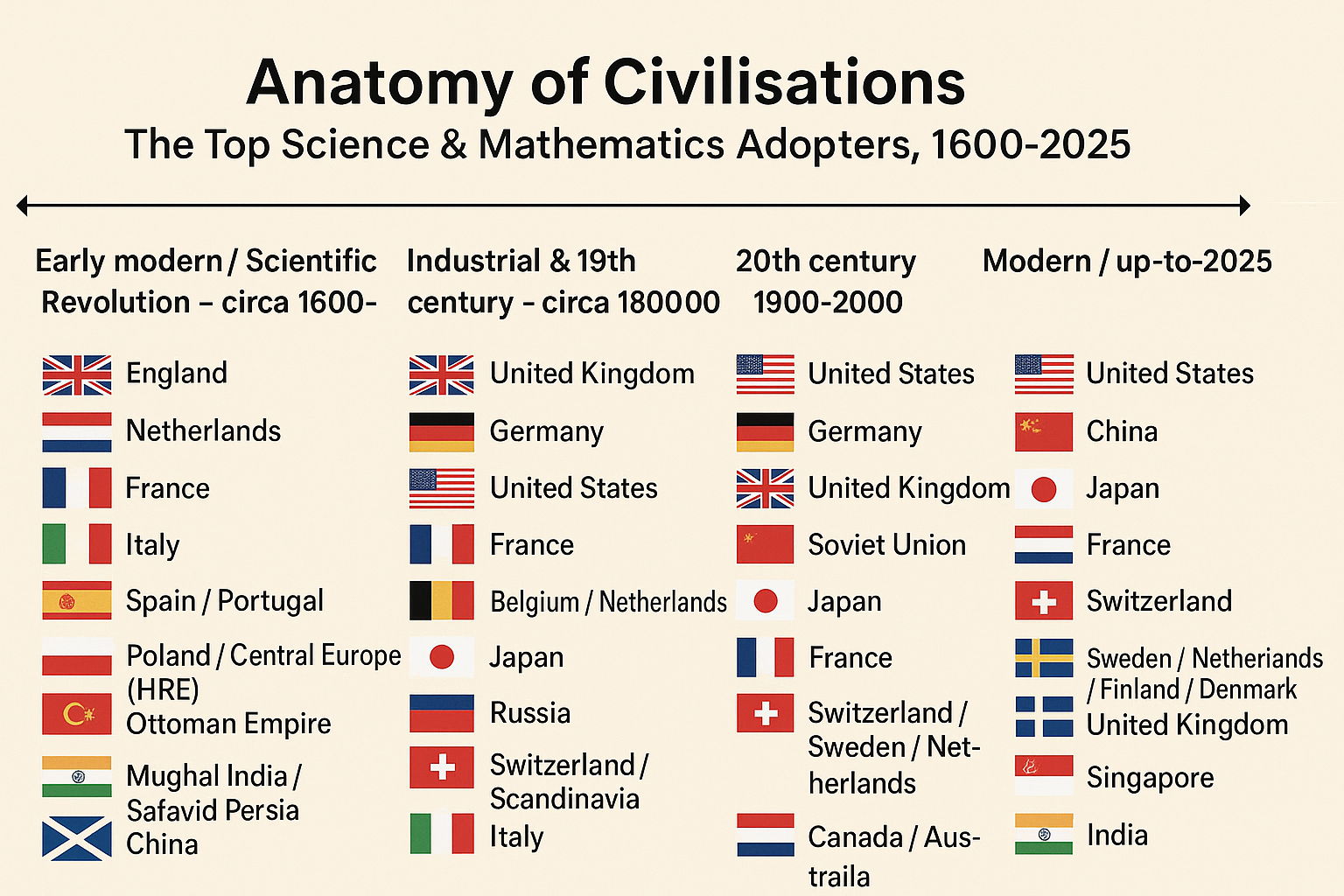
A. Early modern / Scientific Revolution — circa 1600–1800
- England — Royal Society, Newton, strong experimentalism. Pressbooks B.C. Campus
- Netherlands — universities, instrument-makers, cosmopolitan publishing networks. Encyclopedia Britannica
- France — Académie des Sciences; significant state support later in 17–18c. Encyclopedia Britannica
- Italy — centers (Padua, Pisa) and figures like Galileo; tradition of mathematical astronomy. Encyclopedia Britannica
- Spain / Portugal — navigational mathematics and applied astronomy (less emphasis on the new experimentalism but global knowledge flows).
- Poland / Central Europe (HRE) — educated elites and universities feeding learned networks.
- Ottoman Empire — strong mathematical traditions earlier; slower institutional uptake of modern experimentalism in this period.
- Mughal India / Safavid Persia — advanced mathematical/astronomical traditions; selective adoption of European experimental science.
- China (Ming–Qing contacts) — long mathematical tradition; Jesuit exchanges introduced some European modern science.
- Scotland (as part of Britain but with unique university contributions: Edinburgh, Glasgow) — strong mathematics and Enlightenment scholarship.
Why these? The 17th c. transformation was centered in Western Europe (England/Netherlands/France/Italy), but global mathematical traditions and knowledge transfer (Jesuits, trade networks) brought other regions into selective engagement. Encyclopedia Britannica+1
B. Industrial & 19th century — circa 1800–1900
- United Kingdom (Great Britain) — industrial leadership, engineering, mechanisation. Encyclopedia Britannica
- Germany (Prussia/Austria region) — industrial chemistry, technical universities (Politechnikum), research universities. National Geographic Education
- United States — late 19th c. industrial growth, engineering, land-grant universities. Wikipedia
- France — continued scientific institutions and engineering schools (École Polytechnique).
- Belgium / Netherlands — industrialising, strong engineering and colonial science.
- Japan — rapid Meiji-era catch-up (education reforms, applied science).
- Russia — industrialisation and expanding scientific institutions (late 19th c.).
- Switzerland / Scandinavia — technical advances, precision industries.
- Italy — unification-era investment in sciences and engineering.
- Ottoman (late reforms)/Egypt — selective modernising projects (e.g., technical schools).
Why these? The Industrial Revolution linked scientific knowledge with manufacturing, chemical industries, and engineering education. Germany’s model of research universities and Germany’s chemical industry became particularly influential. National Geographic Education+1
C. 20th century — 1900–2000
- United States — dominance in physics, engineering, big-science (Manhattan Project, space), and university research model.
- Germany — early 20th c. leadership in chemistry and physics; strong university-research-industrial ties (pre-WWII).
- United Kingdom — strong universities and postwar science policy.
- Soviet Union / Russia — large state science programmes, space and military tech.
- Japan — post-WWII industrial & technological miracle; electronics, materials.
- France — national labs (CNRS), strong applied research.
- Switzerland / Sweden / Netherlands — high per-capita scientific output and industry links.
- Canada / Australia — strong research in specific domains and close links to US/UK systems.
- India / China (late 20th c. reform) — large math/science traditions; late-century ramp-ups in higher education and research.
- Germany (reunified), Italy, others — important specialised contributions.
Why these? The century saw large-scale state funding, national lab systems, and the rise of university–industry ecosystems that produced leadership in both pure and applied research.
D. Modern / Up-to-2025 — 2000–2025 (top players in science & maths adoption)
Based on R&D spending, innovation indices, AI and patent activity, and institutional depth, the leading countries by 2025 include (not strictly ranked here but listed as top-tier adopters):
- United States (global leader in AI, basic research, venture capital). AP News+1
- China (rapid growth in R&D, patents, innovation — entered top 10 GII by 2025). Reuters
- Japan (technology and engineering depth).
- Germany (industrial innovation, engineering). National Geographic Education
- South Korea (high R&D intensity, electronics). Visual Capitalist
- Switzerland (top of GII for years; high per-capita research excellence). Reuters
- Sweden / Netherlands / Finland / Denmark (Nordic high R&D spending, strong innovation ecosystems). Visual Capitalist+1
- United Kingdom (strong universities, AI and biotech research). AP News
- Singapore (policy-led rapid build of research infrastructure).
- India (rapidly expanding research base, IT/math talent pool, growing AI community). AP News
Evidence: OECD STI reports, GII 2025, R&D spending rankings, and contemporary AI/innovation studies show the multi-polar nature of science/tech leadership by 2025. OECD+2Reuters+2
Mechanisms by which countries “adopted” math & science (patterns & anatomy)
- Institution-building: creation of academies, research universities, journals (Royal Society, Académie des sciences, German research university model, CNRS, NSF/NIH, national labs). These institutional anchors convert individual discoveries into national capacity. Pressbooks B.C. Campus+1
- Education & curricula: introduction of technical universities, secondary mathematics curricula, and mass higher education (land-grant colleges in USA; École Polytechnique; German Technische Hochschulen).
- State funding & industrial ties: state-led research (military, space, health) and public–private R&D partnerships power large-scale adoption. OECD metrics show R&D intensity correlates with national innovation performance. OECD+1
- Diffusion through industry: industrial chemistry, mechanised manufacturing, electronics — where industry demands led to vocational schools and university research agendas (e.g., Germany’s chemical industry, Japan’s electronics). National Geographic Education
- Global knowledge networks: international journals, conferences, and talent flows (students, refugee scientists) spread methods and create ecosystems in adopting countries.
- Policy & strategic focus: deliberate national strategies (e.g., Meiji Japan, postwar U.S. science policy, recent Chinese R&D planning, Singapore’s research investments) accelerate adoption. OECD+1
Short case studies (illustrative)
England / Britain (17th c. → 19th c.)
- How: Royal Society, Newtonian mathematics, later industrial and engineering institutions.
- Result: Early leadership in experimental science and industrial-scale mechanisation. Pressbooks B.C. Campus+1
Germany (19th c.)
- How: Humboldtian research university model + industrial chemistry and technical schools.
- Result: Deep integration of university research and industrial innovation — model copied worldwide. National Geographic Education
United States (20th–21st c.)
- How: Massive federal funding (NSF, NIH, defense), land-grant and research universities, VC-financed industry.
- Result: Dominance in big-science projects, computing, biotech, and AI. OECD+1
China (late 20th–21st c.)
- How: State-led R&D expansion, large-scale funding, targeted innovation policy, and rapid patenting.
- Result: Rapid climb in GII and R&D metrics; major global player by 2025. Reuters
Limitations & caveats
• “Top ten” lists are contextual: which countries lead depends on the metric (pure math output vs applied engineering vs AI vs patents). I used a mix of institutional-historical evidence and modern R&D/innovation metrics.
• Non-state actors matter: universities, cities, firms, and transnational scientific networks play major roles beyond national borders.
• Colonial contexts: adoption patterns were sometimes exported (or extracted) via colonial empires, complicating a clean “national” narrative.
• Data limitations: modern rankings (GII, OECD) are strongest for 21st-century claims; earlier-period assertions rely on historiography rather than uniform numeric metrics. OECD+1
Recommendations for deeper research (next steps you could ask for)
- A detailed, referenced chapter on one period (e.g., “England & the Scientific Revolution, 1600–1700”) with primary sources.
- Comparative numeric analysis (R&D as % GDP, patents per capita, top-cited institutions) for 1990–2025 — I can compile tables from OECD and GII data. OECD+1
- Country case files (10–15 page deep-dives) for selected leaders (UK, Germany, USA, China, Japan, South Korea, India, Switzerland, Sweden, Netherlands).
- A visual timeline showing the rise/fall of influence across centuries (can produce infographic/chart).
Short bibliography / sources used (select)
- Scientific Revolution — Britannica. Encyclopedia Britannica
- Industrial Revolution — Britannica / National Geographic. Encyclopedia Britannica+1
- OECD, Science, Technology and Innovation Outlook 2025 (report). OECD
- Reuters reporting on Global Innovation Index 2025 (China enters top 10). Reuters
- VisualCapitalist — R&D investment by country (2025 summary). Visual Capitalist
- History of Mathematics — surveys and texts (Burton, Cooke summaries). Jontalle+1
Final summary (one-paragraph)
From the early 1600s the center of modern scientific and mathematical adoption began in Western Europe (England, Netherlands, France, Italy) via the Scientific Revolution; industrialisation (18th–19th c.) shifted power to Britain and then to Germany and the United States by the late 19th and early 20th centuries; the 20th century consolidated large-scale state-funded research systems (U.S., USSR, Germany, Japan); and by 2000–2025 the landscape is multipolar — the U.S. remains dominant in many fields, China has rapidly closed gaps in R&D and innovation, and advanced European and East Asian economies (Japan, Germany, South Korea, Switzerland, Nordics, Singapore) are leaders in specialised domains. Institutional ecosystems (universities, academies, state investment) and industry linkages explain how nations “adopted” mathematics and science in depth.



Be First to Comment