
A Complete, In-Depth Explanation of Neurons, Synapses, and the Total Length of Human Nerves
1. Introduction
The human nervous system is the most advanced information-processing network in the known universe. It consists of billions of interconnected cells that sense, interpret, and respond to the environment. This system provides everything from body movement to thoughts, memories, emotions, and consciousness.
To understand how it functions, we must explore the anatomy, architecture, mechanisms of neurons, and the vast synaptic networks that form the biological foundation of human intelligence.
2. Neurons: The Fundamental Processing Units
2.1 What Is a Neuron?
A neuron is a highly specialized cell designed to receive, process, and transmit electrical and chemical signals. It is the most complex cell type in the body.
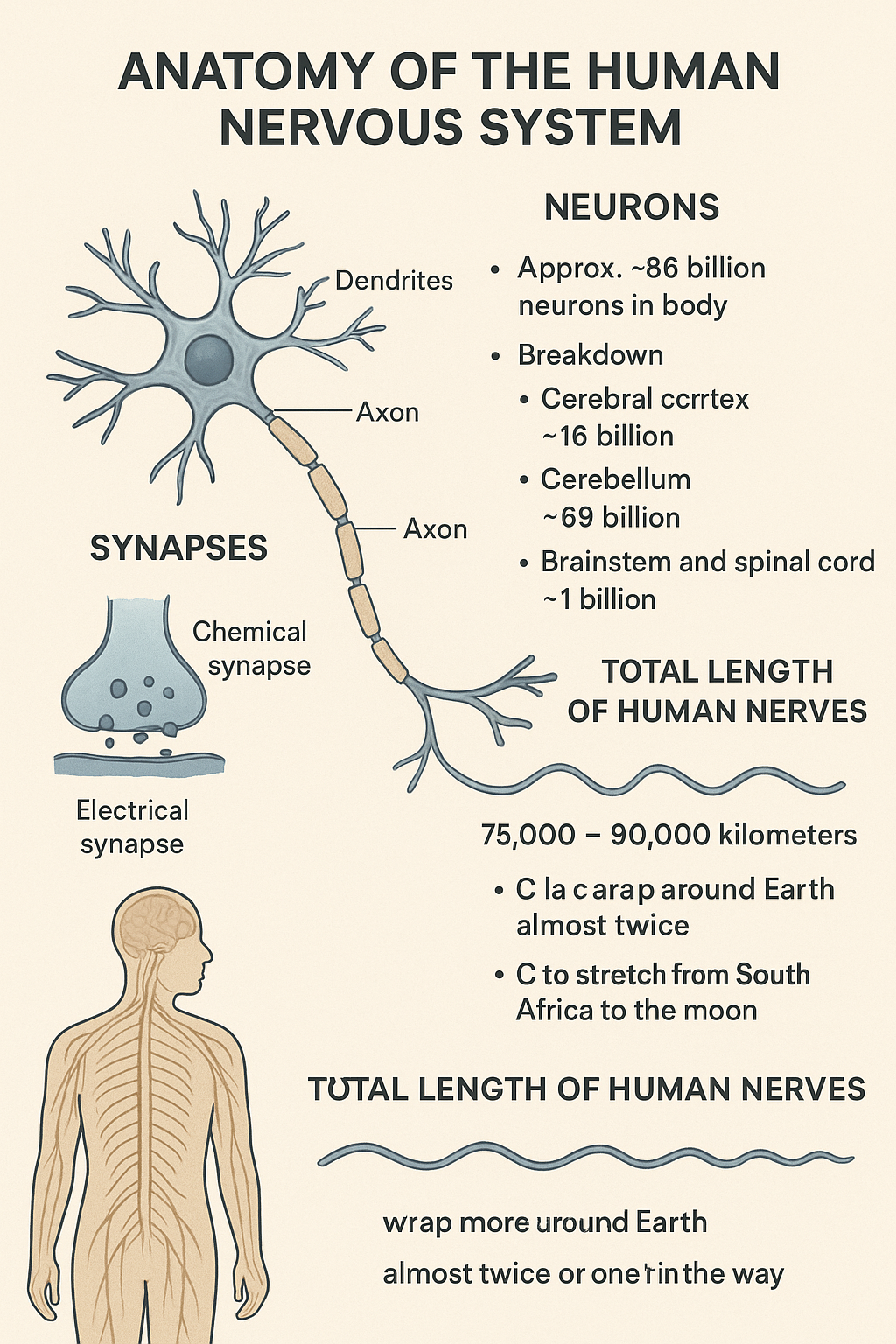
Typical Structure of a Neuron
- Dendrites – Receive incoming signals
- Soma (Cell Body) – Contains the nucleus; processes information
- Axon – Long cable-like extension carrying signals to other neurons or muscles
- Myelin Sheath – Insulating layer that increases speed
- Axon Terminals – Release neurotransmitters to other cells
The average adult human brain contains about 86 billion neurons.
Breakdown:
- Cerebral cortex: ~16 billion
- Cerebellum: ~69 billion (mainly responsible for movement)
- Brainstem and spinal cord: ~1 billion
This immense number provides the processing power required for perception, cognition, memory, and behavior.
3. Synapses: The Communication Network
3.1 What Is a Synapse?
A synapse is the tiny communication point where one neuron passes a signal to another neuron, muscle cell, or gland.
There are two main types:
- Chemical synapses – Use neurotransmitters (serotonin, dopamine, etc.)
- Electrical synapses – Faster, direct electrical channels (gap junctions)
3.2 Total Number of Synapses
The human brain is estimated to contain:
Between 100 trillion and 1,000 trillion synapses.
This enormous number is what allows humans to think creatively, store memories, solve problems, and adapt to new environments.
For example:
- One neuron may have 1,000–10,000 synaptic connections
- Some specialized neurons can have up to 200,000 synapses
4. Mechanisms of Neuronal Communication
4.1 Electrical Signaling: Action Potentials
Neurons communicate via action potentials, electrical impulses created by the movement of ions across the cell membrane.
Key features:
- Travels up to 120 m/s along myelinated axons
- Uses sodium (Na⁺) and potassium (K⁺) channels
- All-or-nothing response
4.2 Chemical Signaling: Neurotransmitters
At the synapse, electrical signals trigger the release of chemical messengers, including:
- Dopamine – reward, motivation
- Serotonin – mood balance
- Glutamate – learning, memory
- GABA – inhibition and relaxation
- Acetylcholine – muscle control
The balance of these chemicals determines mood, thought speed, and body actions.
5. Architecture of the Nervous System
5.1 The Central Nervous System (CNS)
- Brain
- Cerebrum (thought, decision-making)
- Cerebellum (coordination)
- Brainstem (life functions: breathing, heartbeat)
- Spinal Cord
- Main highway connecting body and brain
- Contains reflex circuits
5.2 The Peripheral Nervous System (PNS)
Two divisions:
A. Somatic Nervous System
Controls voluntary actions (e.g., moving your arm).
B. Autonomic Nervous System
Controls automatic functions: breathing, heart rate, digestion.
It has two branches:
- Sympathetic – fight or flight
- Parasympathetic – rest and digest
6. Total Length of Human Nerves
One of the most extraordinary facts about the human body is the total length of its nerve fibers.
Estimated total length: Between 75,000 km and 90,000 km of nerves.
This is enough to:
- Wrap around Earth almost twice
- Stretch from South Africa to the moon one-fifth of the way
Breakdown:
- Peripheral nerves (arms, legs, torso): ~70,000 km
- Spinal cord pathways: ~1 m (but containing millions of fibers)
- Sensory nerves: thousands of kilometers of fine fibers
The massive length ensures communication happens instantly throughout the entire body.
7. How the Nervous System Creates Thought and Consciousness
Understanding how neurons create consciousness is still one of science’s greatest mysteries. But we know that:
- Neurons form electrical patterns
- These patterns spread through synaptic networks
- Networks form circuits responsible for memory, emotions, intelligence
- Circuits interact to create awareness and personality
The brain is like a supercomputer made not of metal, but of living cells.
8. Plasticity: How the Brain Rewires Itself
Neuroplasticity is the ability of the brain to reorganize by forming new connections.
Occurs during:
- Learning
- Healing after injury
- Memory creation
- Skill building
This rewiring is enabled by:
- Growth of new synapses
- Strengthening or weakening of connections
- Creation of new neurons (mainly in the hippocampus)
9. Conclusion
The human nervous system is a masterpiece of biological engineering.
It consists of:
- 86 billion neurons
- Up to a quadrillion synapses
- Over 75,000–90,000 km of nerves
Together, these components form the basis of human sensation, movement, memory, learning, emotion, and consciousness.





Be First to Comment