
Abstract
The electrical network is one of the most important technological systems ever developed by humanity. It connects electricity generators, transmission infrastructure, substations, distribution networks, energy-storage systems, businesses, homes, transportation systems, communication infrastructure, and increasingly sophisticated digital controls into an interconnected energy system.
Modern society depends upon this network for almost every major economic and social activity. Hospitals, schools, factories, mines, farms, telecommunications networks, data centres, water systems, transportation infrastructure, financial institutions, and households all depend on reliable electrical power.
At its simplest, an electrical network moves electrical energy from sources to loads. At its most sophisticated, it is a cyber-physical system in which electrical equipment, sensors, computers, communications networks, automated controls, markets, consumers, and distributed energy resources continuously interact.
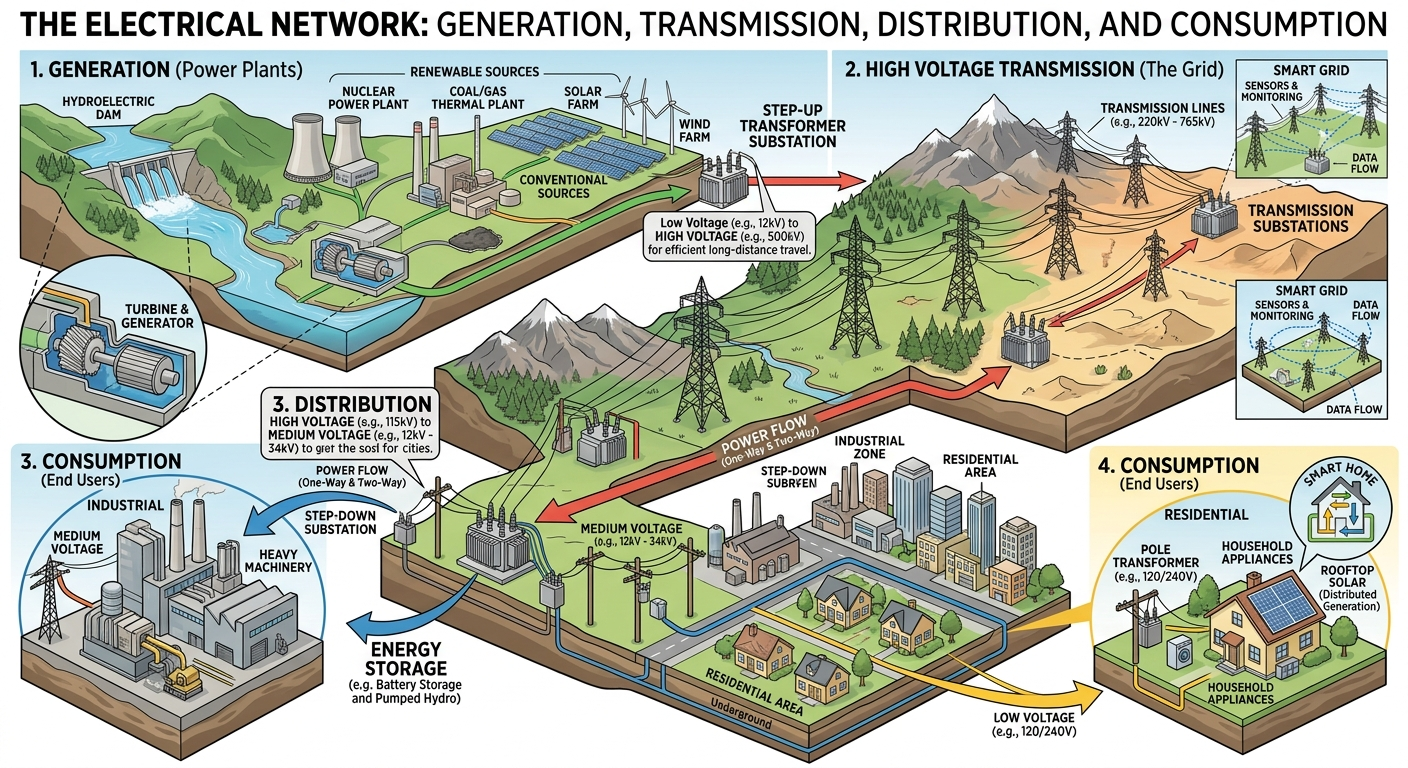
The conventional electricity supply chain consists principally of generation, transmission, and distribution. Generation produces electricity; transmission carries large quantities of power over long distances at high voltage; and distribution delivers electricity to customers at appropriate voltages. Substations and transformers connect these different stages.
The modern electrical network is undergoing another major transformation. Renewable generation, batteries, electric vehicles, rooftop solar, microgrids, advanced power electronics, smart meters, artificial intelligence, automation, and digital communications are changing a historically centralized system into a more distributed, flexible, bidirectional and intelligent network.
1. Introduction
Electricity is the flow of electrical charge and has become one of the fundamental energy carriers of modern civilization.
Unlike many physical commodities, electricity has historically been difficult to store economically at enormous scale. Consequently, electrical systems must continuously coordinate generation and consumption. When consumers increase their demand, the system must respond by adjusting generation, storage, imports, demand response, or other resources.
This creates a remarkable engineering requirement:
Electricity must be generated, transported and consumed within a continuously coordinated system.
The electrical network exists to make this coordination possible.
A person switching on a light may see only a simple event: electricity flows through a cable and illuminates a lamp. Behind that action is a vast infrastructure involving generators, transformers, transmission lines, substations, protection systems, control centres, meters, communications systems and distribution equipment.
The U.S. Department of Energy describes the modern electric grid as a complex machine containing transmission and distribution lines, transformers, sensors, software, communications systems and other equipment connecting generators to customers.
2. What Is an Electrical Network?
An electrical network is an interconnected collection of electrical components and infrastructure designed to generate, transfer, distribute, control, transform, store or consume electrical energy.
The term can refer to different scales.
2.1 Small electrical network
Examples include:
- a household wiring system;
- a solar installation;
- a battery circuit;
- an industrial electrical system;
- an electric vehicle charging system.
2.2 Regional electrical network
A regional network may contain:
- power stations;
- transmission lines;
- substations;
- distribution networks;
- industrial consumers;
- residential consumers;
- renewable generators;
- batteries;
- control centres.
2.3 National or continental electrical network
At the largest scale, interconnected electrical networks can cross administrative and national boundaries.
These systems enable electricity to move between different regions and allow areas with surplus generation to support areas experiencing higher demand.
3. The Fundamental Architecture
A conventional electrical power system can be simplified into five major functional stages:
Energy source → Generation → Transmission → Distribution → Consumption
A more detailed representation is:
Primary energy → Generator → Step-up transformer → High-voltage transmission → Transmission substation → Distribution network → Distribution transformer → Customer
The Department of Energy identifies generation, transmission and distribution as the three principal segments of the electricity supply chain.
4. Generation
Generation is the first major stage of the electrical network.
A generator converts another form of energy into electrical energy.
Possible energy sources include:
- coal;
- natural gas;
- nuclear energy;
- hydroelectric power;
- wind;
- solar;
- geothermal energy;
- biomass;
- other renewable resources.
Electricity itself is generally considered a secondary energy source because it is produced by converting primary energy sources into electrical energy.
4.1 Electromagnetic generation
A traditional generator operates using electromagnetic induction.
A simplified generator consists of:
- magnetic fields;
- conductive windings;
- mechanical rotation;
- electrical terminals.
Mechanical energy rotates part of the generator relative to a magnetic field, producing an electrical voltage.
This principle has enabled enormous power stations to transform mechanical energy into electricity.
5. Different Forms of Generation
5.1 Thermal generation
Thermal power stations use heat to produce mechanical energy.
The general process is:
Fuel → Heat → Steam or hot gas → Turbine → Generator → Electricity
Coal, natural gas and nuclear power can use different technologies but share elements of this energy-conversion chain.
5.2 Hydroelectric generation
Hydroelectric facilities use moving water.
Stored/moving water → Turbine → Generator → Electricity
Hydroelectric systems can also provide valuable flexibility because some facilities can change their output relatively rapidly.
5.3 Wind generation
Wind turbines convert kinetic energy from moving air into mechanical rotation and then electricity.
Wind → Rotor → Generator → Electricity
5.4 Solar photovoltaic generation
Solar photovoltaic systems convert sunlight directly into electrical energy.
Sunlight → Photovoltaic cells → DC electricity → Inverter → AC electricity
Modern grids increasingly incorporate solar generation alongside traditional centralized power plants.
6. Transformers
Transformers are among the most important components of the electrical network.
Their fundamental purpose is to change voltage and current levels in alternating-current systems.
Two broad functions are particularly important:
Step-up transformation
Voltage is increased for efficient long-distance transmission.
Step-down transformation
Voltage is reduced for distribution and customer use.
The reason for transmitting electricity at high voltage is fundamentally related to reducing losses in transmission conductors. The modern grid therefore uses transformers to move electricity between different voltage levels.
7. Transmission Network
The transmission network is the high-voltage backbone of the electrical system.
It carries large quantities of electrical power over relatively long distances between generation centres, substations and major load centres.
A simplified sequence is:
Power station → Step-up transformer → High-voltage transmission line → Transmission substation
Transmission networks may extend across hundreds or thousands of kilometres.
They allow electricity generated in one region to support demand elsewhere.
Transmission is becoming increasingly important because renewable resources are often geographically distant from major population and industrial centres. Modern transmission infrastructure can therefore help connect new generation with consumers.
8. Why High Voltage Matters
Electrical power can be expressed approximately as:
P = V × I
where:
- P = electrical power;
- V = voltage;
- I = current.
For a given power level, increasing voltage allows current to be reduced.
Because resistive losses in conductors are related to current approximately as:
P_loss = I²R
reducing current can substantially reduce resistive losses.
This is one of the fundamental engineering reasons for using high-voltage transmission.
9. Substations
Substations are critical nodes in the electrical network.
They can perform several functions, including:
- changing voltage;
- switching circuits;
- protecting equipment;
- controlling power flows;
- measuring electrical quantities;
- connecting different parts of the network.
The Department of Energy describes substations as critical connection points between generation, transmission and distribution, with transformers commonly used to adjust voltage.
A substation may therefore be viewed as a combination of:
Transformer + Switchgear + Protection + Measurement + Control + Communication
10. Distribution Network
The distribution network is the part of the electrical system that ultimately delivers electricity to consumers.
It generally operates at lower voltages than the transmission network.
The simplified pathway is:
Transmission → Distribution substation → Distribution lines → Local transformer → Customer
Distribution networks supply:
- homes;
- schools;
- offices;
- shops;
- factories;
- farms;
- hospitals;
- public infrastructure.
The distribution system is therefore the electrical network’s final connection to society.
11. Loads
A load is equipment or infrastructure that consumes electrical energy.
Examples include:
Residential loads
- lighting;
- refrigerators;
- televisions;
- computers;
- heating and cooling;
- pumps.
Commercial loads
- lighting systems;
- elevators;
- computers;
- refrigeration;
- air-conditioning;
- commercial machinery.
Industrial loads
- motors;
- furnaces;
- compressors;
- pumps;
- conveyors;
- mining equipment;
- manufacturing machinery.
Infrastructure loads
- water treatment;
- telecommunications;
- transport;
- hospitals;
- data centres.
The changing behaviour of these loads determines the demand profile that the electrical network must satisfy.
12. Electrical Demand
Electricity consumption changes throughout the day.
Demand may rise when:
- people arrive home;
- businesses operate;
- factories increase production;
- heating or cooling demand increases;
- transportation charging increases.
Operators therefore need to continuously balance generation and demand.
The Department of Energy notes that electricity-system operators monitor the grid in real time to maintain balance and respond to changes in usage, weather and system conditions.
13. Frequency
Frequency is another fundamental characteristic of an AC electrical network.
Common nominal frequencies include:
- 50 Hz;
- 60 Hz.
The frequency reflects the balance between generation and consumption in an interconnected AC system.
If demand exceeds generation, frequency tends to decline.
If generation exceeds demand, frequency tends to rise.
Therefore, frequency provides an important indicator of system balance.
14. Voltage Stability
Voltage must also remain within acceptable operating ranges.
Voltage stability is affected by:
- generation;
- load;
- transmission distances;
- reactive power;
- network configuration;
- transformer settings;
- faults;
- power flows.
Voltage-control equipment can include:
- transformers with tap changers;
- capacitor banks;
- reactors;
- synchronous machines;
- power-electronic devices.
Maintaining appropriate voltage is essential for safe and reliable operation.
15. AC and DC Networks
Electrical networks can use both alternating current and direct current.
Alternating current
AC periodically changes direction.
It has historically been dominant in conventional power grids because transformers make voltage conversion relatively straightforward.
Direct current
DC flows in one direction.
Modern power electronics have made high-voltage direct-current transmission increasingly useful for particular applications, especially some long-distance and subsea connections.
DC is also fundamental to:
- batteries;
- solar photovoltaic systems;
- electronics;
- data centres;
- electric vehicles.
Modern electrical networks increasingly require interfaces between AC and DC systems.
16. Protection Systems
Electrical networks must be protected against abnormal conditions.
Potential problems include:
- short circuits;
- equipment failures;
- excessive current;
- lightning;
- insulation failures;
- storms;
- physical damage.
Protection systems detect abnormal conditions and isolate affected sections.
Important equipment includes:
- circuit breakers;
- fuses;
- protective relays;
- current transformers;
- voltage transformers;
- grounding systems.
The goal is not simply to prevent every failure but to contain failures and prevent local problems from becoming large-scale system disturbances.
17. Grounding
Grounding provides controlled electrical paths for fault currents and establishes reference conditions for electrical systems.
Grounding is important for:
- personnel protection;
- equipment protection;
- fault detection;
- system stability;
- lightning protection.
Grounding design varies according to the type and voltage level of the electrical installation.
18. Control Centres
Modern electrical networks are monitored and coordinated from control centres.
Operators may monitor:
- voltage;
- frequency;
- generation;
- power flows;
- transmission-line status;
- transformer status;
- demand;
- faults;
- renewable generation;
- storage resources.
Control centres use extensive information systems to maintain reliable operation.
19. The Electrical Network as a Cyber-Physical System
The traditional electrical grid was primarily an electromechanical system.
The modern grid increasingly combines:
Electrical infrastructure + Computing + Sensors + Communications + Software + Automation
This makes the electrical network a cyber-physical system.
Digital technology enables operators to observe conditions more quickly, analyse large quantities of information and automate certain operations.
The Department of Energy identifies sensors, software and communications systems as integral components of modern grid infrastructure.
20. Smart Grid
The smart grid is the evolution of the conventional electricity network into a more digitally connected and responsive system.
A smart grid can incorporate:
- smart meters;
- automated substations;
- sensors;
- advanced communications;
- digital protection;
- distributed energy resources;
- energy storage;
- automated demand response;
- advanced analytics.
The objective is to make electricity systems more:
- reliable;
- efficient;
- flexible;
- observable;
- responsive;
- resilient.
21. Distributed Energy Resources
One of the most significant transformations is the growth of distributed energy resources, commonly called DERs.
Examples include:
- rooftop solar;
- small wind systems;
- batteries;
- electric vehicles;
- small generators;
- microgrids.
Traditional electricity systems generally moved power in one direction:
Power plant → Grid → Customer
Distributed generation introduces a more complex relationship:
Grid ↔ Customer/Prosumer
A household with solar panels may consume electricity from the grid at one moment and export electricity at another.
DOE notes that rooftop solar and other distributed resources increasingly require the grid to accommodate two-way power flows.
22. The Prosumer
The traditional electricity consumer simply purchased electricity.
The modern prosumer can both produce and consume electricity.
For example:
Solar panels → Home → Battery → Grid
A household may:
- generate electricity;
- consume some of it;
- store some of it;
- export surplus electricity;
- import electricity when generation is insufficient.
This fundamentally changes the architecture of distribution networks.
23. Energy Storage
Energy storage is becoming increasingly important.
Common technologies include:
- batteries;
- pumped-storage hydropower;
- thermal storage;
- other emerging storage technologies.
Storage can help:
- shift energy from one period to another;
- support renewable integration;
- provide backup;
- manage demand peaks;
- provide grid services.
The growth of variable renewable generation makes flexibility increasingly important.
24. Renewable Energy and Grid Transformation
Wind and solar generation introduce variability because their output depends partly on environmental conditions.
The electrical network must therefore coordinate:
Generation variability + Demand variability + Storage + Transmission + Flexible resources
DOE notes that modern grids increasingly contain variable renewable resources, energy storage, power electronics and distributed generation.
This represents a fundamental departure from the historical model dominated by large centralized generators.
25. Power Electronics
Power electronics are becoming increasingly important in modern electrical networks.
They can:
- convert AC to DC;
- convert DC to AC;
- control voltage;
- regulate current;
- control power flows;
- connect renewable resources;
- connect batteries;
- connect electric vehicles.
Inverters are particularly important for solar photovoltaic systems and batteries.
As distributed resources expand, the grid becomes increasingly dependent on power-electronic interfaces.
26. Microgrids
A microgrid is a localized electrical system capable of coordinating generation, storage and loads.
It may include:
- solar panels;
- batteries;
- generators;
- buildings;
- industrial loads;
- control systems.
A microgrid can sometimes operate connected to a larger grid and, depending on its design, may operate independently during certain disturbances.
Microgrids are particularly interesting for:
- remote communities;
- hospitals;
- industrial facilities;
- campuses;
- critical infrastructure.
27. Electrical Networks and Transportation
Transportation is increasingly becoming connected to the electrical network.
Electric vehicles transform transportation energy demand into electrical demand.
The relationship becomes:
Power grid → Charging infrastructure → Battery → Electric motor
Large-scale electric-vehicle adoption could substantially increase electricity demand and create new opportunities for flexible charging.
In more advanced systems, vehicle batteries could potentially participate in grid services through appropriate technologies and regulatory frameworks.
28. Electrical Networks and Data Centres
The digital economy depends heavily on electricity.
Data centres operate:
- servers;
- storage systems;
- networking equipment;
- cooling systems;
- power-conversion equipment.
As artificial intelligence and cloud computing expand, electricity demand from large computing facilities can become a significant consideration for grid planning.
This creates a new relationship:
Electricity network ↔ Digital infrastructure
The future electrical network will therefore increasingly support not only traditional industry but also enormous computational infrastructure.
29. Telecommunications and Electrical Networks
Telecommunications infrastructure depends on electricity.
Cell towers, fibre-optic networks, data centres, routers and switching facilities all require power.
At the same time, modern electrical networks increasingly depend on telecommunications for:
- monitoring;
- automation;
- remote control;
- data exchange;
- protection;
- operational coordination.
Consequently:
Electricity infrastructure and telecommunications infrastructure are becoming increasingly interdependent.
30. Cybersecurity
Digitalization introduces cybersecurity challenges.
Modern grids contain:
- computers;
- communication networks;
- remote-control systems;
- sensors;
- software;
- intelligent electronic devices.
These systems create new digital attack surfaces.
Grid modernization therefore requires cybersecurity to be incorporated into system architecture rather than treated as an afterthought.
DOE identifies cybersecurity incidents among the challenges confronting modern electric grids.
31. Physical Security and Resilience
Electrical networks must also withstand physical disturbances.
Potential threats include:
- extreme weather;
- flooding;
- wildfires;
- storms;
- equipment ageing;
- physical accidents;
- supply-chain disruptions.
A resilient grid should be able to:
- resist disturbances;
- maintain critical services where possible;
- isolate damaged sections;
- restore service rapidly.
Reliability asks:
How often does the system fail?
Resilience asks:
How well does the system withstand and recover from major disturbances?
32. Grid Reliability
Reliability depends on many interconnected factors.
These include:
- sufficient generation;
- adequate transmission capacity;
- robust distribution systems;
- effective protection;
- maintenance;
- spare equipment;
- system monitoring;
- operational planning;
- trained personnel.
A grid cannot be considered reliable simply because it has enough power plants. The complete network must have sufficient capacity and controllability.
33. Electrical Losses
Electricity transmission and distribution inevitably involve losses.
Important sources include:
- conductor resistance;
- transformer losses;
- equipment losses;
- conversion losses.
Engineering therefore attempts to minimize unnecessary losses through:
- appropriate voltage levels;
- efficient transformers;
- improved conductors;
- better network design;
- efficient power electronics;
- optimized dispatch.
34. Electrical Markets
Electricity is not only an engineering system; it is also an economic system.
Depending on the country, electricity markets may involve:
- generators;
- transmission companies;
- distribution companies;
- retailers;
- independent system operators;
- regulators;
- consumers.
Electricity markets may operate through mechanisms for:
- energy;
- capacity;
- ancillary services;
- balancing;
- congestion management.
Market structures differ substantially between countries.
35. Regulation
Electricity infrastructure is strategically important.
Governments and regulators may oversee:
- reliability standards;
- environmental requirements;
- tariffs;
- market structures;
- infrastructure investment;
- consumer protection;
- grid access.
Regulatory structures differ according to national political and economic systems.
36. The Electrical Network and National Development
Electricity is closely associated with economic development.
Reliable electricity enables:
- manufacturing;
- mining;
- agriculture;
- education;
- healthcare;
- communications;
- water infrastructure;
- digital services;
- commerce.
A weak electrical network can therefore become a constraint on economic development.
Conversely, investment in generation, transmission and distribution can support industrialization and technological development.
37. Electrical Networks in Africa
African electricity systems vary considerably between countries.
Some countries have large interconnected networks and substantial generation resources, while others face challenges involving:
- generation shortages;
- transmission constraints;
- distribution losses;
- limited rural access;
- ageing infrastructure;
- insufficient investment;
- financing constraints.
The development of distributed solar, batteries and microgrids creates opportunities for expanding electricity access without relying exclusively on large centralized infrastructure.
This is particularly relevant to geographically dispersed rural communities.
38. The South African Context
South Africa’s electricity system illustrates the importance of generation, transmission, distribution and system reliability.
The country’s economy has historically relied heavily on large-scale electricity generation to support:
- mining;
- manufacturing;
- commerce;
- households;
- public services.
The future South African electrical network will increasingly need to integrate:
- renewable generation;
- storage;
- transmission expansion;
- distributed generation;
- digital grid technologies;
- electric transportation;
- industrial electrification.
This transition requires not simply additional generation but a coordinated transformation of the entire electrical network.
39. The Electrical Network as an Energy Internet
An emerging conceptual model is the energy internet.
The traditional electrical system resembles a hierarchy:
Large generators → Transmission → Distribution → Consumers
The emerging system resembles a network:
Generators ↔ Transmission ↔ Distribution ↔ Prosumers ↔ Storage ↔ Microgrids ↔ Electric vehicles
Power can increasingly move in multiple directions while digital information moves alongside it.
This creates a more dynamic energy ecosystem.
40. Artificial Intelligence and the Electrical Network
Artificial intelligence can potentially assist electrical-network operations through:
- demand forecasting;
- renewable-generation forecasting;
- predictive maintenance;
- fault detection;
- asset inspection;
- congestion analysis;
- outage prediction;
- optimization;
- energy-market analysis.
AI does not replace the physical infrastructure. Instead, it can become an intelligence layer operating on top of sensors, communications, databases and control systems.
A simplified future architecture is:
Physical grid → Sensors → Communications → Data → AI/Analytics → Decision → Automated/Operator Action
41. Digital Twins
A digital twin is a digital representation of a physical system.
For electrical networks, digital twins could represent:
- transmission lines;
- substations;
- transformers;
- distribution networks;
- generators;
- loads.
They can potentially support:
- simulation;
- planning;
- maintenance;
- scenario analysis;
- asset management.
42. Automation
Automation is increasingly important because modern electrical systems contain enormous numbers of devices.
Automated systems can assist with:
- switching;
- voltage control;
- fault isolation;
- restoration;
- demand management;
- renewable integration.
The objective is to reduce response times while maintaining appropriate human oversight.
43. The Future Electrical Network
The electrical network of the future is likely to be:
More distributed
More electricity will be generated closer to consumers.
More digital
Sensors and communications will become embedded throughout the system.
More renewable
Solar, wind and other low-carbon resources are expected to become increasingly important in many electricity systems.
More storage-dependent
Batteries and other storage technologies can provide flexibility.
More automated
Software will increasingly assist system operation.
More bidirectional
Consumers can become producers.
More interconnected
Electricity networks can exchange energy across larger geographical regions.
More cyber-physical
Electrical infrastructure and digital infrastructure will become deeply integrated.
DOE’s current grid-modernization work emphasizes reliability, resilience, security, renewable integration, electric vehicles, energy storage, distributed resources and microgrids.
44. Major Challenges
Despite technological progress, electrical networks face major challenges.
44.1 Ageing infrastructure
Some infrastructure was designed decades ago and requires replacement or modernization.
44.2 Increasing demand
Electrification of transport, heating, industry and computing can increase electricity demand.
44.3 Renewable integration
Variable generation requires greater flexibility.
44.4 Transmission constraints
New generation may be located far from existing transmission infrastructure.
44.5 Cybersecurity
Digitalization creates additional cybersecurity requirements.
44.6 Climate and extreme weather
Infrastructure must increasingly account for changing environmental risks.
44.7 Investment
Grid modernization requires enormous long-term capital investment.
44.8 Skills
The future grid requires engineers, technicians, software specialists, cybersecurity professionals, data scientists and energy-system experts.
45. A Unified Architecture of the Future Grid
The future electrical network can be understood as seven interconnected layers:
Layer 1 — Energy resources
Solar, wind, hydro, nuclear, thermal generation and other sources.
Layer 2 — Conversion
Generators, transformers, converters and inverters.
Layer 3 — Transmission
High-voltage networks carrying electricity across long distances.
Layer 4 — Distribution
Networks delivering electricity to communities and customers.
Layer 5 — Distributed resources
Solar rooftops, batteries, electric vehicles and microgrids.
Layer 6 — Digital intelligence
Sensors, communications, software, automation, analytics and AI.
Layer 7 — Human and economic systems
Consumers, businesses, regulators, utilities, markets and governments.
Together these layers create the modern electrical ecosystem.
46. Why the Electrical Network Is a Civilization-Level Technology
The electrical network is more than an infrastructure system.
It is a foundation for modern civilization.
Consider the chain:
Electricity → Communications → Computing → Internet → Cloud → AI → Digital Economy
Every layer depends upon reliable electrical energy.
Without electricity:
- telecommunications networks become unavailable;
- data centres stop operating;
- water systems may fail;
- factories stop;
- transport infrastructure can be disrupted;
- financial systems can be affected;
- hospitals face serious operational challenges.
Electricity is therefore a foundational infrastructure upon which many other infrastructures depend.
47. Conceptual Comparison
| System | Primary Function |
|---|---|
| Generation | Produces electricity |
| Transmission | Moves large quantities over long distances |
| Substation | Transforms, switches and controls power |
| Distribution | Delivers electricity locally |
| Transformer | Changes voltage |
| Protection | Detects and isolates faults |
| Control centre | Monitors and coordinates the network |
| Smart meter | Measures electricity use |
| Battery | Stores electrical energy |
| Inverter | Converts between AC and DC |
| Microgrid | Coordinates local generation, storage and loads |
| Communication network | Transfers operational information |
| AI/Analytics | Extracts intelligence from system data |
48. The Central Engineering Principle
The electrical network ultimately revolves around one fundamental requirement:
Supply and demand must remain continuously coordinated while voltage, frequency, equipment loading and system security remain within acceptable operating limits.
This requirement explains why the electrical network needs so many different technologies.
A generator alone cannot create a reliable electricity system.
A transmission line alone cannot create a reliable electricity system.
A battery alone cannot create a reliable electricity system.
A computer alone cannot create a reliable electricity system.
Reliability emerges from the interaction of the complete network.
49. Conclusion
The electrical network is one of humanity’s greatest engineering achievements.
It transforms energy resources into electrical power, transports that power over long distances, distributes it to communities and industries, and continuously balances generation with consumption.
Its basic architecture can be summarized as:
Generation → Transmission → Substations → Distribution → Loads
However, the electrical network is rapidly evolving beyond this traditional model.
Solar panels, wind turbines, batteries, electric vehicles, microgrids and distributed generation are transforming electricity from a predominantly one-directional system into a more dynamic and bidirectional network. At the same time, sensors, telecommunications, software, automation, artificial intelligence and advanced power electronics are giving the physical grid a digital intelligence layer.
The modern electrical network must therefore be understood as a large-scale cyber-physical energy system.
Its future will depend on the ability to combine:
Energy + Engineering + Electronics + Computing + Communications + Data + AI + Economics + Policy
The electrical network of the twenty-first century will not merely deliver electricity. It will become an intelligent platform upon which transportation, telecommunications, manufacturing, agriculture, healthcare, artificial intelligence, data centres and entire digital economies operate.
Ultimately, the evolution of the electrical network is the evolution of the infrastructure that powers modern civilization.
Selected References
- U.S. Department of Energy, Electricity 101.
- U.S. Department of Energy, Electric Grids.
- U.S. Department of Energy, How It Works: Electric Transmission & Distribution and Protective Measures.
- U.S. Department of Energy, Solar Systems Integration Basics.
- U.S. Department of Energy, Distribution Grid Transformation.
- U.S. Department of Energy, Transmission.
- U.S. Department of Energy, Interactive Grid.

Be First to Comment