
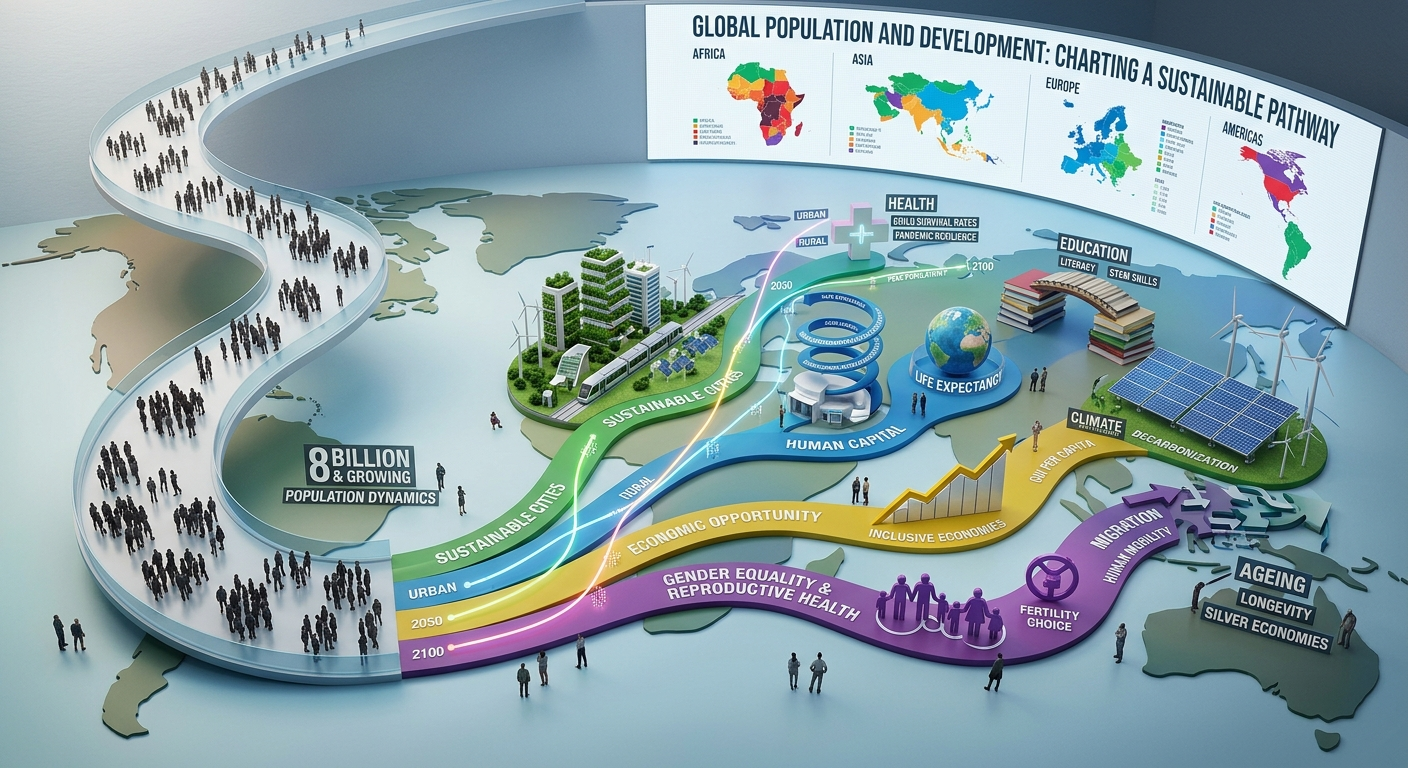
A Comprehensive Thesis on Demographic Change, Human Progress, Economic Transformation, and the Future of Humanity
Abstract
Global population and development are inseparable dimensions of humanity’s future. Population determines the scale of human needs, markets, labour forces, cities, schools, healthcare systems, infrastructure and environmental pressures, while development influences fertility, mortality, migration, education, employment, living standards and the distribution of opportunities. The relationship is therefore multidirectional: populations shape development, while development transforms populations.
The global demographic landscape is undergoing a profound transition. According to the United Nations World Population Prospects 2024, the world population was approximately 8.2 billion in 2024 and is projected to reach about 10.3 billion in the mid-2080s before gradually declining to approximately 10.2 billion by 2100 under the UN medium projection. The UN also estimates that global fertility has fallen substantially, while longevity continues to increase.
These changes mean that the central population question is no longer simply whether the world has “too many people.” Instead, the major questions concern where people live, their ages, their health and education, their economic opportunities, their access to technology and infrastructure, and whether societies can transform demographic change into inclusive and sustainable development.
This thesis examines global population and development through demographic history, fertility, mortality, migration, urbanization, ageing, youth populations, economic growth, poverty, education, healthcare, technology, agriculture, infrastructure, climate change, inequality, governance and human capital. It concludes that population should be understood not merely as a numerical challenge but as humanity’s greatest reservoir of potential. Sustainable development depends on converting that potential into productive, healthy, educated, innovative and empowered human capability.
1. Introduction
Human civilization is fundamentally a demographic phenomenon.
Every city, economy, school, hospital, factory, farm, technology company and government exists because human beings create, organize and use them. Population provides labour, entrepreneurship, knowledge, culture and demand for goods and services. At the same time, every additional generation requires food, housing, education, healthcare, energy, transport, water, employment and social institutions.
The relationship between population and development is consequently complex.
A growing population can create:
- larger markets;
- larger labour forces;
- greater pools of talent;
- more entrepreneurs;
- increased demand for innovation;
- greater tax bases;
- cultural diversity;
- stronger regional economies.
But rapid population growth can also create pressure on:
- schools;
- hospitals;
- housing;
- employment;
- water supplies;
- food systems;
- transportation;
- electricity;
- public finances;
- ecosystems.
Conversely, population decline can reduce pressure on resources but create different challenges, including:
- ageing populations;
- shrinking workforces;
- pension pressures;
- declining tax revenues;
- shortages of skilled workers;
- underused infrastructure;
- regional depopulation.
The demographic transition therefore creates different development problems in different parts of the world.
The United Nations identifies four major demographic forces shaping the contemporary world: population growth, population ageing, urbanization and international migration.
Understanding these forces is essential to understanding the future of development.
2. Defining Population and Development
2.1 What is population?
Population refers to the number and characteristics of people living within a particular geographic area.
Population analysis includes:
- total population;
- population density;
- age distribution;
- sex distribution;
- fertility;
- mortality;
- life expectancy;
- migration;
- household structure;
- urbanization;
- geographic distribution.
Population is therefore much more than a number.
Two countries with identical populations can have completely different demographic structures. One may have a predominantly young population, while the other may have a predominantly elderly population.
The economic and social implications are radically different.
2.2 What is development?
Development traditionally referred primarily to economic growth and rising national income.
Modern development theory is broader.
Development encompasses improvements in:
- health;
- education;
- income;
- employment;
- housing;
- infrastructure;
- equality;
- security;
- political participation;
- technological capability;
- environmental sustainability;
- human freedom and opportunity.
The UN Development Programme emphasizes that human development is ultimately concerned with expanding people’s choices and opportunities rather than measuring prosperity only through economic output.
This distinction is fundamental.
A country can become richer without ensuring that every citizen becomes healthier, better educated or more economically secure.
3. The Historical Expansion of the Human Population
For most of human history, population growth was relatively slow.
High mortality counterbalanced high fertility.
Families could have many children, but infectious diseases, famine, conflict, poor sanitation and limited medical knowledge caused high mortality.
The modern population explosion emerged when mortality began falling while fertility remained relatively high.
Major causes included:
- improved sanitation;
- clean water;
- vaccination;
- antibiotics;
- better nutrition;
- agricultural productivity;
- improved maternal healthcare;
- improved infant survival;
- public health systems.
The result was an unprecedented increase in human survival.
The population transition can therefore be understood as a movement from:
high fertility + high mortality
toward:
low fertility + low mortality.
This transformation is called the demographic transition.
4. The Demographic Transition
The demographic transition is one of the most important concepts in population studies.
Stage 1: High fertility and high mortality
Population growth is limited because many people die young.
Stage 2: Mortality declines
Healthcare, sanitation, nutrition and food production improve.
Population begins growing rapidly.
Stage 3: Fertility declines
Families increasingly choose to have fewer children because:
- child survival improves;
- education becomes more expensive;
- urban living changes household economics;
- women gain greater educational and economic opportunities;
- access to reproductive healthcare improves;
- parents invest more resources in each child.
Stage 4: Low fertility and low mortality
Population growth slows substantially.
Stage 5: Very low fertility
In some societies, deaths exceed births and population begins declining unless migration compensates for the difference.
The contemporary world contains countries at almost every stage of this transition.
5. The Current Global Population
The world entered the 2020s with more than eight billion people.
The UN’s 2024 population assessment estimated approximately 8.2 billion people globally in 2024. Under its central projection, global population is expected to reach approximately 10.3 billion during the mid-2080s before declining slightly toward the end of the century.
This is a major revision in demographic expectations.
The UN now assigns an approximately 80% probability that global population will peak during the twenty-first century.
This means humanity is approaching an extraordinary demographic transition:
Population growth → population stabilization → eventual population decline.
However, the global average hides enormous regional differences.
6. Regional Population Transformation
Population growth is increasingly concentrated in particular regions.
Some countries have already reached population peaks.
Others continue experiencing rapid population growth because they have:
- large young populations;
- relatively high fertility;
- declining mortality;
- demographic momentum.
This creates an increasingly divided demographic world.
One demographic world is ageing.
Countries in parts of Europe and East Asia face:
- low fertility;
- population ageing;
- shrinking workforces;
- increasing pension requirements.
Another demographic world is young.
Many countries, particularly in Africa, have:
- rapidly growing working-age populations;
- large youth populations;
- high demand for education;
- substantial employment requirements;
- opportunities for demographic dividends.
The challenge is therefore not simply global population growth.
It is global demographic divergence.
7. Fertility and Family Size
Fertility is one of the strongest determinants of long-term population change.
The UN reports that global fertility had fallen to approximately 2.25 births per woman, compared with about 3.31 in 1990.
This decline has enormous implications.
Lower fertility can eventually produce:
- slower population growth;
- smaller families;
- ageing populations;
- reduced demand for schools;
- smaller future labour forces.
However, fertility decline should not be interpreted as simply a government objective.
Reproductive decisions are deeply connected to:
- education;
- income;
- housing;
- healthcare;
- gender equality;
- cultural expectations;
- employment;
- family policy.
A sustainable demographic system respects individual reproductive choices while ensuring that people have access to healthcare, education and economic opportunities.
8. Mortality and Life Expectancy
Development has dramatically increased human longevity.
The UN reports that global life expectancy at birth reached approximately 73.3 years in 2024, an increase of 8.4 years since 1995.
Longer life is one of civilization’s greatest achievements.
It reflects improvements in:
- medicine;
- sanitation;
- nutrition;
- maternal care;
- childhood survival;
- disease prevention;
- living standards.
However, longevity also produces new challenges.
Countries must develop systems capable of supporting larger numbers of older people.
These include:
- pensions;
- healthcare;
- long-term care;
- accessible housing;
- age-friendly cities;
- lifelong learning;
- flexible employment.
The goal should not simply be longer lives.
It should be longer healthy lives.
9. Population Ageing
Population ageing is one of the defining demographic developments of the twenty-first century.
As fertility falls and life expectancy increases, the proportion of older people rises.
Ageing affects:
Labour markets
Fewer working-age people may have to support larger retired populations.
Healthcare
Demand for chronic disease management and long-term care increases.
Public finance
Governments face greater pension and healthcare expenditure.
Urban planning
Cities must become more accessible.
Technology
Robotics, artificial intelligence and assistive technologies may become increasingly important.
Ageing should therefore be treated not only as a social challenge but also as an innovation opportunity.
Older populations possess:
- knowledge;
- experience;
- skills;
- capital;
- institutional memory.
A successful ageing society should enable people to remain economically and socially active for as long as they wish and are able.
10. Youth and the Demographic Dividend
The opposite demographic challenge occurs in countries with very young populations.
A large working-age population can produce a demographic dividend.
This occurs when the proportion of people in the working-age population rises relative to dependants.
But the dividend is not automatic.
A young population becomes an economic advantage only when supported by:
- quality education;
- healthcare;
- infrastructure;
- employment;
- entrepreneurship;
- financial systems;
- political stability;
- technological connectivity.
Without these foundations, a rapidly growing young population can experience unemployment and economic exclusion.
The central lesson is:
Young people are an opportunity only when societies invest in their capabilities.
11. Africa and the Global Demographic Future
Africa occupies a particularly important position in the future of global population.
Many African countries have relatively young populations and significant population-growth potential.
This creates both enormous opportunities and enormous responsibilities.
If African countries successfully invest in:
- education;
- electricity;
- digital connectivity;
- transport;
- agriculture;
- manufacturing;
- healthcare;
- entrepreneurship;
- science;
- engineering;
the continent could transform its demographic growth into a major economic advantage.
Africa’s future therefore depends substantially on the conversion of population growth into human capital growth.
12. Population and Economic Growth
Population and economic growth interact through several mechanisms.
A growing population can increase:
Labour supply → production → income → consumption → investment → market expansion.
But this relationship depends on productivity.
A large population with low productivity does not automatically create prosperity.
The key variable is therefore not merely the number of people.
It is:
economic value generated per person.
This makes education, technology, infrastructure and institutions critically important.
13. Human Capital
Human capital is the accumulated knowledge, skills, health and capabilities of people.
It is one of the most important connections between population and development.
A country can possess millions of people but remain economically weak if those people lack:
- education;
- health;
- technical skills;
- employment;
- access to capital;
- technological tools.
Conversely, a relatively small population can become highly productive through advanced human capital.
Modern development is therefore increasingly based on:
people + knowledge + technology + institutions.
14. Education as a Population Multiplier
Education produces effects far beyond literacy.
It improves:
- employment;
- productivity;
- health knowledge;
- entrepreneurship;
- innovation;
- civic participation;
- technological adoption.
Education also influences demographic outcomes.
As educational opportunities expand, especially for girls and women, societies frequently experience changes in:
- age at marriage;
- family size;
- labour-force participation;
- household income;
- child health.
Education is therefore both a development investment and a demographic transformation mechanism.
15. Health and Population Development
Health is foundational to development.
A population experiencing widespread illness loses:
- working hours;
- productivity;
- household income;
- educational opportunities;
- economic potential.
Strong health systems therefore produce economic benefits.
Key components include:
- primary healthcare;
- vaccination;
- maternal healthcare;
- child healthcare;
- nutrition;
- sanitation;
- clean water;
- disease prevention;
- mental and social wellbeing.
The objective should be to create populations that are not only larger or smaller, but healthier and more capable.
16. Population and Urbanization
Humanity is increasingly urban.
Cities attract people because they concentrate:
- employment;
- education;
- healthcare;
- markets;
- infrastructure;
- technology;
- cultural institutions.
Urbanization can increase productivity because businesses, workers and consumers are physically closer together.
But uncontrolled urban expansion can produce:
- housing shortages;
- traffic;
- pollution;
- informal settlements;
- infrastructure deficits;
- water shortages;
- waste-management problems.
The future therefore requires planned urbanization.
17. The Smart City
Technology is increasingly transforming urban development.
Smart-city systems can integrate:
- transport;
- electricity;
- water;
- waste management;
- public safety;
- environmental monitoring;
- telecommunications.
Internet of Things sensors can monitor infrastructure.
Artificial intelligence can analyze transportation patterns.
Digital platforms can improve public services.
Geospatial systems can support urban planning.
The future city is therefore likely to become increasingly data-driven.
However, digital transformation must remain inclusive.
A technologically advanced city that excludes poor communities is not genuinely developed.
18. Population and Employment
Employment is one of the most important links between population and development.
A growing working-age population requires sufficient economic opportunities.
This means countries must expand:
- agriculture;
- manufacturing;
- construction;
- services;
- technology;
- logistics;
- healthcare;
- education;
- renewable energy;
- creative industries.
The future of employment will also be influenced by artificial intelligence and automation.
The challenge is not simply whether machines replace jobs.
The more important question is:
How will societies redesign work so that technology increases human productivity and creates new opportunities?
The UNDP’s 2025 Human Development Report emphasizes that AI’s impact on development depends heavily on the choices societies make about how the technology is integrated into human lives and economies.
19. Artificial Intelligence and Population Development
Artificial intelligence introduces a new dimension to the population-development relationship.
AI can potentially improve:
- education;
- healthcare;
- agriculture;
- scientific research;
- manufacturing;
- logistics;
- financial inclusion;
- government services.
For example, AI-supported systems can help teachers personalize learning and assist researchers in analyzing large datasets.
However, AI can also create risks:
- unequal access;
- job displacement;
- misinformation;
- concentration of technological power;
- privacy challenges;
- digital exclusion.
The central principle should therefore be:
Technology must augment human capabilities rather than deepen human inequality.
UNDP’s 2025 Human Development Report specifically places human choice and capabilities at the center of development in the age of AI.
20. Migration and Development
International migration is another major demographic force.
People migrate for many reasons:
- employment;
- education;
- family;
- safety;
- economic opportunity;
- environmental pressures.
Migration can benefit destination countries by supplying workers and skills.
Origin countries may benefit through:
- remittances;
- knowledge transfer;
- investment;
- diaspora networks.
Migration can also produce challenges, including:
- integration pressures;
- skills shortages;
- social tensions;
- housing demand;
- political controversy.
The UN projects that migration will become increasingly important in offsetting population decline in some low-fertility countries.
Migration should therefore be understood as a major component of twenty-first-century demographic management.
21. Population and Agriculture
Every population requires food.
Population growth therefore places pressure on agricultural systems.
Agriculture must increasingly produce more food while reducing environmental damage.
Important technologies include:
- precision agriculture;
- satellite monitoring;
- sensors;
- automated irrigation;
- improved seeds;
- biotechnology;
- agricultural robotics;
- artificial intelligence;
- weather forecasting.
The future agricultural system can be represented as:
Land + Water + Energy + Knowledge + Technology + Farmers = Food Security.
The challenge is making this system productive while protecting soil, biodiversity and water resources.
22. Population and Water
Water is fundamental to human civilization.
Growing populations increase demand for:
- drinking water;
- sanitation;
- agriculture;
- manufacturing;
- energy.
Climate change can intensify water stress.
Development therefore requires:
- efficient irrigation;
- water recycling;
- leakage reduction;
- watershed management;
- desalination where appropriate;
- groundwater protection;
- rainwater management.
Water infrastructure should be treated as strategic national infrastructure.
23. Population and Energy
Population growth and economic development increase energy demand.
Energy is required for:
- homes;
- schools;
- hospitals;
- factories;
- farms;
- transport;
- telecommunications;
- data centres.
The development challenge is to expand energy access while reducing environmental damage.
This requires a combination of:
- solar;
- wind;
- hydroelectricity;
- nuclear power where appropriate;
- energy storage;
- efficient grids;
- cleaner fuels;
- demand management.
Energy poverty is development poverty.
24. Population and Infrastructure
Population growth creates demand for physical infrastructure.
Infrastructure includes:
- roads;
- railways;
- airports;
- ports;
- electricity grids;
- water systems;
- telecommunications;
- schools;
- hospitals;
- housing.
Infrastructure investment therefore has a multiplying effect.
For example:
Electricity → businesses → employment → income → tax revenue → public investment.
Likewise:
Internet → information → education → skills → innovation → productivity.
Population policy cannot be separated from infrastructure planning.
25. Poverty and Population
Population growth and poverty are frequently discussed together, but the relationship is complex.
Poverty is not caused simply by having many people.
Poverty is influenced by:
- productivity;
- institutions;
- education;
- employment;
- inequality;
- health;
- infrastructure;
- conflict;
- governance;
- access to markets.
A large population can become a large economic market.
The challenge is ensuring that people possess the capabilities required to participate productively in that economy.
26. Inequality
Global development has produced enormous improvements, but progress remains uneven.
People can live in the same country while experiencing radically different realities.
Inequality may involve:
- income;
- education;
- health;
- gender;
- geography;
- technology;
- employment;
- access to finance.
Human development therefore requires more than increasing average income.
It requires expanding opportunities across society.
The UNDP’s recent assessments emphasize that global human-development progress has slowed significantly, making inclusive policy increasingly important.
27. Gender and Population Development
Women and girls are central to demographic and economic transformation.
Development improves when women have meaningful access to:
- education;
- healthcare;
- employment;
- entrepreneurship;
- property;
- finance;
- political participation.
Gender equality can influence:
- household income;
- child health;
- education;
- fertility decisions;
- labour-force participation.
A society cannot fully exploit its human capital while excluding a large portion of its population from economic and social opportunities.
28. Population and Climate Change
Population is one factor influencing environmental pressure, but it is not the only one.
Environmental impact also depends on:
- consumption;
- technology;
- energy systems;
- industrial structure;
- income;
- land use.
A population of one million people with highly resource-intensive consumption can have a very different environmental footprint from a population of one million living with low resource consumption.
The key equation is therefore more complicated than:
More people = more environmental damage.
A more useful framework is:
Population × Consumption × Technology × Production systems = Environmental pressure.
Sustainable development must address all four dimensions.
29. Population and Food Security
Food security requires four major conditions:
- availability;
- access;
- utilization;
- stability.
Population growth increases the scale of the challenge.
Climate change adds additional uncertainty through:
- drought;
- floods;
- heat;
- changing rainfall;
- soil degradation.
Agricultural development must therefore become more resilient.
Future food systems will increasingly combine traditional agricultural knowledge with:
- satellite data;
- AI;
- sensors;
- genetics;
- automation;
- improved irrigation.
30. Population and Technology
Technology changes the relationship between population and resources.
Historically, population growth often meant increasing demand for land and physical resources.
Technological innovation can increase productivity.
Examples include:
Agriculture: more food per hectare.
Manufacturing: more output per worker.
Telecommunications: more communication with fewer physical resources.
Digital services: information distributed globally at extremely low marginal cost.
AI: automated analysis and decision support.
Technology therefore creates the possibility of decoupling economic growth from some forms of resource consumption, although this is not automatic.
31. Digital Divide
Technology can also create new inequality.
The digital divide separates populations according to access to:
- broadband;
- smartphones;
- computers;
- digital literacy;
- cloud services;
- AI;
- financial technology.
A child with high-speed internet and digital educational resources may have very different opportunities from a child without reliable connectivity.
Digital infrastructure is therefore increasingly comparable to traditional infrastructure.
32. Population and Governance
Governments must anticipate demographic change.
A country needs to know:
- how many children will enter schools;
- how many workers will enter the labour market;
- how many people will need healthcare;
- how many homes will be required;
- where populations will move;
- where infrastructure should be built.
Population statistics are therefore essential for public policy.
Accurate censuses, civil registration and demographic databases are fundamental national infrastructure.
33. Population Data and Artificial Intelligence
Modern population analysis is becoming increasingly data-intensive.
Governments and researchers can combine:
- census data;
- satellite imagery;
- mobile-network information;
- health statistics;
- migration data;
- economic statistics;
- geographic information.
AI can potentially identify demographic patterns that would be difficult to detect using traditional methods.
However, demographic AI must protect:
- privacy;
- human rights;
- statistical integrity;
- transparency.
People must never become merely anonymous data points.
34. Population and Education Planning
Governments need demographic projections to determine how many:
- classrooms;
- teachers;
- universities;
- vocational colleges;
- laboratories;
- student residences
will be required.
Rapidly growing populations require rapid expansion of education systems.
Ageing societies may instead need to redirect resources toward:
- adult education;
- lifelong learning;
- retraining;
- healthcare education.
Demographic structure therefore determines educational architecture.
35. Population and Healthcare Planning
Healthcare systems must match demographic realities.
Young populations require significant:
- maternal care;
- child healthcare;
- vaccination;
- reproductive healthcare.
Ageing populations require:
- chronic disease management;
- geriatric care;
- rehabilitation;
- long-term care.
The healthcare system of a country therefore reflects its demographic structure.
36. Population and Economic Productivity
Population size alone does not determine economic power.
A useful conceptual framework is:
Economic output = Population × Employment rate × Productivity per worker.
A country can increase output by:
- increasing the number of workers;
- increasing employment participation;
- increasing productivity.
For ageing societies, productivity-enhancing technology becomes particularly important.
For young societies, job creation and skills development may be the immediate priority.
37. The Demographic Dividend
The demographic dividend occurs when demographic change creates favourable conditions for economic growth.
The basic mechanism is:
Falling fertility → fewer dependants → larger working-age population → greater savings and investment → higher productivity → economic growth.
But this only works if institutions convert demographic opportunity into economic opportunity.
Without jobs and education, demographic change may become a demographic burden.
38. The Demographic Burden
A demographic burden can occur when population change creates costs that exceed economic capacity.
Examples include:
- rapid youth unemployment;
- overloaded schools;
- housing shortages;
- healthcare shortages;
- ageing populations;
- pension pressure.
The solution is not to view people as the problem.
The solution is to build institutions capable of serving them.
39. Population and Housing
Housing is one of the most immediate consequences of population change.
Rapidly growing urban populations require:
- affordable housing;
- water;
- sanitation;
- electricity;
- roads;
- public transport;
- schools;
- healthcare.
Housing policy should therefore be integrated with demographic and economic planning.
Poorly planned housing produces long-term infrastructure costs.
40. Population and Transport
Population concentration changes transportation demand.
Cities need:
- buses;
- trains;
- roads;
- cycling infrastructure;
- pedestrian systems;
- intelligent traffic management.
Urban transport affects:
- productivity;
- pollution;
- access to employment;
- household expenses;
- quality of life.
Efficient transportation can effectively increase the economic size of a city by connecting people to opportunities.
41. Population and Industrialization
Industrialization can transform demographic conditions.
Factories create employment.
Employment increases incomes.
Higher incomes stimulate:
- education;
- healthcare;
- housing;
- consumption;
- investment.
Over time, industrialization often contributes to urbanization and demographic transition.
The challenge for developing countries is to industrialize without reproducing excessive pollution and environmental degradation.
42. Population and the Knowledge Economy
The modern economy increasingly rewards knowledge.
Countries compete through:
- scientific research;
- engineering;
- software;
- biotechnology;
- advanced manufacturing;
- finance;
- telecommunications;
- artificial intelligence.
Population development must therefore include intellectual development.
A country’s most valuable resource increasingly becomes not merely its natural resources but the capabilities of its people.
43. Population and Innovation
Large populations can create large pools of:
- inventors;
- engineers;
- scientists;
- entrepreneurs;
- consumers.
But innovation depends on institutions.
Successful innovation ecosystems usually require:
Education + research + capital + infrastructure + markets + intellectual property + entrepreneurship.
Population creates potential.
Institutions convert potential into innovation.
44. Global Development and the Sustainable Development Goals
The Sustainable Development Goals provide an international framework connecting population wellbeing with development.
Relevant areas include:
- poverty;
- hunger;
- health;
- education;
- gender equality;
- water;
- energy;
- employment;
- cities;
- climate;
- institutions.
Population dynamics influence nearly every SDG.
Development policies therefore need demographic awareness.
45. The Central Development Challenge
The central challenge of the twenty-first century can be summarized as:
How can humanity improve the quality of life of billions of people while maintaining the ecological systems required for future generations?
This requires simultaneous progress in:
- productivity;
- education;
- healthcare;
- infrastructure;
- governance;
- technology;
- environmental protection.
No single sector can solve the problem.
46. Different Demographic Futures
The world is not moving toward one uniform demographic future.
Instead, several futures are emerging.
Future A: High-growth societies
Large youth populations continue expanding.
Priority:
jobs + education + infrastructure.
Future B: Stabilizing societies
Population growth slows.
Priority:
productivity + sustainability + human capital.
Future C: Ageing societies
Population growth stops or becomes negative.
Priority:
automation + migration + healthy ageing + productivity.
Future D: Urban-dominant societies
Most people live in cities.
Priority:
housing + transport + infrastructure + environmental management.
47. The Role of Artificial Intelligence in Future Development
AI may become one of the most important general-purpose technologies in human history.
Its potential applications include:
- medical diagnosis;
- personalized education;
- agricultural optimization;
- scientific discovery;
- industrial automation;
- climate modelling;
- public administration;
- language translation;
- logistics.
But AI’s benefits will not automatically be distributed equally.
Countries need:
- computing infrastructure;
- electricity;
- connectivity;
- skilled workers;
- data systems;
- digital governance.
The 2025 UNDP Human Development Report argues that the future of AI and development depends substantially on human choices about how AI is deployed and whether it expands people’s capabilities.
48. Population, AI and the Future of Work
The combination of demographic ageing and AI may produce a powerful transformation.
Imagine:
Fewer workers + more elderly people + AI automation.
AI and robotics could compensate for some labour shortages.
Examples include:
- automated manufacturing;
- agricultural robotics;
- logistics automation;
- AI-assisted healthcare;
- intelligent administrative systems.
But technological transformation also requires reskilling.
Education can no longer be viewed as something completed during childhood.
It increasingly becomes a lifelong process.
49. Population and the Future of Africa
Africa could become one of the world’s most important demographic and economic regions.
Its young population represents:
- labour potential;
- consumer markets;
- entrepreneurial potential;
- innovation potential.
But this opportunity requires massive investment.
Africa’s demographic future should therefore be connected to:
- industrialization;
- electricity;
- transport;
- digital infrastructure;
- education;
- science;
- agriculture;
- manufacturing;
- regional trade.
The continent’s central challenge is transforming demographic expansion into economic transformation.
50. Population and Global Economic Geography
Population is reshaping the geographic centre of economic activity.
Markets increasingly follow population growth.
As populations expand in emerging regions, businesses may increasingly focus on:
- Africa;
- South Asia;
- Southeast Asia;
- rapidly growing urban markets.
This could gradually shift global investment patterns.
The future world economy will therefore be influenced not only by where capital exists today but by where people and markets will exist tomorrow.
51. Development Is More Than GDP
Gross Domestic Product is important, but it does not capture the whole development story.
A comprehensive development assessment should include:
- health;
- education;
- income;
- inequality;
- poverty;
- environmental sustainability;
- infrastructure;
- digital access;
- institutional quality.
The Human Development Index reflects the broader idea that development involves health, education and income rather than economic production alone.
52. Measuring Human Development
Important development indicators include:
Economic indicators
- GDP;
- GDP per capita;
- employment;
- productivity.
Health indicators
- life expectancy;
- infant mortality;
- maternal mortality;
- healthy life expectancy.
Education indicators
- literacy;
- school completion;
- years of schooling;
- tertiary education.
Social indicators
- poverty;
- inequality;
- housing;
- gender equality.
Infrastructure indicators
- electricity;
- water;
- sanitation;
- internet access;
- transport.
Modern development measurement should combine these dimensions.
53. The Population–Development Feedback Loop
Population and development form a feedback system.
For example:
Education improves → fertility declines → dependency decreases → labour-force participation increases → income rises → investment increases → education improves further.
Another pathway can be:
Population grows rapidly → schools become overcrowded → education quality declines → unemployment rises → poverty persists.
The difference between these outcomes is determined largely by policy and institutional capacity.
54. The Importance of Planning
Population projections are essential because infrastructure takes years to build.
A school planned today may serve children for decades.
A railway may operate for fifty years.
A power station may operate for many decades.
Therefore governments must plan according to future demographic conditions rather than today’s population alone.
55. Strategic Priorities for Governments
A comprehensive population-development strategy should include:
1. Invest in human capital
Improve education, health and skills.
2. Create productive employment
Ensure that growing working-age populations can participate in the economy.
3. Build infrastructure
Expand electricity, water, transport and digital connectivity.
4. Plan cities
Prepare for urban population growth.
5. Support healthy ageing
Develop pension, healthcare and long-term-care systems.
6. Strengthen agricultural productivity
Increase food production sustainably.
7. Promote gender equality
Expand opportunities for women and girls.
8. Use technology responsibly
Apply AI and digital systems to expand human capabilities.
9. Improve demographic data
Maintain accurate population statistics.
10. Protect the environment
Ensure development remains sustainable.
56. A Global Population-Development Framework
A useful framework can be represented as:
POPULATION
↓
Health + Education + Skills
↓
Human Capital
↓
Employment + Entrepreneurship
↓
Productivity
↓
Economic Growth
↓
Infrastructure + Public Services
↓
Higher Quality of Life
↓
Further Human Development
This cycle can become self-reinforcing when supported by effective institutions.
57. The Most Important Demographic Transformation of the Century
The greatest demographic transformation may not ultimately be the increase from eight billion to approximately ten billion people.
It may be the simultaneous transformation of:
- fertility;
- age structure;
- urbanization;
- migration;
- longevity;
- technology.
The world is moving from a period dominated by population expansion toward a period dominated by population restructuring.
This is a profound conceptual shift.
The question changes from:
“How many people will there be?”
to:
“What will the world’s population look like, where will people live, how old will they be, what skills will they possess, and what opportunities will they have?”
58. Key Challenges to 2100
Humanity will have to manage several interconnected challenges.
Demographic challenges
- low fertility;
- high fertility;
- ageing;
- youth unemployment;
- migration;
- urbanization.
Economic challenges
- poverty;
- inequality;
- productivity;
- employment;
- fiscal pressure.
Social challenges
- education;
- healthcare;
- housing;
- gender inequality.
Environmental challenges
- climate change;
- water scarcity;
- food security;
- biodiversity loss.
Technological challenges
- AI;
- automation;
- digital inequality;
- cybersecurity;
- technological concentration.
These challenges cannot be addressed independently.
59. A Vision for Global Development
A successful twenty-first-century development model should aim to create:
Healthy people
↓
Educated people
↓
Skilled people
↓
Productive people
↓
Innovative people
↓
Prosperous societies
↓
Sustainable economies
↓
Resilient civilizations
This is ultimately the purpose of population policy.
Population should never be treated simply as a quantity to control.
People are the foundation of development.
60. Conclusion
Global population and development represent one of the most important subjects of the twenty-first century.
Humanity has entered a new demographic era.
The global population is still growing, but the growth rate is slowing. Fertility is declining. Life expectancy is increasing. Populations are ageing in many countries. Other countries remain exceptionally young. Urbanization continues to reshape settlement patterns. Migration is becoming increasingly important in countries experiencing low fertility and population ageing. The UN projects that the world population will likely peak during the current century rather than continue growing indefinitely.
These changes demonstrate that there is no single global population problem.
There are multiple demographic realities.
Some countries need to prepare for rapidly growing populations.
Others must prepare for shrinking populations.
Some need more schools and jobs.
Others need more healthcare and elderly-care infrastructure.
Some need to maximize a youth demographic dividend.
Others need technology and productivity growth to compensate for labour-force decline.
The common denominator is human capability.
The most successful societies of the future will not necessarily be those with the largest populations. They will be those capable of transforming their populations into highly educated, healthy, productive, innovative and resilient human capital.
Development must therefore move beyond the simple measurement of economic output.
The objective should be a civilization in which people have:
- access to quality education;
- effective healthcare;
- productive employment;
- adequate housing;
- clean water;
- reliable energy;
- digital connectivity;
- economic opportunity;
- social security;
- environmental stability;
- freedom to make meaningful choices.
The emerging demographic era also provides enormous opportunities.
A young population can become a demographic dividend.
An ageing population can become a source of experience and knowledge.
Migration can connect labour and opportunity.
Urbanization can increase productivity.
Technology can amplify human capabilities.
Artificial intelligence can potentially accelerate development if it is deployed inclusively and responsibly. The UNDP’s 2025 Human Development Report places human choice and capabilities at the centre of this transformation.
Ultimately, the central lesson is simple:
Population is not merely a measure of how many people exist. It is a measure of humanity’s potential to create, innovate, cooperate and build the future.
The future of global development will therefore depend on whether governments, institutions, businesses, communities and individuals can convert demographic change into human progress.
The great development challenge of the twenty-first century is not simply to accommodate billions of people.
It is to enable billions of people to live healthy, educated, productive, dignified and sustainable lives.
That is the real meaning of global population and development.
Selected Research Sources
- United Nations Department of Economic and Social Affairs, World Population Prospects 2024.
- United Nations, World Population Prospects 2024: Summary of Results.
- United Nations, Global Population information and demographic indicators.
- United Nations Development Programme, Human Development Report 2025: A Matter of Choice—People and Possibilities in the Age of AI.
- World Bank, World Development Indicators, including population, poverty, health, migration, gender and economic indicators; the July 2026 update refreshed global development datasets.
- United Nations Development Programme, Human Development Data Centre and global development reports.

Be First to Comment