
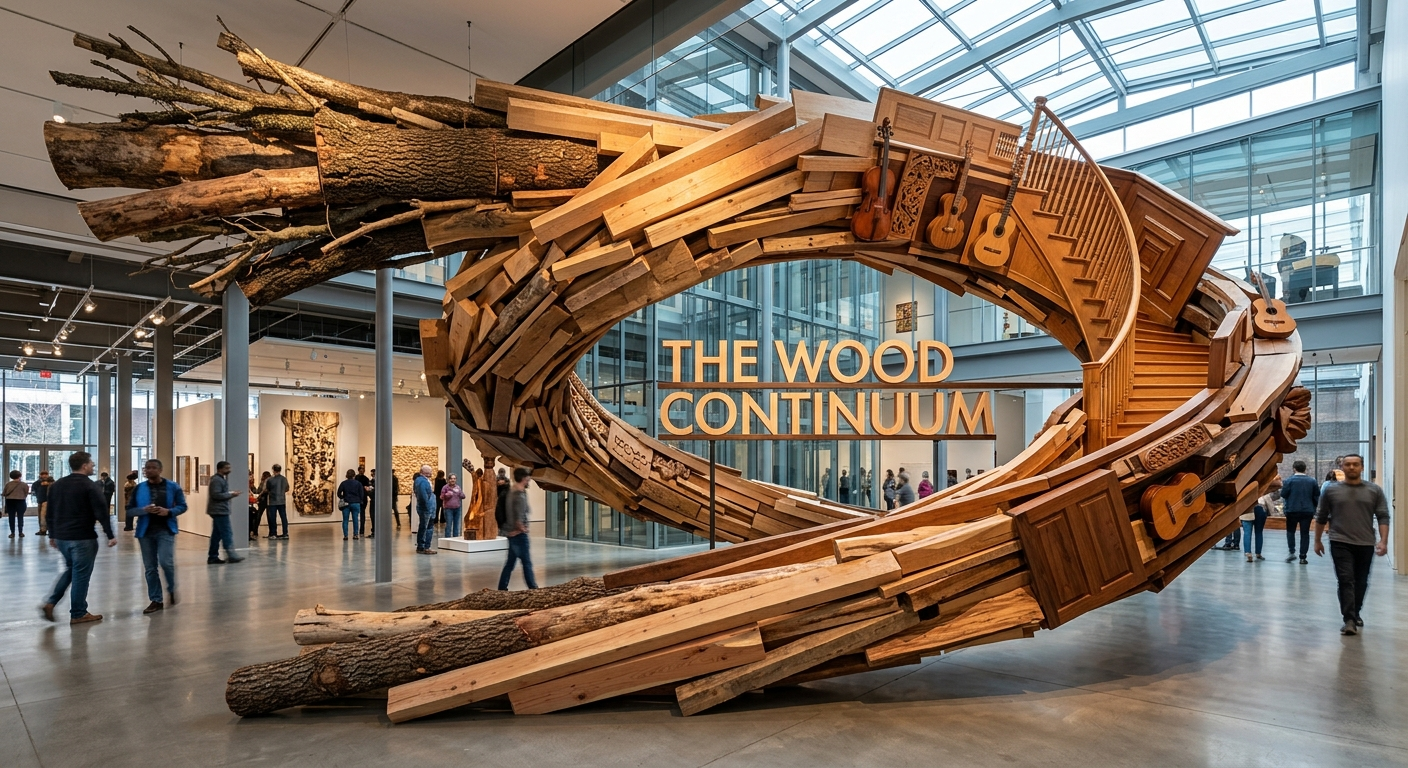
A Comprehensive Thesis on Wood from Living Tree to Engineered Material, Biological System, and Circular Resource
Abstract
Wood is one of humanity’s oldest materials, yet it remains one of the most scientifically complex and technologically relevant. It is simultaneously a living-tree tissue, a biological composite, a structural material, a chemical reservoir, an energy resource, an ecological habitat, and a feedstock for advanced materials. The term Wood Continuum can therefore be understood as a framework connecting wood across scales and stages: from the living tree and its cellular architecture, through harvesting and processing, to timber engineering, decay, recycling, carbon storage, and eventual return of organic matter to ecosystems.
At the microscopic level, wood is a hierarchical cellular material principally constructed from cellulose, hemicellulose and lignin. At larger scales, cells organize into tissues, growth rings, trunks, branches and engineered timber. Its properties vary according to species, density, moisture, temperature, anatomical direction, defects and growth conditions. Wood is strongly anisotropic and time-dependent, making its mechanical behaviour considerably more complicated than that of many conventional engineering materials. Researchers consequently use multiscale modelling, continuum mechanics, finite-element methods and continuum damage mechanics to connect microscopic structure with macroscopic performance.
The Wood Continuum also extends beyond mechanics. A fallen tree does not necessarily represent the end of wood’s significance. Deadwood can support fungi, microorganisms, insects and other organisms and forms an important part of forest nutrient and habitat cycles. In the industrial sphere, wood can progress from logs to sawn timber, plywood, laminated products, pulp, paper, fibre products, bio-based chemicals and other advanced materials. Consequently, understanding the Wood Continuum provides a way to connect forest biology, materials science, engineering, manufacturing, ecology, economics and circular-resource management.
1. Introduction: What Is the Wood Continuum?
Wood is often described simply as a natural material obtained from trees. Such a definition is correct but incomplete.
A tree is not merely a container holding wood. Wood is produced by a living biological system. Its cellular architecture records environmental conditions, transports water and nutrients, provides mechanical support and stores chemical energy and carbon.
Once a tree is harvested, another continuum begins:
forest → tree → stem → log → lumber → engineered wood → building/product → reuse → recycling → degradation → ecological return
At the same time, another continuum exists inside the material:
molecular structure → cell wall → cell → tissue → growth ring → board → structural component → building
Wood science therefore operates across multiple scales.
A major challenge is that properties measured at one scale cannot simply be assumed to apply unchanged at another. The microscopic arrangement of cellulose fibres, cell walls and pores contributes to the behaviour of a board, while knots, grain direction, cracks, moisture and manufacturing processes influence the behaviour of a structural member.
Research into wood mechanics increasingly treats these relationships as multiscale problems.
2. The Biological Beginning of Wood
2.1 Trees as biological manufacturing systems
Wood begins inside a living plant.
Trees continuously manufacture structural material through growth. Water and dissolved minerals move upward through conducting tissues, while photosynthesis supplies organic carbon compounds. Cambial activity produces new tissues that gradually form the expanding stem.
This means that every piece of wood contains a biological history.
Its characteristics may reflect:
- species;
- age;
- climate;
- rainfall;
- soil conditions;
- competition with neighbouring vegetation;
- disease;
- mechanical stresses;
- fire or other disturbances;
- growth rate;
- seasonal conditions.
Consequently, two boards cut from the same species can behave differently.
3. Anatomy of Wood
Wood is a hierarchical material.
A simplified structural hierarchy is:
molecules → polymers → cell walls → cells → tissues → growth rings → stem → tree
The major structural polymers are:
Cellulose
Cellulose consists of long chains of glucose-derived units. It provides much of the fibrous reinforcement within the cell wall.
Hemicellulose
Hemicelluloses form part of the matrix surrounding cellulose and contribute to the chemical and mechanical behaviour of the cell wall.
Lignin
Lignin is a complex polymeric material that contributes rigidity, cohesion and resistance to biological degradation.
Wood therefore resembles a naturally manufactured fibre-reinforced composite: cellulose contributes reinforcement while lignin and hemicelluloses form much of the surrounding matrix.
4. The Cell Wall: The First Engineering Structure
The cell wall is one of the most important levels in the Wood Continuum.
It is not homogeneous.
Its internal architecture includes cellulose microfibrils embedded within a matrix containing hemicelluloses and lignin. The orientation of these microfibrils strongly influences stiffness and deformation.
One consequence is that wood cannot be treated as an ordinary isotropic solid.
Its properties depend on direction.
The principal anatomical directions are generally described as:
- Longitudinal — parallel to the tree stem.
- Radial — from the centre of the stem outward.
- Tangential — approximately along the circumference of the stem.
This directional behaviour is called anisotropy.
5. Growth Rings and the Record of Time
Many trees produce recognizable growth rings.
A growth ring can contain regions associated with different stages of seasonal growth. In many species, differences between earlywood and latewood produce changes in density and mechanical properties.
The tree therefore becomes a biological archive.
A cross-section can reveal patterns associated with:
- annual growth;
- drought;
- favourable growing periods;
- competition;
- injury;
- environmental change.
Wood is consequently both a material and a historical record.
6. Wood Density
Density is one of the most important characteristics influencing wood performance.
However, density should not be regarded as the sole explanation for mechanical behaviour.
Modern anatomical studies show that wood density can emerge from several structural characteristics, including the proportions of fibre walls, lumens, vessels and parenchyma.
This is a fundamental principle of the Wood Continuum:
Macroscopic properties emerge from microscopic architecture.
A heavier wood is not automatically better for every application.
Different combinations of density, anatomy, moisture, grain orientation and defects can make particular woods suitable for very different purposes.
7. Moisture: Wood’s Hidden Variable
One of wood’s most unusual characteristics is its relationship with water.
Wood is hygroscopic, meaning that it interacts strongly with environmental moisture.
Moisture affects:
- dimensions;
- mass;
- stiffness;
- strength;
- biological durability;
- electrical properties;
- thermal behaviour;
- dimensional stability;
- processing behaviour.
Water can exist in different physical relationships with wood, including water associated with cell-wall polymers and water occupying larger void spaces.
The relationship between wood and water is sufficiently important that advanced continuum models explicitly incorporate moisture transport, sorption, thermal effects and mechanical behaviour.
8. Dimensional Change
Wood does not remain dimensionally constant as its moisture content changes.
It can shrink or swell differently in the longitudinal, radial and tangential directions.
This explains phenomena such as:
- warping;
- cupping;
- twisting;
- checking;
- splitting;
- joint movement.
The Wood Continuum therefore connects environmental conditions directly to engineering performance.
A wooden component in a building is not simply a static object. It interacts continuously with temperature and humidity.
9. Wood as an Engineering Material
Engineering traditionally attempts to describe materials through measurable quantities such as:
- density;
- modulus of elasticity;
- strength;
- fracture resistance;
- thermal conductivity;
- moisture diffusivity;
- creep;
- shrinkage;
- expansion.
Wood complicates this approach because these properties can vary significantly with:
- species;
- anatomical direction;
- moisture;
- temperature;
- loading rate;
- growth conditions;
- defects;
- age;
- processing.
Research has consequently developed mathematical models that attempt to describe wood at multiple scales.
10. The Continuum Mechanics View of Wood
In classical continuum mechanics, a material is represented as a continuous body rather than as billions of individual cells.
Instead of modelling every cell, engineers describe a region using quantities such as:
- stress;
- strain;
- displacement;
- temperature;
- moisture;
- energy;
- damage.
This approach makes it possible to analyse large wooden structures.
The central idea is:
microscopic complexity → effective material properties → macroscopic engineering model
This is particularly useful for timber beams, columns, panels, connections and other structural components.
11. Why Wood Is Difficult to Model
Wood possesses several interacting characteristics:
Heterogeneity
Wood varies from location to location.
Anisotropy
Its behaviour depends on direction.
Nonlinearity
The relationship between stress and deformation can become nonlinear.
Viscoelasticity
Wood can exhibit time-dependent deformation.
Plasticity
Some deformation can become permanent under sufficiently large loads.
Damage
Cracks, crushing and other forms of deterioration change the material response.
Hygroscopic behaviour
Moisture changes can cause deformation.
Biological degradation
Fungi and other organisms can alter its structure.
These properties mean that a complete mathematical representation can become highly sophisticated.
12. The Mechanical Continuum
A useful conceptual model is:
Load → stress → cellular deformation → damage → macroscopic deformation → failure
When a wooden component is loaded, forces are transferred through its hierarchical structure.
At relatively low loading levels, deformation may be largely recoverable.
At higher loads, local cell-wall deformation, crushing, cracking or other damage mechanisms can develop.
Eventually, structural failure may occur.
Wood can behave differently in tension, compression and shear. Research on three-dimensional constitutive models has therefore incorporated multiple failure criteria and damage variables to represent these different mechanisms.
13. Wood and Finite-Element Analysis
Finite-element analysis (FEA) divides a structure into many smaller computational elements.
Engineers can then estimate:
- displacement;
- stress;
- strain;
- deformation;
- failure zones;
- load distribution.
FEA has become particularly important because realistic wood structures are too complicated to solve analytically in many situations.
Researchers have developed models ranging from simplified anisotropic continuum descriptions to detailed representations incorporating microstructure.
14. From Microscopic Wood to Macroscopic Structures
The Wood Continuum can be visualized as a chain:
| Scale | Principal structure | Typical question |
|---|---|---|
| Molecular | Cellulose, hemicellulose, lignin | What is wood made of? |
| Nano/micro | Microfibrils and cell walls | Why does it have strength? |
| Cellular | Fibres, vessels and tracheids | How does structure affect properties? |
| Tissue | Xylem and rays | How does the tree transport and support? |
| Growth-ring | Earlywood/latewood | How does growth affect performance? |
| Tree | Stem and branches | How does the tree optimize structure? |
| Log | Industrial raw material | How can it be processed? |
| Board | Sawn timber | What is its engineering performance? |
| Component | Beam/panel/column | How does it carry loads? |
| Building | Structural system | How does it behave as a whole? |
| Landscape | Forest resource | How does it interact with ecosystems? |
This hierarchy demonstrates why wood science cannot be confined to a single discipline.
15. From Forest to Timber
The industrial Wood Continuum begins when trees enter the forest-product system.
A simplified pathway is:
forest management → harvesting → transport → log sorting → sawing → drying → grading → finishing → construction/product
Each stage changes the material.
For example, drying reduces moisture and can improve dimensional stability, but inappropriate processing can produce defects.
Sawing also determines how anatomical directions are distributed within boards.
16. Defects and Natural Variability
Wood is unusual among engineering materials because some of its imperfections are created by its biological origin.
Examples include:
- knots;
- grain deviation;
- resin pockets;
- checks;
- splits;
- reaction wood;
- density variation;
- growth irregularities.
These characteristics can significantly influence structural performance.
Therefore, engineering timber requires grading and characterization rather than assuming that every piece has identical properties.
17. Engineered Wood
Modern technology does not simply use wood as nature provides it.
Engineers can reorganize wood into engineered products.
Examples include:
- plywood;
- laminated veneer lumber;
- glued laminated timber;
- oriented strand board;
- particleboard;
- fibreboard;
- cross-laminated timber;
- other composite timber products.
The fundamental strategy is:
natural variability → controlled processing → engineered performance
This represents a major transition in the Wood Continuum.
18. Wood as a Composite Technology
Engineered wood demonstrates that wood is not merely a traditional material.
It can function as an advanced composite.
By changing:
- fibre orientation;
- layer arrangement;
- adhesive systems;
- density;
- moisture conditions;
- geometry;
- manufacturing pressure;
engineers can produce materials with controlled properties.
This creates opportunities for modern construction and product design.
19. Wood in Architecture and Construction
Wood has been used structurally for centuries.
Modern engineering has expanded its possibilities.
Applications include:
- houses;
- bridges;
- roofs;
- floors;
- wall systems;
- schools;
- public buildings;
- modular construction;
- prefabricated structures.
Digital modelling and modern manufacturing also allow increasingly complex timber geometries.
20. The Thermal Continuum
Wood is not only a mechanical material.
It is also a thermal material.
Its cellular structure contains substantial void space, influencing heat transfer.
This contributes to its use in:
- building envelopes;
- insulation-related systems;
- interior construction;
- thermal design.
However, thermal performance depends on density, moisture, structure and surrounding conditions.
21. The Acoustic Continuum
Wood also interacts with sound.
Its density, stiffness, internal structure and geometry influence:
- vibration;
- resonance;
- sound transmission;
- sound radiation.
This has made wood important in musical instruments and architectural acoustics.
The famous acoustic properties of particular woods demonstrate again that biological structure can produce technologically useful physical behaviour.
22. Wood and Fire
Wood is combustible, but this does not mean that its structural behaviour under fire is simple.
When exposed to sufficiently high temperatures, wood undergoes thermal degradation and can develop a char layer.
For structural engineering, questions include:
- heat penetration;
- charring;
- reduction in effective cross-section;
- moisture effects;
- structural load;
- connection behaviour.
Fire engineering therefore treats timber as a material whose properties evolve during exposure.
23. The Biological Continuum After Death
The Wood Continuum does not necessarily terminate when a tree is cut down.
In natural forests, dead branches, fallen trunks and standing dead trees become deadwood.
Deadwood can provide habitat and resources for organisms including:
- fungi;
- bacteria;
- insects;
- birds;
- small animals;
- decomposer communities.
It also participates in nutrient cycling.
Thus:
living tree → deadwood → decomposition → soil nutrients → new biological growth
This is an ecological continuum rather than an industrial one. Forest management research explicitly recognizes the importance of maintaining deadwood continuity for biodiversity and ecological function.
24. Wood, Fungi and Decomposition
Decomposition is not simply destruction.
It is transformation.
Microorganisms progressively break down components of wood, returning elements to ecological cycles.
Different organisms can specialize in different components or stages of decomposition.
The result is a transition:
complex biological material → simpler compounds → soil and atmospheric cycles
The decomposing log therefore becomes an ecological reactor.
25. Carbon and the Wood Continuum
Trees acquire carbon from atmospheric carbon dioxide through photosynthesis.
Some of that carbon becomes incorporated into biomass.
Wood products can retain part of that carbon for varying periods depending on product type and lifetime.
Eventually, carbon can return to the atmosphere or other environmental pools through:
- decomposition;
- combustion;
- recycling;
- other transformations.
Consequently, wood should be considered within a broader carbon system rather than treated simply as a static carbon store.
26. The Circular Wood Economy
The traditional linear model is:
forest → product → waste
A circular model attempts to create:
forest → product → reuse → repair → remanufacture → recycling → secondary products → biological recovery
This approach seeks to maximize the useful lifetime of wood resources.
A wooden beam, for example, might have several possible lives before becoming a waste or biological resource.
27. Cascading Use
One important concept is cascading use.
A high-quality piece of wood may first serve as a structural or durable product.
After its original service life, it may potentially become another wood-based product, depending on condition and contamination.
Only later might it enter energy recovery or biological decomposition pathways.
The general principle is:
Use the material at the highest practical value for as long as possible.
28. Digital Wood Engineering
The Wood Continuum is increasingly connected to digital technology.
Modern systems can use:
- computer vision;
- laser scanning;
- machine learning;
- digital twins;
- finite-element analysis;
- remote sensing;
- automated grading;
- robotics;
- optimization algorithms.
These technologies can help characterize natural variability and optimize the conversion of logs into products.
29. Artificial Intelligence and Wood
Artificial intelligence can potentially contribute to:
Forest monitoring
Satellite and aerial imagery can identify forest conditions and changes.
Timber grading
Computer vision can identify knots, cracks and other visible characteristics.
Manufacturing optimization
Algorithms can optimize cutting patterns and reduce material waste.
Structural prediction
Machine-learning models can supplement conventional engineering models.
Forest health
Data analysis can assist in detecting patterns associated with stress or disturbance.
AI therefore becomes another layer within the Wood Continuum:
biological material → sensor → data → model → decision → optimized material use
30. Remote Sensing and the Forest-to-Wood Connection
The Wood Continuum begins before a log reaches a sawmill.
Remote sensing technologies can characterize forests using:
- satellite imagery;
- aerial photography;
- LiDAR;
- multispectral sensors;
- hyperspectral methods.
These technologies can provide information about forest structure and condition.
The result is a growing digital connection between ecological systems and industrial material systems.
31. The Mathematical Wood Continuum
Advanced mathematical models can represent wood through coupled fields.
A simplified conceptual representation might involve:
[
\sigma = f(\varepsilon, M, T, \mathbf{A}, D)
]
where:
- (\sigma) = stress;
- (\varepsilon) = strain;
- (M) = moisture condition;
- (T) = temperature;
- (\mathbf{A}) = anisotropic material properties;
- (D) = damage state.
A more complete model can incorporate mechanical, thermal and moisture processes simultaneously.
Researchers have developed continuum descriptions involving balances of momentum, energy and moisture together with constitutive equations describing material behaviour.
32. Wood Rheology
Wood is also a rheological material.
Its deformation can depend on time.
Important mechanisms include:
- elasticity;
- plasticity;
- viscoelasticity;
- mechanosorption;
- hygroexpansion.
Recent research treats these mechanisms as interacting components of wood’s overall deformation behaviour.
This explains why a wooden structure may behave differently under:
- a sudden load;
- a sustained load;
- repeated loading;
- changing humidity;
- changing temperature.
33. Creep
Creep is the gradual deformation of a material under sustained loading.
For wood, creep is particularly important because it can interact with moisture and environmental conditions.
A structural component that initially appears adequately designed may experience gradual changes over long periods.
Therefore, long-term timber engineering requires more than a simple short-term strength calculation.
34. Damage Mechanics
A major research challenge is predicting how damage develops.
Wood may experience:
- localized crushing;
- cracking;
- fibre failure;
- shear failure;
- splitting;
- connection damage.
Continuum damage mechanics provides a framework for representing progressive deterioration without explicitly modelling every microscopic crack.
Three-dimensional wood models have used multiple stress-based failure criteria and damage variables to represent these processes.
35. Wood as a Natural Cellular Material
At the cellular level, wood shares characteristics with other cellular materials.
Its mechanical response depends partly on:
- cell geometry;
- wall thickness;
- density;
- microfibril orientation;
- pore structure.
Finite-element and micromechanical approaches have attempted to connect these characteristics with macroscopic elastic behaviour.
This creates an important engineering insight:
The strength of a tree is not produced by a solid block of matter. It emerges from organized architecture.
36. The Tree as an Engineered Structure
Although trees are biological organisms rather than machines, their structural organization has inspired engineering.
A tree must:
- support its own weight;
- resist wind;
- transport water;
- distribute mechanical loads;
- grow continuously;
- repair some damage;
- adapt to its environment.
Its architecture is therefore the result of biological processes operating under physical constraints.
This makes trees valuable natural examples of multifunctional structural design.
37. Biomimicry and Wood
Engineers can learn from wood’s architecture.
Potential lessons include:
- hierarchical structures;
- lightweight reinforcement;
- directional strength;
- damage tolerance;
- resource-efficient construction;
- adaptive growth;
- multifunctional materials.
The broader lesson is not that technology should copy wood exactly, but that biological organization can inspire new engineering strategies.
38. Advanced Wood Materials
Wood is also becoming a platform for advanced materials research.
Scientists investigate possibilities involving:
- cellulose nanomaterials;
- lignin-derived products;
- transparent or modified wood;
- densified wood;
- bio-based composites;
- functional surfaces;
- carbon-based materials derived from biomass.
These technologies demonstrate that wood can move beyond traditional lumber.
39. Nanocellulose
Cellulose can be processed into nanoscale structures with unusual combinations of:
- low density;
- stiffness;
- high surface area;
- optical properties;
- chemical functionality.
This creates opportunities in advanced composites, packaging, coatings and other research areas.
The tree therefore provides not only timber but also a potential source of sophisticated molecular building blocks.
40. Lignin as a Technology Resource
Lignin was historically viewed primarily as an undesirable component in some industrial processes.
Modern biorefinery research increasingly considers lignin a valuable feedstock.
Potential pathways include:
wood → lignin separation → chemical conversion → bio-based products
This contributes to the transition from a traditional forest-products industry toward a broader bio-based materials industry.
41. Wood and Manufacturing
Manufacturing technologies can substantially change wood’s final performance.
Important processes include:
- sawing;
- drying;
- machining;
- pressing;
- laminating;
- bonding;
- densification;
- coating;
- thermal modification.
Each process introduces another layer into the continuum.
Therefore:
tree biology + processing history = final material behaviour
42. The Wood Continuum and Industry 4.0
The modern wood industry can integrate:
- sensors;
- robotics;
- machine vision;
- industrial automation;
- cloud computing;
- artificial intelligence;
- digital twins;
- predictive maintenance.
A future sawmill could therefore become a data-driven manufacturing environment.
Instead of treating every log as an unpredictable object, systems can increasingly measure and classify its characteristics before deciding how it should be processed.
43. Sustainability
The sustainability of wood depends on the entire system.
Questions include:
- How is the forest managed?
- How much biodiversity is retained?
- How efficiently is wood processed?
- How long do products remain in service?
- Can products be reused?
- What happens after disposal?
- What energy is consumed during processing?
- What environmental impacts occur during transport?
Therefore, simply labeling a product “wood” does not automatically answer whether its entire life cycle is sustainable.
44. The Forest and the Factory
The Wood Continuum connects two environments that are sometimes studied separately.
Forest
The tree is:
- alive;
- growing;
- storing carbon;
- supporting ecosystems;
- cycling water and nutrients.
Factory
The material becomes:
- measured;
- sorted;
- cut;
- dried;
- assembled;
- engineered;
- distributed.
The challenge of sustainable wood systems is to connect these environments without losing ecological, economic or material value.
45. The Wood Continuum and the Built Environment
Wood’s journey does not end at the factory.
Once incorporated into a building, it becomes part of the built environment.
It may contribute to:
- structural capacity;
- thermal performance;
- interior design;
- acoustic performance;
- architectural identity;
- material efficiency.
Digital building models can further connect timber components with information about their dimensions, materials, structural properties and maintenance history.
46. The Building as a Material Bank
A powerful future concept is to treat buildings as material banks.
Instead of assuming that a building will eventually become waste, components can potentially be documented so that they can be:
- maintained;
- repaired;
- removed;
- reused;
- remanufactured.
For timber construction, this approach could increase the number of useful stages within the Wood Continuum.
47. Challenges
Despite its advantages, wood presents major challenges.
Biological variability
No tree grows exactly like another.
Moisture sensitivity
Environmental humidity can change dimensions and performance.
Fire
Wood requires appropriate fire engineering.
Biological degradation
Moisture and biological organisms can cause deterioration.
Defects
Natural irregularities influence structural performance.
Modelling complexity
Wood’s anisotropy and nonlinear behaviour complicate numerical simulation.
Supply-chain pressures
Forest resources must be managed responsibly.
Climate change
Changing temperature, precipitation, pests and disturbance patterns can influence forest productivity and resilience.
48. The Future of the Wood Continuum
The future is likely to involve greater integration between biology, engineering and digital technology.
Potential developments include:
1. Digital trees
Three-dimensional digital representations of trees could connect forest inventories to material predictions.
2. Intelligent timber grading
Computer vision could increasingly identify structural characteristics automatically.
3. Digital twins
Timber buildings could contain continuously updated information about their condition.
4. Advanced engineered wood
Manufacturing could produce increasingly predictable structural materials.
5. Bio-based materials
Cellulose, hemicellulose and lignin could become feedstocks for new products.
6. Circular timber systems
Materials could remain in productive use for longer.
7. Multiscale modelling
Models could increasingly connect molecular structure to structural engineering.
49. A Unified Model of the Wood Continuum
The complete concept can be represented as:
SUNLIGHT
↓
PHOTOSYNTHESIS
↓
TREE GROWTH
↓
CELLULAR WOOD FORMATION
↓
CELL WALL ARCHITECTURE
↓
WOOD ANATOMY
↓
TREE STRUCTURE
↓
FOREST ECOSYSTEM
↓
HARVEST / NATURAL FALL
↓
LOG
↓
PROCESSING
↓
TIMBER / ENGINEERED WOOD
↓
BUILDINGS AND PRODUCTS
↓
USE AND MAINTENANCE
↓
REUSE / RECYCLING
↓
DECOMPOSITION OR OTHER END-OF-LIFE PATHWAYS
↓
CARBON, NUTRIENTS AND NEW BIOLOGICAL CYCLES
This is the Wood Continuum.
50. Conclusion
The Wood Continuum is far more than the study of timber.
It is a way of understanding wood as a continuous system connecting biology, chemistry, physics, mechanics, ecology, manufacturing, architecture, computing and the circular economy.
At the beginning of the continuum stands the living tree. Inside the tree, microscopic biological structures produce a remarkably sophisticated hierarchical material. Cellulose, hemicellulose and lignin combine within cell walls; cells organize into tissues; tissues form growth rings; growth rings form stems; and stems become trees capable of supporting themselves while transporting water and responding to their environment.
When wood enters engineering, its complexity remains. Its anisotropy, heterogeneity, moisture sensitivity, time-dependent behaviour and damage mechanisms require sophisticated material models. Modern continuum mechanics, micromechanics and finite-element methods provide increasingly powerful ways of connecting microscopic architecture with macroscopic structural performance.
The continuum then expands into manufacturing. Logs become lumber, panels, beams, engineered timber and advanced bio-based materials. Digital technologies, artificial intelligence, sensors and computational modelling increasingly allow manufacturers and engineers to characterize and optimize this naturally variable material.
At the ecological end of the continuum, wood remains important after a tree dies. Deadwood contributes to habitat formation, decomposition and nutrient cycling.
The central lesson is therefore profound:
Wood is not simply a material that comes from a tree. It is a continuously transforming biological, physical, engineering and ecological system.
Understanding that continuum provides a foundation for better forest management, more efficient manufacturing, safer timber engineering, advanced bio-based materials and more circular resource systems.
The future of wood will not be defined solely by how much timber humanity can extract from forests. It will increasingly be defined by how intelligently humanity can understand, design, use, preserve, reuse and ultimately return wood to the natural cycles from which it originated.
Selected Research Foundations
- Multiscale descriptions of wood connect molecular constituents, cell-wall structure and macroscopic continuum behaviour.
- Mechanical research treats wood as a heterogeneous, anisotropic cellular material whose behaviour can be modelled from microstructural characteristics through continuum and finite-element approaches.
- Three-dimensional continuum-damage models have been developed to represent wood’s different failure mechanisms under tension, compression and shear.
- Thermo-hygro-mechanical research demonstrates the importance of simultaneously considering temperature, moisture, deformation and material history when modelling wood processing and forming.
- Contemporary rheological research treats elasticity, plasticity, viscoelasticity, mechanosorption and hygroexpansion as interacting mechanisms in wood deformation.





Be First to Comment