
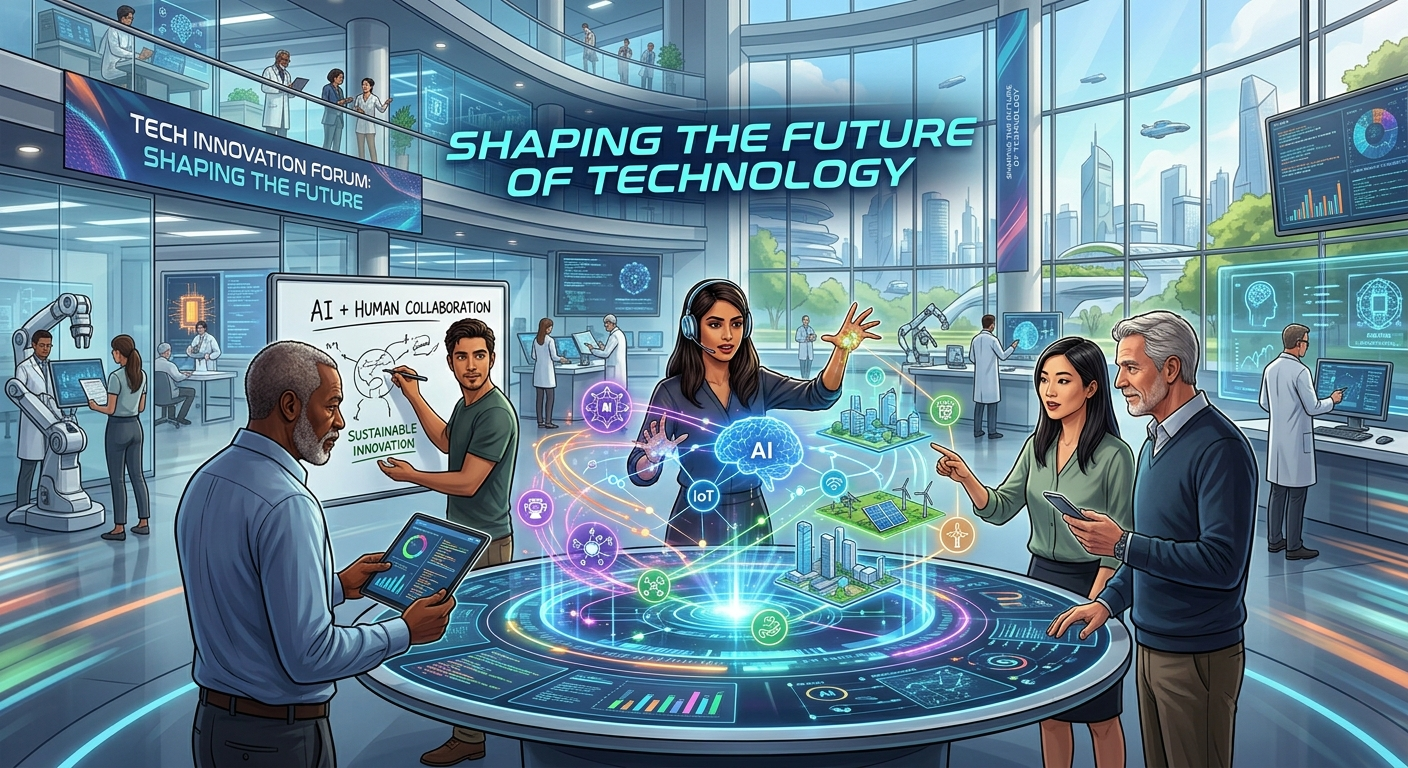
A Comprehensive Thesis on How Emerging Technologies, Human Innovation, Infrastructure and Society Will Define the Next Technological Era
Abstract
Technology has never been merely a collection of machines, software applications or electronic devices. It is a continuously evolving system through which human beings extend their ability to communicate, calculate, manufacture, travel, observe, create, heal and understand the world. From early tools and mechanical inventions to electricity, telecommunications, computers, the internet, artificial intelligence and advanced robotics, each technological era has transformed the possibilities available to society.
The next era is likely to be defined less by a single invention and more by convergence. Artificial intelligence is increasingly interacting with robotics, biotechnology, semiconductors, telecommunications, cloud and edge computing, quantum technologies, advanced materials, energy systems and space technologies. Stanford’s 2026 Emerging Technology Review identifies AI, biotechnology, cybersecurity, energy, materials science, neuroscience, quantum technologies, robotics, semiconductors and space as major emerging technology areas, emphasizing that their convergence is itself an important characteristic of the present technological period.
The future, therefore, should not be understood simply as “more technology.” It should be understood as the construction of increasingly intelligent, connected, autonomous, energy-aware and adaptive technological ecosystems.
This thesis examines the forces shaping that future, the technologies likely to matter most, the infrastructure required to support them, their economic and social consequences, major risks, the changing role of human beings, and a strategic framework for responsible technological development.
1. Introduction
Human civilization is fundamentally a technological civilization.
Every major stage of human development has involved an expansion of technological capability. Stone tools expanded physical capability. Agriculture expanded humanity’s ability to produce food. Writing expanded the ability to preserve and transmit knowledge. Mechanical engineering transformed manufacturing. Electricity created an entirely new industrial infrastructure. Telecommunications compressed distance. Computers transformed information processing. The internet created a planetary information network.
The 21st century has introduced another transformation: intelligence itself is becoming increasingly computational.
Artificial intelligence can recognize patterns, generate content, assist with programming, analyze enormous datasets, interpret images, support scientific discovery and increasingly interact with digital tools. At the same time, robotics is transferring computational intelligence from purely digital environments into the physical world.
Consequently, the technological question is changing.
The question is no longer simply:
What can computers calculate?
It is increasingly:
What can intelligent technological systems perceive, understand, predict, create and do?
That question is central to shaping the future.
2. The Meaning of “Shaping the Future of Technology”
Shaping technology means more than predicting what will happen.
It involves deliberately influencing:
- what technologies are researched;
- what technologies receive investment;
- how infrastructure is constructed;
- how technologies are regulated;
- how people are educated;
- how data is governed;
- how technological benefits are distributed;
- how risks are controlled;
- and how technology is integrated into society.
Technology is therefore simultaneously a scientific, engineering, economic, political, educational and social system.
A technically impressive invention can fail commercially.
A commercially successful technology can create social problems.
A powerful technology can become dangerous if poorly governed.
A technology can also become transformative when science, engineering, capital, infrastructure, education and responsible governance converge.
This means the future of technology will not be determined by engineers alone. It will be shaped by governments, universities, businesses, investors, educators, communities and citizens.
3. From Invention to Technological Ecosystems
Earlier technological revolutions could sometimes be associated with recognizable inventions.
The steam engine became associated with industrialization.
The electric generator became associated with electrification.
The transistor became a foundation of modern electronics.
The personal computer transformed computing.
The internet transformed communication.
The smartphone combined computing, telecommunications, sensors and software into a portable platform.
The emerging technological era is different because many innovations are becoming interconnected.
For example:
AI + semiconductors + data centers + electricity + telecommunications + cloud computing + cybersecurity + robotics
creates a much larger technological system than any one component.
The same applies to:
AI + biotechnology + automation + advanced laboratories
and:
quantum computing + materials science + chemistry + cybersecurity.
The important unit of innovation is increasingly the ecosystem.
4. Artificial Intelligence as a Major Technological Force
Artificial intelligence is arguably one of the strongest forces currently shaping technology.
Modern AI systems can process enormous amounts of information and perform increasingly sophisticated tasks involving language, vision, prediction, generation and decision support.
But the future of AI is not limited to chatbots.
AI is moving toward several major forms:
4.1 Generative AI
Generative systems can produce:
- text;
- software;
- images;
- audio;
- video;
- designs;
- synthetic data;
- scientific hypotheses.
4.2 Agentic AI
Agentic systems aim to move from responding to instructions toward carrying out multi-step objectives using tools and software environments.
This creates enormous opportunities for productivity but also creates new requirements for reliability, security, authorization and human oversight.
Research into trustworthy agentic AI increasingly emphasizes safety, robustness, transparency, accountability, privacy and security as essential properties for systems operating in critical environments.
4.3 Physical AI
Physical AI connects intelligence with machines capable of interacting with the physical environment.
Examples include:
- industrial robots;
- autonomous machines;
- warehouse systems;
- agricultural robotics;
- intelligent vehicles;
- drones;
- medical robotics;
- humanoid robots.
The transition from digital AI to physical AI could become one of the most important technological developments of the coming decades.
5. The Rise of Robotics
Robotics represents the physical manifestation of computational intelligence.
A conventional computer produces digital outputs.
A robot can potentially:
sense → interpret → plan → move → manipulate → observe → adapt.
This creates the possibility of increasingly autonomous physical systems.
Robotics is likely to expand particularly in environments where tasks are repetitive, dangerous, highly controlled or difficult for humans to perform continuously.
Potential applications include:
- manufacturing;
- logistics;
- agriculture;
- mining;
- construction;
- infrastructure inspection;
- healthcare;
- laboratories;
- disaster response;
- space exploration.
However, robotics faces major challenges involving cost, safety, reliability, integration, energy consumption, training data and interaction with humans.
Forrester’s 2026 assessment similarly identifies humanoid robotics as an important emerging technology while noting that significant barriers remain around integration, scaling, safety, data and workforce challenges.
6. The Semiconductor Foundation
Almost every advanced digital technology ultimately depends upon semiconductors.
The semiconductor industry provides the computational foundation for:
- CPUs;
- GPUs;
- AI accelerators;
- smartphones;
- networking equipment;
- automobiles;
- satellites;
- industrial controllers;
- sensors;
- medical equipment.
The future will not necessarily be dominated by a single processor architecture.
Instead, computing is becoming increasingly heterogeneous.
Different workloads may use different processors:
CPU → general-purpose computing
GPU → massively parallel computation
NPU/AI accelerator → neural-network inference
DPU → data processing and networking
FPGA → configurable acceleration
QPU → quantum computation
Neuromorphic processor → brain-inspired computation
This suggests that future computing infrastructure will increasingly resemble an ecosystem of specialized computational engines.
7. The Future of Computing
The future of computing is likely to be heterogeneous and distributed.
Computing will increasingly occur across several layers:
Layer 1: Device Computing
Computers embedded directly into:
- smartphones;
- vehicles;
- appliances;
- industrial equipment;
- sensors;
- wearable devices.
Layer 2: Edge Computing
Processing occurs near the source of data rather than sending everything to a distant cloud.
This can reduce latency and network requirements.
Layer 3: Cloud Computing
Large data centers provide massive computational capacity and centralized services.
Layer 4: High-Performance Computing
Supercomputers support advanced scientific, engineering and AI workloads.
Layer 5: Quantum Computing
Quantum systems may eventually provide advantages for particular classes of problems.
The likely future is therefore not “cloud versus edge” or “classical versus quantum.”
It is hybrid computing.
8. Quantum Technology
Quantum technology represents a fundamentally different approach to information processing, communication and sensing.
Quantum computing may eventually contribute to:
- chemistry;
- materials science;
- optimization;
- cryptography;
- financial modeling;
- drug discovery;
- machine learning.
However, quantum computing should not be confused with a universal replacement for classical computers.
The technology remains technically challenging, particularly in areas such as error correction, scaling, noise management and practical integration.
The World Economic Forum’s 2026 Global Risks Report identifies quantum computing as both a potential source of major technological opportunities and a future cybersecurity challenge.
The emerging model is therefore likely to be:
Classical computers + AI accelerators + quantum processors
rather than:
Classical computers replaced by quantum computers.
9. Biotechnology and Computational Biology
One of the most powerful future technological convergences may occur between computing and biology.
AI can help researchers analyze:
- proteins;
- genomes;
- molecular structures;
- biological pathways;
- medical images;
- drug candidates.
Advanced laboratories can combine automation, robotics, computational models and biological experimentation.
The result is a new scientific workflow:
Data → AI model → hypothesis → automated experiment → measurement → new data → improved model
This could accelerate scientific discovery.
The World Economic Forum’s 2026 emerging-technology research highlights the increasing use of AI throughout scientific discovery, including areas such as drug research and biological analysis.
10. Energy: The Hidden Foundation of Technology
Every digital revolution ultimately depends upon physical infrastructure.
AI requires computing.
Computing requires electricity.
Data centers require electricity and cooling.
Networks require electricity.
Semiconductor manufacturing requires enormous industrial infrastructure.
Therefore:
The future of technology is also the future of energy.
This is particularly important because AI expansion is increasing demand for computational infrastructure.
Recent industry analysis has highlighted power availability and grid capacity as potential constraints on AI growth.
Future technology strategies will therefore need to integrate:
- renewable energy;
- nuclear energy;
- energy storage;
- advanced transmission;
- smart grids;
- efficient computing;
- power electronics;
- distributed generation.
Energy efficiency will become a technology-development objective rather than merely an environmental consideration.
11. Data as the New Industrial Resource
Industrial societies depended heavily on physical resources.
The information economy depends increasingly on data.
Data can describe:
- people;
- machines;
- markets;
- weather;
- biological systems;
- transportation;
- manufacturing;
- scientific experiments.
AI systems require data for development, evaluation and operation.
However, data creates difficult questions:
- Who owns it?
- Who can access it?
- Is it accurate?
- Was it collected ethically?
- Can it be transferred across borders?
- How should sensitive information be protected?
- How can synthetic or manipulated information be identified?
The future therefore requires not simply more data but higher-quality, better-governed data.
12. Telecommunications and the Connected Planet
Technology becomes more powerful when systems can communicate.
Telecommunications provides the nervous system of the digital economy.
The future network environment will combine:
- fiber-optic networks;
- 5G and future 6G;
- satellites;
- edge computing;
- Wi-Fi;
- private cellular networks;
- Internet of Things infrastructure.
The evolution of telecommunications is therefore moving toward an environment where physical objects, machines, people and software systems can communicate continuously.
This creates the foundation for:
smart cities + autonomous systems + industrial IoT + intelligent transportation + connected healthcare + precision agriculture.
13. The Internet of Things
The Internet of Things transforms ordinary physical objects into connected computational entities.
An IoT system typically contains:
Sensor → Connectivity → Data platform → Analytics/AI → Decision → Actuator
This architecture can be applied to:
- agriculture;
- factories;
- buildings;
- vehicles;
- energy systems;
- water infrastructure;
- logistics;
- environmental monitoring.
The future IoT will increasingly become AIoT—the convergence of artificial intelligence and connected physical devices.
Instead of merely collecting data, devices will increasingly interpret data locally and respond intelligently.
14. Edge AI
Edge AI represents a major architectural shift.
Instead of sending every piece of information to a central data center, some AI processing can occur directly on or near the device.
Advantages can include:
- lower latency;
- reduced bandwidth requirements;
- greater resilience;
- improved privacy in some applications;
- faster local decision-making.
This is particularly important for systems that need rapid responses.
Examples include industrial monitoring, autonomous machines and intelligent sensors.
The future computing environment may therefore be:
Cloud AI + Edge AI + Device AI.
15. Cybersecurity in the Future
As technology becomes more interconnected, cybersecurity becomes more important.
The attack surface expands when organizations deploy:
- cloud services;
- IoT devices;
- AI systems;
- mobile applications;
- autonomous machines;
- connected vehicles;
- industrial networks.
Future cybersecurity will increasingly incorporate AI-assisted defense, identity management, continuous monitoring and stronger cryptographic protection.
Quantum computing introduces another challenge because sufficiently capable quantum systems could threaten some existing cryptographic methods.
The World Economic Forum’s 2026 cybersecurity research argues that organizations need to prepare for the transition toward post-quantum cryptography rather than waiting until quantum threats become immediate.
Security therefore needs to be designed into technology from the beginning.
16. Human–Machine Collaboration
The future should not be described simply as humans versus machines.
A more useful model is:
Human intelligence + machine intelligence = augmented capability.
Machines are particularly strong at:
- computation;
- pattern recognition;
- repetitive processing;
- large-scale information retrieval;
- continuous monitoring.
Humans remain essential for:
- judgment;
- values;
- empathy;
- leadership;
- creativity;
- social understanding;
- responsibility;
- defining objectives.
The strongest future systems are therefore likely to combine human strengths with machine strengths.
17. The Future of Work
Technology will transform employment.
Some tasks will be automated.
Other jobs will be redesigned.
Entirely new occupations will emerge.
The critical distinction is between automating jobs and automating tasks.
A profession may survive while its workflow changes dramatically.
For example, a software engineer may spend less time writing routine code and more time:
- designing systems;
- reviewing AI-generated code;
- testing;
- securing applications;
- managing architecture;
- solving complex problems.
This means education must increasingly focus on adaptability.
Recent discussion around technology education emphasizes that rapidly changing AI capabilities are increasing the importance of critical thinking, problem-solving, adaptability and continuous learning.
18. Education for the Technological Future
Traditional education often assumes that knowledge acquired during childhood or university will remain useful for decades.
Technology challenges that assumption.
Future education should emphasize:
Digital literacy
Understanding computers, networks, data and software.
AI literacy
Understanding what AI can and cannot do.
Scientific literacy
Understanding evidence, experimentation and uncertainty.
Computational thinking
Learning how to break complex problems into logical components.
Cybersecurity awareness
Understanding digital risks and responsible behavior.
Creativity
Learning to generate and evaluate new ideas.
Ethical reasoning
Understanding the consequences of technological decisions.
Lifelong learning
Developing the ability to continuously acquire new skills.
The future worker may need to learn repeatedly throughout an entire career.
19. Technology and the Global Economy
Technology has become a major determinant of economic competitiveness.
Countries compete through:
- research;
- universities;
- semiconductor manufacturing;
- AI infrastructure;
- telecommunications;
- energy;
- intellectual property;
- skilled workers;
- venture capital;
- industrial capacity.
The technological race is therefore also an economic race.
However, technology can create inequalities if advanced infrastructure is concentrated in a small number of countries or companies.
This creates the challenge of the digital divide.
20. Africa and the Future of Technology
Africa has an opportunity to move beyond simply consuming imported technology.
The continent can develop technological capacity in areas where its needs create strong incentives for innovation.
Potential areas include:
- fintech;
- telecommunications;
- digital agriculture;
- renewable energy;
- healthcare technology;
- mining technology;
- logistics;
- education technology;
- satellite applications;
- AI services;
- cybersecurity;
- smart infrastructure.
Africa’s large young population could become a major technological asset if education, connectivity, entrepreneurship and infrastructure develop together.
The goal should not simply be to import the latest technology.
The goal should be to develop the capability to create, adapt, maintain and improve technology.
21. Smart Cities
Future cities will increasingly function as integrated technological systems.
A smart city may combine:
Sensors + telecommunications + AI + energy systems + transportation + water systems + digital government.
AI can potentially help analyze traffic, energy demand, infrastructure conditions and environmental data.
However, smart-city development must protect privacy and ensure that technology serves citizens rather than becoming surveillance without appropriate safeguards.
22. Agriculture and Food Technology
Agriculture is another major area of technological transformation.
The combination of:
- IoT sensors;
- satellite imagery;
- AI;
- robotics;
- drones;
- automated irrigation;
- weather forecasting;
- soil monitoring;
can create increasingly data-driven agriculture.
A future farm could continuously monitor:
soil → moisture → temperature → weather → crop health → water requirements → yield predictions.
This can potentially improve resource efficiency and agricultural productivity.
23. Manufacturing and Industry 4.0
Manufacturing is moving toward highly connected production systems.
Industry 4.0 combines:
- robotics;
- IoT;
- AI;
- digital twins;
- advanced analytics;
- automation;
- cloud and edge computing.
A digital twin can represent a physical asset or process computationally.
Engineers can use such models to simulate conditions, monitor equipment and predict potential problems.
The factory of the future may therefore become increasingly autonomous while remaining supervised by humans.
24. Advanced Materials
Technology depends on materials.
Semiconductors, batteries, aerospace systems, medical devices and energy technologies all require advanced materials.
Future materials research includes:
- 2D materials;
- advanced composites;
- high-performance alloys;
- semiconductor materials;
- energy-storage materials;
- photonic materials;
- biomaterials.
The convergence between materials science and AI could accelerate discovery by allowing researchers to search enormous spaces of possible materials computationally.
25. Photonics and the Future of Information
Electronics is not the only way to process and transport information.
Photonics uses light for communication and computation-related applications.
Optical fiber already forms the backbone of global telecommunications.
Future photonic technologies could increasingly appear in:
- data centers;
- communications;
- AI accelerators;
- sensors;
- high-speed computing.
Emerging research also explores hybrid electronic, photonic, analogue and neuromorphic architectures to address energy and data-movement constraints in AI systems.
26. Space Technology
The technological frontier is increasingly expanding beyond Earth.
Future space systems may include:
- reusable launch systems;
- satellite networks;
- Earth observation;
- satellite-to-device communications;
- space-based navigation;
- lunar infrastructure;
- robotic exploration;
- space manufacturing;
- potentially space-based computing infrastructure.
Recent national technology strategies demonstrate how governments are increasingly treating space, quantum computing, biotechnology, energy and advanced materials as interconnected strategic capabilities.
27. Technology and the Environment
Technology can both increase environmental pressure and help reduce it.
Negative effects can include:
- electronic waste;
- energy consumption;
- mining requirements;
- industrial pollution;
- resource extraction.
Positive applications include:
- renewable energy;
- smart grids;
- precision agriculture;
- climate monitoring;
- energy-efficient computing;
- electric transportation;
- carbon monitoring;
- advanced recycling.
The central principle should therefore be:
Build technologies that improve capability without creating unsustainable physical costs.
28. The Importance of Trust
Technological capability alone does not guarantee adoption.
People need to trust:
- AI systems;
- digital identities;
- online transactions;
- autonomous machines;
- healthcare technologies;
- financial platforms;
- information systems.
IEEE Computer Society’s 2026 technology predictions identify trust and power as important adoption bottlenecks and emphasize that the competitive focus is shifting from capability alone toward assurance, evaluation and evidence of trustworthy performance.
This represents a major philosophical shift:
The future question is not only “Can we build it?”
It is also:
“Can we prove that it works safely and responsibly?”
29. Governance and Regulation
Technological development increasingly requires governance frameworks.
Effective governance should address:
- privacy;
- cybersecurity;
- AI safety;
- intellectual property;
- competition;
- data governance;
- digital identity;
- algorithmic accountability;
- consumer protection;
- technological standards.
Regulation must balance two competing objectives:
innovation
and
protection.
Overregulation can slow useful innovation.
Underregulation can allow harmful practices to scale.
The objective should be risk-proportionate governance.
30. The Concentration of Technological Power
Advanced technology can create enormous economic power.
A small number of organizations may possess:
- enormous computing resources;
- large datasets;
- advanced semiconductor access;
- specialized engineering talent;
- global distribution networks.
This creates questions about competition and technological concentration.
Healthy technological ecosystems require:
- open standards where appropriate;
- competition;
- research diversity;
- public research;
- entrepreneurship;
- interoperability;
- access to education.
The future should avoid creating technological systems where innovation depends entirely upon a small number of gatekeepers.
31. Technology and Human Values
Technology has no independent moral direction.
A technology can be used for beneficial or harmful purposes depending upon how people design and deploy it.
Therefore, technological development should incorporate:
Safety
Human dignity
Privacy
Fairness
Transparency
Accountability
Sustainability
Accessibility
These principles should not be added after technology is built.
They should influence architecture and design from the beginning.
32. The Convergence Era
Perhaps the defining characteristic of the next technological era will be convergence.
Consider the following chain:
Semiconductors
↓
Computing
↓
AI
↓
Data
↓
Telecommunications
↓
IoT
↓
Robotics
↓
Biotechnology
↓
Advanced manufacturing
↓
Energy
↓
Autonomous systems
Each technology strengthens others.
This produces a technological feedback loop.
Better chips enable better AI.
Better AI accelerates science.
Better science produces better materials.
Better materials produce better chips and energy systems.
Better networks connect more machines.
More connected machines generate more data.
More data improves intelligent systems.
The result is an accelerating technological ecosystem.
33. The Infrastructure Challenge
One of the least visible aspects of technological progress is infrastructure.
A sophisticated AI application may depend upon:
electricity → power generation → transmission → data center → semiconductor → networking → cloud platform → software → data → AI model → application.
If any layer is inadequate, the application can fail.
This is why future technology policy must consider the complete infrastructure stack.
The technology of tomorrow requires investment in:
- electricity;
- fiber;
- mobile networks;
- data centers;
- semiconductor manufacturing;
- cloud platforms;
- edge infrastructure;
- research laboratories;
- universities;
- cybersecurity.
34. From Software to Intelligent Infrastructure
The previous digital era was dominated by software.
The next era may be dominated by intelligent infrastructure.
Examples include:
- intelligent power grids;
- intelligent factories;
- intelligent vehicles;
- intelligent farms;
- intelligent buildings;
- intelligent logistics;
- intelligent laboratories.
In these environments, AI becomes part of the infrastructure rather than a separate application.
This represents a profound change.
35. The Future Technology Stack
A useful model for understanding future technology is a layered architecture:
Layer 1 — Energy
Electricity, storage and power infrastructure.
Layer 2 — Materials
Semiconductors, metals, polymers, composites and advanced materials.
Layer 3 — Hardware
Processors, sensors, actuators, machines and robots.
Layer 4 — Connectivity
Fiber, cellular networks, satellites and wireless systems.
Layer 5 — Computing
Cloud, edge, HPC, distributed and quantum computing.
Layer 6 — Data
Databases, datasets, sensors and information systems.
Layer 7 — Intelligence
AI, machine learning, optimization and autonomous decision systems.
Layer 8 — Applications
Healthcare, agriculture, finance, manufacturing, transportation and education.
Layer 9 — Governance
Security, regulation, standards, ethics and accountability.
Layer 10 — Human Society
People, organizations, economies and communities.
This final layer is ultimately the reason the other nine layers exist.
36. A Possible Technological Timeline
2026–2030: Intelligent Digital Infrastructure
Likely developments include:
- expansion of generative AI;
- increasing use of AI agents;
- AI-enabled software development;
- rapid AI infrastructure construction;
- stronger edge AI;
- accelerated AI cybersecurity;
- increased automation;
- continued semiconductor innovation.
2030–2040: Physical Intelligence
Potential developments include:
- increasingly capable industrial robots;
- autonomous logistics;
- intelligent manufacturing;
- advanced AI laboratories;
- greater integration of AI and biotechnology;
- quantum systems becoming more specialized;
- expanded autonomous infrastructure.
2040–2050: Deep Technological Convergence
Potential developments may include:
- highly integrated AI-robotic systems;
- advanced biological engineering;
- more mature quantum-classical computing;
- autonomous scientific research;
- advanced energy systems;
- extensive intelligent infrastructure.
Beyond 2050
Forecasting becomes increasingly uncertain.
Potential areas include:
- advanced space infrastructure;
- highly autonomous industrial ecosystems;
- mature brain-computer interfaces;
- advanced synthetic biology;
- radically improved energy systems;
- new computing architectures.
These should be treated as scenarios rather than guaranteed predictions.
37. The Biggest Technological Challenges
The future will not be determined only by technological breakthroughs.
Several constraints may become equally important.
Energy constraints
Computational expansion requires electricity.
Semiconductor constraints
Advanced computing requires complex manufacturing ecosystems.
Talent constraints
Advanced systems require highly skilled researchers and engineers.
Security constraints
More connectivity creates more potential attack surfaces.
Governance constraints
Technology can advance faster than regulatory institutions.
Trust constraints
People and organizations need evidence that systems are reliable.
Inequality constraints
Technological benefits can become concentrated.
Environmental constraints
Technology requires physical resources.
These constraints mean that technological progress must increasingly be treated as a systems-engineering problem.
38. A Strategic Framework for Shaping Technology
A responsible technological strategy can be organized around ten principles.
1. Invest in fundamental science
Breakthrough technologies often originate from research conducted long before commercial applications become visible.
2. Build infrastructure
Innovation requires electricity, communications, computing and manufacturing capacity.
3. Develop human capital
Education is technological infrastructure.
4. Encourage entrepreneurship
Small companies can transform scientific breakthroughs into practical products.
5. Maintain competition
Competitive ecosystems encourage innovation.
6. Develop cybersecurity from the beginning
Security cannot remain an afterthought.
7. Establish trustworthy AI
AI systems need rigorous evaluation and appropriate human oversight.
8. Promote technological inclusion
Infrastructure and skills should reach communities beyond major technological centers.
9. Build sustainable systems
Energy, materials and environmental consequences must be included in technological design.
10. Govern emerging technologies intelligently
Regulation should protect society while allowing beneficial experimentation and innovation.
39. The Role of Young People
The future of technology ultimately belongs to the generations growing up with it.
Young people should not only learn how to use technology.
They should learn how technology works.
Important areas include:
- mathematics;
- physics;
- computer science;
- engineering;
- biology;
- economics;
- cybersecurity;
- AI;
- communication;
- ethics;
- entrepreneurship.
The objective should be to create a generation capable of moving from:
technology consumer → technology user → technology builder → technology innovator → technology leader.
40. The Ultimate Question
The most important technological question is not:
What will technology become?
It is:
What kind of civilization do we want technology to help create?
Technology can produce extraordinary capabilities.
But capability without wisdom can create problems.
The future therefore requires both:
technological intelligence
and
human wisdom.
The strongest civilization will not necessarily be the one possessing the most technology.
It may be the one that learns to use technology most intelligently.
41. Conclusion
The future of technology will be shaped by convergence rather than isolated inventions.
Artificial intelligence, robotics, semiconductors, quantum computing, biotechnology, telecommunications, cloud and edge computing, advanced materials, energy technologies and space systems are increasingly becoming components of a much larger technological ecosystem.
The World Economic Forum’s 2026 research illustrates this transition: emerging technologies are increasingly crossing disciplinary boundaries, while Stanford’s 2026 review explicitly identifies convergence among major technology fields as a defining feature of the current technological environment.
AI will remain a major catalyst, but AI itself depends upon an enormous infrastructure of chips, data centers, networks, energy, software and human expertise.
Robotics will increasingly connect intelligence with the physical world.
Biotechnology will connect computation with living systems.
Quantum technologies may introduce new computational and security possibilities.
Advanced materials will provide the physical foundation for future machines.
Energy will determine how far computational infrastructure can scale.
Cybersecurity will determine whether connected systems can be trusted.
Education will determine whether societies have the people capable of building and governing these technologies.
Governance will determine whether technological progress remains aligned with human interests.
The future should therefore not be viewed as a predetermined destination.
It is a construction project.
Humanity is simultaneously designing its computing systems, energy systems, communications networks, educational institutions, industrial infrastructure and governance frameworks.
The central challenge is to ensure that these systems develop together.
The most important technological revolution may ultimately be the transition from individual technologies to interconnected intelligent ecosystems.
The future will belong not simply to those who invent powerful technologies, but to those who can integrate them responsibly.
Technology will provide the tools. Human beings will determine the direction.
42. Summary Framework
| Dimension | Future Direction |
|---|---|
| Artificial Intelligence | Generative, agentic and increasingly physical AI |
| Computing | Heterogeneous, distributed and hybrid |
| Semiconductors | Specialized accelerators and advanced architectures |
| Robotics | Increasingly intelligent physical systems |
| Telecommunications | High-capacity, low-latency connected infrastructure |
| IoT | AI-enabled connected physical environments |
| Quantum | Specialized quantum-classical computing |
| Biotechnology | AI-assisted biological discovery |
| Energy | More efficient, abundant and intelligent power systems |
| Materials | Advanced and computationally discovered materials |
| Cybersecurity | AI-assisted and post-quantum-ready security |
| Education | Continuous, interdisciplinary learning |
| Manufacturing | Automated and intelligent Industry 4.0 systems |
| Agriculture | Data-driven precision and autonomous agriculture |
| Space | Increasingly autonomous orbital and lunar infrastructure |
| Governance | Risk-based, transparent technological regulation |
| Society | Human-machine collaboration |
| Economy | Increasing dependence on technological capability |
Final Thesis Statement
Shaping the future of technology is ultimately the process of shaping the future capabilities of civilization. The decisive factor will not be the existence of individual breakthroughs, but humanity’s ability to integrate intelligence, computing, energy, communications, biology, materials, automation and human judgment into systems that are productive, secure, sustainable and beneficial to society.
In this sense, the future of technology is not merely about machines becoming more powerful.
It is about civilization becoming more capable—and ensuring that increased capability is accompanied by greater responsibility.


Be First to Comment