
A Comprehensive Historical Thesis
Abstract
Punctuation marks are among the most important technologies ever developed for written communication. Although they appear small and simple—. , ; : ? ! and others—they fundamentally changed how human beings could represent language in writing. Punctuation helps readers identify sentence boundaries, pauses, questions, emphasis, quotations, lists, relationships between ideas, and the structure of complex arguments.
However, punctuation does not have a single inventor. It evolved gradually over thousands of years through contributions from different civilizations, scribes, grammarians, printers, scholars, and typographers. Ancient writing systems often began without spaces or punctuation, while later Greek and Roman writers developed systems for organizing continuous text. Medieval scribes introduced and refined additional marks, and Renaissance printers standardized many forms that remain familiar today.
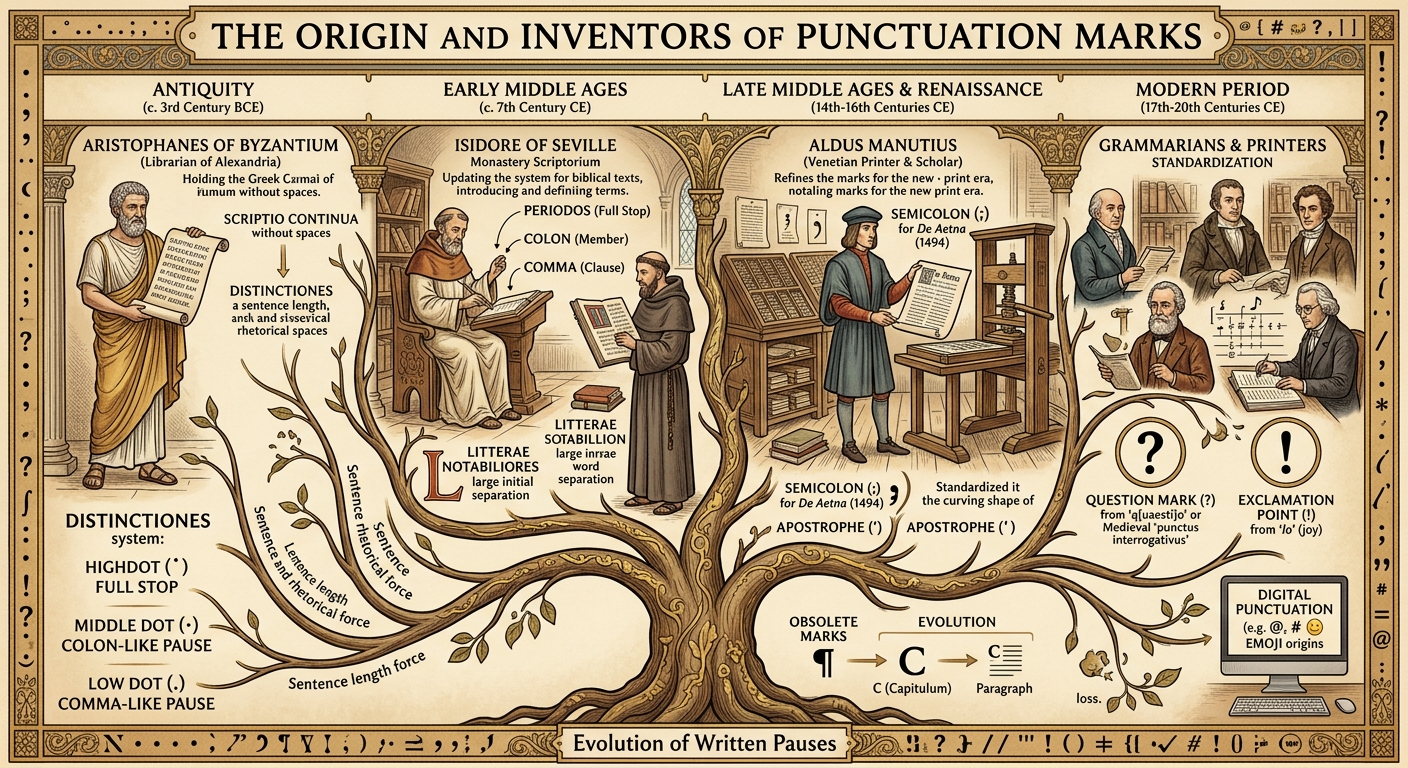
One particularly important figure was Aristophanes of Byzantium (c. 257–180 BCE), a Greek scholar associated with the Library of Alexandria, who is traditionally credited with developing an early systematic system of dots to indicate different levels of pause. Much later, Aldus Manutius (c. 1452–1515), the great Venetian printer, played a major role in developing and popularizing punctuation practices in European printing, particularly the semicolon and the standardized use of the comma. But neither man “invented punctuation” as a whole.
This thesis examines the evolution of punctuation from ancient writing through Greek and Roman civilization, medieval manuscripts, Renaissance printing, modern typography, and the digital age.
1. Introduction
Human speech is naturally organized by rhythm, pauses, intonation, emphasis, questions, and changes of thought. Writing, however, initially had difficulty representing these features.
Consider the following sentence without punctuation:
when we write language we need ways to show where ideas begin and end
A modern reader can understand it, but punctuation makes the structure immediately clearer:
When we write language, we need ways to show where ideas begin and end.
Punctuation therefore acts as a kind of organizational layer between language and writing.
It tells readers things such as:
- Where a sentence ends.
- Where one clause is separated from another.
- Where a pause occurs.
- Whether a statement is a question.
- Whether a word or phrase is being emphasized.
- Where a quotation begins and ends.
- How items in a list relate to one another.
- Whether two ideas are closely or loosely connected.
The history of punctuation is consequently also a history of reading, education, scholarship, religion, literature, printing, and information technology.
2. An Important Correction: There Was No Single Inventor
A common question is:
“Who invented punctuation?”
The historically accurate answer is:
Nobody invented the entire punctuation system.
Punctuation developed incrementally.
Different marks have different histories.
| Mark | Approximate historical development | Important contributors/traditions |
|---|---|---|
Period/full stop . | Ancient Greek and later Latin traditions | Greek scribes, Roman scribes, medieval scribes, printers |
Comma , | Ancient roots, standardized in Renaissance printing | Greek traditions; Aldus Manutius and printers |
Colon : | Ancient and medieval development | Greek/Latin scribes and medieval scholars |
Semicolon ; | Renaissance | Aldus Manutius / Aldine printing tradition |
Question mark ? | Medieval Europe | Medieval scribal tradition |
Exclamation mark ! | Medieval/early modern | European scribal and printing traditions |
Parentheses ( ) | Renaissance printing | Humanist scholars and printers |
Quotation marks " " | Early modern Europe | Printers and typographers |
Apostrophe ' | Renaissance printing | Greek/Latin scholarly printing traditions |
Hyphen - | Medieval/early modern manuscripts and printing | European scribes and printers |
Dash — | Early modern typography | European printers and typographers |
The crucial distinction is between origin, development, standardization, and popularization.
A person may not have created a symbol from nothing but may have played an enormous role in establishing its modern form.
3. Before Punctuation: The Earliest Writing Systems
The history of punctuation begins with the history of writing.
Some of the world’s earliest writing systems were not designed to represent complete spoken sentences in the way modern alphabets do.
3.1 Mesopotamia
The earliest known writing emerged in ancient Mesopotamia, particularly among the Sumerians, by the late fourth millennium BCE.
Cuneiform was primarily used for:
- administration,
- accounting,
- taxation,
- trade,
- religious texts,
- legal records,
- literature.
Early cuneiform did not use punctuation in the modern sense.
The organization of information often depended upon:
- signs,
- spacing,
- line arrangement,
- context,
- grammatical structure.
This demonstrates an important principle:
Writing can function without modern punctuation.
4. Ancient Egyptian Writing
Ancient Egyptian hieroglyphic writing also developed sophisticated conventions for organizing text.
Hieroglyphic inscriptions could use:
- visual grouping,
- determinatives,
- arrangement of signs,
- columns,
- lines,
- spaces.
Again, there was no punctuation system equivalent to today’s comma, semicolon, question mark, and quotation marks.
Ancient Egyptian scribes therefore relied heavily upon the visual organization of writing.
5. The Phoenician Contribution
The development of alphabetic writing was another major milestone.
The Phoenician alphabet, emerging during the second millennium BCE, strongly influenced later alphabetic systems.
The alphabet made writing more economical by representing speech primarily through a relatively small collection of symbols.
However, early alphabetic writing generally lacked the extensive punctuation system used in modern European languages.
6. Ancient Greek Writing
The Greeks made some of the most important early contributions to punctuation.
Early Greek inscriptions were frequently written in forms of scriptio continua, meaning that words could appear without spaces.
For example, something conceptually like:
THISISANEXAMPLEOFCONTINUOUSWRITING
could be written without modern word separation.
Reading such texts required considerable knowledge of the language.
This created a practical problem:
How could readers determine the structure of a continuous text?
Greek scholars gradually developed systems of marks to assist reading.
7. Aristophanes of Byzantium
7.1 The Man Traditionally Associated With Early Punctuation
One of the most important names in punctuation history is:
Aristophanes of Byzantium
c. 257–180 BCE
He was a Greek scholar and librarian associated with the Library of Alexandria.
He is traditionally credited with developing a system involving dots positioned at different heights to indicate different degrees of pause.
This is an extremely important development because it represents one of the earliest known attempts to create a systematic punctuation system for literary reading.
8. Aristophanes’ Three-Dot System
The traditional account associates Aristophanes with three basic positions:
High dot
A dot placed high on the line could indicate a longer pause.
Middle dot
A middle-positioned dot could indicate an intermediate pause.
Low dot
A low-positioned dot could indicate a shorter pause.
The exact historical relationship between Aristophanes’ system and modern punctuation should not be overstated. Ancient punctuation practices varied, and later systems changed considerably.
Nevertheless, Aristophanes is historically significant because he is associated with one of the earliest systematic attempts to guide readers through written language using punctuation.
9. Why Aristophanes Matters
His contribution was not simply the invention of three dots.
His deeper contribution was the recognition that:
Written language needs visual signals that help readers interpret its grammatical and rhetorical structure.
This idea became fundamental to Western writing.
Punctuation gradually evolved from indicating pauses for oral reading toward indicating syntactic and semantic relationships.
That transformation took centuries.
10. Roman Contributions
The Romans inherited much of their literary culture from the Greeks but developed their own writing conventions.
Latin manuscripts commonly used forms of punctuation, although punctuation was not standardized in the modern sense.
Roman writers and scribes used marks to:
- separate sections,
- organize inscriptions,
- indicate pauses,
- clarify text,
- structure lists.
One important mark was the interpunct, a small centered dot used in some ancient inscriptions to separate words.
For example, inscriptions could use something resembling:
ROMA·VINCIT
The interpunct was particularly useful because classical Latin writing frequently did not use modern spaces between words.
11. The Interpunct
The interpunct is historically fascinating.
It resembles:
·
It could function as a word separator.
This demonstrates that punctuation did not necessarily begin as sentence punctuation.
Some early marks were primarily concerned with:
“Where does one unit of writing end and another begin?”
Modern punctuation subsequently developed much more complex functions.
12. Medieval Manuscripts
After the decline of the Western Roman Empire, writing practices continued evolving through medieval Europe.
Monasteries became major centers for copying manuscripts.
Scribes copied:
- Biblical texts,
- theological works,
- philosophical writings,
- classical literature,
- legal documents,
- scientific manuscripts.
The increasing importance of reading silently also affected punctuation.
13. From Reading Aloud to Silent Reading
Early punctuation was strongly associated with helping readers perform texts aloud.
But medieval manuscript culture increasingly developed systems useful for silent reading.
This was an enormous conceptual change.
Punctuation became less about:
“Where should I breathe?”
and increasingly about:
“How is this sentence grammatically structured?”
That transition helped create the punctuation system recognizable today.
14. The Period or Full Stop
The period is one of the oldest and most fundamental punctuation marks.
Modern form:
.
Its ancestors include various dots used by ancient Greek and Latin scribes.
The dot gradually became associated with:
- sentence endings,
- abbreviations,
- textual divisions.
Its modern function became increasingly standardized through medieval and Renaissance writing and printing.
Therefore, it would be incorrect to identify a single inventor of the period.
15. The Comma
Modern comma:
,
The comma has a complicated history.
Ancient Greek scribes used various marks to assist reading, and later medieval and Renaissance traditions developed forms increasingly resembling the modern comma.
The comma eventually became an important grammatical tool for separating:
- clauses,
- phrases,
- list elements,
- introductory expressions.
16. Aldus Manutius
A major turning point occurred during the Renaissance.
One of the most important names in punctuation history is:
Aldus Manutius
c. 1452–1515
He was a Venetian humanist, scholar, publisher, and printer.
His printing operation, known as the Aldine Press, became famous for producing high-quality editions of Greek and Latin literature.
Manutius and his printing tradition played an important role in the development and standardization of punctuation.
17. The Semicolon
Modern semicolon:
;
The semicolon is particularly associated with the Renaissance printing tradition and Aldus Manutius.
It was developed as a mark capable of separating related but independent portions of text.
Conceptually:
Idea A; Idea B.
It occupies a middle position between:
- comma
, - period
.
The semicolon became particularly useful in complex prose.
18. Why the Printing Press Changed Punctuation
The invention of movable-type printing in Europe by Johannes Gutenberg and the subsequent growth of printing transformed punctuation.
Before printing, scribes could vary their practices considerably.
Printing created pressure toward:
- consistency,
- reproducibility,
- standard type forms,
- standardized spacing,
- predictable punctuation.
A manuscript could vary from copy to copy.
A printed book could produce thousands of substantially identical copies.
This made punctuation standardization much more important.
19. Johannes Gutenberg
Johannes Gutenberg
c. 1400–1468
Gutenberg did not invent punctuation.
His importance lies elsewhere.
He helped establish the European movable-type printing revolution.
The printing press created the technological environment in which punctuation conventions could spread rapidly.
Thus:
Aristophanes → early systematic punctuation
Medieval scribes → gradual development
Renaissance printers → standardization
Modern publishers and educational systems → widespread normalization
This is a much more accurate historical model.
20. The Question Mark
Modern question mark:
?
The history of the question mark is particularly interesting.
A commonly repeated explanation connects it with the Latin word associated with questioning, quaestio, but this story should be treated cautiously. Historical evidence shows that the symbol developed through medieval scribal practices rather than appearing suddenly from a single inventor’s decision.
Medieval manuscripts contain forms resembling the modern question mark.
Over time, its shape stabilized.
Today:
Are you coming?
The question mark tells the reader that the sentence is interrogative.
21. The Exclamation Mark
Modern exclamation mark:
!
Its history is also associated with medieval and early modern European manuscript and printing traditions.
One traditional explanation connects the mark with the Latin expression io, associated with joy or exclamation, with the letters eventually becoming stylized.
However, this etymological story is not certain enough to treat as an established fact.
The symbol eventually became associated with:
- surprise,
- excitement,
- emphasis,
- strong emotion,
- commands.
Example:
Stop!
22. The Colon
Modern colon:
:
The colon developed from earlier dot-based punctuation traditions.
Its modern functions include introducing:
- explanations,
- lists,
- examples,
- quotations,
- closely related statements.
Example:
There are three basic requirements: knowledge, practice, and patience.
Its development illustrates how punctuation gradually shifted from simple pauses to grammatical functions.
23. Parentheses
Modern parentheses:
( )
Parentheses became increasingly important during the Renaissance.
They allow writers to insert additional information into a sentence.
Example:
The printing revolution (which began in Europe during the fifteenth century) transformed communication.
The invention of parentheses cannot be assigned securely to one individual.
They emerged from broader European manuscript and printing practices.
24. The Apostrophe
Modern apostrophe:
'
The apostrophe emerged in Renaissance European printing.
It became especially important in languages such as:
- English,
- French,
- Italian,
- Greek.
It can represent:
- omitted letters,
- possession in English,
- certain contractions.
Examples:
don’t
John’s book
The apostrophe is therefore a product of historical writing and printing conventions rather than an invention attributable to one person.
25. Quotation Marks
Modern quotation marks:
" "
Quotation marks are relatively recent compared with the period and comma.
Early printers and scholars used various marks to indicate quotations or noteworthy passages.
Over time, different traditions developed:
"double quotes"'single quotes'- «guillemets»
- „German-style quotation marks“
- 「Japanese quotation marks」
There is therefore no single universal quotation-mark inventor.
26. The Hyphen
Modern hyphen:
-
The hyphen developed partly from manuscript and printing practices involving word division.
It became particularly useful for:
- compound words,
- line breaks,
- prefixes,
- certain grammatical constructions.
Its development was strongly connected to the practical requirements of handwriting and typesetting.
27. The Dash
Modern forms include:
–en dash—em dash
The dash became an increasingly important typographic device during the development of European printing.
It can indicate:
- interruption,
- parenthetical information,
- ranges,
- relationships,
- changes in thought.
The distinction between hyphen, en dash, and em dash is primarily a development of typography rather than an invention attributable to one individual.
28. The Slash
Modern slash:
/
The slash has a long history in writing and typography.
It has been used for:
- abbreviations,
- alternatives,
- divisions,
- dates,
- mathematical notation,
- computing.
Its modern uses expanded dramatically with the development of science, engineering, mathematics, and computing.
29. Punctuation and the Renaissance
The Renaissance was arguably one of the most important periods in the history of punctuation.
Several forces converged:
- Humanist scholarship.
- Recovery and printing of classical texts.
- Expansion of literacy.
- Growth of universities.
- Printing technology.
- Standardization of European languages.
- Development of increasingly complex prose.
Printers therefore needed a more consistent punctuation system.
30. Punctuation and Language Standardization
Punctuation became connected to the development of standardized languages.
For example, European languages gradually developed recognized conventions for:
- spelling,
- capitalization,
- word separation,
- punctuation,
- grammar.
Printed books helped spread these conventions.
Thus punctuation was not merely a typographical invention.
It became part of language standardization.
31. Punctuation in English
English punctuation developed gradually.
Early English manuscripts did not use punctuation in precisely the modern way.
Over centuries, English absorbed and adapted conventions from:
- Latin,
- French,
- Greek scholarship,
- medieval scribal culture,
- Renaissance printing.
By the seventeenth and eighteenth centuries, punctuation in printed English had become much closer to modern practice.
Later dictionaries, grammar books, publishers, schools, and governments reinforced standardized usage.
32. Punctuation in Other Writing Systems
It is important not to assume that punctuation is exclusively a European invention.
Different writing traditions developed their own systems.
Examples include:
Chinese
Traditional Chinese writing historically used little punctuation compared with modern Western writing.
Modern Chinese employs a sophisticated punctuation system including:
。,、?!;:“ ”
Modern Chinese punctuation was influenced partly by Western punctuation systems during modernization.
Japanese
Japanese uses punctuation such as:
。、?!「 」
Arabic
Arabic writing developed its own punctuation conventions, with modern Arabic punctuation incorporating both indigenous practices and forms influenced by European typography.
Indian scripts
Modern languages using scripts such as Devanagari increasingly use punctuation systems incorporating the period, comma, question mark, and other marks, although traditional textual conventions differ.
33. Punctuation Is a Global Technology
The history therefore cannot be reduced to:
“Europe invented punctuation.”
A better interpretation is:
Different writing cultures developed different mechanisms for organizing written language, while modern global publishing subsequently encouraged substantial convergence in punctuation practices.
This is an important distinction.
34. Punctuation and Grammar
One of the greatest changes in punctuation history was the transition from punctuation as a guide to reading rhythm toward punctuation as an indicator of grammar and syntax.
Compare:
Early conceptual function
Pause here.
with:
Modern function
Separate this dependent clause from the independent clause.
Modern punctuation therefore carries grammatical information.
35. Punctuation as an Information Technology
Punctuation can be understood as an early information technology.
It compresses information.
For example:
John said Mary was coming.
is ambiguous.
But:
John said, “Mary was coming.”
is much clearer.
The quotation marks communicate a relationship between the words and the speaker.
Similarly:
Let’s eat, Grandma.
is structurally different from:
Let’s eat Grandma.
The comma changes interpretation.
This demonstrates the extraordinary information density of punctuation.
36. Punctuation and Meaning
Punctuation can alter meaning dramatically.
Consider:
We need to discuss the students.
versus:
We need to discuss the students’ work.
The apostrophe provides grammatical information.
Likewise:
The project succeeded.
versus:
The project succeeded!
The exclamation mark adds emotional emphasis.
Thus punctuation is not merely decorative.
It is semantic.
37. Punctuation and Mathematics
Modern mathematical notation greatly expanded the importance of symbols.
Mathematics uses marks including:
+−=/%:√- parentheses,
- brackets,
- braces.
Some of these are better classified as mathematical operators or notation rather than ordinary punctuation.
Nevertheless, the broader evolution of symbolic writing demonstrates how humans increasingly used small visual marks to encode complex relationships.
38. Punctuation and Science
Scientific writing depends heavily on punctuation.
A scientific paper may use:
- commas,
- semicolons,
- colons,
- parentheses,
- brackets,
- quotation marks,
- hyphens,
- dashes,
- decimal points.
Scientific notation also relies on highly precise symbolic conventions.
A misplaced punctuation mark can sometimes change the interpretation of a technical statement.
39. Punctuation and Programming Languages
Computing transformed punctuation yet again.
Programming languages use punctuation-like symbols extensively:
()
[]
{}
;
:
,
.
These symbols can represent:
- functions,
- arrays,
- objects,
- blocks,
- statements,
- separators,
- namespaces,
- operators.
For example, in many programming languages:
if (x > 10) {
    ...
}
The parentheses and braces are not merely linguistic punctuation.
They are syntactic control symbols.
40. The Digital Revolution
The computer age dramatically expanded the role of punctuation.
Email introduced widespread use of:
@
The internet popularized:
/
URLs use:
:
/
.
Programming uses:
{ }
[ ]
( )
Social media popularized:
#
@
and combinations such as:
:-)
The boundary between punctuation and symbolic notation therefore became increasingly blurred.
41. Emojis and the Evolution Beyond Punctuation
The digital age introduced another major development:
emoji.
Emoji are not simply punctuation marks, but they perform some functions traditionally associated with punctuation.
For example, a sentence may end with:
😊
rather than relying entirely on words to communicate emotional tone.
Digital communication therefore represents a partial return to something ancient:
visual signals helping readers interpret text.
42. Punctuation as Human-Computer Language
Modern computing has made punctuation a component of machine-readable language.
A computer can distinguish:
Afrom:
A;or:
A()or:
A[]The symbols now have formal computational meanings.
This represents a remarkable transformation.
A mark originally used to help a human reader pause can now determine whether a computer program executes correctly.
43. Who Invented Each Major Punctuation Mark?
A useful historical summary is:
Period .
No single inventor.
Developed from ancient dot-based punctuation and later standardized.
Comma ,
No single inventor.
Developed from ancient and medieval punctuation traditions and standardized by printers.
Colon :
No single inventor.
Developed from ancient dot-based systems and later grammatical conventions.
Semicolon ;
Strongly associated with Aldus Manutius and Renaissance printing.
Question mark ?
Medieval European development; no universally accepted single inventor.
Exclamation mark !
Medieval/early modern European development; no securely established single inventor.
Parentheses ( )
Renaissance manuscript and printing development.
Apostrophe '
Renaissance printing development.
Quotation marks " "
Early modern European printing development.
Hyphen -
Medieval/early modern scribal and printing development.
Dash —
Early modern typographic development.
44. The Two Most Important Individuals
If we ask:
“Who are the two most important people associated with the development of Western punctuation?”
Two names stand out.
Aristophanes of Byzantium
Importance:
- ancient Greek scholarship,
- early systematic punctuation,
- reading guidance,
- organization of literary texts.
Aldus Manutius
Importance:
- Renaissance printing,
- punctuation standardization,
- semicolon,
- development of practical punctuation for printed prose,
- enormous influence on European publishing.
But they should not be described as the sole inventors of punctuation.
45. A Chronological Timeline
| Period | Development |
|---|---|
| c. 3200 BCE | Mesopotamian writing emerges |
| c. 3000–2000 BCE | Egyptian writing develops sophisticated visual organization |
| 2nd millennium BCE | Alphabetic traditions develop |
| 1st millennium BCE | Greek alphabetic writing becomes widespread |
| Classical Greece | Various punctuation marks develop |
| c. 257–180 BCE | Aristophanes of Byzantium associated with systematic dot punctuation |
| Roman period | Interpuncts and other marks used in Latin writing |
| Late Antiquity | Christian manuscripts develop additional textual conventions |
| Early Middle Ages | Scribal punctuation evolves |
| Medieval period | Question-mark-like forms and other marks develop |
| 12th–14th centuries | Increasing grammatical and textual punctuation |
| 15th century | European printing revolution |
| c. 1450s onward | Gutenberg printing revolution |
| Late 15th century | Aldine printing develops influential punctuation practices |
| 16th century | Comma, semicolon, parentheses, apostrophe and quotation practices expand |
| 17th century | English punctuation becomes increasingly standardized |
| 18th century | Grammar and publishing conventions strengthen |
| 19th century | Schooling, newspapers and mass printing spread standardized punctuation |
| 20th century | Typewriters and international typography standardize keyboard punctuation |
| Late 20th century | Computers transform symbolic writing |
| 21st century | Digital communication, programming and emoji expand punctuation’s functions |
46. Punctuation and the Printing Press: A Major Turning Point
The printing press deserves special attention.
Before printing:
one manuscript → one physical copy
After printing:
one type arrangement → many copies
This created a powerful incentive to standardize punctuation.
A printer needed to decide:
- Which comma shape to use?
- Where should periods go?
- How should quotations be marked?
- How should paragraphs be separated?
- How should abbreviations be represented?
- How should lines be justified?
- How should hyphenation work?
Typography consequently became an engineering discipline as well as an artistic one.
47. The Industrial Age
The nineteenth century introduced:
- mass newspapers,
- mass education,
- typewriters,
- standardized textbooks,
- dictionaries,
- professional publishing.
These institutions reinforced punctuation conventions.
Schools taught students:
where to put commas,
where sentences end,
how quotations work,
how apostrophes function.
Punctuation therefore became part of formal literacy.
48. The Typewriter
The typewriter further standardized punctuation.
Keyboard layouts had to determine which symbols were easily accessible.
The practical keyboard therefore influenced which punctuation marks people could use efficiently.
This was an important step toward today’s computer keyboard.
49. The Computer Keyboard
Modern keyboards contain punctuation and symbols such as:
, . / ; ' [ ] \ - =and with modifier keys:
< > ? : " { } | _ +Thus modern punctuation is partly shaped by keyboard engineering.
50. Unicode
One of the most important developments in modern symbolic writing is Unicode.
Unicode provides standardized digital representations for characters from many writing systems.
It allows computers to represent:
- Latin punctuation,
- Greek punctuation,
- Arabic punctuation,
- Chinese punctuation,
- mathematical symbols,
- technical symbols,
- many other writing-system characters.
This is effectively a global digital character infrastructure.
51. The Internet and New Punctuation
Internet communication created new conventions.
Examples include:
Hashtag
#
Mention
@
URL
https://
name@example.com
Markdown
# Heading
**bold**
[text](link)
These symbols demonstrate that punctuation has evolved beyond its original role in printed prose.
52. Punctuation in Artificial Intelligence
AI introduces another stage in punctuation’s history.
Large language models process text as sequences of tokens.
Punctuation can become part of those tokenized representations.
For example:
“Hello, world!”
contains words and punctuation that may be represented as separate or combined tokens depending on the tokenizer.
This means punctuation now participates in:
- natural-language processing,
- machine translation,
- speech recognition,
- text generation,
- search engines,
- programming,
- information retrieval.
The tiny marks created and refined by ancient scribes have consequently become part of the computational representation of human language.
53. Punctuation as a Layer of Civilization
The history of punctuation reflects a much larger story.
Stage 1 — Oral language
Humans communicate through:
- sound,
- rhythm,
- pauses,
- gestures.
Stage 2 — Early writing
Writing records:
- objects,
- transactions,
- names,
- events.
Stage 3 — Literary writing
Writing needs mechanisms to guide reading.
Stage 4 — Systematic punctuation
Scholars develop marks to structure text.
Stage 5 — Manuscript culture
Scribes refine punctuation.
Stage 6 — Printing
Printers standardize it.
Stage 7 — Mass education
Schools teach it.
Stage 8 — Typewriting
Keyboard technology constrains and standardizes it.
Stage 9 — Computing
Punctuation becomes machine syntax.
Stage 10 — Artificial intelligence
Punctuation becomes part of machine-readable language.
54. The Deeper Meaning of Punctuation
Punctuation is ultimately an attempt to solve a fundamental problem:
Speech contains information that letters alone cannot easily represent.
Speech includes:
- pauses,
- rhythm,
- emphasis,
- questions,
- emotional tone,
- sentence boundaries,
- relationships between clauses.
Punctuation provides visual representations of some of these features.
It is therefore a bridge between:
spoken language → written language → structured information → machine language.
55. Major Historical Personalities
A broader history of punctuation includes many categories of contributors.
Aristophanes of Byzantium
Ancient Greek scholar associated with early systematic punctuation.
Roman scribes
Developed and transmitted punctuation and word-separation practices in Latin writing.
Medieval Christian scribes
Refined manuscript punctuation and textual organization.
Renaissance humanists
Promoted clearer organization of classical and vernacular texts.
Aldus Manutius
Major figure in Renaissance printing and punctuation development.
Johannes Gutenberg
Created the technological environment that accelerated printing standardization.
Early modern printers
Standardized many punctuation forms through repeated typographic practice.
Grammarians
Converted practical conventions into formal rules.
Dictionary makers
Helped normalize punctuation alongside spelling.
Modern publishers
Established editorial style systems.
Computer scientists
Transformed punctuation into formal programming syntax.
56. What We Should Not Say
Several popular claims about punctuation should be treated carefully.
Incorrect:
“Aristophanes invented punctuation.”
Better:
Aristophanes of Byzantium is traditionally associated with an early systematic system of punctuation.
Incorrect:
“Aldus Manutius invented all modern punctuation.”
Better:
Aldus Manutius and the Aldine printing tradition played a major role in developing and popularizing important Renaissance punctuation conventions, including the semicolon.
Incorrect:
“Gutenberg invented punctuation.”
Better:
Gutenberg’s printing revolution accelerated the standardization and dissemination of punctuation.
57. The Greatest Lesson
The history of punctuation teaches an important lesson about technological innovation.
Most technologies do not appear fully formed.
They evolve through:
experimentation → adoption → modification → standardization → mass dissemination.
Punctuation followed exactly this pattern.
No single person sat down and invented:
. , ; : ? !
Instead, thousands of years of human experimentation gradually produced the system.
58. Conclusion
Punctuation is one of humanity’s oldest information technologies.
Its roots reach back to ancient writing cultures, but its development cannot be attributed to a single inventor.
Ancient civilizations created visual methods for organizing writing. Greek scholars developed systematic approaches to textual pauses and structure. Aristophanes of Byzantium occupies a particularly important position because he is traditionally associated with an early systematic punctuation system.
Roman scribes developed additional conventions, while medieval scribes transformed punctuation as manuscript culture evolved. During the Renaissance, the emergence of printing created unprecedented pressure for consistency. Aldus Manutius and other printers played particularly important roles in the development and dissemination of punctuation forms that eventually became standard.
The printing press then transformed punctuation from a relatively flexible scribal practice into an increasingly standardized component of mass communication.
The nineteenth and twentieth centuries brought newspapers, education, typewriters and publishing standards. The computer age transformed punctuation again, turning familiar marks into elements of programming languages, URLs, email addresses, digital markup and machine-readable syntax.
Today, punctuation exists simultaneously in several worlds:
literature, education, journalism, science, mathematics, computing, telecommunications and artificial intelligence.
A tiny dot can terminate a sentence.
A comma can change interpretation.
A question mark can transform a statement into a question.
A semicolon can connect two independent ideas.
A pair of quotation marks can identify another person’s words.
And a single character such as { can determine the structure of a computer program.
The story of punctuation is therefore not merely the story of small marks on a page. It is the story of humanity learning to transform speech into writing, writing into structured information, and structured information into digital language.
In that sense, punctuation represents one of the quiet technological foundations of civilization.
A concise historical formula
Ancient writing → Greek scholarly punctuation → Roman conventions → medieval scribal systems → Renaissance printing → grammatical standardization → typewriter → computer keyboard → Internet → Unicode → AI and machine language
That is the broad evolutionary pathway from the earliest textual marks to the punctuation system used around the world today.






Be First to Comment