
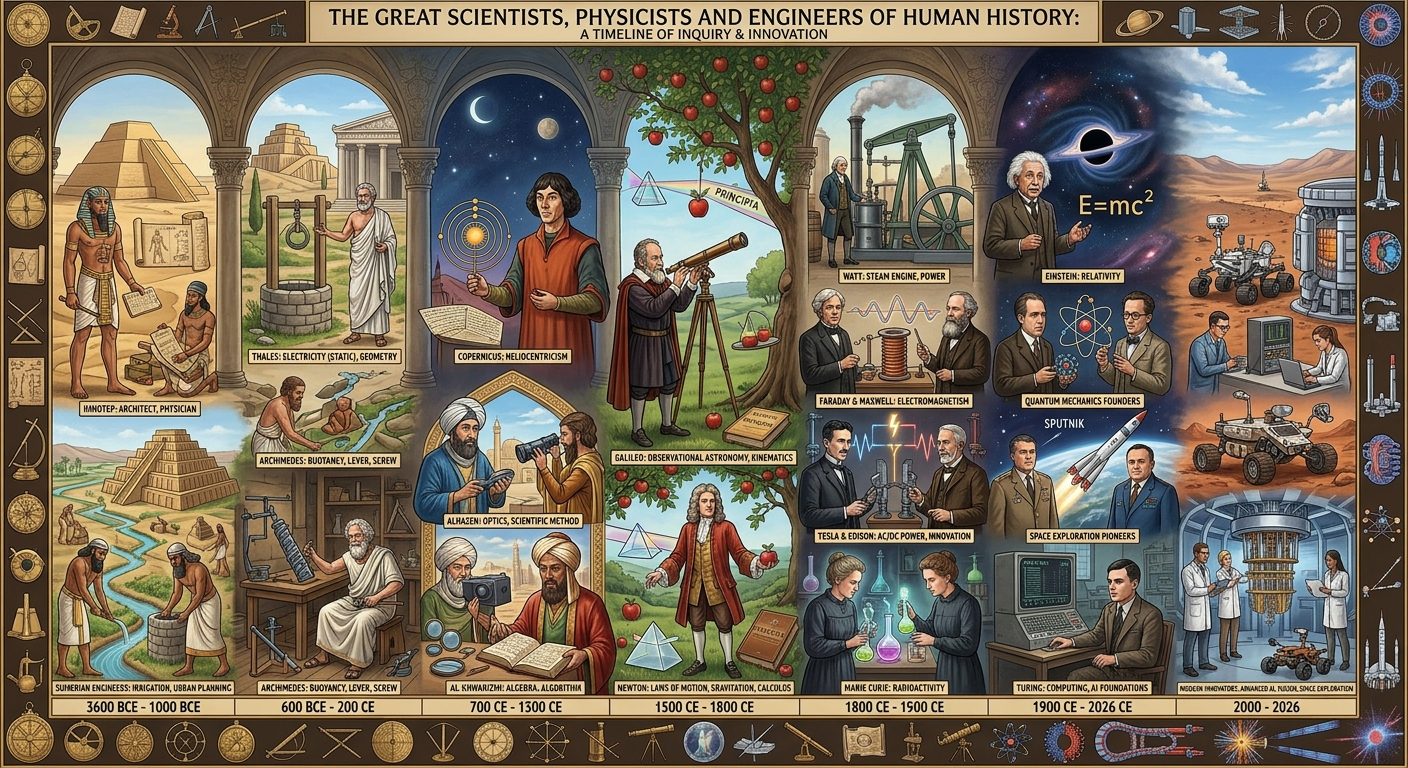
From approximately 5630 years ago to 2026
Abstract
The history of science and engineering is not the history of one civilization, one continent, or one century. It is a cumulative human enterprise that developed through thousands of years of observation, mathematics, experimentation, construction, astronomy, medicine, mechanics, materials science, and technological invention.
Approximately 5,630 years ago—around 3600 BCE—human societies were already developing writing, measurement, mathematics, astronomy, architecture, metallurgy, irrigation, transportation and large-scale construction. However, it is important to distinguish between the history of scientific knowledge and the history of scientists whose personal names are known. Written records from the earliest civilizations are incomplete, and many people responsible for important discoveries remain anonymous. Evidence for systematic scientific activity becomes substantially clearer with the emergence of writing in ancient Egypt and Mesopotamia.
Over subsequent millennia, identifiable intellectual figures emerged: Imhotep, Thales, Pythagoras, Euclid, Archimedes, Aryabhata, Al-Khwarizmi, Ibn al-Haytham, Shen Kuo, Leonardo da Vinci, Copernicus, Galileo, Kepler, Newton, Faraday, Maxwell, Darwin, Tesla, Einstein, Curie, Rutherford, Fermi, Turing, von Neumann, Hubble, Oppenheimer, Shannon, Watson, Crick, Feynman, Hawking and thousands of others.
This thesis presents a chronological intellectual map from approximately 3600 BCE to 2026, emphasizing scientists, physicists, mathematicians and engineers whose work substantially influenced human knowledge and technology.
1. Introduction
Modern science did not suddenly appear in Europe during the Scientific Revolution. Its foundations were constructed gradually by many civilizations.
Ancient Egypt and Mesopotamia developed mathematical, astronomical, medical and engineering knowledge. India, China, Greece, Persia, the Islamic world, Africa, the Americas and Europe each contributed important bodies of knowledge. Modern science subsequently emerged through the interaction of observation, mathematics, experimentation, instruments, institutions and international exchange.
Engineering likewise has extremely ancient roots. The pyramids, Mesopotamian cities, irrigation systems, Indus Valley cities, Chinese infrastructure, Greek mechanical devices and Roman roads and aqueducts demonstrate sophisticated engineering long before the modern professional title “engineer” existed.
Therefore, this thesis uses scientist broadly to include historically important:
- mathematicians
- astronomers
- natural philosophers
- physicists
- chemists
- biologists
- medical scientists
- computer scientists
- engineers
- inventors
- geologists
- Earth scientists
- materials scientists
- technological pioneers
2. An Important Problem: 5630 Years Ago
Around 3600 BCE, humans did not use modern scientific titles such as “physicist,” “engineer” or “scientist.”
Consequently, it would be historically misleading to produce a list of named “scientists” beginning exactly in 3600 BCE.
The earliest civilizations left evidence of sophisticated mathematics, astronomy, architecture, metallurgy and administration, but the identities of many individuals are unknown. Written mathematical and astronomical traditions from Egypt and Mesopotamia provide some of the earliest identifiable intellectual traditions.
For this reason, the historical timeline should be understood as:
Anonymous innovators → named scribes and scholars → natural philosophers → mathematicians and engineers → experimental scientists → modern professional scientists and engineers.
3. c. 3600–2500 BCE — The Age of Anonymous Engineers
Major civilizations
- Sumer and Mesopotamia
- Ancient Egypt
- Indus Valley civilization
- Early Chinese civilizations
Major achievements
Humanity developed or refined:
- writing
- numerical systems
- measurement
- surveying
- irrigation
- monumental architecture
- metallurgy
- wheeled transportation
- calendars
- astronomy
- hydraulic engineering
- agricultural technology
The wheel and wheel-and-axle system appeared in Mesopotamia during the 5th millennium BCE, while early Egyptian and Mesopotamian civilizations developed mathematical and astronomical traditions.
Most of the individuals responsible for these achievements are unfortunately unknown.
This is an important lesson in the history of science:
Humanity’s scientific history is much older than the surviving names of scientists.
4. Ancient Egypt — The First Famous Named Engineer
Imhotep
c. 27th century BCE
Imhotep is one of the earliest known individuals whose name is associated with engineering, architecture and medicine.
He is traditionally associated with the Step Pyramid of Djoser at Saqqara.
His historical importance extends beyond architecture because later Egyptian traditions remembered him as a physician and intellectual.
He is frequently described as the earliest known named engineer or architect in recorded history.
Other early Egyptian intellectuals
- Ahmes (Ahmose) — mathematics
- Hesy-Ra — medicine
- Merer — administration/logistics associated with pyramid construction
- Ptahhotep — intellectual tradition and administration
Not every individual traditionally associated with ancient technical achievements can be classified as a scientist according to modern definitions.
5. Mesopotamian Science
Mesopotamia produced important mathematical and astronomical traditions.
Important developments
- base-60 mathematics
- astronomical observation
- geometric calculation
- calendars
- eclipse records
- surveying
- numerical tables
The Babylonian mathematical tradition eventually influenced later Greek and other scientific traditions.
Many early Mesopotamian mathematicians were anonymous scribes rather than famous individuals.
6. Ancient Greece — The Birth of Natural Philosophy
Thales of Miletus
c. 624–546 BCE
Thales is traditionally associated with mathematics, astronomy and natural philosophy.
He represents an important transition toward explaining natural phenomena through rational causes rather than exclusively mythological explanations.
Anaximander
c. 610–546 BCE
Important contributions included cosmology, geography and attempts to explain nature systematically.
Anaximenes
c. 586–526 BCE
Developed early theories concerning the nature of matter and the cosmos.
Pythagoras
c. 570–495 BCE
Associated with mathematics, geometry and mathematical relationships in nature.
Heraclitus
c. 535–475 BCE
Known for philosophical ideas concerning change and nature.
Democritus
c. 460–370 BCE
Developed an early atomistic philosophy in which matter was understood through fundamental particles.
Plato
c. 428–348 BCE
Made major contributions to philosophy, mathematics and theories of knowledge.
Aristotle
384–322 BCE
Aristotle wrote extensively about physics, biology, astronomy, logic and natural philosophy. His classification of knowledge profoundly influenced scientific thought for centuries.
7. Hellenistic Science
Euclid
fl. c. 300 BCE
Euclid’s Elements became one of the most influential mathematical works in history.
His name became synonymous with classical geometry.
Archimedes
c. 287–212 BCE
Archimedes was simultaneously a mathematician, physicist and engineer.
Major areas include:
- mechanics
- hydrostatics
- geometry
- centers of mass
- levers
- buoyancy
- mechanical devices
He is one of history’s greatest examples of the connection between theoretical mathematics and practical engineering.
Eratosthenes
c. 276–194 BCE
Worked in mathematics, geography and astronomy.
He made an influential calculation of Earth’s circumference.
Aristarchus of Samos
c. 310–230 BCE
Proposed an early heliocentric model in which Earth moved around the Sun.
Hipparchus
c. 190–120 BCE
Major contributions to astronomy, trigonometry and stellar observation.
Hero of Alexandria
c. 1st century CE
Important mathematician and engineer associated with mechanical and pneumatic devices.
8. Roman and Late Classical Science
Vitruvius
1st century BCE
Roman architect and engineer whose writings became influential in architecture and engineering.
Ptolemy
c. 100–170 CE
Claudius Ptolemy contributed to:
- astronomy
- mathematics
- geography
- optics
His astronomical model dominated European and Middle Eastern astronomy for centuries.
9. Indian Scientific Traditions
India produced major developments in mathematics, astronomy, medicine and metallurgy.
Aryabhata
476–c. 550 CE
Major mathematician and astronomer.
Associated with:
- astronomical calculations
- mathematics
- trigonometry
- approximation of π
- explanations of astronomical phenomena
Brahmagupta
598–c. 668 CE
Made major contributions to mathematics, including systematic treatment of zero and negative numbers.
Bhaskara I
c. 600–680 CE
Mathematician and astronomer.
Bhaskara II
1114–c. 1185 CE
Major contributions to mathematics and astronomy.
Sushruta
ancient India
Associated with the development of sophisticated surgical knowledge.
Charaka
ancient India
Important figure in the history of medicine.
10. Chinese Science and Engineering
China developed remarkable traditions in:
- mathematics
- astronomy
- metallurgy
- civil engineering
- mechanical engineering
- printing
- navigation
- military technology
- agriculture
The historical development of Chinese science cannot be reduced to a few individuals; many innovations emerged through institutions and anonymous craftsmen.
Important named scholars
Zhang Heng
78–139 CE
Astronomer, mathematician, engineer and inventor.
Associated with:
- astronomy
- earthquake detection
- mechanical engineering
- mathematics
Zu Chongzhi
429–500 CE
Mathematician and astronomer famous for highly accurate calculations of π.
Shen Kuo
1031–1095
One of China’s great polymaths.
Worked in:
- astronomy
- mathematics
- geology
- engineering
- optics
- magnetism
- cartography
Qin Jiushao
c. 1202–1261
Mathematician.
Guo Shoujing
1231–1316
Astronomer, mathematician and engineer.
11. The Islamic Golden Age
Between approximately the 8th and 14th centuries, scholars working across the Islamic world played a major role in preserving, transforming and extending mathematical, astronomical, medical and scientific knowledge. Modern histories of science increasingly emphasize this period as an essential bridge in the global development of science.
Al-Khwarizmi
c. 780–850
Major mathematician and astronomer.
His name is associated with the word algorithm, while his mathematical work was central to the development of algebra.
Al-Kindi
c. 801–873
Polymath who worked in mathematics, philosophy, optics, music and cryptography.
Al-Farabi
c. 872–950
Philosopher and scholar of logic and natural philosophy.
Al-Battani
c. 858–929
Astronomer and mathematician.
Al-Razi
c. 865–925
Physician, chemist/alchemist and philosopher.
Abu al-Wafa
940–998
Mathematician and astronomer.
Ibn al-Haytham
c. 965–1040
One of the most important figures in the history of optics.
His investigations into vision, light and experimentation helped shape later scientific methodology.
Al-Biruni
973–c. 1050
Polymath whose work included:
- astronomy
- mathematics
- geography
- geology
- anthropology
- chronology
Avicenna — Ibn Sina
c. 980–1037
Physician, philosopher and scholar.
His Canon of Medicine became enormously influential.
Omar Khayyam
1048–1131
Mathematician, astronomer and poet.
Al-Jazari
1136–1206
Engineer and inventor associated with sophisticated mechanical devices, water systems and automata.
12. European Medieval and Renaissance Science
Roger Bacon
c. 1219–1292
Philosopher and advocate of observation and experimentation.
Nicole Oresme
c. 1320–1382
Mathematician and natural philosopher.
Leonardo da Vinci
1452–1519
One of history’s greatest polymaths.
Fields included:
- engineering
- anatomy
- mechanics
- architecture
- hydraulics
- astronomy
- art
His notebooks demonstrate extraordinary interdisciplinary thinking.
Nicolaus Copernicus
1473–1543
Proposed a mathematical heliocentric model of the Solar System.
Tycho Brahe
1546–1601
Produced exceptionally accurate astronomical observations before the invention of modern telescopes.
13. The Scientific Revolution
Galileo Galilei
1564–1642
Physicist, astronomer and mathematician.
Important areas:
- motion
- mechanics
- astronomy
- telescopic observation
Johannes Kepler
1571–1630
Established the three famous laws describing planetary motion.
René Descartes
1596–1650
Mathematician and philosopher who helped establish analytic geometry.
Christiaan Huygens
1629–1695
Physicist, mathematician and astronomer.
Major work included:
- pendulum clocks
- wave theory of light
- astronomy
- mechanics
Robert Hooke
1635–1703
Physicist, microscopist, engineer and inventor.
Isaac Newton
1643–1727
One of the central figures in the history of physics.
Major contributions:
- laws of motion
- universal gravitation
- calculus
- optics
- celestial mechanics
Newton’s work transformed physics and mathematics.
14. Eighteenth-Century Science
Major scientists
- Daniel Bernoulli — mathematics and fluid mechanics
- Leonhard Euler — mathematics, mechanics and physics
- Joseph-Louis Lagrange — mathematics and mechanics
- Pierre-Simon Laplace — mathematics, astronomy and physics
- Benjamin Franklin — electricity and experimental science
- Charles-Augustin de Coulomb — electricity and magnetism
- Henry Cavendish — chemistry and physics
- Antoine Lavoisier — chemistry
- Alessandro Volta — electricity
- Luigi Galvani — bioelectricity
- James Watt — mechanical engineering and steam technology
This period established increasingly quantitative approaches to physics and chemistry.
15. Nineteenth-Century Physics
The nineteenth century produced an extraordinary expansion of physics.
Michael Faraday
1791–1867
Major contributions:
- electromagnetism
- electrochemistry
- electric motors
- generators
André-Marie Ampère
1775–1836
Major figure in electromagnetism.
Georg Ohm
1789–1854
Associated with Ohm’s law.
Joseph Fourier
1768–1830
Developed Fourier analysis and important theories of heat.
Sadi Carnot
1796–1832
Founder of thermodynamic theory.
James Prescott Joule
1818–1889
Major contributions to thermodynamics and energy.
William Thomson — Lord Kelvin
1824–1907
Major physicist in thermodynamics and electromagnetism.
James Clerk Maxwell
1831–1879
Unified electricity, magnetism and light mathematically through Maxwell’s equations.
He is one of the most important physicists in history.
16. Nineteenth-Century Chemistry and Biology
John Dalton
1766–1844
Developed an influential atomic theory of matter.
Dmitri Mendeleev
1834–1907
Developed the periodic arrangement of chemical elements.
Charles Darwin
1809–1882
Developed the theory of evolution by natural selection.
Gregor Mendel
1822–1884
Established foundational principles of genetic inheritance through experiments with pea plants.
Louis Pasteur
1822–1895
Major contributions to microbiology, chemistry and infectious disease science.
Alfred Russel Wallace
1823–1913
Independently developed the theory of evolution by natural selection.
17. Engineering Revolution
The Industrial Revolution transformed engineering into a major professional and scientific discipline.
Important engineers and inventors
- James Watt — steam engines
- George Stephenson — railway engineering
- Isambard Kingdom Brunel — civil and mechanical engineering
- George Cayley — aeronautics
- Gustave Eiffel — structural engineering
- Nikola Tesla — electrical engineering
- Thomas Edison — electrical technology
- Alexander Graham Bell — telecommunications
- Karl Benz — automotive engineering
- Rudolf Diesel — internal-combustion engines
- Orville Wright — aviation
- Wilbur Wright — aviation
18. Electricity and Electromagnetism
The development of electrical engineering involved many scientists.
Major names
- Benjamin Franklin
- Alessandro Volta
- Luigi Galvani
- André-Marie Ampère
- Georg Ohm
- Michael Faraday
- James Clerk Maxwell
- Heinrich Hertz
- Nikola Tesla
- Thomas Edison
- Oliver Heaviside
- Alexander Graham Bell
- Guglielmo Marconi
Their combined work produced the conceptual and technological foundations of modern electrical infrastructure and telecommunications.
19. The Birth of Modern Physics
At the end of the nineteenth century, classical physics encountered phenomena that could not be fully explained using existing theories.
These included:
- blackbody radiation
- the photoelectric effect
- atomic spectra
- radioactivity
- the Michelson–Morley experiment
- electron discovery
- quantum phenomena
This crisis produced modern physics.
20. Marie Curie and Radioactivity
Marie Skłodowska Curie
1867–1934
Physicist and chemist.
Major work:
- radioactivity
- polonium
- radium
- medical applications of radiation
She became one of the most influential scientists in the history of physics and chemistry.
Pierre Curie
1859–1906
Important contributions to:
- radioactivity
- magnetism
- piezoelectricity
Henri Becquerel
1852–1908
Discovered spontaneous radioactivity.
21. Einstein and Relativity
Albert Einstein
1879–1955
One of history’s most influential physicists.
Major contributions include:
- special relativity
- general relativity
- photoelectric effect
- Brownian motion
- quantum theory
His work fundamentally changed humanity’s understanding of space, time, matter and energy.
22. The Quantum Revolution
Major figures
- Max Planck — quantum theory
- Albert Einstein — quantum theory and relativity
- Niels Bohr — atomic theory
- Louis de Broglie — matter waves
- Werner Heisenberg — quantum mechanics
- Erwin Schrödinger — wave mechanics
- Wolfgang Pauli — quantum mechanics
- Paul Dirac — quantum theory and relativistic quantum mechanics
- Max Born — quantum mechanics
- Enrico Fermi — nuclear physics
- Satyendra Nath Bose — quantum statistics
- Lise Meitner — nuclear physics
- Emmy Noether — mathematical physics
- Arthur Compton — quantum physics
- Arthur Eddington — astrophysics and relativity
23. Nuclear Physics
Major figures include:
- Ernest Rutherford
- Niels Bohr
- James Chadwick
- Enrico Fermi
- Lise Meitner
- Otto Hahn
- Leo Szilard
- J. Robert Oppenheimer
- Hans Bethe
- Richard Feynman
Ernest Rutherford’s work was particularly important to the development of nuclear physics.
James Chadwick discovered the neutron.
24. Astronomy and Astrophysics
Major names
- Nicolaus Copernicus
- Tycho Brahe
- Johannes Kepler
- Galileo Galilei
- Isaac Newton
- William Herschel
- Henrietta Swan Leavitt
- Annie Jump Cannon
- Cecilia Payne-Gaposchkin
- Edwin Hubble
- Georges Lemaître
- Subrahmanyan Chandrasekhar
- Arthur Eddington
- Vera Rubin
- Jocelyn Bell Burnell
- Stephen Hawking
- Roger Penrose
- Kip Thorne
These scientists helped transform astronomy from positional observation into modern astrophysics and cosmology.
25. Computing and Information Science
The twentieth century introduced a new scientific domain: computation.
Alan Turing
1912–1954
Founder of important areas of theoretical computer science and artificial intelligence.
John von Neumann
1903–1957
Major contributions to:
- mathematics
- computing
- quantum mechanics
- game theory
- computer architecture
Claude Shannon
1916–2001
Founder of modern information theory.
Norbert Wiener
1894–1964
Founder of cybernetics.
Grace Hopper
1906–1992
Pioneer of programming languages and compiler development.
John Backus
1924–2007
Led development of FORTRAN.
Donald Knuth
1938–
Major figure in algorithms and theoretical computer science.
26. Semiconductor and Microelectronics Revolution
The modern digital world depends on semiconductor science and engineering.
Major figures
- William Shockley
- John Bardeen
- Walter Brattain
- Jack Kilby
- Robert Noyce
- Gordon Moore
- Federico Faggin
- Carver Mead
- Lynn Conway
- Seymour Cray
Their work helped establish:
transistor → integrated circuit → microprocessor → personal computer → smartphone → cloud computing → AI hardware
27. Telecommunications
Important pioneers include:
- Alexander Graham Bell
- Guglielmo Marconi
- Claude Shannon
- Harry Nyquist
- Ralph Hartley
- Edwin Armstrong
- John Bardeen
- Walter Brattain
- William Shockley
- Arthur C. Clarke
Modern telecommunications subsequently expanded through fiber optics, satellites, cellular networks, digital communications and Internet engineering.
28. Space Science and Rocket Engineering
Major names
- Konstantin Tsiolkovsky
- Robert Goddard
- Hermann Oberth
- Sergei Korolev
- Wernher von Braun
- Katherine Johnson
- Mary Jackson
- Dorothy Vaughan
- Margaret Hamilton
- Neil Armstrong
- Buzz Aldrin
- Sally Ride
The space age required the integration of:
physics + mathematics + materials science + electronics + computer science + aerospace engineering + systems engineering.
29. Molecular Biology and Genetics
Major scientists
- Rosalind Franklin
- James Watson
- Francis Crick
- Maurice Wilkins
- Oswald Avery
- Erwin Chargaff
- Barbara McClintock
- Frederick Sanger
- Sydney Brenner
- François Jacob
- Jacques Monod
- Jennifer Doudna
- Emmanuelle Charpentier
Their work transformed biology from primarily observational science into molecular and information-based science.
30. Earth and Geological Sciences
Important scientists include:
- James Hutton — geology
- Charles Lyell — geology
- Alfred Wegener — continental drift
- Arthur Holmes — geochronology
- Harry Hess — seafloor spreading
- Marie Tharp — ocean-floor mapping
- Inge Lehmann — Earth’s inner core
- Walter Alvarez — impact theory
- Clair Cameron Patterson — geochemistry
31. African Scientists and Engineers
African scientific history deserves much greater recognition.
Important African and African-descended scientists
- George Washington Carver — agricultural science
- Ernest Everett Just — biology
- Percy Lavon Julian — chemistry
- Garrett Morgan — engineering and invention
- Daniel Hale Williams — medicine
- Neil deGrasse Tyson — astrophysics
- Francis Allotey — physics
- George Saitoti — mathematics
- Thomas Odhiambo — entomology
- Calestous Juma — science, technology and development
- Tebello Nyokong — chemistry
- Bernard Fanaroff — astronomy and engineering
- Quarraisha Abdool Karim — epidemiology
- Salim Abdool Karim — epidemiology
- Kelly Chibale — medicinal chemistry
- Molefi Molefe — engineering/scientific education
South Africa has also produced important figures in astronomy, medicine, engineering, mathematics and nuclear science.
32. Women Who Changed Science
A complete history cannot be limited to men.
Major women scientists and engineers
- Hypatia
- Émilie du Châtelet
- Caroline Herschel
- Mary Somerville
- Ada Lovelace
- Florence Nightingale
- Marie Curie
- Lise Meitner
- Emmy Noether
- Cecilia Payne-Gaposchkin
- Henrietta Swan Leavitt
- Annie Jump Cannon
- Rosalind Franklin
- Barbara McClintock
- Dorothy Vaughan
- Katherine Johnson
- Mary Jackson
- Grace Hopper
- Chien-Shiung Wu
- Vera Rubin
- Jocelyn Bell Burnell
- Tu Youyou
- Jennifer Doudna
- Emmanuelle Charpentier
- Donna Strickland
- Andrea Ghez
Their achievements demonstrate that the history of science is considerably broader than the traditional list of famous male scientists.
33. Late Twentieth-Century Physics
Major physicists include:
- Richard Feynman
- Julian Schwinger
- Sin-Itiro Tomonaga
- Murray Gell-Mann
- Steven Weinberg
- Abdus Salam
- Sheldon Glashow
- Peter Higgs
- Yoichiro Nambu
- Gerard ‘t Hooft
- Frank Wilczek
- David Gross
- Edward Witten
- Kip Thorne
- Roger Penrose
- Stephen Hawking
These scientists contributed to quantum field theory, particle physics, cosmology, gravitation and theoretical physics.
34. Modern Computer and AI Scientists
The twenty-first century has produced another major transformation.
Important figures include:
- Geoffrey Hinton
- Yann LeCun
- Yoshua Bengio
- Demis Hassabis
- Fei-Fei Li
- Andrew Ng
- Yoshua Bengio
- Stuart Russell
- Judea Pearl
- Ian Goodfellow
- Richard Sutton
- David Silver
- Sebastian Thrun
- Daphne Koller
- Jeff Dean
- Sanja Fidler
- Timnit Gebru
- Joy Buolamwini
Their work spans:
- machine learning
- deep learning
- computer vision
- reinforcement learning
- natural-language processing
- robotics
- AI safety
- scientific AI
35. Materials Science and Nanotechnology
Important figures include:
- Richard Feynman
- Richard Smalley
- Harold Kroto
- Robert Curl
- Sumio Iijima
- Mildred Dresselhaus
- George Whitesides
- Andre Geim
- Konstantin Novoselov
- John Goodenough
- Akira Yoshino
- M. Stanley Whittingham
Their work contributed to nanotechnology, graphene, advanced materials and modern energy-storage technologies.
36. Renewable Energy and Environmental Science
Important contributors include:
- Svante Arrhenius
- Charles Keeling
- James Hansen
- Wallace Broecker
- Klaus Hasselmann
- Syukuro Manabe
- Susan Solomon
- Michael Mann
- Katharine Hayhoe
- Johan Rockström
Modern environmental science combines:
physics + chemistry + biology + geology + atmospheric science + mathematics + computer modelling.
37. A Condensed Master Timeline
| Period | Representative figures | Principal fields |
|---|---|---|
| c. 3600 BCE | Mostly anonymous innovators | Mathematics, writing, engineering |
| c. 2700 BCE | Imhotep | Architecture, engineering, medicine |
| 600 BCE | Thales, Pythagoras | Mathematics, natural philosophy |
| 400 BCE | Democritus, Aristotle | Matter, physics, biology |
| 300 BCE | Euclid, Archimedes | Mathematics, mechanics |
| 250 BCE | Eratosthenes, Aristarchus | Geography, astronomy |
| 100 CE | Hero, Ptolemy | Engineering, astronomy |
| 500 CE | Aryabhata, Zu Chongzhi | Mathematics, astronomy |
| 800–1100 | Al-Khwarizmi, Ibn al-Haytham, Al-Biruni | Mathematics, optics, astronomy |
| 1000–1300 | Shen Kuo, Al-Jazari | Science, engineering |
| 1500s | Copernicus, da Vinci | Astronomy, engineering |
| 1600s | Galileo, Kepler, Newton | Physics, astronomy |
| 1700s | Euler, Lavoisier, Watt | Mathematics, chemistry, engineering |
| 1800s | Faraday, Maxwell, Darwin | Physics, electromagnetism, biology |
| 1900–1930 | Curie, Rutherford, Einstein, Bohr | Nuclear and modern physics |
| 1930–1960 | Fermi, Turing, von Neumann, Shannon | Physics, computing |
| 1960–1990 | Feynman, Bell, Hawking, Rubin | Physics, cosmology |
| 1990–2010 | Hawking, Witten, Doudna and others | Physics, biology, computing |
| 2010–2026 | Modern AI, quantum, biotechnology and space scientists | AI, quantum science, genomics, space |
38. Master List of Major Names
Ancient and Classical
- Imhotep
- Ahmes
- Thales
- Anaximander
- Anaximenes
- Pythagoras
- Democritus
- Plato
- Aristotle
- Euclid
- Archimedes
- Eratosthenes
- Aristarchus
- Hipparchus
- Hero of Alexandria
- Vitruvius
- Ptolemy
Indian
- Aryabhata
- Brahmagupta
- Bhaskara I
- Bhaskara II
- Sushruta
- Charaka
Chinese
- Zhang Heng
- Zu Chongzhi
- Shen Kuo
- Qin Jiushao
- Guo Shoujing
Islamic Golden Age
- Al-Khwarizmi
- Al-Kindi
- Al-Farabi
- Al-Battani
- Al-Razi
- Abu al-Wafa
- Ibn al-Haytham
- Al-Biruni
- Ibn Sina
- Omar Khayyam
- Al-Jazari
Medieval/Renaissance Europe
- Roger Bacon
- Nicole Oresme
- Leonardo da Vinci
- Nicolaus Copernicus
- Tycho Brahe
- Johannes Kepler
- Galileo Galilei
- René Descartes
- Christiaan Huygens
- Robert Hooke
- Isaac Newton
Eighteenth–Nineteenth Century
- Leonhard Euler
- Daniel Bernoulli
- Joseph-Louis Lagrange
- Pierre-Simon Laplace
- Benjamin Franklin
- Henry Cavendish
- Antoine Lavoisier
- Alessandro Volta
- Luigi Galvani
- James Watt
- John Dalton
- Michael Faraday
- André-Marie Ampère
- Georg Ohm
- Sadi Carnot
- James Prescott Joule
- Lord Kelvin
- James Clerk Maxwell
- Heinrich Hertz
- Charles Darwin
- Gregor Mendel
- Louis Pasteur
- Dmitri Mendeleev
- Alfred Russel Wallace
Electrical and Industrial Engineering
- George Stephenson
- Isambard Kingdom Brunel
- George Cayley
- Gustave Eiffel
- Nikola Tesla
- Thomas Edison
- Alexander Graham Bell
- Guglielmo Marconi
- Karl Benz
- Rudolf Diesel
- Wilbur Wright
- Orville Wright
Modern Physics
- Max Planck
- Marie Curie
- Pierre Curie
- Henri Becquerel
- Ernest Rutherford
- Albert Einstein
- Niels Bohr
- Satyendra Nath Bose
- Louis de Broglie
- Werner Heisenberg
- Erwin Schrödinger
- Wolfgang Pauli
- Paul Dirac
- Max Born
- Enrico Fermi
- Lise Meitner
- James Chadwick
- Emmy Noether
- J. Robert Oppenheimer
- Hans Bethe
Computing
- Alan Turing
- John von Neumann
- Claude Shannon
- Norbert Wiener
- Grace Hopper
- John Backus
- Donald Knuth
- Seymour Cray
- John Bardeen
- Walter Brattain
- William Shockley
- Jack Kilby
- Robert Noyce
- Gordon Moore
- Federico Faggin
Space and Astronomy
- Konstantin Tsiolkovsky
- Robert Goddard
- Sergei Korolev
- Wernher von Braun
- Edwin Hubble
- Georges Lemaître
- Subrahmanyan Chandrasekhar
- Vera Rubin
- Jocelyn Bell Burnell
- Katherine Johnson
- Margaret Hamilton
- Neil Armstrong
- Sally Ride
- Roger Penrose
- Stephen Hawking
- Kip Thorne
Biology and Medicine
- Rosalind Franklin
- James Watson
- Francis Crick
- Maurice Wilkins
- Barbara McClintock
- Frederick Sanger
- Sydney Brenner
- François Jacob
- Jacques Monod
- Tu Youyou
- Jennifer Doudna
- Emmanuelle Charpentier
Contemporary Physics and AI
- Richard Feynman
- Murray Gell-Mann
- Abdus Salam
- Steven Weinberg
- Sheldon Glashow
- Peter Higgs
- Frank Wilczek
- David Gross
- Edward Witten
- Geoffrey Hinton
- Yann LeCun
- Yoshua Bengio
- Demis Hassabis
- Fei-Fei Li
- Andrew Ng
- Stuart Russell
- Judea Pearl
- Ian Goodfellow
- Richard Sutton
39. Why Surnames Are Not Available for the Earliest Scientists
The phrase “names and surnames” requires an important historical qualification.
Modern hereditary surnames were not universal in the ancient world.
For example:
- Archimedes is normally identified by one principal name.
- Aristotle is identified by one principal name.
- Euclid is identified by one principal name.
- Aryabhata is identified by one principal name.
- Al-Khwarizmi contains a geographical/lineage-style identification rather than functioning exactly like a modern Western surname.
- Ibn Sina means “son of Sina” and belongs to a different naming tradition.
- Imhotep is a single historical name.
Therefore, adding invented surnames to ancient scientists would be historically incorrect.
From the nineteenth and twentieth centuries onward, modern surname systems become much more straightforward in many societies.
40. The Evolution of the Scientist
The historical progression can be represented as:
Anonymous craft knowledge
↓
Priests, scribes and astronomers
↓
Natural philosophers
↓
Mathematicians and astronomers
↓
Experimental philosophers
↓
Physicists, chemists and biologists
↓
Professional engineers
↓
Laboratory scientists
↓
Industrial researchers
↓
Computer scientists
↓
Systems engineers
↓
AI researchers
↓
Quantum-information scientists
↓
Multidisciplinary scientific teams
The modern scientist is therefore the product of thousands of years of accumulated intellectual development.
41. The Five Great Scientific Transformations
Transformation 1 — Measurement
Ancient civilizations transformed observations into numerical quantities.
Measurement → mathematics → engineering
Transformation 2 — Mathematical Nature
Greek, Indian, Chinese and Islamic scholars increasingly represented natural phenomena mathematically.
Mathematics → models → prediction
Transformation 3 — Experimental Science
The Scientific Revolution increasingly emphasized observation, measurement and experimentation.
Hypothesis → experiment → evidence → theory
Transformation 4 — Industrial Science
The nineteenth century connected science to factories, electricity, engines, chemistry and telecommunications.
Science → engineering → industry
Transformation 5 — Computational Science
The twentieth and twenty-first centuries introduced computers as instruments for calculation, simulation, communication and discovery.
Data → algorithms → computation → simulation → AI
42. From Imhotep to Artificial Intelligence
The complete technological trajectory can be summarized as:
Stone tools
→ metallurgy
→ writing
→ mathematics
→ architecture
→ astronomy
→ mechanics
→ printing
→ scientific instruments
→ steam engines
→ electricity
→ telegraph
→ telephone
→ radio
→ automobile
→ aircraft
→ nuclear physics
→ electronics
→ transistor
→ integrated circuit
→ computer
→ Internet
→ smartphone
→ cloud computing
→ machine learning
→ deep learning
→ generative AI
→ quantum computing
→ advanced biotechnology
→ future scientific systems
43. The Central Conclusion
The greatest lesson from approximately 5630 years of scientific history is that no single scientist created modern science.
Imhotep represents early named engineering.
Euclid represents mathematical formalization.
Archimedes represents mathematical physics and engineering.
Aryabhata and Brahmagupta represent major Indian mathematical and astronomical traditions.
Al-Khwarizmi represents the development of algebra and algorithms.
Ibn al-Haytham represents experimental optics.
Leonardo represents interdisciplinary engineering and scientific observation.
Copernicus, Galileo and Kepler transformed astronomy.
Newton transformed mechanics and mathematical physics.
Faraday and Maxwell transformed electromagnetism.
Darwin transformed biology.
Curie and Rutherford transformed our understanding of atomic phenomena.
Einstein transformed space, time and gravitation.
Bohr, Heisenberg, Schrödinger, Dirac and others transformed physics through quantum mechanics.
Turing, von Neumann and Shannon transformed computation and information.
Feynman and later generations transformed particle physics and theoretical science.
Franklin, Watson, Crick and many others transformed molecular biology.
Modern researchers have expanded these foundations into AI, quantum information, genomics, nanotechnology, robotics, advanced materials, space science and computational discovery.
The history of science is therefore best understood not as a list of isolated geniuses, but as a 5,600-year-plus chain of accumulated human knowledge.
From the anonymous builders and mathematicians of the ancient world to the multidisciplinary scientific teams of 2026, each generation inherited knowledge, challenged existing explanations, developed new instruments and passed new knowledge to the next generation.
The scientific story of humanity is ultimately the story of accumulated curiosity, measurement, reasoning, experimentation, engineering and imagination.
Selected historical basis
The chronology is consistent with broad histories of science showing early Egyptian and Mesopotamian mathematical, astronomical and medical traditions, followed by Greek natural philosophy, Hellenistic science, Indian and Chinese scientific traditions, Islamic Golden Age scholarship, the Renaissance, Scientific Revolution and modern science.
For the earliest period, archaeological evidence is more reliable than attempting to assign modern scientific titles to individuals whose names have not survived. Ancient engineering achievements—including Mesopotamian, Egyptian, Greek, Roman, Chinese and other civilizations—demonstrate that sophisticated engineering existed long before the modern engineering profession.

Be First to Comment