
Abstract
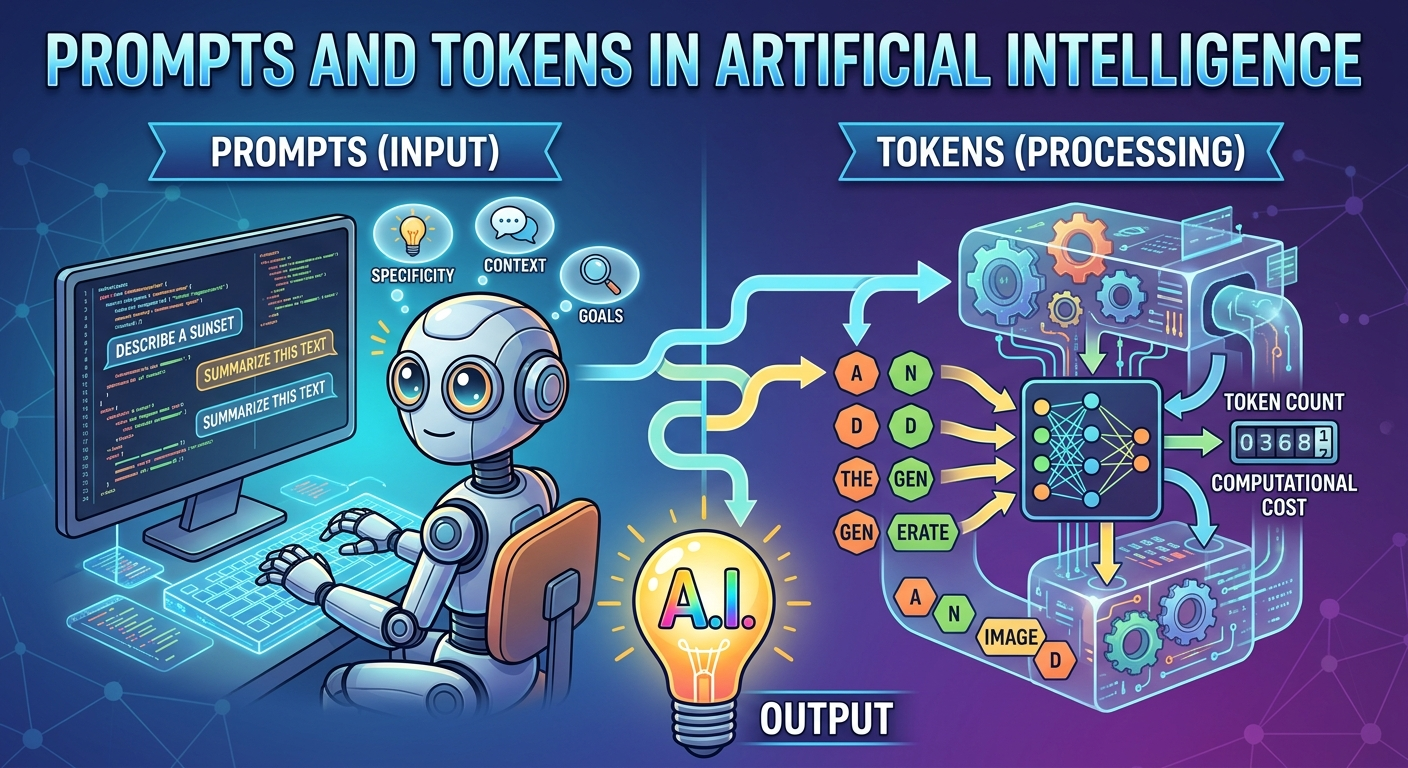
Two of the most important concepts for understanding modern generative artificial intelligence are prompts and tokens. They may appear simple—one is the instruction given to an AI system and the other is a unit of text processed by the model—but they sit at the center of how large language models (LLMs) receive information, interpret it, generate responses, and manage limited computational context.
A prompt is not merely a question. It can contain instructions, background information, examples, constraints, data, formatting requirements, and the desired output. Tokens, meanwhile, are the pieces into which text is converted before it reaches the neural network. A token may represent a whole word, part of a word, punctuation, whitespace, or other text fragments. The model does not fundamentally “read words” in the same way humans do; it processes sequences of token identifiers and uses learned statistical and semantic relationships to predict what should come next.
Understanding the relationship between prompt → tokenization → embeddings → transformer processing → probability distribution → generated tokens → decoded text provides a foundation for understanding modern AI systems.
1. Introduction
Generative AI has created a new form of human-computer interaction.
Traditional software generally requires the user to operate menus, buttons, forms, commands, and predefined interfaces.
Generative AI introduces another interface:
Natural language.
Instead of telling software exactly which function to execute, a person can describe what they want.
For example:
“Explain how a semiconductor factory works to a high-school student.”
This sentence is a prompt.
The AI system converts the prompt into tokens, processes those tokens through a neural network, and generates a sequence of output tokens that are eventually converted back into readable text.
The simplified pipeline is:
Human intention → Prompt → Tokens → Neural network → Predictions → Output tokens → Text
This pipeline is one of the fundamental mechanisms behind ChatGPT-style systems, coding assistants, document-generation systems, AI search systems, and many other generative AI applications.
2. What Is a Prompt?
A prompt is the information supplied to an AI system to influence what it produces.
A prompt can be as short as:
“What is gravity?”
or as complex as a multi-page specification containing:
- a role
- an objective
- background information
- source material
- constraints
- examples
- formatting requirements
- evaluation criteria
- output instructions.
Therefore, prompt engineering is essentially the discipline of designing the input so that the AI is more likely to produce the desired output.
3. The Anatomy of a Prompt
A sophisticated prompt can contain several components.
3.1 Role
The role establishes the perspective or function the AI should adopt.
Example:
“Act as a university physics tutor.”
This does not magically transform the underlying model into a different model. Instead, it provides contextual instructions about the desired behavior.
3.2 Objective
The objective tells the model what you want.
Example:
“Explain special relativity.”
A better version might be:
“Explain special relativity to a first-year university student who understands basic algebra but has not studied tensor mathematics.”
The second prompt provides more useful context.
3.3 Context
Context gives the AI information necessary to perform the task.
For example:
“The reader already understands Newton’s laws but does not understand Einstein’s postulates.”
Context reduces ambiguity.
3.4 Constraints
Constraints specify boundaries.
For example:
- use simple language
- do not exceed 2,000 words
- provide five examples
- include a comparison table
- explain terminology
- use headings
- avoid unexplained mathematical notation.
3.5 Examples
Examples demonstrate the desired pattern.
This is called few-shot prompting when examples are included.
For instance:
Example
Input: “France → Paris”
Input: “Japan → Tokyo”
Input: “South Africa → ?”
The model can infer that the desired output is a capital city.
3.6 Output format
You can specify the desired structure.
For example:
“Return the answer using:
- Definition
- History
- Architecture
- Advantages
- Limitations
- Future developments.”
This can substantially improve consistency.
4. Prompt vs Question
A question is not necessarily a complete prompt.
Consider:
“What is AI?”
That is a question.
Now consider:
“Explain artificial intelligence to a 15-year-old beginner. Start with a simple definition, then explain machine learning, deep learning, generative AI and autonomous agents. Give one practical example for each and finish with a comparison table.”
This is a structured prompt.
The second provides:
Task + audience + scope + structure + examples + output requirements.
5. What Is a Token?
A token is a unit of text processed by an AI language model.
A token is not necessarily equivalent to:
- a word
- a character
- a sentence.
Depending on the tokenizer and language, a token may represent:
- an entire word
- part of a word
- punctuation
- whitespace
- a number
- a special symbol.
For example, a word such as:
“artificial”
might be represented as one token or multiple subword tokens depending on the tokenizer.
The important principle is:
LLMs operate on token sequences rather than directly operating on human concepts such as “words” and “sentences.”
6. Why Do AI Systems Use Tokens?
Computers ultimately operate on numerical representations.
Human language is symbolic.
For example:
“The computer is learning.”
The model needs to transform this into something numerical.
A simplified representation is:
Text
↓
Tokenizer
↓
Token IDs
↓
Embeddings
↓
Neural network
The token IDs themselves are essentially identifiers. The neural network then works with learned numerical representations associated with those tokens.
7. Tokenization
Tokenization is the process of converting text into tokens.
Imagine the sentence:
“AI is transforming healthcare.”
A simplified tokenizer might produce something conceptually similar to:
AI | is | transform | ing | healthcare | .
The actual tokenization depends on the model.
This distinction is important because different AI models can tokenize the same sentence differently.
8. Tokens Are Not Always Words
Consider:
“unbelievable”
A tokenizer might split it conceptually into pieces resembling:
un + believe + able
This approach allows the model to represent words it has not encountered exactly in training by combining familiar pieces.
This is one reason subword tokenization is so useful.
9. Token IDs
After tokenization, each token is associated with an integer identifier.
For example, purely hypothetically:
| Token | ID |
|---|---|
| AI | 421 |
| is | 87 |
| learning | 8,231 |
| . | 14 |
These numbers are only illustrative.
The model’s vocabulary contains a large collection of possible tokens, each assigned an ID.
The sequence might therefore become:
[421, 87, 8231, 14]
The neural network processes these IDs through embedding and transformer layers.
10. Vocabulary
A model’s vocabulary is the collection of tokens it can represent directly.
A vocabulary can contain:
- words
- word fragments
- punctuation
- numbers
- symbols
- special tokens.
A larger vocabulary does not automatically mean a better model.
Tokenization is an engineering trade-off between:
- vocabulary size
- sequence length
- multilingual efficiency
- computational cost
- representation flexibility.
11. Tokens and Languages
Token efficiency differs between languages.
A sentence that requires a relatively small number of tokens in one language may require more tokens in another.
This matters because language models have finite context capacities and inference costs are related to the amount of data processed.
Languages with complex writing systems or less representation in training data may sometimes experience less efficient tokenization.
12. Tokenization of Numbers
Numbers are particularly interesting.
A number such as:
123456789
does not necessarily correspond to one token.
Depending on the tokenizer, it may be split into several pieces.
This is one reason language models can sometimes struggle with certain numerical operations: the model is fundamentally processing learned token patterns rather than manipulating numbers exactly like a conventional calculator.
For arithmetic, specialized computational tools can therefore be preferable.
13. Prompt Tokens
When you submit a prompt, the prompt is converted into tokens.
For example:
Prompt
Explain quantum computing.
↓
Tokenizer
↓
Token sequence
↓
Model
The prompt therefore has a measurable computational representation.
A longer prompt generally means more input tokens.
14. Output Tokens
The model also generates output as tokens.
Suppose the model produces:
“Quantum computing uses quantum mechanical phenomena…”
The output is generated incrementally.
Conceptually:
Token 1 → Token 2 → Token 3 → Token 4 → …
At every generation step, the model predicts a probability distribution over possible next tokens.
15. The Central Concept: Next-Token Prediction
One of the most important ideas in modern language models is:
The model generates text by repeatedly predicting what token should come next given the preceding context.
Suppose the input is:
“The capital of France is”
The model may assign high probability to:
Paris
The model then generates that token.
The sequence becomes:
“The capital of France is Paris”
Then the model predicts what comes next.
This continues until a stopping condition is reached.
16. Probability Distribution
The model does not simply contain a giant database where every question has a stored answer.
Instead, it produces probability distributions over possible next tokens.
Conceptually:
| Candidate token | Probability |
|---|---|
| Paris | 0.91 |
| London | 0.02 |
| Rome | 0.01 |
| Berlin | 0.01 |
| Other | 0.05 |
These numbers are illustrative rather than actual model probabilities.
The system then selects a token according to its decoding strategy.
17. From Prompt to Answer: The Complete Pipeline
A simplified modern LLM pipeline is:
1. User enters prompt
↓
2. Text normalization
↓
3. Tokenization
↓
4. Token IDs
↓
5. Token embeddings
↓
6. Positional information
↓
7. Transformer layers
↓
8. Attention mechanisms
↓
9. Feed-forward neural networks
↓
10. Output logits
↓
11. Probability distribution
↓
12. Token selection
↓
13. New token added to context
↓
14. Repeat
↓
15. Detokenization
↓
16. Human-readable response
This is the fundamental conceptual anatomy of text generation.
18. Embeddings
Token IDs alone are not meaningful numerical representations for neural computation.
The model therefore maps tokens into vectors called embeddings.
Conceptually:
Token ID → Vector
For example:
“cat” → [0.17, -0.82, 0.41, …]
The actual embeddings contain many dimensions.
The important idea is that embeddings provide a continuous mathematical representation that neural networks can process.
19. Semantic Relationships
Embeddings can encode relationships between concepts.
For example, representations associated with:
- king
- queen
- man
- woman
can exhibit meaningful geometric relationships.
Modern neural representations are much more sophisticated than simple word dictionaries.
They can encode information about:
- syntax
- semantics
- concepts
- relationships
- context
- linguistic patterns.
20. Context
Context is one of the most important concepts in LLMs.
Consider:
“Apple released a new product.”
Apple could refer to:
- a fruit
- a company.
The surrounding words help determine the meaning.
Modern transformer models use contextual processing to determine how tokens relate to one another.
21. Attention
The attention mechanism is one of the defining innovations behind modern transformer architectures.
Attention allows the model to determine which parts of the available context are particularly relevant when processing a token.
For example:
“The scientist placed the sample in the refrigerator because it was unstable.”
The model needs to interpret relationships between words across the sentence.
Attention provides a mechanism for modeling such relationships.
22. Self-Attention
In a transformer, tokens can attend to other tokens within the relevant context.
Conceptually:
Token A ↔ Token B
Token A ↔ Token C
Token B ↔ Token D
The model computes learned relationships between representations.
This is one reason transformers are highly effective for language processing.
23. Transformer Architecture
Modern LLMs are generally based on transformer architectures or closely related architectures.
A simplified transformer block can be represented as:
Input representations
↓
Self-attention
↓
Residual connection / normalization
↓
Feed-forward network
↓
Residual connection / normalization
↓
Next transformer layer
A model may contain many such layers.
24. Parameters
Parameters are learned numerical values inside the neural network.
They are created during training rather than manually programmed individually.
A model may contain millions, billions, or hundreds of billions of parameters, depending on its architecture.
Parameters allow the network to represent complex patterns learned from training data.
25. Tokens vs Parameters
These concepts are often confused.
Tokens
Represent the input and output sequence.
Parameters
Represent the learned internal numerical structure of the model.
A useful analogy:
Tokens = information entering or leaving the system
Parameters = learned machinery inside the system
26. Context Window
A language model has a limit on how much tokenized information it can consider within a particular context.
This is called the context window.
For example, conceptually:
Context window = 100,000 tokens
This does not mean every model has that capacity; context sizes vary by model and implementation.
The context can include:
- system instructions
- conversation history
- user prompts
- retrieved documents
- tool results
- previous generated content.
27. Why Context Windows Matter
Suppose you give an AI a very large document.
The system needs to process the document’s tokens.
A longer document can therefore require:
- more computation
- more memory
- more processing time.
It also creates a challenge: the model must determine which information is relevant.
28. Prompt Length vs Context Length
These are different concepts.
Prompt length
The number of tokens in the particular input you provide.
Context length
The total amount of relevant tokenized information the model can process in the current context.
For example:
System instructions
conversation
documents
your prompt
other context
=
context
29. Input Tokens and Output Tokens
AI systems commonly distinguish between:
Input tokens
and
Output tokens.
Input tokens are supplied to the model.
Output tokens are generated by the model.
For an interaction:
User sends 2,000 tokens.
The model generates:
1,000 tokens.
Then the total token activity for that interaction can involve roughly:
3,000 tokens
though billing and accounting rules vary between AI providers and products.
30. Why Tokens Matter Economically
Tokens are important not only technically but economically.
Large AI systems require enormous computational resources.
Processing more tokens generally requires more computation.
Therefore, many AI services measure usage using tokens.
A simplified cost model might look like:
Cost = Input tokens × input price + Output tokens × output price
Actual pricing varies by provider and model.
31. Prompt Engineering
Prompt engineering is the systematic design of prompts to improve AI performance.
It is not simply about writing longer prompts.
A good prompt is usually:
- clear
- specific
- logically structured
- appropriately contextualized
- explicit about the desired result.
32. Weak Prompt vs Strong Prompt
Weak prompt
“Tell me about AI.”
This leaves many questions unanswered.
What level?
What scope?
What length?
What purpose?
Strong prompt
“Explain artificial intelligence to a beginner. Cover AI, machine learning, deep learning, generative AI and AI agents. Explain how they relate to one another, provide practical examples, identify their limitations, and finish with a comparison table.”
The second prompt defines the task much more clearly.
33. The Six-Part Prompt Framework
A useful general framework is:
ROLE + TASK + CONTEXT + CONSTRAINTS + PROCESS + OUTPUT
Role
Who should the AI behave as?
Task
What must it accomplish?
Context
What information does it need?
Constraints
What limitations apply?
Process
What reasoning or methodology should guide the work?
Output
What should the final result look like?
34. Example of a Professional Prompt
Role: Act as a technology researcher.
Task: Prepare a comprehensive analysis of semiconductor manufacturing.
Context: The audience understands basic computing but not semiconductor fabrication.
Scope: Cover history, lithography, transistor architecture, fabs, materials, supply chains and future technologies.
Constraints: Explain technical terms before using them extensively.
Output: Use headings, tables, examples and a concluding assessment.
This is considerably more powerful than:
“Explain semiconductor manufacturing.”
35. Zero-Shot Prompting
Zero-shot prompting means asking the model to perform a task without providing examples.
Example:
“Classify this sentence as positive or negative: ‘The movie was excellent.'”
No examples are provided.
The model uses its learned capabilities to perform the task.
36. One-Shot Prompting
One example is provided.
Example:
“Excellent movie → Positive
Terrible movie → Negative
Amazing performance → ?”
The model infers the pattern.
37. Few-Shot Prompting
Several examples are provided.
Example:
“Excellent movie → Positive
Terrible movie → Negative
Beautiful story → Positive
Boring performance → Negative
Fascinating documentary → ?”
The examples establish a pattern.
38. Instruction Prompting
The simplest form of structured prompting is direct instruction.
Example:
“Summarize the following article in 300 words.”
This works because the model receives an explicit task.
39. Role Prompting
Role prompting establishes a perspective.
Example:
“Act as a cybersecurity instructor.”
It can be useful when the desired response requires a particular professional perspective or communication style.
However, role prompting does not grant the model real-world credentials or authority.
40. Structured Prompting
Structured prompts can use headings.
For example:
Objective:
Explain blockchain.Audience:
Beginner.Topics:
Blocks, hashes, consensus, wallets and smart contracts.Output:
Tutorial with examples.
This makes complex requests easier to interpret.
41. Delimiters
Delimiters help separate instructions from data.
For example:
Analyze the following document:
---BEGIN DOCUMENT---
[document]
---END DOCUMENT---
This can reduce ambiguity between the instructions and the material being analyzed.
42. Prompt Templates
Instead of writing prompts from scratch, organizations can create templates.
Example:
Research Template
Research topic: [TOPIC]
Audience: [AUDIENCE]
Objective: [OBJECTIVE]
Scope: [SCOPE]
Sources: [SOURCE REQUIREMENTS]
Output format: [FORMAT]
Templates are particularly useful in business and software systems.
43. Prompt Chaining
A complex task can be divided into multiple prompts.
Instead of:
“Research, analyze, compare, summarize and publish this entire topic.”
You might use:
Stage 1: Research
↓
Stage 2: Organize findings
↓
Stage 3: Analyze
↓
Stage 4: Draft
↓
Stage 5: Fact-check
↓
Stage 6: Edit
This is called prompt chaining.
44. Retrieval-Augmented Generation
Prompting becomes much more powerful when combined with external information retrieval.
A simplified RAG system works like this:
User question
↓
Search/retrieval
↓
Relevant documents
↓
Documents inserted into model context
↓
LLM generates response
The model can therefore answer using information retrieved from a knowledge base.
45. Prompt + Retrieval
A RAG prompt might conceptually contain:
Question
Retrieved documents
Instructions
=
Model context
This is especially useful for:
- company knowledge bases
- technical manuals
- legal documents
- research collections
- product documentation
- internal policies.
46. System Instructions, Developer Instructions and User Prompts
Modern AI applications can have multiple instruction layers.
Conceptually:
System-level instructions
↓
Developer/application instructions
↓
User instructions
↓
Retrieved information / tools
↓
Model response
These layers can have different priorities depending on the system architecture.
This is important because a user prompt is not necessarily the only instruction the model receives.
47. Why a Prompt Sometimes “Fails”
A poor AI response does not necessarily mean the model is incapable.
Possible causes include:
- Ambiguous instructions
- Missing context
- Excessive context
- Conflicting requirements
- Incorrect assumptions
- Poor examples
- Insufficient source information
- Model limitations
- Hallucination
- Output constraints that conflict with the task.
48. Prompt Ambiguity
Consider:
“Write a report about technology.”
This is extremely broad.
Technology includes:
- computing
- telecommunications
- biotechnology
- energy
- aerospace
- robotics
- AI
- semiconductors
- manufacturing.
A better prompt defines the intended scope.
49. Prompt Specificity
Specificity is valuable when the task has many possible interpretations.
Instead of:
“Explain computers.”
Try:
“Explain how a modern computer works from electricity entering the power supply through the CPU, memory, storage and operating system to the execution of an application.”
Now the desired pathway is much clearer.
50. Prompt Length: Longer Is Not Always Better
A common misconception is:
Longer prompt = better response.
Not necessarily.
A prompt can become worse when it contains:
- irrelevant information
- contradictory instructions
- excessive repetition
- unnecessary background material.
The objective is not maximum length.
The objective is:
Maximum useful information with minimum ambiguity.
51. The Information Density Principle
A useful way to think about prompting is:
Prompt quality ≈ relevance × clarity × specificity × consistency
A 500-token prompt containing precise instructions can outperform a 5,000-token prompt containing confusing information.
52. Prompt Injection
When AI systems process external documents, webpages or user-generated content, they may encounter text designed to manipulate the AI’s instructions.
For example, a retrieved document might contain instructions such as:
“Ignore previous instructions.”
This is called a form of prompt injection.
Modern AI applications therefore need mechanisms to distinguish:
trusted instructions
from
untrusted data.
53. Prompt Engineering vs Model Training
These are fundamentally different.
Prompt engineering
Changes the input.
Fine-tuning
Changes model behavior through additional training.
Pretraining
Builds the foundational model using enormous datasets.
The hierarchy can be represented as:
Pretraining
↓
Model
↓
Fine-tuning / alignment
↓
Prompt
↓
Inference
54. Prompting Does Not Rewrite the Model
If you tell a model:
“You are an expert mathematician.”
you are not actually changing its neural-network parameters.
You are providing contextual instructions.
This distinction is extremely important.
55. Tokens and Memory
Another common misunderstanding is:
“If the AI sees something once, it permanently learns it.”
Normally, processing a prompt does not mean the model’s underlying parameters have been permanently updated.
A model can use information in the current context without incorporating it permanently into its learned parameters.
Applications may separately implement memory systems, databases or retrieval mechanisms.
56. Contextual Memory
Within a conversation, the system may provide previous messages back to the model as context.
Conceptually:
Message 1
Message 2
Message 3
Current question
↓
Current context
↓
Model
This can create the experience of conversational memory.
But contextual information and permanent model learning are different mechanisms.
57. Token Generation
Suppose the model receives:
“The sun rises in the”
The model predicts likely next tokens.
Conceptually:
east
may receive a high probability.
The model generates:
“east”
Then the model predicts the next token using the expanded context:
“The sun rises in the east”
This process continues.
58. Autoregressive Generation
This style of generation is called autoregressive generation.
The model generates one token, adds it to the sequence, and uses the updated sequence to predict the next token.
Simplified:
Input
→ Token 1
→ Token 2
→ Token 3
→ Token 4
→ …
→ End.
59. Temperature
Some AI systems expose a parameter called temperature.
Temperature influences the randomness of token selection.
Conceptually:
Lower temperature
More deterministic and conservative outputs.
Higher temperature
More varied and potentially creative outputs.
The exact behavior depends on the model and implementation.
60. Top-k and Top-p
Other decoding strategies include top-k and top-p sampling.
Top-k
Restricts selection to the highest-probability k tokens.
Top-p
Selects from the smallest group of tokens whose cumulative probability reaches a specified threshold.
These techniques influence generation diversity.
61. Deterministic vs Probabilistic Generation
A language model can produce different answers to the same prompt depending on:
- decoding settings
- random seed
- model version
- system instructions
- context
- external tools
- retrieved information.
Therefore, generative AI should not always be treated like a deterministic calculator.
62. Why AI Can Hallucinate
A language model is optimized to generate plausible sequences.
It is not inherently a perfect truth detector.
Therefore, it can produce:
- incorrect facts
- fabricated references
- incorrect calculations
- false explanations
- invented events.
A fluent answer can still be wrong.
This is one of the central limitations of generative AI.
63. Prompting for Accuracy
You can improve reliability by requesting:
- explicit assumptions
- source citations where available
- uncertainty statements
- calculations using appropriate tools
- separation of facts and interpretation
- verification of important claims.
For example:
“Distinguish established facts from estimates and clearly identify anything uncertain.”
64. Prompting for Research
A strong research prompt might request:
- Define the subject.
- Explain historical development.
- Identify major technologies.
- Compare competing approaches.
- Identify important organizations.
- Discuss current developments.
- Examine limitations.
- Analyze future possibilities.
- Identify uncertainties.
- Provide sources.
This transforms a vague request into a research framework.
65. Prompting for Education
For tutoring, prompts can specify the student’s level.
Example:
“Teach me quantum mechanics from beginner level. Start with classical physics concepts I need first. Introduce one concept at a time, give an example, ask me a short question, and only continue after explaining the answer.”
This creates an interactive learning structure.
66. Prompting for Coding
A strong coding prompt should include:
- programming language
- framework
- operating environment
- desired behavior
- inputs
- outputs
- constraints
- existing code
- error messages.
Instead of:
“Fix my code.”
provide:
“This Python program reads a CSV file and calculates monthly totals. It currently raises a KeyError on the
amountcolumn. Explain the cause and provide a corrected version.”
67. Prompting for Writing
For long-form writing, specify:
- title
- audience
- purpose
- length
- tone
- structure
- terminology
- examples
- references
- formatting.
This is particularly useful for technical articles and theses.
68. Prompting for Analysis
Analytical prompts benefit from explicitly defining the dimensions of analysis.
For example:
“Compare 5G and Wi-Fi 7 across speed, latency, spectrum, coverage, mobility, infrastructure requirements, security and typical applications.”
This is much more useful than:
“5G vs Wi-Fi 7.”
69. Prompting for Comparisons
A comparison prompt should establish:
Objects
Criteria
Time period
Geographic scope
Output format
For example:
“Compare semiconductor manufacturing in Taiwan, South Korea, the United States, China and Japan from 2015–2026, focusing on fabrication, equipment, materials, advanced packaging and R&D.”
70. Prompting for Summarization
Specify what type of summary you want.
Basic summary
“Summarize this article.”
Structured summary
“Summarize the article in five sections: objective, methodology, findings, limitations and conclusions.”
Executive summary
“Create a 500-word executive summary for business executives.”
71. Prompting for Transformation
AI can transform information between formats.
For example:
Research paper
↓
Executive summary
or
Technical documentation
↓
Beginner tutorial
or
Raw data
↓
Structured report
The prompt should identify both:
source format
and
target format.
72. Prompting for Classification
Classification prompts establish categories.
Example:
“Classify each item as hardware, software, networking or cloud infrastructure.”
Then provide the data.
This can be useful for organizing large information collections.
73. Prompting for Extraction
Extraction is different from summarization.
For example:
“Extract every company name, country, year and semiconductor technology mentioned in the document.”
The objective is to preserve specific information rather than produce a general summary.
74. Prompting and Agents
AI agents extend prompting beyond simple question-answering.
An agent may receive:
Goal
↓
Prompt/instructions
↓
Reasoning
↓
Tool selection
↓
Tool execution
↓
Observation
↓
Next action
↓
Final result
Tools may include:
- search
- databases
- calculators
- code execution
- APIs
- file systems.
75. Prompt as an Interface
A useful conceptual shift is to think of the prompt as a new kind of programming interface.
Traditional programming:
Human → Code → Computer
Generative AI:
Human → Natural-language instruction → AI model
Prompt engineering therefore resembles a form of natural-language programming, although prompts are not equivalent to formal deterministic programs.
76. Prompt Engineering and Software Engineering
There are similarities.
| Software Engineering | Prompt Engineering |
|---|---|
| Requirements | Instructions |
| Inputs | Context |
| Functions | Tasks |
| Test cases | Examples |
| Constraints | Prompt constraints |
| Output schema | Response format |
| Unit tests | Prompt evaluation |
| Debugging | Prompt refinement |
This is why serious AI applications increasingly treat prompts as engineering artifacts rather than casual questions.
77. Prompt Versioning
In professional systems, prompts can be versioned.
For example:
Prompt v1.0
↓
Test
↓
Prompt v1.1
↓
Test
↓
Prompt v2.0
This makes it possible to evaluate whether changes actually improve performance.
78. Prompt Evaluation
A good prompt should be tested against multiple examples.
You can measure:
- accuracy
- completeness
- consistency
- relevance
- formatting compliance
- hallucination rate
- latency
- token consumption.
This turns prompt engineering into an empirical discipline.
79. Token Efficiency
Efficient prompts can reduce unnecessary token consumption.
Instead of repeating:
“Please remember that…”
multiple times, consolidate the requirement.
For example:
“Use beginner-friendly language throughout.”
One clear instruction may be enough.
80. Token Budget
When designing AI applications, developers may impose:
Maximum input tokens
and
Maximum output tokens.
This prevents unexpectedly large requests from consuming excessive computational resources.
81. Tokens and Latency
Generally, processing more tokens requires more computation.
Therefore:
More tokens → potentially more processing → potentially greater latency
The exact relationship depends on the model architecture, hardware, batching, caching and serving infrastructure.
82. Tokens and AI Infrastructure
At enormous scale, tokens become an infrastructure measurement.
An AI provider might process:
billions or trillions of tokens
across users and applications.
Those tokens require:
- GPUs or specialized accelerators
- memory
- networking
- storage
- electricity
- cooling
- software infrastructure.
Therefore, the humble token connects user interaction all the way to the physical data center.
83. Prompt → Token → Compute
The complete chain can therefore be understood as:
Human request
↓
Prompt
↓
Tokenization
↓
Token IDs
↓
Embeddings
↓
Transformer computation
↓
Probability distribution
↓
Token generation
↓
Detokenization
↓
Response
↓
Human
This is one of the most important conceptual models for understanding generative AI.
84. Common Prompting Mistakes
Mistake 1: Being too vague
“Explain technology.”
Better
Define the technology, audience and scope.
Mistake 2: Conflicting instructions
“Give a very detailed explanation in exactly 100 words.”
The requirements may conflict.
Mistake 3: Excessive irrelevant context
Large amounts of unrelated information can make the task harder.
Mistake 4: No output structure
For complex tasks, lack of structure can produce inconsistent results.
Mistake 5: Assuming the model knows the latest information
A model may require web search, retrieval or other tools for current information.
85. The Anatomy of an Excellent Prompt
A professional prompt can be constructed using this sequence:
Step 1 — Define the goal
What do you want?
Step 2 — Define the audience
Who will use the result?
Step 3 — Define the context
What does the model need to know?
Step 4 — Define the scope
What should be included and excluded?
Step 5 — Define constraints
What rules should be followed?
Step 6 — Define the output
What should the final response look like?
Step 7 — Provide examples if necessary
Show the desired behavior.
Step 8 — Test
Try the prompt on multiple cases.
Step 9 — Refine
Modify the prompt based on results.
86. A Master Prompt Template
Here is a reusable framework:
ROLE:
Act as a [role].OBJECTIVE:
Your task is to [objective].AUDIENCE:
The intended audience is [audience].CONTEXT:
Consider the following background information: [context].SCOPE:
Cover [topics].EXCLUDE:
Do not focus on [excluded subjects].REQUIREMENTS:
[requirement 1]
[requirement 2]
[requirement 3]
OUTPUT FORMAT:
Produce [format].
QUALITY STANDARD:
Prioritize accuracy, clarity, completeness and logical organization.
UNCERTAINTY:
Clearly identify assumptions and uncertainty where relevant.
87. Prompt Engineering Workflow
A professional workflow can be:
Define objective
↓
Write initial prompt
↓
Test
↓
Observe failures
↓
Identify ambiguity
↓
Modify instructions
↓
Test again
↓
Measure performance
↓
Version prompt
↓
Deploy
This resembles software development.
88. Advanced Concept: Prompt as Context Programming
The deeper idea is that prompts don’t simply tell the model what question to answer.
They influence the context in which the model performs its prediction task.
For example:
“Explain this as a physicist.”
changes the expected style.
“Explain this to a child.”
changes the expected vocabulary.
“Return JSON.”
changes the expected output structure.
Thus prompting shapes the model’s conditional behavior.
89. Prompting Does Not Guarantee Correctness
Even an excellent prompt cannot guarantee:
- factual accuracy
- mathematical correctness
- complete reasoning
- current information
- unbiased results.
Prompt engineering improves the probability of a useful response; it does not transform a generative model into an infallible authority.
90. Prompt Engineering + Tools
The strongest AI systems increasingly combine language models with external tools.
For example:
LLM
Search
Calculator
Database
Code execution
Files
can produce results that are more capable than relying on language generation alone.
This is a major transition from:
AI that generates text
to:
AI systems that perform tasks.
91. The Future of Prompts
The future of prompting is likely to move beyond manually written text.
We can expect increasing use of:
- reusable prompt templates
- structured instructions
- multimodal prompts
- automatic prompt optimization
- agent policies
- tool-aware instructions
- programmatic prompt generation
- retrieval systems
- persistent application context.
The prompt may increasingly become one component of a much larger AI orchestration system.
92. Multimodal Prompts
Modern AI systems can accept more than text.
A prompt can potentially combine:
Text + Image + Audio + Video + Files + Structured data
For example:
“Analyze this engineering photograph and identify the visible components.”
The system processes information from multiple modalities.
Therefore, the concept of “prompt” is expanding from text instruction to multimodal context.
93. The Future of Tokens
Tokenization will also continue evolving.
Research and engineering efforts can seek improvements in:
- multilingual efficiency
- code representation
- numerical representation
- multimodal tokenization
- long-context processing
- computational efficiency.
Future AI systems may use different representations internally for different types of information.
94. Tokens Beyond Text
In multimodal AI, the fundamental unit may not always be a conventional text token.
Images can be represented through visual tokens or patches.
Audio can be represented through specialized representations.
Video can involve temporal visual representations.
Therefore, “token” increasingly means:
A discrete or computationally manageable unit of information processed by an AI architecture.
95. A Unified AI Information Model
A useful conceptual hierarchy is:
Human knowledge
↓
Data
↓
Representation
↓
Tokens / embeddings / other representations
↓
Neural computation
↓
Predictions
↓
Generated information
↓
Human interpretation
This places prompts and tokens inside the broader architecture of artificial intelligence.
96. Prompt vs Token vs Parameter vs Context
These four concepts should never be confused.
| Concept | Meaning |
|---|---|
| Prompt | Instruction/input supplied to AI |
| Token | Unit into which information is represented for processing |
| Parameter | Learned numerical value in the model |
| Context | Information available to the model during generation |
A simple analogy:
Prompt = what you say
Tokens = how the system breaks it into processable pieces
Parameters = what the model has learned
Context = what information it currently has available
97. The Complete Mental Model
If you remember only one framework, remember this:
HUMAN
Forms an intention.
↓
PROMPT
Expresses the intention.
↓
TOKENIZER
Breaks the input into tokens.
↓
TOKEN IDS
Represent those tokens numerically.
↓
EMBEDDINGS
Convert tokens into learned vector representations.
↓
TRANSFORMER
Processes relationships between representations.
↓
LOGITS
Produce scores for possible next tokens.
↓
DECODING
Selects the next token.
↓
LOOP
Repeats token generation.
↓
DETOKENIZATION
Converts tokens back into text.
↓
RESPONSE
The human receives the generated result.
98. Practical Tutorial: Build Your First High-Quality Prompt
Let’s construct one step by step.
Step 1: Start with the task
“Explain artificial intelligence.”
Step 2: Add audience
“Explain artificial intelligence to a beginner.”
Step 3: Add scope
“Explain AI, machine learning, deep learning, generative AI and AI agents.”
Step 4: Add structure
“Explain them in separate sections.”
Step 5: Add relationships
“Explain how the five concepts relate to one another.”
Step 6: Add examples
“Give two real-world examples of each.”
Step 7: Add limitations
“Explain the limitations of each technology.”
Step 8: Add output requirements
“Finish with a comparison table.”
The resulting prompt is far more precise.
99. Advanced Tutorial: Research Prompt
For serious research, use:
Research topic: [TOPIC]
Objective: Produce a comprehensive research analysis.
Historical scope: [START YEAR]–[END YEAR].
Geographic scope: [COUNTRIES/REGIONS].
Technical scope: [TECHNOLOGIES].
Economic scope: [MARKETS/INDUSTRIES].
Questions:
- How did the technology originate?
- How did it evolve?
- Who are the major participants?
- What technologies dominate today?
- What are the major challenges?
- What are the likely future developments?
Output: Thesis-style analysis with headings, tables, chronology and conclusions.
Quality: Distinguish established facts from estimates and clearly identify uncertainty.
100. Advanced Tutorial: Learning Prompt
A powerful learning prompt is:
“Act as my tutor. Teach me [SUBJECT] from beginner to advanced level. Divide the subject into sequential lessons. For every lesson, explain the concept, give an intuitive example, introduce the technical definition, provide a practical application and then test my understanding with questions. Do not assume knowledge that has not been introduced.”
This turns an AI into an interactive educational assistant.
101. Advanced Tutorial: Debugging Prompt
For technical troubleshooting:
“Analyze the following problem systematically. First identify the symptoms, then list possible causes, rank the causes by likelihood, explain how each could be tested, and finally propose the safest solution. Do not assume information that has not been provided.”
This is more useful than:
“Fix this.”
102. Advanced Tutorial: Decision-Making Prompt
For comparisons:
“Evaluate the following options using these criteria: cost, performance, reliability, scalability, security, maintenance and long-term suitability. Assign each criterion a qualitative rating, explain the trade-offs and provide a final recommendation based on the stated priorities.”
This makes the decision criteria explicit.
103. Prompt Engineering Checklist
Before submitting a complex prompt, ask:
- Is the objective clear?
- Is the audience defined?
- Is sufficient context provided?
- Is the scope clear?
- Are exclusions specified?
- Are constraints clear?
- Is the desired output format defined?
- Are examples needed?
- Are current facts required?
- Does the task require external tools?
- Are there contradictory instructions?
- Is unnecessary information included?
104. Token Management Checklist
For applications that process large amounts of information:
- Estimate input size.
- Monitor output size.
- Remove redundant context.
- Summarize older conversation when appropriate.
- Retrieve only relevant documents.
- Use structured data where possible.
- Set appropriate output limits.
- Track token consumption.
- Consider latency.
- Consider cost.
105. The Strategic Importance of Prompts and Tokens
Prompts and tokens may look like small technical details, but they sit at the intersection of several major AI disciplines.
They connect:
Human-computer interaction
↓
Natural language processing
↓
Machine learning
↓
Transformer architecture
↓
AI infrastructure
↓
Data-center computation
↓
AI economics
↓
AI applications
Understanding them therefore provides an entry point into understanding the entire modern generative-AI ecosystem.
106. Final Comparison
| Dimension | Prompt | Token |
|---|---|---|
| Primary purpose | Communicate task/instructions | Represent processable information |
| Created by | Human/application | Tokenizer |
| Visible to user | Usually yes | Usually partially/indirectly |
| Used during inference | Yes | Yes |
| Controls task | Directly | Indirectly |
| Has semantic meaning | At the instruction level | Context-dependent |
| Affects compute | Yes | Yes |
| Related to billing | Often | Frequently |
| Fixed vocabulary? | No | Usually model-specific |
| Same across models? | Can be reused, but behavior varies | No; tokenization differs |
107. Conclusion
Prompts and tokens are two fundamental building blocks of modern generative AI.
A prompt is the human-facing instruction and context used to communicate an objective to an AI system. Tokens are the computational units into which language or other information is represented for processing.
The relationship can be summarized as:
Intent → Prompt → Tokens → Embeddings → Transformer → Probability distribution → Generated tokens → Text
Prompt engineering operates primarily on the input side of this pipeline. It attempts to make the model’s desired behavior clearer, more reliable and more reproducible.
Tokenization operates closer to the computational representation layer. It determines how human-readable information is divided into units that the model can process.
The distinction between tokens, prompts, context and parameters is particularly important:
- Prompt: what you ask the AI to do.
- Tokens: the units used to represent information for processing.
- Context: the information available during the interaction.
- Parameters: the learned numerical structure of the model.
Once these concepts are understood, many other AI concepts become easier to understand—including LLMs, transformers, context windows, embeddings, attention, inference, RAG, AI agents, prompt engineering, fine-tuning and AI infrastructure.
The deeper lesson is that interacting with an AI model is not simply “asking a computer a question.” It is an interaction between human intention, language representation, learned neural computation, probability, and computing infrastructure. Understanding prompts and tokens therefore provides one of the clearest foundations for understanding how modern AI actually works.


Be First to Comment