
Abstract
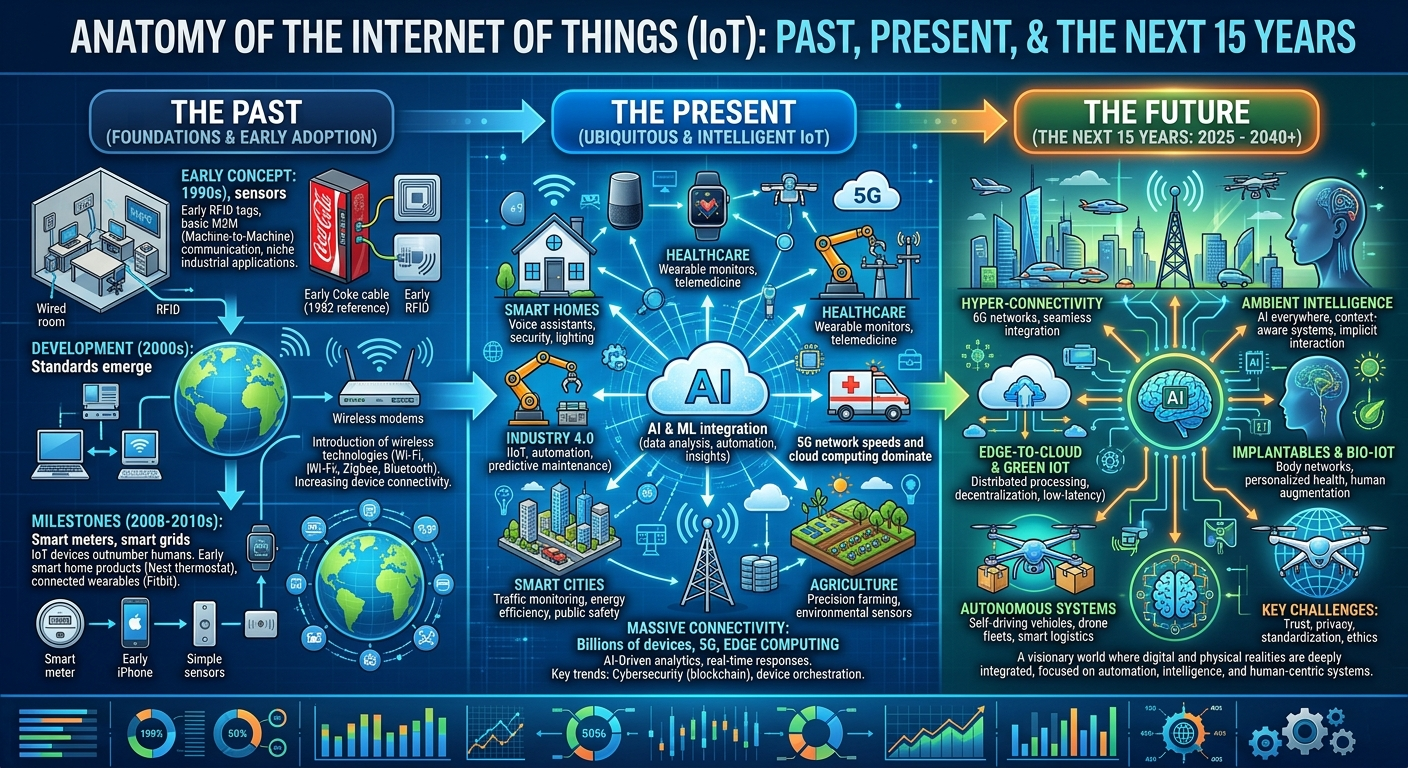
The Internet of Things (IoT) represents one of the most important technological transformations of the modern digital era. It describes the growing ecosystem of physical objects—sensors, machines, vehicles, appliances, industrial equipment, agricultural systems, buildings and infrastructure—that can collect data, communicate through networks, receive instructions, and increasingly make intelligent decisions.
IoT is not simply a collection of connected devices. It is an entire technological architecture involving sensing, computing, connectivity, networking, cybersecurity, data platforms, artificial intelligence, edge computing, cloud infrastructure and physical actuation. Its development has followed the broader evolution of computing: from isolated machines, to connected computers, to mobile devices, to cloud platforms, and now toward intelligent physical systems.
The next fifteen years are likely to transform IoT from today’s predominantly connected-device model into an increasingly autonomous, AI-driven and distributed cyber-physical ecosystem. Edge AI, digital twins, 5G and emerging 6G networks, low-power computing, satellite connectivity, advanced robotics, intelligent sensors and stronger interoperability standards are expected to reshape how machines interact with the physical world.
This article examines the anatomy of IoT from its historical foundations through its present architecture and toward possible developments between 2026 and approximately 2041.
1. Introduction: What Is the Internet of Things?
The Internet of Things can be understood as a system in which physical objects are equipped with some combination of:
- sensors;
- processors;
- software;
- communications capabilities;
- unique identities;
- data storage;
- artificial intelligence;
- actuators; and
- security mechanisms.
These capabilities allow physical objects to participate in digital networks.
A traditional object simply exists in the physical world. An IoT-enabled object can sense, communicate, analyze and respond.
For example, a conventional agricultural irrigation system may operate according to a manually configured schedule. An IoT-enabled irrigation system can combine soil-moisture sensors, weather information, pumps, communications networks and software. An AI-enhanced version can potentially analyze historical and real-time conditions and determine when irrigation should occur.
The fundamental IoT cycle can therefore be summarized as:
Sense → Connect → Transport → Process → Understand → Decide → Act → Measure Again
This creates a feedback loop between the physical and digital worlds.
IoT architecture has never had a single universally accepted structure. Research commonly describes three-layer, four-layer and five-layer architectures depending on the purpose of the model. A five-layer architecture, for example, can separate sensing, networking, processing, applications and business/management functions.
2. The Historical Roots of IoT
Although the expression “Internet of Things” became popular in the late twentieth century, its technological roots are considerably older.
IoT emerged from the convergence of several technological histories:
- measurement and instrumentation;
- electrical engineering;
- telecommunications;
- computer science;
- networking;
- embedded systems;
- wireless communication;
- cloud computing;
- artificial intelligence.
The IoT therefore did not suddenly appear. It was assembled gradually from multiple technological revolutions.
3. Before the Internet: The Age of Measurement
Long before computers existed, humans created devices capable of measuring physical phenomena.
Examples include instruments for measuring:
- temperature;
- pressure;
- time;
- distance;
- atmospheric conditions;
- mechanical movement;
- electrical properties.
The fundamental concept was already present:
The physical world can be converted into information.
Modern IoT builds on precisely this principle.
A temperature sensor, for example, converts a physical condition into an electrical or digital representation.
The difference between historical instrumentation and modern IoT is that modern systems can automatically transmit, analyze and act upon that information.
4. The Birth of Telecommunications
The development of telegraphy and telephony introduced another critical concept: machines could communicate information over distance.
Telecommunications transformed information from something physically transported into something electronically transmitted.
The progression was approximately:
Physical information → electrical signal → communication network → digital information
This became one of the fundamental prerequisites for IoT.
Without telecommunications, a sensor could measure something, but it would have limited ability to communicate its measurement to a distant system.
5. Computing Creates the Digital Brain
The twentieth century introduced electronic computing.
Computers transformed raw information into something that could be:
- stored;
- calculated;
- searched;
- compared;
- classified;
- transmitted; and
- manipulated automatically.
The development of microprocessors and microcontrollers was particularly important for IoT.
Instead of requiring a large computer, a small embedded processor could be incorporated into a physical object.
This produced the concept of embedded intelligence.
A washing machine, industrial controller, vehicle component or medical instrument could contain computing capabilities without looking like a conventional computer.
6. Networking Changes Everything
The next major transformation was computer networking.
Networks allowed computers to communicate with other computers.
The Internet subsequently created a global communications architecture based on interoperable networking protocols.
The conceptual transition became:
Computer → Networked computer → Networked device → Networked physical object
This is the foundation upon which IoT developed.
7. The Emergence of Embedded Systems
Embedded systems are among the most important ancestors of IoT.
An embedded system combines:
Physical object + processor + software + input/output
Examples include:
- vehicle control systems;
- industrial controllers;
- elevators;
- thermostats;
- cameras;
- printers;
- appliances;
- industrial machines.
Initially, many embedded systems operated independently.
IoT added another dimension:
Embedded system + network connectivity + data platform
The object became part of a larger digital ecosystem.
8. The Internet of Things Concept
The term Internet of Things is widely associated with the late 1990s, particularly with work by Kevin Ashton involving RFID and supply-chain applications.
The underlying idea was powerful:
Objects could have identities and could communicate information about themselves without humans manually entering every piece of data.
This represented an important philosophical shift:
Human-generated data → Machine-generated data
Instead of humans constantly telling computers what was happening, machines could increasingly observe the world themselves.
9. The Anatomy of an IoT System
A complete IoT system can be understood as a series of interconnected layers.
Layer 1: Physical World
This includes:
- machines;
- buildings;
- farms;
- vehicles;
- factories;
- homes;
- infrastructure;
- people interacting with systems;
- environmental conditions.
Layer 2: Sensors and Actuators
Sensors observe physical conditions.
Actuators influence physical conditions.
Sensors may measure:
- temperature;
- humidity;
- pressure;
- light;
- sound;
- vibration;
- motion;
- location;
- electrical characteristics;
- chemical conditions.
Actuators may:
- open valves;
- move motors;
- switch equipment;
- adjust temperatures;
- control pumps;
- operate mechanisms.
Together they create the physical interface of IoT.
10. The Sensor: IoT’s Digital Eye
A sensor converts a physical phenomenon into information that a computing system can understand.
The basic process is:
Physical phenomenon → Sensor → Electrical/digital signal → Data
For example:
Temperature → Temperature sensor → Digital reading → Network message
Sensors are becoming increasingly sophisticated.
Modern sensors may incorporate:
- local processors;
- calibration;
- communications;
- encryption;
- machine-learning models;
- energy-management systems.
This leads toward the concept of the smart sensor.
11. Actuators: IoT’s Physical Hands
Sensors allow an IoT system to observe.
Actuators allow it to act.
This creates a fundamental distinction:
Sensor = perception
Actuator = action
An IoT system becomes much more powerful when these functions are connected.
For example:
Sensor detects abnormal temperature → software analyzes condition → decision is made → actuator responds
This is the beginning of a cyber-physical feedback system.
12. The Connectivity Layer
IoT devices require communication technologies appropriate to their environment.
No single communication technology is ideal for every IoT application.
Common technologies include:
| Technology | Typical Strength |
|---|---|
| Wi-Fi | High data-rate local connectivity |
| Bluetooth/BLE | Short-range, low-power connectivity |
| Zigbee | Low-power mesh networking |
| Thread | IP-based low-power mesh networking |
| LoRaWAN | Long-range, low-power communications |
| Cellular IoT | Wide-area connectivity |
| 4G | Mature mobile connectivity |
| 5G | High capacity, low latency and network flexibility |
| Satellite | Connectivity in remote locations |
| Ethernet | Reliable wired connectivity |
| NFC | Very short-range communication |
Modern IoT architectures increasingly use multiple technologies simultaneously. Multi-protocol gateways are therefore becoming important for connecting heterogeneous networks and translating between different technologies.
13. IoT Protocols: The Language of Machines
Connectivity alone does not guarantee interoperability.
Devices also need protocols that define how information is exchanged.
Important IoT protocols include:
MQTT
MQTT uses a lightweight publish/subscribe communication model and is widely associated with IoT messaging.
CoAP
The Constrained Application Protocol is designed for resource-constrained devices and networks.
HTTP
HTTP remains important when IoT devices interact with conventional web services.
OPC UA
OPC UA is particularly important in industrial environments.
DDS
Data Distribution Service is designed for distributed real-time systems and machine-to-machine communication.
LwM2M
Lightweight M2M provides capabilities for device management and communication.
Current research continues to explore protocols such as Zenoh and QUIC-based approaches for IoT and edge environments.
14. Matter and Thread: The Smart-Home Evolution
Smart homes historically suffered from fragmented ecosystems.
Different manufacturers could use different technologies, applications and communication systems.
The development of Matter seeks to improve interoperability among smart-home ecosystems, while Thread provides an IP-based low-power mesh networking foundation.
Recent experimental research comparing Zigbee with Matter over Thread illustrates an important point: IoT networking involves trade-offs among scalability, latency, overhead, reliability and fault recovery rather than one technology simply replacing all others.
The broader lesson is that the future of IoT requires interoperability rather than isolated ecosystems.
15. The Gateway: IoT’s Translator
Many IoT devices do not communicate directly with the cloud.
Instead, they communicate with an IoT gateway.
The gateway can:
- collect data;
- translate protocols;
- authenticate devices;
- filter information;
- aggregate data;
- perform analytics;
- enforce security policies;
- connect local networks to cloud services.
A simplified architecture is:
Sensors → Gateway → Internet → Cloud
Modern gateways are increasingly becoming computing platforms rather than simple networking devices.
They can execute containers, AI models and analytics locally.
The IETF’s IoT edge architecture work identifies gateways as important locations for communication brokering, protocol translation, analytics and other local functions.
16. Edge Computing
Traditional cloud architecture sends substantial amounts of data to centralized data centers.
IoT creates a problem:
Millions or billions of devices can potentially generate continuous streams of data.
Sending everything to the cloud can create:
- latency;
- bandwidth requirements;
- cost;
- privacy concerns;
- availability dependencies.
Edge computing addresses this by moving some computation closer to the physical devices.
Instead of:
Device → Internet → distant cloud → decision → device
the architecture can become:
Device → Edge → decision → device
This can significantly reduce response time and network traffic.
17. Edge AI
The combination of IoT and artificial intelligence creates a particularly important technological direction.
Traditional IoT:
Sense → transmit → analyze
AI-enabled edge IoT:
Sense → analyze locally → predict → act
A camera, for example, may process video locally rather than transmitting every frame to a distant server.
Edge AI can support:
- anomaly detection;
- predictive maintenance;
- object recognition;
- energy optimization;
- industrial monitoring;
- agricultural intelligence;
- transportation systems;
- robotics.
The evolution is therefore:
IoT → Smart IoT → AIoT → Autonomous IoT
18. Cloud Computing: The Large-Scale Brain
Edge computing does not eliminate the cloud.
Instead, modern IoT increasingly uses a cloud-edge continuum.
The edge handles tasks requiring:
- low latency;
- local control;
- immediate response;
- privacy;
- bandwidth efficiency.
The cloud handles tasks requiring:
- massive storage;
- large-scale analytics;
- model training;
- cross-site analysis;
- fleet management;
- long-term historical analysis.
The resulting architecture becomes:
Device → Edge → Regional infrastructure → Cloud → AI/data platforms
This distributed model is becoming increasingly important for industrial and enterprise IoT. Recent research on Industry 5.0 specifically examines the integration of IIoT, edge-cloud architectures and emerging 6G capabilities.
19. Data: The Real Fuel of IoT
Connectivity is not the ultimate purpose of IoT.
Data is.
An IoT device generates observations.
Those observations can be transformed into:
Data → Information → Knowledge → Decision → Action
For example:
A temperature sensor produces:
38°C
That is data.
A system comparing it with historical conditions may determine:
Temperature is 12°C above the normal operating range.
That becomes information.
An AI model might determine:
The equipment has a high probability of overheating.
That becomes knowledge.
The system can then:
Reduce operating load and alert an engineer.
That becomes action.
20. Artificial Intelligence Changes IoT
Traditional IoT primarily answers:
What is happening?
Analytics can answer:
Why is it happening?
AI can increasingly answer:
What is likely to happen next?
Autonomous systems attempt to answer:
What should the system do about it?
This progression can be represented as:
Monitoring → Analytics → Prediction → Decision → Autonomy
This is one of the most important transformations occurring in IoT.
21. Digital Twins
A digital twin is a digital representation of a physical object, system or process that can be updated using real-world data.
An industrial machine can have:
Physical machine ↔ sensors ↔ data platform ↔ digital representation
The digital twin can incorporate:
- current operating conditions;
- historical performance;
- maintenance records;
- simulations;
- AI predictions.
Digital twins could become increasingly important during the next fifteen years because they connect IoT data with simulation, engineering and decision-making.
22. IoT in Manufacturing
Industrial IoT, or IIoT, is one of the most significant IoT applications.
Factories can connect:
- machines;
- robots;
- sensors;
- production lines;
- warehouses;
- energy systems;
- quality-control equipment;
- supply-chain systems.
The result is a cyber-physical manufacturing environment.
Modern smart manufacturing increasingly combines IoT with cloud computing, AI, cybersecurity and digital representations of industrial processes.
The factory of the future is therefore not simply automated.
It is increasingly:
Connected + observable + analytical + predictive + adaptive
23. IoT in Agriculture
Agriculture provides another major IoT application.
Sensors can monitor:
- soil moisture;
- temperature;
- humidity;
- weather;
- water systems;
- equipment;
- livestock environments;
- crop conditions.
IoT can support precision agriculture by connecting physical conditions with data-driven decisions.
AI can then identify patterns that may not be obvious to human observers.
The long-term direction is toward:
Precision agriculture → predictive agriculture → autonomous agriculture
24. IoT in Healthcare
Healthcare IoT can involve connected:
- monitoring equipment;
- hospital infrastructure;
- medical devices;
- environmental sensors;
- logistics systems;
- patient-support technologies.
The major value proposition is continuous information.
Instead of collecting information only during occasional interactions, connected systems can potentially provide continuous observations.
However, healthcare IoT also requires particularly strong attention to:
- privacy;
- cybersecurity;
- reliability;
- safety;
- data governance;
- human oversight.
25. IoT in Transportation
Modern transportation increasingly incorporates sensors and connectivity.
Connected vehicles can contain numerous electronic systems monitoring:
- location;
- vehicle condition;
- energy consumption;
- environmental conditions;
- driver-assistance systems;
- communications.
The future could combine:
Connected vehicles + roadside infrastructure + cloud + edge AI + intelligent traffic management
This creates an emerging transportation ecosystem rather than isolated vehicles.
26. IoT in Smart Cities
A smart city can connect infrastructure such as:
- street lighting;
- water networks;
- traffic systems;
- waste-management systems;
- environmental monitoring;
- public transport;
- energy infrastructure.
The objective is not simply to install sensors.
The objective is to create a city capable of measuring conditions and responding intelligently.
The city therefore becomes a large-scale cyber-physical system.
27. IoT and Energy
Energy systems are becoming increasingly digital.
IoT can connect:
- electricity meters;
- solar systems;
- batteries;
- transformers;
- substations;
- buildings;
- industrial consumers;
- charging infrastructure.
This can support more dynamic energy management.
The long-term direction is toward increasingly intelligent energy networks capable of coordinating distributed generation, storage and consumption.
28. IoT Security: The Biggest Structural Challenge
Every connected object creates another potential security boundary.
IoT security must address the entire lifecycle:
Manufacturing → deployment → authentication → operation → updates → maintenance → retirement
Security measures can include:
- strong device identity;
- secure authentication;
- encryption;
- secure boot;
- signed firmware;
- access control;
- network segmentation;
- vulnerability management;
- security monitoring;
- secure software updates.
IoT security cannot be treated as an optional layer added after deployment.
It must be designed into the architecture.
29. The Expanding IoT Attack Surface
Traditional IT systems often operate within comparatively recognizable computing environments.
IoT devices may be:
- geographically distributed;
- physically accessible;
- resource constrained;
- difficult to update;
- deployed for many years;
- connected to operational systems.
This creates unique security challenges.
A compromised IoT device could potentially become a gateway into a larger network.
Therefore, the future IoT architecture must increasingly follow a zero-trust and identity-centric philosophy.
30. Privacy
IoT can collect information about the physical world at unprecedented scale.
This creates important privacy questions.
Connected environments may reveal:
- locations;
- routines;
- environmental conditions;
- machine operations;
- usage patterns.
Consequently, future IoT systems will need increasingly sophisticated approaches to:
- data minimization;
- consent;
- access control;
- encryption;
- anonymization;
- local processing;
- governance.
Edge computing can help because sensitive information can sometimes be processed locally rather than transmitted unnecessarily.
31. Interoperability: IoT’s Persistent Problem
One of IoT’s greatest historical weaknesses has been fragmentation.
Different devices may use:
- different protocols;
- different data formats;
- different identities;
- different APIs;
- different cloud platforms.
A truly global IoT ecosystem requires machines from different manufacturers to communicate reliably.
The current research environment continues to identify interoperability and heterogeneous-network integration as major IoT challenges.
The future therefore depends not only on better devices but also on better standards.
32. IoT and 5G
5G provides capabilities relevant to IoT, including:
- high capacity;
- improved latency;
- support for large numbers of connected devices;
- network flexibility;
- private-network capabilities.
5G-enabled IoT architectures increasingly combine intelligent sensing, edge computing and advanced networking.
However, 5G is not automatically the answer to every IoT problem.
Low-power sensors may continue to use technologies such as Bluetooth, Thread, Zigbee or LoRaWAN, depending on requirements.
The future is likely to remain multi-network.
33. IoT and 6G
Over the next fifteen years, 6G research could influence IoT in several ways.
Potential capabilities include:
- extremely high data rates;
- very low latency;
- integrated sensing and communication;
- intelligent network management;
- advanced positioning;
- massive device connectivity;
- AI-native networking.
Research into Industry 5.0 already considers how 6G and integrated sensing/communication could interact with IIoT and edge-cloud architectures.
The important point is that 6G should not be viewed simply as “faster 5G.”
It could become part of a fundamentally more intelligent communication architecture.
34. The Next 15 Years: 2026–2041
The next fifteen years are likely to be characterized by a shift from connected things toward intelligent physical systems.
A useful conceptual timeline is:
2026–2030: Intelligent Connectivity
Major themes:
- AI-enabled IoT;
- edge AI;
- Matter and interoperability;
- stronger cybersecurity;
- advanced 5G;
- low-power intelligent sensors;
- cloud-edge integration;
- digital twins.
2030–2035: Autonomous IoT
Likely developments include:
- more capable edge processors;
- AI-native devices;
- autonomous industrial systems;
- increasingly intelligent vehicles;
- robotics integration;
- advanced digital twins;
- wider use of distributed AI.
2035–2041: Ambient and Autonomous Intelligence
The longer-term possibility is an environment in which computing becomes increasingly embedded in infrastructure.
Instead of people explicitly interacting with computers, systems may increasingly:
sense → understand → coordinate → act
with humans providing goals, supervision and authorization.
35. The Evolution of the IoT Device
The IoT device itself is changing.
First generation
Sensor + basic processor
Second generation
Sensor + processor + connectivity
Third generation
Sensor + processor + connectivity + cloud
Fourth generation
Sensor + processor + connectivity + edge AI
Emerging fifth generation
Sensor + AI + connectivity + autonomy + collaborative intelligence
This progression illustrates the transformation from a passive sensing device into an intelligent cyber-physical agent.
36. TinyML and Intelligence at the Extreme Edge
One particularly important future direction is TinyML.
TinyML involves running machine-learning capabilities on extremely resource-constrained devices.
This could allow small devices to perform tasks such as:
- detecting abnormal vibration;
- recognizing simple sound patterns;
- monitoring environmental changes;
- identifying anomalies.
The benefit is that the device does not always need to transmit raw data.
Instead:
Raw signal → local model → useful result
This can reduce bandwidth, improve privacy and lower latency.
37. Energy-Efficient IoT
Billions of IoT devices create an energy challenge.
Many sensors need to operate for years.
Future research is therefore likely to emphasize:
- ultra-low-power processors;
- efficient radios;
- energy harvesting;
- improved batteries;
- sleep modes;
- adaptive computation;
- low-power AI.
Potential energy sources include:
- solar energy;
- vibration;
- thermal gradients;
- radio-frequency energy;
- mechanical movement.
The ultimate objective is to create devices capable of operating for extremely long periods with minimal maintenance.
38. Satellite IoT
Traditional terrestrial networks do not cover every location.
Satellite connectivity can extend IoT into:
- remote agriculture;
- oceans;
- mining;
- environmental monitoring;
- logistics;
- remote infrastructure.
The combination of terrestrial and satellite networks could produce a more continuous global IoT connectivity layer.
39. IoT and Robotics
IoT and robotics are increasingly converging.
IoT provides:
Sensing + connectivity + data
Robotics provides:
Perception + movement + manipulation
AI provides:
Interpretation + decision-making
Together they form increasingly sophisticated cyber-physical systems.
A future industrial environment could therefore contain fleets of machines that coordinate with:
- sensors;
- robots;
- digital twins;
- edge computers;
- cloud systems;
- human operators.
40. IoT Becomes a System of Systems
Early IoT projects often focused on individual devices.
The future is increasingly about systems of systems.
For example:
Smart building
could connect:
- lighting;
- HVAC;
- security;
- elevators;
- energy;
- occupancy;
- fire systems.
The building can then interact with:
Smart grid + transportation + city infrastructure
The result is a network of interconnected cyber-physical systems.
41. From IoT to AIoT
The combination of AI and IoT is often called AIoT.
Traditional IoT provides the data.
AI provides intelligence.
AIoT combines:
Sensors + connectivity + data + AI + automation
This changes the purpose of IoT from simply reporting conditions to actively interpreting them.
Recent industry analysis reflects the growing importance of AI in IoT for areas such as anomaly detection, predictive maintenance, security and automation.
42. From AIoT to Autonomous IoT
AIoT still often depends on humans to make final decisions.
Autonomous IoT moves toward systems that can operate within defined objectives and constraints.
For example:
Sensor detects abnormal condition
↓
AI evaluates the condition
↓
System predicts consequences
↓
System selects an approved response
↓
Actuator responds
↓
System measures the outcome
↓
Model updates its understanding
This produces a closed-loop intelligent system.
However, autonomy should not mean removing human responsibility.
High-consequence systems will require human oversight, safety constraints and auditable decisions.
43. Explainable and Traceable IoT
As AI begins controlling physical systems, an important question emerges:
Why did the system take that action?
This becomes particularly important when an AI model receives information from multiple sensors and controls physical equipment.
Emerging research is exploring architectures that preserve traceability from sensor evidence → communication → AI decision → actuator action.
This could eventually produce an “explainable IoT” paradigm in which consequential machine actions are traceable to their evidence and decision processes.
44. IoT and Digital Sovereignty
As IoT becomes infrastructure, countries and organizations will increasingly care about:
- where data is stored;
- who controls cloud platforms;
- which standards are used;
- who manufactures critical components;
- who operates communications infrastructure.
IoT is therefore becoming not only a technical issue but also an economic and strategic issue.
45. The Economic Anatomy of IoT
The IoT economy consists of many layers.
Hardware
- sensors;
- processors;
- microcontrollers;
- gateways;
- networking equipment.
Connectivity
- cellular;
- Wi-Fi;
- satellite;
- LPWAN;
- industrial networks.
Platforms
- device management;
- data ingestion;
- analytics;
- cloud services.
Intelligence
- AI;
- machine learning;
- digital twins;
- predictive models.
Applications
- manufacturing;
- agriculture;
- healthcare;
- energy;
- transportation;
- retail;
- smart cities.
Services
- installation;
- maintenance;
- cybersecurity;
- systems integration;
- consulting.
The largest economic opportunity may therefore not reside in selling sensors alone.
It may reside in turning sensor-generated data into useful decisions and services.
46. Why Many IoT Projects Fail
IoT is technologically complex.
Common causes of failure include:
- unclear business objectives;
- poor interoperability;
- weak cybersecurity;
- inadequate network planning;
- poor data quality;
- insufficient device management;
- unrealistic deployment assumptions;
- excessive dependence on proprietary systems;
- lack of maintenance planning.
IoT should therefore begin with a problem rather than with a desire to “add sensors.”
The correct question is:
What physical problem are we trying to measure, understand or control?
47. A Future IoT Architecture
A mature IoT architecture around 2041 could potentially look like:
Physical Environment
↓
Intelligent Sensors & Actuators
↓
Local AI / TinyML
↓
Edge Computing
↓
5G/6G + Wi-Fi + LPWAN + Satellite
↓
Regional Edge Infrastructure
↓
Cloud Data Platforms
↓
Large AI Models + Digital Twins
↓
Decision Systems
↓
Human Governance
↓
Physical Action
↓
Continuous Feedback
This represents a transition from today’s connected-device architecture toward a continuously intelligent cyber-physical ecosystem.
48. The Major Challenges Through 2041
The next fifteen years will not be defined only by technological progress.
Major challenges include:
1. Cybersecurity
More devices mean more potential attack surfaces.
2. Privacy
Continuous sensing creates enormous quantities of potentially sensitive information.
3. Interoperability
Devices must work across vendors and generations.
4. Energy
Billions of devices require sustainable power strategies.
5. Data Governance
Organizations need rules governing ownership, access and retention.
6. AI Reliability
AI-driven IoT must behave predictably.
7. Legacy Infrastructure
Future IoT systems will need to coexist with older equipment.
8. Skills
IoT requires expertise across electronics, networking, software, data, AI and cybersecurity.
9. Sustainability
The environmental cost of producing, operating and eventually disposing of billions of devices must be addressed.
10. Human Oversight
Autonomous physical systems must remain accountable to humans.
49. The IoT Sustainability Question
IoT can reduce waste by optimizing:
- energy;
- water;
- transportation;
- manufacturing;
- agriculture.
But IoT itself consumes resources.
Its environmental footprint includes:
- semiconductor production;
- batteries;
- network infrastructure;
- data centers;
- device replacement;
- electronic waste.
The future therefore requires sustainable IoT, not merely larger IoT.
Design principles should include:
repairability + longevity + low power + efficient computing + recycling + responsible materials
50. The Ultimate Evolution of IoT
The history of IoT can be summarized through several technological eras:
| Era | Dominant Characteristic |
|---|---|
| Pre-IoT | Measurement |
| Early computing | Automation |
| Networking era | Communication |
| Internet era | Connectivity |
| Cloud era | Centralized data processing |
| IoT era | Physical-world connectivity |
| AIoT era | Intelligent interpretation |
| Edge AI era | Local intelligence |
| Autonomous IoT era | Machine decision-making |
| Future IoT | Coordinated cyber-physical intelligence |
The direction is clear:
From objects that can be connected to objects that can understand, coordinate and act.
51. Conclusion
The Internet of Things is much larger than the concept of connected devices.
It represents the merging of the physical and digital worlds.
Its anatomy consists of:
Physical objects → sensors → processors → connectivity → protocols → gateways → edge computing → cloud → data → AI → decisions → actuators
Each component is important, but the real power emerges from their interaction.
Historically, IoT evolved from measurement, telecommunications, computing, embedded systems and the Internet. In the present era, it is becoming increasingly integrated with cloud computing, edge computing, AI, digital twins, 5G and emerging interoperability standards.
The next fifteen years could represent an even greater transformation.
By approximately 2041, the defining characteristic of IoT may no longer be that objects are connected. Connectivity could become an assumed capability. The defining characteristic may instead be that physical systems are context-aware, intelligent, collaborative, predictive and increasingly autonomous.
The technological journey can therefore be expressed as:
Measure → Connect → Compute → Understand → Predict → Decide → Act → Learn
The ultimate significance of IoT is that computing is moving beyond the screen.
Computers are becoming embedded in buildings, factories, farms, vehicles, energy networks, infrastructure and machines.
The Internet is consequently evolving from a network primarily connecting people and information into an increasingly complex network connecting people, machines, environments and intelligent physical systems.
That is the deeper anatomy of the Internet of Things—and it is likely to make IoT one of the foundational technological architectures of the next fifteen years.
Selected Research References
- Internet Engineering Task Force, RFC 9556: Internet of Things (IoT) Edge Challenges and Functions.
- Discover Internet of Things, A systematic literature review on IoT application layer protocol testing and future research directions, 2026.
- Internet of Things, IoT application protocols: a survey on Zenoh, Volume 38, 2026.
- Internet of Things, Survey of IoT multi-protocol gateways: Architectures, protocols and cybersecurity, 2025.
- Bădoi et al., Information integration for Industry 5.0: A review of IIoT–edge–cloud architectures with 6G/ISAC capabilities, 2026.
- Yang et al., The Internet of Things for Smart Manufacturing: A Review, 2026.
- Nobile et al., Zigbee vs. Matter over Thread: Understanding IoT Protocol Performance in Practice, 2026.
Final Perspective
The Internet of Things should ultimately be understood not as a single technology, but as an architecture for connecting the physical world to computation and intelligence.
Its first revolution was connectivity.
Its second is intelligence.
Its emerging third revolution is likely to be autonomy.
And the defining technological question of the period from 2026 to 2041 may therefore become:
How intelligently, securely, sustainably and responsibly can humanity connect the physical world to machines that can perceive, reason and act?

Be First to Comment