
Abstract
Financial technology—commonly known as fintech—is one of the most consequential transformations in the modern financial system. It represents the convergence of finance with computing, telecommunications, data science, artificial intelligence, cloud computing, cybersecurity, digital identity, distributed ledgers, mobile technologies, and increasingly automated decision-making.
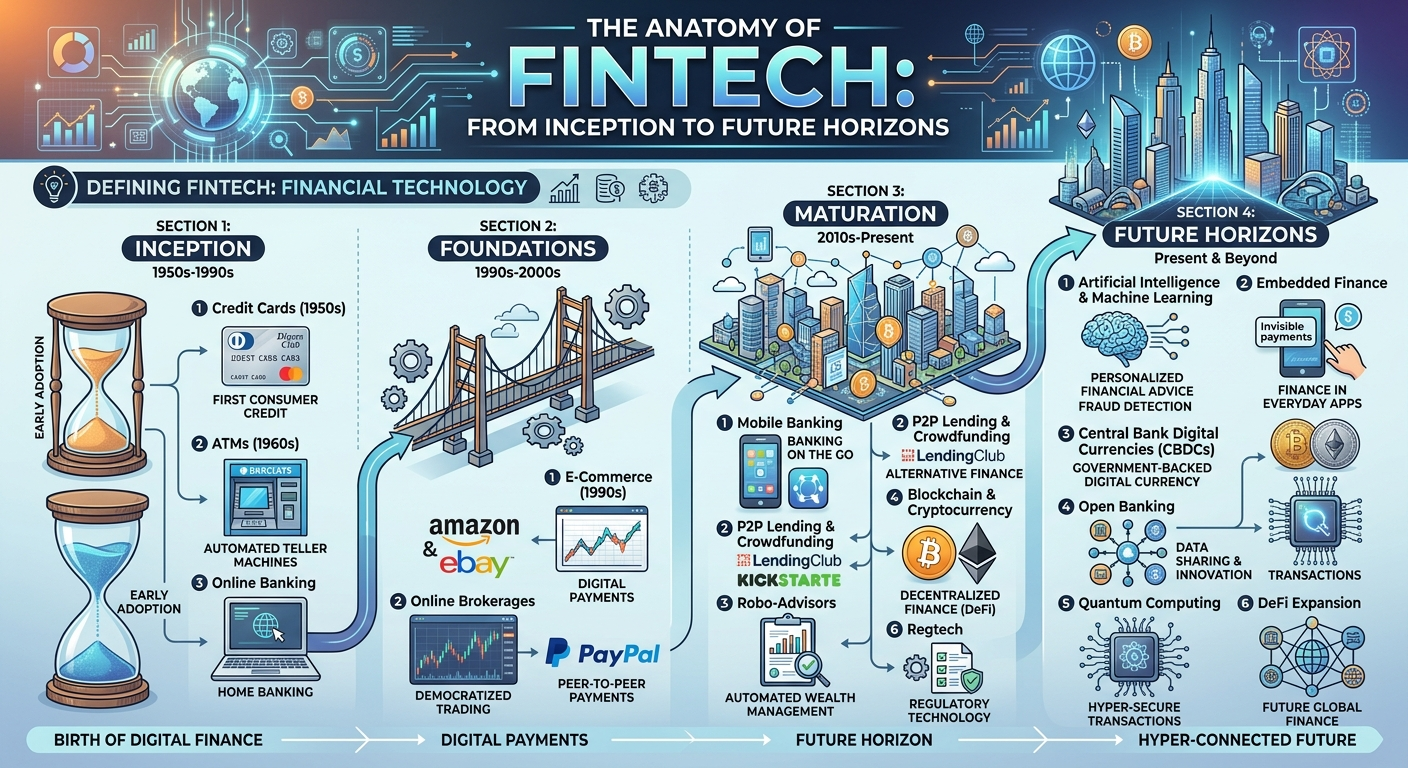
Fintech is not simply the replacement of cash with mobile payments. It is a broader restructuring of how money is created, transferred, stored, invested, borrowed, insured, regulated, and analyzed. Its development has progressed from early electronic banking and card networks to internet banking, mobile money, digital wallets, instant payments, online lending, robo-advisory services, open banking, embedded finance, blockchain-based systems, tokenization, and AI-powered financial services.
The transformation is particularly significant in emerging markets. The IMF’s 2025 Financial Access Survey reported that digital transactions—including mobile money, mobile banking, and internet banking—in emerging and developing economies increased from 55 transactions per adult in 2017 to 251 in 2024. Sub-Saharan Africa has been one of the strongest areas of mobile-money adoption.
At the same time, fintech creates new challenges involving cybersecurity, privacy, fraud, algorithmic bias, consumer protection, financial stability, market concentration, digital exclusion, and regulatory complexity.
This article examines the anatomy of fintech: its historical origins, technological foundations, major sectors, business models, infrastructure, economic significance, risks, regulatory architecture, regional development, and possible future. It argues that the future of fintech will not be defined by technology alone. Its success will depend on the interaction between technological capability, trustworthy institutions, resilient infrastructure, responsible innovation, regulation, and inclusive access.
1. Introduction: What Is Fintech?
Fintech can be understood as technology-enabled innovation in financial services that creates or materially changes business models, applications, processes, or products.
The World Bank describes fintech as the application of digital technology to financial services and emphasizes that it is reshaping the financial landscape while creating both opportunities and risks.
A useful way to understand fintech is to imagine the financial system as a large technological organism.
Its:
- nervous system is telecommunications and digital connectivity;
- memory is databases and cloud infrastructure;
- brain increasingly consists of analytics and AI;
- identity system consists of digital identity and authentication;
- circulatory system is the payments infrastructure;
- security system is cybersecurity and fraud detection;
- regulatory system consists of laws, supervisory institutions, standards, and compliance mechanisms;
- economic organs are banks, insurers, investment firms, payment companies, fintech companies, governments, businesses, and consumers.
Fintech therefore should not be viewed as a single industry. It is an ecosystem of technologies, institutions, infrastructures, markets, and users.
2. The Historical Inception of Financial Technology
Although the word fintech is relatively modern, the relationship between finance and technology is centuries old.
Financial systems have repeatedly adopted new technologies to solve problems involving:
- record keeping;
- communication;
- payments;
- credit;
- risk management;
- investment;
- settlement;
- identity;
- financial information.
The history of fintech can therefore be divided into several major technological eras.
Era 1: Physical and Mechanical Finance
Early financial systems depended heavily on physical records, paper documents, ledgers, coins, bills of exchange, and human intermediaries.
Technology was primarily mechanical and organizational.
Era 2: Telegraphic and Electronic Finance
The telegraph radically accelerated the transmission of financial information.
Banks and financial markets no longer needed to depend entirely on physical movement of information.
Era 3: Computerized Finance
The emergence of computers introduced electronic accounting, automated transaction processing, databases, and increasingly sophisticated financial calculations.
Era 4: Networked Finance
The internet connected banks, businesses, financial institutions, and consumers.
Online banking and electronic commerce became possible.
Era 5: Mobile Finance
Smartphones transformed financial services into portable applications.
Financial services could now reach people outside conventional banking infrastructure.
Era 6: Platform Finance
Financial services increasingly became integrated into digital platforms.
Payments, credit, insurance, investment, commerce, and financial management began converging.
Era 7: Intelligent and Programmable Finance
AI, machine learning, blockchain, tokenization, cloud infrastructure, APIs, and automated systems are creating a new generation of financial architecture.
The progression can therefore be summarized as:
Physical finance → electronic finance → computerized finance → internet finance → mobile finance → platform finance → intelligent and programmable finance.
3. The Fundamental Anatomy of Fintech
The fintech ecosystem can be divided into several interconnected layers.
Layer 1: Physical Infrastructure
Although fintech appears digital, it ultimately depends upon physical infrastructure.
This includes:
- data centers;
- telecommunications networks;
- mobile networks;
- fiber-optic networks;
- undersea cables;
- electricity;
- smartphones;
- payment terminals;
- servers;
- network equipment.
Without this infrastructure, digital financial systems cannot operate.
Layer 2: Computing Infrastructure
The next layer consists of computing systems.
These include:
- CPUs;
- GPUs;
- cloud servers;
- databases;
- storage systems;
- distributed computing;
- application servers;
- edge computing;
- high-performance computing.
Modern fintech increasingly requires enormous computational capacity because financial institutions process billions of transactions and increasingly analyze massive quantities of data.
Layer 3: Connectivity
Fintech depends on reliable connectivity.
Important technologies include:
- 4G;
- 5G;
- broadband;
- Wi-Fi;
- fiber;
- satellite communications;
- Internet protocols;
- APIs.
Connectivity allows a consumer’s smartphone to communicate with a bank, payment processor, merchant, government service, or financial platform.
Layer 4: Data
Data is one of fintech’s most important assets.
Financial data can include:
- transaction history;
- account balances;
- income information;
- payment behavior;
- business information;
- credit history;
- market prices;
- insurance information;
- identity information.
The transformation of raw data into useful financial intelligence is one of the foundations of modern fintech.
4. APIs: The Connective Tissue of Fintech
Application programming interfaces—APIs—allow different software systems to communicate.
For example:
Customer → Fintech App → API → Bank → Payment Network → Merchant
Instead of every company building an entire financial infrastructure independently, APIs allow organizations to connect to existing systems.
This has contributed to:
- open banking;
- embedded finance;
- account aggregation;
- payment initiation;
- digital lending;
- financial management applications;
- fintech marketplaces.
APIs therefore function as the connective tissue of digital finance.
5. Digital Identity: The Foundation of Trust
A financial system must answer a fundamental question:
Who is conducting this transaction?
Traditional banking relied heavily on physical documents and face-to-face identification.
Digital finance requires digital identity systems.
These can involve:
- passwords;
- PINs;
- one-time passwords;
- biometrics;
- digital certificates;
- device authentication;
- multi-factor authentication;
- national digital identity systems.
Digital identity is particularly important for financial inclusion because a person cannot easily access formal financial services if the system cannot reliably establish who they are.
6. The Payments Layer
Payments are arguably the most visible component of fintech.
Modern payment technologies include:
- debit cards;
- credit cards;
- mobile wallets;
- QR payments;
- contactless payments;
- online transfers;
- instant payments;
- mobile money;
- digital remittances.
Fast-payment systems have become important catalysts for fintech development. BIS research covering 95 countries found that the introduction of retail fast-payment systems was associated with increased adoption of digital finance applications, particularly in lower-income economies.
The payment system can be represented as:
Payer → Authentication → Payment Interface → Payment Infrastructure → Settlement → Recipient
The user may see only a few seconds of activity on a smartphone, but underneath that simple experience may be a complex network of banks, payment processors, switches, clearing systems, authentication systems, fraud controls, and settlement mechanisms.
7. Mobile Money
Mobile money represents one of fintech’s most important developments in emerging economies.
It allows users to store and transfer value through mobile technology without necessarily relying on a conventional bank branch.
Its significance is especially strong in regions where traditional banking infrastructure has historically been limited.
The World Bank identifies electronic money and mobile money as among the most widespread forms of digital financial services.
Mobile money can support:
- person-to-person transfers;
- merchant payments;
- bill payments;
- government payments;
- remittances;
- savings-related services;
- access to additional financial products.
In Sub-Saharan Africa, mobile money has played an especially important role in expanding financial access.
8. Digital Banking
Digital banking moves traditional banking functions into digital channels.
It includes:
- online account management;
- mobile banking;
- digital transfers;
- digital statements;
- remote customer service;
- electronic onboarding;
- digital payments;
- automated financial management.
The major difference between traditional and digital banking is not necessarily the financial product itself.
The transformation is often in how the product is delivered.
A traditional bank might require:
Customer → Branch → Employee → Paperwork → Processing
A digital bank may use:
Customer → Smartphone → Digital Identity → Automated Processing → Digital Account
9. Neobanks and Digital-First Banks
A neobank is generally a financial institution or financial service provider designed around digital channels rather than traditional physical branches.
Digital-first models can reduce certain operating costs and provide highly automated user experiences.
Typical characteristics include:
- mobile-first interfaces;
- automated onboarding;
- real-time notifications;
- integrated payments;
- API connectivity;
- data-driven personalization;
- automated customer support.
However, digital banking does not eliminate the fundamental responsibilities of banking.
Trust, capital, liquidity, cybersecurity, compliance, risk management, and consumer protection remain essential.
10. Digital Lending
Lending is another major fintech domain.
Traditional lending often relies on:
- credit histories;
- income documentation;
- collateral;
- bank relationships;
- physical paperwork.
Fintech lenders can incorporate additional digital information and automated analytics.
Potential data sources include:
- transaction behavior;
- business cash flow;
- payment history;
- digital invoices;
- platform activity;
- alternative financial information.
Machine-learning systems can identify patterns in large datasets and assist with credit decisions.
However, automated credit scoring introduces important risks.
If the underlying data is incomplete or biased, an algorithm can reproduce or amplify those problems.
Therefore:
More data does not automatically mean better decisions.
11. Buy Now, Pay Later and Digital Consumer Credit
Buy Now, Pay Later systems represent another evolution in digital credit.
The basic model allows consumers to purchase goods while spreading payment over multiple installments.
Its growth illustrates how financial services can become integrated directly into commerce.
This represents the broader concept of embedded finance.
Instead of asking:
“Where can I obtain a financial product?”
the consumer may encounter the financial product directly within another digital service.
12. Embedded Finance
Embedded finance integrates financial services into non-financial platforms.
Examples include:
- payments within shopping platforms;
- insurance embedded in travel booking;
- credit offered at checkout;
- financial services inside business software;
- payment accounts integrated into marketplaces.
This changes the traditional separation between:
Commerce + Banking
into:
Commerce × Banking
The financial service becomes part of the customer’s normal digital journey.
The World Bank notes that fintech is blurring the boundaries between financial firms and other sectors, creating important implications for competition, regulation, and supervision.
13. Digital Investment and Wealth Technology
Fintech has also transformed investment.
Technology can provide:
- digital brokerage;
- portfolio management;
- automated investment tools;
- financial education;
- market information;
- portfolio analytics;
- automated reporting.
Robo-advisory systems use algorithms to assist with portfolio construction and financial decision processes.
The broader trend is toward making investment services more accessible through digital interfaces.
14. Insurtech
Insurtech refers to technology-driven innovation in insurance.
Traditional insurance involves:
- underwriting;
- claims;
- actuarial analysis;
- risk assessment;
- customer management.
Technology can transform each stage.
Applications include:
- digital insurance distribution;
- automated claims processing;
- data-driven underwriting;
- telematics;
- fraud detection;
- predictive analytics;
- personalized insurance products.
Artificial intelligence can help insurers analyze large datasets, but regulatory oversight is particularly important when automated systems influence decisions affecting consumers.
15. Regtech
Regtech means regulatory technology.
Financial institutions operate under extensive regulatory requirements involving:
- customer identification;
- anti-money-laundering controls;
- transaction monitoring;
- reporting;
- sanctions compliance;
- risk management;
- record keeping.
Regtech can automate portions of these processes.
Its objective is not to eliminate regulation.
Rather, it seeks to make compliance more efficient, scalable, and data-driven.
16. Suptech
Suptech—supervisory technology—extends the concept to regulators.
Instead of regulators receiving only periodic reports, modern supervisory systems can increasingly analyze large quantities of financial information.
Potential applications include:
- systemic-risk monitoring;
- transaction analysis;
- regulatory reporting;
- fraud detection;
- market surveillance;
- cybersecurity monitoring.
This could eventually create a more data-intensive relationship between financial institutions and regulators.
17. Artificial Intelligence and Fintech
AI is becoming one of the most important technologies in fintech.
Its applications include:
Fraud Detection
AI can identify unusual transaction patterns.
Credit Analysis
Machine-learning models can analyze large quantities of information to assist credit decisions.
Customer Service
AI systems can provide automated assistance.
Market Analysis
AI can process large quantities of financial information.
Risk Management
Models can identify patterns associated with financial risk.
Cybersecurity
AI can assist in detecting anomalous behavior.
Document Processing
AI can extract information from financial documents.
Personalization
Financial platforms can use data to tailor products and interfaces.
The deeper transformation is that fintech is moving from rule-based automation toward increasingly adaptive systems.
However, AI introduces challenges involving explainability, privacy, model risk, bias, security, and accountability.
18. Blockchain and Distributed Ledger Technology
Blockchain introduced a different concept of financial infrastructure.
Traditional databases generally rely on controlled institutions.
Distributed ledger technologies allow multiple participants to maintain synchronized records under defined consensus mechanisms.
Potential financial applications include:
- digital assets;
- tokenized securities;
- settlement;
- cross-border payments;
- smart contracts;
- decentralized financial applications;
- asset registries.
The IMF notes that digital technologies are creating new forms of digital assets and new infrastructures for recording and settling assets, while raising questions around interoperability, financial stability, integrity, and consumer protection.
19. Tokenization
Tokenization involves representing assets or claims digitally on programmable infrastructure.
Potentially tokenized assets include:
- securities;
- deposits;
- bonds;
- funds;
- commodities;
- real-world assets.
The BIS argues that tokenization could improve existing financial processes while enabling new arrangements, particularly in payments and securities markets.
A future transaction could therefore look increasingly like:
Asset → Digital Representation → Programmable Transaction → Automated Settlement
This could reduce some forms of friction between issuance, trading, clearing, and settlement.
20. Stablecoins and Digital Money
Stablecoins are digital assets designed to maintain a relatively stable value against a reference asset, often a fiat currency.
They have generated significant interest because they may potentially support:
- digital payments;
- cross-border transfers;
- digital commerce;
- programmable transactions.
However, stablecoins also raise questions about:
- reserves;
- redemption;
- financial stability;
- monetary sovereignty;
- consumer protection;
- anti-money-laundering controls;
- interoperability.
The BIS has argued that stablecoins have potential in tokenization but do not fully satisfy all the requirements it considers necessary for the core monetary system.
21. Central Bank Digital Currencies
Central Bank Digital Currencies, or CBDCs, represent another potential evolution of money.
A CBDC would be a digital form of central-bank money designed for particular uses, depending on its architecture and jurisdiction.
Potential objectives include:
- improving payments;
- increasing resilience;
- promoting financial inclusion;
- modernizing government payments;
- supporting innovation;
- maintaining access to central-bank money in a digital economy.
The IMF continues to study CBDCs, digital money, tokenization, stablecoins, and their implications for monetary and financial systems.
CBDCs are not simply a technological project.
They involve questions about:
money + privacy + monetary policy + banking + cybersecurity + sovereignty + regulation.
22. Open Banking
Open banking allows customers, under appropriate authorization and regulatory frameworks, to enable financial information to be shared between institutions and third-party providers.
The objective is to create a more interoperable financial ecosystem.
Instead of:
Customer → One Bank
the model can become:
Customer → Multiple Authorized Financial Services
Open banking can encourage competition and innovation, but it requires strong:
- consent mechanisms;
- data protection;
- authentication;
- cybersecurity;
- liability frameworks.
23. The Data Economy of Fintech
Fintech increasingly operates on a simple economic principle:
Better access to relevant data can improve financial decision-making.
But data has economic and social value.
The key questions become:
- Who owns the data?
- Who can access it?
- Who can process it?
- How long can it be retained?
- Can it be transferred?
- Can automated systems make decisions from it?
- Can consumers challenge those decisions?
This means data governance is becoming a core component of financial governance.
24. Cybersecurity: The Defensive Anatomy of Fintech
The greater the digitalization of finance, the greater the importance of cybersecurity.
Threats can target:
- customers;
- smartphones;
- applications;
- APIs;
- banks;
- payment processors;
- cloud systems;
- data centers;
- financial infrastructure.
Security mechanisms include:
- encryption;
- multi-factor authentication;
- fraud monitoring;
- secure software development;
- network segmentation;
- identity management;
- threat intelligence;
- incident response;
- backup systems.
Financial institutions must also plan for operational resilience.
A fintech system that cannot operate during a major disruption can create economic consequences far beyond an ordinary software failure.
25. Fraud Detection and Financial Crime Prevention
Fintech creates both new opportunities and new forms of financial crime.
Digital systems can support sophisticated fraud detection by analyzing transaction patterns.
Potential signals include:
- unusual transaction frequency;
- unexpected geographic behavior;
- abnormal device activity;
- account takeover indicators;
- suspicious transaction patterns.
AI and machine learning can improve detection, but automated systems must be continuously tested because criminals adapt.
This creates an ongoing technological contest:
Financial innovation → New vulnerabilities → Defensive innovation → New attacks → Further defensive innovation.
26. Financial Inclusion
One of fintech’s most important promises is financial inclusion.
Traditional financial institutions can be expensive or difficult to access for:
- rural populations;
- low-income households;
- small businesses;
- informal enterprises;
- people without conventional credit histories.
Mobile phones and digital services can reduce some geographic and transactional barriers.
The World Bank’s Global Findex 2025 is based on surveys of about 148,000 adults across 141 economies and examines access to and use of financial services, digital connectivity, and digital safety.
Fintech therefore has the potential to transform financial inclusion from:
“Build a branch near the customer”
toward:
“Build a digital service accessible through the customer’s existing connectivity.”
27. Fintech and Small Businesses
Small and medium-sized enterprises often experience financing challenges.
Fintech can potentially help through:
- digital payments;
- digital accounting;
- cash-flow analysis;
- online lending;
- invoice financing;
- digital marketplaces;
- business banking;
- automated tax services.
A small business that generates digital transaction records can potentially create a richer financial footprint than one operating entirely through cash.
This can improve the information available to lenders—although it does not guarantee credit approval or affordability.
28. Fintech and Remittances
International remittances have historically faced problems involving:
- high fees;
- slow processing;
- limited accessibility;
- foreign-exchange friction.
Digital platforms can reduce some of these barriers.
The IMF’s 2025 Financial Access Survey reported that the share of remittance flows conducted digitally rose substantially between 2019 and 2024.
The future of cross-border finance will depend heavily on interoperability between national payment systems.
29. The African Fintech Revolution
Africa has become one of the world’s important fintech development regions.
Several factors contribute to this:
- widespread mobile-phone adoption;
- large young populations;
- gaps in traditional financial infrastructure;
- entrepreneurial ecosystems;
- demand for low-cost payments;
- mobile-money networks;
- growing digital commerce.
The continent demonstrates an important principle:
Fintech does not always have to reproduce the financial infrastructure of advanced economies.
In some cases, countries can move directly from limited traditional infrastructure toward mobile and digital systems.
This is sometimes called leapfrogging.
30. South Africa and Fintech
South Africa occupies an important position in Africa’s financial technology ecosystem.
Its advantages include:
- relatively sophisticated banking infrastructure;
- strong telecommunications networks;
- developed financial markets;
- growing digital-payment adoption;
- substantial technology talent;
- established regulatory institutions.
South Africa’s fintech future is likely to involve increasing integration between:
banking + payments + AI + APIs + digital identity + cybersecurity + open finance.
At the same time, challenges remain around affordability, digital inclusion, cybersecurity, consumer protection, and unequal access to advanced digital infrastructure.
31. Fintech Business Models
Fintech companies can generate revenue through numerous models.
Transaction Fees
A small fee is charged for payments or transfers.
Subscription
Customers pay recurring fees for premium services.
Interest Income
Lending platforms may earn income from credit products.
Interchange and Payment Economics
Payment platforms can receive fees associated with transactions.
SaaS
Financial software can be sold as a service to businesses.
Marketplace Model
Platforms connect buyers and sellers of financial products.
Data and Analytics
Businesses may provide financial intelligence and analytics, subject to applicable data and privacy rules.
Embedded Finance
Companies can generate revenue by integrating financial products into other platforms.
32. Fintech Versus Traditional Banking
The relationship between fintech companies and banks is more complicated than simple competition.
There are three major relationships.
Competition
Fintech companies can compete directly with banks.
Collaboration
Banks can use fintech technologies and partner with fintech firms.
Infrastructure
Banks can provide regulated financial infrastructure while fintech companies provide the customer-facing technology.
The modern financial system is therefore increasingly characterized by coopetition—competition and cooperation occurring simultaneously.
The IMF has similarly described fintech companies as both competitors and collaborators with traditional banks.
33. The Changing Architecture of the Bank
The traditional bank could be represented as:
Branch → Employees → Paper → Centralized Systems → Customer
The digital bank increasingly resembles:
Cloud → APIs → Data → AI → Mobile Interface → Customer
But the underlying financial responsibilities remain.
The bank must still manage:
- liquidity;
- capital;
- credit risk;
- operational risk;
- cybersecurity;
- regulatory compliance;
- customer protection.
Thus, fintech changes the architecture of delivery without eliminating the fundamentals of finance.
34. The Regulatory Anatomy of Fintech
Fintech regulation is difficult because technology evolves faster than legislation.
Regulators must address:
- consumer protection;
- cybersecurity;
- financial stability;
- competition;
- data protection;
- digital identity;
- money laundering;
- payment security;
- operational resilience;
- AI governance;
- digital assets.
The World Bank emphasizes the need to modernize regulatory and supervisory frameworks while preserving competition and financial stability.
The regulatory challenge can be summarized as:
Innovation must be encouraged without allowing innovation to become an excuse for uncontrolled risk.
35. Regulatory Sandboxes
Regulatory sandboxes allow certain innovative financial products to be tested under controlled regulatory conditions.
They can help regulators understand new technologies while allowing innovators to test products.
A sandbox can provide a bridge between:
Innovation → Testing → Evidence → Regulation
However, a sandbox does not eliminate regulatory responsibility.
36. The Major Risks of Fintech
Fintech creates significant opportunities, but it also introduces risks.
36.1 Cybersecurity Risk
Digital financial infrastructure can become a target for cyberattacks.
36.2 Privacy Risk
Financial data is highly sensitive.
36.3 Algorithmic Risk
Automated decisions can produce unfair or inaccurate outcomes.
36.4 Operational Risk
A software failure can interrupt financial services.
36.5 Concentration Risk
A small number of cloud, technology, payment, or platform providers can become systemically important.
36.6 Consumer Risk
Consumers may misunderstand digital financial products.
36.7 Regulatory Risk
Companies may operate across jurisdictions with different rules.
36.8 Financial Stability Risk
Rapid digital lending or asset-market innovation can potentially amplify financial cycles.
The IMF’s recent work emphasizes that fintech can expand access while also creating challenges involving infrastructure, literacy, competition, regulation, cybersecurity, and financial stability.
37. The Economics of Fintech
Fintech can reduce several traditional costs.
These include:
- transaction costs;
- information costs;
- distribution costs;
- customer acquisition costs;
- administrative costs;
- geographic costs.
Digital infrastructure allows one software platform to potentially serve millions of users.
This creates powerful economies of scale.
But fintech can also create economies of concentration.
A company with:
- enormous data;
- large computing capacity;
- extensive users;
- strong network effects
may become difficult for competitors to challenge.
This creates an important policy question:
Can fintech increase competition while simultaneously creating new digital monopolies?
38. Fintech and Network Effects
Many fintech platforms become more valuable as more people use them.
For example:
More users → More merchants → More transactions → More data → Better service → More users
This creates a feedback loop.
Network effects can accelerate adoption extremely quickly.
But they can also make markets difficult for new entrants.
39. The Role of Cloud Computing
Cloud computing has become a major component of modern financial technology.
Cloud infrastructure provides:
- scalable computing;
- storage;
- databases;
- machine learning;
- analytics;
- disaster recovery;
- application deployment.
Instead of purchasing all computing infrastructure directly, organizations can consume computing resources as services.
This has reduced barriers to technological experimentation.
However, cloud concentration introduces operational and systemic risks that regulators and institutions increasingly need to understand.
40. The Role of Quantum Computing
Quantum computing remains an emerging technology rather than a mainstream fintech infrastructure.
Its long-term potential could involve:
- optimization;
- portfolio calculations;
- risk modeling;
- cryptography;
- financial simulation.
However, practical large-scale quantum advantages in financial services remain a future research question.
One immediate issue is quantum cybersecurity.
Financial institutions must consider how future quantum computers could affect currently used cryptographic systems.
41. The Future of Payments
Payments are likely to become:
- faster;
- cheaper;
- more interoperable;
- more programmable;
- increasingly invisible to the customer.
The customer may eventually care less about the payment mechanism and more about whether the transaction is:
instant + secure + reliable + inexpensive + universally accepted.
Fast-payment infrastructure is already demonstrating how public digital payment infrastructure can accelerate private-sector innovation.
42. The Future of Banking
Banking may become increasingly modular.
Instead of one institution providing every service, financial services may be assembled from multiple specialized components.
For example:
Identity provider + Payment provider + Credit engine + Bank + AI platform + Insurance provider
The customer may experience this as one application.
This is sometimes described as banking-as-a-service or a broader platform-oriented financial architecture.
43. The Future of AI in Finance
AI may become embedded throughout the financial lifecycle.
A future financial platform could potentially use AI for:
Identity → Onboarding → Risk assessment → Fraud detection → Customer support → Financial planning → Compliance → Monitoring
This creates an important transition:
Traditional automation
“Follow these predefined rules.”
AI-enabled automation
“Analyze patterns and generate an adaptive response.”
The second model can be more powerful but also requires stronger governance.
44. The Future of Programmable Finance
Programmable finance could allow financial transactions to contain automated conditions.
For example:
Condition met → Transaction authorized → Settlement executed
Potential applications include:
- automated settlement;
- trade finance;
- supply-chain finance;
- insurance claims;
- government payments;
- corporate treasury.
Tokenization and smart-contract technologies may contribute to this development.
45. The Future of Cross-Border Finance
Cross-border payments remain one of fintech’s major opportunities.
Future systems may increasingly connect:
- instant-payment systems;
- digital identity systems;
- foreign-exchange platforms;
- tokenized assets;
- bank money;
- central-bank infrastructure.
The objective is not simply faster transfers.
It is interoperability.
A truly global digital financial system would ideally allow different national financial infrastructures to communicate efficiently while preserving monetary and regulatory sovereignty.
46. The Future of Financial Inclusion
The next stage of fintech should not simply focus on serving wealthier digitally connected consumers.
The greatest social opportunity may be serving people who remain financially underserved.
This requires:
- affordable connectivity;
- digital literacy;
- accessible identity;
- consumer protection;
- reliable payment systems;
- responsible credit;
- multilingual services;
- accessible interfaces.
The IMF and World Bank continue to emphasize that infrastructure, digital literacy, affordability, and regulatory conditions remain important determinants of fintech adoption.
47. Fintech and the Future of Money
The concept of money itself is changing.
Historically:
Commodity money → Coins → Paper money → Bank deposits → Electronic money → Mobile money → Digital assets → Tokenized money
The future may involve multiple forms of digital value operating simultaneously.
These could include:
- commercial-bank deposits;
- electronic money;
- mobile money;
- stablecoins;
- tokenized deposits;
- CBDCs;
- other regulated digital instruments.
The central challenge will be ensuring that different forms of digital value remain trustworthy, interoperable, secure, and appropriately regulated.
48. From Fintech to Intelligent Finance
The next stage of development may be described as intelligent finance.
Traditional fintech digitized financial processes.
The next generation may increasingly make those processes:
- predictive;
- adaptive;
- personalized;
- automated;
- programmable.
This creates a potential progression:
Digital Finance → Automated Finance → AI Finance → Programmable Finance → Intelligent Finance
The difference is profound.
Digitization converts paper into data.
Automation converts manual processes into software.
AI converts data into predictions and decisions.
Programmability converts financial conditions into executable logic.
Intelligent finance combines these capabilities into integrated systems.
49. The Emerging Financial Super-Platform
A possible future architecture is a financial super-platform combining:
Identity
↓
Payments
↓
Banking
↓
Credit
↓
Insurance
↓
Investment
↓
Tax
↓
Business Services
↓
AI Financial Assistant
The consumer could interact with one digital environment while multiple regulated institutions and technology providers operate behind the scenes.
This model could greatly simplify finance.
But it also raises major questions about:
- competition;
- privacy;
- concentration;
- consumer autonomy;
- systemic risk.
50. The Human Dimension of Fintech
Technology alone cannot create a successful financial system.
Finance is fundamentally about trust.
People trust financial institutions to:
- protect their money;
- process transactions correctly;
- preserve their information;
- honor contracts;
- provide access;
- behave responsibly.
Therefore:
Fintech = Technology + Finance + Trust + Regulation + Human Behavior
If trust collapses, technological sophistication cannot rescue the system.
51. The Central Paradox of Fintech
Fintech contains a major paradox.
It can simultaneously:
Democratize finance
by reducing barriers to access.
Concentrate finance
by allowing dominant platforms to accumulate data, users, and market power.
It can:
Improve decision-making
through AI and analytics.
But also:
Automate mistakes
if models are poorly designed.
It can:
Increase convenience
through instant digital services.
But also:
Increase vulnerability
by making financial systems more dependent on digital infrastructure.
Understanding this paradox is essential to understanding fintech.
52. A Unified Fintech Architecture
The entire fintech ecosystem can be conceptualized as follows:
Physical Infrastructure
↓
Connectivity
↓
Computing
↓
Cloud
↓
Data
↓
Digital Identity
↓
APIs
↓
Payment Infrastructure
↓
Financial Applications
↓
AI / Analytics
↓
Financial Products
↓
Consumers & Businesses
↓
Regulation & Supervision
↓
Trust & Economic Outcomes
Every layer depends on the layers beneath it.
A sophisticated financial application cannot compensate for unreliable electricity.
An excellent AI model cannot compensate for poor-quality data.
A powerful payment system cannot compensate for weak cybersecurity.
A technically excellent fintech product cannot succeed sustainably without consumer trust.
53. The Future Horizons of Fintech
The next decade is likely to be characterized by several overlapping trends.
Horizon 1: Instant Finance
Real-time payments will become increasingly normal.
Horizon 2: Embedded Finance
Financial services will disappear into non-financial applications.
Horizon 3: AI Finance
AI will become integrated throughout financial operations.
Horizon 4: Open Finance
Financial information and services will become increasingly interoperable where regulation and customer consent permit.
Horizon 5: Tokenized Finance
More financial and real-world assets may acquire digital representations.
Horizon 6: Programmable Finance
Financial transactions may increasingly execute automatically according to predefined conditions.
Horizon 7: Global Digital Finance
National financial systems may become more interconnected.
Horizon 8: Intelligent Financial Agents
AI systems may eventually help users analyze financial information and execute permitted financial tasks under appropriate safeguards.
54. The Strategic Questions for the Future
The future of fintech will depend on several unresolved questions.
Question 1
Who controls financial data?
Question 2
Who controls the AI models used in financial decision-making?
Question 3
How should algorithmic decisions be audited?
Question 4
How can financial systems remain competitive while benefiting from network effects?
Question 5
How should tokenized assets interact with conventional financial infrastructure?
Question 6
How should CBDCs, bank deposits, stablecoins, and other digital forms of money coexist?
Question 7
How can fintech expand inclusion without increasing consumer vulnerability?
Question 8
How should regulators supervise technology companies that increasingly perform financial functions?
These questions may be more important than any individual fintech application.
55. Conclusion
The anatomy of fintech reveals a transformation far larger than the rise of mobile banking applications.
Fintech is the convergence of:
Finance + Computing + Telecommunications + Data + Software + AI + Digital Identity + Payments + Cybersecurity + Regulation.
Its history began long before the modern fintech startup. Financial systems have always adopted technologies that improve the movement of information, money, and risk. What has changed dramatically is the speed and scale of technological transformation.
The modern fintech revolution has transformed payments, banking, lending, insurance, investment, remittances, regulatory compliance, and financial inclusion. Fast-payment systems have helped accelerate digital finance adoption, while mobile money has demonstrated how digital financial services can reach populations that traditional banking infrastructure struggled to serve.
The next phase is likely to be even more profound.
AI will make finance increasingly intelligent.
Cloud infrastructure will make financial computing increasingly scalable.
APIs will make financial systems increasingly interconnected.
Tokenization may make assets increasingly programmable.
Instant-payment infrastructure may make settlement increasingly immediate.
Digital identity may make onboarding increasingly seamless.
And regulation will have to evolve alongside all of them.
The ultimate future of fintech, however, should not be measured simply by the number of apps, transactions, AI models, or digital assets created.
It should be measured by whether technology produces a financial system that is:
more accessible, more efficient, more secure, more transparent, more competitive, more resilient, and more trustworthy.
The World Bank’s work on fintech emphasizes precisely this balance: technological innovation can broaden access and improve efficiency, but policy frameworks must evolve to manage risks and preserve competition, stability, and consumer protection.
The deepest lesson is therefore simple:
Fintech is not merely the digitization of finance. It is the redesign of the architecture through which society stores, moves, allocates, protects, and understands economic value.
Its journey began with the computerization of financial processes.
Its present is defined by mobile, cloud, data, platforms, APIs, and AI.
Its future may be defined by intelligent, interoperable, tokenized, programmable, and increasingly autonomous financial infrastructure.
The financial system of the future may therefore look very different from today’s banking system—but its fundamental purpose will remain the same: enabling people, businesses, and economies to exchange value, manage risk, save, invest, borrow, and participate in economic life.
Selected Research Sources
- World Bank — Fintech and the Future of Finance.
- World Bank — Global Findex Database 2025.
- IMF — 2025 Financial Access Survey: Fintech, a Catalyst for Financial Access, Innovation and Growth.
- BIS — Retail Fast Payment Systems as a Catalyst for Digital Finance.
- BIS — The Next-Generation Monetary and Financial System.
- IMF — Digital Payments and Finance.
- IMF — Tech Meets Finance.
- World Bank — Fintech: The Experience So Far.
- IMF — Prometheus Unbound: What Makes Fintech Grow?.
Final Perspective
Fintech should ultimately be understood not as a collection of financial apps but as a new technological layer of the global economy.
The financial institution of the future may be less defined by its buildings and more by its software, data, infrastructure, algorithms, APIs, security systems, regulatory relationships, and ability to establish trust.
That is the true anatomy of fintech—and its future horizon extends far beyond payments into the fundamental architecture of the global economy.




Be First to Comment