
Abstract
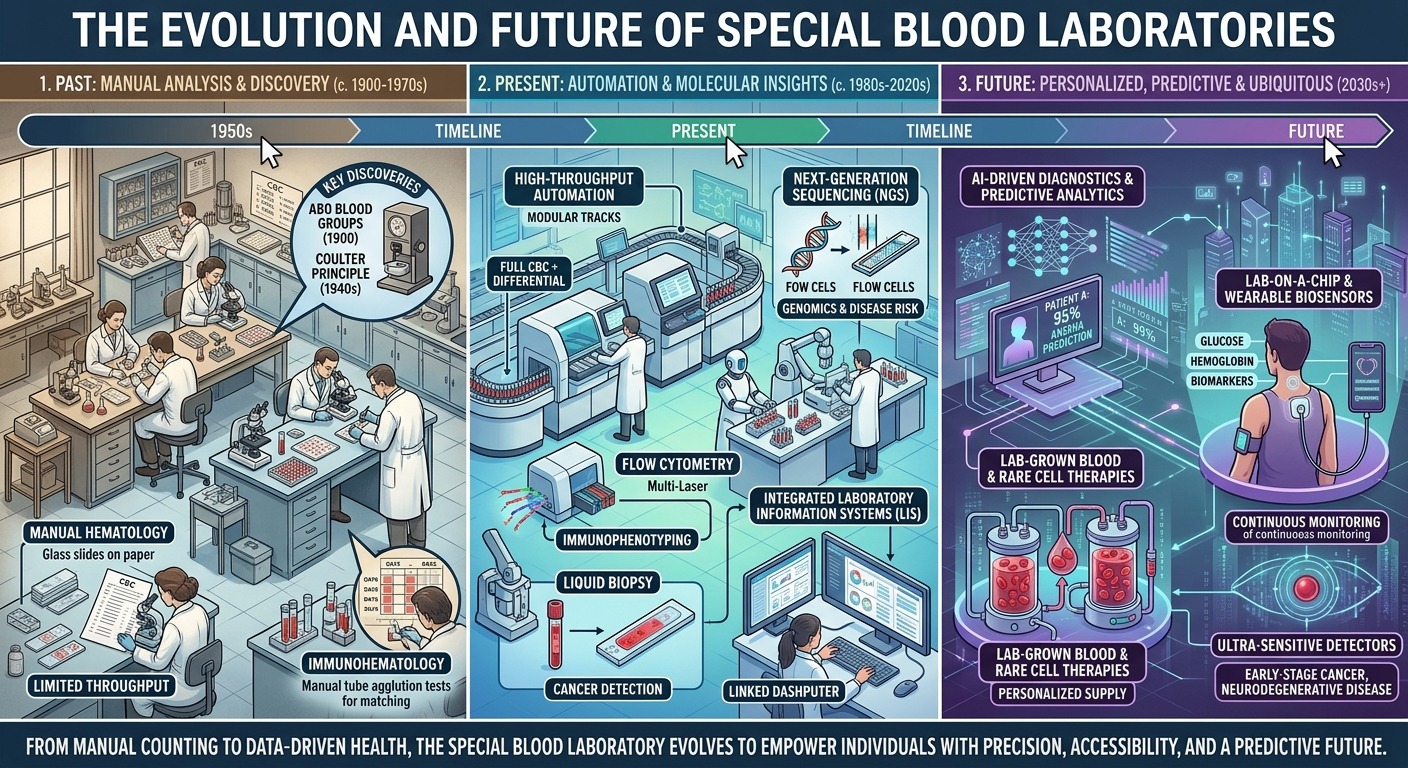
Special blood laboratories represent one of the most sophisticated branches of modern laboratory medicine. They exist to solve blood-related problems that cannot always be resolved by routine blood grouping, antibody screening, or conventional transfusion-service testing. Their work encompasses advanced immunohematology, molecular blood-group testing, investigation of complex antibodies, identification of rare blood types, compatibility investigations, transfusion-reaction analysis, specialized reference testing, and increasingly, genomic and computational approaches to blood-group biology.
The historical development of these laboratories reflects a broader transformation in medicine: blood changed from being viewed primarily as a vital biological fluid into a highly characterized biological system containing genetically determined antigens, antibodies, cells, proteins, nucleic acids, and therapeutic components. The discovery of the ABO blood groups, development of compatibility testing, expansion of blood transfusion services, recognition of increasingly complex blood-group systems, and emergence of molecular genetics progressively created the need for specialized reference laboratories.
Today, specialized blood laboratories operate at the intersection of transfusion medicine, immunology, hematology, genetics, microbiology, information technology, quality management, and clinical medicine. Their future is likely to be shaped by automation, artificial intelligence, genomic blood-group typing, digital laboratory information systems, advanced data analytics, improved rare-donor databases, pathogen detection, personalized transfusion medicine, robotics, and increasingly sophisticated quality and risk-management systems.
The evolution is therefore not simply from manual testing to automated testing. It is a transition from serology-centered laboratories toward integrated biological-information laboratories, in which blood cells, antibodies, DNA, clinical records, population genetics, artificial intelligence, and real-time laboratory systems may increasingly be interpreted together.
1. Introduction
Blood is one of the most complex biological materials handled routinely in medicine. It contains red blood cells, white blood cells, platelets, plasma proteins, antibodies, antigens, nucleic acids, electrolytes, hormones, metabolites, and numerous other biological components. Because blood is transferred between individuals during transfusion, the biological differences between donor and recipient can have major clinical consequences.
Routine blood-bank laboratories can resolve many transfusion questions. However, some cases are considerably more complicated. A patient may possess multiple antibodies, an unusual antibody that is difficult to identify, an uncommon blood-group phenotype, or genetic characteristics that make conventional serological interpretation difficult. A patient may also have been recently transfused, making conventional phenotyping unreliable.
This is where special blood laboratories become important.
The term can encompass several closely related specialized laboratory functions, particularly:
- immunohematology reference laboratories;
- advanced transfusion laboratories;
- molecular blood-group laboratories;
- rare-donor and rare-blood investigations;
- specialized antibody-identification services;
- transfusion-reaction investigation laboratories;
- blood-group genetics laboratories;
- platelet and neutrophil immunology laboratories;
- selected laboratories supporting cellular and blood-based therapies.
A modern immunohematology reference laboratory, for example, provides specialized services for patients with complex serological problems and those requiring rare blood components. Current AABB standards explicitly recognize these laboratories as specialized services for complex serologic cases and rare blood requirements.
The importance of such laboratories is increasing because modern transfusion medicine is becoming increasingly precise. Instead of asking simply:
“What is this patient’s blood group?”
the modern laboratory may need to answer:
- Which blood-group antigens does the patient possess?
- Which antigens are absent?
- Which antibodies are present?
- Are those antibodies clinically significant?
- Has the patient recently received transfused blood?
- Could a genetic variant explain an unusual serological pattern?
- Which donor units are compatible?
- Is a rare donor required?
- What is the patient’s predicted antigen profile?
- Can molecular testing resolve an ambiguous serological result?
The laboratory is consequently becoming a decision-support center for personalized transfusion medicine.
2. Understanding What Makes a Blood Laboratory “Special”
A conventional blood bank or transfusion service performs essential activities such as:
- ABO grouping.
- RhD typing.
- Antibody screening.
- Compatibility testing.
- Blood-component storage.
- Issuing blood components.
- Routine transfusion-related investigations.
A special blood laboratory goes further.
It investigates problems that require deeper technical expertise, specialized reagents, advanced instrumentation, molecular analysis, or access to specialized donor information.
2.1 Core characteristics
A special blood laboratory generally has several characteristics:
- highly trained specialist personnel;
- advanced serological methods;
- specialized reference reagents;
- molecular testing capabilities;
- extensive reference databases;
- rare-donor information;
- sophisticated quality-management systems;
- strong links with hospitals and transfusion services;
- close communication with clinicians;
- capacity to investigate unusual cases;
- capability to interpret complex laboratory findings.
These laboratories are therefore not simply “larger blood banks.” They represent a different level of diagnostic complexity.
3. Historical Foundations of Blood Laboratories
3.1 Before modern blood grouping
For much of human history, transfusion was not based on modern biological understanding.
Early attempts at transfusion were experimental and sometimes dangerous because physicians did not understand the immunological differences between individuals.
The fundamental problem was eventually recognized: blood from one person is not necessarily biologically compatible with another person.
The discovery of blood groups transformed transfusion medicine.
4. The Discovery of the ABO Blood Group System
The discovery of the ABO system by Karl Landsteiner in the early twentieth century established the scientific foundation of modern blood compatibility.
Landsteiner demonstrated that human blood could be divided into different groups according to reactions between red blood cells and serum.
The basic ABO groups are:
- A;
- B;
- AB;
- O.
This discovery had enormous consequences.
Blood transfusion could now be approached scientifically rather than experimentally.
The laboratory became essential because determining blood compatibility required controlled testing.
The development of ABO testing therefore created one of the earliest major forms of specialized blood laboratory practice.
5. The Rise of the Blood Bank
During the twentieth century, blood collection, storage, testing, preservation, and transfusion became increasingly organized.
Hospitals established blood banks and transfusion services.
These organizations developed procedures for:
- donor selection;
- blood collection;
- blood grouping;
- infectious-disease screening;
- component separation;
- storage;
- compatibility testing;
- distribution;
- transfusion documentation.
The laboratory became the central verification point between the donor and recipient.
This created a new principle in medicine:
Every transfusion should be supported by laboratory evidence that the blood component is appropriate for the patient.
6. The Expansion of Blood-Group Systems
ABO was only the beginning.
Researchers subsequently identified many additional blood-group antigens and systems.
The Rh system became particularly important because of the clinical significance of antibodies against Rh antigens.
Other blood-group systems were subsequently characterized.
As the number of known antigens increased, transfusion compatibility became increasingly complicated.
A patient could be:
- ABO compatible but incompatible for another clinically significant antigen;
- positive for some antigens and negative for others;
- exposed to foreign antigens through previous transfusions or pregnancy;
- producing antibodies against specific donor red-cell antigens.
This created the need for laboratories capable of identifying antibodies beyond routine screening.
Thus emerged the modern field of immunohematology.
7. The Birth of Immunohematology Reference Laboratories
Immunohematology reference laboratories developed to solve difficult serological problems.
Their work can include:
7.1 Complex antibody identification
A patient may have several antibodies simultaneously.
The laboratory must determine which antibodies are present and which are clinically significant.
7.2 Investigation of unusual serological reactions
Sometimes test results do not fit expected patterns.
Specialist laboratories investigate possible explanations.
7.3 Rare blood-group investigations
Some individuals possess uncommon combinations of antigens or lack antigens that are common in the population.
Finding compatible blood can therefore require specialized donor resources.
7.4 Difficult crossmatching
A routine compatibility procedure may not resolve a complex case.
Reference laboratories can use additional techniques to clarify compatibility.
7.5 Transfusion-reaction investigations
When an unexpected reaction occurs following transfusion, specialized testing may help investigate its cause.
8. The Evolution of Laboratory Technology
The history of special blood laboratories can be understood through several technological eras.
Era 1: Manual Serology
Early testing depended heavily on:
- glass tubes;
- pipettes;
- centrifuges;
- visual interpretation;
- manual reagent preparation;
- handwritten records.
Laboratory expertise was highly dependent on the experience and observational skill of the technologist.
Advantages
Manual methods were relatively flexible and could be adapted to unusual cases.
Limitations
They were:
- labor-intensive;
- susceptible to interpretation differences;
- slower;
- difficult to scale;
- dependent on careful documentation.
9. Era 2: Standardization
As transfusion medicine matured, laboratories increasingly introduced:
- standardized reagents;
- standardized procedures;
- quality controls;
- proficiency testing;
- documented operating procedures;
- reference ranges and interpretation criteria.
Quality management became a fundamental component of laboratory medicine.
Modern standards increasingly treat the laboratory as a complete system rather than merely a collection of analytical procedures.
AABB’s current standards, for example, organize blood-bank and reference-laboratory requirements around quality-system concepts and technical requirements.
10. Era 3: Gel and Solid-Phase Technologies
New testing platforms reduced dependence on traditional tube methods.
Technologies such as:
- column agglutination;
- gel testing;
- solid-phase testing;
made many procedures more standardized and suitable for automation.
These technologies improved consistency and helped laboratories process larger workloads.
11. Era 4: Automation
Automation transformed blood laboratories.
Modern systems can perform multiple analytical steps with limited manual intervention.
Automation can support:
- sample identification;
- reagent handling;
- incubation;
- centrifugation;
- result interpretation;
- data transmission;
- instrument maintenance;
- quality-control monitoring.
The objective is not simply speed.
Automation can also reduce opportunities for human error and create traceable electronic records.
However, automation does not eliminate the need for specialist expertise.
A machine may identify an unusual reaction, but a specialist may still need to determine why it occurred.
12. Era 5: Molecular Blood-Group Testing
One of the most important developments has been the introduction of molecular biology into transfusion medicine.
Traditional serology examines the expression of antigens on cells.
Molecular testing examines the underlying genetic information.
In simplified form:
DNA → gene variant → protein expression → blood-group phenotype
Molecular blood-group testing can therefore provide information that may not be easily obtained through conventional serology.
AABB’s standards recognize molecular testing for red-cell, platelet, and neutrophil antigens as a distinct specialized discipline.
13. Why Genomics Matters
Blood-group genes contain naturally occurring genetic variation.
Two people can have apparently similar serological characteristics while possessing genetic differences that may become clinically relevant.
Molecular approaches can help investigate:
- unusual blood-group phenotypes;
- weak or variant antigen expression;
- complex transfusion histories;
- recently transfused patients;
- multiple antibodies;
- rare phenotypes;
- difficult serological interpretations.
The future therefore moves from:
“What does the red cell look like?”
toward:
“What genetic information explains the red-cell phenotype?”
14. The Emergence of Rare-Blood Laboratories
Some blood types are uncommon within particular populations.
A patient requiring a rare antigen-negative blood component may therefore face a difficult logistical problem.
Special laboratories can contribute to:
- identification of rare phenotypes;
- maintenance of rare-donor records;
- donor recruitment;
- specialized compatibility investigations;
- coordination between blood centers;
- international or national searches for compatible units.
Rare blood is therefore both a laboratory and information-management problem.
A laboratory may know that a compatible unit exists, but the larger challenge may be identifying where that donor or component is located and coordinating its availability.
15. Population Genetics and Special Blood Laboratories
Population genetics is becoming increasingly relevant to transfusion medicine.
Blood-group frequencies differ among populations.
Consequently, a blood supply designed around one population may not optimally represent another.
This has important implications for countries with substantial genetic diversity.
A sophisticated future blood system could integrate:
- blood-group genetics;
- population data;
- donor registries;
- rare-variant databases;
- geographic information;
- transfusion requirements.
This could make it easier to identify appropriately matched donors.
16. Special Blood Laboratories and Personalized Transfusion Medicine
Modern medicine increasingly emphasizes personalized treatment.
Transfusion medicine is following the same trajectory.
Traditional model:
Patient → ABO/RhD → compatible blood
Emerging model:
Patient → clinical history + antibody profile + antigen phenotype + genotype + transfusion history → individualized component selection
This becomes especially important for patients who receive repeated transfusions.
The more frequently an individual is exposed to donor blood, the greater the importance of carefully managing antigen compatibility.
17. The Role of Laboratory Information Systems
Special blood laboratories increasingly depend on digital information systems.
A modern laboratory information system can connect:
- patient identification;
- laboratory results;
- historical antibody records;
- blood-group phenotypes;
- molecular results;
- donor information;
- component inventory;
- compatibility records;
- quality-control information.
This creates an important concept:
The patient’s transfusion history becomes part of the laboratory’s diagnostic memory.
A previous antibody can remain clinically important even when it is no longer easily detectable.
Consequently, historical data can be as important as today’s laboratory result.
18. Artificial Intelligence and Special Blood Laboratories
Artificial intelligence could become one of the most important future technologies in specialized blood testing.
Potential applications include:
18.1 Pattern recognition
AI could assist with interpretation of complex testing patterns.
18.2 Antibody investigation
Machine-learning systems could compare current results with large reference datasets.
18.3 Risk prediction
AI could potentially help identify patients at increased risk of transfusion complications.
18.4 Rare-donor matching
Algorithms could search large donor databases for compatible antigen profiles.
18.5 Quality control
AI could identify unusual instrument behavior or patterns associated with laboratory errors.
18.6 Workflow optimization
AI could prioritize urgent or complex cases.
However, AI should be treated as a decision-support technology, not an unquestioned replacement for specialist judgment.
Clinical accountability, validation, explainability, cybersecurity, and human oversight remain essential.
19. Robotics
Robotics could further transform specialized blood laboratories.
A future laboratory could contain automated systems capable of moving samples through:
- specimen reception;
- identification;
- preparation;
- testing;
- imaging;
- result verification;
- database integration;
- storage or disposal.
The laboratory could become a highly coordinated cyber-physical system.
Robotic automation would be particularly useful for high-volume repetitive activities.
Complex interpretation would remain a domain where expert human involvement is important.
20. Digital Microscopy and Computational Vision
Another emerging direction is computational image analysis.
Instead of relying entirely on human visual interpretation, digital systems can capture laboratory images and analyze them computationally.
Possible applications include:
- cell morphology;
- agglutination patterns;
- reaction grading;
- quality assessment;
- automated documentation.
This creates another transition:
human observation → digital image → computational interpretation → specialist verification
21. Cloud Computing and Distributed Blood Laboratories
Cloud technology could allow specialized laboratories to share information securely.
Instead of every laboratory maintaining completely isolated datasets, appropriately governed networks could support:
- shared reference databases;
- rare-donor searches;
- distributed expertise;
- remote consultation;
- quality-management systems;
- epidemiological surveillance;
- laboratory benchmarking.
This could be particularly valuable in regions where specialist expertise is concentrated in only a few major centers.
22. The Future Laboratory as a Network
The future special blood laboratory is unlikely to operate as an isolated room.
It may become one node in a larger network involving:
Donor → Blood center → Hospital → Routine laboratory → Reference laboratory → Molecular laboratory → Specialist → Clinical team
Digital communication could connect these participants in near real time.
This would make specialized blood medicine increasingly collaborative.
23. Advanced Genomic Blood Typing
The long-term future could involve increasingly comprehensive genomic analysis.
Instead of testing a small number of blood-group genes, laboratories could potentially characterize a much larger portion of the patient’s blood-group genetic profile.
This could produce a digital blood-group genotype profile.
Such a profile could be stored securely and reused throughout the patient’s lifetime.
The concept would resemble a genomic identity card for transfusion compatibility, although implementation would require careful regulation, privacy protection, validation, and clinical governance.
24. Next-Generation Sequencing
Next-generation sequencing provides the ability to analyze large amounts of genetic information simultaneously.
Its potential role in blood laboratories includes investigation of:
- unusual blood-group variants;
- complex genotypes;
- rare alleles;
- difficult phenotype/genotype relationships;
- population variation.
The major challenge is not simply generating genetic data.
The laboratory must determine:
Which genetic differences actually matter clinically?
That requires validated databases, expert interpretation, and clinical correlation.
25. Artificial Intelligence + Genomics
The combination of genomics and AI may become particularly powerful.
Imagine a system containing:
- millions of donor profiles;
- thousands of blood-group variants;
- patient antibody histories;
- clinical transfusion records;
- blood inventory;
- geographic information.
An algorithm could potentially search this information to identify compatible donor options.
The future could therefore move toward:
Genomic matching rather than simple blood-group matching.
This does not mean ABO compatibility becomes irrelevant. Rather, compatibility could become progressively more sophisticated.
26. Pathogen Detection and Blood Safety
Blood laboratories also play a critical role in protecting recipients from transfusion-transmitted infections.
Blood systems must continuously address infectious risks.
The World Health Organization’s 2025 global status report, published in June 2026, analyzed blood safety and availability across 168 countries and highlighted continuing differences in blood availability, safety, quality assurance, governance, and laboratory screening capacity.
This demonstrates that laboratory technology is only one component of blood safety.
A sophisticated analyzer cannot compensate for weak:
- governance;
- quality systems;
- supply chains;
- trained personnel;
- donor recruitment;
- laboratory infrastructure;
- regulatory systems.
27. The Importance of Quality Management
The future laboratory will require stronger—not weaker—quality systems.
As laboratories become more automated, new categories of risk emerge.
Examples include:
- software errors;
- incorrect configuration;
- instrument failures;
- connectivity problems;
- cybersecurity incidents;
- algorithmic errors;
- database corruption;
- inappropriate automated interpretation.
AABB’s 2026 standards for immunohematology reference laboratories specifically introduced requirements concerning risk-based monitoring of critical technology infrastructure.
This is significant because it demonstrates that laboratory quality is expanding beyond traditional reagent and procedural control toward technology-system reliability.
28. Cybersecurity
The increasingly digital blood laboratory creates a new vulnerability: cybersecurity.
A future blood laboratory may depend on:
- laboratory information systems;
- cloud databases;
- networked instruments;
- electronic patient records;
- donor databases;
- automated inventory systems;
- AI systems.
Therefore, cybersecurity becomes part of patient safety.
A cyberattack affecting a blood laboratory could potentially disrupt:
- testing;
- patient identification;
- inventory information;
- compatibility records;
- communication;
- reporting.
Future laboratory design must therefore incorporate cybersecurity from the beginning.
29. Data Governance and Privacy
Genomic blood-group information is sensitive biological information.
Future laboratories will need strong governance around:
- consent;
- data ownership;
- data access;
- encryption;
- retention;
- sharing;
- secondary research use;
- international data transfer.
The more powerful the database becomes, the more important governance becomes.
30. Special Blood Laboratories in Developing Countries
The future cannot be designed only for wealthy countries.
Many low- and middle-income countries continue to face fundamental challenges in blood availability and laboratory capacity.
WHO’s 2026 global report identifies persistent gaps affecting the sufficiency, safety, equitable availability, and quality assurance of blood systems, particularly in low- and middle-income countries.
Therefore, technological progress must be accompanied by infrastructure development.
A practical development pathway may include:
Level 1
Reliable basic blood grouping and infectious-disease screening.
Level 2
Modern blood-bank automation and quality management.
Level 3
Regional immunohematology reference laboratories.
Level 4
Molecular blood-group testing.
Level 5
National genomic and rare-donor databases.
Level 6
Integrated AI-assisted national transfusion networks.
This staged approach may be more realistic than attempting to establish fully automated genomic laboratories everywhere simultaneously.
31. Africa and the Future of Special Blood Laboratories
Africa presents both significant challenges and extraordinary opportunities.
The continent contains substantial genetic diversity, which makes comprehensive blood-group characterization particularly valuable.
At the same time, many health systems face limitations involving:
- laboratory infrastructure;
- specialist staffing;
- funding;
- equipment maintenance;
- reagent supply;
- transportation;
- data systems;
- blood donation;
- rural accessibility.
Regional centers of excellence could help address these problems.
Instead of requiring every hospital to maintain every specialized capability, countries could establish interconnected regional reference laboratories.
For example:
Local hospital → Provincial laboratory → National reference laboratory → Regional specialist network
Such a system could distribute expertise more efficiently.
32. South Africa as a Potential Regional Model
South Africa has an important opportunity to develop highly specialized transfusion and blood-genomics capabilities that could serve both national needs and wider regional cooperation.
A future model could connect:
- hospitals;
- blood services;
- universities;
- research laboratories;
- genomic centers;
- biotechnology companies;
- national health authorities.
The objective would be to build a connected ecosystem rather than isolated laboratories.
Such an ecosystem could support:
- rare blood investigations;
- advanced immunohematology;
- molecular blood typing;
- research;
- specialist training;
- regional consultation;
- population-genetics research.
33. The Future Workforce
Technology will change the skills required of laboratory professionals.
The future specialist may need knowledge of:
Traditional disciplines
- hematology;
- immunology;
- transfusion medicine;
- microbiology;
- genetics.
New disciplines
- bioinformatics;
- genomics;
- data science;
- artificial intelligence;
- cybersecurity;
- laboratory automation;
- digital quality management.
The future blood scientist may therefore be part laboratory scientist, part genomic analyst, part data specialist, and part clinical consultant.
34. From Laboratory Technician to Laboratory Data Scientist
This transformation does not mean traditional laboratory skills disappear.
Rather, the skill set expands.
A future specialist might need to understand:
Sample → Instrument → Biological signal → Data → Algorithm → Clinical interpretation
The laboratory professional becomes responsible not only for generating data but also for understanding whether the data are reliable and clinically meaningful.
35. The Role of Standards
As technology advances, standards become increasingly important.
AABB currently maintains separate standards covering areas including:
- blood banks and transfusion services;
- immunohematology reference laboratories;
- molecular testing;
- cellular therapy;
- patient blood management;
- relationship testing.
In 2026, AABB introduced its 35th edition of Blood Banks and Transfusion Services standards and 14th edition of Immunohematology Reference Laboratory standards, both effective April 1, 2026.
The evolution of standards illustrates an important principle:
Laboratory technology can advance only safely when quality systems advance with it.
36. The Future of Laboratory Accreditation
Future accreditation will likely evaluate not only whether a laboratory follows procedures but also whether its entire technological ecosystem is controlled.
Future assessments may increasingly examine:
- software validation;
- algorithm validation;
- cybersecurity;
- electronic records;
- AI governance;
- instrument connectivity;
- data integrity;
- genomic interpretation;
- change management;
- disaster recovery.
AABB’s current standards already demonstrate movement toward stronger monitoring of critical technology infrastructure.
37. The Economics of Special Blood Laboratories
Specialized laboratories can be expensive.
Major costs include:
- specialized instruments;
- reagents;
- sequencing technologies;
- software;
- laboratory information systems;
- maintenance;
- highly trained staff;
- quality assurance;
- accreditation;
- cybersecurity;
- data storage.
However, economic evaluation must consider the cost of not having specialized capability.
Incorrect or delayed compatibility decisions can contribute to:
- prolonged hospitalization;
- delayed procedures;
- additional investigations;
- blood wastage;
- avoidable transfusion complications;
- increased healthcare expenditure.
Thus, special laboratories should be viewed as critical infrastructure, not merely expensive diagnostic units.
38. Sustainability
Future laboratories will also need to become more environmentally sustainable.
Potential strategies include:
- energy-efficient instruments;
- optimized reagent use;
- reduced waste;
- efficient sample transportation;
- digital documentation;
- responsible disposal;
- intelligent laboratory scheduling.
Automation may reduce some forms of waste while increasing electronic and equipment-related energy consumption.
The future laboratory must therefore balance technological sophistication with environmental responsibility.
39. The Concept of the “Digital Blood Profile”
One of the most interesting long-term possibilities is the creation of a comprehensive digital blood profile.
Such a profile could contain:
Identity
Secure patient identification.
Serology
- ABO;
- Rh;
- antibody history;
- clinically significant findings.
Genetics
- blood-group genotype;
- selected relevant variants.
Clinical history
- previous transfusions;
- relevant pregnancy history where clinically appropriate;
- previous reactions.
Compatibility information
- known antibodies;
- special transfusion requirements.
Laboratory history
- previous investigations;
- reference laboratory findings.
The objective would be to prevent the loss of important historical information when a patient moves between hospitals.
40. The “Blood Laboratory of the Future”
A conceptual future special blood laboratory could contain several integrated layers.
Layer 1: Specimen Reception
Automated identification and tracking.
Layer 2: Serology
Automated blood grouping and antibody testing.
Layer 3: Molecular Analysis
Genotyping and advanced genomic investigation.
Layer 4: Data Integration
Combining laboratory, donor, and clinical information.
Layer 5: Artificial Intelligence
Pattern recognition, matching, anomaly detection, and decision support.
Layer 6: Human Specialist Review
Expert interpretation of complex cases.
Layer 7: Clinical Communication
Rapid delivery of clinically meaningful recommendations.
Layer 8: National/International Network
Connection to rare-donor and reference resources.
This represents a shift from a laboratory as a physical room toward a distributed digital-biological network.
41. A Possible Future Workflow
A future complex transfusion case might follow this pathway:
Patient identification
↓
Electronic clinical history
↓
Automated serological testing
↓
Antibody detection
↓
Automated recognition of complexity
↓
Specialist review
↓
Molecular blood-group testing
↓
Genomic interpretation
↓
AI-assisted donor matching
↓
Rare-donor database search
↓
Compatibility confirmation
↓
Clinical recommendation
↓
Transfusion
↓
Digital haemovigilance record
The important transformation is that information would move continuously through the system instead of being repeatedly reconstructed manually.
42. Challenges to the Future
Despite its promise, the future of special blood laboratories faces major challenges.
42.1 Cost
Advanced genomic and automated systems can be expensive.
42.2 Workforce shortages
Highly trained specialists are difficult to produce quickly.
42.3 Technology dependence
Greater automation creates greater dependence on infrastructure.
42.4 Cybersecurity
Connected systems create new attack surfaces.
42.5 Algorithmic bias
AI systems may perform differently across populations if training data are not representative.
42.6 Genetic complexity
Not every genetic variant has a straightforward clinical interpretation.
42.7 Interoperability
Different laboratories may use incompatible information systems.
42.8 Data privacy
Genetic and clinical information requires strong protection.
42.9 Regulatory complexity
New technologies must be validated and governed before becoming routine clinical tools.
43. AI Must Not Replace Specialist Judgment
A particularly important principle for the future is:
Automation should remove repetitive work, not remove responsibility.
An AI system could flag an unusual antibody pattern.
A specialist must determine:
- whether the finding is real;
- whether the interpretation is clinically meaningful;
- whether additional testing is required;
- what limitations exist;
- what should be communicated to the clinical team.
This human-machine partnership will probably be more reliable than either extreme:
manual-only medicine
or
uncontrolled automation.
44. Research Opportunities
The evolution of special blood laboratories creates many research opportunities.
Important areas include:
- Blood-group genomics.
- Rare blood-group variants.
- AI-assisted antibody identification.
- Automated serological interpretation.
- Genomic donor matching.
- Population blood-group databases.
- Transfusion-risk prediction.
- Digital haemovigilance.
- Laboratory cybersecurity.
- Robotics.
- Point-of-care blood testing.
- Artificial blood and blood substitutes.
- Cellular therapies.
- Advanced blood-component preservation.
- Personalized transfusion medicine.
The field is therefore increasingly interdisciplinary.
45. Artificial Blood and the Longer-Term Horizon
One of the ultimate questions is whether laboratories will eventually manage products that reduce dependence on conventional donor blood.
Research into artificial or engineered blood substitutes, cultured blood cells, and advanced cellular therapies could change transfusion medicine.
If laboratory-produced blood components become clinically practical at scale, specialized laboratories could evolve from testing donor blood to characterizing and quality-controlling engineered biological products.
This would represent another major transition:
Donor-derived transfusion → engineered biological transfusion
However, this remains a scientific and clinical-development challenge rather than a replacement for conventional blood services today.
46. Cellular and Regenerative Medicine
Blood laboratories are increasingly connected to broader biotherapies.
Red cells and platelets are not the only biologically important products.
The wider field includes:
- hematopoietic cells;
- cellular therapies;
- plasma-derived products;
- engineered biological products.
Consequently, the specialized blood laboratory of the future may increasingly overlap with:
transfusion medicine + genomics + cellular therapy + biotechnology.
This is consistent with the broader expansion of AABB standards into cellular therapy and related blood-and-biotherapy disciplines.
47. From Blood Bank to Blood Intelligence Center
The term “blood bank” may eventually become insufficient to describe the most advanced institutions.
A future center could manage:
- biological samples;
- donor genetics;
- patient genetics;
- antibody histories;
- compatibility data;
- blood inventory;
- rare-donor networks;
- AI models;
- population-level information.
Such an organization would function as a blood intelligence center.
Its principal asset would not simply be stored blood.
Its greatest asset would be trusted biological information.
48. A New Architecture for Global Blood Systems
A future global architecture could be represented as:
Local Laboratory
↓
Regional Reference Laboratory
↓
National Blood Laboratory
↓
National Genomic Blood Database
↓
International Rare-Donor Network
↓
Global Specialist Knowledge Network
Such a system could improve access to expertise, particularly for rare and complex cases.
It could also help smaller hospitals access capabilities that would be economically impossible to maintain locally.
49. Ethical Considerations
The future of blood laboratories also raises ethical questions.
Who controls genomic blood information?
Who can access a patient’s transfusion history?
Should genetic profiles be retained indefinitely?
How should AI decisions be challenged?
How can disadvantaged populations avoid being underrepresented in databases?
How should rare-donor information be protected?
How can laboratories balance rapid information sharing with privacy?
These questions must be addressed alongside technological development.
50. The Importance of Equity
Advanced blood technology should not become available only to wealthy healthcare systems.
A future global blood strategy should aim to reduce disparities between:
- high-income and low-income countries;
- urban and rural populations;
- major hospitals and smaller hospitals;
- genetically well-represented and underrepresented populations.
WHO’s latest global assessment emphasizes continuing differences in blood safety, availability, laboratory screening, and health-system capacity across countries.
The future should therefore be measured not only by technological sophistication but also by equitable access.
51. Strategic Roadmap for the Next Generation
A practical development strategy for special blood laboratories could follow ten stages.
Stage 1 — Strengthen fundamentals
Reliable blood grouping, screening, compatibility testing, and quality management.
Stage 2 — Digitize records
Replace fragmented paper histories with secure electronic systems.
Stage 3 — Automate routine testing
Introduce validated automation where appropriate.
Stage 4 — Build reference laboratories
Create regional centers for complex cases.
Stage 5 — Introduce molecular testing
Develop validated blood-group genotyping.
Stage 6 — Develop rare-donor databases
Connect donor phenotype/genotype information to inventory.
Stage 7 — Integrate national networks
Connect hospitals and reference laboratories.
Stage 8 — Introduce advanced analytics
Use computational systems for matching and anomaly detection.
Stage 9 — Develop AI carefully
Validate decision-support systems against clinical and laboratory standards.
Stage 10 — Build genomic blood ecosystems
Integrate blood-group genetics, donor networks, clinical history, and laboratory intelligence.
52. The Laboratory as a Learning System
A future special blood laboratory should continuously learn from its own performance.
It could analyze:
- near misses;
- rejected samples;
- instrument failures;
- unusual antibody cases;
- transfusion reactions;
- workflow delays;
- quality-control trends;
- inventory shortages.
This creates a continuous improvement cycle:
Measure → Analyze → Learn → Improve → Validate → Repeat
Such systems could make laboratories safer over time.
53. The Human Element Remains Central
Despite technological progress, blood medicine remains fundamentally human.
A transfusion is ultimately performed to help a person.
Behind every laboratory number is a patient who may be:
- undergoing surgery;
- receiving cancer treatment;
- recovering from trauma;
- experiencing severe anemia;
- managing a chronic transfusion requirement;
- preparing for childbirth;
- undergoing complex medical treatment.
Technology must therefore serve clinical care rather than become an end in itself.
54. Conclusion
The history of special blood laboratories is a story of increasing biological understanding.
The journey began with the recognition that human blood is not universally interchangeable. The discovery of ABO blood groups established the scientific foundation of compatibility testing. The expansion of blood-group knowledge created immunohematology. Increasingly complex transfusion cases created reference laboratories. Automation improved efficiency and standardization. Molecular biology introduced genetic blood typing. Digital information systems connected laboratory data. And artificial intelligence and advanced genomics are now opening another stage of development.
The modern special blood laboratory is consequently much more than a facility that performs blood tests.
It is becoming an integrated center for:
immunology + transfusion medicine + genetics + genomics + automation + data science + artificial intelligence + quality management.
The latest international developments already show this transition. Current AABB standards distinguish specialized immunohematology reference laboratories and molecular testing services, while the 2026 standards place greater emphasis on technology infrastructure, quality systems, and risk management.
The next generation may take this transformation much further.
The laboratory of the future could maintain a continuously updated digital understanding of a patient’s blood-group biology, antibody history, genetic profile, and transfusion requirements. AI could assist specialists in interpreting complex patterns. Genomics could improve donor-recipient matching. Automated systems could handle repetitive processes. National and international databases could help locate rare compatible blood. And interconnected reference laboratories could make specialist knowledge accessible across geographic boundaries.
Yet the fundamental mission will remain unchanged:
To provide the right blood product, for the right patient, at the right time, with the highest achievable level of safety.
The ultimate evolution of special blood laboratories is therefore not simply toward faster machines or more sophisticated genetic testing. It is toward a precision transfusion ecosystem in which biological information, technology, specialist expertise, and clinical decision-making work together.
In that future, the most advanced blood laboratory will not merely analyze blood.
It will understand blood.


Be First to Comment