
Introduction
Artificial intelligence (AI), machine learning (ML), and deep learning (DL) are three of the most important concepts in modern computing. They are also among the most frequently confused. The terms are closely related, but they do not mean the same thing.
The simplest way to understand their relationship is:
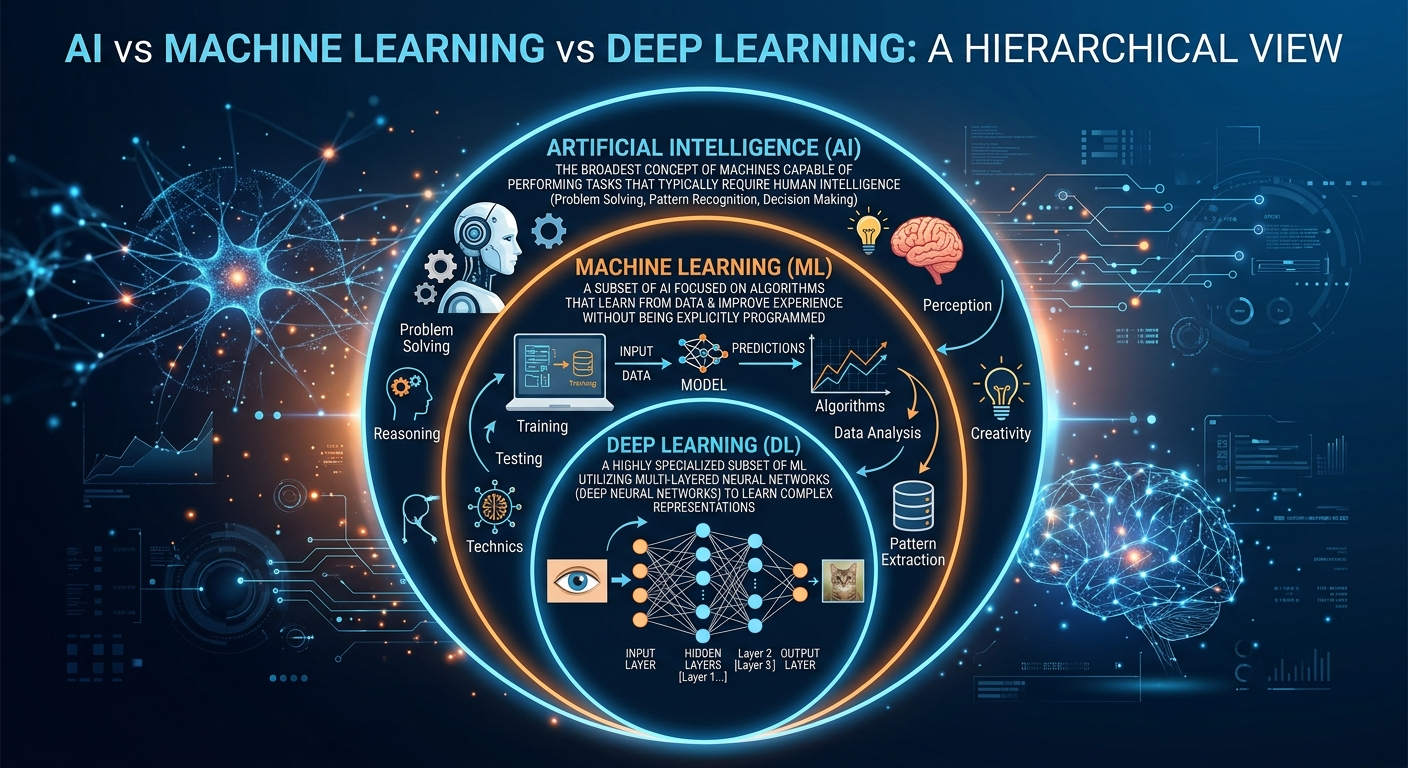
Artificial Intelligence → Machine Learning → Deep Learning
AI is the broadest field. Machine learning is one major approach within AI, while deep learning is a specialized branch of machine learning based primarily on multilayer artificial neural networks.
This relationship is important because many technologies marketed as “AI” do not necessarily use deep learning, and not every AI system learns from data. Some AI systems can operate through rules, search, logic, optimization, planning, or other computational techniques.
At the same time, the rise of deep learning has transformed AI. Modern speech recognition, computer vision, large language models, generative AI, recommendation systems, autonomous systems, and many other technologies rely heavily on machine learning and deep neural networks.
Understanding the differences therefore requires looking beyond the labels and examining how each technology represents knowledge, processes information, learns, makes predictions, and interacts with the real world.
1. What Is Artificial Intelligence?
Artificial intelligence is the broadest concept of the three.
AI is the field concerned with creating computer systems capable of performing tasks associated with forms of intelligence such as perception, reasoning, learning, decision-making, language processing, planning, and problem solving.
An AI system does not necessarily need to learn from examples.
For example, a computer program could be designed with explicit rules:
If condition A occurs, perform action B.
Such a system can be considered an AI system when those rules are designed to solve problems that require forms of reasoning or decision-making.
Examples of AI approaches
AI can include:
- Rule-based systems
- Expert systems
- Search algorithms
- Planning systems
- Knowledge representation
- Optimization
- Natural-language processing
- Computer vision
- Robotics
- Machine learning
- Deep learning
- Generative AI
Therefore, AI is a field rather than a single algorithm.
IBM similarly describes AI as technology enabling computers and machines to simulate capabilities such as learning, comprehension, problem solving, decision-making, creativity and autonomy.
2. What Is Machine Learning?
Machine learning is a subset of artificial intelligence.
Instead of manually programming every rule needed to solve a problem, machine-learning systems learn patterns from data and use those patterns to make predictions, classifications, recommendations, or decisions.
A simplified process is:
Data → Training algorithm → Model → Prediction
Imagine a system designed to predict whether an email is likely to be spam.
Traditional programming might attempt to create thousands of explicit rules.
Machine learning takes another approach.
The system can be given examples of emails and their classifications. During training, the algorithm searches for patterns that distinguish different categories. The resulting model can then evaluate new emails.
The important concept is generalization.
A useful machine-learning model should not merely memorize its training examples. It should learn patterns that allow it to perform reasonably well on previously unseen data.
3. Major Types of Machine Learning
Machine learning is not one technique. It is a large collection of methods.
3.1 Supervised Learning
In supervised learning, the training data contains known answers or labels.
For example:
| Input | Label |
|---|---|
| Image of an animal | Cat |
| Image of another animal | Dog |
| Image of another animal | Cat |
The algorithm learns a relationship between inputs and outputs.
Common applications include:
- Classification
- Regression
- Forecasting
- Fraud detection
- Medical-image classification
- Customer churn prediction
- Credit-risk modeling
Common algorithms include:
- Linear regression
- Logistic regression
- Decision trees
- Random forests
- Support vector machines
- k-nearest neighbors
- Neural networks
3.2 Unsupervised Learning
Unsupervised learning works with data where the desired output is not explicitly provided.
The algorithm attempts to discover structure within the data.
For example, a retailer could analyze purchasing behavior and discover groups of customers with similar patterns.
Typical techniques include:
- Clustering
- Dimensionality reduction
- Association analysis
- Representation learning
K-means clustering is a classic example.
3.3 Reinforcement Learning
Reinforcement learning is based on interaction.
An agent performs an action, receives feedback from its environment, and gradually learns which actions produce better outcomes.
The simplified loop is:
State → Action → Environment → Reward → Updated strategy
Applications include:
- Robotics
- Game-playing systems
- Resource management
- Control systems
- Certain optimization problems
Reinforcement learning is particularly interesting because the system learns through a feedback process rather than simply receiving a fixed collection of correct answers.
4. What Is Deep Learning?
Deep learning is a specialized subset of machine learning.
It uses artificial neural networks containing multiple computational layers to learn increasingly complex representations of data.
The basic hierarchy is:
Artificial Intelligence
↓
Machine Learning
↓
Deep Learning
↓
Deep Neural Networks
Deep learning became particularly influential as large datasets, powerful computing hardware, specialized accelerators, and improved training techniques became available.
Modern deep-learning systems can contain enormous numbers of adjustable parameters.
5. What Is a Neural Network?
A neural network is a computational model composed of interconnected processing units commonly called neurons or nodes.
A simplified neural network contains:
Input layer → Hidden layers → Output layer
The input layer receives information.
The hidden layers transform that information.
The output layer produces a result.
During training, the network adjusts numerical parameters called weights so that its predictions increasingly match the desired objective.
IBM describes neural networks as the backbone of many deep-learning systems, with interconnected layers of computational nodes.
6. Why Is It Called “Deep” Learning?
The word deep refers to the presence of multiple layers in the neural network.
A shallow model may have relatively few computational layers.
A deep neural network can contain many layers, sometimes extremely many depending on the architecture.
The conceptual progression can be illustrated as:
Raw input
↓
Low-level patterns
↓
Intermediate patterns
↓
High-level representations
↓
Prediction or generation
For image recognition, for example, earlier layers may learn relatively simple visual structures, while later layers can combine those representations into more complex concepts.
Deep learning therefore allows the system to construct increasingly abstract representations through its layers.
7. AI vs ML vs DL: The Fundamental Difference
The most important distinction is scope.
Artificial Intelligence
AI asks:
“How can we make machines perform tasks requiring forms of intelligence?”
Machine Learning
ML asks:
“How can machines learn useful patterns from data?”
Deep Learning
DL asks:
“How can multilayer neural networks automatically learn complex representations from data?”
This produces a nested relationship:
AI
- Rule-based AI
- Search and planning
- Expert systems
- Machine learning
- Traditional ML
- Neural networks
- Deep learning
- Deep neural networks
- Modern foundation models
- Many generative AI systems
The boundaries can become more complicated in modern AI, but this hierarchy remains an excellent starting point.
8. The Three Technologies Compared
| Characteristic | AI | Machine Learning | Deep Learning |
|---|---|---|---|
| Scope | Broadest | Subfield of AI | Subfield of ML |
| Primary idea | Intelligent behavior | Learning from data | Learning through deep neural networks |
| Requires learning? | Not necessarily | Yes, generally | Yes |
| Neural networks required? | No | No | Yes |
| Data requirements | Varies | Usually significant | Often very large |
| Feature engineering | Varies | Often important | Frequently learned automatically |
| Computational demand | Varies | Moderate to high | Often high |
| Best suited to | Broad intelligent behavior | Structured prediction and classification | Complex pattern recognition |
| Interpretability | Varies | Often better with simpler models | Frequently more difficult |
| Examples | Expert systems, planning, robotics | Forecasting, recommendations, fraud detection | Vision, speech, LLMs, generative AI |
The exact differences depend on the architecture and application; there is no universal boundary based only on computational requirements or data volume.
9. Traditional Programming vs Machine Learning
One of the easiest ways to understand machine learning is to compare it with conventional programming.
Traditional programming
A traditional program commonly follows:
Rules + Data → Output
The programmer explicitly defines the logic.
Machine learning
Machine learning commonly follows:
Data + Desired outcome → Learned model
The model learns parameters or patterns that can subsequently be used on new inputs.
For example, suppose we want to determine whether a transaction is suspicious.
A traditional system might contain rules such as:
- If transaction exceeds a particular threshold, flag it.
- If transaction occurs in a particular location, flag it.
- If a particular pattern appears, flag it.
A machine-learning system can instead learn statistical relationships from historical examples.
This does not make machine learning automatically better. A carefully designed rule-based system can be extremely effective when the rules are stable and well understood.
10. Feature Engineering: One of the Major Differences
Traditional machine learning frequently relies on feature engineering.
A feature is an input representation that helps a model solve a problem.
Suppose a model is trying to predict house prices.
Useful features might include:
- Floor area
- Number of rooms
- Location
- Property age
- Distance from transport
- Historical prices
Humans or conventional data-processing systems may need to determine which features are useful.
Deep learning can reduce some of this manual feature engineering by learning representations directly from relatively raw data.
This is one reason deep learning has become particularly powerful for:
- Images
- Audio
- Video
- Natural language
- Other high-dimensional data
IBM and Google Cloud both identify automatic feature extraction or representation learning as an important distinction between deep learning and many traditional machine-learning approaches.
11. Data: The Fuel of Modern AI
Data is fundamental to modern machine learning.
A machine-learning system can potentially learn relationships from:
- Numbers
- Tables
- Text
- Images
- Audio
- Video
- Sensor readings
- Transaction records
- Scientific measurements
- Web content
However, more data does not automatically produce a better model.
The quality of data matters enormously.
Problems can arise from:
- Incorrect labels
- Missing values
- Duplicated information
- Sampling bias
- Outdated information
- Measurement errors
- Data leakage
- Poor representation of important populations
Consequently:
Better data + appropriate algorithms + sufficient computing + careful evaluation = stronger AI systems
12. Computing Power and the Rise of Deep Learning
Deep learning has benefited enormously from advances in computing.
Training modern neural networks can involve enormous numbers of mathematical operations.
Graphics processing units (GPUs) are particularly useful because neural-network training involves large quantities of parallel mathematical computation.
Other specialized accelerators, including tensor-processing and AI accelerator architectures, can also be used.
This creates a technological chain:
Electricity → Computing hardware → Accelerators → Memory → Data → Algorithms → Models → Applications
The rise of modern AI is therefore not solely an algorithmic story.
It is also a story about:
- Semiconductor technology
- Memory systems
- Networking
- Data centers
- Cloud computing
- Distributed computing
- Software frameworks
- Data infrastructure
- Algorithms
13. Training and Inference
A crucial distinction in AI systems is between training and inference.
Training
Training is the process through which model parameters are adjusted using data.
Conceptually:
Training data → Model computation → Error measurement → Parameter update → Repetition
The process is repeated until the model reaches an acceptable level of performance according to its training objective.
Inference
Inference happens after or during deployment.
The trained model receives new information and produces an output.
For example:
New image → Trained model → Prediction
or:
User question → Trained language model → Generated response
Training can require substantial computing resources, while inference requirements vary enormously depending on the model and application.
14. Deep Learning and Unstructured Data
One of deep learning’s major strengths is its ability to process complex, high-dimensional information.
Consider an image.
An image can contain thousands or millions of individual pixel values.
A conventional approach might require engineers to manually design useful characteristics.
A deep neural network can instead learn increasingly complex representations through its layers.
The same general idea applies to:
- Speech
- Natural language
- Video
- Sensor signals
This capability has contributed heavily to the rapid development of modern computer vision, speech recognition and language technologies.
15. AI, ML and DL in Everyday Technology
These technologies are already embedded in many systems.
Search engines
Machine-learning and deep-learning models can help rank information, understand queries and identify relationships between content.
Recommendation systems
Streaming platforms, online retailers and social platforms can use machine-learning models to estimate which content or products may be relevant to users.
Voice recognition
Deep-learning models can convert speech into machine-readable representations and help interpret spoken language.
Computer vision
Deep learning can identify objects, patterns and other characteristics within images and video.
Fraud detection
Machine-learning systems can identify unusual transaction patterns.
Predictive maintenance
Industrial systems can analyze sensor data to estimate whether equipment may require attention.
Language technology
Deep-learning architectures power many modern natural-language systems.
16. Generative AI: Where Does It Fit?
Generative AI is another term that is frequently confused with AI, ML and DL.
Generative AI refers broadly to AI systems designed to generate new content such as:
- Text
- Images
- Audio
- Video
- Software code
- Other forms of digital content
Many modern generative AI systems are built using deep-learning architectures.
Large language models are a major example.
The conceptual relationship can therefore be represented as:
AI
→ Machine Learning
→ Deep Learning
→ Large-scale neural architectures
→ Foundation models
→ Generative AI applications
However, not every AI system is generative AI, and not every machine-learning system is deep learning.
17. Large Language Models
Large language models (LLMs) demonstrate how deep learning has evolved into highly sophisticated systems.
An LLM is trained to process and generate language using large-scale neural architectures.
Modern LLM development involves several major components:
- Data
- Tokenization
- Neural architecture
- Model parameters
- Training algorithms
- Computing infrastructure
- Evaluation
- Alignment and post-training
- Inference infrastructure
- Applications
The resulting model can be integrated into:
- Chatbots
- Search systems
- Coding assistants
- Document analysis
- Education tools
- Customer-service systems
- Research systems
- Agentic applications
The important point is that an LLM is not synonymous with AI itself.
It is one sophisticated class of AI system built largely from machine-learning and deep-learning techniques.
18. Why Deep Learning Often Requires More Computing
Traditional machine-learning models can sometimes be trained relatively efficiently.
Deep neural networks may contain:
- Millions
- Billions
- Or even more adjustable parameters
Training such systems can require large quantities of:
- Compute
- Memory
- Electricity
- Data
- Networking
- Storage
This is one reason modern AI has become closely connected with data-center infrastructure.
The AI industry is therefore increasingly dependent on the interaction between:
Semiconductors + Accelerators + Memory + Networking + Data Centers + Algorithms + Data
19. Explainability and the “Black Box” Problem
Another major difference involves interpretability.
A simple decision tree can often be inspected relatively easily.
For example:
If income > X and debt < Y → classification A.
A large neural network is substantially more difficult to interpret.
Its decision can depend on complex interactions among enormous numbers of learned parameters.
This creates an important challenge:
A model can produce a highly accurate prediction without providing a simple human-readable explanation of how it reached that result.
This is why AI research increasingly considers:
- Explainability
- Interpretability
- Robustness
- Fairness
- Privacy
- Security
- Reliability
- Evaluation
These concerns become particularly important when AI systems are used in consequential settings.
20. AI Does Not Automatically Mean Intelligence Equal to Humans
A common misunderstanding is that an AI system that performs one impressive task possesses general human intelligence.
That conclusion does not necessarily follow.
A system can be extremely capable at:
- Chess
- Image classification
- Speech recognition
- Translation
- Code generation
- Mathematical calculation
while still being specialized or constrained in other areas.
AI capability should therefore be evaluated according to the actual tasks, environments and objectives for which a system has been designed and tested.
21. The Relationship Between Algorithms, Models and Applications
These concepts should also be separated.
Algorithm
An algorithm is a procedure or computational method.
Model
A model is the learned computational representation produced through a training process.
Application
An application is the software system that uses models and other components to provide a service.
For example:
Algorithm → Training process → Model → API/software → Application → User
This distinction is crucial because people sometimes refer to an entire AI application as “the AI model,” even though the application may contain databases, business rules, search systems, safety mechanisms, user interfaces and several different models.
22. When Should You Use AI, ML or DL?
The terms describe levels of abstraction, not competing products.
The question is therefore not normally:
“Should I choose AI or machine learning?”
Machine learning is already one way of implementing AI.
A better question is:
“What computational approach is appropriate for my problem?”
Use rule-based AI when:
- Rules are well understood.
- The environment is predictable.
- Explainability is important.
- The number of rules is manageable.
Use traditional machine learning when:
- You have structured data.
- You need prediction or classification.
- The problem can be represented with useful features.
- A simpler model can achieve sufficient performance.
Use deep learning when:
- The problem involves complex patterns.
- Large quantities of data are available.
- Automated representation learning is valuable.
- The available computing resources justify the approach.
The most sophisticated model is not automatically the best model.
23. A Practical Example: Agriculture
Consider an agricultural operation.
AI
The overall intelligent agricultural system might:
- Monitor crops
- Analyze weather
- Plan irrigation
- Detect anomalies
- Recommend actions
- Automate equipment
Machine Learning
ML could analyze:
- Soil measurements
- Weather history
- Irrigation records
- Crop yields
- Sensor readings
and predict irrigation requirements or crop outcomes.
Deep Learning
Deep learning could analyze images from cameras or drones to identify visual patterns associated with crop stress, disease or other conditions.
Thus, one agricultural platform could contain AI as the overall system, ML as its predictive component, and DL as a specialized perception component.
24. A Practical Example: Autonomous Vehicles
An autonomous vehicle illustrates how multiple technologies can work together.
The overall AI system may include:
- Perception
- Localization
- Mapping
- Prediction
- Planning
- Control
- Decision-making
Deep learning may be used heavily for perception tasks such as interpreting camera or sensor data.
Machine-learning models can assist with prediction.
Other computational methods can contribute to planning and control.
Therefore, autonomous driving should not be reduced simply to “deep learning.”
It is an integrated computational system.
25. A Practical Example: Healthcare
AI technologies can support healthcare-related applications such as:
- Medical-image analysis
- Risk prediction
- Administrative automation
- Pattern detection
- Decision-support systems
- Research analysis
Machine learning may work particularly well with structured clinical or operational data.
Deep learning can be particularly useful when processing complex images, signals or language.
However, healthcare applications require especially careful validation, privacy protection, human oversight and evaluation because errors can have serious consequences.
26. A Practical Example: Banking
A financial institution might use:
AI
For broader automated decision-support and intelligent processes.
Machine Learning
For:
- Fraud detection
- Credit-risk modeling
- Customer segmentation
- Forecasting
- Anomaly detection
Deep Learning
For particularly complex pattern-recognition problems involving:
- Documents
- Images
- Language
- Complex transaction relationships
Again, these technologies can coexist within the same organization.
27. Advantages of AI
AI’s broad scope allows organizations to build systems that combine:
- Reasoning
- Automation
- Search
- Planning
- Prediction
- Perception
- Language processing
- Learning
AI can therefore address problems that cannot be solved efficiently through conventional deterministic programming alone.
28. Advantages of Machine Learning
Machine learning is particularly valuable because it allows systems to discover patterns from data.
Benefits can include:
- Automated prediction
- Pattern recognition
- Personalization
- Forecasting
- Anomaly detection
- Scalability
- Adaptation to changing data
It can also reduce the need to manually encode every relationship within a complex dataset.
29. Advantages of Deep Learning
Deep learning’s major strengths include:
- Automatic feature learning
- Strong performance on complex data
- Excellent scalability with suitable data and computing
- Powerful image processing
- Powerful speech processing
- Powerful language processing
- Ability to model highly nonlinear relationships
These characteristics have made deep learning central to many recent advances in AI.
30. Limitations of AI
AI systems can suffer from:
- Poorly defined objectives
- Incorrect assumptions
- Limited knowledge
- Brittle behavior
- Data limitations
- Bias
- Security vulnerabilities
- Poor generalization
- High development costs
AI should therefore not be treated as automatically correct simply because it is computationally sophisticated.
31. Limitations of Machine Learning
Machine learning can experience:
Overfitting
The model learns the training data too closely and performs poorly on new data.
Underfitting
The model is too simple to capture important patterns.
Data bias
If training data contains systematic bias, model outputs can reproduce or amplify that bias.
Distribution shift
The environment can change after deployment.
A model trained on historical conditions may therefore perform differently when the real-world environment changes.
32. Limitations of Deep Learning
Deep learning introduces additional challenges.
Large computing requirements
Training sophisticated models can require substantial computational infrastructure.
Large datasets
Performance can depend heavily on the quantity and quality of training data.
Complexity
Deep networks can be difficult to interpret.
Training costs
Large-scale training can require substantial time, engineering effort and infrastructure.
Deployment challenges
Models may need optimization to operate efficiently on devices with limited memory, power or computing capacity.
33. The Importance of Human Expertise
AI, ML and DL do not eliminate the importance of humans.
Humans remain responsible for many critical activities:
- Defining objectives
- Collecting and evaluating data
- Designing experiments
- Selecting models
- Testing systems
- Monitoring performance
- Identifying failures
- Establishing governance
- Making policy decisions
- Determining appropriate applications
The most effective AI systems are often not simply “machines replacing people.”
They are systems in which people and computational tools work together.
34. The Future Relationship Between AI, ML and DL
The distinction between AI, ML and DL will remain important even as the technologies evolve.
The direction of AI development increasingly involves combining:
Data + Algorithms + Deep Learning + Foundation Models + Agents + Robotics + Edge Computing + Cloud Infrastructure
Future AI systems may increasingly combine multiple models and computational approaches rather than relying on one algorithm.
For example, an intelligent application might contain:
- A language model
- A vision model
- A retrieval system
- A planning component
- A database
- External tools
- A rules engine
- Human oversight
Such systems demonstrate why “AI” should be understood as a broad technological ecosystem rather than a single type of software.
35. The Most Important Mental Model
The simplest conceptual model is:
ARTIFICIAL INTELLIGENCE
│
├── Rule-based AI
├── Search
├── Planning
├── Knowledge systems
│
└── MACHINE LEARNING
    │
    ├── Regression
    ├── Decision Trees
    ├── Random Forests
    ├── Support Vector Machines
    ├── Clustering
    ├── Reinforcement Learning
    │
    └── DEEP LEARNING
        │
        ├── Neural Networks
        ├── CNNs
        ├── RNNs
        ├── Transformers
        ├── Foundation Models
        └── Many Generative AI Systems
This should not be interpreted as a perfect taxonomy of every modern AI technique, but it provides a powerful conceptual framework.
36. The Core Difference in One Sentence Each
Artificial Intelligence:
The broad field of creating machines capable of tasks associated with intelligence.
Machine Learning:
A major AI approach in which systems learn patterns from data to make predictions, classifications or decisions.
Deep Learning:
A specialized form of machine learning that uses multilayer neural networks to learn complex representations.
37. Final Comparison
The distinction can ultimately be reduced to three questions:
AI asks:
What can machines do that appears intelligent?
Machine Learning asks:
How can machines learn useful patterns from data?
Deep Learning asks:
How can multilayer neural networks learn increasingly complex representations from data?
Therefore:
AI is the broadest field. Machine learning is a major method within AI. Deep learning is a specialized method within machine learning.
The modern technological revolution comes from the combination of these concepts with massive datasets, powerful semiconductor hardware, cloud infrastructure, specialized accelerators, advanced algorithms and increasingly sophisticated software architectures.
Understanding this hierarchy is essential for understanding virtually every major AI development today—from recommendation engines and computer vision to robotics, autonomous systems, large language models and generative AI.
Conclusion
AI, machine learning and deep learning should not be viewed as three competing technologies.
They are better understood as nested layers of an increasingly specialized technological ecosystem.
AI provides the broad objective: creating systems capable of intelligent behavior.
Machine learning provides a powerful way of achieving that objective by allowing computers to learn patterns from data.
Deep learning takes machine learning further through multilayer neural networks capable of automatically learning complex representations.
The progression is therefore:
Artificial Intelligence → Machine Learning → Deep Learning → Advanced Neural Models → Foundation Models → Generative and Agentic AI
The distinction matters because it explains why some intelligent systems can operate through explicit rules, why other systems require statistical learning, and why deep neural networks have become so important to today’s most advanced AI applications.
Once these relationships are understood, the modern AI landscape becomes much easier to navigate. What initially appears to be a collection of unrelated technologies becomes a connected architecture—one in which data, algorithms, models, computing infrastructure and applications work together to transform information into increasingly sophisticated forms of machine-assisted intelligence.

Be First to Comment