
Abstract
The Internet of Things (IoT) is one of the most important technological developments of the modern digital era. It describes systems in which physical objects—such as machines, vehicles, agricultural equipment, household appliances, buildings, industrial equipment, meters, environmental monitors, and many other devices—are equipped with computing capabilities, sensors, actuators, software, and network connectivity so that they can collect information, communicate with other systems, and sometimes take actions with limited human intervention.
There is no single universally accepted definition of IoT. NIST describes IoT systems as involving networked components that interact with physical entities through sensors and/or actuators, distinguishing IoT from conventional information technology because IoT can directly interact with the physical world.
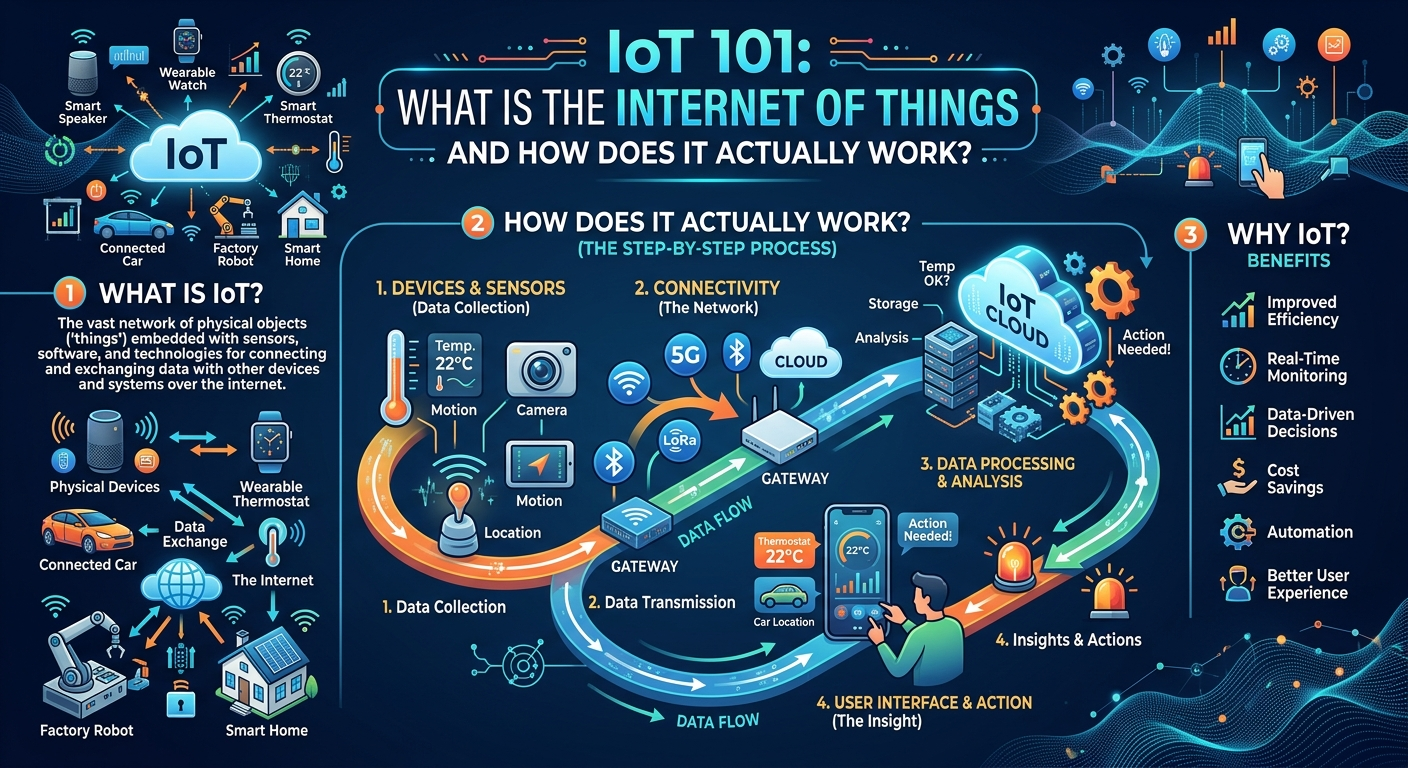
At its simplest, IoT can be understood as a continuous cycle:
Sense → Connect → Process → Decide → Act → Measure Again
A temperature sensor measures temperature. A network transports that measurement. Computing resources interpret it. Software determines whether something should happen. An actuator may then switch equipment on or off. The sensor measures the new condition, and the cycle continues.
This thesis explains the anatomy of IoT, its hardware and software, communications technologies, edge and cloud computing, data processing, artificial intelligence, cybersecurity, applications, economics, challenges, and the future evolution of connected systems.
1. Introduction: Understanding the Internet of Things
For much of computing history, computers were primarily designed to process information entered by humans. People used keyboards, mice, screens, databases, and applications to create and manipulate digital information.
IoT changes the relationship between computers and the physical world.
Instead of requiring a person to constantly observe a machine and enter information manually, an IoT system can allow the machine itself to generate information.
A water pump can report its operating condition.
A tractor can report its location and engine parameters.
A refrigerator can measure temperature.
A factory machine can report vibration.
A smart electricity meter can record energy consumption.
A soil sensor can report moisture.
A vehicle can communicate information about its operating environment.
The important transformation is therefore not simply “putting things on the Internet.” It is the creation of systems in which physical objects become sources of digital information and, in many cases, recipients of digital instructions.
NIST identifies four fundamental activities underlying IoT: sensing, computing, communication, and actuation.
2. What Exactly Is an “IoT Thing”?
The word “thing” is deliberately broad.
A thing can be almost any physical or cyber-physical object capable of participating in an IoT system.
Examples include:
- Temperature sensors
- Cameras
- Smart meters
- Industrial machines
- Agricultural pumps
- Irrigation systems
- Vehicles
- Drones
- Wearable devices
- Smart lighting systems
- Building-management equipment
- Environmental monitoring stations
- Factory robots
- Refrigeration equipment
- Energy-storage systems
- Water-treatment equipment
- Logistics trackers
- Connected appliances
A modern IoT device normally contains some combination of:
- Physical hardware
- Sensors
- Actuators
- Processor or microcontroller
- Memory
- Firmware/software
- Network interface
- Power system
- Device identity
- Security mechanisms
NIST’s IoT device definition emphasizes two important characteristics: interaction with the physical world through at least one sensor or actuator, and connectivity to the digital world through a network interface such as Ethernet, Wi-Fi, Bluetooth, LTE, Zigbee, or similar technologies.
3. The Fundamental IoT Architecture
Although implementations differ considerably, a useful conceptual IoT architecture can be divided into several layers.
Layer 1 — Physical World
This is the environment being observed or controlled.
Examples:
- Soil
- Water
- Air
- Buildings
- Machines
- Roads
- Vehicles
- Electrical equipment
- Agricultural fields
Layer 2 — Sensors and Actuators
Sensors observe physical conditions.
Actuators influence physical conditions.
Layer 3 — Embedded Computing
Microcontrollers, processors, and embedded software process information close to the device.
Layer 4 — Connectivity
Communication technologies move information between devices, gateways, edge systems, and cloud platforms.
Layer 5 — Edge Computing
Nearby computing resources can process information without sending every piece of data to a remote cloud.
Layer 6 — Cloud and Data Platforms
Large computing systems can store, analyze, correlate, and manage enormous volumes of IoT information.
Layer 7 — Applications
Applications transform processed information into useful services.
Layer 8 — Humans and Organizations
People use dashboards, alerts, reports, automation systems, and business applications to make decisions.
A simplified representation is:
Physical World
↓
Sensors
↓
Embedded Device
↓
Network
↓
Gateway / Edge
↓
Cloud / Data Platform
↓
Analytics / AI
↓
Application
↓
Decision
↓
Actuator
↓
Physical World
NIST similarly describes IoT architectures in which data can be processed locally on the device, at the edge, or in the cloud.
4. Sensors: How IoT Sees the Physical World
The sensor is one of the most fundamental components of IoT.
A sensor converts some physical phenomenon into information that an electronic system can interpret.
Examples include:
| Sensor | What it measures |
|---|---|
| Temperature sensor | Temperature |
| Humidity sensor | Moisture in air |
| Pressure sensor | Pressure |
| Light sensor | Light intensity |
| Accelerometer | Acceleration |
| Gyroscope | Angular movement |
| Proximity sensor | Nearby objects |
| Soil-moisture sensor | Water content in soil |
| Gas sensor | Specific gases |
| Vibration sensor | Mechanical vibration |
| GPS/GNSS receiver | Position and timing |
| Camera | Visual information |
| Microphone | Sound |
The basic process is:
Physical phenomenon → Sensor → Electrical signal → Digital representation → Data
For example, suppose an agricultural sensor measures soil moisture.
The physical soil condition changes.
The sensor detects the change.
The electronic circuitry converts the measurement into an electrical signal.
An analog-to-digital converter may transform that signal into numerical data.
A microcontroller processes the measurement.
The device attaches metadata such as:
- Device identity
- Time
- Location
- Measurement value
- Measurement unit
- Sensor status
The resulting information might conceptually look like:
Device 1042 | 14:32:10 | Soil moisture = 27% | Field A
That is now digital information that an IoT system can transmit and analyze.
5. Actuators: How IoT Acts on the Physical World
Sensors allow IoT systems to observe.
Actuators allow them to act.
An actuator converts an electronic instruction into a physical action.
Examples include:
- Motors
- Valves
- Relays
- Pumps
- Servos
- Switches
- Heating elements
- Cooling systems
- Locks
- Industrial control mechanisms
Consider an irrigation system.
A soil sensor reports:
Soil moisture = below configured threshold
Software evaluates the measurement.
If the irrigation condition is satisfied, the system sends an instruction to an actuator.
The actuator opens a valve or starts a pump.
Water flows.
The soil becomes wetter.
The sensor measures the new condition.
The system can then determine whether irrigation should continue or stop.
This illustrates why IoT is fundamentally different from ordinary data processing.
The system can form a loop between digital information and physical reality.
6. Embedded Computing: The Brain Inside the Device
Most IoT devices require some form of embedded computing.
A small IoT device might contain a microcontroller with:
- CPU
- RAM
- Flash memory
- Input/output interfaces
- Communication interfaces
- Timers
- Analog-to-digital converters
- Security features
More powerful IoT devices may contain application processors capable of running operating systems and sophisticated software.
The embedded processor performs tasks such as:
- Reading sensors
- Filtering measurements
- Converting signals
- Checking device conditions
- Managing communications
- Encrypting data
- Running local algorithms
- Controlling actuators
- Detecting faults
- Updating firmware
This means an IoT device is not simply a sensor connected to Wi-Fi.
It can be a small computer embedded into a physical system.
7. Firmware: The Hidden Software of IoT
Firmware is software designed to operate hardware.
In IoT, firmware is especially important because it determines how a device behaves.
Firmware can control:
- Sensor sampling
- Communication
- Power management
- Device configuration
- Local decision-making
- Security
- Actuator control
- Error handling
- Firmware updates
Because IoT devices can remain deployed for years, firmware management is a major engineering issue.
A manufacturer therefore needs mechanisms for securely updating devices when vulnerabilities are discovered or functionality needs to change.
This is one reason cybersecurity must be considered throughout the IoT lifecycle rather than added after deployment. NIST’s IoT cybersecurity guidance emphasizes security requirements during acquisition, integration, and system risk management.
8. Connectivity: How Things Communicate
An IoT system requires communication.
Different applications require different networking technologies.
Common connectivity options include:
Wi-Fi
Useful for devices with relatively substantial power and data requirements.
Common in:
- Homes
- Offices
- Buildings
- Consumer devices
Bluetooth and Bluetooth Low Energy
Useful for short-range communications and low-power devices.
Zigbee and Similar Mesh Technologies
Useful for networks containing many low-power devices.
Ethernet
Useful when reliable wired networking is required.
Common in:
- Industrial systems
- Buildings
- Data centers
- Infrastructure
Cellular Networks
Technologies such as LTE and 5G can connect devices over large geographical areas.
Useful for:
- Vehicles
- Logistics
- Smart infrastructure
- Remote monitoring
LPWAN Technologies
Low-power wide-area networking is designed for devices that may transmit small quantities of data over long distances.
Satellite Connectivity
Can provide connectivity in areas where terrestrial networks are unavailable or unreliable.
The correct technology depends on:
- Range
- Bandwidth
- Power consumption
- Reliability
- Cost
- Mobility
- Environment
- Security
- Device density
9. Protocols: The Language of IoT Communication
Connectivity hardware provides the communication pathway, while protocols define how information is exchanged.
IoT systems may use technologies and protocols such as:
- IP
- TCP
- UDP
- HTTP/HTTPS
- MQTT
- CoAP
- WebSockets
- Bluetooth protocols
- Zigbee protocols
- Cellular protocols
One particularly important IoT messaging approach is MQTT, which uses a publish/subscribe communication model.
For example:
A temperature sensor can publish:
factory/line1/machine7/temperature
Another system can subscribe to that topic.
The sensor does not necessarily need to know which application ultimately consumes the information.
This creates a flexible architecture in which producers and consumers can be loosely connected.
10. The Gateway
Many IoT systems contain a gateway between local devices and larger networks.
A gateway can:
- Aggregate data
- Translate protocols
- Authenticate devices
- Filter information
- Perform local processing
- Store temporary data
- Connect local networks to the Internet
- Apply security policies
For example:
100 sensors → Local gateway → Internet → Cloud platform
Instead of every sensor independently communicating with a cloud service, the gateway can consolidate communications.
This can reduce network traffic and simplify management.
11. Edge Computing
One of the major developments in IoT is the movement of computation closer to the physical devices.
This is called edge computing.
Instead of:
Device → Internet → Distant Cloud → Decision
the architecture can become:
Device → Nearby Edge Computer → Decision
This can provide advantages in:
- Latency
- Bandwidth efficiency
- Resilience
- Privacy
- Local autonomy
Consider an industrial machine.
If a sensor detects a dangerous operating condition, waiting for a distant cloud service to respond may be undesirable.
An edge computer can analyze the measurement locally and immediately trigger a response.
The cloud can still receive the information later for:
- Historical analysis
- Reporting
- Model training
- Fleet management
- Long-term optimization
NIST explicitly recognizes local device processing, edge processing, and cloud processing as possible locations for IoT data processing.
12. Cloud Computing and IoT
The cloud provides large-scale computing and storage capabilities.
An IoT cloud platform may provide:
- Device registration
- Device authentication
- Data ingestion
- Databases
- Analytics
- Machine learning
- Dashboards
- Alerts
- Software updates
- Digital twins
- Application programming interfaces
- Device management
Imagine a company operating 50,000 connected machines.
Each machine may generate measurements every few seconds.
A cloud platform can collect and organize those measurements.
The organization can then analyze:
- Machine health
- Energy consumption
- Production rates
- Fault frequency
- Maintenance requirements
- Geographic distribution
- Operational efficiency
IoT therefore creates a bridge between physical operations and large-scale digital infrastructure.
13. The IoT Data Pipeline
The journey of IoT data can be represented as:
1. Generate
A physical event occurs.
2. Sense
A sensor detects it.
3. Digitize
The measurement becomes digital information.
4. Process
An embedded processor may clean or interpret the measurement.
5. Communicate
The information travels through a network.
6. Aggregate
A gateway or edge platform may combine information from multiple devices.
7. Store
Data can be stored locally or in cloud infrastructure.
8. Analyze
Software identifies patterns.
9. Decide
Rules, algorithms, or AI determine what should happen.
10. Act
An actuator or human receives the resulting instruction.
11. Verify
Sensors measure the result.
This produces a continuous feedback loop.
14. IoT Data Is More Than Numbers
IoT data normally contains context.
A useful IoT record may include:
- Device ID
- Sensor ID
- Measurement
- Unit
- Timestamp
- Location
- Device status
- Network information
- Battery status
- Quality indicators
For example:
Device: Pump-27
Location: Irrigation Zone 4
Time: 14:32:10
Pressure: 4.7 bar
Temperature: 31°C
Pump status: Running
Without context, a number can be almost meaningless.
IoT systems therefore depend heavily on metadata and data models.
15. From Data to Information
IoT generates enormous amounts of raw data.
But raw data is not automatically useful.
Suppose a machine produces:
2, 4, 5, 7, 9, 15, 23, 31…
These numbers become useful only when software understands what they represent.
Perhaps they are vibration measurements.
The system may discover that vibration is increasing over time.
The organization can then infer that the machine may require inspection.
This transformation can be represented as:
Data → Information → Insight → Decision → Action
The value of IoT therefore does not come merely from connecting devices.
It comes from converting measurements into useful outcomes.
16. IoT and Artificial Intelligence
IoT and artificial intelligence increasingly operate together.
IoT provides real-world data.
AI provides pattern recognition, prediction, classification, optimization, and decision support.
The relationship can be summarized as:
IoT = sensing the world
AI = interpreting patterns in data
Automation = acting on decisions
Together:
Sense → Understand → Decide → Act
Examples include:
Predictive Maintenance
Sensors measure:
- Vibration
- Temperature
- Pressure
- Current
- Acoustic signals
AI analyzes patterns to identify abnormal behavior.
Smart Agriculture
Sensors monitor:
- Soil moisture
- Weather
- Temperature
- Humidity
- Irrigation conditions
Analytics and AI can support decisions about agricultural operations.
Smart Buildings
Sensors monitor:
- Occupancy
- Temperature
- Energy consumption
- Lighting
- Air quality
Software can optimize building operations.
17. Digital Twins
A digital twin is a digital representation of a physical object, system, or process.
An IoT system supplies the data required to keep the digital representation connected to the physical world.
For example, a factory may have:
Physical machine → Sensors → IoT network → Data platform → Digital representation
The digital representation can show:
- Current operating state
- Historical performance
- Temperature
- Vibration
- Maintenance history
- Energy consumption
- Predicted conditions
Digital twins can become especially powerful when combined with simulation and AI.
18. IoT Cybersecurity
Connectivity creates opportunities, but it also creates risks.
An unsecured IoT device can potentially become an entry point into a larger system.
Security concerns include:
- Weak authentication
- Default credentials
- Unpatched firmware
- Insecure communication
- Poor access control
- Inadequate encryption
- Vulnerable APIs
- Physical tampering
- Insecure cloud services
- Poor device lifecycle management
NIST emphasizes that integrating IoT devices into an information system can introduce new risks and therefore requires appropriate security requirements and risk assessment.
19. IoT Security Must Be End-to-End
Security cannot be limited to the sensor.
A complete IoT security model should consider:
Device → Firmware → Network → Gateway → Edge → Cloud → Application → User
Security mechanisms may include:
- Strong authentication
- Encryption
- Secure boot
- Signed firmware
- Secure updates
- Access control
- Network segmentation
- Logging
- Monitoring
- Vulnerability management
- Device identity
- Credential management
NIST’s IoT cybersecurity requirements catalog addresses both technical capabilities and supporting actions needed from manufacturers and other entities.
20. Privacy
IoT can generate information about people, homes, workplaces, vehicles, and environments.
For example, connected devices can potentially reveal:
- Occupancy patterns
- Energy-use patterns
- Movement
- Device usage
- Location
- Environmental conditions
Therefore, IoT systems should consider:
- What information is collected?
- Why is it collected?
- Who can access it?
- How long is it retained?
- How is it protected?
- Can unnecessary information collection be reduced?
Privacy should be treated as part of system architecture rather than as an afterthought.
21. Reliability and Availability
Many IoT systems operate continuously.
A smart-home device may need to function every day.
A factory monitoring system may operate continuously.
Agricultural monitoring may need to work in remote locations.
Infrastructure monitoring can involve critical equipment.
Reliability therefore depends on:
- Hardware quality
- Network reliability
- Power availability
- Software stability
- Data integrity
- Backup systems
- Fault detection
- Maintenance
- Environmental protection
An IoT system should be designed around the consequences of failure.
22. Power Management
Power is one of the most important engineering considerations for IoT.
Some devices have continuous electrical power.
Others operate from batteries for months or years.
Low-power devices may therefore:
- Sleep when inactive
- Wake periodically
- Measure only when necessary
- Transmit small messages
- Perform local processing
- Minimize radio activity
The engineering challenge becomes:
Maximum useful functionality with minimum energy consumption.
This is particularly important for remote environmental sensors, agricultural devices, logistics trackers, and infrastructure monitoring.
23. IoT at Home
Consumer IoT includes devices such as:
- Smart lights
- Smart thermostats
- Smart security systems
- Connected appliances
- Smart speakers
- Smart meters
- Environmental sensors
A simple smart-home example:
Motion detected
↓
Sensor sends event
↓
Hub or cloud receives event
↓
Software evaluates rule
↓
Lighting command generated
↓
Smart light turns on
The system transforms a physical event into an automated response.
24. IoT in Agriculture
Agriculture is one of the major application areas for IoT.
Sensors can monitor:
- Soil moisture
- Temperature
- Humidity
- Weather
- Water levels
- Equipment status
- Livestock environments
- Irrigation systems
A simplified smart irrigation system could operate as follows:
Soil sensor
↓
Moisture measurement
↓
Edge controller
↓
Decision algorithm
↓
Irrigation valve
↓
Water application
↓
New soil measurement
This creates a closed-loop agricultural control system.
When combined with weather information, satellite imagery, AI, and farm-management software, IoT can become part of a much broader digital agriculture platform.
25. IoT in Manufacturing
Industrial IoT, often called IIoT, applies connected technologies to industrial environments.
Machines can generate information about:
- Temperature
- Pressure
- Vibration
- Energy consumption
- Production rates
- Equipment status
- Fault conditions
A manufacturing organization can use this information for:
- Predictive maintenance
- Production optimization
- Quality control
- Energy management
- Asset tracking
- Operational visibility
The objective is to move from:
“The machine failed.”
toward:
“The system detected abnormal behavior early enough to investigate it.”
26. IoT in Transportation
Connected transportation systems can combine:
- Vehicle sensors
- GPS/GNSS
- Cameras
- Road infrastructure
- Traffic information
- Cellular connectivity
- Cloud platforms
Applications include:
- Fleet monitoring
- Route optimization
- Vehicle diagnostics
- Traffic management
- Asset tracking
- Logistics monitoring
The connected vehicle is therefore not merely a car with Internet access.
It can become a mobile IoT platform containing numerous sensors, processors, communication interfaces, and software systems.
27. IoT in Energy
IoT plays an important role in modern energy systems.
Connected equipment can monitor:
- Electricity consumption
- Voltage
- Current
- Equipment temperature
- Grid conditions
- Solar generation
- Battery status
Smart energy systems can connect:
Generation → Transmission → Distribution → Consumption
This enables more detailed visibility into how energy is produced and used.
28. IoT in Water Management
Water systems can use sensors to monitor:
- Flow
- Pressure
- Water levels
- Pump conditions
- Reservoir levels
- Leakage indicators
- Water quality parameters
Connected monitoring can help organizations detect abnormal conditions earlier and improve operational visibility.
The same principle applies to municipal water systems, agricultural irrigation, industrial water systems, and reservoirs.
29. IoT in Buildings and Cities
Smart buildings can connect:
- Lighting
- HVAC systems
- Security systems
- Energy meters
- Occupancy sensors
- Environmental sensors
- Access systems
At a larger scale, smart-city systems can connect:
- Traffic infrastructure
- Street lighting
- Waste-management systems
- Parking systems
- Environmental monitoring
- Public infrastructure
The objective is to create infrastructure that can be observed and managed using continuously generated information.
30. IoT Versus Traditional Internet
The traditional Internet primarily connects computing and communication systems.
IoT extends connectivity deeper into the physical world.
Traditional Internet:
Human → Computer → Internet → Computer → Human
IoT:
Physical World → Sensor → Network → Computing → Decision → Actuator → Physical World
The distinction is not absolute because modern computing systems overlap.
Nevertheless, IoT is characterized strongly by the interaction between digital systems and physical processes.
NIST specifically highlights this physical-world interaction as a distinguishing characteristic of IoT systems.
31. IoT Versus Ordinary Sensors
A sensor alone is not necessarily an IoT system.
A conventional sensor might simply measure temperature and display the value locally.
An IoT sensor could:
- Measure temperature.
- Process the measurement.
- Identify itself.
- Communicate through a network.
- Send data to another system.
- Receive configuration.
- Trigger an action.
- Receive software updates.
The difference is therefore the system surrounding the sensor, not merely the existence of the sensing element.
32. IoT as a Cyber-Physical System
IoT increasingly overlaps with the concept of cyber-physical systems (CPS).
A cyber-physical system combines:
Physical processes + Computing + Communication + Control
Examples include:
- Industrial automation
- Smart grids
- Robotics
- Connected transportation
- Automated buildings
IoT provides much of the connectivity and sensing infrastructure through which physical systems become digitally observable and controllable.
33. The Five Fundamental Questions of IoT
Almost every IoT system can be analyzed through five questions:
1. What is being measured?
This identifies the physical phenomenon.
2. How is it measured?
This identifies the sensor.
3. How is the information communicated?
This identifies the network and protocols.
4. What happens to the information?
This identifies the processing, storage, analytics, and AI.
5. What happens after the decision?
This identifies the actuator, automation, or human response.
This framework provides an excellent starting point for understanding unfamiliar IoT systems.
34. The IoT Value Chain
IoT is not one technology.
It is an ecosystem.
A typical value chain includes:
Sensors
↓
Semiconductors
↓
Embedded hardware
↓
Firmware
↓
Connectivity
↓
Gateways
↓
Edge computing
↓
Cloud infrastructure
↓
Data platforms
↓
Analytics
↓
AI
↓
Applications
↓
Business processes
↓
Physical outcomes
Companies may specialize in only one part of this chain, while other organizations integrate several layers.
35. Why Semiconductors Matter
IoT ultimately depends on semiconductor technology.
Microcontrollers, processors, memory chips, communication chips, sensor interfaces, power-management components, security components, and specialized accelerators can all appear inside IoT devices.
A tiny sensor node may therefore represent the combined work of:
- Semiconductor engineering
- Embedded systems engineering
- Wireless engineering
- Software engineering
- Cybersecurity
- Cloud computing
- Data engineering
IoT is consequently not a single industry.
It is a technology convergence.
36. Why Data Is the Fuel of IoT
Without data, most IoT systems have little intelligence.
Sensors create measurements.
Networks transport them.
Computers process them.
Databases store them.
Analytics interpret them.
AI can learn patterns from them.
Applications turn those patterns into useful outcomes.
This produces the relationship:
Things → Data → Intelligence → Action
The strategic value of IoT therefore increases when organizations can transform large quantities of physical-world measurements into reliable decisions.
37. The Importance of Time
IoT data is often time-dependent.
A temperature of 30°C means something different depending on:
- Where it was measured
- When it was measured
- What was being measured
- What the previous measurement was
- What the expected range was
IoT systems therefore rely heavily on timestamps and historical data.
Time-series databases and event-processing systems are particularly relevant because many IoT measurements are naturally represented as:
Value + Time + Device + Location
38. Real-Time IoT
Not every IoT system needs real-time processing.
Some systems can tolerate delays of:
- Seconds
- Minutes
- Hours
- Days
Others require extremely rapid responses.
For example:
Environmental monitoring: minutes may be acceptable.
Energy optimization: seconds may be sufficient.
Industrial control: very low latency may be required.
This is why IoT architecture must be designed around the actual operational requirements rather than assuming that every IoT system must send everything immediately to a cloud.
39. Scalability
IoT systems can contain:
- One device
- Hundreds of devices
- Thousands of devices
- Millions of devices
Scaling from ten devices to a million devices introduces major challenges.
The system must manage:
- Device identity
- Authentication
- Connectivity
- Firmware
- Data volume
- Storage
- Network traffic
- Monitoring
- Security
- Configuration
- Fault management
IoT architecture must therefore consider scalability from the beginning.
40. Device Management
Large IoT deployments require centralized or distributed device management.
Organizations may need to know:
- Which devices exist?
- Where are they?
- Are they online?
- What firmware are they running?
- What configuration do they have?
- What data are they producing?
- Are they malfunctioning?
- Are they secure?
- When were they last updated?
Device management transforms a collection of independent devices into a manageable technology fleet.
41. The IoT Lifecycle
An IoT device has a lifecycle.
Stage 1 — Design
Hardware and software are engineered.
Stage 2 — Manufacturing
The device is produced and configured.
Stage 3 — Provisioning
The device receives its identity and configuration.
Stage 4 — Deployment
It is installed in the physical environment.
Stage 5 — Operation
It collects data and performs its functions.
Stage 6 — Maintenance
Software, firmware, hardware, and configurations are maintained.
Stage 7 — Decommissioning
The device is removed from service.
Security and data protection should exist across every stage.
42. The Economics of IoT
IoT creates value in several ways.
Cost Reduction
Automation can reduce unnecessary resource consumption.
Predictive Maintenance
Early detection of abnormal conditions can reduce unexpected downtime.
Operational Efficiency
Organizations can see what is happening across distributed assets.
New Services
Connected products can enable new service models.
Better Decision-Making
Continuous data can improve operational visibility.
Automation
Systems can perform repetitive actions without constant human intervention.
The strongest IoT projects generally begin with a clearly defined business or operational problem rather than simply connecting devices because connectivity is available.
43. Major IoT Challenges
IoT faces significant technical and organizational challenges.
Security
More connected devices create more potential attack surfaces.
Privacy
Sensors can collect information about people and environments.
Interoperability
Different manufacturers may use different technologies.
Reliability
Devices must operate under real-world conditions.
Power
Battery-operated systems require careful energy management.
Data Volume
Large deployments can generate enormous amounts of information.
Lifecycle Management
Devices may remain deployed for many years.
Standards
Organizations need common interfaces and communication mechanisms.
Cost
Hardware, connectivity, cloud services, maintenance, and security all have financial implications.
Environmental Conditions
Outdoor and industrial devices may face:
- Dust
- Water
- Heat
- Cold
- Vibration
- Corrosion
- Electrical interference
44. Interoperability
One of IoT’s greatest challenges is making devices from different manufacturers work together.
Imagine a smart building containing:
- Lighting from Company A
- HVAC equipment from Company B
- Security systems from Company C
- Sensors from Company D
- Energy meters from Company E
If every system uses incompatible interfaces, integration becomes difficult.
Standards and common protocols can reduce this problem.
Interoperability is therefore a major requirement for large-scale IoT ecosystems.
45. IoT and the Human Being
Despite the emphasis on automation, humans remain central to many IoT systems.
Humans:
- Define objectives
- Configure systems
- Interpret information
- Establish policies
- Investigate unusual events
- Maintain equipment
- Make strategic decisions
The goal of IoT should not necessarily be to remove humans.
In many cases, its purpose is to give humans better information at the right time.
46. The IoT Feedback Loop
The most powerful way to understand IoT is as a feedback system.
Step 1: Sense
The physical environment changes.
Step 2: Capture
A sensor detects the change.
Step 3: Communicate
The measurement is transmitted.
Step 4: Compute
A processor or platform interprets the data.
Step 5: Decide
Rules, analytics, or AI determine what should happen.
Step 6: Act
An actuator changes the physical environment.
Step 7: Measure Again
Sensors determine whether the action produced the intended result.
This produces:
Sensing → Computing → Communication → Decision → Actuation → Feedback
NIST’s foundational IoT work describes sensing, computing, communication, and actuation as central elements of IoT systems.
47. A Complete Example: Smart Irrigation
Consider a connected agricultural irrigation system.
Step 1 — Sensor
A soil sensor measures moisture.
Step 2 — Embedded Device
A microcontroller reads the sensor.
Step 3 — Local Processing
The controller removes obvious measurement errors.
Step 4 — Communication
The device transmits the measurement.
Step 5 — Gateway
A gateway collects measurements from multiple field sensors.
Step 6 — Edge Processing
The edge system evaluates local irrigation conditions.
Step 7 — Cloud
Long-term data is stored for analysis.
Step 8 — Analytics
Software examines historical soil conditions.
Step 9 — AI
An AI model may estimate future irrigation requirements using multiple variables.
Step 10 — Decision
The system determines whether irrigation should occur.
Step 11 — Actuation
A valve or pump receives an instruction.
Step 12 — Feedback
The soil sensor measures the result.
The complete system is therefore not merely a “smart sensor.”
It is a connected cyber-physical control system.
48. IoT + Edge + Cloud + AI
The future architecture of many sophisticated IoT systems can be understood as four complementary layers:
IoT
Provides physical-world sensing and actuation.
Edge
Provides fast local processing.
Cloud
Provides large-scale storage, computing, coordination, and analytics.
AI
Provides advanced pattern recognition, prediction, optimization, and decision support.
Together:
Physical World
↓
IoT Devices
↓
Edge Computing
↓
Cloud Platform
↓
AI / Analytics
↓
Decision
↓
Automation
↓
Physical World
This architecture is increasingly important because no single computing location is ideal for every task.
49. The Future of IoT
IoT is evolving from simple connected sensors toward increasingly intelligent autonomous systems.
Future developments are likely to involve greater integration among:
- IoT
- Edge computing
- AI
- Robotics
- 5G and future networks
- Digital twins
- Cloud computing
- Computer vision
- Satellite connectivity
- Advanced semiconductors
- Cybersecurity
- Automation
The result may be a world in which physical infrastructure continuously produces machine-readable information and increasingly participates in automated decision-making.
50. From IoT to Intelligent Physical Systems
The first generation of IoT primarily focused on:
“Can we connect this device?”
The next question became:
“Can we collect useful information from it?”
Then:
“Can we analyze the information?”
Now the emphasis increasingly becomes:
“Can the system understand conditions, predict what may happen, and respond intelligently?”
This progression can be represented as:
Connected Things
↓
Connected Data
↓
Connected Intelligence
↓
Connected Decisions
↓
Connected Automation
This is the deeper evolution of IoT.
51. IoT as an Operating Layer for the Physical World
The most important conceptual insight is that IoT can be viewed as a digital nervous system for physical environments.
Sensors resemble sensory organs.
Networks resemble communication pathways.
Processors resemble local computing centers.
Cloud platforms resemble large information-processing systems.
AI resembles an analytical layer.
Actuators provide physical responses.
Humans establish objectives and oversight.
The analogy is not biologically exact, but it helps explain the architecture:
Sense → Communicate → Interpret → Decide → Act
At large scale, this architecture can be applied to farms, factories, buildings, transportation networks, energy systems, water infrastructure, logistics networks, and cities.
52. A Practical Framework for Evaluating Any IoT System
When studying or designing an IoT system, ask these questions:
Physical layer
What physical process is being monitored or controlled?
Sensor layer
What measurements are required?
Computing layer
Where is the data processed?
Connectivity layer
How do devices communicate?
Gateway layer
Is protocol translation or aggregation required?
Edge layer
What decisions need to happen locally?
Cloud layer
What information needs centralized storage or analysis?
AI layer
Would machine learning provide useful predictions or classifications?
Application layer
Who uses the resulting information?
Actuation layer
What physical action should occur?
Security layer
How are devices, networks, data, and applications protected?
Lifecycle layer
How will devices be updated, maintained, replaced, and eventually retired?
This framework can be used to analyze almost any IoT deployment.
53. IoT’s Core Formula
The entire field can be summarized with a conceptual formula:
IoT = Things + Sensing + Computing + Connectivity + Data + Intelligence + Actuation
But a more complete representation is:
**Physical World
- Sensors
- Embedded Computing
- Networks
- Edge/Cloud Computing
- Data Platforms
- Analytics/AI
- Security
- Applications
= Intelligent Connected System**
This is why IoT should not be understood merely as “devices connected to the Internet.”
It is an integrated technological ecosystem.
54. Conclusion
The Internet of Things represents the extension of computing into the physical world.
At its foundation are four essential capabilities:
Sensing, computing, communication, and actuation.
Sensors allow machines to observe physical conditions. Embedded computers process measurements. Networks transport information. Edge and cloud platforms provide increasingly powerful computing resources. Data platforms store and organize information. Analytics and AI transform data into insights and predictions. Actuators allow digital decisions to influence physical processes.
NIST’s IoT research similarly frames IoT around networked components that interact with physical entities through sensors and actuators, while recognizing that processing can occur on devices, at the edge, or in the cloud.
The greatest value of IoT therefore does not come from simply connecting more objects.
It comes from creating a continuous relationship between:
The physical world → data → computing → intelligence → action → the physical world.
That feedback loop is the heart of IoT.
The technology is consequently much larger than smart homes or connected appliances. IoT is becoming an important foundation for industrial automation, agriculture, transportation, energy, water management, buildings, logistics, environmental monitoring, and intelligent infrastructure.
At the same time, IoT introduces significant responsibilities. Security, privacy, reliability, interoperability, lifecycle management, and responsible data use must be built into systems from the beginning. Current NIST guidance continues to emphasize that IoT deployment can introduce new cybersecurity risks and that organizations should establish appropriate security requirements throughout the device lifecycle.
The central lesson of IoT 101 is therefore simple:
IoT is the technological bridge between the physical world and the digital world.
Once that bridge is established, machines can observe their surroundings, communicate what they observe, receive information from other systems, make or support decisions, and influence the physical environment.
That is how the Internet of Things actually works—and why it has become one of the foundational technologies of the connected digital economy.
Key Takeaways
- IoT connects physical objects with digital systems.
- Sensors allow systems to observe the physical world.
- Actuators allow digital systems to influence the physical world.
- Embedded processors provide local intelligence and control.
- Networks transport IoT information.
- Gateways aggregate, translate, and sometimes secure communications.
- Edge computing enables local processing and rapid responses.
- Cloud computing provides large-scale storage and analytics.
- AI can transform IoT data into predictions and intelligent decisions.
- Digital twins can connect physical assets with digital representations.
- Cybersecurity must cover the complete IoT lifecycle.
- IoT creates value when data produces useful decisions or actions.
- The fundamental IoT cycle is Sense → Connect → Process → Decide → Act.
- The future of IoT lies increasingly in the convergence of IoT, edge computing, AI, robotics, advanced networking, and automation.
Selected References
- National Institute of Standards and Technology (NIST), Internet of Things Glossary.
- NIST, Frequently Asked Questions — Cybersecurity for IoT Program.
- NIST, Internet of Things Advisory Board Report.
- NIST Special Publication 800-183, Networks of ‘Things’.
- NIST Special Publication 800-213, IoT Device Cybersecurity Guidance.
- NIST Special Publication 800-213A, IoT Device Cybersecurity Requirement Catalog.
- NIST, Cybersecurity for IoT Program / SP 800-213 Series.


Be First to Comment