
A Comprehensive History of the Minds, Discoveries, Ideas, and Technologies That Built Human Civilization
Abstract
Human civilization is the product of an extraordinary accumulation of knowledge. From the earliest observations of the sky, seasons, animals, plants, fire, materials, and human society to mathematics, physics, medicine, computing, artificial intelligence, and space exploration, humanity has continuously transformed information into understanding and understanding into capability.
The history of knowledge is therefore not simply a history of famous individuals. It is a history of interconnected minds, civilizations, cultures, institutions, observations, experiments, mathematical systems, technologies, and discoveries. Scientific progress frequently emerges from the interaction of many contributors rather than from a single isolated genius. The modern body of knowledge is consequently a vast intellectual structure built across thousands of years.
This thesis examines the major giants of human knowledge and the intellectual revolutions associated with them. It follows the development of human understanding from prehistoric knowledge systems through ancient civilizations, classical philosophy and mathematics, the Islamic Golden Age, medieval scholarship, the Scientific Revolution, the Enlightenment, the Industrial Revolution, modern physics, biology, chemistry, telecommunications, computing, the semiconductor revolution, the Internet, artificial intelligence, and emerging scientific frontiers.
The central proposition is that humanity’s greatest intellectual achievement is not any individual discovery but the construction of a cumulative global knowledge system capable of preserving, testing, communicating, combining, and extending ideas across generations.
TABLE OF CONTENTS
- Introduction: What Is Human Knowledge?
- The First Knowledge Revolution: Prehistoric Humanity
- The Birth of Writing and Recorded Knowledge
- Ancient Mesopotamia and the Mathematics of Civilization
- Ancient Egypt: Engineering, Medicine, Astronomy and Administration
- India: Mathematics, Astronomy, Medicine and Philosophy
- China: Science, Engineering, Printing and Technology
- Greece: Philosophy, Logic, Mathematics and Natural Science
- Rome: Engineering, Law, Administration and Infrastructure
- African Knowledge Systems and Intellectual Civilization
- The Islamic Golden Age
- Medieval Europe and the Transformation of Scholarship
- The Renaissance and the Rediscovery of Knowledge
- Copernicus, Galileo and the New Cosmos
- Kepler and the Mathematical Universe
- Newton and the Laws of Nature
- The Scientific Method
- The Enlightenment and the Organization of Knowledge
- Chemistry: From Alchemy to Atomic Science
- Biology and the Discovery of Life’s Organization
- Medicine and the Transformation of Human Health
- Darwin and Evolution
- Maxwell and the Electromagnetic Universe
- The Industrial Revolution
- Thermodynamics and the Science of Energy
- Mathematics: The Language of Science
- Einstein and the Revolution in Space and Time
- Quantum Mechanics and the Microscopic Universe
- Nuclear Physics and the Atomic Age
- Genetics, DNA and Molecular Biology
- The Computer Revolution
- Alan Turing and Machine Intelligence
- Information Theory and the Mathematical Information Revolution
- The Transistor and the Semiconductor Revolution
- The Integrated Circuit and the Microprocessor
- Telecommunications and the Global Information Network
- The Internet and the World Wide Web
- Artificial Intelligence
- The Giants of Modern Technology
- Space Science and the Expansion of Human Knowledge
- Earth Science, Climate and Planetary Knowledge
- Neuroscience and the Human Brain
- The Philosophy of Knowledge
- How Scientific Knowledge Is Created
- Collaboration: From Individual Geniuses to Global Science
- Women and Historically Underrepresented Giants
- The Globalization of Knowledge
- Knowledge, Technology and Civilization
- The Future of Human Knowledge
- Conclusion: Standing on the Shoulders of Giants
- Selected References
CHAPTER 1 — INTRODUCTION: WHAT IS HUMAN KNOWLEDGE?
Human knowledge is humanity’s accumulated understanding of reality.
It includes what humans know about:
- nature;
- mathematics;
- matter;
- energy;
- life;
- Earth;
- the universe;
- human societies;
- language;
- technology;
- economics;
- philosophy;
- medicine;
- computation;
- information;
- intelligence.
Knowledge begins with observation.
A person sees the Sun rise.
Another notices that seasons repeat.
Another recognizes that certain plants can be eaten.
Another discovers that particular stones can be shaped into tools.
Another learns that fire can transform materials.
Another develops a method for recording numbers.
Another develops writing.
Another creates mathematics.
Another proposes a theory.
Another performs an experiment.
Another builds a machine.
Another writes a program.
The process continues.
Human civilization is therefore an enormous chain of intellectual inheritance.
1.1 Knowledge Is Cumulative
One of the most important characteristics of scientific civilization is cumulative development.
A modern engineer does not need to rediscover geometry.
A physicist does not need to rediscover calculus before studying relativity.
A computer scientist does not begin with stone tools.
A modern semiconductor engineer works with concepts accumulated from physics, chemistry, mathematics, materials science, electrical engineering, computer science and manufacturing.
This cumulative structure explains why the history of knowledge is so important.
CHAPTER 2 — THE FIRST KNOWLEDGE REVOLUTION
Before writing, human knowledge existed primarily through observation, memory, imitation and oral transmission.
Early humans learned:
- how to find food;
- how to identify dangerous animals;
- how to construct shelters;
- how to control fire;
- how to manufacture tools;
- how to track seasons;
- how to navigate landscapes;
- how to cooperate;
- how to communicate.
The first technological revolution was therefore not digital.
It was cognitive.
The human ability to observe the environment and transmit knowledge between individuals created the foundation for civilization.
Fire as Knowledge
Fire represents one of humanity’s most transformative technological achievements.
It provided opportunities for:
- cooking;
- warmth;
- protection;
- material processing;
- landscape management;
- eventually metallurgy.
The significance of fire extends beyond the flame itself.
Humanity learned that nature could be deliberately manipulated.
That conceptual transition—from observing nature to intentionally transforming nature—became one of the foundations of technology.
CHAPTER 3 — WRITING: THE MEMORY OF CIVILIZATION
Writing created an external memory system for humanity.
Before writing, information depended heavily on biological memory and oral traditions.
After writing, knowledge could be:
- stored;
- copied;
- transported;
- compared;
- corrected;
- accumulated.
Writing transformed civilization.
Mathematical records, laws, astronomical observations, agricultural information, commercial transactions and historical narratives could survive beyond the lifetime of their creators.
The emergence of writing therefore represents one of the greatest information revolutions in human history.
CHAPTER 4 — ANCIENT MESOPOTAMIA
Mesopotamian civilizations developed sophisticated systems of administration, mathematics and astronomy.
Their achievements included numerical systems, record keeping, calendars and astronomical observations.
The development of mathematics was closely connected to practical problems:
- agriculture;
- taxation;
- construction;
- trade;
- land measurement;
- astronomy.
Knowledge did not develop in isolation from civilization.
It developed because societies needed methods for managing increasingly complex systems.
CHAPTER 5 — ANCIENT EGYPT
Ancient Egyptian civilization produced major achievements in:
- architecture;
- engineering;
- mathematics;
- medicine;
- astronomy;
- agriculture;
- administration.
The construction of monumental architecture demonstrated sophisticated organizational and engineering capabilities.
Egypt also demonstrates an important principle:
Knowledge becomes civilization when societies develop institutions capable of preserving and applying it.
CHAPTER 6 — INDIA
Indian intellectual traditions contributed significantly to mathematics, astronomy, medicine, linguistics and philosophy.
The development and transmission of the decimal place-value system and the concept of zero were particularly consequential for mathematical computation.
Modern computing ultimately depends upon mathematical notation capable of representing quantities efficiently.
The history of mathematics therefore demonstrates how an abstract intellectual idea can eventually become a technological foundation.
CHAPTER 7 — CHINA
Chinese civilization produced major advances in:
- papermaking;
- printing;
- navigation;
- engineering;
- metallurgy;
- astronomy;
- medicine;
- mathematics.
Printing was especially important because it dramatically expanded the ability to reproduce information.
The information revolution has therefore occurred repeatedly throughout history:
oral memory → writing → manuscripts → printing → telegraphy → telephone → radio → television → computers → Internet → artificial intelligence.
Each stage increased humanity’s capacity to preserve and transmit information.
CHAPTER 8 — GREECE: PHILOSOPHY AND LOGIC
Ancient Greek thinkers transformed questions about nature into systematic philosophical inquiry.
Among the most influential were:
- Socrates;
- Plato;
- Aristotle;
- Euclid;
- Archimedes;
- Pythagoras;
- Eratosthenes;
- Hipparchus.
Their contributions demonstrate that knowledge is not merely the accumulation of facts.
It also requires methods for reasoning.
Aristotle
Aristotle contributed to logic, biology, philosophy and natural inquiry.
Euclid
Euclidean geometry established a rigorous mathematical framework that influenced mathematics for centuries.
Archimedes
Archimedes made major contributions to geometry, mechanics and mathematical reasoning.
The Greek tradition helped establish the idea that nature could be investigated through systematic reasoning.
CHAPTER 9 — AFRICAN KNOWLEDGE SYSTEMS
Africa possesses an enormous and diverse history of knowledge.
Knowledge developed through numerous civilizations and societies involving:
- agriculture;
- metallurgy;
- medicine;
- architecture;
- astronomy;
- navigation;
- mathematics;
- governance;
- oral history;
- environmental knowledge.
Ancient Egypt and the intellectual centers of North Africa formed important parts of the wider history of knowledge.
The intellectual history of Africa should therefore not be treated as an appendix to European history.
It is part of humanity’s broader scientific and cultural history.
CHAPTER 10 — THE ISLAMIC GOLDEN AGE
Between approximately the eighth and fourteenth centuries, major centers of scholarship developed across the Islamic world.
Important fields included:
- mathematics;
- astronomy;
- medicine;
- optics;
- geography;
- chemistry;
- philosophy.
Among the influential scholars was Al-Khwarizmi, whose mathematical work contributed to the development and transmission of algebraic methods.
The word “algorithm” ultimately derives from the Latinized form of his name.
This is particularly significant for the modern technological era.
Algorithms are now fundamental to:
- search engines;
- software;
- cryptography;
- artificial intelligence;
- financial systems;
- robotics;
- telecommunications.
A mathematical tradition developed more than a millennium ago has therefore become foundational to the digital age.
CHAPTER 11 — THE RENAISSANCE
The Renaissance accelerated intellectual transformation through renewed engagement with classical learning, observation, artistic experimentation and technological development.
Major figures included:
- Leonardo da Vinci;
- Nicolaus Copernicus;
- Johannes Gutenberg;
- Andreas Vesalius.
Leonardo demonstrated the power of interdisciplinary thinking.
He studied:
- anatomy;
- engineering;
- mechanics;
- architecture;
- fluid motion;
- machines;
- artistic representation.
His notebooks illustrate an enduring principle:
The boundaries between disciplines are often created by institutions rather than by nature.
CHAPTER 12 — THE SCIENTIFIC REVOLUTION
The Scientific Revolution transformed the way humanity investigated nature.
Observation became increasingly connected with:
- measurement;
- mathematical description;
- experimentation;
- prediction;
- reproducibility.
Copernicus challenged the traditional geocentric model.
Galileo expanded experimental and astronomical investigation.
Kepler discovered mathematical relationships governing planetary motion.
Newton unified terrestrial and celestial mechanics.
Together, these developments transformed humanity’s understanding of the universe.
CHAPTER 13 — ISAAC NEWTON
Isaac Newton stands among the most influential figures in mathematical physics.
His work unified:
- motion;
- force;
- gravity;
- mathematics;
- astronomy.
Newton’s laws demonstrated that apparently different phenomena could be described through common mathematical principles.
This became a recurring pattern in modern science:
many observations → mathematical framework → unified theory.
CHAPTER 14 — THE SCIENTIFIC METHOD
Modern science is not simply a collection of discoveries.
It is a system for producing reliable knowledge.
A simplified scientific cycle is:
Question → Observation → Hypothesis → Experiment → Measurement → Analysis → Peer Review → Replication → Theory Refinement
Scientific knowledge remains provisional.
A theory becomes powerful not because it is declared permanently true, but because it survives extensive testing.
CHAPTER 15 — CHEMISTRY
Chemistry transformed humanity’s understanding of matter.
Major developments included:
- atomic theory;
- conservation of mass;
- chemical classification;
- periodic organization of elements;
- thermochemistry;
- molecular chemistry.
Antoine Lavoisier helped establish quantitative chemistry.
Dmitri Mendeleev organized chemical elements into the periodic table.
The periodic table became one of the great organizing frameworks of science.
CHAPTER 16 — BIOLOGY AND EVOLUTION
Biology moved from descriptive natural history toward systematic scientific investigation.
Charles Darwin’s theory of evolution by natural selection transformed understanding of biological diversity.
Evolution provided a framework connecting:
- heredity;
- variation;
- adaptation;
- natural selection;
- common ancestry.
Modern biology has subsequently integrated evolutionary theory with genetics, molecular biology and genomics.
CHAPTER 17 — ELECTROMAGNETISM
James Clerk Maxwell demonstrated that electricity, magnetism and light could be described within a unified mathematical framework.
This was extraordinarily important.
Light was no longer simply an optical phenomenon.
It became part of the electromagnetic spectrum.
Maxwell’s theory helped establish the conceptual foundations for:
- radio;
- telecommunications;
- radar;
- wireless networks;
- antennas;
- electronics.
A theoretical mathematical framework eventually became a technological foundation for global communication.
CHAPTER 18 — THE INDUSTRIAL REVOLUTION
The Industrial Revolution transformed knowledge into large-scale mechanical power.
Major technologies included:
- steam engines;
- mechanized manufacturing;
- railways;
- industrial metallurgy;
- machine tools;
- electrical systems.
The fundamental transition was:
human and animal muscle → mechanical power.
Civilization acquired an unprecedented ability to convert energy into productive work.
CHAPTER 19 — THERMODYNAMICS
Thermodynamics created a scientific framework for understanding energy.
Important contributors included:
- Sadi Carnot;
- James Prescott Joule;
- Rudolf Clausius;
- William Thomson;
- Ludwig Boltzmann.
The laws of thermodynamics became fundamental to:
- engines;
- refrigeration;
- power generation;
- chemistry;
- materials science;
- astrophysics;
- information physics.
CHAPTER 20 — EINSTEIN AND SPACE-TIME
Albert Einstein transformed physics through special and general relativity.
Special relativity established relationships between:
- space;
- time;
- motion;
- energy;
- mass.
The famous relationship
E = mc²
expresses the equivalence of mass and energy.
General relativity subsequently transformed gravity from a conventional force into a manifestation of spacetime geometry.
These theories fundamentally changed humanity’s conception of the universe.
CHAPTER 21 — QUANTUM MECHANICS
Quantum mechanics revealed that microscopic nature behaves according to principles profoundly different from classical intuition.
Major contributors included:
- Max Planck;
- Albert Einstein;
- Niels Bohr;
- Louis de Broglie;
- Werner Heisenberg;
- Erwin Schrödinger;
- Wolfgang Pauli;
- Paul Dirac.
Quantum theory eventually became foundational to:
- semiconductors;
- lasers;
- atomic clocks;
- medical imaging;
- quantum information;
- modern electronics.
CHAPTER 22 — GENETICS AND DNA
The discovery of DNA’s molecular structure and the development of molecular genetics transformed biology.
Knowledge progressed from:
organism → cell → chromosome → DNA → gene → molecular mechanism.
Modern genomics now allows scientists to investigate biological systems at enormous scale.
Genetics has transformed:
- medicine;
- agriculture;
- evolutionary biology;
- biotechnology;
- forensic science;
- biological research.
CHAPTER 23 — THE COMPUTER REVOLUTION
The computer represents a transformation in humanity’s relationship with information.
Earlier machines primarily transformed physical energy.
Computers transformed information.
Important figures include:
- Charles Babbage;
- Ada Lovelace;
- Alan Turing;
- John von Neumann;
- Claude Shannon;
- Grace Hopper;
- many generations of engineers and scientists.
The computer became a universal information-processing machine.
CHAPTER 24 — ALAN TURING
Alan Turing made foundational contributions to mathematical logic and computation.
His work helped establish the theoretical concept of a general-purpose computational machine.
Turing also contributed to the foundations of artificial intelligence through questions concerning machine intelligence.
The modern digital world rests partly upon this transition:
calculation → computation → programmable intelligence.
CHAPTER 25 — INFORMATION THEORY
Claude Shannon developed information theory, providing a mathematical framework for understanding information and communication.
Information could be represented, transmitted, compressed and reconstructed mathematically.
This became foundational to:
- digital communications;
- data compression;
- error correction;
- telecommunications;
- networking;
- computing;
- modern AI systems.
CHAPTER 26 — THE TRANSISTOR
The transistor was one of the most consequential inventions of the twentieth century.
It enabled electronic switching and amplification on a practical scale.
The technological progression became:
transistor → integrated circuit → microprocessor → personal computer → smartphone → cloud computing → AI accelerator.
The transistor is therefore one of the fundamental building blocks of the modern digital civilization.
CHAPTER 27 — THE INTERNET
The Internet transformed computers from isolated machines into a global network.
Its development involved many researchers, engineers and institutions.
The resulting architecture enabled:
- global communication;
- digital commerce;
- online education;
- scientific collaboration;
- social communication;
- cloud computing;
- global information access.
The Internet transformed geography.
Knowledge could increasingly travel around the planet almost instantaneously.
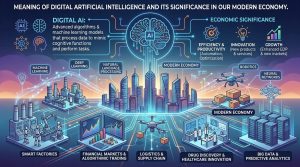
CHAPTER 28 — ARTIFICIAL INTELLIGENCE
Artificial intelligence represents another major stage in the history of knowledge.
Earlier technologies stored information.
Computers processed information.
AI systems can increasingly analyze patterns, generate content, translate languages, reason over information and assist with complex intellectual tasks.
Modern AI rests upon decades of work in:
- mathematics;
- statistics;
- computer science;
- neuroscience;
- information theory;
- optimization;
- semiconductor engineering;
- machine learning.
AI is therefore not an isolated invention.
It is the convergence of many intellectual traditions.
CHAPTER 29 — THE GIANTS OF MODERN TECHNOLOGY
The modern technological civilization was built by enormous communities rather than by isolated individuals.
Important technological domains include:
| Domain | Knowledge Foundation |
|---|---|
| Semiconductors | Quantum physics + materials science |
| Computers | Mathematics + logic + electronics |
| Internet | Networking + information theory |
| AI | Statistics + computation + mathematics |
| GPS | Relativity + atomic clocks + satellites |
| Biotechnology | Genetics + chemistry + computing |
| Nuclear energy | Nuclear physics + engineering |
| Space exploration | Physics + mathematics + materials |
| Robotics | Mechanics + electronics + AI |
| Telecommunications | Electromagnetism + information theory |
This illustrates a central principle:
The greatest technologies are usually interdisciplinary.
CHAPTER 30 — SPACE AND THE EXPANSION OF KNOWLEDGE
Astronomy began with naked-eye observations.
It progressed through:
eyes → telescopes → radio telescopes → space telescopes → planetary probes → gravitational-wave observatories.
Humanity now studies:
- planets;
- moons;
- asteroids;
- comets;
- stars;
- galaxies;
- black holes;
- neutron stars;
- cosmic background radiation;
- gravitational waves.
The observable universe has become one of humanity’s greatest laboratories.
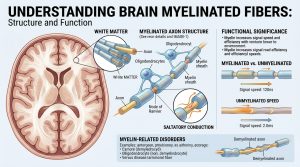
CHAPTER 31 — THE HUMAN BRAIN
Perhaps the greatest remaining frontier is the organ that generates knowledge itself.
Neuroscience investigates:
- neurons;
- synapses;
- brain networks;
- perception;
- memory;
- learning;
- decision-making;
- consciousness.
This creates a remarkable intellectual loop:
The brain created science to study the universe and eventually began using science to study itself.
CHAPTER 32 — THE PHILOSOPHY OF KNOWLEDGE
Humanity must distinguish between:
- information;
- knowledge;
- understanding;
- wisdom.
Information tells us what data exists.
Knowledge organizes information.
Understanding explains relationships.
Wisdom concerns how knowledge should be used.
Technological capability without wisdom can produce serious consequences.
Therefore, the future of civilization depends not merely on increasing intelligence but on improving judgment, responsibility and cooperation.
CHAPTER 33 — FROM INDIVIDUAL GENIUSES TO COLLECTIVE INTELLIGENCE
The traditional image of scientific progress often focuses on famous individuals.
But modern science increasingly operates through enormous collaborative systems.
Large scientific projects can involve:
- thousands of researchers;
- international laboratories;
- massive databases;
- supercomputers;
- specialized instruments;
- automated experiments.
The “giant” of the twenty-first century may therefore be less frequently an individual and increasingly a knowledge network.
CHAPTER 34 — WOMEN AND UNDERREPRESENTED GIANTS
The history of knowledge has frequently underrepresented contributors whose work was essential.
Examples include:
- Hypatia;
- Émilie du Châtelet;
- Mary Anning;
- Ada Lovelace;
- Marie Curie;
- Lise Meitner;
- Emmy Noether;
- Rosalind Franklin;
- Katherine Johnson;
- Dorothy Vaughan;
- many others.
A complete history of knowledge must examine contributions based on intellectual achievement rather than historical visibility alone.
CHAPTER 35 — THE GLOBALIZATION OF KNOWLEDGE
Knowledge is no longer geographically isolated.
A researcher in South Africa can access scientific papers produced in Europe.
An engineer in Asia can use mathematical theories developed centuries ago.
A programmer in Africa can build software using open-source technologies developed by global communities.
A student can access lectures from universities thousands of kilometres away.
The knowledge system has become planetary.
CHAPTER 36 — KNOWLEDGE AND CIVILIZATION
Civilization can be understood as an infrastructure for preserving and applying knowledge.
Its components include:
Education
↓
Research
↓
Knowledge
↓
Technology
↓
Infrastructure
↓
Economic production
↓
Improved living conditions
↓
New knowledge
This creates a positive feedback loop.
CHAPTER 37 — THE KNOWLEDGE ACCUMULATION ENGINE
Human progress can be represented conceptually as:
Observation
↓
Question
↓
Knowledge
↓
Experiment
↓
Discovery
↓
Theory
↓
Technology
↓
Application
↓
New Problems
↓
New Questions
↓
New Knowledge
This cycle has continued for thousands of years.
CHAPTER 38 — THE FUTURE OF HUMAN KNOWLEDGE
The next major knowledge revolutions may emerge from combinations of:
- artificial intelligence;
- quantum computing;
- biotechnology;
- advanced robotics;
- nanotechnology;
- space science;
- synthetic biology;
- advanced materials;
- fusion research;
- neuroscience;
- computational science.
The boundaries between disciplines are likely to become increasingly interconnected.
Physics will influence computing.
Computing will influence biology.
Biology will influence engineering.
AI will accelerate scientific discovery.
Space science will generate new materials and engineering requirements.
CHAPTER 39 — THE NEW GIANTS
The future “giants” of knowledge may not resemble the historical image of the solitary genius.
They may be:
- interdisciplinary research teams;
- AI-assisted scientists;
- global scientific networks;
- automated laboratories;
- open-source communities;
- citizen scientists;
- institutions;
- universities;
- research organizations;
- human-machine collaborations.
The unit of intellectual progress may gradually shift from individual genius toward collective intelligence.
CHAPTER 40 — THE GREAT CHAIN OF HUMAN KNOWLEDGE
The entire history can be represented as a chain:
Fire
↓
Language
↓
Writing
↓
Mathematics
↓
Philosophy
↓
Science
↓
Engineering
↓
Industrialization
↓
Electricity
↓
Electronics
↓
Computing
↓
Internet
↓
Artificial Intelligence
↓
Human-Machine Collaboration
↓
Future Intelligence
Every stage inherits something from the previous stage.
CHAPTER 41 — THE CENTRAL LESSON
The greatest lesson of intellectual history is that knowledge is rarely created from nothing.
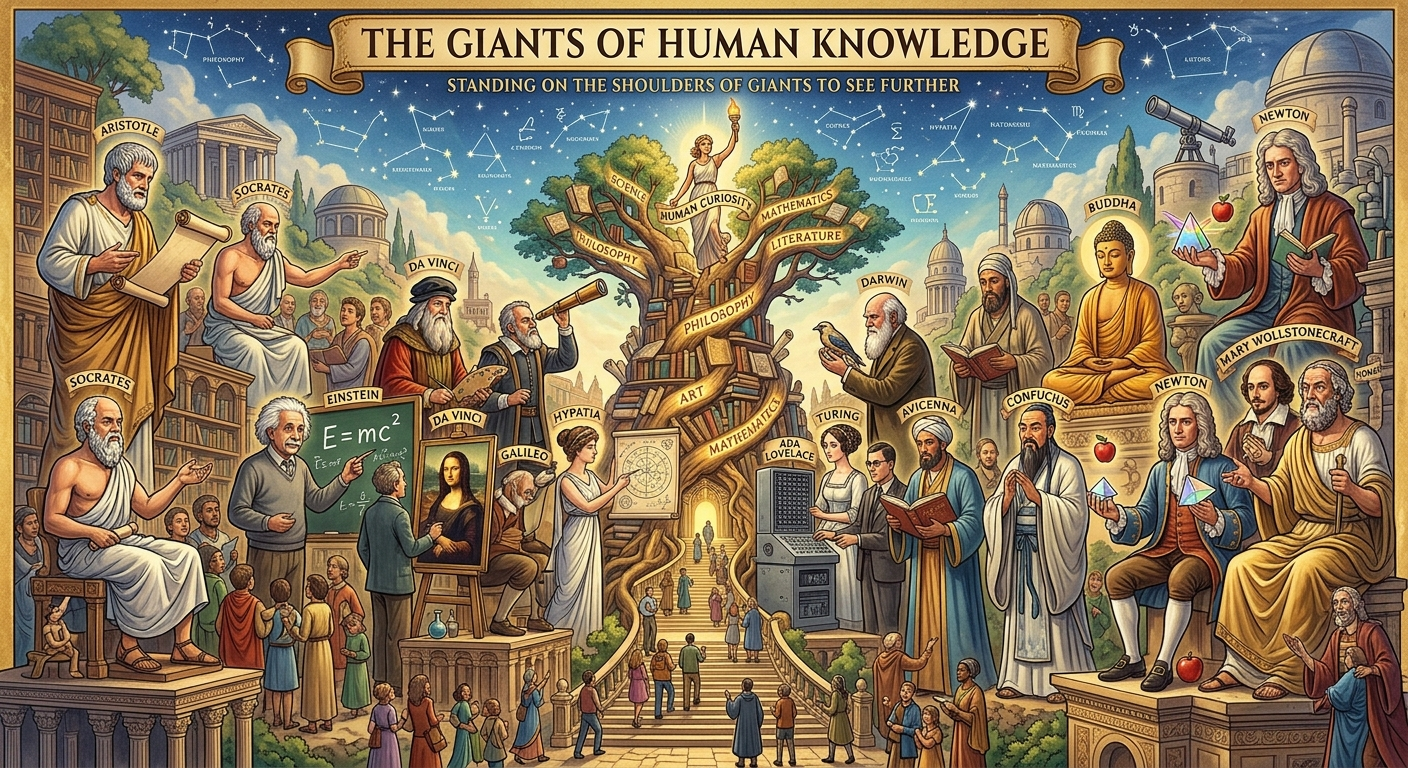
Newton famously described scientific progress through the metaphor of standing on the shoulders of giants. The concept captures a fundamental characteristic of civilization: later generations can see farther because earlier generations constructed intellectual foundations upon which they can build. The broader literature on scientific history similarly emphasizes how accumulated knowledge crosses generations and disciplines.
Einstein built upon Newtonian mechanics and nineteenth-century physics.
Quantum physicists built upon classical physics while challenging its limits.
Computer scientists built upon mathematics and logic.
Modern AI researchers build upon statistics, information theory, computing and decades of machine-learning research.
Humanity continuously inherits, modifies and extends knowledge.
CHAPTER 42 — KNOWLEDGE AS HUMANITY’S GREATEST TECHNOLOGY
Humanity’s most important technology may not be the wheel, steam engine, transistor or computer.
It may be the knowledge system itself.
Humanity developed methods for:
- asking questions;
- preserving discoveries;
- testing claims;
- teaching future generations;
- correcting errors;
- sharing information;
- combining ideas;
- building upon previous discoveries.
This system allows knowledge to survive individual lifetimes.
A human being may live for decades.
Knowledge can survive for thousands of years.
That is one of civilization’s greatest achievements.
CHAPTER 43 — CONCLUSION
THE GIANTS OF HUMAN KNOWLEDGE
The history of humanity can be interpreted as the history of an expanding intellectual universe.
Our ancestors looked at the stars.
They learned to predict seasons.
They developed language.
They created symbols.
They invented writing.
They developed mathematics.
They built cities.
They studied nature.
They questioned traditional explanations.
They created experimental methods.
They discovered physical laws.
They decoded biological information.
They harnessed electricity.
They created computers.
They connected the planet.
They began constructing artificial intelligence.
And now humanity is beginning to use machines to help investigate the very universe from which intelligence emerged.
The great intellectual achievement of humanity is therefore not the work of one civilization, one nation, one century or one individual.
It is a cumulative inheritance.
Every generation receives knowledge from those before it, modifies that knowledge, discovers new truths, develops new technologies and passes an expanded intellectual inheritance to the next generation.
The giants of human knowledge are consequently not merely the famous names written in textbooks.
They include the mathematicians who developed numerical systems, the astronomers who watched the heavens, the engineers who built machines, the physicians who studied disease, the philosophers who questioned reality, the scientists who designed experiments, the programmers who created algorithms, the technicians who manufacture modern computers, the teachers who transmit knowledge and the researchers who continue asking questions whose answers humanity has not yet discovered.
The story of knowledge is ultimately the story of humanity learning how to learn.
And the greatest question remains open:
What will the next generation discover that today’s giants cannot yet see?
SELECTED REFERENCES AND RESEARCH DIRECTIONS
A publication-quality version of this thesis should draw upon primary sources and authoritative scholarship covering:
- Ancient mathematics and astronomy.
- History of writing and information systems.
- Greek philosophy and mathematical science.
- African intellectual and technological history.
- Islamic Golden Age scholarship.
- Renaissance science.
- Scientific Revolution literature.
- Newtonian mechanics.
- History of chemistry.
- Darwinian evolution.
- Maxwell’s electromagnetic theory.
- Thermodynamics.
- Einstein’s relativity.
- Quantum mechanics.
- Molecular biology and genetics.
- History of computing.
- Information theory.
- Semiconductor engineering.
- Internet history.
- Artificial intelligence and machine learning.
- History and philosophy of science.
- Contemporary neuroscience.
- Space science and astronomy.
- The sociology of scientific collaboration.
Final Thesis Statement
Human civilization is the accumulated intelligence of generations.
Every discovery becomes a foundation for another discovery.
Every theory creates new questions.
Every technology expands the space of possible human action.
And every generation inherits the responsibility to preserve, test, improve and extend the knowledge of those who came before.
We are not the beginning of human knowledge.
We are one generation in an intellectual chain that began thousands of years ago and whose future remains unknown.
THE GIANTS OF HUMAN KNOWLEDGE are therefore not simply the people who changed the world.
They are the generations of humanity that learned how to understand it.

Be First to Comment