
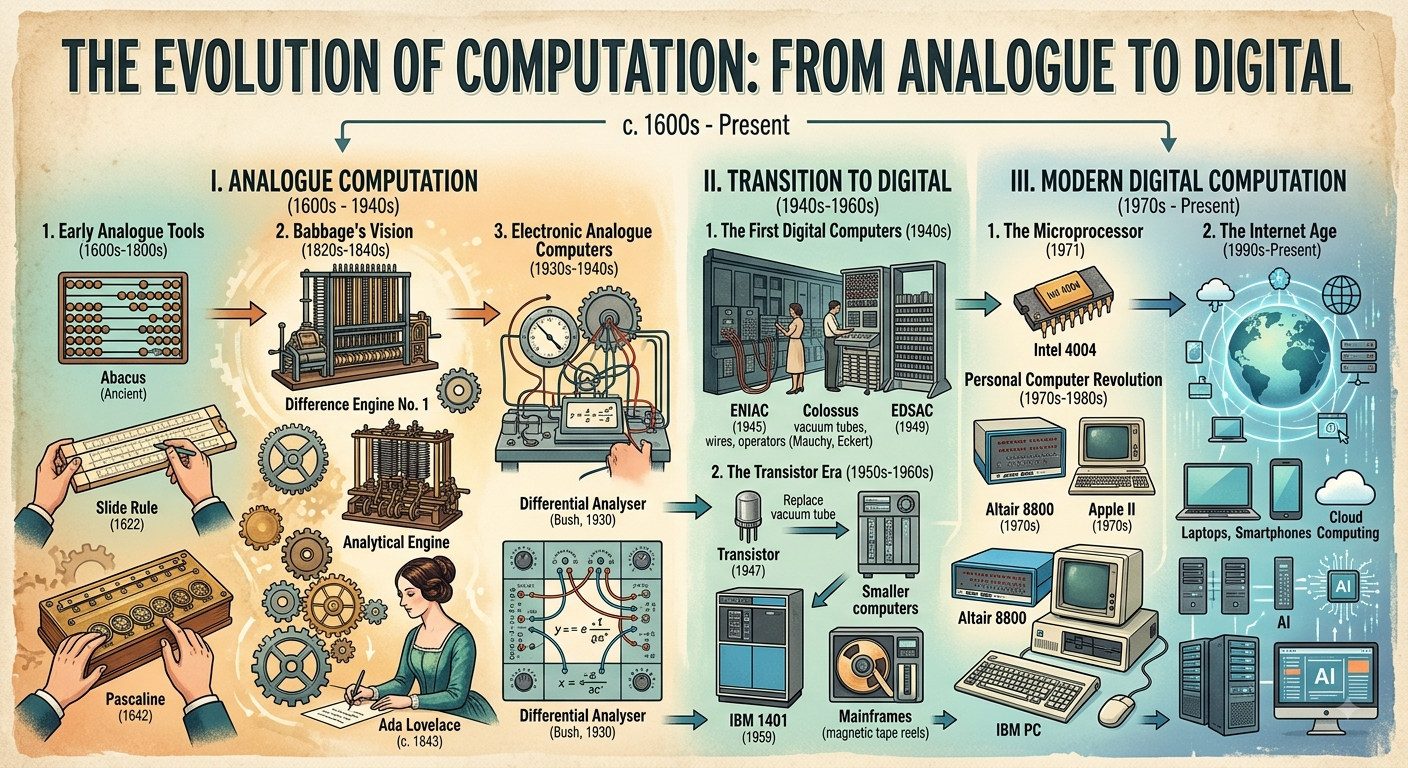
A Comprehensive Scientific and Technological Thesis from Mechanical Calculation to Artificial Intelligence
Abstract
The history of computation is the history of humanity’s attempt to transform information into useful knowledge through increasingly powerful physical and mathematical processes. Long before the modern computer, humans developed counting systems, numerical notation, astronomical instruments, mechanical calculators, logarithmic devices and mathematical algorithms. Over centuries, these technologies progressively separated computation from the physical limitations of the human mind.
The evolution was not a simple linear transition from mechanical machines to analogue computers and then to digital computers. Instead, it was a complex convergence of mathematics, mechanical engineering, electricity, electronics, logic, information theory, semiconductor physics, software engineering and communications. Mechanical machines could perform both analogue and digital operations; electromechanical machines introduced relays and automated switching; analogue computers represented quantities through continuously varying physical variables; and digital computers eventually represented information using discrete symbolic states.
The twentieth century transformed computation through vacuum tubes, transistors, integrated circuits and microprocessors. The late twentieth and early twenty-first centuries then extended computation from isolated machines into global networks, cloud data centres, mobile devices, graphics processors and artificial-intelligence systems. Modern computing increasingly combines digital logic with analogue circuits, optical communication, specialised accelerators, neuromorphic architectures and emerging quantum technologies.
This thesis examines that transformation from its ancient origins to contemporary computing and considers the technological trajectory toward increasingly heterogeneous and intelligent computational systems.
Chapter 1 — Introduction
1.1 What Is Computation?
Computation is the systematic transformation of information according to rules.
At its most fundamental level, computation involves:
Input → Processing → State/Memory → Output
A human performing arithmetic mentally is computing. An abacus is a computational tool. A mechanical calculator is a computational machine. A transistor-based processor is a computational circuit. A modern artificial-intelligence system is an enormously complex computational architecture.
The physical implementation changes, but the underlying concept remains:
Information is represented physically, transformed according to rules, and converted into a result.
The history of computing therefore extends much further back than electronic computers. The University of Auckland’s computing-history timeline describes the development as a combination of mechanical calculation, analogue computation, programmed computation, communications, business data processing, electronics and mathematical logic.
Chapter 2 — The Human Before the Machine
2.1 Counting
The earliest computational technology was the human ability to count.
Humans developed numerical representations to manage:
- quantities of food;
- livestock;
- trade;
- taxation;
- calendars;
- astronomical observations;
- construction;
- navigation;
- population records.
Objects such as stones, marks, fingers and counting boards became external representations of numerical information.
2.2 The Abacus
The abacus transformed counting from a purely mental activity into manipulation of physical states.
Each bead represented a numerical state.
The conceptual architecture was already surprisingly powerful:
Physical position → numerical representation → arithmetic operation → numerical result
This is an early example of humans moving computation outside the brain.
Chapter 3 — Ancient Mechanical Computation
3.1 The Antikythera Mechanism
The Antikythera Mechanism demonstrates that sophisticated mechanical computation existed more than two thousand years ago.
Dating to approximately the second or first century BCE, the mechanism used interconnected gears to represent astronomical cycles.
Its significance lies not simply in its gears but in the principle behind them:
Gear ratios → mathematical relationships → mechanical prediction
It therefore illustrates a fundamental idea of analogue computation: physical relationships can embody mathematical relationships.
Chapter 4 — The Mechanical Calculation Revolution
4.1 Napier’s Logarithms
John Napier’s logarithms transformed multiplication and division into operations involving addition and subtraction.
This led to logarithmic calculating devices and eventually the slide rule.
4.2 The Slide Rule
William Oughtred’s slide rule became one of the most influential analogue calculating instruments in history.
It allowed engineers, scientists and mathematicians to perform:
- multiplication;
- division;
- powers;
- roots;
- logarithmic calculations;
- trigonometric calculations.
Its importance lasted for centuries.
The slide rule demonstrates that computation does not necessarily require a machine to explicitly execute every mathematical operation. Instead, mathematical transformations can be encoded into physical scales.
Chapter 5 — Pascal, Leibniz and Mechanical Arithmetic
5.1 Pascaline
Blaise Pascal developed the Pascaline in the seventeenth century.
It used mechanical wheels to perform arithmetic operations.
5.2 Leibniz’s Stepped Reckoner
Gottfried Wilhelm Leibniz developed a more advanced mechanical calculating mechanism capable of multiplication and division through repeated mechanical operations.
These machines established an important technological principle:
Human arithmetic → mechanical arithmetic
The machine was no longer merely representing numbers; it was mechanically executing mathematical operations.
Chapter 6 — Babbage and the Programmable Machine
6.1 Charles Babbage
Charles Babbage represents one of the greatest conceptual transitions in computing history.
His Difference Engine was designed to automate mathematical table generation.
His later Analytical Engine went much further.
It incorporated concepts analogous to:
- memory;
- processing;
- control;
- input;
- output;
- programmable instructions.
Although Babbage did not complete a fully operational Analytical Engine, its conceptual architecture anticipated several principles of modern programmable computers.
6.2 Ada Lovelace
Ada Lovelace recognised that a general-purpose computational machine could manipulate symbols according to rules rather than merely calculate numerical tables.
This was a major conceptual breakthrough.
The computer was becoming a general information-processing machine.
Chapter 7 — Punch Cards and Programmable Control
Joseph-Marie Jacquard’s punched-card-controlled loom demonstrated that instructions could be encoded physically.
A punched card contained patterns representing instructions.
This established a fundamental relationship:
Physical pattern → encoded instruction → machine operation
Punch cards later became central to data processing and early computing.
They provided one of the bridges between mechanical automation and programmable computation.
Chapter 8 — Analogue Computation
8.1 What Is Analogue Computing?
Analogue computation represents information using continuously varying physical quantities.
Examples include:
- position;
- rotation;
- voltage;
- current;
- pressure;
- fluid level;
- mechanical displacement;
- electrical frequency.
Instead of representing a number as a binary sequence, an analogue machine can represent it as a physical magnitude.
For example:
Voltage = mathematical variable
Changing the voltage changes the represented quantity.
Chapter 9 — Mechanical Analogue Computers
Mechanical analogue computers became increasingly sophisticated during the nineteenth and twentieth centuries.
Important examples included:
- tide-predicting machines;
- differential analysers;
- fire-control computers;
- navigational calculators;
- astronomical instruments.
9.1 Tide-Predicting Machines
Lord Kelvin’s tide-predicting machines used mechanical components to combine periodic components of tides.
The machine transformed mathematical equations into physical motion.
9.2 Differential Analysers
Vannevar Bush and his collaborators developed powerful mechanical differential analysers in the twentieth century.
These machines could solve differential equations using mechanical integration.
This was extremely important for engineering and scientific research.
Chapter 10 — Electronic Analogue Computing
Electricity transformed analogue computation.
Mechanical motion could be replaced by:
Voltage → amplifier → mathematical operation → voltage
Electronic analogue computers could represent mathematical variables using electrical signals.
Operational amplifiers could perform operations corresponding to:
- addition;
- subtraction;
- integration;
- differentiation;
- multiplication;
- scaling.
This dramatically increased computational speed for many classes of continuous mathematical problems.
Chapter 11 — Electromechanical Computation
The next major transition combined mechanical switching with electrical control.
Relays became computational components.
A relay could represent states such as:
ON / OFF
This created a bridge between mechanical machinery and electronic digital logic.
Electromechanical computers could therefore combine:
- mechanical movement;
- electrical switching;
- punched-card input;
- magnetic storage;
- programmed sequences.
Konrad Zuse’s Z3, completed in 1941, is a landmark example of programmable electromechanical digital computation.
Chapter 12 — Boolean Logic and Digital Computation
12.1 George Boole
George Boole developed mathematical logic based on symbolic variables and logical operations.
The fundamental states could be represented as:
True / False
or physically:
1 / 0
12.2 Claude Shannon
Claude Shannon demonstrated how Boolean algebra could be applied to electrical switching circuits.
This became one of the intellectual foundations of modern digital electronics.
The key idea was profound:
Logic → mathematical expression → switching circuit
Digital computing could therefore be constructed from networks of simple switching elements.
Chapter 13 — Vacuum Tubes
Vacuum tubes replaced mechanical relays in many high-speed computational systems.
They enabled electronic switching at much greater speeds.
The architecture changed dramatically:
Mechanical movement → electrical switching → electronic switching
This was one of the major technological discontinuities in computing history.
Chapter 14 — ENIAC and the Electronic Computer
The ENIAC project began in 1943 and was built by John Mauchly, J. Presper Eckert and their colleagues at the University of Pennsylvania.
ENIAC represented a major milestone in large-scale electronic digital computation. The Computer History Museum identifies its development as one of the foundational projects in post-war computing history.
The machine demonstrated the enormous potential of electronic computation.
But it also revealed the limitations of first-generation computers:
- enormous physical size;
- high energy consumption;
- extensive heat production;
- difficult programming;
- expensive maintenance;
- limited reliability.
The industry therefore needed another technological revolution.
Chapter 15 — The Transistor Revolution
In 1947, the transistor transformed computing.
Compared with vacuum tubes, transistors could be:
- smaller;
- more reliable;
- more energy efficient;
- faster;
- easier to manufacture at scale.
The fundamental computational element became microscopic.
This initiated the transition from room-sized electronic machines toward increasingly compact computers.
Chapter 16 — Integrated Circuits
The next breakthrough was the integrated circuit.
Instead of assembling individual electronic components separately, engineers could place many components onto a single semiconductor substrate.
The evolution became:
Transistor → multiple transistors → integrated circuit → large-scale integration → very-large-scale integration
This created the economic and technological foundation for modern computing.
Chapter 17 — Moore’s Law and Semiconductor Scaling
As semiconductor manufacturing improved, transistor density increased dramatically.
Smaller transistors enabled:
- greater processing power;
- lower energy per operation;
- smaller devices;
- larger memories;
- more sophisticated operating systems;
- increasingly complex software.
The computer moved from a room-sized machine toward:
mainframe → minicomputer → workstation → personal computer → laptop → smartphone → embedded computer
Chapter 18 — The Microprocessor
The microprocessor integrated a central processing unit onto a semiconductor chip.
This was revolutionary because computing capability could now be embedded into almost anything.
Microprocessors eventually became components of:
- personal computers;
- vehicles;
- telecommunications equipment;
- industrial machines;
- medical equipment;
- cameras;
- household appliances;
- spacecraft;
- smartphones.
The computer was no longer a separate machine.
It became a component of the technological environment.
Chapter 19 — Memory: From Paper to Semiconductor
Computational power requires memory.
The evolution of memory includes:
Human memory → writing → punched cards → magnetic tape → magnetic drums → magnetic core → semiconductor memory → flash memory → advanced memory technologies
Modern computers separate computation and storage into increasingly specialised architectures.
Major categories include:
- registers;
- cache;
- RAM;
- non-volatile memory;
- solid-state storage;
- distributed storage;
- cloud storage.
The relationship between processor and memory has become one of the central constraints of modern computing.
Chapter 20 — Software Becomes a Computational Layer
Hardware alone cannot provide modern computing.
Software introduced abstraction.
The hierarchy became:
Transistors
↓
Logic gates
↓
Processor architecture
↓
Machine instructions
↓
Assembly language
↓
Programming languages
↓
Operating systems
↓
Applications
↓
Artificial intelligence
Each layer hides complexity beneath it.
This abstraction is one of the most important reasons computing became accessible to billions of people.
Chapter 21 — Programming Languages
Early computers required extremely low-level programming.
Over time, programming languages evolved to provide greater abstraction.
Important developments include:
- assembly language;
- FORTRAN;
- COBOL;
- Lisp;
- BASIC;
- C;
- C++;
- Java;
- Python;
- JavaScript;
- modern domain-specific languages.
Programming changed computation from hardware-specific instruction manipulation into increasingly expressive symbolic design.
Chapter 22 — Personal Computing
During the late twentieth century, computing moved from institutions and corporations into homes.
The personal computer transformed:
- education;
- accounting;
- publishing;
- engineering;
- communications;
- entertainment;
- business;
- scientific research.
Graphical user interfaces further reduced the barrier between humans and machines.
The computer evolved from a specialised mathematical instrument into a general-purpose personal information environment.
Chapter 23 — The Internet Changes the Computer
The standalone computer eventually became a node within a global network.
The architecture changed from:
Computer
to:
Computer ↔ Network ↔ Computer
Then:
Device ↔ Internet ↔ Cloud ↔ Global Services
Computing became distributed.
Information could now move globally in milliseconds.
Chapter 24 — Mobile Computing
The smartphone represents the convergence of several technologies:
- microprocessors;
- memory;
- wireless communication;
- sensors;
- cameras;
- displays;
- operating systems;
- cloud computing;
- artificial intelligence.
A modern smartphone contains computational capabilities that would have required specialised infrastructure only decades earlier.
Chapter 25 — Graphics Processing Units
Graphics processing units introduced massively parallel computational architectures.
Instead of relying exclusively on a small number of highly flexible CPU cores, GPUs contain large numbers of specialised computational units.
This makes them particularly effective for:
- graphics;
- scientific simulation;
- matrix operations;
- machine learning;
- neural-network training;
- artificial intelligence.
The GPU has therefore become an important computational engine of the AI era.
Chapter 26 — Data Centres
Modern computing increasingly occurs inside enormous data centres.
A data centre integrates:
Electricity
↓
Power conversion
↓
Processors
↓
Memory
↓
Storage
↓
Networking
↓
Software
↓
Applications
↓
Users
The computer has effectively become an industrial infrastructure system.
Chapter 27 — Cloud Computing
Cloud computing abstracts physical infrastructure from the user.
Instead of purchasing a computer for every computational task, organisations can access:
- virtual machines;
- storage;
- databases;
- networking;
- GPUs;
- AI accelerators;
- software services.
Computing becomes an on-demand utility.
Chapter 28 — Artificial Intelligence
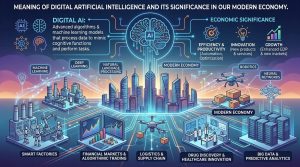
Artificial intelligence represents another major transformation.
Traditional software generally follows explicitly designed rules.
Machine learning systems can instead learn statistical relationships from data.
A simplified AI pipeline is:
Data → Training → Model → Parameters → Inference → Output
Modern AI therefore introduces a new computational paradigm in which computation is closely connected to data and learned representations.
Chapter 29 — The AI Computing Stack
Modern AI systems operate across multiple layers.
Layer 1 — Energy
Electricity powers the computational infrastructure.
Layer 2 — Semiconductor
Transistors provide physical switching and signal processing.
Layer 3 — Accelerator
CPUs, GPUs and specialised AI processors perform computation.
Layer 4 — Memory
High-speed memory stores model parameters and intermediate data.
Layer 5 — Networking
High-speed interconnects connect processors and machines.
Layer 6 — Systems Software
Operating systems, drivers, runtimes and libraries coordinate hardware.
Layer 7 — Models
Machine-learning models transform inputs into predictions or generated outputs.
Layer 8 — Applications
AI becomes useful to humans through search, assistants, scientific systems, robotics and business applications.
Chapter 30 — The Return of Analogue Computing
The digital revolution did not eliminate analogue computation.
Instead, analogue techniques are returning in specialised areas.
Modern research investigates analogue computation for applications where continuous physical quantities can be processed directly.
Potential advantages include:
- high computational throughput;
- reduced data movement;
- potentially lower energy consumption;
- efficient matrix operations;
- specialised AI acceleration.
Research has specifically examined analogue computing as a possible energy-efficient approach to scientific and machine-learning workloads.
The future may therefore be neither purely analogue nor purely digital.
It may be hybrid.
Chapter 31 — Neuromorphic Computing
The human brain processes information using enormous networks of neurons and synapses.
Neuromorphic computing attempts to reproduce some principles of neural information processing in hardware.
Instead of conventional CPU-style computation, neuromorphic architectures may emphasise:
- parallelism;
- event-driven processing;
- distributed memory;
- low-power operation;
- neural dynamics.
This could become important for robotics, sensory processing and edge AI.
Chapter 32 — Optical Computing
Electrical signals are not the only possible carriers of information.
Photons can transmit information at extremely high speeds.
Optical technologies are increasingly important in:
- data-centre networking;
- telecommunications;
- high-speed interconnects;
- specialised computation.
Photonic computing seeks to go further by using light not merely to move data but potentially to perform computational operations.
Chapter 33 — Quantum Computing
Quantum computing represents a fundamentally different computational model.
Classical computers use bits.
A quantum computer uses quantum bits, or qubits.
Classical bit:
0 or 1
Quantum state:
superposition of quantum states
Quantum algorithms exploit quantum mechanical phenomena to address particular classes of computational problems.
Quantum computing should not be understood as a universal replacement for conventional computers. Its significance lies in potentially providing major advantages for selected problems.
Chapter 34 — Edge Computing
Cloud computing centralises processing.
Edge computing moves some computation closer to where data is generated.
For example:
Sensor → Edge processor → Local decision
rather than:
Sensor → Internet → Data centre → Result → Device
Edge computing can reduce:
- latency;
- bandwidth requirements;
- network dependency.
It is particularly relevant to:
- autonomous systems;
- industrial automation;
- telecommunications;
- robotics;
- smart infrastructure.
Chapter 35 — The Evolution of Computational Representation
The history of computation can also be understood as a history of representation.
Stage 1
Physical objects represent numbers.
Stage 2
Mechanical positions represent mathematical quantities.
Stage 3
Electrical quantities represent continuous variables.
Stage 4
Relays represent discrete states.
Stage 5
Vacuum tubes represent electronic switching states.
Stage 6
Transistors represent binary logic.
Stage 7
Integrated circuits contain billions of computational elements.
Stage 8
Software represents increasingly abstract information.
Stage 9
AI models represent complex statistical relationships.
Stage 10
Future systems may combine digital, analogue, optical, neuromorphic and quantum representations.
Chapter 36 — A Comparative Architecture
| Era | Representation | Main Technology | Typical Strength |
|---|---|---|---|
| Ancient | Physical quantities | Counting devices | Basic arithmetic |
| Mechanical | Position/rotation | Gears | Mathematical calculation |
| Analogue | Continuous physical quantities | Mechanical/electrical circuits | Simulation |
| Electromechanical | Discrete switching | Relays | Automated calculation |
| Vacuum-tube | Electronic states | Vacuum tubes | High-speed computation |
| Transistor | Binary states | Transistors | Compact reliable computing |
| Integrated circuit | Digital logic | Semiconductor ICs | Mass-scale computation |
| Microprocessor | Programmable binary data | CPU | General-purpose computing |
| Parallel computing | Distributed operations | GPUs/accelerators | High-throughput computation |
| Cloud | Distributed digital resources | Data centres | Scalable computing |
| AI | Learned representations | AI accelerators | Intelligent information processing |
| Hybrid future | Multiple physical representations | AI/analogue/optical/neuromorphic/quantum | Specialised high-efficiency computing |
Chapter 37 — The Great Compression of Computing
One of the most remarkable characteristics of computing history is physical compression.
A computational capability that once required:
an entire room
became:
a cabinet
then:
a desktop
then:
a laptop
then:
a smartphone
and increasingly:
a chip embedded inside another object.
The computational machine has progressively disappeared into the environment.
This is sometimes described as ubiquitous or pervasive computing.
Chapter 38 — The Increasing Abstraction of Computation
Computing has also undergone an abstraction revolution.
Early users manipulated:
physical objects
Later users manipulated:
mechanical controls
Then:
switches
Then:
machine instructions
Then:
programming languages
Then:
graphical interfaces
Then:
natural language
Modern AI increasingly allows humans to express computational objectives in ordinary language.
The interface is therefore moving from:
Human → Machine Instructions
toward:
Human → Language → AI → Software/Computing Infrastructure
This could represent one of the most important transformations in the history of computation.
Chapter 39 — Energy as the Hidden Foundation
Every computational operation ultimately requires physical resources.
The computational hierarchy is therefore:
Energy → Semiconductor Physics → Transistors → Logic → Processor → Software → Application
As computational demand increases, energy efficiency becomes increasingly important.
This is particularly significant for:
- AI data centres;
- supercomputers;
- mobile devices;
- satellites;
- autonomous systems;
- edge computing.
Future computing will therefore be judged not merely by operations per second but increasingly by:
operations per joule.
Chapter 40 — Computation and the Physical Universe
Computation is ultimately constrained by physics.
Every computer has limits involving:
- energy;
- heat;
- signal propagation;
- materials;
- noise;
- memory;
- bandwidth;
- manufacturing precision.
As transistor dimensions approach extremely small scales, traditional scaling becomes increasingly difficult.
This creates pressure for new architectures rather than simply smaller transistors.
Chapter 41 — The Future: From Digital Computing to Heterogeneous Computing
The next stage is unlikely to be a single replacement technology.
Instead, future systems may combine:
CPU + GPU + AI accelerator + analogue circuits + optical interconnects + neuromorphic processors + quantum processors + distributed cloud infrastructure
Each technology can perform the tasks for which it is best suited.
This produces a heterogeneous computational ecosystem.
Chapter 42 — The Millennium Tech Saga 3001 Perspective
From the perspective of a technological history extending toward the year 3001, computation can be interpreted as a sequence of increasingly powerful transformations:
Era I — Human Computation
The brain performs calculation.
Era II — Externalised Computation
Objects such as counting boards and abaci extend human memory.
Era III — Mechanical Computation
Gears and mechanical mechanisms automate arithmetic.
Era IV — Analogue Computation
Physical quantities directly represent mathematical relationships.
Era V — Electromechanical Computation
Electrical control operates mechanical switching systems.
Era VI — Electronic Digital Computation
Vacuum tubes and transistors create high-speed electronic logic.
Era VII — Integrated Computing
Millions and then billions of transistors become integrated into semiconductor chips.
Era VIII — Networked Computing
Computers become interconnected through global telecommunications networks.
Era IX — Cloud Computing
Computational resources become globally distributed services.
Era X — Artificial Intelligence
Computing begins transforming data into learned representations and increasingly autonomous decisions.
Era XI — Hybrid Intelligence
Digital, analogue, optical, neuromorphic and quantum technologies increasingly cooperate.
Era XII — Millennium Computing
By the far future, computation may become deeply integrated into materials, infrastructure, robotics, biological interfaces and planetary-scale information systems.
Chapter 43 — Historical Timeline
| Period | Milestone |
|---|---|
| Ancient world | Counting systems and abaci |
| c. 2nd–1st century BCE | Antikythera Mechanism |
| 1614 | Napier’s logarithms |
| 1620s | Slide-rule development |
| 1640s | Pascaline |
| 1670s | Leibniz mechanical calculator |
| 1800s | Jacquard punched cards |
| 1820s | Babbage Difference Engine |
| 1830s–1840s | Analytical Engine concept |
| 1840s | Boolean logic |
| Late 1800s | Mechanical/electrical calculating technologies expand |
| 1930s | Formal foundations of computation and switching logic |
| 1940s | Electromechanical and electronic computers |
| 1940s | ENIAC |
| 1947 | Transistor |
| 1950s | Commercial electronic computers |
| 1960s | Integrated circuits |
| 1970s | Microprocessors |
| 1980s | Personal computer revolution |
| 1990s | World Wide Web |
| 2000s | Mobile and cloud computing |
| 2010s | GPU acceleration and deep learning |
| 2020s | Large-scale AI and specialised AI computing |
| Future | Hybrid, neuromorphic, optical and quantum systems |
Chapter 44 — The Central Technological Pattern
The entire history can be summarised as a series of transformations:
Human Mind
↓
Physical Representation
↓
Mechanical Automation
↓
Analogue Representation
↓
Electrical Switching
↓
Electronic Digital Logic
↓
Semiconductor Integration
↓
Programmable Computing
↓
Networked Computing
↓
Cloud Computing
↓
Artificial Intelligence
↓
Heterogeneous Intelligence
The remarkable feature is not simply that computers became faster.
They became:
- smaller;
- cheaper;
- more reliable;
- more connected;
- more programmable;
- more energy efficient;
- more specialised;
- more autonomous;
- more deeply integrated into society.
Chapter 45 — Conclusion
The evolution of computation is one of humanity’s greatest technological transformations.
The journey began with simple counting and gradually progressed through mechanical instruments, mathematical notation, analogue machines, electromechanical systems, vacuum tubes, transistors, integrated circuits and microprocessors.
The digital computer did not emerge from a single invention. It emerged from the convergence of mathematics, mechanical engineering, electrical engineering, logic, information theory, semiconductor physics and programming.
The modern computer is consequently not merely a machine for arithmetic. It is a universal information-processing platform.
The transformation continues.
Analogue computing is being reconsidered for specialised high-efficiency applications. GPUs and AI accelerators are reshaping processor architecture. Optical technologies are transforming communication and potentially computation. Neuromorphic systems explore brain-inspired architectures. Quantum computing investigates new computational principles.
The future therefore may not be “analogue versus digital.”
It may be:
Analogue + Digital + Optical + Neuromorphic + Quantum + Biological + Artificial Intelligence.
The deepest lesson of computing history is that computation is not tied to one physical technology.
Gears can compute.
Electrical circuits can compute.
Transistors can compute.
Light can potentially compute.
Quantum systems can compute.
And future technologies may discover entirely new physical mechanisms for transforming information.
From the first counting stone to the artificial-intelligence data centre, the fundamental human ambition has remained remarkably consistent:
to extend the limits of what can be calculated, represented, communicated and understood.
That is the continuing evolution of computation—from analogue mechanisms to digital intelligence and ultimately toward increasingly integrated forms of machine intelligence.
Selected References and Further Reading
- Stanford Encyclopedia of Philosophy — The Modern History of Computing.
- Computer History Museum — Timeline of Computer History.
- University of Auckland — Computing History Displays.
- Millennium Tech Saga 3001 — The Evolution of Computation: From Analogue to Digital.
- Ulmann, B. — Analog Computing for the 21st Century.
- Köppel et al. — Using Analog Computers in Today’s Largest Computational Challenges.

Be First to Comment