
A Comprehensive Scientific and Technological Thesis
Abstract
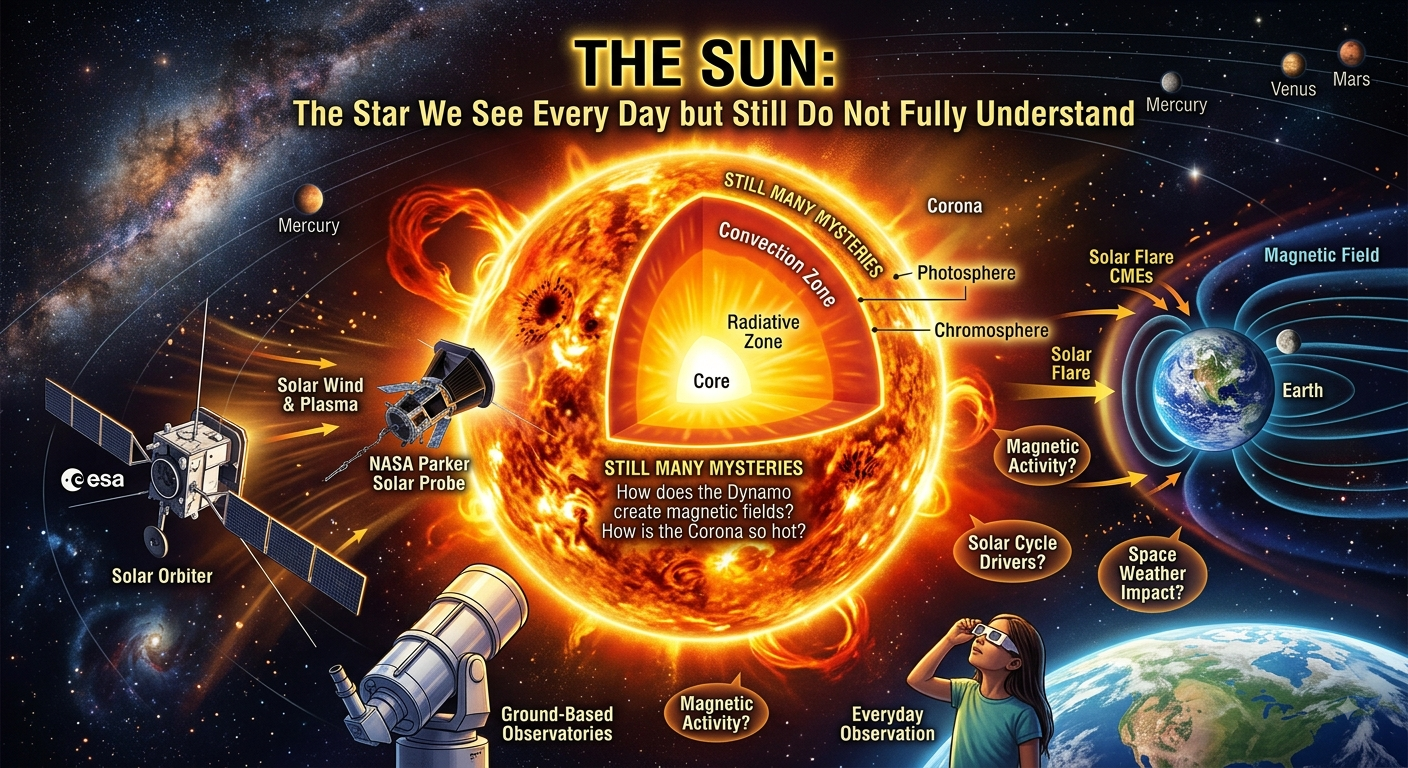
The Sun is the central star of the Solar System, the dominant source of energy driving Earth’s climate and biosphere, and the natural laboratory in which nuclear physics, plasma physics, magnetism, particle physics, stellar evolution, and space-weather science intersect. Although humanity has observed the Sun for thousands of years and spacecraft have studied it in unprecedented detail, fundamental questions remain unresolved—particularly concerning the heating of its corona, the generation and evolution of its magnetic field, the mechanisms responsible for solar eruptions, and the transport of energy through its turbulent plasma.
This thesis follows the Sun across approximately 4.6 billion years of history: from the gravitational collapse of the molecular cloud that produced it, through the formation of its nuclear-burning core, to its present main-sequence existence and eventual evolution into a red giant and ultimately a white dwarf. It examines the Sun’s internal architecture, nuclear fusion, radiation, convection, magnetic dynamo, sunspots, prominences, solar flares, coronal mass ejections, solar wind, heliosphere, neutrinos, and interactions with Earth. It also considers the technological consequences of solar activity, including satellite operations, navigation, communications, aviation, power grids, spacecraft, and human exploration.
The central argument is that the Sun should not be regarded merely as a luminous ball in the sky. It is a dynamic, magnetized, self-gravitating plasma system whose behavior connects microscopic nuclear reactions with planetary-scale and technological consequences.
Table of Contents
- Introduction
- The Sun in Human History
- Birth of the Sun
- Fundamental Properties of the Sun
- The Architecture of the Sun
- The Nuclear Engine
- How Energy Travels from the Core to Space
- The Solar Atmosphere
- The Sun as a Plasma Laboratory
- Solar Magnetic Fields and the Solar Dynamo
- Sunspots and the Solar Cycle
- Solar Flares and Coronal Mass Ejections
- The Solar Wind and the Heliosphere
- Solar Neutrinos
- The Sun and Earth’s Climate
- Space Weather and Human Technology
- Solar Effects on Satellites and Communications
- Solar Effects on Electrical Infrastructure
- Spacecraft and Solar Observation
- Major Solar Missions
- Unsolved Problems in Solar Physics
- The Sun’s Influence on the Solar System
- The Future Evolution of the Sun
- The Red-Giant Phase
- The White-Dwarf Remnant
- Scientific and Technological Future
- Historical Timeline
- Integrated Solar-System Model
- Conclusion
- Selected References
1. Introduction
Every sunrise is evidence of an extraordinary physical process occurring approximately 150 million kilometres away.
The Sun appears deceptively simple. To the unaided eye it is a bright disk. Scientifically, however, it is an enormous sphere of plasma containing approximately 99.86% of the mass of the Solar System.
Its gravity governs planetary orbits. Its radiation provides the energy required for almost all terrestrial ecosystems. Its ultraviolet radiation influences atmospheric chemistry. Its magnetic field produces solar activity capable of disrupting technological systems. Its particles continuously stream through interplanetary space.
The Sun therefore connects:
nuclear physics → plasma physics → electromagnetism → planetary science → climate → technology → human civilization.
Understanding the Sun is consequently not merely an astronomical exercise. It is a technological necessity.
2. The Sun in Human History
Long before modern astronomy, civilizations recognized the Sun as fundamental to life.
Ancient societies developed calendars based upon solar cycles, used shadows to measure time and orientation, and developed astronomical systems for predicting seasonal changes.
The scientific interpretation changed dramatically after the development of telescopes.
Major intellectual transitions
| Period | Development |
|---|---|
| Antiquity | Sun understood through mythology and observational astronomy |
| 1600s | Telescopic observations reveal sunspots |
| 1800s | Spectroscopy reveals the Sun’s chemical composition |
| Early 1900s | Nuclear physics begins explaining stellar energy |
| Mid-1900s | Fusion becomes established as the Sun’s energy source |
| Space age | Spacecraft begin observing the Sun from above Earth’s atmosphere |
| Modern era | Helioseismology, neutrino detection and advanced spacecraft probe the solar interior and atmosphere |
The great transition was from observing what the Sun does to understanding why it does it.
3. Birth of the Sun
The Sun formed approximately 4.6 billion years ago from a collapsing region of a giant molecular cloud.
The cloud contained:
- hydrogen,
- helium,
- dust,
- heavier elements produced by earlier generations of stars.
Gravity caused part of the cloud to collapse.
As contraction proceeded, gravitational potential energy was converted into thermal energy.
A rotating disk developed around the growing protostar.
This disk eventually supplied material for the formation of the planets, asteroids and other Solar System bodies.
Simplified formation sequence
Molecular cloud
↓
Gravitational collapse
↓
Protostar
↓
Rotating protoplanetary disk
↓
Increasing temperature and pressure
↓
Hydrogen fusion begins
↓
Main-sequence Sun
The formation of the Sun therefore simultaneously initiated the formation of the planetary system.
4. Fundamental Properties of the Sun
Some fundamental parameters are approximately:
| Property | Approximate value |
|---|---|
| Age | 4.6 billion years |
| Mass | 1.989 × 10³⁰ kg |
| Radius | 696,000 km |
| Diameter | 1.392 million km |
| Mean distance from Earth | 149.6 million km |
| Surface temperature | ~5,500 °C |
| Core temperature | ~15 million °C |
| Composition | Primarily hydrogen and helium |
| Luminosity | ~3.83 × 10²⁶ W |
| Spectral type | G2V |
| Rotation | Differential |
| Current evolutionary stage | Main sequence |
The Sun is therefore a G-type main-sequence star.
It is neither exceptionally large nor exceptionally small by stellar standards.
Its importance comes primarily from its proximity to Earth.
5. The Architecture of the Sun
The Sun does not possess a conventional solid surface.
Instead, it consists of layers of extremely hot plasma.
A simplified structure is:
                  SOLAR ATMOSPHERE
        ┌──────────────────────────────┐
        │            Corona            │
        ├──────────────────────────────┤
        │         Chromosphere         │
        ├──────────────────────────────┤
        │         Photosphere          │
        ├──────────────────────────────┤
        │      Convection Zone         │
        ├──────────────────────────────┤
        │       Radiative Zone         │
        ├──────────────────────────────┤
        │            Core              │
        │       Nuclear Fusion         │
        └──────────────────────────────┘
5.1 Core
The core is the nuclear engine.
Temperatures reach approximately 15 million °C.
Pressure and density are sufficiently high for nuclear fusion to occur.
5.2 Radiative Zone
Energy moves outward primarily through the repeated absorption and re-emission of photons.
Energy transport is extraordinarily slow compared with the speed of an individual photon because photons repeatedly interact with matter.
5.3 Convection Zone
Closer to the surface, energy transport becomes dominated by convection.
Hot plasma rises.
Cooler plasma descends.
This creates enormous circulating motions.
5.4 Photosphere
The photosphere is the visible layer commonly regarded as the Sun’s surface.
Its temperature is approximately 5,500 °C.
5.5 Chromosphere
Above the photosphere lies the chromosphere, where temperature begins increasing with altitude.
5.6 Corona
The corona is the outer atmosphere.
One of the great mysteries of solar physics is why the corona reaches temperatures of millions of degrees while the photosphere is only thousands of degrees.
6. The Nuclear Engine
The Sun’s energy ultimately comes from nuclear fusion.
The dominant process is the proton-proton chain.
In simplified form:
Hydrogen nuclei → helium nucleus + energy
Four hydrogen nuclei ultimately become one helium nucleus, with a small amount of mass converted into energy.
Einstein’s relationship:E=mc2
explains the enormous energy produced.
The Sun converts roughly 600 million tonnes of hydrogen per second through nuclear reactions, with a small fraction of the mass appearing as energy.
This energy becomes:
- electromagnetic radiation,
- kinetic energy,
- neutrinos.
The process has operated for billions of years and is expected to continue for billions more.
7. How Energy Travels from the Core to Space
The journey from nuclear reaction to sunlight is complicated.
Stage 1 — Nuclear fusion
Fusion releases energy in the core.
Stage 2 — Photon transport
Energy moves outward through the radiative region.
Stage 3 — Convection
In the outer interior, plasma transports energy through large-scale circulation.
Stage 4 — Radiation
At the photosphere, energy escapes as electromagnetic radiation.
Stage 5 — Interplanetary propagation
Solar radiation travels outward through space at approximately the speed of light.
Solar energy reaches Earth approximately 8 minutes 20 seconds after leaving the Sun.
8. The Solar Atmosphere
The solar atmosphere is extraordinarily dynamic.
It includes:
- photosphere,
- chromosphere,
- transition region,
- corona.
The corona extends far into space and gradually transitions into the solar wind.
Unlike Earth’s atmosphere, the solar atmosphere consists primarily of ionized plasma controlled strongly by electromagnetic forces.
9. The Sun as a Plasma Laboratory
Plasma is matter in which many atoms have become ionized.
The Sun is therefore fundamentally a plasma object.
Plasma behaves differently from ordinary gases because charged particles interact with electromagnetic fields.
This creates:
- magnetic loops,
- waves,
- reconnection,
- plasma instabilities,
- shocks,
- turbulence,
- eruptions.
Understanding solar plasma helps scientists understand many other astrophysical environments.
10. Solar Magnetic Fields and the Solar Dynamo
The Sun’s magnetic field is generated by motions within its electrically conducting plasma.
This process is called the solar dynamo.
Differential rotation stretches and reorganizes magnetic fields.
Convection also transports and distorts them.
The result is a constantly evolving magnetic system.
This magnetic activity is responsible for many of the Sun’s most spectacular phenomena.
11. Sunspots and the Solar Cycle
Sunspots are relatively cooler, darker regions of the photosphere associated with strong magnetic fields.
They are not actually cold in absolute terms.
They are simply cooler than their surroundings.
Sunspot activity changes over a cycle averaging approximately 11 years.
However, the complete magnetic cycle is approximately 22 years because the Sun’s global magnetic polarity eventually returns to its original orientation.
Simplified cycle
Solar minimum
      ↓
Increasing magnetic activity
      ↓
More sunspots
      ↓
Solar maximum
      ↓
Magnetic-field reorganization
      ↓
Declining activity
      ↓
Solar minimum
12. Solar Flares and Coronal Mass Ejections
Two of the most important manifestations of solar magnetic activity are solar flares and coronal mass ejections (CMEs).
Solar flares
A flare is an enormous release of electromagnetic energy associated with magnetic restructuring.
Radiation may be emitted across a broad range of wavelengths.
Coronal mass ejections
A CME involves the expulsion of large quantities of magnetized plasma into space.
If directed toward Earth, such events can produce geomagnetic disturbances.
These events demonstrate that the Sun is not a static light source.
It is an active magnetic star.
13. The Solar Wind and the Heliosphere
The Sun continuously releases charged particles into space.
This outflow is the solar wind.
It consists primarily of:
- protons,
- electrons,
- alpha particles,
- magnetic fields.
The solar wind creates a gigantic region of solar influence called the heliosphere.
The heliosphere extends far beyond the planets.
Its boundary represents the region where solar influence eventually encounters the surrounding interstellar medium.
14. Solar Neutrinos
Nuclear reactions inside the Sun produce neutrinos.
Neutrinos are extraordinarily difficult to detect because they interact very weakly with matter.
Trillions pass through every human body continuously.
Solar neutrinos provide a unique method for testing our understanding of the Sun’s nuclear interior.
They also helped reveal one of the great discoveries in particle physics: neutrinos change flavor as they travel.
15. The Sun and Earth’s Climate
The Sun provides virtually all of Earth’s primary external energy.
Solar radiation drives:
- atmospheric circulation,
- ocean heating,
- evaporation,
- weather,
- photosynthesis,
- much of the terrestrial carbon cycle.
However, Earth’s climate cannot be explained by solar radiation alone.
Climate depends upon interactions among:
Sun + atmosphere + oceans + land + ice + biosphere + greenhouse gases + orbital geometry.
Solar variability influences climate, but modern climate change is primarily associated with human-driven increases in greenhouse gases rather than changes in solar output.
16. Space Weather and Human Technology
Space weather describes changing conditions in near-Earth space caused largely by solar activity.
It includes:
- solar flares,
- CMEs,
- energetic particles,
- geomagnetic storms.
Space weather has become increasingly important because civilization depends upon space-based and electrically interconnected infrastructure.
17. Solar Effects on Satellites and Communications
Solar activity can affect:
Satellites
Energetic particles can damage electronic components and solar panels.
Radio
Solar disturbances can interfere with some radio communications.
Navigation
Changes in Earth’s ionosphere can influence satellite-navigation signals.
Aviation
High-altitude aviation and polar routes can be affected by radiation and communication disturbances during significant solar events.
Spacecraft
Solar energetic particles represent an important radiation hazard for spacecraft and astronauts.
18. Solar Effects on Electrical Infrastructure
Strong geomagnetic storms can induce currents in long conductors.
Potentially affected systems include:
- electricity transmission networks,
- pipelines,
- railway systems,
- communications infrastructure.
This creates an unusual connection:
A magnetic disturbance 150 million kilometres away can influence infrastructure on Earth.
Space weather is therefore a genuine engineering problem.
19. Spacecraft and Solar Observation
Earth’s atmosphere blocks much of the electromagnetic spectrum.
Spacecraft therefore provide an extraordinary advantage.
Solar observatories can observe wavelengths including:
- ultraviolet,
- extreme ultraviolet,
- X-rays,
- visible light,
- infrared.
Modern missions can investigate both the Sun’s surface and its surrounding plasma environment.
20. Major Solar Missions
Several missions have transformed our understanding of the Sun.
SOHO
The Solar and Heliospheric Observatory dramatically expanded observations of the solar atmosphere and interior.
SDO
The Solar Dynamics Observatory provides continuous high-resolution observations of solar activity.
STEREO
STEREO provided stereoscopic observations that improved understanding of solar eruptions and three-dimensional structures.
Solar Orbiter
Solar Orbiter combines remote sensing with in-situ measurements to study the Sun and heliosphere.
Parker Solar Probe
Parker Solar Probe represents one of humanity’s most ambitious attempts to approach a star.
Its mission is particularly important for understanding:
- coronal heating,
- solar wind acceleration,
- magnetic-field structure,
- energetic particles.
21. Unsolved Problems in Solar Physics
Despite enormous progress, major questions remain.
21.1 Why is the corona so hot?
The photosphere has a temperature of thousands of degrees, while the corona reaches millions of degrees.
The mechanisms responsible for transferring sufficient energy into the corona remain an active research field.
21.2 How exactly does the solar dynamo operate?
Scientists understand the broad principles of magnetic-field generation, but the detailed dynamo mechanism remains complex.
21.3 How is the solar wind accelerated?
The solar wind begins in the corona, but the precise mechanisms responsible for accelerating its different components remain an important problem.
21.4 What determines the size and severity of solar eruptions?
Predicting the timing and magnitude of major solar eruptions remains difficult.
21.5 How does turbulence transport energy?
The Sun is one of nature’s largest laboratories for turbulent plasma physics.
22. The Sun’s Influence on the Solar System
The Sun controls the Solar System through several fundamental forces and processes.
Gravity
Determines planetary and small-body orbits.
Radiation
Provides energy to planets.
Solar wind
Fills interplanetary space with plasma.
Magnetic field
Creates the heliosphere and controls charged-particle propagation.
Particle radiation
Influences planetary atmospheres and spacecraft environments.
The Solar System is therefore better understood as a Sun-centered physical system than merely a collection of planets orbiting a star.
23. The Future Evolution of the Sun
The Sun is currently approximately halfway through its main-sequence lifetime.
As hydrogen in the core is converted into helium, the core gradually changes.
The Sun will slowly become more luminous.
Eventually, core hydrogen will become depleted.
The balance between gravity and nuclear energy production will change.
This will initiate a dramatic transformation.
24. The Red-Giant Phase
When core hydrogen fusion eventually ceases, the Sun will expand dramatically.
Its outer layers will become enormously larger.
The Sun will enter the red-giant stage.
During this phase:
- the core contracts,
- surrounding layers undergo hydrogen burning,
- the outer atmosphere expands,
- luminosity increases substantially.
Later, helium fusion will occur in the core.
Eventually the Sun will exhaust the nuclear fuel available for sustained stellar fusion.
25. The White-Dwarf Remnant
The Sun will not end its life as a supernova.
It lacks sufficient mass.
Instead, after losing its outer layers, the remaining core will become a white dwarf.
A white dwarf is approximately Earth-sized but contains a substantial fraction of the Sun’s current mass.
It is supported primarily by electron degeneracy pressure rather than ordinary thermal pressure.
Initially extremely hot, it will gradually cool over immense periods.
The final object will be a compact stellar remnant.
26. Scientific and Technological Future
The study of the Sun is entering a new era.
Future solar science will increasingly combine:
- artificial intelligence,
- machine learning,
- high-performance computing,
- spacecraft observations,
- numerical plasma simulations,
- helioseismology,
- spectroscopy,
- particle detection.
AI could help identify patterns in enormous volumes of solar data.
One important long-term objective is improving space-weather prediction.
A mature forecasting system could potentially provide earlier warnings of dangerous solar events, allowing operators to protect vulnerable infrastructure.
27. Historical Timeline
| Date / Period | Development |
|---|---|
| ~4.6 billion years ago | Sun forms |
| Ancient civilizations | Systematic solar observations |
| 1610s | Telescopic sunspot observations expand |
| 1800s | Solar spectroscopy develops |
| 1900s | Stellar energy problem linked to nuclear physics |
| 1930s | Nuclear processes explaining stellar energy established |
| 1960s–1970s | Spacecraft begin systematic solar observations |
| 1990s | SOHO transforms solar observation |
| 2010s | SDO provides continuous high-resolution monitoring |
| 2018 | Parker Solar Probe launches |
| 2020s | Increasing emphasis on solar-weather prediction |
| Future | Sun enters red-giant evolution |
| Far future | White-dwarf remnant |
28. Integrated Solar-System Model
The complete Sun–Earth relationship can be represented as:
                     THE SUN
                        │
          ┌─────────────┼─────────────┐
          │             │             │
       Gravity       Radiation     Solar Wind
          │             │             │
          ↓             ↓             ↓
     Planetary       Climate       Heliosphere
      Orbits          System           │
                                        ↓
                                 Space Weather
                                        │
                     ┌──────────────────┼──────────────────┐
                     ↓                  ↓                  ↓
                 Satellites        Communications       Power Grids
                     │                  │                  │
                     └──────────────────┼──────────────────┘
                                        ↓
                              Human Technology
This diagram captures the central scientific principle of the thesis:
The Sun is simultaneously an astronomical object, a nuclear reactor, a plasma laboratory, a magnetic engine and a technological influence.
29. Why We Still Do Not Fully Understand the Sun
The phrase “the star we see every day but still do not fully understand” is scientifically justified.
We know:
- how the Sun formed,
- its approximate age,
- its chemical composition,
- its mass and dimensions,
- the basic mechanism of nuclear fusion,
- its broad internal structure,
- the existence of its magnetic cycle,
- the physics behind many solar phenomena.
But important questions remain.
The Sun contains enormous quantities of plasma behaving collectively under gravity and electromagnetism.
Its magnetic field is generated by complex internal motions.
Its atmosphere exhibits counterintuitive temperature structures.
Its eruptions involve nonlinear processes that can be difficult to predict.
Its interior cannot be directly sampled.
Consequently, solar physics combines direct observation, mathematical modelling, spectroscopy, particle detection and spacecraft measurements.
30. Conclusion
The Sun is far more than a bright object in Earth’s sky.
It is a gigantic fusion-powered plasma system whose gravity assembled and continues to govern the Solar System. Its radiation powers Earth’s biosphere. Its magnetic field produces sunspots, flares, prominences and coronal mass ejections. Its solar wind creates the heliosphere. Its particles and radiation interact with Earth’s magnetic environment and can affect modern technological infrastructure.
The Sun also provides one of the most important natural laboratories for fundamental science.
Inside its core, nuclear physics converts mass into energy.
Within its interior, convection and rotation generate complex magnetic fields.
Above its visible surface, plasma becomes structured by electromagnetic forces.
Far from the Sun, the solar wind interacts with planets and the interstellar environment.
On Earth, these processes ultimately connect to communications, navigation, electricity, climate, aviation, satellites and space exploration.
And yet the scientific story remains incomplete.
We still seek deeper explanations for coronal heating, solar-wind acceleration, magnetic-field generation and the prediction of extreme solar eruptions.
The Sun therefore represents an unusual scientific paradox:
It is the closest star to Earth, the star we can observe every day, and simultaneously one of the most complex natural laboratories available to science.
Its story began approximately 4.6 billion years ago and will continue for billions of years more. Eventually the Sun will exhaust its nuclear fuel, expand into a red giant, shed its outer layers and leave behind a hot, compact white dwarf.
Human civilization occupies only an extraordinarily brief interval within this stellar history.
The deeper we study the Sun, the more clearly we see that understanding our star is also a way of understanding Earth, the Solar System, stellar physics, space weather, technological civilization and the long-term future of our planetary environment.
Selected Scientific Reference Framework
For a publication-grade version, the thesis should draw from primary and authoritative material including:
- NASA solar-physics and heliophysics publications
- ESA solar-mission documentation
- peer-reviewed Astrophysical Journal research
- Astronomy & Astrophysics
- Solar Physics
- Living Reviews in Solar Physics
- National Academies reports on space weather
- Intergovernmental climate-science assessments for Sun–Earth climate interactions
- Parker Solar Probe scientific publications
- Solar Orbiter scientific publications
- helioseismology and solar-neutrino literature




Be First to Comment