
From Web Directories and Keywords to Semantic Search, Artificial Intelligence and the Future of Digital Discovery
Abstract
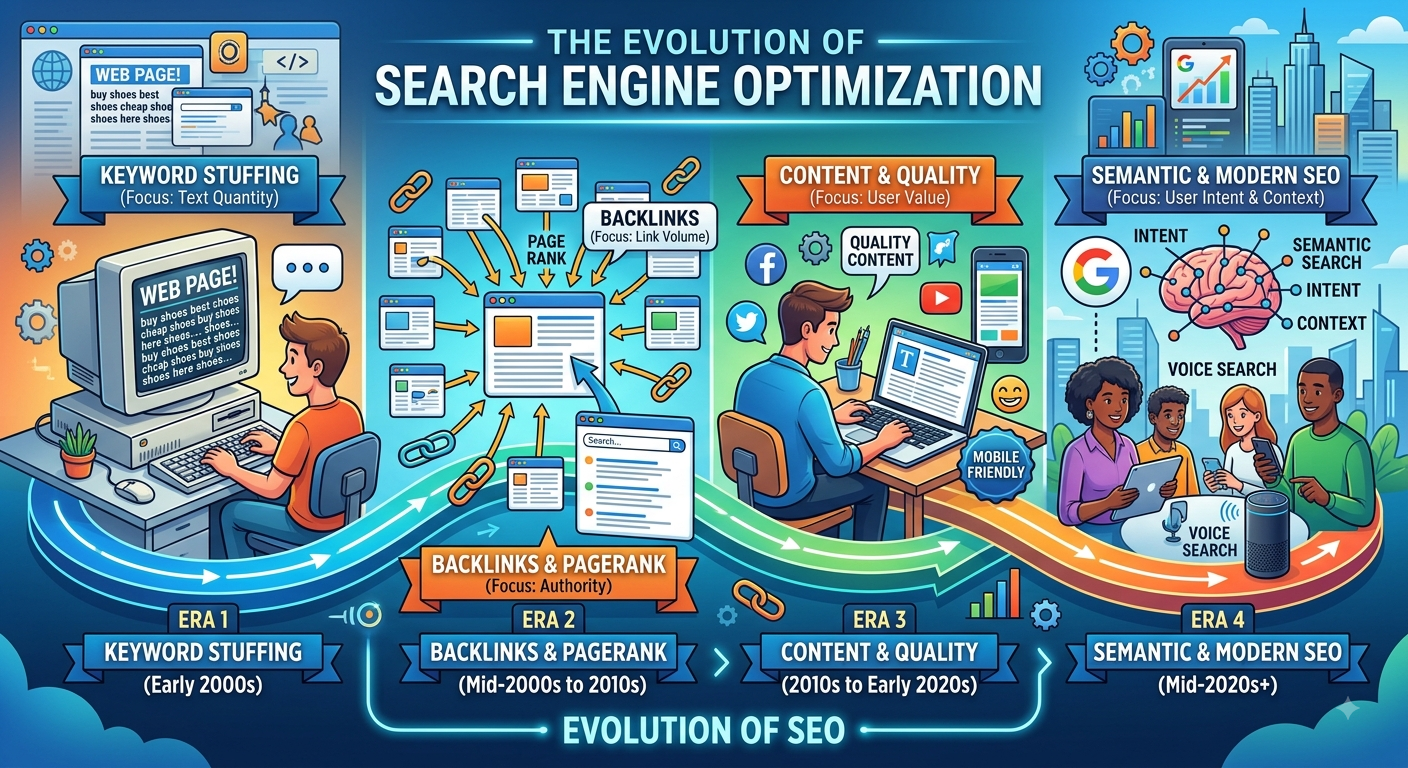
Search Engine Optimization (SEO) is the technological, analytical and strategic discipline concerned with improving the discoverability, interpretation and visibility of digital information within search systems. Although SEO is commonly associated with Google rankings, its intellectual foundations extend to the development of information retrieval, web crawling, indexing, hyperlink analysis, databases, natural-language processing and artificial intelligence.
The history of SEO therefore mirrors the history of the Web itself. Early Internet information systems relied on manually maintained directories and relatively simple indexing mechanisms. As the number of websites expanded during the 1990s, automated crawlers and search engines became essential. SEO subsequently emerged as website publishers learned to influence how search engines discovered, interpreted and ranked their pages. The appearance of Google in 1998, and particularly the importance of PageRank, transformed the relationship between hyperlinks, authority and search visibility. PageRank drew upon the idea that links could function somewhat like academic citations, providing evidence about the importance of a page.
Over subsequent decades, SEO evolved through keyword optimization, link building, technical optimization, semantic search, machine learning, mobile-first indexing, structured data, user experience and content-quality systems. Major algorithmic developments such as Panda, Penguin, Hummingbird, RankBrain and BERT progressively reduced the effectiveness of simplistic manipulation and increased the importance of relevance, context and content quality.
The emergence of generative artificial intelligence represents another major transition. Search systems increasingly synthesize information rather than merely presenting lists of links. Consequently, the future of SEO is likely to encompass not only traditional search-engine visibility but also machine-readable authority, entity recognition, structured information, factual reliability and visibility within AI-generated answers.
Keywords: Search Engine Optimization, SEO, search engines, web crawling, indexing, PageRank, Google, backlinks, keywords, semantic search, machine learning, artificial intelligence, generative AI, search algorithms, digital marketing.
Chapter 1 — Introduction
1.1 The Problem of Information Discovery
The World Wide Web created an extraordinary information problem: once billions of documents became interconnected, how could a person locate the most relevant document for a particular question?
The fundamental problem can be expressed as:
Human information need → search query → retrieval system → ranked information → human decision
Search engines became the infrastructure connecting these stages.
SEO developed on the other side of the same relationship:
Website/content → crawlability → indexing → interpretation → ranking → visibility → user interaction
Thus SEO is not merely advertising. It is partly an engineering discipline concerned with making information understandable to machines and useful to humans.
Chapter 2 — Before Modern SEO
2.1 The Origins of Web Search
The history of search predates Google.
One important early milestone was Archie, launched in 1990. It was designed to locate files available through FTP servers and demonstrated the fundamental concept of automatically collecting information and making it searchable.
As the World Wide Web expanded, other systems emerged, including:
- WebCrawler
- Lycos
- AltaVista
- Excite
- Infoseek
- Yahoo!
- Ask Jeeves
- later Google and Bing
The technological progression can be simplified:
Files → Web pages → Crawlers → Indexes → Ranking algorithms → Semantic understanding → AI answers
Chapter 3 — Birth of Search Engine Optimization
3.1 The Mid-1990s
SEO emerged as website owners discovered that search engines were becoming major gateways to online audiences.
Early optimization was comparatively simple.
Search engines examined signals such as:
- page titles
- headings
- visible text
- meta descriptions
- keywords
- URLs
- links
- page structure
Website owners consequently began modifying pages to increase search visibility.
The practice that became known as SEO emerged during the mid-to-late 1990s, before Google became dominant.
Chapter 4 — The Keyword Era
4.1 Keywords as the Language of Search
Early search systems depended heavily upon matching words in a query with words contained in documents.
A simplified model was:
Query: “computer history”
Document A: contains “computer” and “history” repeatedly.
Document B: contains related concepts but uses different terminology.
A primitive retrieval system could favour Document A because the literal words appeared frequently.
This created the first major SEO optimization principle:
Make the language of a webpage understandable to the search engine.
4.2 Keyword Stuffing
The weakness of keyword-based systems created opportunities for manipulation.
Some publishers excessively repeated keywords, sometimes using:
- hidden text
- unnatural repetition
- excessive meta keywords
- doorway pages
- automatically generated pages
This produced an important evolutionary conflict:
SEO manipulation → search-engine countermeasure → improved algorithm → new optimization technique
That cycle has continued throughout SEO history.
Chapter 5 — Google and the PageRank Revolution
5.1 The Arrival of Google
Google was founded in 1998 by Larry Page and Sergey Brin.
Its early success was strongly associated with the PageRank concept.
Instead of treating every webpage as an isolated document, PageRank examined the structure of hyperlinks connecting webpages.
A simplified conceptual representation is:
Page A → Page B → Page C
A hyperlink became more than navigation. It could also provide evidence concerning authority and importance.
PageRank was influenced by ideas from citation analysis: an academic paper cited by many important papers may be considered influential, and similarly a webpage linked by important pages could receive greater authority.
Chapter 6 — The Backlink Economy
The rise of Google transformed SEO.
Webmasters began attempting to acquire backlinks because links could contribute to search visibility.
The resulting ecosystem included:
- natural editorial links
- directories
- reciprocal links
- guest publishing
- link exchanges
- paid links
- link networks
- automated link generation
This produced another technological arms race.
The fundamental conflict
Search engine objective:
Find the most useful and relevant result.
Manipulator objective:
Produce signals that make a page appear more authoritative than it actually is.
Search-engine algorithms consequently became increasingly sophisticated.
Chapter 7 — SEO Becomes an Engineering Discipline
SEO gradually separated into several interconnected disciplines.
7.1 On-Page SEO
Concerned with the page itself:
- titles
- headings
- content
- internal links
- URLs
- images
- structured information
- accessibility
7.2 Off-Page SEO
Concerned with external signals:
- backlinks
- citations
- references
- reputation
- digital authority
7.3 Technical SEO
Concerned with how search-engine systems access and interpret websites:
- crawling
- indexing
- XML sitemaps
- robots directives
- canonical URLs
- redirects
- JavaScript rendering
- HTTPS
- site architecture
- structured data
The modern SEO system therefore resembles an engineering stack.
                 SEARCH VISIBILITY
                       │
          ┌────────────┴────────────┐
          │                         │
     CONTENT SEO                TECHNICAL SEO
          │                         │
   Relevance/Quality       Crawlability/Indexing
          │                         │
          └────────────┬────────────┘
                       │
                 SEARCH ENGINE
                       │
       ┌───────────────┼───────────────┐
       │               │               │
    Crawling        Indexing        Ranking
       │               │               │
       └───────────────┼───────────────┘
                       │
                    USER
Chapter 8 — The Algorithmic Revolution
SEO changed dramatically as search engines introduced increasingly sophisticated ranking systems.
8.1 Panda
Google’s Panda system targeted problems associated with low-quality and thin content.
The broader lesson was:
More pages ≠ more value.
8.2 Penguin
Penguin addressed manipulative link practices.
The lesson became:
More backlinks ≠ automatically more authority.
The quality, relevance and legitimacy of links became increasingly important.
8.3 Hummingbird
Hummingbird represented a major movement toward understanding the meaning and intent behind queries rather than merely matching individual words.
This was part of the broader movement from:
keyword matching → semantic understanding
8.4 RankBrain
Machine learning increasingly entered search.
Search engines could use machine-learning techniques to interpret unfamiliar, ambiguous and conversational queries.
8.5 BERT
Natural-language processing became increasingly important.
Rather than interpreting words independently, systems became better at considering relationships between words and the surrounding context.
The overall historical direction was therefore:
Strings → phrases → concepts → entities → context → intent
Chapter 9 — Mobile Search Revolution
The smartphone fundamentally changed search behaviour.
Google began its mobile-first indexing transition in 2016 and subsequently expanded it across the Web. In 2023, Google announced that the transition to mobile-first indexing had been completed.
Mobile-first indexing means that Google primarily uses the mobile version of a site’s content for indexing.
This transformed website engineering.
A modern website must therefore consider:
- responsive design
- small screens
- touch interfaces
- mobile performance
- readable typography
- efficient images
- responsive navigation
- mobile accessibility
SEO consequently became inseparable from web-development quality.
Chapter 10 — Page Experience and Core Web Vitals
Search engines increasingly incorporated user-experience considerations into their systems.
Important technical measurements have included:
- loading performance
- responsiveness
- visual stability
- mobile usability
- HTTPS
- intrusive interstitial considerations
The underlying principle is straightforward:
A search result is only useful if the user can successfully access and use the destination.
SEO therefore moved from purely textual optimization toward:
content + technology + experience
Chapter 11 — Structured Data and the Semantic Web
Traditional webpages primarily communicate with humans.
Search engines, however, need machine-readable information.
Structured data helps identify entities and relationships.
For example:
Person
 ├── Name
 ├── Occupation
 ├── Organization
 └── Location

Product
 ├── Name
 ├── Brand
 ├── Price
 ├── Availability
 └── Reviews
This represents a fundamental transformation.
The Web is increasingly interpreted not merely as a collection of pages but as a network of:
entities + attributes + relationships + evidence
Chapter 12 — The Transformation of the SERP
The traditional search-result page was often described as a list of “10 blue links.”
Modern search-result pages have become substantially more complex.
Research examining the evolution of search-result pages shows increasing incorporation of diverse elements and direct-answer formats rather than simply presenting traditional organic links.
Modern search interfaces may include:
- organic results
- advertisements
- maps
- images
- videos
- news
- shopping information
- knowledge panels
- featured snippets
- related questions
- local information
- direct answers
- increasingly AI-generated summaries
Thus SEO evolved from:
“How do I rank my webpage?”
toward:
“How does my information become visible wherever users search?”
Chapter 13 — Content Quality and Search Intent
Modern SEO increasingly revolves around understanding what the user actually wants.
A query such as:
“best computer for university”
may represent a purchasing investigation.
A query such as:
“how does a CPU work?”
represents an informational need.
A query such as:
“Microsoft official website”
represents a navigational need.
SEO therefore needs to distinguish:
- Informational intent
- Navigational intent
- Commercial investigation
- Transactional intent
The most technically optimized page can still perform poorly if it answers the wrong question.
Chapter 14 — E-E-A-T and Trust
Modern search quality increasingly emphasizes concepts associated with:
- Experience
- Expertise
- Authoritativeness
- Trustworthiness
This is particularly important for subjects involving:
- medicine
- finance
- law
- science
- safety
- government
- education
The future of SEO consequently depends less on simply producing enormous quantities of text and more on establishing credible information ecosystems.
Chapter 15 — The Rise of Generative AI
Generative AI is creating another major transition in information retrieval.
Traditional search:
Question
   ↓
Search engine
   ↓
Ranked webpages
   ↓
User reads results
Generative search:
Question
   ↓
AI retrieval system
   ↓
Multiple information sources
   ↓
Semantic processing
   ↓
Generated response
   ↓
Citations / references / links
The user may therefore receive an answer without visiting the original webpage.
This creates a new strategic problem for publishers:
How does a website remain discoverable when the search engine can answer the question itself?
Chapter 16 — SEO and Generative Engine Optimization
A new field commonly discussed as Generative Engine Optimization (GEO) seeks to understand how content can become visible within AI-generated answers.
The terminology is still evolving, and GEO should not simply be regarded as “SEO with a new name.”
Traditional SEO emphasizes:
ranking a webpage
AI-oriented optimization increasingly emphasizes:
being understood, retrieved, represented and cited by an AI system
This creates several important requirements:
- clear factual writing
- strong entity relationships
- authoritative sources
- original information
- structured content
- consistent terminology
- transparent authorship
- citations and references
- technically accessible webpages
Chapter 17 — SEO in the Age of AI-Generated Content
AI has dramatically lowered the cost of producing text.
This creates both opportunities and risks.
Positive possibilities
AI can help with:
- research organization
- keyword clustering
- content outlines
- translation
- summarization
- technical analysis
- metadata generation
- programming
- data analysis
Risks
Mass-produced low-value content can create:
- duplication
- misinformation
- factual errors
- content saturation
- declining user trust
The strategic distinction is therefore increasingly:
AI-generated quantity vs. human-verified value
The strongest future publishing model may combine:
Human expertise + AI assistance + original research + factual verification
Chapter 18 — The Technical Anatomy of Modern SEO
A modern SEO architecture can be represented as follows:
                     WEBSITE
                        │
             ┌──────────┴──────────┐
             │                     │
          CONTENT               CODE
             │                     │
       ┌─────┴─────┐        ┌──────┴──────┐
       │           │        │             │
   Relevance    Authority  HTML         JavaScript
       │           │        │             │
       └─────┬─────┘        └──────┬──────┘
             │                     │
             └──────────┬──────────┘
                        │
                     CRAWLER
                        │
                     INDEX
                        │
                  SEARCH SYSTEM
                        │
              ┌─────────┼─────────┐
              │         │         │
           Ranking    Entities   Context
              │         │         │
              └─────────┼─────────┘
                        │
                      SERP
                        │
                       USER
Chapter 19 — The SEO Technology Stack
| Layer | Main function |
|---|---|
| Domain | Digital identity |
| DNS | Domain-to-server resolution |
| Web server | Delivers website resources |
| HTML | Defines document structure |
| CSS | Defines presentation |
| JavaScript | Provides application behaviour |
| Crawler | Discovers webpages |
| Index | Stores searchable information |
| Structured data | Communicates entities and attributes |
| Ranking system | Determines result ordering |
| SERP | Presents search results |
| Analytics | Measures performance |
| AI systems | Interpret, summarize and generate answers |
SEO therefore sits at the intersection of web engineering, information retrieval, linguistics, statistics, marketing and artificial intelligence.
Chapter 20 — Historical Timeline
| Period | Major development | SEO consequence |
|---|---|---|
| 1990 | Archie | Early information retrieval |
| 1991 | World Wide Web | Rapid growth of online documents |
| 1994–1996 | Early web search engines/directories | Website discoverability becomes important |
| 1995 | AltaVista | Large-scale web indexing |
| 1997 | SEO terminology/practice emerges | Optimization becomes a recognizable discipline |
| 1998 | Link-based relevance becomes transformative | |
| 1998 onward | PageRank | Backlinks become strategically important |
| 2000s | Link-building era | SEO becomes commercialized |
| 2011 | Panda | Content quality becomes more important |
| 2012 | Penguin | Manipulative links increasingly targeted |
| 2013 | Hummingbird | Semantic understanding expands |
| 2015 | Mobile-friendly search | Mobile SEO becomes strategically important |
| 2015 | RankBrain | Machine learning enters search |
| 2016 | Mobile-first indexing begins | Mobile content becomes increasingly central |
| 2019 | BERT | Contextual language understanding improves |
| 2021 | Page-experience/Core Web Vitals era | Technical UX becomes increasingly important |
| 2022 | Helpful Content era | People-first content becomes a major theme |
| 2023 | Mobile-first indexing transition completed | Mobile becomes the primary indexing paradigm |
| 2024 onward | Generative search expansion | Search begins moving toward synthesized answers |
| 2026 | AI-search ecosystem | SEO increasingly intersects with AI visibility |
Google’s mobile-first transition is especially significant because Google formally announced its completion in October 2023.
Chapter 21 — The Evolution of the SEO Professional
The SEO professional of the 1990s could concentrate heavily on:
keywords + metadata + directories
The 2000s expanded the role toward:
keywords + links + content + analytics
The 2010s expanded it further:
content + technical SEO + mobile + semantics + UX + data
The 2020s increasingly require:
content + entities + structured data + technical architecture + AI + analytics + authority + trust
Consequently, SEO increasingly resembles a multidisciplinary technology profession.
Chapter 22 — SEO Analytics
SEO cannot be managed effectively without measurement.
Important measurements include:
- impressions
- clicks
- click-through rate
- rankings
- organic traffic
- indexed pages
- conversions
- engagement
- backlinks
- referring domains
- crawl errors
- page performance
- search visibility
A simplified performance equation is:
SEO value ≈ Visibility × Relevance × Trust × User Experience × Conversion
A high ranking with irrelevant traffic can produce little business value.
Chapter 23 — The Economics of SEO
SEO transformed the economics of digital publishing.
A successful webpage can potentially generate continuing organic traffic without paying for every individual visitor.
This creates a distinction between:
Paid acquisition
and
Organic discovery
However, SEO requires investment in:
- writers
- developers
- researchers
- designers
- analytics
- infrastructure
- digital PR
- technical maintenance
SEO is therefore better understood as a long-term information asset strategy than as a completely free marketing channel.
Chapter 24 — Ethical SEO
The history of SEO contains an important ethical dimension.
White-hat practices
Generally focus on:
- useful information
- technically accessible websites
- legitimate references
- transparent authorship
- good user experience
Manipulative practices
Historically included:
- keyword stuffing
- hidden text
- cloaking
- deceptive redirects
- link schemes
- automatically generated low-value pages
The long-term pattern of search evolution demonstrates an important principle:
The more effectively a search engine detects manipulation, the less valuable manipulation becomes.
Chapter 25 — The Future of SEO
The next generation of search is likely to combine several technologies:
                 FUTURE SEARCH
                      │
       ┌──────────────┼──────────────┐
       │              │              │
   Traditional      Semantic       Generative
     Search          Search           AI
       │              │              │
       └──────────────┼──────────────┘
                      │
                  AI RETRIEVAL
                      │
          ┌───────────┼───────────┐
          │           │           │
       Web pages    Databases    Knowledge
          │           │           │
          └───────────┼───────────┘
                      │
                 AI RESPONSE
                      │
                  USER ANSWER
Future SEO may therefore increasingly focus on:
- Entity recognition
- Semantic relationships
- Original research
- Data provenance
- Author credibility
- Structured information
- Multimedia discoverability
- Conversational search
- AI-answer visibility
- Cross-platform digital authority
Chapter 26 — SEO and the Knowledge Economy
SEO has become more important because information itself has become an economic resource.
A company possesses not only:
- buildings
- equipment
- employees
- products
- capital
but increasingly:
- websites
- datasets
- knowledge bases
- digital identities
- online reputation
- searchable information
SEO is therefore part of the infrastructure of the modern knowledge economy.
Chapter 27 — South African and African Context
SEO has particular importance for Africa because digital discovery can reduce geographic barriers.
A small South African business can potentially become discoverable beyond its immediate physical location.
SEO can support:
- small businesses
- tourism
- education
- technology companies
- agricultural enterprises
- professional services
- e-commerce
- local information
- African research publishing
For African publishers, the opportunity is particularly significant because high-quality locally generated information can fill gaps in global digital knowledge.
The long-term objective should not simply be:
“How can Africa rank higher?”
but:
“How can Africa become a major producer of authoritative digital knowledge?”
Chapter 28 — A New Conceptual Model
The historical evolution of SEO can be summarized through nine technological eras:
Era 1 — Directory Discovery
Human-curated information
Era 2 — Keyword Search
String matching
Era 3 — Link Authority
Hyperlink-based ranking
Era 4 — Quality Algorithms
Content and link quality
Era 5 — Semantic Search
Meaning and intent
Era 6 — Mobile Search
Device-aware discovery
Era 7 — Machine Learning
Algorithmic interpretation
Era 8 — Entity and Knowledge Search
Things and relationships
Era 9 — Generative AI Search
Synthesized knowledge
The historical trajectory can therefore be expressed as:
Directory → Keyword → Link → Quality → Meaning → Mobile → Machine Learning → Entity → Generative AI
Chapter 29 — Conclusion
The history of Search Engine Optimization is fundamentally the history of humanity’s attempt to organize an exponentially expanding digital information universe.
SEO began when website owners discovered that search engines could determine who was visible and who remained invisible. Early optimization relied heavily upon keywords and metadata. Google’s PageRank revolution introduced a powerful new concept: hyperlinks could provide evidence of authority. Subsequent algorithmic developments progressively reduced the effectiveness of crude manipulation and increased the importance of relevance, quality, context and user experience.
The mobile revolution then transformed the technical architecture of SEO. Google ultimately completed its mobile-first indexing transition, demonstrating that search had become fundamentally mobile-centric.
The next transformation is even more profound.
Artificial intelligence is changing search from a system that primarily retrieves documents into a system that can increasingly interpret, synthesize and communicate knowledge.
Consequently, SEO is evolving from:
Search Engine Optimization
toward a broader discipline of:
Digital Knowledge Optimization
The future belongs not simply to websites that contain the most keywords, the most pages or the most links. Increasingly, it will favour information that machines can understand, humans can trust, and intelligent systems can correctly retrieve, contextualize and attribute.
The central lesson of SEO’s history is therefore remarkably consistent:
Search technology changes continuously, but the fundamental objective remains the connection of people with useful, relevant and trustworthy information.
Selected References
- Brin, S. & Page, L. The Anatomy of a Large-Scale Hypertextual Web Search Engine.
- Franceschet, M. PageRank: Standing on the Shoulders of Giants.
- Google Search Central. Mobile-first indexing.
- Lewandowski, D. & Schultheiß, S. Public awareness and attitudes towards search engine optimization.
- Oliveira, B. & Lopes, C. From 10 Blue Links Pages to Feature-Full Search Engine Results Pages.
- Search Engine Journal. 20+ Years of SEO: A Brief History of Search Engine Optimization.
- Historical literature concerning web information retrieval, hyperlink analysis, natural-language processing and search-engine ranking.
Final Thesis Proposition
SEO has evolved from manipulating keywords to engineering discoverable knowledge.
Its first generation optimized words.
Its second generation optimized links.
Its third generation optimized content and websites.
Its fourth generation optimized meaning, entities and user experience.
Its emerging fifth generation must optimize for an information ecosystem in which search engines, knowledge graphs and generative AI systems collectively determine how humanity discovers and consumes digital knowledge.
That makes SEO one of the most important technological disciplines connecting the Web, information retrieval, artificial intelligence, commerce and human knowledge.

Be First to Comment