
A Comprehensive Scientific and Technological Thesis on Specialized AI Computing Infrastructure
Abstract
Modern artificial intelligence is not produced by algorithms alone. The capabilities of contemporary foundation models arise from the interaction of mathematics, data, neural-network architectures, semiconductor engineering, memory systems, high-speed networking, compilers, distributed computing, and enormous data-centre infrastructure.
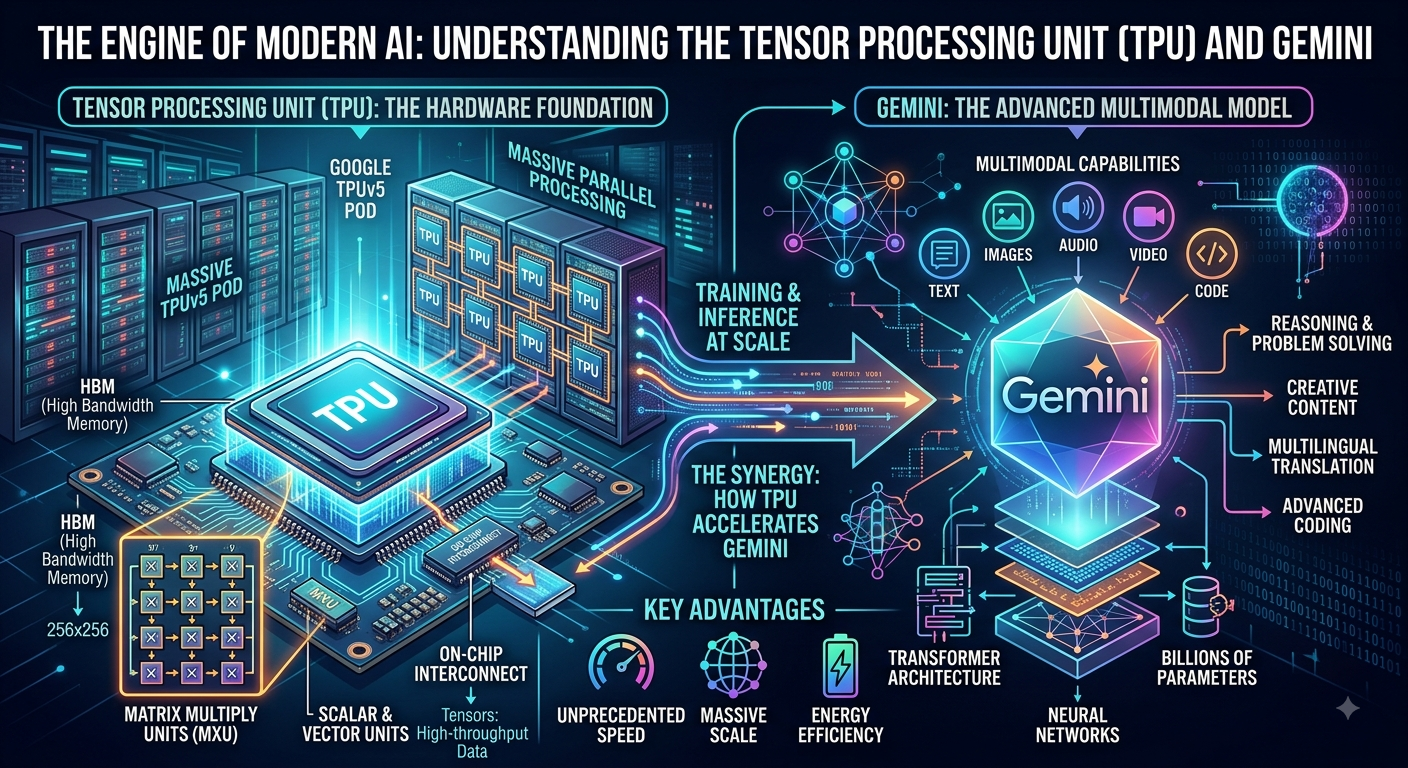
Google’s Tensor Processing Unit (TPU) is a particularly important example of this systems-engineering approach. A TPU is a custom application-specific integrated circuit (ASIC) designed specifically to accelerate machine-learning workloads. Rather than attempting to be a general-purpose processor, it dedicates a large proportion of its architecture to the tensor and matrix operations that dominate neural-network computation. (Google Cloud Documentation)
This specialization has evolved alongside Google’s AI research. Early TPU generations were designed primarily for neural-network inference; subsequent generations added increasingly powerful training capabilities, high-bandwidth memory, high-speed interconnects and large-scale distributed systems. Google’s sixth-generation TPU, Trillium (TPU v6e), is optimized for transformer, text-to-image and convolutional-neural-network workloads, while Google’s seventh-generation Ironwood (TPU7x) extends the architecture substantially, particularly for inference. (Google Cloud)
The relationship with Gemini illustrates why specialized AI infrastructure matters. Google has explicitly stated that Gemini models have been trained and served using TPUs. Google also stated that 100% of Gemini 2.0 training and inference was powered by TPUs, with Trillium forming an important part of the infrastructure. (Google Cloud)
The fundamental thesis is therefore:
Gemini is the intelligence expressed through a neural-network model; the TPU is one of the specialized computational engines that makes the training and execution of that model practical at Google’s scale.
1. Introduction: AI Is a Computing System
Artificial intelligence is often presented as software:
data → algorithm → model → answer
At industrial scale, that description is incomplete.
A modern foundation model requires a much deeper chain:
Electricity → semiconductor → transistor → digital logic → arithmetic → tensor computation → memory → interconnect → accelerator cluster → distributed training → neural-network model → inference → application
Every layer affects the others.
A more complete representation is:
[
\boxed{
\text{Energy}
\rightarrow
\text{Silicon}
\rightarrow
\text{TPU}
\rightarrow
\text{Memory}
\rightarrow
\text{Network}
\rightarrow
\text{Compiler}
\rightarrow
\text{Model}
\rightarrow
\text{Inference}
}
]
This is the technological foundation upon which large-scale generative AI is constructed.
Google describes its TPU strategy as part of an integrated AI infrastructure approach in which specialized hardware, software, networking, storage and orchestration are designed to operate together. This broader architecture is now referred to as AI Hypercomputer. (Google Cloud)
2. What Is a TPU?
TPU stands for Tensor Processing Unit.
It is a Google-designed application-specific integrated circuit, or ASIC, intended to accelerate machine-learning computations. (Google Cloud Documentation)
The key word is tensor.
A tensor is a mathematical structure that generalizes scalars, vectors and matrices.
For example:
- scalar = one number
- vector = one-dimensional array
- matrix = two-dimensional array
- tensor = potentially many-dimensional array
Neural networks manipulate enormous numbers of these structures.
A simplified neural-network operation can be expressed as:
[
Y = XW + b
]
where:
- (X) = input tensor
- (W) = model weights
- (b) = bias
- (Y) = resulting activation
The multiplication of (X) and (W) can require billions or trillions of arithmetic operations.
TPUs are designed to execute these operations efficiently.
3. Why Google Built Specialized AI Hardware
The original motivation was straightforward: AI workloads were becoming too computationally expensive for conventional processors.
Google’s historical TPU research describes the first TPU as a custom ASIC deployed in its data centres beginning in 2015. The original architecture was optimized primarily for neural-network inference. Google’s published analysis reported that, for the workloads studied, the first-generation TPU achieved substantially higher performance and performance-per-watt than contemporary CPU and GPU alternatives. (Google Research)
The underlying engineering principle was:
If a workload is sufficiently important and sufficiently repetitive, hardware can be designed around the workload itself.
Instead of asking:
“How can a general-purpose processor run AI?”
Google effectively asked:
“What processor would we design if AI were the primary workload?”
That distinction is fundamental.
4. CPU, GPU and TPU
The three architectures can be understood conceptually as follows.
| Processor | Primary design philosophy | Major strength |
|---|---|---|
| CPU | General-purpose computing | Flexibility |
| GPU | Highly parallel computing | Parallel numerical workloads |
| TPU | AI/tensor-specialized computing | Neural-network tensor operations |
A CPU must support an enormous variety of software.
A GPU is highly parallel but remains programmable for a broad range of workloads.
A TPU sacrifices some generality in exchange for specialized AI performance.
Google’s own TPU architecture documentation describes TPUs as matrix processors designed specifically for neural-network workloads. (Google Cloud Documentation)
This is a classic example of domain-specific architecture.
5. The Mathematical Core of AI
The importance of TPUs becomes clearer when we examine what a neural network actually calculates.
Consider a simple matrix multiplication:
[
C = A \times B
]
For each element:
[
C_{ij}=\sum_k A_{ik}B_{kj}
]
The computer must perform repeated:
- multiplication,
- addition,
- memory movement,
- synchronization.
A large neural network may perform these operations across enormous matrices.
This creates an unusual computational characteristic:
AI workloads contain enormous amounts of structured numerical parallelism.
Thousands or millions of individual arithmetic operations can be performed simultaneously.
That is exactly the type of workload specialized tensor hardware is designed to exploit.
6. Multiply-Accumulate Operations
One of the most important operations in neural-network computation is the multiply-accumulate, commonly abbreviated MAC.
Mathematically:
[
S = \sum_{i=1}^{n} x_iw_i
]
Each pair of values is multiplied and accumulated into a running sum.
For matrix multiplication:
[
C_{ij}
A_{i1}B_{1j}
+
A_{i2}B_{2j}
+
\cdots
+
A_{in}B_{nj}
]
A neural-network accelerator therefore benefits enormously from having many arithmetic units operating concurrently.
This is why TPU architecture places enormous emphasis on matrix multiplication.
7. The Systolic Array
One of the defining architectural ideas behind Google’s TPUs is the systolic array.
A systolic array connects many arithmetic units together so that data flows through the array in a structured manner.
Conceptually:
Input → [MAC] → [MAC] → [MAC] → [MAC]
          ↓       ↓       ↓       ↓
        [MAC] → [MAC] → [MAC] → [MAC]
          ↓       ↓       ↓       ↓
        [MAC] → [MAC] → [MAC] → [MAC]
Instead of repeatedly retrieving intermediate values from conventional memory, computation can flow through interconnected arithmetic units.
Google’s architecture documentation explains that TPUs use Matrix Multiplication Units (MXUs) based on systolic arrays. Current TPU generations use larger MXUs; for example, v6e uses 256×256 MXUs. (Google Cloud Documentation)
This design is important because moving data can be as difficult as calculating data.
8. Memory: The Other Half of AI Computing
Computational speed alone does not determine AI performance.
A processor can have enormous arithmetic capacity but remain underutilized if data cannot reach the arithmetic units quickly enough.
This creates a fundamental engineering problem:
[
\text{Performance}
\approx
f(\text{compute},\text{memory bandwidth},\text{communication})
]
Modern TPUs therefore incorporate high-bandwidth memory (HBM).
For example, Google lists TPU v6e at:
- 32 GB HBM per chip
- 1,638 GB/s HBM bandwidth per chip
- 918 BF16 TFLOPs peak compute per chip. (Google Cloud Documentation)
These specifications illustrate an important principle:
AI acceleration requires both enormous computation and enormous data movement.
9. Why Bandwidth Matters
Suppose an accelerator can calculate billions of operations per second but the required model weights arrive too slowly.
The arithmetic units wait.
This produces:
[
\text{High compute capacity}
+
\text{Low memory bandwidth}
\rightarrow
\text{underutilized accelerator}
]
Conversely:
[
\text{High compute}
+
\text{High memory bandwidth}
\rightarrow
\text{higher utilization}
]
This is why Google’s TPU generations have simultaneously increased:
- computational throughput,
- HBM capacity,
- HBM bandwidth,
- inter-chip bandwidth.
Trillium, for example, substantially increased both computation and memory capabilities relative to TPU v5e. (Google Cloud)
10. The TPU TensorCore
Modern TPUs are not simply collections of independent arithmetic units.
They are organized around TensorCores.
Google’s documentation states that each TPU chip contains one or more TensorCores depending on the generation. A TensorCore includes:
- Matrix Multiplication Units (MXUs)
- vector units
- scalar units. (Google Cloud Documentation)
The architecture can therefore be conceptually represented as:
                 TPU CHIP
                    │
              ┌─────┴─────┐
              │ TensorCore│
              ├───────────┤
              │   MXU     │
              │   MXU     │
              │ Vector    │
              │ Scalar    │
              └───────────┘
                    │
                  HBM
The MXUs perform the dominant matrix calculations.
The vector and scalar components handle other operations required by the model.
11. Numerical Precision
AI models do not necessarily require every calculation to use traditional 64-bit floating-point precision.
Machine learning frequently uses reduced-precision numerical formats to increase throughput and reduce memory requirements.
One important format is:
bfloat16 (BF16)
TPUs have been heavily optimized around reduced-precision computation while maintaining higher precision where accumulation requires it.
Google’s current architecture documentation states that TPU MXUs accept bfloat16 inputs while accumulations are performed in FP32. (Google Cloud Documentation)
This creates an important compromise:
[
\text{Lower precision}
\rightarrow
\text{less memory + higher throughput}
]
while:
[
\text{higher-precision accumulation}
\rightarrow
\text{numerical stability}
]
This is one of the central principles behind modern AI accelerator design.
12. From One TPU to a TPU Pod
A single chip cannot train the world’s largest models.
Therefore, Google connects many TPUs into a larger computational system.
A collection of interconnected TPU chips is called a TPU Pod.
The architecture becomes:
TPU
 ↓
TensorCore
 ↓
TPU chip
 ↓
TPU slice
 ↓
TPU Pod
 ↓
Multiple Pods
 ↓
Data-centre AI supercomputer
The network connecting the chips is therefore as important as the processors themselves.
13. Inter-Chip Interconnect
Google uses specialized Inter-Chip Interconnect (ICI) technology to allow TPUs to communicate rapidly.
This enables distributed computation.
Imagine a neural network whose parameters are too large for one accelerator.
The model can be divided across many accelerators:
[
Model =
Shard_1 + Shard_2 + \cdots + Shard_n
]
Each accelerator computes part of the workload.
The accelerators must then exchange information.
Consequently:
[
\text{AI scalability}
\text{compute scalability}
+
\text{memory scalability}
+
\text{communication scalability}
]
Google’s v6e architecture specifies 800 GB/s bidirectional ICI bandwidth per chip and a 256-chip Pod. (Google Cloud Documentation)
14. Trillium: TPU v6e
Trillium, also called TPU v6e, represents Google’s sixth-generation TPU architecture.
Google describes it as being optimized for:
- transformer models,
- text-to-image systems,
- convolutional neural networks,
- training,
- fine-tuning,
- serving. (Google Cloud Documentation)
Its published specifications include:
| Feature | TPU v6e |
|---|---|
| Peak BF16 compute/chip | 918 TFLOPs |
| HBM/chip | 32 GB |
| HBM bandwidth/chip | 1,638 GB/s |
| ICI bandwidth/chip | 800 GB/s |
| Chips/Pod | 256 |
| Topology | 2D torus |
These figures demonstrate how TPU development has moved from designing a chip to designing an entire computational fabric.
15. Ironwood: TPU7x
The TPU story continued beyond Trillium.
Google’s TPU7x, known as Ironwood, is the seventh-generation TPU architecture.
Google describes Ironwood as particularly focused on inference workloads. Its published specifications include:
- 2 TensorCores per chip,
- 4 SparseCores per chip,
- 2,307 BF16 TFLOPs per chip,
- 192 GiB HBM per chip,
- 7,380 GB/s HBM bandwidth per chip,
- configurations up to 9,216 chips per Pod. (Google Cloud Documentation)
Google announced Ironwood in 2025 and described its larger configuration as reaching 42.5 exaFLOPS of peak compute. (Google Cloud)
This demonstrates an important transition:
The AI infrastructure problem is no longer simply “How do we train a model?”
It increasingly includes:
How do we run enormous models economically for millions or billions of interactions?
16. Training vs Inference
AI computation has two major phases.
Training
Training creates or updates the model.
The basic cycle is:
[
Input
\rightarrow
Forward\ Pass
\rightarrow
Loss
\rightarrow
Backpropagation
\rightarrow
Gradient
\rightarrow
Weight\ Update
]
Repeated billions or trillions of times, this produces a trained model.
Inference
Inference uses the trained model.
For a language model:
[
Prompt
\rightarrow
Tokens
\rightarrow
Neural\ Network
\rightarrow
Probability\ Distribution
\rightarrow
Next\ Token
]
The process repeats until the response is generated.
Training emphasizes enormous computational throughput.
Inference adds an equally important requirement:
[
\text{low latency}
+
\text{high throughput}
+
\text{memory efficiency}
+
\text{cost efficiency}
]
TPU architectures increasingly address both.
17. What Is Gemini?
Gemini is Google’s family of advanced AI models developed by Google DeepMind.
The model layer is fundamentally different from the hardware layer.
TPU:
[
\boxed{\text{computational infrastructure}}
]
Gemini:
[
\boxed{\text{trained AI model}}
]
They are therefore complementary.
A useful analogy is:
TPU = engine
Gemini = trained intelligent system operating on that engine
But the analogy should not be taken literally: Gemini is not permanently “inside” a particular TPU. Rather, model computations are executed on accelerator infrastructure during training and serving.
18. Gemini and Multimodality
One of Gemini’s important characteristics is its ability to work across multiple information modalities.
Depending on the model and product configuration, these can include:
- text,
- images,
- audio,
- video,
- code.
This creates a much more demanding computational problem than a simple text classifier.
A multimodal model can be represented conceptually as:
[
Text + Image + Audio + Video + Code
\rightarrow
Representation
\rightarrow
Transformer computation
\rightarrow
Reasoning/generation
]
Each modality must ultimately be transformed into numerical representations that neural-network hardware can process.
19. From Human Input to TPU Computation
Consider a simplified Gemini interaction.
Stage 1 — User input
A person enters:
“Explain this photograph.”
Stage 2 — Encoding
The input is converted into machine-readable representations.
Text becomes tokens.
An image becomes numerical representations.
Stage 3 — Tensor formation
These representations become tensors.
Stage 4 — Neural-network processing
The model performs enormous numbers of operations involving:
- matrix multiplication,
- attention,
- nonlinear transformations,
- normalization,
- probability calculations.
Stage 5 — Accelerator execution
The mathematical operations are mapped onto accelerator hardware.
Stage 6 — Output generation
The model generates a sequence of output tokens or other appropriate output representations.
Conceptually:
[
Human\ Input
\rightarrow
Encoding
\rightarrow
Tensors
\rightarrow
TPU\ Computation
\rightarrow
Neural\ Network
\rightarrow
Output
]
20. The Transformer Connection
Modern generative AI owes much of its success to the Transformer architecture.
The Transformer relies heavily on matrix and tensor operations.
A simplified attention calculation is:
[
Attention(Q,K,V)
softmax
\left(
\frac{QK^T}{\sqrt{d_k}}
\right)V
]
where:
- (Q) = query matrix,
- (K) = key matrix,
- (V) = value matrix,
- (d_k) = dimensionality of the key vectors.
This calculation involves substantial matrix multiplication.
That makes the Transformer particularly compatible with specialized tensor processors.
Google has explicitly connected the development of its TPU infrastructure with the scaling of modern neural-network and Transformer-based systems. (Google Cloud)
21. The AI Compiler Layer
Hardware alone cannot efficiently execute a modern neural network.
There must be software that translates model operations into hardware operations.
One important component is XLA, Google’s compiler technology for accelerating machine-learning computations.
The conceptual stack is:
Gemini / AI Model
       ↓
JAX / Framework
       ↓
XLA Compiler
       ↓
TPU Runtime
       ↓
TPU Instructions
       ↓
TensorCore / MXU
       ↓
Silicon
This is an example of hardware-software co-design.
Google describes AI Hypercomputer as combining specialized hardware with software and frameworks such as JAX and PyTorch/XLA. (Google Cloud)
22. JAX and TPU Computing
JAX is particularly important in Google’s AI ecosystem.
It provides a programming environment for numerical and machine-learning computation and can transform high-level mathematical descriptions into optimized computations.
The programmer can describe a mathematical operation.
The compiler can then determine how that operation should be mapped onto available hardware.
This allows researchers to think more in terms of:
[
f(x)
]
rather than manually managing every individual accelerator operation.
The compiler and runtime become the bridge between:
[
\text{mathematical model}
]
and
[
\text{physical silicon}
]
23. Distributed Training
Large AI models cannot necessarily fit inside one accelerator’s memory.
Therefore, the model and its computation can be distributed.
Several forms of parallelism can be used.
Data parallelism
Different accelerators process different batches of data.
[
GPU_1 \rightarrow Batch_1
]
[
TPU_2 \rightarrow Batch_2
]
[
TPU_3 \rightarrow Batch_3
]
Model parallelism
Different accelerators contain different portions of the model.
Tensor parallelism
Individual mathematical operations are divided across accelerators.
Pipeline parallelism
Different stages of the neural network execute on different accelerator groups.
Large-scale AI systems often combine several forms.
24. Why Networking Becomes Part of the Computer
At very large scale, a TPU cluster behaves less like a collection of independent computers and more like a distributed supercomputer.
The system becomes:
[
\text{Compute}
+
\text{Memory}
+
\text{Interconnect}
+
\text{Software}
\text{AI Supercomputer}
]
Google’s Trillium infrastructure was designed to scale beyond individual Pods through multislice systems and large data-centre networking. Google reported deployments involving thousands of chips and very high scaling efficiency. (Google Cloud)
Therefore:
The network is effectively part of the AI accelerator.
If communication is slow, computation must wait.
25. AI Hypercomputer
Google’s AI Hypercomputer represents the broader infrastructure surrounding TPUs.
It integrates:
- TPU accelerators,
- GPUs,
- CPUs,
- networking,
- storage,
- compilers,
- machine-learning frameworks,
- orchestration,
- scheduling,
- data-centre infrastructure.
This is important because the fastest chip does not automatically produce the fastest AI system.
The entire pipeline must be optimized.
Google explicitly describes AI Hypercomputer as a systems-level approach combining performance-optimized hardware, software and frameworks. (Google Cloud)
26. Gemini 2.0 as an Infrastructure Example
The relationship between Gemini and TPU infrastructure is unusually explicit.
Google announced that Gemini 2.0 was trained using Trillium TPUs. (Google Cloud)
Google separately stated during the Gemini 2.0 announcement that TPUs powered 100% of Gemini 2.0 training and inference. (blog.google)
This illustrates the complete vertical stack:
Google DeepMind
      ↓
Gemini architecture
      ↓
Training algorithms
      ↓
JAX / XLA
      ↓
Trillium TPU
      ↓
TPU Pods
      ↓
AI Hypercomputer
      ↓
Google Data Centres
      ↓
Gemini inference
      ↓
Applications
The model and the infrastructure were therefore developed within a broader vertically integrated technology ecosystem.
27. Why Specialized Infrastructure Matters for Gemini
Gemini-class models create several enormous computational demands.
27.1 Model size
Large models contain enormous numbers of parameters.
27.2 Training data
The model must process huge datasets.
27.3 Training duration
Training can require sustained accelerator operation.
27.4 Memory
Parameters, activations and other intermediate states consume large amounts of memory.
27.5 Communication
Distributed accelerators must continuously exchange information.
27.6 Inference
Once deployed, the model must respond to large numbers of users.
Therefore:
[
AI\ Infrastructure
Compute
+
Memory
+
Networking
+
Storage
+
Software
+
Energy
+
Cooling
+
Scheduling
]
28. Energy Efficiency
AI computation consumes physical energy.
The fundamental relationship is:
[
Energy = Power \times Time
]
Therefore, reducing either power consumption or computation time can reduce total energy use.
Specialized hardware attempts to improve:
[
\frac{\text{AI operations}}{\text{joule}}
]
This is particularly important because AI data centres can contain enormous numbers of accelerators.
Google reported that Trillium was more than 67% more energy-efficient than TPU v5e. (Google Cloud)
The importance of energy efficiency extends beyond electricity costs.
It affects:
- data-centre design,
- cooling,
- power infrastructure,
- operating cost,
- carbon footprint,
- geographic deployment.
29. The Economics of AI Hardware
AI infrastructure represents a capital-intensive technology stack.
Costs include:
[
Total\ Cost
Silicon
+
Memory
+
Servers
+
Networking
+
Data\ Centre
+
Electricity
+
Cooling
+
Maintenance
+
Software
]
A useful metric is not merely:
[
\text{TFLOPS}
]
but:
[
\frac{\text{Useful AI work}}{\text{Total cost}}
]
This is why Google frequently discusses performance per dollar, performance per watt, throughput and scaling efficiency rather than peak arithmetic capacity alone.
30. Sparse Computation
Not every AI operation necessarily requires dense computation.
Some models contain large embedding or sparse workloads.
Google has therefore developed SparseCore, specialized hardware for sparse operations.
SparseCore is particularly relevant to workloads involving very large embeddings and recommendation systems. Google states that v6e includes two SparseCores per chip, while TPU7x has four. (Google Cloud Documentation)
This demonstrates a broader trend:
Specialized AI hardware is becoming increasingly specialized within itself.
Instead of one accelerator performing everything equally, different hardware units can be optimized for different mathematical patterns.
31. The Memory Wall
One of the major challenges facing AI systems is often described as the memory wall.
The basic problem is:
[
Compute\ Speed > Data\ Movement\ Speed
]
When this happens, processors spend time waiting for data.
Large language models intensify this problem because the system must repeatedly access:
- model weights,
- activations,
- attention data,
- key-value caches,
- intermediate tensors.
Future accelerator architectures therefore increasingly focus on bringing memory closer to computation and increasing memory bandwidth.
Google’s newer TPU designs explicitly address these memory and inference challenges. (Google Cloud)
32. The Scaling Law of AI Infrastructure
A simplified view of AI scaling is:
[
More\ Parameters
+
More\ Data
+
More\ Compute
\rightarrow
Potentially\ More\ Capable\ Models
]
But the relationship is not unlimited.
At some point:
- memory becomes a bottleneck,
- communication becomes a bottleneck,
- power becomes a bottleneck,
- training cost becomes a bottleneck,
- data quality becomes a bottleneck,
- inference cost becomes a bottleneck.
Thus, the future of AI is not merely:
“build a bigger model.”
It is:
“build a more efficient computational system.”
33. Hardware–Software Co-Design
One of the deepest lessons from Google’s TPU strategy is the importance of co-design.
Hardware is designed around AI workloads.
Software is designed around the hardware.
The compiler understands the hardware.
The networking system understands distributed training.
The model architecture is influenced by computational efficiency.
The result is:
[
\boxed{
Hardware
\leftrightarrow
Compiler
\leftrightarrow
Framework
\leftrightarrow
Model
}
]
This can produce much greater efficiency than optimizing each component independently.
34. From Transistor to Gemini
The entire system can now be represented as a technological hierarchy.
Level 1 — Physics
Electrons move through semiconductor structures.
Level 2 — Semiconductor
Transistors implement digital logic.
Level 3 — Processor
Arithmetic and control units execute operations.
Level 4 — TPU
Tensor operations are accelerated.
Level 5 — Memory
HBM supplies model data at high bandwidth.
Level 6 — Network
Thousands of accelerators communicate.
Level 7 — Compiler
Mathematical operations are translated into efficient hardware execution.
Level 8 — Neural network
The transformer performs learned mathematical transformations.
Level 9 — Gemini
The trained model produces useful multimodal AI behavior.
Level 10 — Application
People interact with the resulting AI system.
Therefore:
[
\boxed{
Physics
\rightarrow
Silicon
\rightarrow
TPU
\rightarrow
Cluster
\rightarrow
Model
\rightarrow
Intelligence
\rightarrow
Application
}
]
35. TPU Is Not the Same Thing as Gemini
This distinction is essential.
A TPU is hardware.
Gemini is software/model intelligence.
The relationship can be compared with a computer:
- CPU/GPU = computational hardware
- operating system = software infrastructure
- application = useful software
But AI is considerably more complicated because the model itself has been trained through enormous amounts of computation.
A more accurate relationship is:
[
\boxed{
TPU
\rightarrow
\text{enables computation}
}
]
while:
[
\boxed{
Gemini
\rightarrow
\text{contains learned parameters and algorithms}
}
]
The TPU does not “think.”
The model does not operate without computational hardware.
The capability emerges from the complete system.
36. TPU and GPU Are Not Mutually Exclusive
It is also important not to assume that modern AI infrastructure consists only of TPUs.
Google Cloud provides both TPU and GPU infrastructure.
Google’s AI Hypercomputer approach integrates different forms of compute depending on workload requirements. (Google Cloud)
Therefore the modern AI infrastructure landscape is better represented as:
[
CPU + GPU + TPU + Network + Storage + Software
]
rather than:
[
TPU\ versus\ GPU
]
The appropriate architecture depends on:
- model architecture,
- framework,
- workload,
- scale,
- software ecosystem,
- latency,
- cost,
- availability.
37. The Data-Centre Becomes the Computer
Traditional computing often begins with:
one processor + memory
Modern frontier AI increasingly begins with:
thousands of accelerators + high-bandwidth memory + specialized networking + distributed software
Consequently:
The data centre itself increasingly functions as the computer.
This is one of the most important technological changes produced by modern AI.
The physical boundaries of the “computer” have expanded from a chip to:
[
Chip
\rightarrow
Server
\rightarrow
Rack
\rightarrow
Pod
\rightarrow
Cluster
\rightarrow
Data\ Centre
]
38. The Future: AI Supercomputers
The direction of TPU development suggests that AI infrastructure will increasingly resemble specialized supercomputers.
The architecture will combine:
- enormous accelerator counts,
- very high-bandwidth memory,
- optical and electrical networking,
- advanced cooling,
- specialized processors,
- distributed compilers,
- intelligent scheduling,
- large-scale storage.
Google’s published TPU infrastructure already demonstrates this movement toward building-scale systems containing thousands or potentially tens of thousands of accelerators. (Google Cloud)
39. Future Challenges
The next generation of AI infrastructure will face several fundamental challenges.
39.1 Energy
AI computation requires enormous electrical resources.
39.2 Heat
Nearly all consumed electrical energy eventually becomes heat.
39.3 Memory
Model sizes and inference caches continue to increase.
39.4 Networking
Large models require enormous communication bandwidth.
39.5 Semiconductor manufacturing
Advanced AI accelerators require sophisticated semiconductor manufacturing.
39.6 Cost
Frontier AI systems require substantial capital expenditure.
39.7 Reliability
Thousands of interconnected components create opportunities for failures.
39.8 Software complexity
Distributed AI systems are extraordinarily difficult to program and optimize.
40. A Unified Scientific Model
The relationship between TPU and Gemini can be summarized mathematically.
Let:
[
D = \text{training data}
]
[
M = \text{model architecture}
]
[
W = \text{model parameters}
]
[
H = \text{hardware}
]
[
C = \text{compiler/software}
]
Then training can be represented conceptually as:
[
W_{t+1}
W_t
\eta
\nabla L(D,W_t)
]
where:
- (W_t) = current model parameters,
- (\eta) = learning rate,
- (L) = loss function,
- (\nabla L) = gradient.
The TPU provides the physical computational machinery needed to evaluate these enormous mathematical operations efficiently.
Thus:
[
\boxed{
AI\ capability
f(Data, Architecture, Training, Compute, Software)
}
]
Not:
[
AI\ capability = Model\ alone
]
41. The Complete Gemini Computational Pipeline
A simplified end-to-end model is:
                 HUMAN
                   │
                   ▼
             User Request
                   │
                   ▼
            Input Encoding
                   │
                   ▼
              Tokenization
                   │
                   ▼
          Multimodal Representations
                   │
                   ▼
             Tensor Operations
                   │
                   ▼
             Transformer
                   │
          ┌────────┴────────┐
          │                 │
          ▼                 ▼
       Attention        Feed-Forward
          │                 │
          └────────┬────────┘
                   ▼
            Neural Layers
                   │
                   ▼
          Learned Parameters
                   │
                   ▼
             TPU Compute
                   │
                   ▼
             Probability
                   │
                   ▼
            Token Selection
                   │
                   ▼
             Output Text
                   │
                   ▼
                 HUMAN
In an actual production system, the architecture is vastly more sophisticated, but this representation captures the fundamental computational relationship.
42. Why the TPU–Gemini Relationship Is Historically Important
The TPU represents a major transition in computing.
Traditional computing developed general-purpose processors first and then adapted them to emerging applications.
AI increasingly reverses that philosophy.
The workload itself influences processor design.
This produces:
[
AI\ Algorithm
\rightarrow
Hardware\ Architecture
\rightarrow
Compiler
\rightarrow
Network
\rightarrow
Data\ Centre
]
The result is a new form of application-specific computing.
43. The Broader Technological Significance
The TPU is important beyond Google.
Its development demonstrates that future computing may increasingly consist of specialized accelerators for particular mathematical workloads.
Potential domains include:
- artificial intelligence,
- scientific simulation,
- genomics,
- robotics,
- autonomous systems,
- computer vision,
- recommendation systems,
- language processing,
- climate modelling.
The broader trend is:
[
General\ Computing
\rightarrow
Heterogeneous\ Computing
\rightarrow
Domain\ Specific\ Computing
]
AI is one of the strongest forces accelerating this transition.
44. Final Synthesis
The story of modern AI cannot be understood by studying neural networks alone.
A frontier AI model such as Gemini depends on a technological ecosystem extending from fundamental semiconductor physics to global data-centre infrastructure.
At the bottom are:
electrons and transistors.
Above them are:
logic gates and arithmetic units.
Above those are:
TPU TensorCores and matrix-multiplication engines.
Above those are:
HBM and high-speed interconnects.
Above those are:
TPU Pods and distributed AI supercomputers.
Above those are:
compilers, frameworks and orchestration systems.
Above those are:
training algorithms and neural-network architectures.
And finally:
Gemini and the applications through which people interact with AI.
The complete technological chain is therefore:
[
\boxed{
\text{Physics}
\rightarrow
\text{Semiconductors}
\rightarrow
\text{Transistors}
\rightarrow
\text{TPU}
\rightarrow
\text{Memory}
\rightarrow
\text{Networking}
\rightarrow
\text{AI Hypercomputer}
\rightarrow
\text{Training}
\rightarrow
\text{Gemini}
\rightarrow
\text{Inference}
\rightarrow
\text{Human Application}
}
]
The central conclusion is that TPUs do not constitute Gemini itself, but they are a critical part of the computational infrastructure that makes large-scale Gemini training and serving possible. Google’s own disclosures provide direct evidence of this relationship: Gemini models have been trained and served using TPUs, Gemini 2.0 was trained on Trillium, and Google stated that TPUs powered 100% of Gemini 2.0 training and inference. (Google Cloud)
The deeper lesson is even more significant:
The future of artificial intelligence will be determined not only by better algorithms and larger datasets, but by the co-evolution of models, specialized silicon, memory, networking, compilers, energy systems and data-centre-scale computing.
Google’s TPU program is therefore not simply a story about a faster processor. It is an example of the transformation of the entire computer—from a chip into an integrated AI supercomputer—and of how specialized infrastructure can become a fundamental component of modern machine intelligence.
Selected primary sources
- Google Cloud — TPU Architecture
- Google Cloud — TPU v6e / Trillium specifications
- Google Cloud — TPU7x / Ironwood specifications
- Google Research — In-Datacenter Performance Analysis of a TPU
- Google Cloud — Introducing Trillium, sixth-generation TPUs
- Google Cloud — Trillium General Availability
- Google — Introducing Gemini 2.0

Be First to Comment