
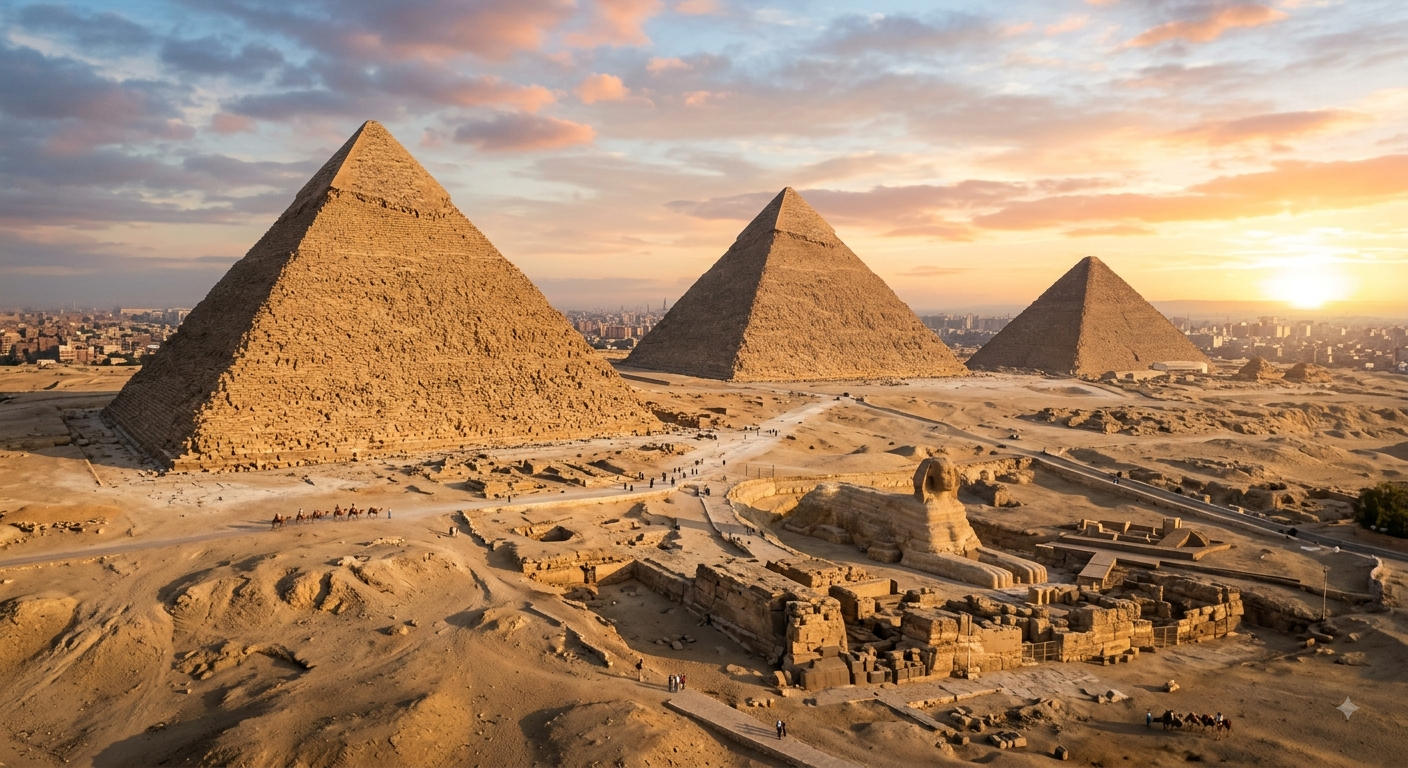
A Comprehensive Scientific, Historical, Architectural, and Engineering Thesis
Abstract
The Pyramids of Giza represent one of humanity’s greatest demonstrations of large-scale engineering before the development of modern machinery. Constructed during Egypt’s Fourth Dynasty, approximately 4,500 years ago, the Giza pyramid complex transformed enormous quantities of limestone and granite into monumental structures through the coordinated application of surveying, geometry, quarrying, transportation, stoneworking, structural design, logistics, astronomy, administration, and human labor.
The Great Pyramid of Khufu is the largest of the three principal pyramids. It originally reached approximately 146.6 metres in height and contained roughly 2.3 million stone blocks. Its construction required not merely physical labor but an integrated technological system capable of extracting, transporting, positioning, and precisely aligning enormous quantities of material.
Modern research continues to investigate precisely how the Egyptians accomplished this feat. Ramp systems remain an important construction hypothesis, while newer computational research has proposed multi-ramp and integrated ramp configurations. These remain research models rather than universally established explanations.
The pyramids therefore should not be understood simply as enormous piles of stones. They were integrated technological projects—combining architecture, civil engineering, mathematics, resource management, transportation, astronomy, religion, political authority, and social organization.
1. Introduction
The Giza Plateau in Egypt contains three principal royal pyramids:
- The Great Pyramid of Khufu
- The Pyramid of Khafre
- The Pyramid of Menkaure
Together with temples, causeways, subsidiary pyramids, tombs, settlements, and the Great Sphinx, these monuments formed an extensive royal landscape.
The pyramids were constructed within a civilization that lacked modern cranes, engines, steel machinery, computer-aided design, electricity, and modern surveying equipment.
Yet the builders achieved:
- enormous scale;
- sophisticated geometry;
- remarkable orientation;
- controlled stone extraction;
- large-scale transportation;
- complex internal architecture;
- precise stone placement;
- long-term structural stability.
The central scientific question is therefore:
How could an ancient civilization organize human knowledge and physical resources sufficiently well to construct monuments of such extraordinary scale and precision?
2. Historical Context
2.1 Ancient Egyptian Civilization
The Giza pyramids belong primarily to Egypt’s Fourth Dynasty, during the Old Kingdom.
The construction of monumental pyramids developed from earlier funerary architecture.
The architectural sequence included:
- mastabas;
- stepped pyramids;
- increasingly geometrical pyramids;
- smooth-sided pyramids;
- large royal pyramid complexes.
The Great Pyramid represents the culmination of a long technological development rather than an isolated invention.
3. The Three Great Pyramids
3.1 The Great Pyramid of Khufu
The Great Pyramid was constructed for Pharaoh Khufu.
Its original height was approximately 146.6 metres, although erosion and the loss of its outer casing reduced its present height.
It was originally covered with highly finished limestone casing stones, producing a much smoother external surface than the pyramid seen today.
The structure contains approximately 2.3 million blocks according to commonly cited estimates.
Its internal architecture includes:
- descending passage;
- subterranean chamber;
- ascending passage;
- Grand Gallery;
- King’s Chamber;
- Queen’s Chamber;
- relieving chambers;
- additional corridors and voids.
4. The Pyramid of Khafre
The Pyramid of Khafre is slightly smaller than Khufu’s pyramid but can appear taller because it stands on higher ground.
An important surviving feature is a portion of its original limestone casing near the summit.
This provides direct visual evidence of the highly finished exterior originally intended for pyramid architecture.
Khafre’s complex was also closely associated with the Great Sphinx.
5. The Pyramid of Menkaure
Menkaure’s pyramid is substantially smaller than the two larger Giza pyramids.
Its construction nevertheless demonstrates the continued application of large-scale Egyptian engineering.
Its complex includes:
- mortuary structures;
- temples;
- subsidiary pyramids;
- causeways;
- associated tombs.
The change in scale illustrates that pyramid construction was adaptable to different royal requirements.
6. Geology: Building With the Earth
One of the most important aspects of pyramid engineering was geology.
The builders did not manufacture their primary construction material.
They exploited naturally occurring stone.
Major materials included:
Limestone
Used extensively for the pyramid bodies and casing.
Granite
Used in important structural and architectural elements, particularly within Khufu’s pyramid.
Mortar
Used in construction joints and leveling.
Alabaster
Used in selected architectural and decorative contexts.
The selection and transportation of different stones required an enormous logistical network.
7. Quarrying Technology
The first engineering problem was:
How do you transform a geological formation into standardized construction blocks?
Quarry workers had to:
- identify suitable stone;
- mark extraction areas;
- separate blocks;
- shape surfaces;
- transport the blocks;
- deliver them to construction teams.
The process demonstrates that pyramid construction began long before a stone reached the pyramid itself.
The true construction chain was:
Geology → Quarry → Extraction → Shaping → Transportation → Raising → Positioning → Finishing
8. Stoneworking Technology
Ancient Egyptian craftsmen possessed sophisticated knowledge of stoneworking.
Different stones required different approaches.
Soft limestone could be worked more readily than hard granite.
Granite presented a substantially greater challenge.
The technological system incorporated:
- stone tools;
- copper tools;
- abrasive materials;
- wooden implements;
- pounding stones;
- levers;
- sledges;
- ropes.
The important point is that ancient technology did not need to resemble modern technology to be effective.
It relied on the intelligent combination of relatively simple mechanisms.
9. Transportation of Stone
Moving stone was one of the largest logistical problems.
A block could be:
quarried → placed on a sled → dragged → transported by land or water → delivered to the construction area → raised → positioned.
The Nile River was particularly important to Egyptian transportation networks.
Water transportation dramatically changed the logistics of moving heavy materials over long distances.
The engineering system therefore combined:
- waterways;
- boats;
- sledges;
- ropes;
- workers;
- temporary roads;
- ramps;
- staging areas.
10. The Physics of Sledges
One important principle is friction.
A heavy stone does not necessarily need to be lifted vertically.
It can instead be transported horizontally.
This converts a difficult lifting problem into a pulling problem.
Experiments and physical analysis have shown why prepared surfaces and controlled friction could make sled transportation more practical.
The ancient engineers therefore exploited basic mechanics:
Reduce friction → reduce required pulling force → increase transport efficiency.
11. Ramps and Vertical Transportation
The most important unresolved engineering question concerns the movement of blocks upward.
Ramps are among the leading explanations.
Possible configurations include:
- straight ramps;
- zigzag ramps;
- side ramps;
- spiral ramps;
- internal ramps;
- combinations of different systems.
Archaeological evidence demonstrates that ancient Egyptians used ramps in quarrying and construction contexts, but the precise configuration used for every stage of the Great Pyramid remains debated.
12. The Hatnub Quarry Evidence
A particularly important discovery occurred at Hatnub, an ancient alabaster quarry.
Researchers identified a ramp system dating to approximately the period of Khufu.
The system included:
- a steep central ramp;
- stairways;
- post holes;
- hauling infrastructure.
It demonstrates that Egyptian engineers possessed sophisticated methods for moving heavy stone on steep inclines.
However, it does not automatically prove that the identical system was used to construct the Great Pyramid.
The distinction between archaeological evidence and engineering hypothesis is essential.
13. New Computational Approaches
Modern researchers increasingly use computational engineering to test pyramid-building hypotheses.
A 2026 study in npj Heritage Science developed a computational framework for evaluating an integrated edge-ramp model.
The proposed system uses a multi-ramp/helical construction pathway integrated into the pyramid’s perimeter.
The research is significant because it attempts to quantify:
- construction throughput;
- geometry;
- logistics;
- structural stresses;
- construction duration.
The model remains a hypothesis requiring further archaeological testing rather than a final historical answer.
14. Surveying and Measurement
The precision of the Great Pyramid raises another question:
How did Egyptian surveyors establish such a large structure accurately?
The answer probably involved repeated measurements rather than a single measurement event.
Surveyors needed to establish:
- cardinal directions;
- horizontal levels;
- slope;
- corners;
- vertical alignment;
- construction boundaries.
Possible instruments and techniques included:
- sighting rods;
- plumb lines;
- measuring cords;
- leveling systems;
- astronomical observations;
- geometric procedures.
15. Mathematics of the Pyramid
The pyramid represents a three-dimensional mathematical system.
Its geometry incorporates:
- squares;
- triangles;
- slopes;
- proportional relationships;
- vertical axes;
- horizontal planes;
- angular measurements.
The basic pyramid can be understood geometrically as a square base with four triangular faces converging toward an apex.
This creates a structure that distributes gravitational loads toward the ground.
16. Structural Engineering
The pyramid is naturally stable because its enormous mass is concentrated over a broad foundation.
The fundamental structural principle is:
Large base + decreasing mass toward the top + symmetrical geometry = exceptional stability.
The structure places tremendous loads primarily in compression.
Stone is particularly effective under compression.
This means the pyramid’s basic geometry works with the mechanical properties of stone rather than against them.
17. Load Distribution
Every upper block contributes gravitational force to the structure below.
The pyramid’s stepped internal mass gradually transfers these forces toward the foundation.
The enormous base spreads the load across the bedrock.
This creates a highly stable structural system.
Recent research has also investigated the pyramid’s resistance to seismic forces. Measurements and structural analysis indicate that its geometry, broad foundation, symmetry, and internal architectural features contribute to its remarkable resilience.
18. The King’s Chamber
Khufu’s King’s Chamber is constructed largely from granite.
Its roof required exceptional engineering because the chamber creates a substantial internal opening within an enormous stone structure.
Above it are multiple relieving chambers.
These architectural layers help redistribute loads away from the central chamber.
This represents a sophisticated application of structural load management.
19. The Grand Gallery
The Grand Gallery is one of the most remarkable internal spaces of the Great Pyramid.
Its steeply ascending geometry demonstrates that the builders were capable of constructing:
- accurately aligned corridors;
- inclined surfaces;
- large internal spaces;
- carefully fitted stonework.
Its exact functional role remains a subject of scholarly discussion.
20. Astronomy and Orientation
The pyramids are remarkably aligned with the cardinal directions.
This raises the question of how ancient surveyors established north, south, east, and west.
Astronomical observation provides a plausible explanation.
The sky offered a natural reference system.
By observing celestial objects and their movement, Egyptian surveyors could establish directional relationships without magnetic compasses.
Thus:
Astronomy → Orientation → Geometry → Architecture
became part of the pyramid-building system.
21. The Pyramid as a Coordinate System
The pyramid can also be interpreted as a large physical coordinate system.
The builders established:
- a ground plane;
- four corners;
- central axes;
- vertical height;
- slope;
- internal corridors;
- chambers.
Each element had to relate to the others.
A small error at the foundation could potentially produce a much larger error near the summit.
Therefore surveying had to be continuous.
22. Workforce Organization
The pyramids were not constructed by isolated workers.
They required large organizational systems.
Workers could be divided into specialized groups including:
- quarry workers;
- stonecutters;
- transport teams;
- carpenters;
- rope specialists;
- surveyors;
- architects;
- engineers;
- administrators;
- food suppliers;
- boat crews;
- builders;
- craftsmen.
The pyramid was therefore also an exercise in organizational engineering.
23. The Human Machine
One of the most useful ways to understand pyramid construction is to regard the workforce itself as a technological system.
A human team could function like a machine when properly organized.
For example:
Worker force + rope + sled + ramp + lubrication + coordination = mechanical system
The Egyptians did not possess engines.
They possessed organized human energy.
This distinction is fundamental.
24. Project Management
The construction of a pyramid required long-term planning.
Managers had to coordinate:
- food;
- water;
- accommodation;
- tools;
- stone;
- transportation;
- labor;
- schedules;
- construction sequences;
- religious requirements.
The pyramid was therefore simultaneously:
an architectural project + engineering project + supply-chain project + political project + religious project.
25. The Economics of Monument Building
Monumental construction required enormous resource mobilization.
Resources included:
- stone;
- timber;
- copper;
- food;
- water;
- boats;
- ropes;
- tools;
- labor;
- administrative infrastructure.
The project therefore demonstrates the economic capacity of the Egyptian state.
26. Religion and Engineering
Engineering cannot be separated from the religious purpose of the pyramids.
The pyramid was designed as a royal funerary monument.
Its architecture expressed beliefs concerning:
- death;
- resurrection;
- kingship;
- divine order;
- the afterlife;
- celestial existence.
Engineering served cultural and religious objectives.
27. Political Power
The pyramid also represented state authority.
Only a highly organized society could mobilize the resources necessary to construct such a monument.
The pyramid therefore communicated:
Political authority → Economic capacity → Organizational power → Monumental architecture
The monument was both a tomb and a demonstration of civilization’s ability to organize matter and people on an enormous scale.
28. The Myth of “Primitive Technology”
Calling the Egyptians “primitive” is misleading.
Their technology was ancient, but it was not necessarily simple.
Technology should be judged according to what a civilization could accomplish with its available resources.
The Egyptians lacked:
- diesel engines;
- hydraulic cranes;
- steel cables;
- computers.
But they possessed:
- mathematics;
- geometry;
- surveying;
- astronomy;
- materials knowledge;
- logistics;
- mechanical principles;
- specialized craftsmanship;
- administrative organization.
Their technological system was different rather than simply inferior.
29. What Remains Unknown?
A scientifically responsible account must distinguish between established evidence and speculation.
We know substantial information about:
- the pyramids’ architecture;
- their materials;
- their approximate historical period;
- Egyptian stoneworking;
- quarrying;
- transportation;
- surveying;
- labor organization.
But important questions remain concerning:
- the exact ramp configuration;
- the precise lifting sequence;
- the organization of the upper construction stages;
- the exact number of workers at different times;
- the detailed construction schedule.
Modern computational models can test possible solutions, but a model is not automatically archaeological proof.
30. Modern Scientific Investigation
Modern researchers can investigate the pyramids using technologies unavailable to the original builders.
These include:
- laser scanning;
- photogrammetry;
- seismic measurements;
- muon tomography;
- computer simulation;
- finite-element analysis;
- satellite imaging;
- digital reconstruction.
These methods allow researchers to investigate hidden spaces and structural behavior without dismantling the monument.
The discovery of previously unknown internal spaces demonstrates the continuing scientific value of non-invasive investigation.
31. Engineering Lessons From Giza
The pyramids offer several lessons applicable to modern engineering.
Lesson 1: Geometry can create stability
A carefully designed shape can reduce structural complexity.
Lesson 2: Logistics can be as important as construction
Moving materials efficiently is fundamental to large projects.
Lesson 3: Simple machines can create powerful systems
Levers, ramps, sledges, ropes, and inclined surfaces can multiply human capability.
Lesson 4: Measurement controls large-scale construction
Precision at the foundation determines precision throughout the structure.
Lesson 5: Organization is technology
A coordinated workforce can function as a sophisticated production system.
32. The Pyramid as a Systems-Engineering Project
The Great Pyramid can be represented as an interconnected system:
Geology
↓
Quarrying
↓
Stoneworking
↓
Transportation
↓
Construction Logistics
↓
Vertical Movement
↓
Surveying
↓
Structural Engineering
↓
Architectural Integration
↓
Religious and Political Objective
This systems perspective explains why the pyramids are so important to engineering history.
33. The Information Architecture of Pyramid Construction
There was another invisible technology:
information.
Workers had to know:
- where a block belonged;
- how large it should be;
- where it should be transported;
- which team should handle it;
- what level was being constructed;
- how the structure was aligned.
This required communication and administration.
The pyramid was therefore not only a structure made of stone.
It was a structure made possible by information.
34. Ancient Engineering and Modern Engineering
Modern construction uses:
- computers;
- cranes;
- excavators;
- concrete;
- steel;
- GPS;
- drones;
- digital models.
Ancient Egyptian construction used:
- human labor;
- ropes;
- sledges;
- ramps;
- stone tools;
- astronomical observation;
- geometry;
- organizational systems.
The technological tools differed, but the fundamental engineering process remained surprisingly familiar:
Plan → Measure → Acquire Materials → Transport → Construct → Inspect → Correct → Finish
35. The Pyramids as a Human Achievement
The most extraordinary feature of Giza may not be any single tool.
It may be the combination of thousands of relatively simple technologies.
A rope alone is simple.
A sledge is simple.
A ramp is simple.
A measuring cord is simple.
A quarry is simple.
A boat is simple.
But when thousands of these components are integrated into a coordinated system, the result becomes extraordinary.
This is a fundamental principle of engineering:
Complex results can emerge from the intelligent organization of relatively simple components.
36. Conclusion
The Pyramids of Giza are among the greatest surviving demonstrations of ancient engineering.
Their importance extends far beyond their enormous size.
They represent the convergence of:
- mathematics;
- geometry;
- astronomy;
- geology;
- architecture;
- mechanics;
- materials science;
- transportation;
- logistics;
- project management;
- economics;
- political organization;
- religion;
- human cooperation.
The precise construction sequence of the Great Pyramid remains an active research question. New computational models continue to test possible ramp and transportation systems, while archaeological evidence provides constraints that competing theories must satisfy.
The greatest lesson of Giza is therefore not that ancient people possessed mysterious technology.
It is that human beings can achieve extraordinary engineering results when knowledge, mathematics, resources, organization, skilled labor, and long-term ambition are combined into a single coordinated system.
The pyramids remain standing because their builders understood a fundamental principle of engineering:
A great structure begins not with the stone, but with the system that makes the stone possible.
37. Proposed Research Questions
A deeper scientific investigation of Giza can examine:
- How accurately could ancient Egyptians measure large distances?
- What surveying techniques established the pyramid’s orientation?
- How were quarry blocks separated from bedrock?
- What tools were most effective for limestone?
- How was granite worked?
- How were stones transported by river?
- How were sledges engineered?
- What role did surface friction play?
- What ramp configurations are physically plausible?
- How were upper courses constructed?
- How were internal chambers engineered?
- Why did the pyramid remain structurally stable?
- How was the workforce organized?
- How much food and water did the project require?
- How did Egyptian administrators coordinate the supply chain?
- What astronomical methods were used?
- What was the relationship between pyramid geometry and religion?
- How did pyramid technology develop from earlier monuments?
- What can modern scanning reveal about hidden structures?
- Which construction hypotheses can be tested experimentally?
38. Final Perspective
The Giza pyramids should be studied not merely as ancient monuments but as integrated technological systems.
They demonstrate that engineering is not defined exclusively by modern machinery.
Engineering is the disciplined application of:
knowledge + measurement + materials + energy + mathematics + organization + purpose.
More than four millennia later, the pyramids continue to provide humanity with an extraordinary case study in how civilization can transform natural materials into structures of immense scale, stability, precision, and cultural meaning.





Be First to Comment