
A Comprehensive Scientific, Technological, Legal, and Engineering Thesis
Abstract
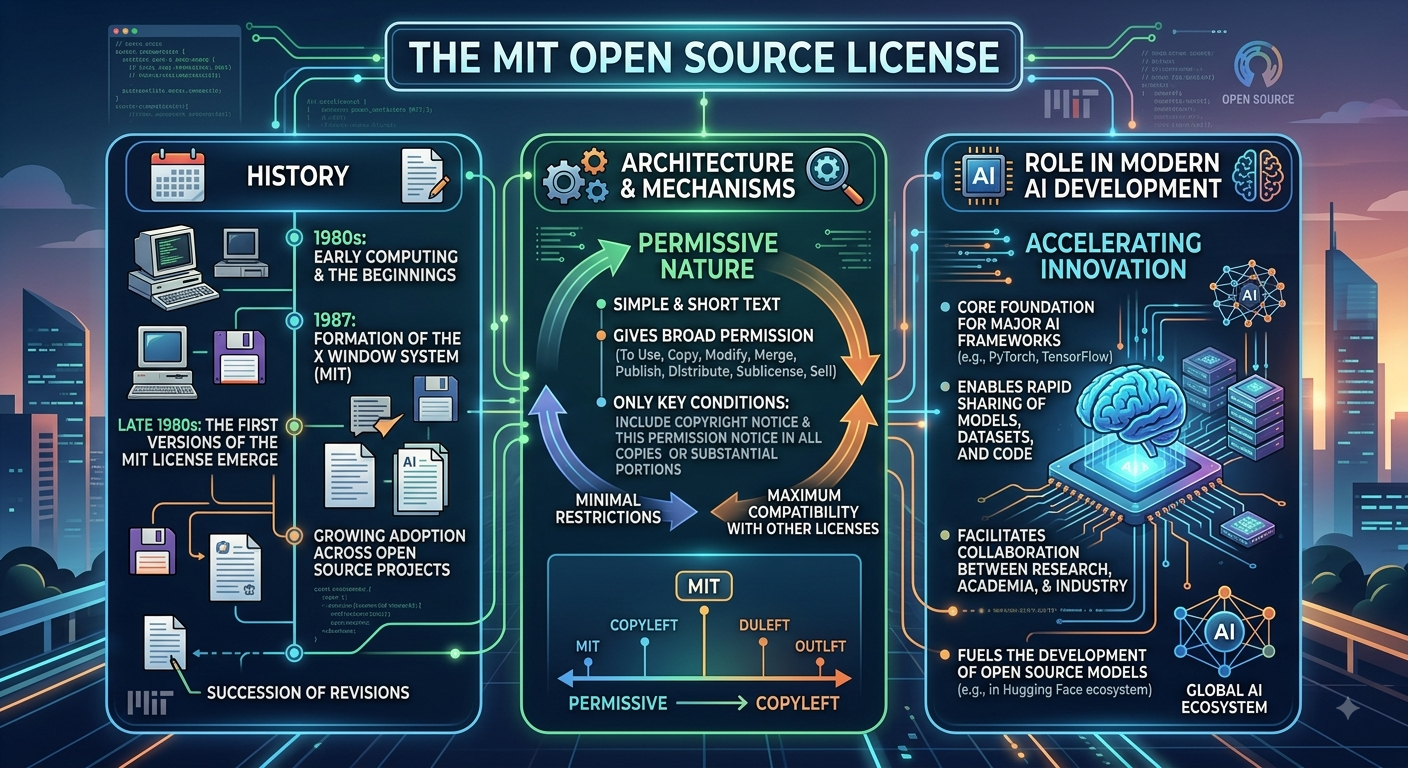
The MIT License is one of the most influential permissive open-source software licenses in modern computing. Its unusually short and flexible structure has enabled software to be reused, modified, incorporated into larger systems, redistributed, commercialized, and integrated into complex technological ecosystems.
This thesis examines the MIT License from historical, legal, architectural, software-engineering, economic, cybersecurity, artificial-intelligence, and technological perspectives. Particular attention is given to how a simple licensing framework can enable the construction of increasingly complex computational systems.
The analysis distinguishes between software code, libraries, frameworks, datasets, machine-learning models, model weights, documentation, training data, and AI services, because the legal status of one component does not automatically determine the status of the entire AI system.
The MIT License is also examined within the broader history of open-source development. The Open Source Initiative was established in 1998, during a period when collaborative software development was gaining mainstream recognition. The OSI subsequently developed and maintained the Open Source Definition and an approved-license ecosystem.
1. Introduction
Modern artificial intelligence is not created from a single technological component.
An AI system may contain:
- source code;
- operating systems;
- programming languages;
- mathematical libraries;
- machine-learning frameworks;
- data-processing tools;
- model architectures;
- trained parameters;
- datasets;
- documentation;
- APIs;
- hardware drivers;
- cloud infrastructure;
- user interfaces;
- security systems; and
- commercial services.
Open-source licensing provides one of the mechanisms through which many of these components can be shared and incorporated into larger technological systems.
Among the most important permissive licenses is the MIT License.
Its importance comes partly from its simplicity. Rather than imposing extensive reciprocal obligations on downstream developers, it grants broad permissions while requiring preservation of the copyright and permission notices and providing the software without warranty.
The result is a licensing structure that can fit naturally inside commercial software, academic research, startups, operating systems, scientific computing, developer tools, and AI applications.
2. What Is the MIT License?
The MIT License is a permissive open-source software license.
Its core permissions allow recipients to:
- use the software;
- copy the software;
- modify the software;
- publish the software;
- distribute the software;
- sublicense the software; and
- sell copies of the software.
The license requires the applicable copyright and permission notices to remain with copies or substantial portions of the software. It also contains a warranty disclaimer and limitation of liability.
This creates a relatively simple relationship:
Author → License → Developer → Modification → Redistribution → New Software
The license therefore acts as a legal interface between software creators and downstream users.
3. Historical Foundations
The MIT License belongs to a much larger historical development in software engineering.
Early computing developed within environments where researchers frequently shared algorithms, source code, mathematical methods, and technical knowledge.
As commercial software became increasingly important, copyright and licensing became central mechanisms for controlling software distribution.
Open-source development emerged partly as an alternative model emphasizing collaborative access to source code.
The modern open-source movement received major institutional recognition during the 1990s. The Open Source Initiative was founded in 1998, shortly after the release of Netscape’s source code attracted substantial attention to collaborative software development.
The OSI subsequently developed the Open Source Definition and established a formal license-review system.
4. The Open-Source Ecosystem
Open source is larger than any individual license.
A simplified hierarchy is:
Open Development Philosophy
↓
Open-Source Definition
↓
Open-Source Licenses
↓
Source Code
↓
Libraries and Frameworks
↓
Applications
↓
Platforms
↓
AI Systems
The Open Source Initiative explains that approved open-source licenses allow software to be freely used, modified, and shared, subject to the particular terms of each license.
The MIT License therefore represents one legal mechanism within a much larger technological ecosystem.
5. Architecture of the MIT License
The MIT License can be understood as a compact legal architecture.
5.1 Permission layer
The permission layer grants broad rights to recipients.
This is the foundation for:
- experimentation;
- modification;
- redistribution;
- integration;
- commercial use; and
- derivative development.
5.2 Attribution layer
The copyright and permission notices must remain with copies or substantial portions of the software.
This preserves recognition of the original rights holder.
5.3 Warranty layer
The software is provided “as is.”
This means the license does not promise that the software will be:
- accurate;
- secure;
- reliable;
- fit for a particular purpose; or
- free from defects.
5.4 Liability layer
The license limits the liability of the authors and contributors to the extent expressed in the license.
This is particularly important for software distributed globally.
6. Why Simplicity Matters
One of the MIT License’s greatest technological advantages is simplicity.
Developers can understand its principal structure without navigating an extensive set of reciprocal obligations.
This reduces friction when software is incorporated into:
- applications;
- research projects;
- commercial products;
- developer tools;
- cloud systems;
- educational projects; and
- AI applications.
The simplicity of the license does not eliminate the need for legal review. Instead, it makes the basic permissions relatively straightforward.
7. MIT License and Software Architecture
Software architecture can be visualized as layers:
Hardware
↓
Firmware
↓
Operating System
↓
Runtime
↓
Libraries
↓
Frameworks
↓
Application
↓
User Interface
The MIT License may apply to one or more software components inside this architecture.
For example:
MIT-licensed library
↓
AI framework
↓
AI application
↓
Commercial product
The downstream product may contain many other components with different licenses.
Therefore:
An MIT-licensed component does not automatically make an entire product MIT-licensed.
This distinction is fundamental to responsible software engineering.
8. MIT License and Dependencies
Modern software is rarely built entirely from scratch.
A typical application may depend upon hundreds or thousands of external packages.
The dependency structure may look like:
Application
├── Library A
│ ├── Library B
│ └── Library C
├── Framework D
│ ├── Library E
│ └── Library F
└── Utility G
Each dependency may have its own license.
Consequently, software-license management becomes a form of dependency management.
This is especially important for large AI systems.
9. The Rise of Open-Source AI
Artificial intelligence has transformed the meaning of software openness.
Traditional software openness primarily concerned source code.
AI introduces additional layers:
Code
↓
Architecture
↓
Training data
↓
Training process
↓
Model parameters
↓
Evaluation
↓
Deployment
↓
Inference
Therefore, the question:
“Is this AI open source?”
may be substantially more complicated than:
“Is this software source code available?”
The Open Source Initiative has explicitly expanded its work into the question of what constitutes Open Source AI. Its 2024 reporting described work toward the Open Source AI Definition, while its 2025 reporting identified Open Source AI as an important research and standards area.
10. MIT License and AI Code
MIT licensing can be particularly useful for AI software.
Examples include:
- inference utilities;
- preprocessing libraries;
- data pipelines;
- evaluation tools;
- visualization software;
- model-serving software;
- machine-learning utilities;
- developer tools;
- experimental research code.
A developer may therefore take MIT-licensed AI-related software, modify it, and incorporate it into a larger application, while complying with the license’s conditions.
11. Code Is Not the Same as a Model
A critical distinction in AI licensing is:
Software code ≠ trained model
A machine-learning system may contain:
Code
Instructions defining how the system operates.
Data
Information used during development or training.
Parameters
Numerical values learned during training.
Architecture
The mathematical structure of the model.
Documentation
Information describing how the system works.
Weights
Trained numerical parameters used during inference.
Different components can have different legal and licensing conditions.
Therefore, an MIT license attached to an AI project’s source code does not automatically establish that every model weight, dataset, or third-party component is governed by the same license.
12. The AI Software Stack
A modern AI system can be represented as:
Electricity
↓
Computing Hardware
↓
Accelerators
↓
Operating System
↓
Compiler
↓
Mathematical Libraries
↓
Machine-Learning Framework
↓
Training Infrastructure
↓
Model Architecture
↓
Model Weights
↓
Inference Engine
↓
API
↓
AI Application
↓
Human User
The MIT License may apply to selected software layers.
It does not automatically govern the physical hardware, electricity, human-generated data, or every component of the system.
13. MIT License and Machine-Learning Frameworks
Machine-learning frameworks are foundational infrastructure.
They provide capabilities such as:
- tensor computation;
- automatic differentiation;
- optimization;
- model construction;
- GPU acceleration;
- distributed training;
- inference;
- data processing.
Open-source frameworks can dramatically reduce the cost of entering AI research.
Developers can therefore build sophisticated systems without implementing every mathematical operation from the beginning.
This demonstrates a fundamental economic function of open-source software:
Reuse converts previous engineering work into infrastructure for future innovation.
14. MIT License and Innovation
The permissive structure of the MIT License can encourage innovation by reducing barriers to reuse.
A researcher can build upon existing software.
A startup can incorporate an existing component.
A university can modify a research tool.
A developer can create a new application.
Another developer can then build upon that application.
This produces a cumulative innovation chain:
Research
→ Open Code
→ Reuse
→ Modification
→ New Application
→ New Research
→ New Open Code
The cycle can continue indefinitely.
15. Open Source as Technological Infrastructure
Open-source software should not be understood merely as free software.
It functions as infrastructure.
Modern digital civilization depends upon enormous quantities of shared software.
Examples include:
- compilers;
- operating systems;
- databases;
- networking libraries;
- programming languages;
- cryptographic libraries;
- scientific libraries;
- AI frameworks;
- developer tools.
The MIT License is one of the mechanisms that allows portions of this infrastructure to circulate broadly.
16. Economic Architecture
The economic model of permissive open source is unusual.
A company may use open-source software while generating revenue from:
- hardware;
- cloud computing;
- consulting;
- support;
- subscriptions;
- hosting;
- customization;
- enterprise services;
- advertising;
- proprietary extensions.
Thus:
Open-source software
does not necessarily mean:
No commercial activity.
Indeed, the MIT License expressly permits commercial use and selling of copies, subject to its conditions.
17. MIT License and Startups
For technology startups, permissively licensed software can reduce development time.
Instead of creating:
- database libraries;
- authentication systems;
- numerical libraries;
- AI utilities;
- developer tooling;
from zero, teams can integrate existing components.
This can allow scarce engineering resources to focus on differentiated products.
The economic effect can be described as:
Shared infrastructure → lower development cost → faster experimentation → faster product development
18. MIT License and Research
Open-source licensing is particularly valuable in scientific computing.
Researchers can:
- reproduce experiments;
- inspect algorithms;
- modify implementations;
- test alternative approaches;
- compare results;
- collaborate internationally.
This supports computational reproducibility.
However, reproducibility also requires attention to:
- datasets;
- software versions;
- hardware;
- random seeds;
- model parameters;
- configuration;
- documentation.
A license alone does not guarantee scientific reproducibility.
19. Cybersecurity Considerations
Open source introduces an important security paradox.
Source availability allows researchers to inspect software.
This can improve:
- auditing;
- vulnerability discovery;
- peer review;
- security research;
- transparency.
But publicly available code can also make weaknesses easier to discover.
Therefore:
Open source ≠ automatically secure.
Security depends on:
- code quality;
- maintenance;
- dependency management;
- vulnerability response;
- testing;
- secure development practices;
- responsible disclosure;
- deployment configuration.
20. Software Supply Chains
Modern AI applications inherit the security properties of their dependencies.
Consider:
AI Application
↓
AI Framework
↓
Numerical Library
↓
System Library
↓
Operating System
Each layer may contain dependencies.
Therefore, software supply-chain security becomes essential.
Organizations should maintain:
- software bills of materials;
- dependency inventories;
- license inventories;
- vulnerability scanning;
- version control;
- provenance records;
- update procedures.
21. License Compliance
A responsible organization should know:
- what software it uses;
- who created it;
- which license applies;
- which version is being used;
- what modifications were made;
- what notices must be preserved;
- what other dependencies exist.
This can be represented as:
Inventory → Identify → Classify → Review → Comply → Document → Monitor
Large organizations increasingly automate portions of this process.
OSI reported that it launched a public API in 2025 for its approved-license information, aimed in part at making license data easier to integrate into developer and compliance tooling.
22. MIT License Compared With Copyleft
Open-source licenses can follow different philosophical and legal models.
Permissive model
Examples include:
- MIT;
- BSD-style licenses;
- Apache License 2.0.
The emphasis is generally on broad downstream freedom.
Copyleft model
Examples include:
- GPL;
- LGPL;
- AGPL.
These licenses impose additional requirements concerning redistribution and derivative works.
The distinction can be summarized:
Permissive
“You may build upon this software broadly, subject to these conditions.”
Copyleft
“You may build upon this software, but specified freedoms and licensing obligations must continue under defined circumstances.”
Neither model is universally superior. The appropriate choice depends on the objectives of the project.
23. MIT License Compared With Apache 2.0
MIT and Apache 2.0 are both permissive licenses, but they are not identical.
Apache 2.0 contains more detailed provisions, including an express patent-license framework.
The MIT License is considerably shorter.
This creates a useful conceptual comparison:
| Characteristic | MIT | Apache 2.0 |
|---|---|---|
| General model | Permissive | Permissive |
| Use | Allowed | Allowed |
| Modification | Allowed | Allowed |
| Redistribution | Allowed | Allowed |
| Commercial use | Allowed | Allowed |
| Patent provisions | Less explicit | More explicit |
| Textual complexity | Low | Higher |
For projects involving substantial patent considerations, legal review may be especially important.
24. MIT-0 and the MIT License
The MIT No Attribution License, commonly identified as MIT-0, is distinct from the conventional MIT License.
MIT-0 removes the attribution requirement found in the standard MIT License while retaining broad permissions and the warranty/liability language. OSI lists MIT-0 separately with the SPDX identifier MIT-0.
This illustrates an important principle:
Similar names do not necessarily mean identical licenses.
Developers should identify the exact license rather than relying only on informal terminology.
25. MIT License and Global Software
Software crosses national boundaries almost instantly.
An open-source project can have:
- an American developer;
- a European contributor;
- an African user;
- an Asian company;
- an Australian research institution.
The license becomes a common legal framework connecting participants across jurisdictions.
However, international software distribution can involve additional legal issues, including:
- copyright law;
- patent law;
- export regulations;
- privacy law;
- data protection;
- contractual obligations;
- product liability.
Therefore, an open-source license is not a complete substitute for legal compliance.
26. Open Source and Artificial Intelligence Governance
AI creates new questions that traditional software licensing does not completely answer.
For example:
- Is access to source code sufficient?
- Must training information be available?
- Should model weights be available?
- What information about training must be disclosed?
- How should datasets be licensed?
- How should AI-generated material be treated?
- How should safety restrictions interact with openness?
- How should model modifications be documented?
These questions have contributed to the development of dedicated discussions around Open Source AI.
27. The Anatomy of an Open AI System
A more complete AI architecture can be represented as:
1. Hardware
↓
2. Firmware
↓
3. Operating system
↓
4. Compiler
↓
5. Mathematical libraries
↓
6. AI framework
↓
7. Data pipeline
↓
8. Training algorithm
↓
9. Model architecture
↓
10. Training data
↓
11. Model parameters
↓
12. Evaluation
↓
13. Inference
↓
14. Application
↓
15. User
A license may govern one layer without governing every other layer.
This is one of the most important conceptual lessons when discussing “open-source AI.”
28. The MIT License as a Digital Building Block
The MIT License can therefore be understood metaphorically as a digital building block.
A developer receives a component.
They may:
Use → Study → Modify → Combine → Redistribute → Commercialize
The component becomes part of a larger technological structure.
That structure can itself become a building block for another system.
Thus modern software resembles a technological ecosystem rather than a collection of isolated programs.
29. Dependency Graphs and AI
Modern AI systems can contain enormous dependency graphs.
A simplified example is:
AI Product
├── User Interface
├── API
├── Model Server
├── AI Framework
├── Numerical Libraries
├── Data Processing
├── Database
├── Operating System
└── Cloud Infrastructure
Each component can introduce:
- functionality;
- licensing obligations;
- security dependencies;
- maintenance requirements;
- compatibility considerations.
Consequently, license analysis is increasingly becoming part of software architecture.
30. Open Source and the Future of AI
The future of AI is likely to involve several parallel models:
Closed AI
Code, models, infrastructure, or data remain proprietary.
Open software AI
AI application and infrastructure code are openly available.
Open-weight AI
Model parameters are released under specified terms.
Open-source AI
Broader elements satisfy an applicable definition of open-source AI.
Hybrid AI
Some components are open while others remain proprietary.
The distinction between these categories is increasingly important.
31. The Growing Importance of Precise Terminology
Technology discussions frequently use “open,” “open source,” “open weights,” “free,” and “publicly available” as though they were synonymous.
They are not.
A project can be:
- publicly downloadable;
- source-available;
- open-weight;
- open-source software;
- open-source AI;
- commercially usable;
without all of these characteristics being identical.
Precise terminology is essential for scientific and legal analysis.
32. Open Source as a Civilization-Scale Collaboration Model
The significance of open source extends beyond programming.
It demonstrates a broader model of human collaboration:
Individual contribution
↓
Shared infrastructure
↓
Collective improvement
↓
Reuse
↓
New innovation
↓
Further contribution
This resembles other cumulative knowledge systems such as:
- mathematics;
- scientific literature;
- engineering standards;
- academic research;
- language;
- encyclopedic knowledge.
Open-source software therefore represents an important experiment in large-scale collaborative technological production.
33. Limitations of the MIT License
The MIT License is powerful, but it does not solve every problem.
It does not automatically provide:
- cybersecurity;
- technical support;
- documentation;
- quality assurance;
- maintenance;
- data rights;
- model governance;
- privacy compliance;
- regulatory compliance;
- guaranteed performance.
The license establishes permissions and disclaimers.
Engineering responsibility remains with the users and developers of the software.
34. Responsible Use in AI Development
Organizations using MIT-licensed AI software should establish a governance process.
Recommended architecture
Source discovery
↓
License identification
↓
Dependency inventory
↓
Security assessment
↓
Legal review
↓
Integration
↓
Testing
↓
Documentation
↓
Deployment
↓
Continuous monitoring
This converts open-source adoption from an informal activity into an engineering governance process.
35. The MIT License and the AI Economy
The AI economy requires enormous amounts of software infrastructure.
Open-source licensing can lower barriers to entry by allowing researchers and developers to reuse existing technology.
This can contribute to:
- faster innovation;
- startup formation;
- academic research;
- educational access;
- developer productivity;
- international collaboration;
- technological diffusion.
The MIT License is one small but significant component of this broader economic mechanism.
36. The 2026 Perspective
The open-source ecosystem continues to evolve.
OSI reported that MIT was its most-viewed license in 2025, with more than 1.5 million pageviews, substantially ahead of the other licenses in its reported ranking.
In March 2026, OSI also announced adoption of SPDX identifiers in its license URLs to improve consistency and stability in license identification.
At the same time, AI is forcing the software community to examine whether traditional software licensing concepts adequately describe models, weights, datasets, training procedures, and AI systems.
37. Scientific Interpretation
From a systems perspective, the MIT License can be viewed as a mechanism for increasing the reusability of computational knowledge.
Software is encoded knowledge.
A program contains:
- algorithms;
- mathematical relationships;
- engineering decisions;
- data structures;
- computational procedures.
When software is openly licensed, portions of this encoded knowledge can be reused by other engineers.
Therefore:
Open-source licensing → reusable computational knowledge → cumulative engineering capability
This is one reason open-source software has become foundational to modern computing.
38. Technological Interpretation
From a technological perspective, the MIT License reduces friction between independent software components.
It facilitates:
Component A + Component B + Component C → New System
This modularity is fundamental to modern software engineering.
AI intensifies the importance of modularity because AI systems increasingly combine:
- data;
- algorithms;
- models;
- infrastructure;
- APIs;
- interfaces;
- accelerators.
39. Legal Interpretation
From a legal perspective, the MIT License is a permission mechanism combined with conditions, disclaimers, and limitations.
Its simplicity should not be mistaken for the absence of legal significance.
A developer should still determine:
- what exactly is licensed;
- who owns the copyright;
- whether dependencies have compatible licenses;
- whether separate datasets or models have additional restrictions;
- whether patents or trademarks create separate considerations;
- whether applicable laws impose additional obligations.
40. Engineering Interpretation
For engineers, licensing should become part of the software-development lifecycle.
A mature organization can integrate license management into:
Planning → Coding → Testing → Build → Release → Monitoring
This allows license compliance to become an automated engineering property rather than a last-minute administrative task.
41. Educational Interpretation
Teaching the MIT License provides students with an opportunity to understand that software is simultaneously:
- mathematics;
- engineering;
- information;
- intellectual property;
- infrastructure;
- economic capital.
Understanding open-source licensing therefore belongs not only to lawyers but also to:
- programmers;
- engineers;
- researchers;
- entrepreneurs;
- universities;
- technology managers;
- AI developers.
42. A Complete MIT-to-AI Architecture
The relationship can be summarized as:
MIT License
↓
Reusable Software
↓
Libraries
↓
Frameworks
↓
AI Infrastructure
↓
Machine-Learning Systems
↓
AI Applications
↓
Commercial and Scientific Products
↓
Digital Economy
This represents the technological propagation of an open software component through increasingly complex systems.
43. Major Lessons
The most important lessons are:
- The MIT License is a permissive open-source software license.
- Its simplicity is one of its major strengths.
- It permits broad reuse under specified conditions.
- It does not automatically govern every component of a larger system.
- AI introduces licensing questions beyond traditional source code.
- Model weights, datasets, code, and documentation can have different legal statuses.
- Open source does not automatically mean secure.
- Open source does not automatically mean free of all obligations.
- License management is increasingly part of software engineering.
- The MIT License has become deeply embedded in the modern software ecosystem.
- AI development makes precise definitions of “open” increasingly important.
- Open-source software functions as shared technological infrastructure.
44. Conclusion
The MIT Open Source License represents one of the clearest examples of how a relatively compact legal instrument can have consequences far beyond the text of the license itself.
Its broad permissions enable software to move through technological ecosystems, from individual developers to libraries, frameworks, research systems, commercial applications, and increasingly sophisticated AI platforms.
Its importance is therefore not merely legal.
It is simultaneously:
a licensing mechanism,
a software-development tool,
an innovation mechanism,
an economic infrastructure layer,
a research enabler,
and a component of modern digital civilization.
The emergence of AI makes this subject even more important. Modern AI is a layered system containing code, data, models, parameters, infrastructure, hardware, and services. A license governing one layer cannot automatically determine the legal status of all the others.
The central principle is therefore:
Open-source AI must be analyzed layer by layer.
The MIT License occupies an important position within that architecture because it provides a highly permissive mechanism for sharing and reusing software. The continuing growth of open-source development, combined with the rapid evolution of AI, means that licensing will remain an important part of the technical, economic, legal, and scientific architecture of computing.
Ultimately, the MIT License illustrates a profound principle of technological development:
When reusable knowledge becomes shared infrastructure, one generation of engineers can build upon the work of another, accelerating the creation of increasingly complex technological systems.


Be First to Comment