
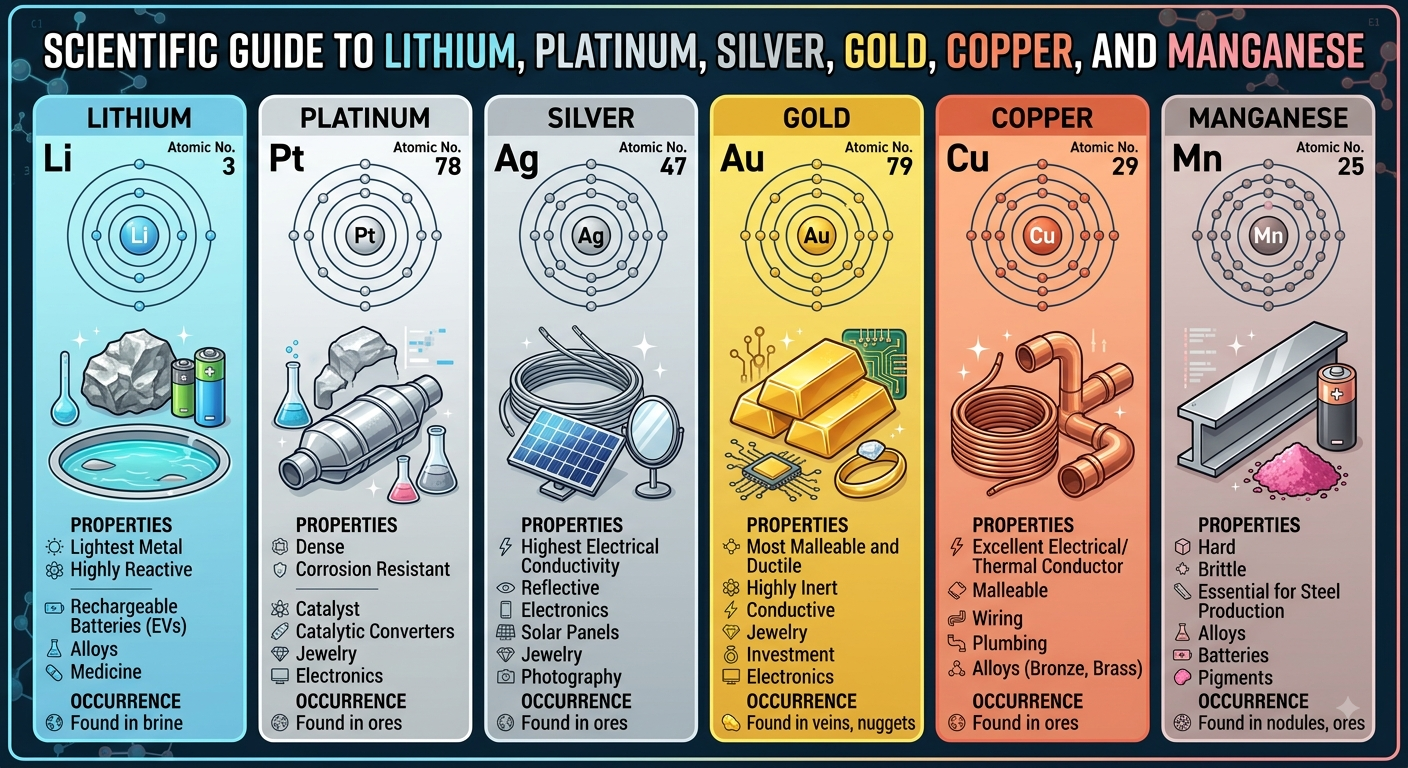
A Comprehensive Scientific Guide to Lithium, Platinum, Silver, Gold, Copper, and Manganese
Abstract
Lithium, platinum, silver, gold, copper, and manganese are chemically distinct metallic elements that occupy important positions within Earth’s geological systems and modern industrial civilization. Their importance extends from fundamental chemistry and mineralogy to energy storage, electrical infrastructure, electronics, transportation, metallurgy, catalysis, medicine, communications, investment, and national resource security.
This thesis examines these six elements from the atomic scale to the global industrial scale. It distinguishes an element, a mineral, an ore, a mineral deposit, a concentrate, and a refined metal, while explaining how geological processes concentrate otherwise dispersed elements into economically useful deposits.
Lithium is particularly important in rechargeable batteries; manganese is fundamental to steelmaking and has important battery applications; copper is indispensable to electrical infrastructure; platinum has major catalytic and industrial applications; silver combines electrical, optical, chemical, and monetary uses; and gold possesses exceptional chemical stability together with important electrical, technological, and financial applications. Lithium and manganese are included on the U.S. Geological Survey’s 2025 critical-minerals list, while platinum is also identified because of its importance to industrial supply chains.
PART I — THE SCIENCE OF CHEMICAL MINERALS
1. Introduction to Minerals and Elements
A mineral is a naturally occurring inorganic solid with an ordered atomic structure and characteristic chemical composition, although natural mineral systems can contain compositional variation.
An element is a fundamental chemical substance defined by its number of protons.
The distinction is essential:
- Lithium is an element.
- Copper is an element.
- Gold is an element.
- Manganese is an element.
- Platinum is an element.
- Silver is an element.
- Spodumene is a lithium-bearing mineral.
- Chalcopyrite is a major copper-bearing mineral.
- Manganese oxides can constitute important manganese ores.
- Native gold and native silver occur as elemental minerals.
Therefore, mining generally does not begin with a block of pure metal. It begins with geological material containing minerals in which the desired element is concentrated.
2. The Atomic Foundation
The six elements have different atomic numbers and electronic structures.
| Element | Symbol | Atomic number | Major characteristic |
|---|---|---|---|
| Lithium | Li | 3 | Extremely light alkali metal |
| Manganese | Mn | 25 | Transition metal with multiple oxidation states |
| Copper | Cu | 29 | Highly conductive transition metal |
| Silver | Ag | 47 | Extremely conductive noble metal |
| Platinum | Pt | 78 | Noble transition metal and catalyst |
| Gold | Au | 79 | Highly stable noble metal |
Atomic structure determines chemical behavior.
The number of protons identifies the element, while the arrangement of electrons determines many of its chemical, electrical, optical, magnetic, and bonding properties.
PART II — LITHIUM
3. Lithium: The Lightweight Energy Metal
Lithium is the lightest metal and has atomic number 3.
Its low atomic mass and electrochemical characteristics make it particularly valuable in rechargeable energy-storage systems.
Lithium resources occur in several geological settings, including:
- granitic pegmatites;
- continental brines;
- clay deposits;
- geothermal fluids;
- oilfield brines;
- lithium-bearing silicate minerals.
USGS identifies spodumene as an important lithium ore mineral and describes lithium production from both brines and granitic pegmatites.
3.1 Important Lithium Minerals
Important lithium-bearing minerals include:
- spodumene;
- lepidolite;
- petalite;
- amblygonite.
3.2 Lithium and Batteries
Lithium-ion batteries depend upon reversible movement of lithium ions between electrode materials.
The general system contains:
- cathode;
- anode;
- electrolyte;
- separator;
- current collectors;
- casing and control electronics.
Lithium therefore connects geology directly with modern computing, telecommunications, electric mobility, and energy storage.
3.3 Lithium’s Broader Applications
Lithium compounds are also used in:
- glass;
- ceramics;
- metallurgy;
- polymers;
- air-treatment systems;
- specialized industrial chemistry.
USGS identifies batteries, ceramics, glass, metallurgy, pharmaceuticals, polymers, and air treatment among lithium applications.
PART III — PLATINUM
4. Platinum: The Catalyst Metal
Platinum (Pt), atomic number 78, belongs to the platinum-group elements.
It possesses:
- high chemical stability;
- excellent catalytic properties;
- high-temperature resistance;
- corrosion resistance;
- useful electrical characteristics.
Platinum is particularly important as a catalyst.
4.1 Geological Occurrence
Platinum commonly occurs with other platinum-group elements and is frequently associated with large mafic or ultramafic geological systems.
Its extraction can therefore involve complex mineral processing because several valuable elements may occur together.
4.2 Industrial Applications
Platinum is used in:
- catalytic systems;
- chemical processing;
- petroleum refining;
- electronics;
- laboratory equipment;
- high-performance alloys;
- specialized medical and technological applications.
The USGS’s 2025 critical-minerals information identifies platinum applications including catalytic converters, aerospace alloys, chemical refining, and petroleum processing.
4.3 Platinum and South Africa
South Africa is particularly important to the global platinum-group-metals industry because of its major geological resources and long-established mining sector.
This makes platinum an important example of the relationship between:
geology → mining → refining → manufacturing → international trade.
PART IV — SILVER
5. Silver: The Conductive Precious Metal
Silver (Ag), atomic number 47, is both a precious metal and an important industrial material.
It has exceptionally high electrical and thermal conductivity.
5.1 Properties
Silver possesses:
- high electrical conductivity;
- high thermal conductivity;
- strong reflectivity;
- malleability;
- ductility;
- useful chemical properties.
5.2 Geological Occurrence
Silver can occur:
- as native silver;
- in silver-bearing sulfide minerals;
- with lead and zinc deposits;
- with copper deposits;
- with gold;
- in polymetallic hydrothermal systems.
Silver production is therefore often connected to mining operations primarily targeting other metals.
5.3 Applications
Silver has applications in:
- electronics;
- electrical contacts;
- solar technologies;
- mirrors and optical applications;
- specialized chemical processes;
- jewelry;
- investment and monetary systems.
Silver demonstrates an important principle in mineral economics: a metal can be simultaneously a precious metal and an industrial metal.
PART V — GOLD
6. Gold: The Chemically Stable Precious Metal
Gold (Au), atomic number 79, is one of the best-known chemical elements.
It is characterized by:
- high resistance to corrosion;
- exceptional chemical stability;
- malleability;
- ductility;
- electrical conductivity;
- distinctive optical properties.
6.1 Geological Formation
Gold can occur in:
- quartz veins;
- hydrothermal systems;
- disseminated deposits;
- ancient geological formations;
- alluvial deposits.
Gold may be deposited through geological fluids that transport dissolved elements and subsequently precipitate minerals when temperature, pressure, chemistry, or oxidation conditions change.
6.2 Gold and Technology
Although traditionally associated with jewelry and monetary systems, gold also has technological uses.
Its resistance to corrosion and useful electrical properties make it valuable for specialized electrical and electronic connections.
6.3 Gold as a Resource
Gold illustrates the difference between:
geological occurrence → mineral resource → economically recoverable resource → mined production → refined metal.
Not every geological occurrence is economically mineable.
PART VI — COPPER
7. Copper: The Metal of Electrification
Copper (Cu), atomic number 29, is one of civilization’s most important industrial metals.
Its combination of:
- electrical conductivity;
- thermal conductivity;
- ductility;
- malleability;
- corrosion resistance;
- alloy-forming capability
makes it fundamental to modern infrastructure.
7.1 Copper Minerals
Important copper-bearing minerals include:
- chalcopyrite;
- bornite;
- chalcocite;
- covellite;
- malachite;
- azurite.
7.2 Copper and Electricity
Copper is used extensively in:
- power cables;
- transformers;
- motors;
- generators;
- electrical equipment;
- telecommunications;
- electronics;
- renewable-energy infrastructure.
7.3 Copper and the Digital Economy
Every layer of modern digital infrastructure requires physical materials.
Copper participates in:
power generation → transmission → distribution → data centers → telecommunications → computing → consumer electronics.
Consequently, copper is not simply a traditional industrial commodity. It is a fundamental material of the digital and electrified economy.
PART VII — MANGANESE
8. Manganese: The Steel and Battery Element
Manganese (Mn), atomic number 25, is a transition metal capable of forming compounds in several oxidation states.
Its most important historical industrial role has been associated with metallurgy.
8.1 Manganese and Steel
Manganese contributes to steelmaking by helping control sulfur and improving important mechanical characteristics of steel.
This makes manganese essential to:
- construction steel;
- infrastructure;
- transportation equipment;
- machinery;
- industrial manufacturing.
8.2 Manganese and Batteries
Manganese is also used in several battery chemistries.
Its ability to participate in different oxidation states makes manganese compounds useful in electrochemical systems.
USGS identifies manganese as a critical mineral and notes its importance in steel production and batteries.
PART VIII — COMPARATIVE CHEMISTRY
9. Comparing the Six Elements
| Property | Lithium | Platinum | Silver | Gold | Copper | Manganese |
|---|---|---|---|---|---|---|
| Symbol | Li | Pt | Ag | Au | Cu | Mn |
| Atomic number | 3 | 78 | 47 | 79 | 29 | 25 |
| Major classification | Alkali metal | Transition metal | Transition metal | Transition metal | Transition metal | Transition metal |
| Major industrial role | Batteries | Catalysis | Electronics | Specialized technology/precious metal | Electricity | Steel/batteries |
| Major geological challenge | Concentration and processing | Complex PGM ores | Often polymetallic | Grade and recovery | Large-scale ore processing | Ore beneficiation |
| Recycling importance | Increasing | Very high | High | Very high | Very high | Increasing |
PART IX — FROM GEOLOGY TO METAL
10. The Mineral Supply Chain
A modern mineral supply chain can be represented as:
Earth’s crust
↓
Geological exploration
↓
Mineral deposit
↓
Resource evaluation
↓
Mine development
↓
Extraction
↓
Crushing and grinding
↓
Mineral separation
↓
Concentrate
↓
Metallurgical processing
↓
Refined metal
↓
Manufacturing
↓
Finished products
↓
Use
↓
Recycling
This chain demonstrates that mining is only one component of the mineral economy.
11. Geological Exploration
Exploration attempts to identify geological structures and chemical signatures associated with economically valuable mineralization.
Methods can include:
- geological mapping;
- geochemical sampling;
- geophysical surveys;
- remote sensing;
- drilling;
- laboratory analysis;
- three-dimensional geological modelling.
The objective is to transform geological uncertainty into increasingly reliable information.
12. Mineral Processing
After extraction, mined material usually contains a mixture of valuable minerals and waste rock.
Processing can involve:
- crushing;
- grinding;
- screening;
- gravity separation;
- magnetic separation;
- flotation;
- leaching;
- filtration;
- concentration.
The precise process depends on the mineralogy of the deposit.
13. Metallurgy
Metallurgy converts mineral concentrates or ores into useful metals or chemical compounds.
Three broad approaches are particularly important:
Pyrometallurgy
Uses elevated temperatures to transform and separate materials.
Hydrometallurgy
Uses aqueous chemical systems to dissolve and recover selected elements.
Electrometallurgy
Uses electrical processes to refine or recover metals.
Modern mineral processing frequently combines several of these approaches.
PART X — ECONOMIC GEOLOGY
14. Mineral Deposits Are Geological Systems
A mineral deposit is not simply a pile of metal.
It is the result of geological processes operating over enormous periods.
Important processes include:
- magmatic differentiation;
- hydrothermal circulation;
- weathering;
- sedimentation;
- metamorphism;
- evaporation;
- weathering and supergene enrichment;
- fluid-rock interaction.
The concentration of an element must become sufficiently high, accessible, and economically recoverable before a deposit can become a viable mining project.
15. Resources, Reserves, and Economics
A useful distinction is:
Occurrence
A geological presence of an element or mineral.
Resource
A concentration with sufficient geological evidence to support consideration of economic extraction.
Reserve
The economically mineable portion of a resource under defined technical, economic, legal, environmental, and operating conditions.
Thus:
Geological abundance does not automatically mean economic abundance.
Commodity prices, technology, energy costs, infrastructure, taxation, environmental requirements, and processing technology can all influence whether a deposit becomes economically viable.
PART XI — TECHNOLOGY AND CIVILIZATION
16. The Six-Mineral Civilization Model
These six elements illustrate six major technological requirements:
Lithium
Energy storage
Copper
Electrical infrastructure
Manganese
Steel and electrochemistry
Platinum
Catalysis and advanced industry
Silver
High-performance electrical and technological applications
Gold
Specialized electronics and durable value storage
Together they connect:
geology → chemistry → metallurgy → engineering → electronics → energy → transportation → finance → civilization.
17. Minerals and the Digital Economy
Digital civilization appears intangible because information travels electronically.
However, every digital system requires physical materials.
A data center requires:
- electrical conductors;
- structural steel;
- cooling systems;
- electronic components;
- batteries;
- power-generation infrastructure;
- communication equipment.
Consequently, mineral resources form the physical foundation underneath the digital economy.
PART XII — ENVIRONMENTAL DIMENSION
18. Mining and Environmental Responsibility
Mining can produce substantial economic benefits but can also create environmental pressures.
Potential issues include:
- land disturbance;
- water consumption;
- waste-rock generation;
- tailings;
- dust;
- energy consumption;
- greenhouse-gas emissions;
- habitat disruption;
- chemical contamination if poorly managed.
Responsible mining therefore requires environmental planning from exploration through closure and rehabilitation.
19. Mine Rehabilitation
A complete mining lifecycle should include:
Exploration
→ Development
→ Production
→ Closure
→ Rehabilitation
→ Long-term monitoring
The goal is not merely to extract minerals but to manage the entire lifecycle of the mining operation.
PART XIII — RECYCLING AND THE CIRCULAR MINERAL ECONOMY
20. Recycling as a Second Mineral Resource
A modern mineral economy should not depend exclusively on new extraction.
Metals already contained in:
- vehicles;
- electrical equipment;
- electronics;
- batteries;
- industrial machinery;
- jewelry;
- communication infrastructure
represent a secondary resource.
The circular model is:
Mining → Manufacturing → Use → Collection → Recycling → Refined material → Manufacturing
This can reduce pressure on primary mineral deposits while recovering valuable materials from products already in circulation.
21. Urban Mining
The concentration of metals in discarded technological equipment can sometimes be economically significant.
This concept is known as urban mining.
Instead of extracting every material from geological deposits, society can recover materials from:
- obsolete electronics;
- electrical infrastructure;
- vehicles;
- industrial equipment;
- batteries.
The future mineral industry will therefore increasingly operate across both geological mines and technological waste streams.
PART XIV — CRITICAL MINERALS AND NATIONAL SECURITY
22. Why Minerals Become Critical
A mineral can become strategically important when it is:
- economically important;
- difficult to substitute;
- geographically concentrated;
- vulnerable to supply disruption;
- essential to important technologies.
The USGS’s critical-minerals work evaluates mineral importance in relation to economic and national-security considerations.
Lithium, manganese, and platinum provide useful examples of materials whose supply chains have strategic significance.
23. Africa’s Mineral Opportunity
Africa possesses significant geological diversity and is important to numerous global mineral supply chains.
The strategic opportunity is not simply to export ore.
A higher-value development pathway is:
Exploration
→ Mining
→ Concentration
→ Refining
→ Chemical processing
→ Component manufacturing
→ Industrial manufacturing
→ Technology development
→ Recycling
This represents the transition from a primarily extractive economy toward a mineral-based industrial economy.
PART XV — THE FUTURE OF MINERAL SCIENCE
24. Artificial Intelligence and Mineral Exploration
Artificial intelligence can increasingly assist geologists by processing large quantities of:
- geological maps;
- satellite imagery;
- geochemical data;
- geophysical measurements;
- drilling information;
- historical exploration records.
AI does not replace geological verification, but it can help identify patterns within large datasets.
25. Automation and Smart Mining
Future mines can increasingly incorporate:
- autonomous vehicles;
- remote-controlled equipment;
- robotic inspection;
- digital twins;
- real-time sensors;
- automated ore sorting;
- predictive maintenance;
- advanced process control.
The mine of the future will increasingly resemble a highly instrumented industrial information system.
26. New Extraction Technologies
Research is expanding into methods designed to improve:
- recovery rates;
- energy efficiency;
- water efficiency;
- mineral selectivity;
- waste reduction;
- recycling;
- processing of lower-grade resources.
Technological progress can change the economic definition of a mineral resource.
A material that is uneconomic to recover today may become economically recoverable after improvements in extraction, processing, energy, or recycling technology.
PART XVI — A UNIFIED MATERIALS FRAMEWORK
27. Six Elements, Six Civilizational Functions
The six elements can be placed within a broader technological framework:
| Element | Fundamental strength | Major civilization function |
|---|---|---|
| Lithium | Electrochemical energy storage | Batteries |
| Copper | Electrical conductivity | Electrification |
| Manganese | Metallurgical and electrochemical versatility | Steel and batteries |
| Platinum | Catalytic activity | Chemical and environmental technologies |
| Silver | Exceptional conductivity and reflectivity | Electronics and advanced applications |
| Gold | Chemical stability and conductivity | Technology and monetary systems |
The importance of these elements does not arise from a single property. It arises from the interaction between chemistry, geology, engineering, economics, and human technological requirements.
28. The Complete Mineral-to-Technology Equation
A useful conceptual equation is:
Atomic properties
Geological concentration
Extraction technology
Metallurgical processing
Industrial engineering
Economic demand
=
Strategic mineral value
This explains why an element that exists naturally in Earth’s crust can become extraordinarily important to civilization.
29. Conclusion
Lithium, platinum, silver, gold, copper, and manganese represent six very different chemical elements, yet they are connected through a common geological and industrial system.
Lithium connects mineral resources with rechargeable energy storage.
Copper connects geology with electrification and digital infrastructure.
Manganese connects mineral resources with steel and battery chemistry.
Platinum connects geological resources with catalysis and advanced industrial chemistry.
Silver connects precious-metal geology with electronics and high-performance industrial applications.
Gold connects geological concentration with specialized technology and one of humanity’s longest-standing systems of monetary value.
Their complete story cannot therefore be understood through chemistry alone. It requires an integrated study of atomic physics, chemistry, mineralogy, geology, mining, metallurgy, engineering, economics, environmental science, technology, geopolitics, and recycling.
The central lesson is that modern civilization is fundamentally a materials civilization. Digital networks, electric vehicles, batteries, buildings, telecommunications systems, power grids, spacecraft, medical equipment, computers, and industrial machines all depend upon materials extracted and transformed from Earth’s geological systems.
Understanding minerals is therefore equivalent to understanding one of the physical foundations of civilization itself.
Suggested Scientific Reference Framework
For further development, the thesis should draw particularly on authoritative geological and mineral-resource sources such as the U.S. Geological Survey’s mineral-resource publications and critical-minerals assessments. The USGS maintains comprehensive scientific material covering lithium, manganese, platinum-group elements and numerous other mineral commodities, including their geology, resources, uses, distribution, and environmental considerations.


Be First to Comment