
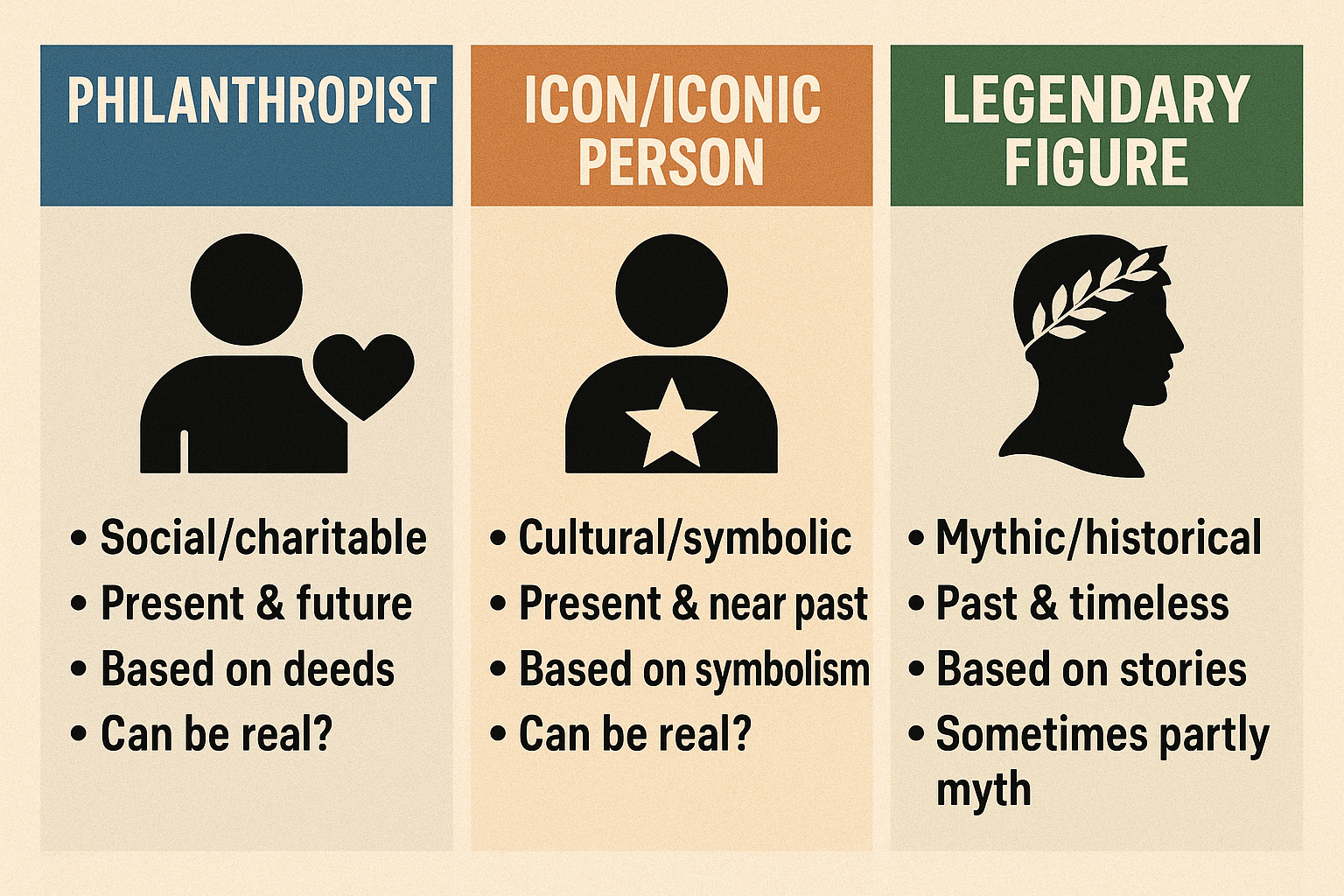
- Philanthropists
- Iconic Persons
- Legendary Figures**
By Request — In Depth, Clear, and Fully Explained
Introduction
Human societies have always elevated certain individuals based on their contributions, influence, or extraordinary stories. Over time, different categories emerged to classify these influential individuals. Among the most significant categories are:
- Philanthropists — people who dedicate wealth, time, or resources to improve society.
- Iconic Persons — individuals who become symbolic representations of ideas, movements, eras, or cultures.
- Legendary Figures — personalities whose lives or achievements transcend ordinary limits, sometimes blending history with myth.
This thesis explores the definitions, history, characteristics, and notable examples of each category, providing a deep comparative understanding.
I. PHILANTHROPISTS — HISTORY, EVOLUTION & IMPACT
1. Definition
A philanthropist is someone who actively seeks to promote the welfare of others, usually through generous donations of money, time, or influence.
The term comes from the Greek philanthrōpos meaning “love of mankind”.
2. Historical Evolution
a) Ancient Civilizations
- Greece: Wealthy Athenians were required to fund public theaters, schools, and festivals — an early form of philanthropy.
- Rome: Patrons supported infrastructure, libraries, and poor citizens.
- African Kingdoms: Leaders like Mansa Musa donated wealth for education, mosques, and community support.
b) Middle Ages
- Religious institutions became the center of charity.
- Islamic zakat, Christian alms-giving, and African communal support systems shaped philanthropy.
c) Industrial Era (18th–20th century)
The modern concept formed as wealthy industrialists began investing in social improvement:
- Andrew Carnegie (libraries, education)
- John D. Rockefeller Sr. (medicine, science)
d) 20th–21st Century — Globalized Philanthropy
Modern philanthropists use strategic, corporate, and scientific methods:
- Bill & Melinda Gates Foundation
- Warren Buffett’s Giving Pledge
- Oprah Winfrey’s educational philanthropy
- African modern philanthropists like Patrice Motsepe
3. Characteristics of Philanthropists
- Motivated by compassion and social responsibility
- Use wealth or influence to solve problems
- Often support education, healthcare, poverty reduction, or global challenges
- Not always famous — many remain unseen
- Their impact is measurable in societal change
4. Notable Examples
| Name | Region | Contributions |
|---|---|---|
| Nelson Mandela | Africa | Social justice, peace, education |
| Bill Gates | USA | Global health technologies |
| Oprah Winfrey | USA | Schools, empowerment programs |
| Patrick Motsepe | SA | Development, upliftment through Motsepe Foundation |
| Mansa Musa | Mali Empire | Community wealth-sharing, education |
II. ICON OR ICONIC PERSON — HISTORY & EVOLUTION
1. Definition
An iconic person is an individual who becomes a symbol of a particular idea, movement, culture, or era.
They represent something larger than themselves.
Examples:
- Michael Jackson → Icon of pop culture
- Marilyn Monroe → Icon of beauty and Hollywood
- Nelson Mandela → Icon of peace and freedom
2. Historical Development
a) Ancient Icons
- Pharaohs
- Greek heroes (Achilles, Hercules)
- African chiefs and spiritual leaders
These figures became icons through storytelling, art, and public memory.
b) Cultural Icons of the 20th Century
The era of mass media amplified iconic identities:
- Musicians (Bob Marley)
- Actors (Bruce Lee)
- Activists (Martin Luther King Jr.)
- Leaders (Winston Churchill)
c) Social Media Era (21st Century)
Instant global visibility creates new icons:
- Beyoncé
- Cristiano Ronaldo
- Elon Musk
- Trevor Noah
- Black Coffee (DJ)
Icons now influence fashion, culture, economics, and politics.
3. Characteristics of Iconic Persons
- Easily recognizable
- Symbolic representation of a cultural idea
- Influence extends across generations
- Global or national visibility
- Strong emotional connection with the public
4. Examples of Global Icons
| Icon | Why They Are Iconic |
|---|---|
| Nelson Mandela | Forgiveness, justice, democracy |
| Michael Jackson | Transformative music & dance |
| Bob Marley | Reggae and global Rastafarian identity |
| Princess Diana | Compassion, humanitarian representation |
| Serena Williams | Sports excellence and empowerment |
| Trevor Noah | Comedy and global African representation |
III. LEGENDARY FIGURES — HISTORY, MYTH & IMMORTALITY
1. Definition
A legendary figure is a person whose story is so extraordinary that it becomes part of cultural mythology—sometimes mixing real history with myth.
2. Origins of Legendary Figures
a) Prehistoric & Ancient Folklore
Humanity created legends to explain:
- Nature
- War
- Heroism
- Royal ancestry
Examples:
- Shaka Zulu (African warrior-king)
- King Arthur (British hero)
- Hua Mulan (Chinese warrior)
b) The Role of Oral Tradition
In many cultures, especially African societies, oral tradition preserved legends through:
- Poetry
- Storytelling
- Praise singing
- Songs and rituals
3. What Makes Someone Legendary?
- Extraordinary deeds
- Stories retold across centuries
- Cultural immortality
- Sometimes supernatural or exaggerated attributes
- Often inspire pride, identity, or moral lessons
4. Examples of Legendary Figures
| Name | Region | Legacy |
|---|---|---|
| Shaka Zulu | Africa | Military genius, nation unifier |
| Miyamoto Musashi | Japan | Samurai legend, undefeated swordsman |
| King Arthur | UK | Legendary king of Camelot |
| Robin Hood | England | Folk hero stealing for the poor |
| Sundiata Keita | Mali | Founder of the Mali Empire; Mandinka epic |
| Hercules | Greece | Demi-god hero of strength |
IV. COMPARATIVE ANALYSIS: PHILANTHROPIST vs ICON vs LEGEND
| Feature | Philanthropist | Icon/Iconic Person | Legendary Figure |
|---|---|---|---|
| Primary Impact | Social/charitable | Cultural/Symbolic | Mythic/Historical |
| Time Influence | Present & future | Present & near past | Past & timeless |
| Recognition | Often based on deeds | Based on symbolism | Based on stories |
| Can be real? | Yes | Yes | Sometimes partly myth |
| Duration of Fame | As long as impact lasts | Generational | Centuries |
V. How One Person Can Be All Three
Some figures cross all categories:
Nelson Mandela
- Philanthropist (education & peace initiatives)
- Icon (global symbol of justice)
- Legendary (his story is told as a heroic epic)
Mansa Musa
- Philanthropist (education, charity)
- Icon (symbol of African wealth)
- Legendary (his wealth is described in mythical terms)
Mother Teresa
- Philanthropist
- Icon of compassion
- Legendary in stories of service
Conclusion
Philanthropists, icons, and legendary figures all shape human society, but in different ways:
- Philanthropists change society through action and generosity.
- Icons shape culture through symbolism and influence.
- Legends shape identity, imagination, and collective memory.
Though different, all three categories represent humanity’s need to honor those who rise above ordinary life to create extraordinary impact.






Be First to Comment